Second Peter 1; Peter 3 also has a reference. Keep it moving; I'll just take the one in Second Peter. Second Peter says, "For if God spared not the angels that sinned, but cast them down to hell," and the word he uses happens—that's what it's translated in English; it happens to be Tartarus.
I'll come back to that—and delivered them under chains of darkness to be reserved in judgment; and spared not the old world, but saved Noah. " He goes on; Peter echoes the same thing that Jude says, but he adds a couple of insights. He ties it to the days of Noah.
These are angels that sinned. Where are they now? They are in a special holding place.
They are not in hell, as we think of it—neither Sheol nor Gehenna—something someplace else, a place that Peter calls Tartarus. The word Tartarus only appears here in the Greek New Testament; however, we know a lot about the word in the Greek vocabulary. The word Tartarus is a Greek term for a dark abode of woe.
It's the pit of darkness of the unseen world. It shows up, for example, in Homer's Iliad, and it's described as being as far below Hades as the Earth is below Heaven. This is not just a regular place; it's someplace really special.
Now, I want to nail another alternative view down, because many people in this audience probably—I will not ask for a show of hands—have been taught a different view of this passage, a very commonly taught view, and there are many outstanding, excellent authorities that happen to hold this view, but I don't. I no longer believe it's very optional for us. Like many, there are many things in Scripture where good men can have different views, but I think it's important for you to consider for yourself the viability of the "line of Seth" view.
Because unless you go the other way, there are many other things that I don't think you'll be able to understand. Let me just—indulge me, if you will—the line of Seth view is a view that this word "sons of God" really refers to the faithful leadership of the Sethites; the "daughters of Adam" really refers to the daughters of Cain, and they were supposed to be separate. The sin that's involved is their failure to maintain separation.
There is no really good answer as to what the term "Nephilim" means by this view. They—that sort of, frankly, that doesn't have a good response, but that's not elaborated. But that's the essence of the Sethite view.
That the "sons of God" really refers to the good guys, the leadership of the good guys, and they were supposed to stay separate from the Canaanites, but they married the Canaanite—excuse me, not Canaanites, the Canyanites—the daughters of Cain, and they married and had offspring. Well, there are some problems with this. The text itself—the "sons of God" is never used of believers in the Old Testament.
People who impute that view are bringing in—misapplying New Testament passages. And, by the way, Seth was not God, and Cain was not Adam; I'm not being cute here. I'm saying that's what, in effect, they're imputing to the text.
And, by the way, there's no mention of the daughters of Elohim, so you've got some problems. But more important is there is a grammatical antithesis between the sons of God and the daughters of men. You see, the structure is clear.
In fact, in Psalm 82, we also see it; he says, "Ye are gods, and all of you are children of the most high; but ye shall die like men and fall like one of the princes. " These antitheses show up in the Old Testament in several places. Also, the line of Seth infers that there's a separation they are supposed to keep.
But that's a fallacy, because the lines of separation of nations didn't get separate until Genesis 11. We're talking about Genesis 6. This concept of separation was imposed upon Isaac and following, not beforehand.
There's no textual basis for that. And, by the way, Ishmael was not told to be separate. Don't assume the Arabs today are descendants of Israel; they can't prove it.
Why? Because Israel never kept separate. Small point, but I just thought—any Muslims here?
I want to have something to offend everyone; I don't want to play favorites. Furthermore, Genesis 6:12 indicts this view, because that's all flesh was corrupted. It doesn't say that one particular group was the problem.
The line of Seth also implies that—or infers that—the line of Seth was godly. Only Enoch and Noah's eight were spared from the flood; there aren't any godly people there except those nine. Also, the text says that the "sons of God" took wives of all whom they chose.
You don't get the impression it was a participative choice; you get the impression they took wives; it doesn't sound like they're too godly in terms of prayer. That may be pushing something. Why did the Sethites, if they're so godly, perish in the flood?
That's probably the real nail in that coffin. And, by the way, Enosh, who was Seth's son, is the one that initiated defiance of God. Most people don't know this, because there's a mistranslation in most of our Bibles in Genesis 4:25.
It doesn't say, "Then man began to call upon the name of the Lord," as the English would render it; it really says, "Then man began to profane the name of the Lord," in the Targum of Onkelos, the Targum of Jonathan, and Kimi Rashi, among other Jewish and also Christian sources. The 12th century authorities, that if you really get in behind that verse, you'll discover that our English Bible has a misleading rendering of that "in the days of Enosh" is when apostasy began. So, it's a small point, but what it does cloud is the idea that the lines of Seth were good guys, and the daughters of Cain, the implication of the Canaanites, are bad guys.
Well, first of all, there's no basis for a subset of the daughters of Adam—that's conjecture. The Canaanites were not necessarily Godless. If you study Cain's genealogy, following Cain in Genesis chapter 4, you'll discover in verse 18 that many of his descendants had the name of God in their names.
We don't know, but if you're going to draw a conjecture, it's more likely that even though he was guilty of that sin with Abel, he repented and tried to raise his family to be God-fearing. This idea that the Sethites were good guys and the Canaanites were bad guys is a contrivance of liberal scholarship, not of the text. By the way, were the daughters of Seth so unattractive?
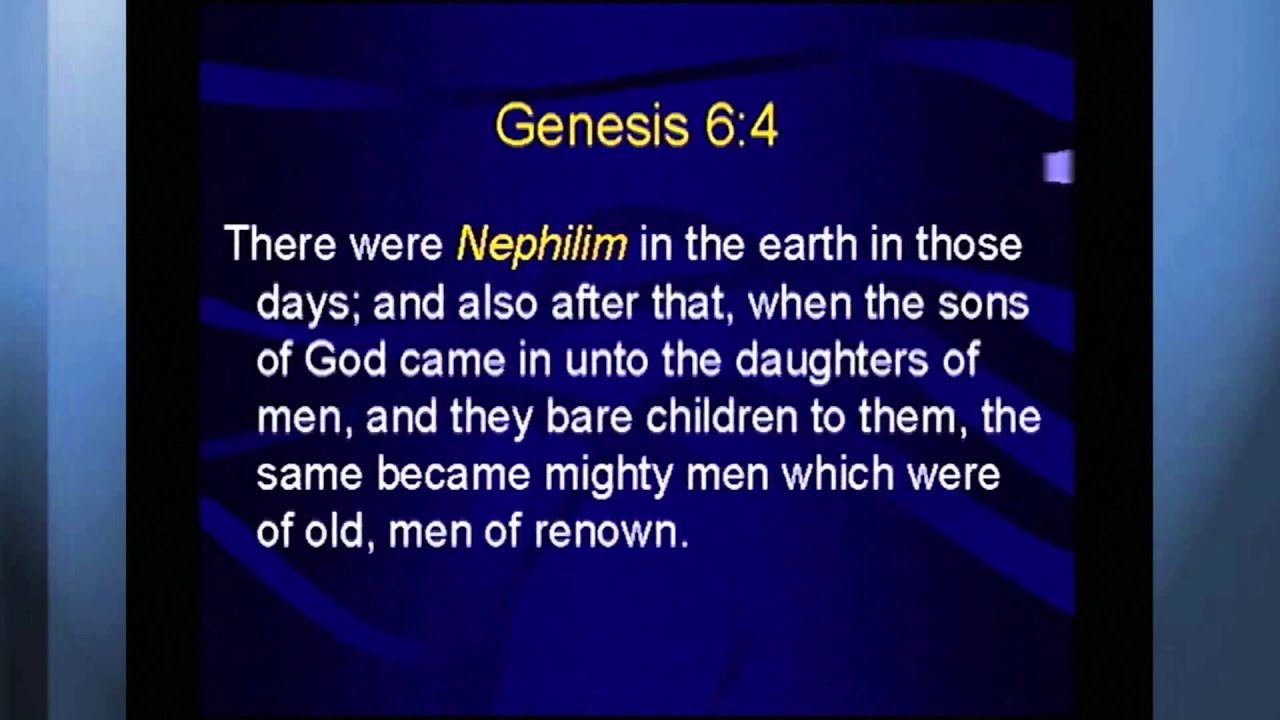
I don't quite understand. But the other issue is the unnatural offspring as a result of the union—what are these Nephilim? Now, they had supernatural offspring.
Now, by the way, when a believer or an unbeliever gets married, they may have monsters, but they don't have supernatural offspring. Also, it implies that there were no exceptional chromosomes among the Sethites; there were no women of renown, only men of renown. And why was Noah's genealogy so distinctively highlighted in Genesis 6:9?
Now, in the mouth of two or three witnesses, as I pointed out in Jude 6 and 7, 1 Peter 3:19 and 20, and 2 Peter 2, verses 4 and 5, even the unique use of that Greek term is fascinating. The New Testament seems to very clearly corroborate what I'll call the angel view of Genesis 6. So let me just summarize: we have a problem with the text itself, inferred separation, inferred godliness of Sethites, and inferred Canaanite subsets with supernatural offspring.
New Testament confirmations—these are the major, in my mind, indictments of the so-called lines of Seth view, although it's held by many. But here's the thing that may surprise you: there are also post-flood events in the Old Testament and prophetic issues that you will be blind to if you adhere to the line of Seth view. Let's explore some of these.
By the way, the angel view, prior to the birth of Christ, was in the traditional literature—Book of Enoch, as I mentioned—earlier the testimony of the 12 Patriarchs. It's not a member of the canon, but it does describe the linguistic structure of that day. Josephus, Flavius, the Septuagint, the early church fathers, Philo of Alexandria, Justin Martyr, Irenaeus, and the whole list held the angel view.
The early church believed in angels. Then where did the line of Seth idea begin? In the fifth century, Salis and Julian the Apostate used the traditional belief in angels to attack Christianity, and Julius Africanus resorted to the Sethite theory as a more comfortable explanation.
They were uncomfortable with the angel idea, and understandably so. As we look at that, it's pretty weird. Ser of Alexander used the line of Seth to repudiate the Orthodox prediction.
Here's the problem: Augustine picked it up and he embraced the Sethite theory, and it became the doctrine of the Catholic Church. Thus, it still derives to the denominational churches, and it prevailed, of course, as a dominant view into the Middle Ages. Modern scholarship has—as I just picked a few—P.
Dean, Macintosh, D. E. H.
Gin, Arthur Pink, Donald Grey Barnhouse, Henry Morris, Merl Longer, Arnold Fruchtenbaum, of course Hal Lindsey and Chuck Smith, more recent well-known examples, are angel view people. If you've read Henry Morris's definitive commentary on the Book of Genesis, he of course goes into all those for us.