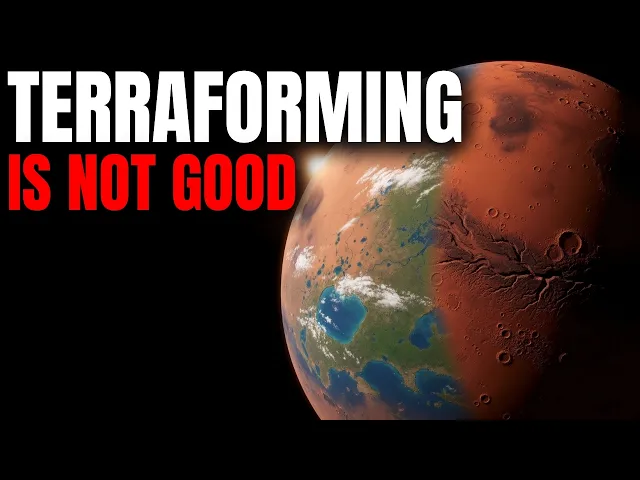
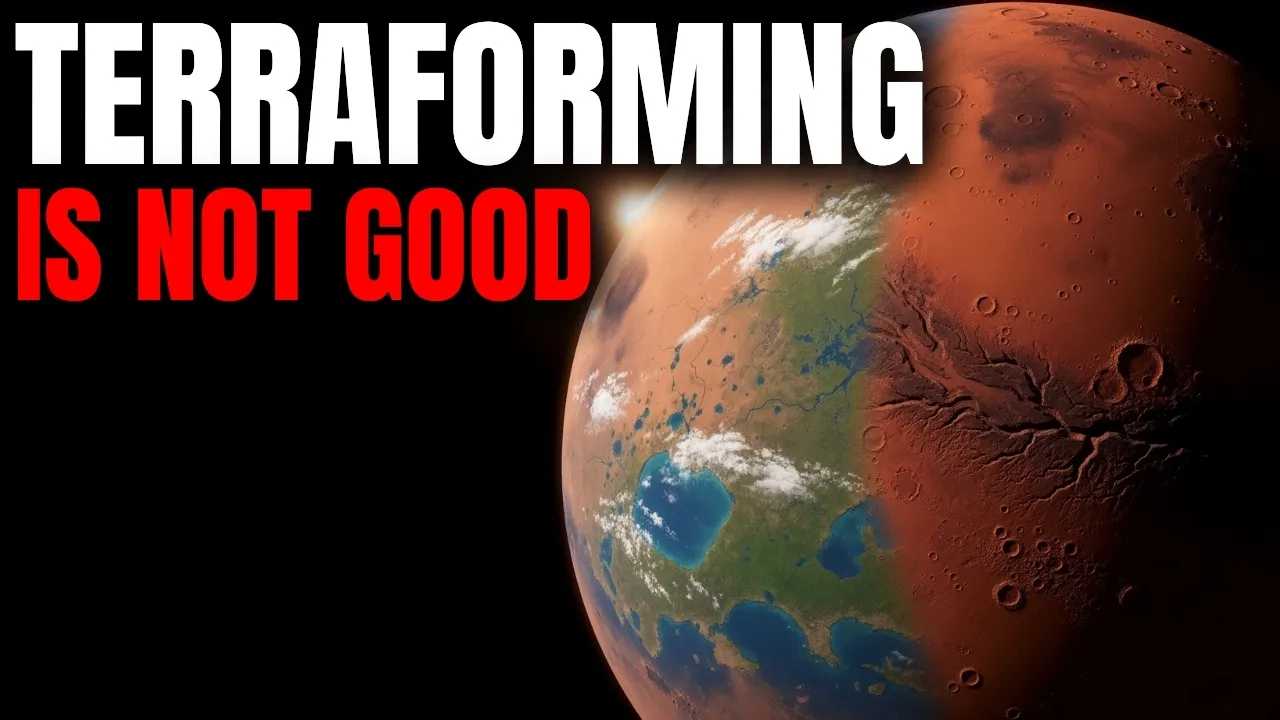
Mars does not want us there. This is not science fiction. This is not speculation. This is what the first humans will actually die for. Radiation that rewrites your DNA. Soil so toxic it kills every plant you try to grow. An atmosphere so thin your blood would boil if you stepped outside unprotected. And a journey so far that the moment you leave Earth, you can never return. The scientists say terraforming Mars could Take 100,000 years. that is longer than human civilization has existed. The people who begin this project will never see it completed. Their grandchildren will
never see it completed. Their grandchildren multiplied by a thousand will never see it completed. So why would anyone volunteer? Why would anyone choose to die slowly on a frozen poisonous world millions of miles from everyone they have ever loved? Because some dreams are worth dying for even When you will never see them come true. This is the dark side of terraforming Mars and it begins now. But before we begin, do not forget to subscribe and if you truly enjoy these videos, please leave a like. One last thing before we drift into tonight's topic. If you've
been struggling with sleep, you already know how it ripples through everything. Your energy, your focus, your overall well-being. The good news, better sleep isn't about luck. It's about having the Right approach. I've put together Sleepmarter for a Better Life, a practical guide that walks you through proven strategies for deeper, more restorative sleep. No fluff, just what actually works. It's in the description below, and right now it's just $17. All right, let's begin. What you're about to hear is not science fiction. It is not a fantasy conjured for entertainment. It is the cold and brutal truth
about what humanity will face when we attempt to Transform Mars into a second Earth. We will talk about radiation that rewrites your DNA. Soil that poisons every plant you try to grow. An atmosphere so thin that your blood would boil if exposed. Gravity that dissolves your bones month after month. And the psychological horror of being trapped millions of miles from everyone you have ever loved with no possibility of return. This is the dark side of terraforming Mars. This is what the first humans will actually Die for. Let us begin. Chapter 1. The Red Dream and
its price. The year is sometime in the future. Perhaps 2050. Perhaps 2100. The exact date does not matter because the dream remains the same. Humanity reaches for Mars. We have talked about it for generations. We have written stories and filmed movies and built rovers that crawl across its rusty surface, sending photographs back to Earth. And now we are ready. We are Ready to send people. But here is the truth nobody wants to say out loud. Mars does not want us there. Mars is not a frontier waiting to be settled. Mars is a graveyard waiting to
be filled. And the first humans who walk upon its surface will not be explorers in the romantic sense. They will be sacrifices, willing sacrifices perhaps, volunteers who understand the cost, but sacrifices nonetheless. Let us start with the basic facts. Mars sits approximately 225 Million km from Earth on average. That distance varies depending on where both planets are in their orbits around the sun. At closest approach, Mars comes within roughly 54 million km. At its farthest, it stretches to 400 million km away. This is not a weekend trip. This is not even a long vacation. At
current propulsion capabilities, a journey to Mars takes between 6 and 9 months. one way. 6 to9 months in a metal tube hurtling through the void. 6 to9 months Of cosmic radiation bombarding your cells. 6 to9 months of your muscles weakening and your bones losing density. And when you arrive, you do not get to rest. You step out onto a world that is actively trying to kill you in at least a dozen different ways simultaneously. The average temperature on Mars hovers around -60°. That is -76° F for those keeping track. But this average hides brutal extremes.
Near the equator during summer, a midday Temperature might climb to a relatively comfortable 20° C. But at night, even at the equator, temperatures plunge to -73°. At the poles during winter, temperatures drop to -25°, colder than anything naturally occurring on Earth, colder than the most extreme Antarctic winter. But cold is not the primary killer. Cold can be managed with insulation and heating. The primary killer is something you cannot see, Cannot taste, cannot feel until the damage is already done. The atmosphere. Mars has an atmosphere. This is technically true. But calling it an atmosphere is generous.
The atmospheric pressure at the Martian surface averages around 610 pascals. To understand what this means, consider that Earth's atmospheric pressure at sea level is approximately 101,325 pascals. Mars has less than 1% of Earth's atmospheric pressure, less than 1%. At this pressure, water cannot exist as a liquid under normal temperature conditions. It either freezes into ice or sublimates directly into vapor. Your saliva would boil on your tongue, not from heat, but from the lack of pressure. Your blood would begin to bubble in. Your veins, your lungs would be unable to function. Without a pressure suit, you
would be dead in under 2 minutes, probably less than 1 minute, possibly within seconds, Depending on how quickly decompression affects your cardiovascular system. And what is this thin wisp of atmosphere made of? 95% carbon dioxide, less than 3% nitrogen, about 1.6% argon, and trace amounts of oxygen so small they are essentially irrelevant. On Earth, our atmosphere contains approximately 21% oxygen. On Mars, it contains 0.13%, not 13%. 0.13%. You would suffocate long before you had Time to worry about the pressure. The scientists call this an unbreathable atmosphere, and they are being polite. It is a toxic
atmosphere. Carbon dioxide at the concentrations found on Mars causes drowsiness at just 1%. At 7 to 10% it causes suffocation even in the presence of adequate oxygen. The Martian atmosphere is 95% carbon dioxide. You would not merely fail to breathe. You would be actively poisoned with every attempted breath. This is the world we Want to transform. This is the world we dream of making into a second Earth. And here is the scope of that ambition. To terraform Mars, we would need to increase atmospheric pressure by a factor of at least 100. We would need to
heat the planet by approximately 60° C on average. We would need to convert or import vast quantities of oxygen while somehow dealing with the carbon dioxide that currently dominates. We would need to create or restore a magnetic field to Protect any atmosphere we build from being stripped away by solar wind. We would need to detoxify soil that contains chemicals harmful to all known Earth life. We would need to establish water cycles with liquid water on the surface. We would need to do all of this on a planet that lacks the internal geological activity that makes
Earth so dynamic and livable. The time scales being discussed by serious scientists are not decades. They are not centuries. They are millennia. The warming phase alone, where we attempt to release enough greenhouse gases to raise temperatures and thicken the atmosphere, might take 100 years under the most optimistic projections. The oxygenation phase, where we actually create breathable air, could take 100,000 years. Not 100 years, 100,000 years. Think about that number. 100,000 years ago, humans had not yet developed agriculture. We were scattered bands of Hunter gatherers making stone tools. Written language would not exist for another 95,000
years. Everything we consider civilization, every city, every nation, every empire, every technology fits into the last 10,000 years of human history. And we are talking about a project that might take 10 times longer than all of recorded human existence. This is not a project for a generation. This is not a project for a civilization. This is a project for a Species. And here is the darkest truth of all. The humans who begin this project will never see it completed. Their children will never see it completed. Their grandchildren multiplied by a thousand will never see it
completed. The first colonists will live and die on a hostile world, knowing that the paradise they are working toward exists only in the imagination of descendants so distant they cannot be conceived. Why would anyone volunteer For this? Why would anyone choose to leave Earth knowing they will spend their remaining years in a pressurized habitat on a frozen poisonous world? Why would anyone sacrifice the blue sky and green trees and the feeling of wind on bare skin for the rustcoled desolation of Mars? The answer is complicated. Some will go for science. The desire to understand another
world, to search for evidence of past or present life, to expand the boundaries of human Knowledge. Some will go for adventure, the call of the unknown, the drive to be first to see what has never been seen. Some will go for ideology, the belief that humanity must become a multilanetary species to survive the belief that spreading beyond Earth is our destiny or our duty. and some will go because they have nothing left to lose. This may sound cynical, but it is historically accurate. The great voyages of exploration in Human history were not crude exclusively by
optimists and visionaries. They were crude by the desperate, by the outcasts, by those fleeing something on Earth as much as seeking something beyond it. Mars colonization will be no different. Whatever their reasons, the first colonists will face a choice that no humans before them have ever faced. They will choose to leave Earth knowing they can never return. The physics of space travel make return Trips extraordinarily expensive in terms of fuel and resources. Early colonies will not have the infrastructure to manufacture return vehicles. The colonists will be permanent residents of Mars from the moment they land.
This is called a one-way mission and it changes everything about the psychology of exploration. When you cannot go home, you must make home where you are. When you cannot escape your circumstances, you must transform them. The colonists Will not be visitors. They will be immigrants, permanent immigrants to a world that does not want them. The settlement of Mars will not begin with terraforming. Terraforming is the dream for later. The settlement will begin with survival. Pressurized habitats, imported food, or carefully cultivated green houses, recycled water, and manufactured oxygen. Every breath, every drink, every bite will depend
on technology functioning correctly in an Environment that punishes failure with death. NASA and other space agencies have studied what happens when life support systems fail. On Earth, when your air conditioning breaks, you open a window. On Mars, when your atmospheric processor fails, you have approximately 8 hours before carbon dioxide buildup renders you unconscious and 12 hours before you dead. On Earth, when your water recycling system fails, you drink bottled water from the store. On Mars, When your water recycler fails, you have perhaps 3 days before dehydration begins causing serious cognitive impairment and perhaps 5 days
before death. Every system must have redundancy. Every redundancy must have its own redundancy. And all of it must be maintained by humans who are themselves deteriorating from radiation exposure, low gravity, and psychological stress. The margins for error are essentially zero. The consequences of error are Absolutely fatal. Yet, humans will go. We know this because humans have always gone to the poles, to the depths of the ocean, to the highest mountains, to war zones and disaster areas, and anywhere else that sanity suggests they should avoid. We are a species defined by our willingness to risk everything
for the chance to see what lies beyond the next horizon. Mars is simply the next horizon. But let us be honest about what we're asking those first colonists to Do. We're asking them to live shortened lives. Radiation exposure alone will significantly increase their cancer risk. Low gravity will weaken their cardiovascular systems and skeletal structures. The psychological toll of permanent isolation may manifest in ways we cannot predict. These are not heroic deaths in dramatic moments. These are slow deaths, grinding deaths. deaths measured in percentages of lung function and bone density and cognitive Performance declining year after
year. The first generation of Mars colonists will likely have life expecties 20 to 30% shorter than they would have had on Earth, perhaps more. They will age faster. They will weaken sooner. They will die younger. And they will do this knowing that their sacrifice is just the first installment in a payment that will not be completed for a thousand generations. This is the price of the red dream. Not the rocket fuel, not the Habitat modules, not the billions of dollars in development costs. The real price is measured in human lives, in years stolen from people
who chose to give them. In children who will grow up knowing they can never walk under an open sky, in elders who will die knowing they have barely begun the work that must be done. When we talk about terraforming Mars, we must talk about this. Not just the engineering challenges and the scientific puzzles, The human cost, the moral weight, the question of whether it is right to ask people to sacrifice so much for a dream they will never see realized. There are no easy answers. Perhaps there are no answers at all. Perhaps we simply go
because going is what humans do. Perhaps we accept the cost because the alternative is to remain forever earthbound, watching our single fragile world and knowing that one catastrophe could and everything we have ever been. Mars waits, cold and silent and utterly indifferent to human ambition. It does not care if we come. It will not welcome us when we arrive. It will test us with every tool at its disposal. Radiation, vacuum, cold, poison, isolation, distance, time, and we will go anyway. In the chapters that follow, we will examine each of these challenges in detail. We will
look at what science knows about the obstacles to Martian colonization and terraforming. We will Explore the technologies being developed to overcome them. We will consider the human factors that will determine success or failure. And we will confront the darkest possibilities, the ways that Mars could defeat us, the ways that we could defeat ourselves. This is not a story with a guaranteed happy ending. This is a story still being written. And the first chapter is about to begin with human footprints in Martian dust. But first, we must understand what those Humans will face the moment they
step outside their spacecraft. We must understand the thin veil that separates life from death on the red planet. We must understand the atmosphere. Let us continue. Chapter 2, the thin veil of death. Stand on the surface of Mars and look up. If you could remove your helmet for just a moment, you would see a sky the color of butterscotch, pinkish during the day from fine dust particles suspended in the air. Darker toward the Horizons where that dust thickens. And at sunset, the colors reverse from what we know on Earth. The sun sets in a blue
glow surrounded by pink and salmon hues. Beautiful, alien, and absolutely lethal. That sky you are admiring is trying to kill you. Not through malice. Mars has no malice, but through simple physics, through the absence of what Earth provides so abundantly that we never think about it, atmosphere. The Martian atmosphere weighs Approximately 25 teratons. That sounds like a lot until you compare it to Earth, where the atmospheric mass is, approximately 5.15 * 10 18th kg. Mars has roughly 1% the atmospheric mass of Earth spread over a planet with about the same land area. The result is
pressure so low that it exists below what scientists call the Armstrong limit. The Armstrong limit, named after American physician Harry George Armstrong, is the altitude at which Atmospheric pressure drops to the point where water boils at the temperature of the human body. On Earth, this occurs at approximately 18,900 m above sea level. Above this altitude, exposed body fluids begin to boil. Your tears, your saliva, the moisture coating your lungs, all of it begins transitioning from liquid to gas, not because of heat, but because of insufficient pressure to keep water in its liquid state. The entire
surface of Mars exists below the Armstrong limit. Every square meter of that rustcoled world sits at a pressure where your blood would begin to bubble if exposed. Not immediately, perhaps. The human body is more resilient than simple physics might suggest. Your skin would provide some containment, but within seconds of exposure to Martian surface pressure, you would experience ebism, gas bubbles forming in your bodily fluids, expanding, causing tissue damage, leading to unconsciousness within 15 Seconds, and death within 1 to 2 minutes. This is not speculation. This is what happened to a technician at NASA in 1966
when a leak in his spac suit exposed him to near vacuum conditions during a ground test. He remained conscious for approximately 14 seconds before losing awareness. He survived only because technicians were able to repress the chamber within 30 seconds. His last conscious memory was of the saliva boiling on his tongue. On Mars, There is no one to repressurize the chamber. There is no chamber. There is only the thin poisonous atmosphere and approximately 600 pascals of pressure standing between you and death. Let us talk about what that atmosphere actually contains. 95.32% carbon dioxide, 2.7% nitrogen, 1.6%
argan, 0.13% oxygen. Trace amounts of carbon monoxide and water vapor and other gases in concentrations too small to matter for human survival. On Earth, We breathe air that is approximately 78% nitrogen and 21% oxygen with traces of other gases. We exhale carbon dioxide as a waste product of cellular respiration. Our bodies are designed to operate in this specific gaseous environment. Change the ratios even slightly and problems begin. Carbon dioxide at concentrations above 0.5% causes increased respiratory rate as your body tries to expel what it perceives as excess CO2. At 2% you experience headaches and difficulty
concentrating. At 3% you experience dizziness and visual disturbances. At 5% you experience severe respiratory distress. At 10% you lose consciousness within minutes. At 20% death can occur within a few breaths. Mars has 95% carbon dioxide. 95%. Even if the pressure were adequate to breathe, even if there were enough oxygen mixed in to sustain you, the Carbon dioxide alone would kill you almost instantly. Your body would attempt to inhale and would instead receive a concentrated dose of a gas that at these levels acts as an asphyxiient. This is why every human on Mars must exist inside
a pressurized environment. Habitats, rovers, suits, every moment of their lives must be spent within a manufactured bubble of Earthlike atmosphere. Step outside that bubble and you have seconds to live. Now Consider what this means for colonization, for terraforming, for the dream of walking freely on Martian soil. We must not merely add some oxygen to the Martian air. We must fundamentally transform it. We must reduce the carbon dioxide from 95% to less than 1% ideally much less. We must increase the oxygen from essentially zero to approximately 20%. We must increase the total pressure by a factor
of at least 40 to approach the minimum necessary for human survival And ideally by a factor of 150 to reach earthlike sea level conditions. How do you add atmosphere to a planet? Where does the gas come from? These are not trivial questions. The mass of gas required is staggering. To raise Martian atmospheric pressure to just 10% of Earth's, we would need to add approximately 250 teratons of gas. That is 250 trillion metric tons. The entire mass of all human manufactured goods throughout all of history does not Approach this figure. There are only a few possible
sources for this much gas. The first is the planet itself. Mars is believed to have significant carbon dioxide locked in its polar ice caps and absorbed into its soil. Estimates vary widely, but some researchers suggest there may be enough releasable carbon dioxide to raise atmospheric pressure to perhaps 50 or even 100 mib. This is still far below Earthlike conditions, but it represents a meaningful first Step. The second source is importation. Comets and asteroids contain volatile compounds, including water, ice, and frozen gases. In theory, these could be redirected to impact Mars releasing their contents into the
atmosphere. The logistics of this are almost impossible to comprehend. Moving a single asteroid of meaningful size requires energies on par with major nuclear detonations. Moving enough asteroids to meaningfully contribute to Martian atmospheric Pressure would require an industrial capacity beyond anything humanity has ever contemplated. The third source is manufacturing. If we could establish industrial facilities on Mars capable of processing the Martian regalith and extracting gases, we might slowly build atmospheric mass over generations. This assumes available energy sources likely nuclear and available raw materials and available labor and above all available Time. Time is the factor that
makes atmospheric engineering so difficult. Even under the most optimistic scenarios where we successfully release all available carbon dioxide from Martian polar caps and soil, we are looking at a warming phase of approximately 100 years. 100 years just to get the atmosphere warm and thick enough that water might occasionally exist as a liquid on the surface. And that is the easy part. The hard part is oxygen. Plants produce oxygen through photosynthesis. They take in carbon dioxide and water and sunlight and they release oxygen as a byproduct. On Earth, billions of years of plant life and photosynthetic
bacteria transformed our atmosphere from one rich in carbon dioxide and methane to one rich in oxygen. This is called the great oxygenation event and it took approximately 300 million years. We do not have 300 million years. We do not Have 3 million years. The scientists who study terraforming estimate that even with genetically engineered photosynthetic organisms working at maximum efficiency, the oxygenation of Mars would take approximately 100,000 years. Not 100 years, 100,000 years. Let that number sink in. 100,000 years ago, anatomically, modern humans existed. But we had not yet developed the cognitive abilities associated with behavioral
modernity. We Were making stone tools, but we had not yet invented art or music or symbolic thought, as far as we can determine from the archaeological record. Agriculture would not appear for another 90,000 years, writing for another 95,000, the wheel for another 94,000. The time it takes to oxygenate Mars is longer than the entire span of human civilization multiplied by 10. This is why many researchers have given up on the idea of true terraforming in favor Of what they call paratraforming. Instead of transforming the entire planet, you create enclosed habitable zones, domes, underground caverns, sealed
cities. You terraform a small area and accept that the rest of the planet remains hostile. But even parerraforming faces the fundamental problem of the thin atmosphere. Any enclosed structure must withstand the pressure differential between its interior and the near vacuum outside. On Earth, we build structures to withstand wind and rain and snow. On Mars, we must build structures to withstand atmospheric pressure, trying to burst them outward from within. A habitat maintaining Earthlike pressure on Mars must contain approximately one atmosphere of internal pressure against approximately 0.00.6 atmosphere's external pressure. This is a pressure differential of over
100 kilopascals. For comparison, a typical car tire is Pressurized to about 200 kilopascals above ambient. The walls of a Martian habitat must be as strong proportionally as a car tire and must maintain that strength continuously for decades without failure. One puncture, one structural failure, one seal that degrades just slightly over time and everyone inside dies. The engineers who design spacecraft and space habitats have developed remarkable techniques for maintaining pressure integrity. They use Multiple redundant seals. They use pressure monitoring systems. They use compartmentalization so that a breach in one area does not necessarily doom the entire
structure. These techniques work. They have been proven on the International Space Station and on various spacecraft over decades of space flight. But the International Space Station is relatively small. A permanent Mars colony would need to be much larger to support a viable population. Larger Structures mean more potential failure points, more seals that could degrade, more structural members that could fatigue, more opportunities for catastrophe. And here is the darkest consideration. On the International Space Station, if a serious breach occurs, the crew can potentially evacuate to a spacecraft and return to Earth. On Mars, there is no
evacuation. There is nowhere to go. If your habitat fails catastrophically, you have minutes To reach a pressure suit or another sealed area. If you cannot, then you die watching your breath condense and boil simultaneously in the thin Martian air. The psychological weight of this must not be underestimated. Every colonist will know that the thin walls around them are all that separates them from instant death. Every strange sound will provoke anxiety. Every pressure fluctuation will trigger alarm. The stress of living under this constant Low-level threat will accumulate over years. It will affect mental health. It will
affect decisionm. It will affect relationships and community cohesion. Studies of isolated populations in extreme environments on Earth provide some insight. Antarctic research stations where personnel are cut off during the long winter months show elevated rates of depression, anxiety, and interpersonal conflict. Submarine crews forced to live in close quarters Under stress for extended deployments show similar patterns. Now multiply this stress by the knowledge that outside your walls is not merely cold ocean water, but the absolute hostility of an alien world that will kill you in seconds if given the opportunity. There is another aspect of the
thin atmosphere that affects human life on Mars. Radiation shielding. On Earth, our thick atmosphere absorbs much of the harmful radiation from the Sun and from deep space. The atmosphere equivalent to roughly 10 meters of water provides significant protection against cosmic rays and solar particles. On Mars, the thin atmosphere provides almost no protection. Radiation that would be absorbed before reaching Earth's surface passes directly to the Martian surface. We will discuss radiation in detail in the next chapter. But understand that the thin atmosphere is not merely a problem of pressure and Breathability. It is a problem of
protection. The shield that keeps Earth habitable is absent on Mars. Until we rebuild that shield by thickening the atmosphere, humans must live underground or behind thick walls of regalith or behind some other form of shielding. The thin atmosphere also affects temperature regulation. On Earth, our atmosphere acts as an insulating blanket, trapping heat and moderating temperature swings between day and night. The greenhouse Effect that we associate with climate change is actually essential for making Earth habitable. Without it, our average temperature would be approximately -8° rather than the +15° we actually experience. Mars has minimal greenhouse effect
despite its atmosphere being 95% carbon dioxide because there is so little atmosphere total. The thin Martian air cannot trap enough heat to significantly warm the planet. This is one reason temperatures swing so Dramatically between day and night. Without atmospheric insulation, heat radiates rapidly back into space as soon as the sun sets. Paradoxically, the first stage of terraforming would increase Mars greenhouse effect by releasing more carbon dioxide into the atmosphere. More carbon dioxide means more heat. Trapping means warmer temperatures means more ice. Melting means more water vapor. Another greenhouse gas means even more warming. This is
the runaway greenhouse effect that we fear on Earth deliberately induced on Mars. But to trigger this cascade, we must first release the carbon dioxide currently locked in polar caps and soil. Various methods have been proposed. Giant mirrors in orbit focusing sunlight on the poles. Nuclear explosions to vaporize ice deposits. Factories producing super greenhouse gases far more potent than carbon dioxide. Asteroid impacts delivering Both energy and additional volatile compounds. All of these methods share common characteristics. They are technologically unprecedented. They require resources beyond anything humanity has ever marshaled for a single project. They would take decades
to show results. And they come with risks of unintended consequences. What if we trigger a runaway effect that goes too far? What if we release carbon dioxide faster than the planet can adapt, Creating massive dust storms or other catastrophes? What if we discover that the carbon dioxide we thought was available is not actually accessible or that releasing it triggers chemical reactions we did not anticipate? The thin atmosphere of Mars is both our enemy and our target. We must work against it to survive in the short term and work with it to transform the planet in
the long term. We must shield ourselves from its inadequacy while Simultaneously trying to make it adequate. Every habitat is a statement of defiance against that butterscotch sky. Every breath of manufactured air is a small victory. And every moment of existence on Mars is borrowed time until the atmosphere becomes something humans can actually use. The first colonists will know this. They will wake each morning and check their pressure gauges. They will perform maintenance on their seals and filters And atmospheric processes. They will drill emergency response for hull breaches until the procedures become automatic reflexes. and they
will live with the constant awareness that a few centimeters of engineered material is all that stands between them and a death that would come too quickly to even feel. This is life under the thin veil of death. This is what terraforming Mars requires us to endure before the transforming even Truly begins. But the atmosphere is not the only absent shield. Mars lacks something even more fundamental. Something that Earth possesses and that makes all life on our world possible. Mars has no magnetic field. And without that magnetic field, the atmosphere we try to build will be
stripped away by the sun itself, particle by particle, century by century, forever. Let us continue. Chapter 3. A world without a shield. Billions of years ago, Mars was A different world. Evidence etched into its ancient surface tells a story of rivers and lakes and perhaps even oceans. Valley networks that could only have been carved by flowing water snake across the southern highlands. Mineral deposits that form only in the presence of liquid water dot the landscape. Delta formations where rivers once emptied into standing bodies of water remain frozen in stone, waiting for waters that will never
return. Mars was wet. Mars Was warm. Mars might have been habitable. What happened? The answer lies deep beneath the Martian surface in the planet's core, or rather in what the planet's core no longer does. Mars lost its magnetic field. And when it lost its magnetic field, it lost everything else. To understand why this matters, you must first understand what a magnetic field does for a planet. Earth has a magnetic field generated by the churning of molten iron in its outer core. This Churning is called the geodynamo and it produces a magnetic field that extends thousands
of kilome into space creating a protective bubble called the magnetosphere. The magnetosphere does something crucial. It deflects the solar wind. The solar wind is a constant stream of charged particles, protons and electrons and heavier ions flowing outward from the sun at speeds of 300 to 800 km/s. These particles carry energy and Momentum. When they strike an unprotected atmosphere, they can literally knock atmospheric molecules loose and carry them away into space. On Earth, the magnetosphere channels most of the solar wind around the planet. The particles flow along magnetic field lines and concentrate at the poles creating
the Aurora Borealis and Aurora Australis. Some particles do penetrate the magnetosphere, especially during solar storms. But the bulk of the solar Wind passes by without touching our atmosphere. Mars has no such protection. Mars lost its global magnetic field approximately 4 billion years ago when its core cooled and the geodamo stopped. Without the magnetic shield, the solar wind began stripping the Martian atmosphere away. Molecule by molecule, yearby year, eon by eon. The thick atmosphere that had kept Mars warm and wet, slowly eroded into space. NASA's Melvin mission, which stands for Mars Atmosphere and volatile evolution, has
been studying this process since 2014. Melvin found that Mars currently loses about 100 g of atmospheric mass every second to the solar wind. That does not sound like much, but over billions of years, it adds up to a devastating loss. At current loss rates, Mars loses approximately 3.2 2 million tons of atmosphere per year over 4 billion years, even accounting for variations in solar activity. This translates to the Loss of most of the planet's original atmosphere. The thick blanket of gas that once kept Mars warm is now a thin remnant. The oceans that once graced
its surface are now ice buried beneath dust and regalith or lost entirely to space. The solar wind did this. The absent magnetic field allowed it to happen. Here is the terrifying implication for terraforming. Any atmosphere we create on Mars will face the same fate. Without magnetic protection, the solar wind will Begin stripping our carefully constructed atmosphere the moment we build it. We will be filling a bathtub with no plug, pouring water into a container with a hole in the bottom. The faster we add atmosphere, the faster the sun takes it away. The numbers vary depending
on what assumptions you make, but the estimates are consistent in their implications. At current solar wind intensities, Mars would lose a meaningful fraction of any Added atmosphere over time scales of hundreds of millions of years. This sounds long enough to not worry about, but consider the full picture. We're talking about a terraforming project that might take 100,000 years just to oxygenate the atmosphere. During that time, the solar wind will be constantly removing what we add. And this assumes current solar conditions. The sun was more active in its youth. The solar wind was stronger. Atmospheric stripping
Would have been faster. If we trigger a period of increased solar activity by some cosmic coincidence, our terraforming efforts could be set back by millions of years worth of work in a few centuries of intense solar storms. There is another form of radiation that the magnetic field would normally protect against. Galactic cosmic rays. These are not particles from our sun, but high energy particles from outside our solar system. Supernovi and other Violent cosmic events accelerate protons and heavier nuclei to enormous energies. These particles travel across interstellar space and bombard every planet in their path. On
Earth, the magnetic field deflects some of these cosmic rays. The atmosphere absorbs most of the rest. The combined protection reduces cosmic ray exposure at sea level to a relatively modest background level. Humans have evolved with this background radiation. Our cells have repair Mechanisms that can handle the damage it causes. On Mars, neither protection exists. The absent magnetic field allows cosmic rays to reach the atmosphere unimpeded. The thin atmosphere does almost nothing to stop them. Cosmic rays pass directly to the Martian surface, carrying energies that can damage DNA and other biological molecules. The radiation exposure on
Mars is significantly higher than on Earth. How much higher depends on where you are and What shielding you have, but estimates suggest that someone on the unprotected Martian surface would receive an annual radiation dose of approximately 233 mills. For comparison, the average annual radiation dose on Earth from all sources is approximately 3 mill. The Martian surface is roughly 80 times more radioactive than Earth. This level of radiation has serious health implications. It increases cancer risk Significantly. It may cause cardiovascular disease. It can damage the central nervous system, potentially causing cognitive decline. It can harm the
immune system, making colonists more susceptible to infections. It can cause cataracts and other vision problems. And some of these effects may not appear until years or decades after exposure. For a terraforming mission lasting generations, this is catastrophic. The first colonists will accumulate Radiation damage year after year. Their children will be conceived and born in a high radiation environment, potentially causing developmental abnormalities. Even if colonists spend most of their time underground or behind shielding, they will still receive more radiation than any human population on Earth. Shielding helps, but shielding has limits. The most effective shielding against
cosmic rays is mass. Water, rock, metal, anything with significant Density that can absorb or deflect high energy particles. The more mass between you and the radiation, the more protection you receive. Studies suggest that approximately 2 to 3 m of Martian regalith would reduce radiation exposure to near-ear levels. This means that truly protected habitats would need to be buried under significant amounts of soil. Surface structures would need walls thick enough to provide meaningful shielding while still being practical to Construct. This has major implications for how colonies would be designed. Forget the gleaming domed cities of science
fiction. Real Mars colonies would likely be underground complexes, networks of tunnels and chambers dug into hillsides or excavated beneath the surface. The iconic image of colonists looking up at the Martian sky through transparent domes would be replaced by the reality of colonists rarely seeing the sky at All. Living underground introduces its own challenges. Psychological effects of not seeing natural light or open spaces. engineering challenges of excavating and reinforcing tunnels in Martian rock, ventilation and climate control for enclosed underground spaces. The risk of collapse or other structural failures. None of these are insurmountable, but they add
complexity and cost and risk to an already challenging endeavor. Now, consider what all of this means for Terraforming. Even if we succeed in thickening the Martian atmosphere, we will not have restored magnetic protection. The solar wind will continue stripping atmosphere. Cosmic rays will continue bombarding the surface. Any life we introduce to the Martian surface will face radiation levels far higher than anything on Earth. Some researchers have proposed artificial solutions to the magnetic field problem. One idea is to place a powerful magnetic deepole at The Mars Sun Lrangee point L1. This point lies between Mars and
the sun about 1 million km from Mars. A magnetic field generator at this location could create a bubble of magnetic protection around Mars, deflecting the solar wind before it reaches the planet. The concept is theoretically sound. Simulations suggest that a magnetic shield at L1 could reduce atmospheric stripping dramatically. Over time, the Martian atmosphere might even begin to Recover as volcanic outgassing, and comet impacts add gases faster than the solar wind removes them. The engineering challenges are substantial. We would need to deploy and maintain a magnetic field generator at a.1 million km from Mars. The generator
would need to produce a magnetic field strong enough to deflect the solar wind at that distance. It would need to operate continuously for centuries or millennia. Any failure would immediately expose Mars to renewed atmospheric stripping. We have never built anything like this. The largest artificial magnetic fields we have created are in particle accelerators and fusion reactors. Scaling up to a planetary defense system represents a technological leap beyond anything in our current capability. Other researchers have proposed even more ambitious solutions. Restart the Martian core. If we could somehow initiate convection in the Martian Interior, we might
be able to restart the geodynamo and create a natural magnetic field. The methods proposed for this include concentrated asteroid bombardment of one hemisphere to create temperature differentials or even crashing a large moon into Mars to deliver additional heat and angular momentum. These ideas exist purely in the realm of speculation. We do not fully understand how planetary dynamos work even on Earth. We have no proven Method for restarting a dead core. And the energies involved in these proposed solutions are so enormous that we would be talking about planetary engineering on a scale that makes atmospheric modification
look simple by comparison. For the foreseeable future, Mars will remain without magnetic protection. Any colonization effort must accept this reality. Any terraforming plan must account for the ongoing atmospheric loss that results. What does this mean Practically? It means that even if we achieve partial terraforming raising atmospheric pressure and temperature to the point where liquid water can exist, the surface of Mars will remain more dangerous than Earth for the indefinite future. Colonists will need radiation protection throughout their lives. Agricultural activities will need to take place in shielded environments. The dream of walking freely under a Martian
sky will remain just that, a dream, at Least for many generations. The radiation environment also affects any life we try to introduce to Mars. Plants evolved on Earth under the protection of atmosphere and magnetic field. They have some ability to repair radiation damage, but they are not designed for Martian surface conditions. Animals, including humans, are even more susceptible. Any ecosystem we try to establish on Mars will need to be protected from radiation or genetically Modified to tolerate it. Genetic engineering offers some possibilities. We can already create organisms with enhanced radiation resistance by incorporating genes from
extreme offles. Some bacteria on Earth thrive in radiation environments that would kill most other life. If we can transfer those capabilities to plants and other organisms, we might create life forms that can survive on Mars. But this introduces new questions. Would Genetically modified Martian life be compatible with Earth life? If we eventually open the Martian biosphere to human habitation, would we face conflicts between radiation tolerant organisms and those adapted to lower radiation? How would we manage an ecosystem containing both Earth standard and Mars modified life forms? The absent magnetic field is a problem without a
simple solution. It shapes everything about how Mars can be Colonized and terraformed. It dictates that colonists will live shortened lives compared to what they might have had on Earth. It requires that any atmospheric buildup be continuous and ongoing to counteract solar wind stripping. It means that the Martian surface will remain hostile to Earth life for the foreseeable future regardless of what we do to the atmosphere and temperature. The first colonists must understand this. They are not just pioneers Settling a new frontier. They are volunteers for an experiment in living without the magnetic shield that has
protected all Earth life for billions of years. They will absorb radiation damage that accumulates over time. They will face elevated risks of cancer and cardiovascular disease and cognitive impairment. They may pass damaged genes to their children. This is the price of living on a world without a shield. This is what the absent magnetic field means For the dream of a second Earth. But radiation from space is not the only danger hidden in the Martian environment. There is something else, something closer, something in the very soil that colonists would walk upon and try to grow food
within. The ground itself is poisoned. Let us continue. Chapter 4. The poison beneath our feet. In the movie, the Martian astronaut Mark Wattney survives by growing potatoes in Martian soil. He mixes the ruddy dirt With human waste to provide organic matter and bacteria. He waters his improvised garden with hydrogen and oxygen burned together and his potatoes grow. It is a triumph of human ingenuity over hostile conditions. It is also science fiction. The real Martian soil would kill those potatoes. It would kill almost any plant we try to grow in it. Not from cold or drought
or lack of nutrients, but from poison, specifically from a class of chemicals called Perchloretses. In 2008, the Phoenix lander touched down near the Martian North Pole. Among its instruments was a wet chemistry laboratory designed to analyze the composition of Martian soil. What Phoenix found shocked scientists. The soil contained perchlorates at concentrations of approximately 0.5% by weight. 0.5% might not sound like much, but for pllorets, it is an enormous amount. On Earth, percllorates occur naturally in some desert regions at concentrations typically measured in parts per billion. The Martian concentration is roughly 10,000 times higher than what
we consider problematic on Earth. Plorates are salts containing the percllorate ion CL4 minus. They are powerful oxidizers used on Earth in rocket propellants, fireworks, and explosives. They're also toxic to humans and most other Earth life at the concentrations found on Mars. How do percllorates harm living things? In humans, they interfere with thyroid function. The thyroid gland absorbs iodine from the bloodstream to produce hormones essential for metabolism and development. Percllorates compete with iodine for absorption, blocking the thyroid from getting the iodine it needs. Prolonged exposure causes thyroid disorders that can lead to developmental problems, especially in
fetuses and young children. On Earth, we Have established safety limits for per chlorate in drinking water at approximately 15 parts per billion. The Martian soil contains 5,000 parts per million. That is more than 300,000 times the safe limit for human consumption. If colonists were to drink water extracted from Martian soil without removing the perch laurates, they would rapidly develop thyroid dysfunction. Pregnant women would risk developmental abnormalities in their children. Long-term exposure would lead to chronic health problems affecting metabolism and cognitive function. But the problems with perllorat go beyond human consumption. Plants absorb perlorates through their
roots, concentrating them in their tissues. Leafy vegetables are particularly efficient at this. A tomato or lettuce plant grown in perchlorate contaminated soil will contain high concentrations of perchlorate in its edible parts. Eating such plants would Be just as harmful as drinking contaminated water. This means that Martian soil cannot be used directly for agriculture. The dream of simply adding water and fertilizer to Martian dirt and growing food is impossible. Any agricultural system on Mars must either use imported soil from Earth, an incredibly expensive proposition, or find ways to remove perchlorates from Martian soil before use. Perclorate
removal is possible on Earth. We use Biological treatment with bacteria that metabolize perchlorates as an energy source. These bacteria reduce perchlorate to chloride and oxygen, both relatively harmless. This process takes time and requires controlled conditions, but it works. Researchers have proposed using similar biological treatment on Mars. Before Martian soil can be used for agriculture, it would be processed through bioreactors containing perchlorate reducing bacteria. The Bacteria would convert the toxic percllorates to harmless products. The decontaminated soil could then be used for growing food. This sounds straightforward, but consider the scale of the problem. A functioning agricultural
system to support a colony would require large volumes of decontaminated soil. The bioreactors would need to process tons of Martian dirt. They would need consistent conditions, including temperature water And nutrient supplies for the bacteria. They would need time. Percolate reduction is not instantaneous. And here is a complication that makes everything harder. When perchlorates are exposed to ultraviolet radiation, they become even more dangerous. UV light breaks perchlorate molecules into reactive oxygen species. These reactive compounds are extraordinarily destructive to organic matter. They can break down complex molecules including DNA and Proteins into simpler constituents. Mars has no
ozone layer to block UV radiation. The thin atmosphere provides almost no UV protection. Pcllorates on the Martian surface are constantly exposed to intense UV bombardment. This means that the Martian surface is not merely contaminated with perllorates, but with percllorates that have been activated by UV into even more reactive and dangerous forms. Laboratory experiments have demonstrated this. When Soil simulants containing perllorates at Martian concentrations were exposed to UV radiation at Martian intensities, the resulting mixture killed bacteria several times faster than percllorates alone would predict. The combination of percllorates and UV creates a sterilizing environment, a toxic
soup that destroys organic molecules on contact. This has profound implications for the search for life on Mars. If life ever existed on Mars and if any remnants Of that life persist on the surface, the percolorate UV combination may have destroyed all evidence. The very soil we would need to examine for bio signatures may have chemically degraded those bios signatures beyond recognition. For colonization and terraforming, it means that the Martian surface is even more hostile than previously understood. Space suits that contact Martian dust will carry that dust inside when colonists return to habitats. Dust will Accumulate
on equipment and surfaces. No matter how careful colonists are, some of this toxic dust will end up being inhaled or ingested. The Martian dust is itself a hazard beyond its chemical composition. The dust particles are extremely fine, averaging about 3 micrometers in diameter. This is small enough to penetrate deep into human lungs into the alvoli where gas exchange occurs. Fine particulate matter at these sizes causes Respiratory disease on Earth. Construction workers and miners who breathe fine dust develop silicosis and other lung diseases. Martian dust would likely cause similar problems, but Martian dust carries additional threats.
The particles are angular and sharp, not rounded by wind and water erosion, as most Earth dust eventually becomes. Sharp particles cause more tissue damage. They cut and araid lung tissue, creating inflammation and scarring. And The dust is electrostatically charged. The dry Martian environment and the way dust is lofted by winds creates strong static charges on individual particles. This makes Martian dust cling the inside of your lungs once inhaled. It does not settle or clear as easily as Earth dust would. NASA has studied these hazards extensively because they apply to any human mission to Mars, not
just colonization. The agency has developed protocols for Dust mitigation, including airlocks with brushing and vacuum systems to remove dust from suits before entry. These systems work reasonably well, but they cannot remove all dust. Some contamination is inevitable. For long-term colonization, this means colonists will have chronic low-level exposure to toxic dust. Over years, this will cause respiratory decline. Lung function will decrease. Respiratory infections will become more dangerous. Some colonists may develop serious lung disease. The soil toxicity affects terraforming plans as well. If we successfully thicken the Martian atmosphere and warm the planet, we will still have
a surface covered in perlorate contaminated soil. Plants introduced to this environment will absorb perlorates and become toxic themselves. Any ecosystem we try to establish must first deal with the soil chemistry problem. Bio remediation at a Planetary scale is theoretically possible. If we introduce basloret reducing bacteria to the Martian environment and they thrive, they could gradually decontaminate the soil across the entire planet. This would take time, probably centuries at minimum, but it could eventually transform the toxic Martian regalith into something more Earthlike. The problem is that pushlorate reducing bacteria require liquid water and Moderate temperatures. They
cannot function in the current Martian environment. We would need to warm and wet Mars before bioreediation could work. But warming and wetting Mars means that people would be living on the surface during the contamination period. They would face decades or centuries of exposure to toxic soil while waiting for bio remediation to take effect. There may be other options. Chemical treatment could neutralize pllorets more quickly Than biological methods. Heating perchlorate contaminated soil to high temperatures breaks down the perchlorates into chloride and oxygen. This could be done on a small scale around habitats and agricultural areas, but
chemical or thermal treatment requires energy, lots of energy. Processing the enormous volumes of soil needed for a functioning colony would require industrial scale operations consuming power that might be better Used for life support or other essential systems. Some researchers have suggested simply avoiding the soil entirely. Hydroponic agriculture does not require soil at all. Plants grow in nutrient solutions with their roots suspended in water or inert media. This eliminates the perch laurate problem for food production, though it requires importing or manufacturing all nutrients and growing media. Hydroponics is already the preferred method for space-based Agriculture. The
International Space Station grows plants hydroponically. Any early Mars colony would likely rely on hydroponics rather than soil based farming. But hydroponics at scale has its own challenges. It requires precise control of nutrient solutions. It requires significant infrastructure. It may not scale efficiently to the food production levels needed for a large colony. The long-term vision of terraforming imagines colonists Eventually farming Martian soil directly as we farm Earth soil today. This vision requires solving the pers at a planetary scale. Decontaminating enough soil to support agriculture for millions of people. Creating safe conditions for outdoor food production. Neutralizing
billions of tons of toxic material. This is possible. We have the scientific knowledge to understand what needs to be done. We can imagine technologies that could accomplish it. But the time and Resource requirements are enormous. add soil decontamination to the list of challenges that must be overcome before Mars can truly become a second Earth. The first colonists will not see this problem solved. They will live with toxic soil outside their airlocks. They will develop protocols for minimizing dust exposure. They will grow food in protected hydroponic systems. They will accept chronic low-level contamination as a cost
of being pioneers. And they Will hope that someday, far in the future, their descendants will walk on soil that does not poison them. Soil that can grow food without elaborate processing. Soil that is merely dirt. Ordinary, unremarkable, life sustaining dirt, that day is very far away. The poison beneath Martian feet is one more obstacle on the long road to a habitable world. But even if we solve the problems of atmosphere and radiation and toxic soil, there remains another challenge. One that cannot be engineered away or remediated. One that affects every human who sets foot on
Mars from the first moment they arrive until the day they die. Mars has lower gravity than Earth. And low gravity changes human bodies in ways that cannot be fully prevented. Let us continue. Chapter 5. Bodies that betray. The human body is a machine built for Earth. Not designed exactly since evolution does not design but shaped over millions of years by the Conditions of our home planet. And the most fundamental of those conditions is gravity. We live at the bottom of an atmosphere under approximately 1g of gravitational force. This force pulls us downward every moment of
our lives. Our hearts pump blood upward against it. Our muscles work against it every time we stand or walk or lift an object. Our bones are dense and strong because they must support our weight against it. Take that force away and the machine starts To break down. Astronauts on the International Space Station experience this in microgravity. Within days of arriving in orbit, their bodies begin to change. Fluid shifts upward, no longer pulled toward the feet. Faces become puffy. Sinuses feel congested. Vision may blur as increased pressure affects the eyes. Over weeks, the changes deepen. Muscles
begin to atrophy, no longer working against gravity. Hearts become smaller and less Efficient because pumping blood requires less effort. Bones begin to lose calcium because the skeleton no longer bears weight. Over months, these changes become serious. Astronauts can lose 1 to 2% of their bone density per month in microgravity. Their leg muscles may shrink by up to 20%. Their cardiovascular systems decondition, becoming less capable of handling the demands of activity in normal gravity. When astronauts return to Earth after Extended missions, they're often too weak to walk unassisted. They require weeks or months of rehabilitation to
rebuild lost muscle and bone. Some experience orthostatic intolerance, the inability to maintain blood pressure when standing, leading to dizziness and fainting. This is what microgravity does to the human body. Mars does not have microgravity, but it has low gravity. The surface gravity of Mars is approximately 38% of Earth's gravity. This is better than microgravity, but it is not good enough. We do not have extensive data on how human bodies adapt to partial gravity at Martian levels. No human has ever experienced Martian gravity for extended periods. The closest analog we have is bed rest and centrifuge
experiments that simulate reduced gravity. What we know from these studies is concerning. At Martian gravity levels, the human body will still experience significant Deconditioning. Bone loss will be slower than in microgravity, but it will still occur. Muscle atrophy will be reduced, but not prevented. Cardiovascular deconditioning will happen, though perhaps more gradually. The mathematics of bone remodeling suggest that bone loss on Mars would proceed at roughly 1/2 to 2/3 the rate observed in microgravity. Instead of losing 1 to 2% of bone mass Per month, colonists might lose 0.5 to 1.3% per month. Over a year, this
translates to 6 to 15% bone loss. Over a decade, 50 to 100% of original bone mass could be affected. These numbers are not precise. We are extrapolating from limited data. The actual rates might be better or worse, but the direction is clear. Human bones were not built for Martian gravity. They will deteriorate over time in that environment. What does bone loss mean practically? It means Increased fracture risk. Bones that have lost significant density break more easily. A fall that would cause bruising on Earth could cause a shattered hip or spine on Mars. And on Mars,
a broken bone is not just a medical emergency. It is a potential death sentence. There are no ambulances on Mars, no emergency rooms, no trauma surgeons standing by. A colonist with a serious fracture would depend entirely on whatever medical capability exists in their colony. If That capability is inadequate, if surgery is needed that cannot be performed, if the injury is too severe, the colonist may simply die from complications that would be survivable on Earth. And the risk of falls is actually higher on Mars than on Earth despite the lower gravity. The lower gravity means that
objects fall more slowly and you can jump higher. But it also means that your sense of balance trained by a lifetime on Earth is Slightly wrong. You misjudge distances and trajectories. You overcorrect movements. You're more likely to stumble and fall, especially when tired or distracted or ill. Exercise can help reduce bone and muscle loss. Astronauts on the International Space Station exercise for 2 hours every day. They use resistive exercise devices that simulate weightlifting. They run on treadmills with bungee cords holding them down. These counter measures reduce but do not Eliminate the deconditioning effects of microgravity.
On Mars, colonists would need similar exercise regimens. 2 hours every day devoted to maintaining bone and muscle mass. This is a significant investment of time and energy for people who will have many other demands on their attention. The temptation to skip exercise sessions to focus on other priorities will be constant and exercise may not be enough. Studies suggest that Even with optimal exercise regimens some bone loss in reduced gravity is inevitable. The body simply does not receive the mechanical loading signals it needs to maintain full bone density. No amount of treadmill running can fully replace
the constant gravitational loading of standing and walking on Earth. There are pharmaceutical options. Bisphosphinates are drugs that reduce bone absorption, slowing the loss of bone density. They used on Earth to Treat osteoporosis. NASA has tested them on astronauts with some success. Colonists might need to take these drugs continuously for their entire lives on Mars. The long-term effects of lifetime bisphosphinate use are not fully understood. These drugs have side effects. They can cause digestive problems, bone pain, and rarely atypical fractures. Taking them for decades rather than years might reveal new problems. But the alternative Is progressive
bone deterioration leading to inevitable fractures. Muscle loss has its own consequences. Weaker muscles mean reduced physical capability. Tasks that would be easy on Earth become difficult on Mars. Colonists may find themselves unable to perform physical labor that the colony requires for its survival. Emergency evacuations become harder when people cannot move quickly. Cardiovascular deconditioning is perhaps most Concerning. The heart is a muscle. It adapts to its workload. In reduced gravity, where pumping blood is easier, the heart becomes smaller and weaker. Blood vessels lose tone, becoming less responsive to changes in posture or activity level. When deconditioned
cardiovascular systems are stressed, they perform poorly. Blood pressure drops or becomes unstable. Fainting becomes more likely. Exercise tolerance decreases. And for colonists who might Need to perform emergency physical activity in a crisis, this could be fatal. There is another effect of reduced gravity that may be the most troubling of all for long-term colonization. Reproduction. We have very limited data on mamalian reproduction in reduced gravity. Some experiments have been done with rodents on the space shuttle and space station. The results are concerning. Fertilization and early embryionic development seem to occur Normally, but later development shows problems.
In near microgravity experiments, mamalian embryos that developed past a certain stage showed abnormalities. Vestibular systems developed incorrectly because they had no gravitational reference to calibrate against. Motor systems showed problems presumably for similar reasons. Some fetuses did not survive to term. We do not know if these problems would occur at Martian gravity Levels. 0.38G is much more than 0g, but it is also much less than 1g. Human embriionic development may require gravitational forces above some threshold to proceed normally. That threshold might be above Martian levels. If humans cannot successfully reproduce on Mars, the implications for colonization
are profound. Either colonists would need to return to Earth to have children, which would require a rotation system rather than permanent Settlement, or children would need to be conceived and gestated in artificial gravity environments, either on rotating space stations or in centrifuges on the Martian surface. Centrifuge habitats are theoretically possible. A rotating chamber could create artificial gravity for pregnant women and developing children, but these would need to be large enough to avoid problematic rotational effects. Small centrifuges cause nausea and disorientation from the Corololis effect. Larger centrifuges are more comfortable but require more resources to construct.
Even if children can be successfully conceived and born on Mars, they would grow up in reduced gravity. Their bodies would develop differently than bodies on Earth. Their bones would be less dense. Their muscles would be adapted to lower loads. Their cardiovascular systems would be calibrated for different conditions. These Martianborn children might never Be able to visit Earth. or if they could visit, they would experience Earth gravity as crushing, oppressive, exhausting. Simple activities would leave them breathless. Standing for extended periods might be impossible. They would be trapped on Mars, not by lack of transportation, but by
biology. This is what some researchers call the one-way adaptation. Once human bodies fully adapt to Martian conditions, they may be unable to readapt to Earth Conditions. Colonists who arrive as adults might retain enough Earth conditioning to potentially return even after years on Mars though with difficulty. But their children would be Martians in a biological sense, unable to function in the gravity their species evolved for. We would be creating a new human population, not through intentional genetic modification, but through environmental adaptation. Martian humans Would be different from Earth humans in measurable physical ways. Over generations, these
differences might deepen as natural selection favors traits suited to Martian conditions. This is evolution in action. The same process that shaped humans for Earth would begin reshaping humans for Mars. We would diverge into two populations, two branches of humanity living on different worlds with different physical requirements. Potentially over very long Time scales, we would become different species unable to interbreed. This is science fiction becoming science reality. The Martian colonist gradually becoming something other than Earth human. Not through intentional design, but through the relentless pressure of physics. Bodies built for 1g slowly transforming under 0.38G generation
after generation, century after century. The first colonists will see the Beginnings of this process. They will watch their bones thin and their muscles weaken. They will exercise dutifully knowing it is not enough. They will take their medications and manage their symptoms. They will witness their own bodies betraying the adaptation of millions of years of Earth evolution. And if they have children on Mars, they will watch those children grow up different, taller perhaps in the lower gravity, thinner certainly, unable to Dream of ever walking on the home world of their species, adapted to Mars, trapped by
Mars. This is the price of colonization that no engineering can avoid. This is what choosing Mars costs on the most fundamental biological level. This is bodies that betray. But physical adaptation is only part of the challenge. There is another dimension to human existence on Mars that may prove even more difficult. The psychological dimension, the isolation, The confinement, the knowledge that Earth is visible in the sky but forever out of reach. We must stop here and wait for your confirmation before continuing to the remaining chapters. Let us continue when you are ready. Chapter 6. The long
silence of space. Picture this moment. You are standing on the surface of Mars. It is evening and the sun has set in that strange blue glow that marks Martian twilight. The sky deepens from salmon to purple to black. Stars begin To appear. And there among them is a pale blue dot. Earth. Home. Everyone you have ever known except for the handful of people in your colony lives on that dot. Your parents if they still live, your siblings, your childhood friends, the places where you grew up, the oceans and forests and cities, all of it compressed
into a point of light barely distinguishable from the stars around it. You cannot go back. You knew this when you volunteered, but knowing and Feeling a different things. And standing here in the cold Martian darkness, looking at that unreachable light, you feel the distance in your chest like a physical weight. This is what psychologists call Earth out of view phenomenon. And it may be the greatest challenge facing Mars colonists. Greater than radiation, greater than toxic soil, greater than low gravity. The psychological devastation of permanent separation from everything and everyone Familiar. Humans are social creatures. We
evolved in small groups of closely connected individuals. Our brains are wired for face-to-face interaction, for physical touch, for the subtle cues of body language and facial expression that convey meaning beyond words. We form attachments to places as well as people. Home is not just a concept, but a physical and emotional anchor. Mars colonists will be severed from all of this, not temporarily, but permanently. They will never again walk in the places of their childhood. They will never again embrace family members who remain on Earth. They will communicate only through time delayed messages that cannot capture
the immediiacy of real conversation. The communication delay alone is psychologically significant. Depending on orbital positions, the distance between Earth and Mars varies from approximately 54 million km to 400 million km. At the speed of light, this Translates to signal delays of 3 to 22 minutes one way. A simple exchange of question and answer takes 6 to 44 minutes. Realtime conversation is impossible. You cannot call your mother and hear her voice responding to your words. You can only send a message and wait. Wait while the signal crosses into planetary space. Wait while she receives it and
composes a response. Wait while her response travels back. minutes stretching into what feels like hours. The isolation made manifest in the lag between words. NASA and other space agencies have studied the psychological effects of communication delay extensively. Astronauts on the International Space Station can communicate with Earth in near real time. But researchers have simulated Mars mission communication delays in analog studies. The results are troubling. Subjects in these studies report feeling increasingly disconnected From ground support as delays increase. They rely more on each other and less on external guidance. This might seem adaptive, but it can
lead to problems. Crews may make decisions that ground support would have advised against if communication had been faster. Misunderstandings accumulate when clarification takes too long. More personally, the delayed communication affects emotional connections. Conversations with loved ones feel Stilted and unsatisfying. You cannot share a moment with someone when that moment takes 20 minutes to transmit. Jokes fall flat. Emotional support arrives too late. The comfort of hearing a familiar voice is diminished when that voice comes from the past by the time you hear it. Some colonists will adapt better than others. Personality factors matter. People with secure
attachment styles who are comfortable with independence and solitude will fare Better than those who need constant connection and reassurance. Introverts may have advantages over extroverts. Those with strong internal lives may cope better than those who depend on external stimulation. But even the most psychologically resilient individuals will struggle. Studies of isolated populations in extreme environments consistently show elevated rates of depression, anxiety, and interpersonal conflict. Ant toxic winter over crews Experienced what is called the third quarter phenomenon. Morale and performance declined significantly in the third quarter of the isolation period. Regardless of how well the crew was
functioning earlier on Mars, there is no third quarter. There is no end to the isolation. The colonists are not waiting out a winter before relief arrives. They are permanent residents of an alien world. The psychological stresses that build over months in Antarctic stations will build over years on Mars with no prospect of relief. The composition of the colony matters enormously. Early colonies will be small, perhaps a dozen people, perhaps a few dozen. These individuals will be each other's entire social world. They will work together, eat together, sleep in adjacent quarters. They will have no escape
from each other. Small, isolated groups develop intense dynamics. Personality conflicts that would be Minor irritations in a larger community become major crises when you cannot get away from the person who annoys you. Romantic relationships form and dissolve with consequences that ripple through the entire group. Leadership disputes can fracture a community that has no outside authority to appeal to. The Mars 500 study conducted in Russia simulated a 520day Mars mission with six crew members isolated in a mock spacecraft. Despite careful psychological screening, The crew experienced significant problems. Sleep patterns became disrupted. Two crew members became increasingly
withdrawn. Conflicts emerged that required intervention from mission controllers, and this was a simulation. The crew members knew they could leave if truly necessary. They knew the isolation was temporary. Real Mars colonists will have neither of these psychological safety valves. They cannot leave. The isolation is not Temporary. Whatever problems emerge must be solved internally or endured indefinitely. There are strategies that may help. Careful selection of colonists based on psychological profiles and interpersonal compatibility. Training in conflict resolution and group dynamics. Structured activities that provide purpose and variety. Communication with Earth despite the delays to maintain connections to
the broader human community. Private spaces where Individuals can retreat from the group when needed. Virtual reality may offer some relief. Colonists could potentially experience simulated Earth environments, walk through virtual forests, sit on virtual beaches, visit virtual recreations of places they remember. This is not the same as actually being there, but it might provide some of the psychological benefits of environmental variety. But virtual reality cannot replace human Connection. You cannot hug a simulation. You cannot share a meal with an avatar in any meaningful sense. The fundamental isolation remains no matter what technological palatives we provide. Religious
and philosophical frameworks may help some colonists find meaning in their circumstances. The sense of participating in something larger than themselves. The belief that their sacrifice serves a transcendent purpose. Historical examples of isolated Communities sustained by shared faith suggest this can be powerful. But faith does not protect against mental illness. Depression, anxiety, and other psychological disorders will occur in Mars colonies just as they occur in every human population. The question is how they will be treated with limited medical resources and no possibility of evacuation. On Earth, someone experiencing a psychiatric crisis can be hospitalized. They can
receive intensive Treatment. They can be separated from triggers and stresses. On Mars, none of this is possible. The person in crisis remains in the colony. They continue to interact with the same small group of people. They receive whatever treatment can be provided with available medications and the skills of whoever serves as the colony medical officer. In extreme cases, psychiatric illness could threaten colony survival. A colonist who becomes delusional or violent poses a Danger to everyone in the confined habitat. How do you restrain someone in a Mars colony? How do you protect others while also trying
to help the afflicted individual? What do you do if treatment fails and the person remains dangerous indefinitely? These questions have no good answers. They will need to be figured out in real time by colonists facing real crisis. The solutions may be ugly. Forced medication, prolonged restraint, in the worst cases, something Darker. Decisions that would be unthinkable on Earth may become necessary on Mars. Suicide is another concern that must be addressed directly. Rates of suicide are elevated in isolated populations. The combination of depression, limited treatment options, and constant awareness of one's trapped circumstances creates risk. A
colonist who decides they cannot continue has many ways to end their life in an environment full of airlocks and toxic Atmospheres. Colonies will need suicide prevention protocols, monitoring for warning signs, intervention strategies, restriction of access to means, peer support systems. All the tools we use on Earth adapted for Martian conditions. But even with these measures, some colonists will likely die by their own hand. It is a statistical near certainty in any isolated population of significant size over extended time. The psychological burden extends beyond Individuals to relationships. Marriage and partnership under these conditions face unique stresses.
Divorce on Mars is not the same as divorce on Earth. You cannot establish separate households. You cannot move to a different city. You continue living meters away from your former partner, seeing them everyday unable to escape reminders of what was lost. Children growing up in this environment face their own psychological challenges. Limited peer groups, few if any adults outside their immediate family network, restricted experiences. They will never see a forest or an ocean except in recordings. They will never meet more than a few dozen people in their entire lives. Their psychological development will follow patterns
we cannot fully predict. Some researchers worry about a kind of psychological inbreeding in small isolated colonies. Not genetic inbreeding though that is also a concern But the cultural and intellectual narrowing that occurs when a small group is cut off from broader human society. New ideas stop flowing in perspectives oify. The colony develops its own insular worldview that may drift further and further from mainstream human thought. Over generations this could create something strange. A Martian culture that is recognizably human but also alien in ways that Earth humans find difficult to understand. values Shaped by scarcity and
isolation and constant danger. Social structures adapted to tiny populations and confined spaces. A psychology molded by the certain knowledge that the stars above are forever out of reach. The first colonists will plant the seeds of this culture. Their choices about how to organize their society, how to resolve conflicts, how to raise children will echo through generations. They carry an enormous responsibility Not just to survive but to create a social foundation that can sustain human flourishing for centuries to come. This is what the long silence of space demands. Not just physical endurance, but psychological resilience at
both individual and collective levels. The ability to find meaning and connection and hope in circumstances that would crush most humans. the strength to look at that pale blue dot in the Martian sky and accept that it is beautiful Precisely because it can never be reached. Some will rise to this challenge. Humans have shown remarkable adaptability throughout our history. We have survived and even thrived in conditions that seemed impossible. Perhaps we will do the same on Mars. But we should be honest about what we are asking. We are asking people to endure psychological hardship beyond anything
most humans have ever experienced. We are asking them to do this not for Months or years but for the rest of their lives. We are asking them to raise children in this environment knowing those children will face the same burdens. The long silence of space is not merely the absence of sound. It is the absence of easy connection to everything that makes us human. And those who venture into it will need to find new ways to be human or they will break. Now we must turn from the challenges of living on Mars to the Challenges
of transforming it. The methods proposed for terraforming are as dramatic as the obstacles they seek to overcome. Let us continue. Chapter 7. Fire and ice and desperate measures. Elon Musk once suggested nuking Mars. The idea caught public attention partly because it came from a billionaire who builds rockets and partly because it sounds like something a super villain would propose. Detonate nuclear weapons over the Martian polar Caps. Vaporize the ice. release carbon dioxide and water vapor into the atmosphere, trigger a greenhouse effect that warms the planet. It is a dramatic image. Mushroom clouds rising over alien
ice fields. The flash of nuclear fire reflected off rust colored dust. The violent beginning of planetary transformation. It is also almost certainly impossible. The science does not support it. NASA researchers have calculated that even if we detonated Every nuclear weapon on Earth over the Martian poles, the energy released would be trivial compared to what is needed. All the nuclear weapons in existence contain roughly the equivalent of half an hour of Martian sunlight. You cannot warm a planet with half an hour of sunlight. More problematically, the nuclear explosions would loft massive amounts of dust into the
atmosphere. This dust would block incoming sunlight, creating not warming, but cooling. Nuclear winter on Mars. The opposite of the intended effect. The Nukem Mars proposal fails on basic physics, but it illustrates something important about terraforming discussions. The scale of the challenge drives people toward increasingly dramatic solutions. When you need to move a planet, you start thinking about planet-sized forces. Let's examine the methods that serious researchers have proposed. They fall into several categories. Adding Greenhouse gases to trap heat. increasing the amount of sunlight reaching the surface, releasing volatiles currently locked in the Martian crust and combinations
of these approaches. The most straightforward approach involves manufacturing greenhouse gases on Mars and releasing them into the atmosphere. Not carbon dioxide, which is already present, but super greenhouse gases that trap heat far more Efficiently. Perluocarbon such as carbon tetraflloride and hexafllorane are thousands of times more effective at trapping heat than carbon dioxide per molecule. Calculations suggest that releasing enough per floor to warm Mars significantly would require mining and processing approximately 11 km of fluorite or this ore would need to be refined and chemically processed to produce the gases. The production facilities would need to operate
Continuously for about a century powered by approximately 200 nuclear reactors worth of energy. This is not impossible. It is not even beyond our current technological capabilities in principle. But the infrastructure required is enormous. Building 200 nuclear reactors on Mars while also establishing basic survival infrastructure for colonists is a staggering undertaking. It would require continuous supply missions from Earth for decades before local Manufacturing could become self-sufficient. And the perfllorocarbons would not last forever. They break down over time under ultraviolet radiation. The production would need to continue indefinitely to maintain the atmospheric concentration. stop producing and the
atmosphere begins cooling again. Another approach involves orbital mirrors, giant reflective surfaces positioned in space to direct additional sunlight onto the Martian Surface. The concept is elegantly simple. Mars receives less solar energy than Earth because it is farther from the sun. Increase the incoming sunlight and you increase the temperature. The engineering is decidedly not simple. To provide meaningful warming, the mirrors would need to be enormous. Some proposals call for mirrors with diameters of over 100 km. These could not be manufactured on Earth and launched. They would need to be Constructed in space from materials mined from
asteroids or Martian moons. The mirrors would be positioned at the Lrangee point between Mars and the sun where gravitational forces balance. From there, they would redirect sunlight onto the Martian polar caps, accelerating ice sublimation and releasing trapped volatiles. A single large mirror could potentially raise temperatures in targeted areas by several degrees. A constellation of mirrors working Together could contribute significantly to planetary warming. And unlike chemical greenhouse gases, mirrors provide their warming effect passively once deployed, requiring only occasional orbital corrections. The challenges are substantial. We have never built structures of this scale in space. The manufacturing
and assembly would require capabilities we do not yet possess. The mirrors would be vulnerable to micrometeorite damage and would degrade Over time. Maintaining them over the centuries required for terraforming would be an ongoing commitment. A more violent approach involves redirecting asteroids and comets to impact Mars. The logic is straightforward. Impacts release energy. Energy heats the planet. Impacting bodies from the outer solar system also deliver volatiles, including water and nitrogen that Mars currently lacks. The numbers are impressive. A single 10 billion ton asteroid impacting Mars at typical interplanetary velocities would release energy equivalent to about 130
million megawatt. That is enough to power Earth for a decade. The impact would vaporize the asteroid and significant amounts of Martian surface material. Temperatures in the impact zone would spike dramatically. A campaign of asteroid impacts over several decades could meaningfully warm Mars and deliver substantial amounts of water and other Volatiles. Some researchers have proposed capturing ammoniarich asteroids from the outer solar system because ammonia would provide both nitrogen for the atmosphere and hydrogen for water synthesis. The challenges are immense. Moving asteroids requires attaching propulsion systems and slowly adjusting their orbits over years or decades. The energy
required to redirect even a modest asteroid is enormous. And the impacts themselves would be catastrophic For anything on the surface. You cannot live on a planet you're actively bombarding. This means asteroid bombardment would need to happen before significant colonization or during a period when colonists could shelter in deeply buried habitats. The bombardment phase would delay human presence on the surface by decades or centuries. There is also the matter of precision. Redirecting asteroids across the solar system involves small errors compounding Over vast distances. A miscalculation could result in an asteroid missing Mars entirely after decades of
effort. Or worse, an asteroid could impact in an unintended location with unintended consequences. The most recent proposal to gain serious scientific attention involves engineered nano particles. In 2024, researchers published a paper suggesting that iron or aluminum nanors released into the Martian atmosphere could warm the planet Thousands of times more effectively than conventional greenhouse gases. The concept exploits the physics of light absorption. Particles sized to match infrared wavelengths interact strongly with thermal radiation. Nanors approximately 9 micrometers long would absorb and remit infrared radiation, efficiently trapping heat in the lower atmosphere. The materials are common on Mars.
Iron and aluminum can be extracted from Martian regalith. Once released, the nanors would be lofted by winds and distributed globally. They would remain suspended in the atmosphere for approximately 10 years before settling, providing continuous warming during that period. Repeated releases of nanors could sustain warming indefinitely. The total mass required is modest compared to other approaches, perhaps a few million tons distributed over decades. This is achievable with industrial scale Production on Mars. The approach is new and unproven. We do not fully understand how engineered nano particles would behave in the Martian atmosphere. They might clump together,
losing effectiveness. They might interact with Martian dust in unexpected ways. They might have environmental effects we cannot predict. All of these methods share common characteristics. They are technologically unprecedented. They require resources and infrastructure Beyond anything currently deployed in space. They operate on time scales of decades to centuries, and they address only part of the terraforming challenge. Warming Mars and thickening its atmosphere with carbon dioxide is the relatively easy part. The hard part comes after converting a thick carbon dioxide atmosphere to one breathable by humans. Carbon dioxide at the concentrations needed for significant warming is toxic
to humans. We cannot Breathe it. Any atmosphere we create through these methods would still require colonists to wear breathing apparatus outdoors. The pink sky of a warmed Mars would remain as lethal as the current butterscotch sky. just for different reasons. Creating breathable air requires oxygen and oxygen must come from somewhere. The most plausible source is biological photosynthetic organisms converting carbon dioxide to oxygen just as Cyanobacteria did on Earth billions of years ago. But photosynthesis is slow. Even with genetically engineered organisms working at maximum efficiency, the oxygenation of Mars would take tens of thousands of years
at minimum. During all that time, the atmosphere would be warm enough for liquid water, but still toxic to breathe. This is the timeline that no dramatic intervention can accelerate. You cannot nuke your way to an oxygen atmosphere. You cannot mirror Your way to breathable air. You can only create the conditions and then wait for biology to do its work over time scales longer than human civilization has existed. Some researchers have proposed industrial oxygen production as a supplement to biological processes. The Moxy experiment on the Perseverance rover demonstrated that oxygen can be extracted from Martian carbon
dioxide. A scaled up version could produce meaningful quantities of oxygen. But the Scale required is staggering. To raise Martian oxygen levels to breathable concentrations would require producing approximately 880 trillion tons of oxygen. Moxy produces about 10 g. Scaling up by a factor of trillions requires industrial infrastructure beyond comprehension. The honest assessment is this. We have theoretical methods for warming Mars and thickening its atmosphere. These methods are technologically challenging but not Impossible in principle. However, we have no realistic method for creating a breathable atmosphere in less than geological time. The best case scenario involves a multi-phase
approach spanning millennia. First, warm the planet using some combination of greenhouse gases and orbital mirrors. This might be achievable in one to two centuries with sufficient commitment. Second, release water from polar caps and subsurface ice creating liquid water on the surface. Third, introduce photosynthetic life to begin the long slow process of oxygenation. Fourth, wait. Wait for 10,000 years. Wait for 50,000 years. Wait for 100,000 years. The colonists who begin this process will not see it completed. Nor will their children or grandchildren multiplied by a thousand. The terraformed Mars is not a destination anyone alive today
could reach. It is a gift we might give to descendants so distant they are Essentially a different civilization. This is the fire and ice of terraforming. the dramatic interventions that capture imagination and the cold patience that reality demands. The nuclear explosions and asteroid impacts that might begin the process and the countless generations who must continue it without seeing results. The first colonists will light this fire knowing they will never feel its warmth. They will start the melting of Martian ice Knowing they will never swim in Martian seas. Their contribution will be to begin nothing more
and nothing less. and even beginning is not certain. The resources required for terraforming compete with the resources required for survival. A colony struggling to maintain life support may not have capacity for planetary engineering projects. The infrastructure for manufacturing greenhouse gases or deploying orbital mirrors must be built By people who are simultaneously building everything else a civilization needs. This is the dark side of the dramatic proposals. They assume a thriving Martian civilization with industrial capacity to spare. But that civilization must first survive its early precarious decades. It must solve the problems of radiation and toxic soil
and psychological stress. It must establish self-sufficiency before it can afford the luxury of planetary Transformation. The fire and ice wait. They will still be there when humanity is ready. The question is whether humanity will ever become ready, whether the colony survives, whether the commitment persists across the generations necessary, and always in the background, the time scale that dwarfs all others, the 100,000year wait for breathable air. Let us continue. Chapter 8, the 100,000year wait. Consider what 100,000 years means. Not as an abstract Number, but as lived time. As generations born and dying, as civilizations rising and
falling, as humanity slowly transforming itself and the world around it. 100,000 years ago, modern humans had only recently evolved the cognitive capabilities that distinguish us from our ancestors. We were making sophisticated stone tools, but we had not yet developed art or music or symbolic representation. We lived in Small bands following animal migrations and seasonal food sources. We had not domesticated any plants or animals. We had not built any permanent structures. Everything we consider civilization fits into the last 10,000 years. Agriculture, writing, cities, mathematics, philosophy, science, technology. All of it emerged in 1/10enth of the time
that terraforming Mars might require. When researchers say that oxygenating Mars could take 100,000 Years, they are describing a project longer than human civilization has existed, they are describing a commitment that no human institution has ever maintained. They are describing a time frame so vast that the humans who complete it would be as different from us as we are from our stone age ancestors. This is the 100,000year wait and it changes everything about how we must think about terraforming. The warming phase of terraforming can Potentially be accomplished in centuries. Release enough greenhouse gases, deploy enough orbital
mirrors, trigger the feedback loops that warm the planet and thicken the atmosphere. This is still an enormous undertaking, but it operates on time scales that humans can conceptualize. A few generations might see meaningful progress, but warming is not the goal. The goal is habitability. And habitability requires breathable air. Air that humans can inhale without Masks or life support. Air that sustains not just human life, but the complex ecosystems we depend upon. Plants that grow in open fields, animals that graze on open plains, rain that falls from clouds and collects in rivers, an environment recognizably earthlike.
This requires oxygen, roughly 21% of the atmosphere by volume. Mars currently has 0.13%. The gap is immense. Where does oxygen come from? On Earth, almost all Atmospheric oxygen derives from photosynthesis. Plants and algae and cyanobacteria absorb carbon dioxide and water. Using energy from sunlight, they combine these molecules to produce sugars for their own use. Oxygen is released as a byproduct. This process has been happening on Earth for approximately 2.4 billion years. The great oxygenation event that transformed Earth's atmosphere from one dominated by carbon Dioxide and methane to one rich in oxygen began around 2.4 billion
years ago and proceeded over hundreds of millions of years. We do not have hundreds of millions of years for Mars. But even with genetically engineered organisms optimized for Martian conditions, we are looking at tens of thousands to hundreds of thousands of years. The exact number depends on assumptions about how effectively photosynthetic life can spread across Mars and how much carbon dioxide is available for conversion. Some researchers have modeled accelerated oxygenation scenarios if we cover a significant fraction of the Martian surface with photosynthetic organisms. And if those organisms photosynthesize at maximum efficiency, and if we supplement
biological oxygen production with industrial processes, then perhaps we could achieve breathable oxygen levels in as little as 10,000 years. 10,000 years is still longer than recorded human history. It is still longer than any human institution has survived. It is still longer than most people can meaningfully comprehend. And 10,000 years is the optimistic scenario. It assumes everything goes right. The organisms thrive. The industrial processes scale. The commitment persists. The colony survives generation after generation maintains the project without faltering. What happens during This waiting period? Humans live on Mars, but they cannot breathe Martian air. They work
and raise children and build civilization, but always inside pressurized environments or wearing breathing apparatus. They look out at a warming world where liquid water flows and plants might grow in the open, but they themselves remain confined for a 100 generations or a thousand generations. This is what Martian life looks like. Not the triumphant Culmination of terraforming, but the long slow middle. Not the destination, but the endless journey. Parents tell children about the goal they're working toward. Children grow old and tell their own children and still the air is not breathable and still the work continues.
How do you maintain commitment across such time scales? Human institutions struggle to maintain focus for decades, let alone millennia. Governments change, priorities shift, economic conditions Fluctuate, wars erupt. On Earth, a project that spans generations faces constant risk of abandonment as new generations question the value of continuing what their ancestors began. On Mars, the situation is different in some ways. The colonists cannot simply walk away. They're committed to Mars by geography. But they can abandon the terraforming project even if they cannot abandon Mars. They can decide that the effort is not worth the cost, that Maintaining
their habitats is sufficient, that transformation of the planet is a luxury they cannot afford. This is a real risk. In the early decades of colonization, every resource will be precious. Every hour of labor will be needed for survival. Diverting resources to greenhouse gas production or ecosystem development means taking those resources away from life support and expansion. The calculation may not favor terraforming. And as generations Pass, the initial motivation may fade. The colonists who arrived from Earth had memories of blue sky and green trees. They knew what they were working toward because they had experienced it.
Their descendants born on Mars know these things only from recordings. The vision becomes abstract. The commitment becomes harder to sustain. Religious or ideological frameworks might help. If the terraforming project is embedded in a belief system that gives it sacred Significance, it might persist across generations. Human religions have maintained themselves for thousands of years. Perhaps a Mars faith centered on the transformation of the planet could provide the continuity needed. But even religions change over millennia. They schism, they reform, they fade and are replaced. Depending on religious commitment for a 100,000 year project introduces its own risks.
What happens If the faith fractures? What happens if new beliefs reject the old goals? Another approach involves designing institutions specifically for extreme long-term persistence. Kim Stanley Robinson in his Mars trilogy imagined constitutional frameworks that built terraforming commitments into the fundamental structure of Martian society. Every citizen had an obligation to the project. Every government was bound to continue the work. This could Work in fiction. In reality, institutions have limited lifespans. The longest lived institutions on Earth, such as certain universities and religious orders, have survived roughly a thousand years. Extending institutional commitment by two orders of magnitude
requires solving problems we do not yet know how to solve. There is a darker possibility. Perhaps the 100,000year weight cannot be completed through voluntary commitment. Perhaps Some form of coercive structure would be needed to ensure that generation after generation continues working toward a goal none of them will see achieved. This leads to uncomfortable questions about autonomy and freedom. Do future generations have the right to reject projects begun by their ancestors? Do the people who start terraforming have the right to bind their descendants to its completion? These are not merely philosophical questions. They are Questions that
Martian society would need to answer practically. The alternative to completing terraforming is accepting permanent habitat living. Humans might colonize Mars without ever making it truly Earthlike. They might live for thousands of years in pressurized environments, adapting to that life rather than adapting Mars to human needs. This is a valid choice. It requires less ambition and fewer resources. It accepts Mars as It is rather than trying to transform it into something it is not. Some researchers argue this is the more realistic path, that true terraforming is a fantasy that diverts attention from the practical work of
making Mars habitable through technology rather than biology. But habitat living has its own 100,000year challenges. Habitats require maintenance. Seals degrade, structures fail, atmospheric processes need replacement. A civilization dependent on Technological life support must maintain that technology indefinitely or face extinction. Earth life evolved to survive without technology because it had billions of years to adapt. Martian humans would not have that time. They would remain dependent on machines and manufacturing for as long as they existed on Mars. Any collapse in technological capability would be fatal. The choice between terraforming and permanent habitat Living is really a choice
between two different forms of the 100,000-year commitment. either commit to transforming the planet or commit to maintaining technological life support. Either depends on sustained effort across time scales that dwarf human experience. Perhaps this is simply what interplanetary colonization requires. Perhaps any expansion beyond Earth demands this kind of multigenerational mule millennial commitment. Perhaps the Colonization of space is not an adventure but a sentence passed on all future generations to maintain what their ancestors began. The first colonists will not see this clearly. They will be focused on immediate survival, on establishing the first habitats, on proving that
humans can live on Mars at all. The 100,000-year weight will seem abstract to them, a problem for the distant future. But their choices will shape that future. The institutions they create, the values they instill, the culture they establish, all of it will propagate forward through time influencing generations they cannot imagine. They are not just founding a colony. They are launching a civilization into a trajectory that may not resolve for a thousand centuries. This is the weight of going first. This is what the pioneers carry, whether they know it or not. The responsibility not just for
Themselves, but for everyone who comes after. For all the generations who will live in the world they create. For the descendants who will either complete the terraforming or live forever in sealed habitats on an alien world. The 100,000-year weight begins with a single decision. The decision to go, everything after flows from that moment. Every year of effort, every generation of commitment, every step toward a goal that recedes even as we approach it. And Through all those years, the same sky, the same rustcoled plains, the same thin wind carrying the same toxic dust, slowly warming, slowly
thickening, slowly becoming something other than what it is. But not yet, not for a very long time, not for longer than anyone can truly comprehend. Let us continue. Chapter 9. The first to fall. There will be deaths. This is certain. Not possible, not probable, certain. The first human mission to Mars will bury Someone in Martian soil or cremate their body in a Martian furnace or simply leave them where they fall because retrieval is too dangerous. The colony will lose people. accidents, illness, equipment failure, the thousand ways that Mars can kill waiting patiently for their moments.
We do not talk about this enough when we discuss space colonization. We talk about challenges and obstacles and problems to solve. We use language that implies solutions are Available. We imagine scenarios where smart planning and good engineering prevent tragedy. But tragedy is built into the endeavor. Death is the price of admission to Mars. Consider the historical precedents. The age of exploration on Earth killed people by the shipload. Mellan circumnavigation lost all but 18 of approximately 270 crew members. Early Arctic expeditions ended with entire parties frozen in the ice. The Franklin expedition vanished With 129 men.
Settlers died of disease and starvation and exposure in numbers we can barely comprehend today. Space exploration has already claimed lives. Cosmonauts and astronauts have died in training. They have died on launch when boosters failed. They have died on re-entry when heat shields failed. They have died in orbit when fires broke out or oxygen ran low. The names are engraved on memorials. Kamarov, the Apollo 1 crew, Challenger Colombia. Each Name represents someone who chose to go knowing the risks. Mars will add to this list. The first Martian dead will become part of exploration history. Their names
will be remembered. Their sacrifice acknowledged. But for the colonists who survive them, the deaths will be personal. Friends lost, colleagues gone, the small community made smaller. How will colonies handle death? On Earth, we have elaborate rituals for processing grief, funerals and wakes and periods of Mourning. Communities that gather to support the bererieved. Religious frameworks that give meaning to loss. Space and time to heal before returning to normal life. Mars colonies will have none of this luxury. The work must continue. Life support systems do not pause for grief. Food production does not stop because the colony
is mourning. A death means redistributing the lost person's workload among survivors. It means covering shifts and learning Skills that the dead person possessed. It means moving forward even when moving forward feels impossible. Psychological research on isolated communities suggests that death hits harder in small groups. Each person represents a larger fraction of the social world. Losing one member of a 12person crew is like losing 8% of your entire community. The grief is concentrated. The disruption is profound. And the deaths will not be clean. Science fiction often depicts Death in space as sudden and merciful. An airlock
opens. A person is there and then gone. The reality will be messier. Radiation exposure causes cancer. Canceron. Mars means dying slowly with limited paliotative care. Equipment failure might leave someone trapped. Rescue might be impossible. You might hear their voice on the radio as they slowly suffocate. Medical emergencies that would be survivable on Earth will be fatal on Mars. A heart attack Requires immediate intervention. A burst appendix requires surgery within hours. A severe allergic reaction requires epinephrine and observation. Mars colonies will have medical capabilities, but not hospitals, not specialists, not the redundancy that lets Earth medicine
save people on the edge of death. Colonists will watch people die who would have lived on Earth. They will make decisions about who receives limited medical resources when multiple People are sick or injured. Triage on Mars will be brutal. The cold calculation of who has the best chance of survival. The knowledge that you are deciding who lives and who dies. Children born on Mars will grow up with death as a familiar presence. They will lose playmates to accidents. They will lose parents to illness. They will attend funerals and memorials throughout their childhoods. This is not
necessarily traumatic. Humans have lived With death as a constant companion for most of our history. But it will shape Martian psychology in ways we cannot fully predict. There is also the question of how to handle remains. Burial uses land that might be needed for other purposes. Bodies do not decompose normally in the cold, dry Martian environment. They might need to be exumed later as the colony expands. Cremation requires energy that is precious. It produces emissions that Must be managed. Some have proposed composting human remains for use in agriculture. The nutrients in a human body could
support plant growth. In a resource constrained environment, this logic is compelling, but it runs against deep human instincts about the treatment of the dead. Colonies will need to develop new rituals and beliefs to navigate these practical and psychological tensions. The first deaths will establish precedents. How the Colony responds will shape its culture for generations. If death is treated with dignity and mourning is respected, survivors will feel that their own eventual deaths will be honored. If death is treated as mere resource reallocation, survivors will feel devalued. The choices made in moments of crisis will echo through
Martian history. Beyond individual deaths, there is the risk of catastrophic loss. A habitat breach that kills everyone Inside. An epidemic that spreads through the confined population. A power failure that cannot be repaired in time. A dust storm that buries solar panels and drains batteries. The first colonies will be fragile. A single bad event could end everything. This is the fundamental risk that early colonists accept. They might not just die individually. They might die together. The entire colonial project might end in a single catastrophe that leaves nothing Behind but empty habitats and frozen bodies. Mars might
be littered with failed colonies. Archaeological sites for future explorers. Warnings written in the bones of those who tried too soon. NASA and other space agencies have studied acceptable risk levels extensively. For missions within the solar system, they typically aim for 99% probability of crew survival. But these calculations are based on short duration missions with return to Earth planned. A Permanent colony changes the math entirely. What is the acceptable casualty rate for a permanent Mars colony? If we send 100 people and 10 die in the first year, is that success or failure? If we send 1,000
and 100 die, where is the line between acceptable pioneering losses and reckless disregard for human life? These questions do not have clean answers. Different ethical frameworks give different results. Utilitarian calculations might accept High casualties if the long-term benefit is great enough. Deontological perspectives might reject any venture that treats human lives as acceptable losses. Virtue ethics might focus on whether the colonists chose their fate with full understanding. The colonists themselves will have their own views. They will have volunteered knowing the risks. They will have made their peace with the possibility of death. This consent matters morally.
We cannot Prevent adults from taking risks they understand and accept. But we can question whether the risks are truly necessary and whether alternatives might reduce casualties without abandoning the mission. Advances in robotics and artificial intelligence might allow extensive preparation of Mars bases before humans arrive. Autonomous systems could build habitats and test life support and stockpile supplies. The first humans could arrive to a Functioning settlement rather than building from scratch. This would reduce early mortality significantly. But even with extensive preparation, the first colonists will face novel situations that no amount of advanced work can anticipate. They
will encounter problems that require human judgment and improvisation. They will take risks that robots cannot take. Some of them will die. The question is whether those deaths will mean something. Whether the Colony survives and thrives because of their sacrifice, whether the people who come after remember those who fell and build upon what they began, or whether the deaths are simply waste, lives spent for a dream that was never realistic. The first colonists must believe it will be worth it. They must believe that their potential deaths will contribute to something larger than themselves. Without this belief,
the psychological burden would be unbearable. You cannot Face death everyday without believing that your life and death have meaning. But belief is not certainty. The colonists might be wrong. The project might fail despite their sacrifice. Mars might prove too hostile. The resources might run out. The commitment might fade. The colonies might dwindle and die one by one until the last survivors face the choice of a futile return to Earth or a lonely death on an alien world. This is the darkest possibility. that All of it, the preparation and the training and the voyage and the
struggle and the loss, that all of it comes to nothing. That the names of the first Martian dead are forgotten because no one survives to remember them. History is full of failed colonies, Ron Oak, the early James Town settlements, Norse Greenland, places where people tried to establish new communities and failed, places where death claimed everyone. Mars could be another entry on this List. Another failed attempt, another cautionary tale, or it could be different. The first Martian dead could be the foundation of something that endures. Their sacrifice could enable the survival of generations who never knew
them. Their names could be remembered for a 100,000 years as the planet they died on slowly becomes habitable. Either way, the first to fall will not know the outcome. They will die without certainty, without knowing Whether their deaths mattered, without seeing whether the project they gave their lives for succeeds or fails. This is what they will sacrifice. Not just their lives, but the knowledge of whether their lives meant anything. The closure that we all want, the sense that our existence contributed to something lasting. They will give this up along with everything else. And we who
remain on Earth must decide whether to send them, whether to ask this sacrifice, Whether the dream of Mars is worth the certainty that some who pursue it will not survive. Let us continue. Chapter 10. what we leave behind. We come now to the end. Not the end of the story because the story has not yet begun. But the end of what we can say before the first ship launches, before the first bootprints mark Martian dust, before the first of many die in pursuit of a dream older than any of us, what do we leave behind
when we go to Mars? The Obvious answer is Earth. The blue and green world that made us. The oceans and forests and mountains that shaped human evolution for millions of years. The cities and cultures and histories that connect us to everyone who came before. The relationships and places and experiences that constitute our individual lives. The colonists leave all of this. They step into a spacecraft knowing that everything they have known will shrink to a point of light in an Alien sky. They accept permanent exile as the price of participation in something they consider worth that
price. But there is something else we leave behind when we commit to Mars. Something less tangible but equally significant. We leave behind the version of humanity that stays on one world. For all of human history, we have been a single planet species. All of our conflicts and achievements have occurred on Earth. All Of our ancestors lived and died on Earth. Our entire genetic and cultural heritage is rooted in this one world. If we establish a permanent presence on Mars, we become something different. We become a multilanetary species. We fork the human story into branches that
may eventually become as different as any two human civilizations have ever been. The colonists will adapt to Mars physically through the changes that low gravity and radiation and confinement Will force upon their bodies culturally through the development of values and practices suited to Martian conditions. perhaps eventually genetically as natural selection favors those best suited to the red planet. Their descendants will be Martians in a way that we cannot fully anticipate. They will think differently because they will have been shaped by different circumstances. They will value different things because different things will Matter for their survival.
They will create art and music and literature that reflects experiences we on Earth cannot share. This is not a tragedy. Divergence is how life spreads and diversifies. Species that remain static eventually fail. Cultures that cannot adapt eventually disappear. The forking of humanity into Earth and Mars branches might be essential for our long-term survival as a species. But it is change, a fundamental transformation in what it Means to be human. After the first permanent Mars colony succeeds, humanity will never again be singular. We will always be plural Earthlings and Martians at first. Perhaps later Venuians and
Titanians and Europans, a family of human cultures spreading across the solar system and perhaps eventually beyond. The first colonists are the hinge point, the ones who make this transformation possible. They do not merely settle a new world. They initiate A process that will reshape our species for millions of years. This is the weight of being first. This is what those pioneers carry, even if they do not fully understand it. Every choice they make ripples forward through time. Every institution they create, every value they instill, every precedent they set influences the Martian civilization that will grow
from their efforts. What should we want them to take with them? What aspects of human culture should Seed the Martian future? What should we hope they leave behind? They should take our science, the accumulated understanding of the universe that humanity has built over centuries, the methods of inquiry that let us separate truth from wishful thinking, the knowledge of physics and chemistry and biology that will keep them alive. They should take our best technologies, not gadgets and devices, but the underlying capabilities that let us manipulate Matter and energy. The ability to manufacture what they need from
available materials. The ability to grow food in hostile conditions. The ability to heal the sick and maintain infrastructure. They should take our art. The paintings and sculptures and music and literature that express what it means to be human. The stories that connect us across cultures and centuries. The beauty that reminds us why life is worth living even when Circumstances are hard. They should take our wisdom. The ethical frameworks that help us treat each other with respect. the political principles that balance individual freedom with collective welfare, the spiritual insights that give meaning to existence in a
vast and indifferent universe. But they should also leave some things behind. They should leave behind the hatreds and prejudices that divide us on Earth, the nationalism and tribalism that cause so Much suffering, the short-term thinking that sacrifices the future for the present, the greed and cruelty that mar human history. This is perhaps too much to ask. Colonists will be human. They will carry human flaws along with human virtues. The Martian civilization they create will be imperfect as all human societies are imperfect. But we can hope that the fresh start the opportunity to build something. You
might let them avoid some of our worst mistakes. Or Perhaps Mars will simply repeat Earth's patterns. Perhaps the constraints of survival will force hierarchies and inequalities. Perhaps scarcity will breed conflict. Perhaps the same dark impulses that have plagued humanity throughout our history will appear on Mars in new forms. We cannot know. We can only hope. And we can try to select and prepare colonists in ways that give the best possible chance for a humane Martian society. What do the colonists themselves leave behind? Beyond the physical departure from Earth, what do they give up? They leave
behind safety. On Earth, despite all our problems, most people in developed nations face minimal risk of death from environmental causes. We live in controlled climates. We have abundant food and clean water. We have medical systems that can address most health problems. Mars offers none of this security. They leave behind freedom Of movement. On Earth, you can walk outside anytime you want. You can travel to new places. You can escape situations that feel constraining. On Mars, every moment outside a habitat requires preparation and equipment. Travel is limited by available transport and the hostility of the environment.
You cannot simply leave. They leave behind the diversity of human society. On Earth, there are billions of people with millions of different perspectives and Skills. You can find communities that share your interests. You can seek out people who understand your experiences. On Mars, there are only the people in your colony. If you do not fit with them, you have nowhere else to go. They leave behind the natural world as humans have known it. No forests, no oceans, no animals in the wild, no rain on your face or grass under your feet. Just rock and dust
and manufactured environments for the rest of their lives. Some will Adapt to these losses. They will find meaning in the challenge. They will discover new forms of beauty in the alien landscape. They will build community with their fellow colonists. They will not miss what they have left behind because they will have found something else. Others will struggle. They will mourn what they have lost. They will feel trapped and diminished. They will wonder if the sacrifice was worth it. Some may break under the Weight of what they have given up. The colonists leave behind their chance
to change their minds. Every other major life decision can be reconsidered. Careers can be changed. Relationships can be ended. Cities can be abandoned. But Mars is permanent. The colonists cannot return. They make their choice once and live with it forever. This finality changes the nature of the decision. It is not like choosing to move to a new country where you can Always go back if things do not work out. It is more like choosing to have a child. A commitment that cannot be undone. A path that once taken cannot be unwalked. We should not romanticize
this choice. It is not purely noble. Some colonists will be running from problems on Earth rather than running toward opportunities on Mars. Some will have been misled about what Mars will be like. Some will regret their decision within months of arrival. But we should Also not dismiss the choice as foolish or death-seeking. Humans have always sought new frontiers. We have always been willing to sacrifice comfort and safety for the chance to see what lies beyond the known. This impulse has driven exploration and migration throughout our history. It is part of what makes us human. The
first Mars colonists are heirs to the first humans who crossed the landbridge to the Americas. To the Polynesians who sailed Across the Pacific in canoes, to the pioneers who crossed prairies and deserts to reach unknown territories. They are following the same urge that has dispersed humanity across every continent and every environment earth has to offer. Mars is the next continent, the next ocean, the next horizon. And as with every as previous frontier, reaching it will cost lives and require sacrifice and leave permanent marks on those who go. This is The dark side of terraforming Mars.
Not just the technical challenges and the physical dangers, but the human cost, the shortened lives, the psychological burdens, the isolation and confinement, the deaths that will certainly occur, the separations that cannot be healed, the choices that cannot be unmade. Anyone who goes to Mars should go with eyes open, understanding what they are choosing, accepting the costs along with the possibilities, knowing that they may Be among those who fall, that they will certainly be changed by the experience, that they are leaving behind not just a planet, but a version of themselves that can never be recovered.
And yet, some will go, some always have, some always will. Because beyond the calculations and the warnings, there is something else. Something that cannot be reduced to risk assessment or costbenefit analysis. The pull of the unknown. The desire to stand where no one has stood Before. The dream of beginning something that will outlast any individual life. Mars waits. Cold and patient and utterly indifferent to human aspiration. It does not call to us. It does not care if we come. But we look up at that rustcoled point in the night sky and we feel something. a
longing, a curiosity, a restlessness that will not be satisfied until we have walked upon that distant world and tried to make it ours. The dark side of this dream is real. The Costs are real. The suffering that will come is real. But the dream is also real. And some dreams are worth pursuing even when the price is high. Perhaps especially when the price is high. The first colonist will decide this for themselves. They will weigh the darkness against the light. They will choose to go or choose to stay. And those who go will carry with
them all of human history. All of our achievements and failures, all of our hopes and fears, All of our potential for greatness and for destruction. What they build on Mars will be the answer to a question we have been asking since we first looked up at the stars. Can we become more than what we are? Can we reach beyond our cradle? Can we take the next step in an endless journey that might one day span the galaxy? The dark side of terraforming Mars is the price of attempting to answer yes. And someday soon, someone will
decide That yes is worth saying. Until then, Mars waits. The red planet, the God of War, the next world. If you enjoyed this deep dive into the science and the human reality of Mars colonization, please leave a like and subscribe to the channel. Your support makes these detailed investigations possible. Tell me in the comments, would you go to Mars knowing what you now know? Would you accept the radiation and the isolation and the permanent exile for the chance To be part of something this momentous? And what do you think we should do? Should we send
people to Mars, even knowing the costs, or should we wait until we can do it more safely? These are questions without easy answers. But they are questions worth asking because someday we will have to decide. Thank you for watching. I will see you in the next investigation.