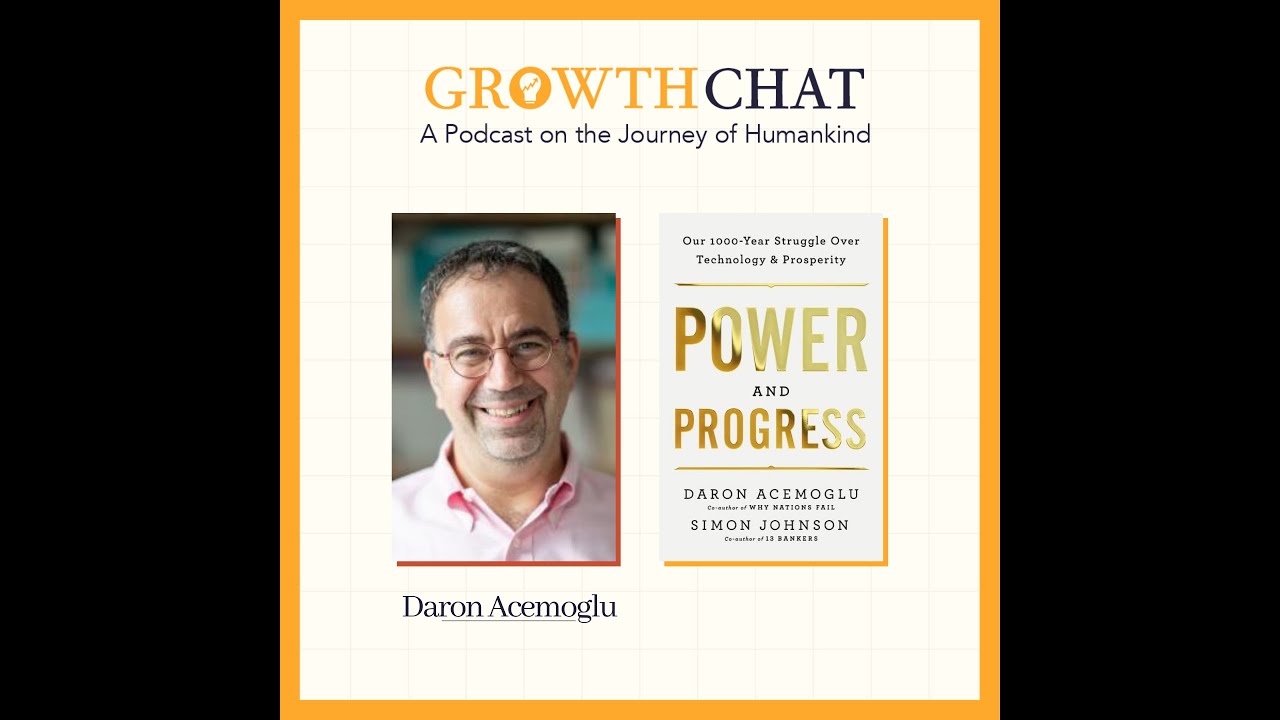
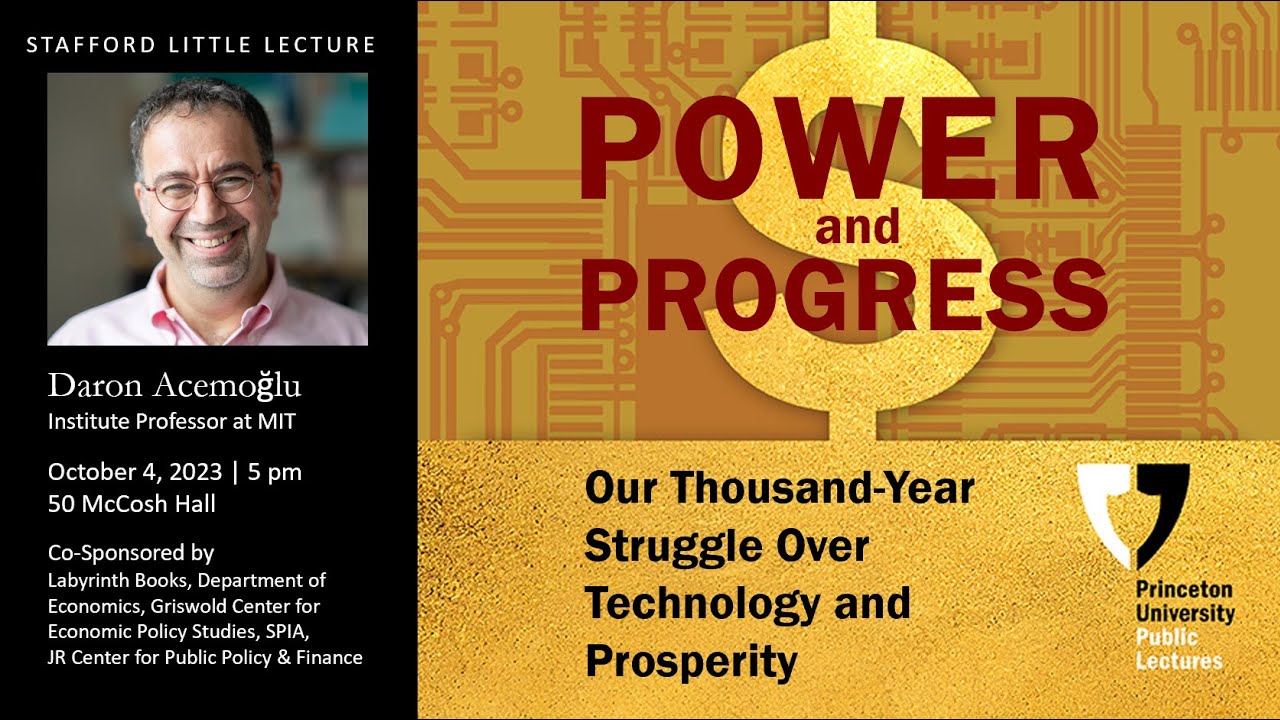
hello and welcome to intelligent squared with me Carl Miller uh we're calling here in London of course on May the 24th uh and I'm excited really excited to introduce I guess today Darren ASA mogloo he's an acclaimed Economist he's taught as a professor in the Massachusetts institute for technology since 1993 and is the author of best-selling books including why Nations fail and the narrow Corridor his new book which we're discussing today is called power and progress our thousand-year-old struggle over technology and prosperity Darren thanks so much for coming thanks Kyle it's great to be here
all right so um let's start with the um overall idea perhaps that you're trying to kill with the book tell us about the the kind of uh the the bandwagon of of progress and why that's wrong yeah so let me actually be step take back take one step back what we are in some sense attacking is a deep rooted techno optimism which claims that technology by its nature is always good for Humanity as a pre-ordained essentially definitive path upon which we are bound to progress unless we somehow block it and if you put these two
together you arrive to A world view in which there may be transition costs some people may suffer temporarily but ultimately we're all going to benefit whatever happens so long as we are working towards technological progress and this is what we want to push against and we want to push against that because a We Believe based on history and economics that there are many ways in which you can use technologies that do not generate these broad-based benefits and second that the path of technology is very malleable there's a lot of choice which specific Direction you develop
it with very different distributional consequences and the bandwagon of progress is essentially the name we give to the body of work in economics that is part of this argument which says you know as long as technology improves your capabilities to produce goods and services it's going to increase wages so it is sort of a happy story that labor demand and firm's desire to increase their scale are sufficient forces to translate some of the technological improvements into benefits for workers and we question that how how old is this argument because of course like I think those
of us that are living through the current Revolution might trace it back to the kind of Bay Area Libertarians and a certain Vision coming from Silicon Valley but is this a kind of argument which we've always been told as as a as a culture and as a society um has stretching back through the various revolutions which have previously previously swept through and the way that we live yes and yes in a broad way humans live in communities and they have to coordinate they have to follow some sort of common path and so they have to
be convinced of accepting certain Arrangements so the argument that whatever is being chosen by leaders is for the common good I think is as old as humanity and sometimes it is sometimes when a band of hunter-gatherers choose to go north rather than South that could in fact be exactly what they need to do and a leader may be the one who catalyzes that decision but in many many places especially since the beginning of settled agricultures leaders have also told us toil harder and that's good for society you're going to get your reward in the other
world or this is your station in life but but the specific version of the productivity bandwagon techno optimism actually you start seeing that in a very clear version for example in the middle starting in the middle of the 18th century with the British Industrial Revolution so ideas that technological progress will generate benefits then those will start becoming broadly shared through the labor market through improvements in quality and product variety you see that already in some of the you know forerunners of modern economics who were amazingly revolutionary in their way of thinking you know Adam Smith
how could I disagree with his super amazing intellectual leadership I'm an economist but Adam Smith was a firm believer in the productivity bandwagon he did not want to entertain the idea that technological improvements could for example create joblessness and David Ricardo by the way who is perhaps the second most important Economist after Adam Smith also started there he was a member of parliament as you know he made speeches to Parliament saying Machinery will not create unemployment but then he changed his mind and then he started he added a chapter to his uh principles of economics
saying you know actually I'm worried about new Machinery creating joblessness and and and so how to turn turn around on that so so there's there's been a debate on this all the time but when economists came back to it at the beginning of the 20th century it was again the more optimistic take that was uh was the one that was adopted so does capital and the elites that wield it do they always win from these revolutions no no uh I mean first of all there are many disruptions inflation world wars they led to Big losses
to Capital owners in the 20th century but the reason why I hesitated is actually if you find a path of technology that is more pro-human more useful for workers we can talk more about what that is in a second but actually firms benefit from that the best example for that I would say is the Social Democratic equilibrium that emerged in Sweden after you know the Great Depression and uh uh sort of the the victory of the Swedish Workers Party in the 1932 election that led to a corporatist model that was quite Cooperative between capital and
labor labor had very strong bargaining power High wages social welfare programs but at the same time that whole system was very encouraging for businesses to invest in education and technology so in in in in in in in in in machinery and Technology choose a path of technology that was both good for their competition and Export markets but at the same time help workers and businesses made a lot of profits out of that so there's a path that's actually good for Capital out of this as well but you know in the US for example over the
last four and a half decades many business managers and many capital owners or you know the richest sort of people who control corporations have gone much more into a strategy that squeezes labor heart tries to reduce labor costs automation surveillance again that can generate profits for Capital but it's not the only thing that generates capital I gave a very long answer to this because I I don't want to create the impression that there is a mortal conflict between capital and labor I think creating the right type of technological path can be beneficial for Capital as
well well Darren we I know lots of people listen to this are going to be very anxious possibly um maybe excited as well about the current Revolution we're living through of course artificial intelligence and you can't move for someone asking chat gbt something at the moment so we're of course going to get to that but I know in the book you Tracer a much longer threat looking at the Revolutions of the past and what they can teach us about a current moment and I think you know as a as a kind of a one-time historian
myself that is an important thing for us also to consider and to dwell on just for a moment to consider the time we live in now so tell us about the Panama Canal and and the lessons that that the that that has for us around the kind of power of persuasion perhaps of gender setting and Powerful Visions yeah I mean absolutely I think if you look at history especially you know of course history is there to be interpreted to some degree so the lenses through which you look at them is important but if you look
at it through these lenses of people acting as technological leader Visionaries articulating the common good and and optimism about the future of technology you see so many examples of it and you see successful applications and you see disastrous ones and the Panama Canal is very important because it is the it's a big project of Ferdinand de lesseps who was you know the epitomization of the Techno optimism of the second half of the 19th century and he was very successful because he brought exactly that Vision a belief in technology belief in trade small people will contribute
Capital build a big public infrastructure and that's going to spearhead trade between east and west and it's going to open up uh Oceanic route and technology is going to come to make things that appeared in feasible feasible that was exactly his stick for the Suez Canal and people were skeptical he pushed he was very skillful in building coalitions cajoling people getting uh French investors on board getting Egyptians ruler on board and he succeeded all his techno optimism paid off when people said no you cannot build a canal at the sea level without the locks in
Suez he said no we'll find a way of working out the technology and he turned out to be right but that's the problem that success made him even more hubristic and that success was always a success from his own point of view for example he didn't care about course laborers in in in Egypt who were not beneficiaries of the Suez Canal and he brought the same set of blinders the same confidence the same rhetoric the same techno optimism to the Panama Canal where conditions were very different and it was a complete disaster he went in
thinking he could do exactly the same but the in two ways the Panama was very different first of all there was no way you could build a canal without locks without doing a much much bigger scale project and second the local conditions especially yellow fever malaria in the rainy season meant that the type of heavy labor based approach wouldn't be feasible as a result 22 000 plus people died thousands of the best Engineers from France perished millions of millions of dollars equivalent of money was lost by many many small investors you know it was a
complete disaster because he was approaching it with the same set of blinders that had become more confident because of his earlier successes see what optimism then the Panama Canal proves is is something which can lead us in the wrong direction technologically is the next historical import you look at settled agriculture evidence of even when the revolution might pay off in terms of productivity increases that might not be a good thing for society and for most of us to live within it or I would say it's not enough to create broad-based Prosperity so the let's just
you know to keep it brief let's just take one formative technological breakthrough in the Medieval Era uh water Mills and then windmills that both really completely revolutionized a lot of the production but you know great amazing improvements in labor productivity amazing improvements in what we could do uh but they weren't enough to increase the living conditions of the majority of the population who are working as farming workers why because those workers had no organization they were still tied by feudal or servile relations there was no competition windmills for example were completely monopolized by abbots and
uh and a very small group of uh Noble land older holders no competition actually in many ways coercive relations intensified and that's not the kind of institutional structure that's sufficient to generate broad-based prosperity when have we Darren most successfully kind of pushed back I guess against the kind of um collectivizing kind of impulses of these revolutions you know and either I I guess through either social or institutional reform either forced the benefits to become more widely distributed or Force technology to be developed in a certain direction which led to more widely distributed outcomes yeah I
think two examples are really inspiring and very well understood by now one is what started happening in the UK for instance in the second half of the 19th century and the second is what happened in throughout the industrialized world in the three three and a half decades after World War II in both cases at least Simon Johnson and my interpretation is very much consistent with our conceptual framework you had the two pillars of broad-based prosperity shared Prosperity one a technology that was worker friendly it wasn't just automating work it was creating new tasks for workers
it was helping workers become more productive in their tasks and second it was a bolstered by an Institutional structure that created bargaining power negotiation power for workers so that they could not be completely monitored uh hugely disciplined course into a relationship and they could ask for a fair share of the Surplus that they created in the second half of the 19th century this is very telling because it is such a contrast to what happened the previous 100 years the beginning of the Industrial Revolution was a harsh time for the working people real incomes for workers
by and large did not increase much for about 100 years their working hours intensify their working conditions worsen their living conditions worsens and infested very unhealthy very crowded cities so the first 100 Years of the Industrial Revolution produced very little benefit for the working people why did that change in the second half democracy Civil Service becoming more interested in cleaning up cities and providing Public Services education and trade unions so trade unions became legal things like Master servant acts became abolished in the 1870s and so that created the bargaining power together with that both because
of the Technologies coming from the United States because of the push from unions and other factors technologies that started increasing workers capabilities in new manufacturing tasks and white color tasks started spreading as well and you see exactly the same factors in the decades after World War II there was a lot of automation but automation was not the only thing that technology did lots of new tasks lots of new activities for workers new Industries and bolstered by a strong labor movement and a democratic process and those two pillars I think are really critical for understanding these
processes and they're dismantling is also very important for understanding what went on after the 1980s right artificial intelligence we've arrived so what historical Echoes when you sit back and you consider the moment we're living through now what are the historical Echoes that you think are most poignant or most important for us to remember you know do you see the the powerful visions of the Panama Canal do you see the prospect of workers losing out like some of the Agricultural forms do you see either the prospect or the reality of institutional reform like post-world War II
reconstruction what are the big ideas or moments of the past you think that we need to remember all of the above well that was a that's a nice short answer but let me let me see two things and then we can do first of all I said 1980s because I think we cannot understand the current moment in isolation of how we've used digital Technologies over the last 40 years AI is different but it is a continuation of the digital Revolution that started sometime in the 1970s and it really came into fruition in the 1980s now
some people will criticize me and say AI is completely different from previous computers and we can debate that but there is actually a lot of continuity in terms of what AI is being used and how it's being processed that's the first thing so we'll talk about digital Technologies but second yes if you want to see historical parallels the lessepsis Panama hubris Jeremy bentham's panopticon idea of monitoring workers monitoring schools monitoring hospitals the medieval separation of Elites to non-elites the two-tiered society the early stages of the British Industrial Revolution where you know there was this idea
that meritocratically the innovators the entrepreneurs would benefit and the lazy not so productive people could be left behind all of these plus standard oils monopolization of Key Resources all of them bunched into one I think we get AI I I know you make much in your book of the idea that actually the directions that technology goes in is a choice that we make and and it can go in One Direction it can go in another and that the current directions in AI are around Automation and the replacement of workers and how that might you know
have all kinds of deleterious and harmful consequences for society beginning to think about Solutions and responses now what do you do about that kind of thing because it often feels like this idea of permissionless innovation you know the idea that a tiny number of elite technologists you know um with access to vast reserves of capital and Talon kind of make these decisions themselves about about which direction they want to go and then they made that decision around automation how do we people listening to this policy makers may be right as academics what do we do
about that seemingly kind of Fairly essential nature of of the way that technology development actually works well I think those are exactly the right questions