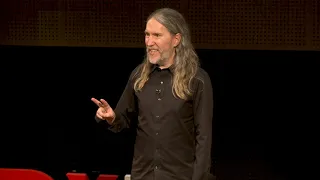
TEDx RíodelaPlata x= Independient TED event Ideas that transform you Joaquín Fargas: Symbiosis between art, science and technology This is possible thanks to Intel www. tedxriodelaplata. org When I was nine, I ran out of batery.
A batery that I used for my toys, for my flashlight, it had run out and I thought: ''If a water tank gets empty, what do I refill it with? '' With water. '' So I said: ''If the battery, that produces electricity runs out, it has to be recharged with electricity.
'' It's so simple and obvious that I made an experiment. I took some cables and connected them to the terminals of the battery and I plugged them to 220 volts. The reaction was immediate.
I was handling the cables, I received an electric shock, the installation collapsed, there was no breaker or thermomagnetic switch, the fuses blew, and the experiment became public. That means my parents noticed what was happening. Well, they could have been with me in my experiences, or say: "You have to be more careful, don't do anything without adult supervision", or something, but the immediate reaction was to absolutely forbid any experiment that could be a risk for me and the property, I mean the house.
As a result, I immediately went underground. I mean, I went on with my experiments in marginality. For example, I made a car.
A small car, like a toy, with the engine of a turntable. Turntable: some kind of MP3 player of that time that played vinyls. It had the peculiarity that it didn't use batteries, you had to plug it.
So my car was an automobile that had a lot of "mobile", but a little of "auto", because it had the autonomy of the cable it was plugged to. With the will of going beyond that limit, I started to add cable. I didn't have enough money to buy a 30 or 40 meters-long cable.
I just collected little pieces that I was finding around, joined them with tape. And that umbilical cord grew up in a poor way, until what had to happen happened I mean, the installation went on fire and my parents appeared in the scene again, and the device disappeared. I never saw it again, not even when I grew up.
The thing is that I went on with the experiments. The house gave me the chance, there was a really distant patio, the garden was very far, in a terrace some floors up and the explosions or shots that were produced they weren't, let's say, taken into a count. When I was 15, already in school, the school made a proposal, as they saw my interests.
They said. ''Why don't you organize a science club? '' So, well, I asked my classmates to bring some devices from home.
We started making things, like telephones, until we decided to make a jet car. A little jet car that was going to be powered with what we had discovered. We had discovered gunpowder.
What does that mean? We knew how to make it. The thing is that we didn't buy the components in an armory, but in pharmacies.
So there was one pharmacy that sold us potassium chloride tablets, that were used to soften the throat at that time. We went to another pharmacy, obviously we didn't buy in the same one because the pharmaceutic would think: "These kids are into something strange. " We bought the brimstone that people used to cure sore necks or something, we put all the pieces together, and that car was improving its performance.
Until during one of those tests in which we wanted to increase the speed of the gas outlet the outlet pipe got clogged and the car exploded. As a consequence of the explosion, we got some kids injuried. The next day, some of us went back to school blindfolded.
That was the end of the science club, too. Next year, when I was 16, I decided to study engineering, I started to take the admission course and I said: "Well, I will find now the chance to be in an institution, a university that will give me the academic shelter, the support to keep on going with my experiments. " Let's say, to satisfy my curiosity and my interests.
But, far from that, I found something very formal, abstract, that wouldn't let me in any way get in touch with that reality. If I wanted to know how did a car engine work I had to see it on a book. I remember the thermal machines book with schemes, performance curves.
And I've never ever been in touch--inside a technology university, with a tool to dismantle an engine or touch something--. The thing is that art has always been with me in some way while I was studying engineering my first works were sculptures, some pieces of carved wood that I sold. I was a craftsman too, I worked with metals, leather.
The metals I used were aluminum, bronze, copper, stainless steel. Everything that was at my reach, I would turn it into something that could be aesthetic and sold. The thing is that I think that always, in some way, in human history, there has always been this conjunction of all this technology, of that way of expression, using the tools available at the time.
Here we see a painting, a cave painting, these paintings that our ancestors made on rocks 10. 000, 20. 000 or even 30.
000 years ago, and that in some way remain until now. And you ask yourself: "How do these inks, these paints, could be made at that moment? " They used everything they had at hand: the plant, animal, mineral kindoms and they didn't use them directly, but through a very sophisticated process.
The techniques to make these paints have been emulated. Also the application, here we see a hand used as a pattern, a stencil and also an application like made with an airbrush, trying to propel the paint with different styles. Here, closer to our times, we see this pyramid, in Mexico, this is the Chichen Itzá pyramid, which I think is the paradigm of the encounter of different disciplines.
There, scientists of that time, the astronomers had such a developed knowledge of the behavior of the system, that we can still see today, during the equinoxes a set of lights and shadows that represent a snake going down the top of the pyramid. This snake, that also joins the social and religious aspects, showing that it is going down at that time to bless the crops, the need that those people had to feed themselves. Many people also ask me: "How did you get involved with the arts?
" Although I consider that it was never dissociated, I did had a somewhat formal appearance in art. My projects didn't have a defined objective, but art people did start to show up. I remember once a person came from Canada, and said: "This project is an art project, because it has a poetry, an aesthetics, a metaphor.
'' And I said: "Well, maybe it's time to get involved with art, that is going to allow me to step into a place where I will find a freer way of thinking. " I am going to find, as opposed to the hard structure of engineering, of science, I am going to find the artistic part. And, quite the contrary, I found an absolutely protocolary system, I mean, a rigid thing, that had, for example, the role of the critic.
The art critic, who says this is good, this is bad, with a subjectivity probably even greater than that in sciences. I found the role of the curator, who decides what can be exhibited or not, and how. In Spain it is called "comisario" [TR: commissioner], and in France is the "commissaire", with all that word means.
The institution, the gallery. In fact, I am wearing a T-Shirt that represents a conjunction between Warhol and Einstein. This is also subject to a curator's work.
There was a curatorial treatment to determine what could I wear, I mean, nothing is random. The thing is that, with all this conjunction, I start to work in some projects that, like in this case, are sculptures. It's an art project about placing some natural ecosystems within a closed space.
I mean, this totally sealed space has a goal: that we make ourselves some questions. What can we wonder about a place that is fully closed with living organisms inside? Well, the question is: How can these elements, organisms survive if they are enclosed?
So this, in an infinitesimal scale, is like our planet. We can ask ourselves the same question, being enclosed here, in this space, in this planet. How do we breathe?
Where does oxygen come from? Do we have a connection with outer space? The fact is that we have to work it out ourselves.
Although the planet seems something infinite because we go out and at a human scale its dimensions exceeds us, somehow all these elements aim at showing us the fragility of our planet. This planet that we can show in this format in different places. Like an art gallery, a public space, different places.
Now I'm going to show you this little one here. This is a biosphere, that has a 7,5 cm diameter. It's very small as you can see.
And it's made to fit in your hand, with the idea that the world is in our hands. Now these ones are given to leaders. Those opinion-formers, those decision-makers, who, while we know that the world is in the hands of each of us, they have a some greater responsibility.
With these little ones, we can also study what's going on inside them. We praise them for their green, we know that there is life in there, but if we make a microscopic study (this has a simple rubber cap, which allow us to take a drop of water and make a study) an amazing microscopic world appears, which interacts with the rest of the world. It interacts with what we see, everything that we see is in there too.
And what's going on here? How is that we and this element can survive? I mean, it needs light, sunlight.
Light, which is the main resource of energy and of life to us in this planet, it makes plants produce photosynthesis plants and also other animals produce photosynthesis. Here we are representing the animal and plant kingdom with two very simple organisms. Just one cell, both are green because they make chlorophyll, as a result of their process of photosynthesis.
In these biospheres and in our world, all the cycles necessary to have everything recycled happen. We have the water cycle, that makes water evaporate move to other places, rain and generate life, and it is produced freely. We also have the nitrogen cycle and we always go back to the fundamental photosynthesis.
The project also has an educational part, in which kids can make their own biosphere, make their own design and follow the evolution of those elements. Here is another project that I'm interested in and has to do with climate change. The project is called Utopia Project, and it's a worldwide call to artists, to present projects related to climate change, that could be a solution even if completely crazy, impossible.
That's why the project is called Utopia. And these are the 3 mills that I installed this year in the Buenos Aires glacier, at the Esperanza base, the Argentinian base Esperanza, in order to cool down the glacier. The glacier took million years to form, now it's defrosting and we have to do something.
So this project is called Don Quixote fighting climate change. Just like Don Quixote fought against those mills thinking they were some weird alien beings that came to invade the region of La Mancha, these mills try to show how we, in some way, have to fight adversity and say: "We have to do something. " Here we also show how biotechnology can be an artistic expression tool.
In this case, those spots represent places where the idea is to place a group of neural cultures that are going to be interconnected through the Internet, and they will gather information from the environment, they are going to transform that input into electric impulses that will travel through the web and will configure a neural network. A universal neural network from which we will extract these brain waves and this neural network is going to try to represent, somehow, that human beings are connected and we don't know exactly how. Here is another project that has to do with the culturing of heart cells.
This project is far developed, it has 3 phases and we are at the second one. The objective of this project is to make a semi-alive organism that could remain forever. The project is called Immortality, and during two years, it has been working specially in these cells, which are cells from a mice carcinoma, which have the characteristic of not having the aging clause in their DNA.
What does that mean? Every time these cells replicate, they have biological age zero back again. They would be theoretically immortal.
These cells were taken out of the lab. We made a bio-reactor, a device that let us keep, somehow, a controlled atmosphere, and in that way be able to show them to people. That is the Centro Cultural Recoleta, where the cells were exhibited and it was possible to interact with some digital equipment available.
The second part of the project was to make those cells beat. Here we have cells beating. They are in a bi-dimensional situation, in two dimensions.
And the third part of the project, which is in process right now, is to create a bio-reactor that make those cells survey the environment, know that there are people around, and increase their pulse rate. And somehow, that excitement state, show it back with some multimedia effect. Here we have another project that has to do with biotechnology.
Evolution took away from us the capacity to dress naturally. Here we are all dressed. If someone wasn't, it would be, say, something surprising to us.
The idea is that somehow, in the future maybe, we can get that ability back of dressing with our own body. It is planned for mid next year a performance, in which I am going to donate a part of my epithelial tissue to start making a clothe-shaped culture setting the milestone of what could be that possibility to dress with our own body again. The university of Fashion Design with their students, are going to design a series of clothes.
This meta-dermis, they are going to think how could that meta-dermis be in the future. Here we have Robotika, let me introduce you to Robotika. Robotika is a technological baby-sitter that has the ability to learn.
It has artificial intelligence and it learns how to take care of human babies. We are also going to make a performance with Robotika and real babies, to mark the beginning of that possibility, in which Robotika will be in the future some kind of galactic ark. This is, a being that is going to carry frozen human embryos to different places of the universe, to guarantee the survival of mankind.
Where she finds a right place, she will begin the development. The idea is that somehow, mankind is facing big challenges in the short, medium and long term. Climate change, the increasing probability of a meteorite crash of proportions, the extinction of the sun, which we may think is infinite, but is a star with a given lifespan.
We have to go against the tide, face what may look insurmountable. In conclusion, I think that we have to do something, even when we don't know the results. Because if we don't do anything, we already know the results.
Thank you.