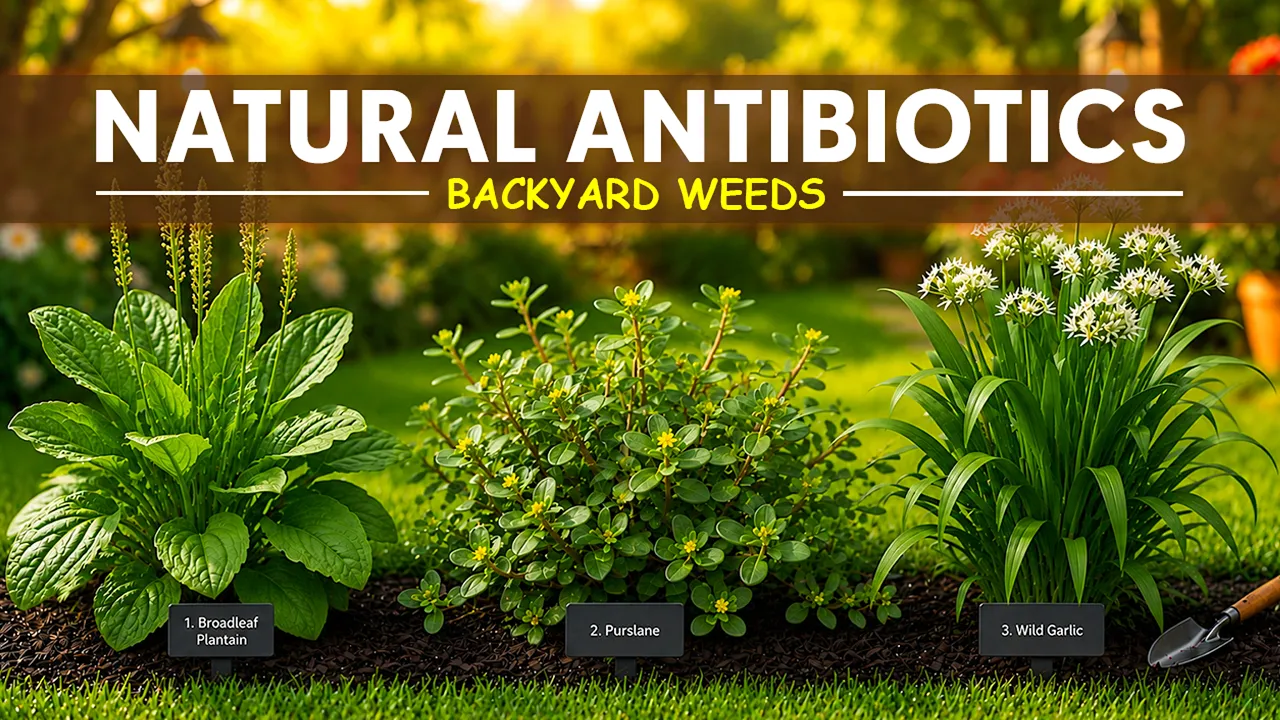
What if I told you that some of the most powerful infection-fighting plants in the world [music] are not locked away behind a pharmacy counter, but are growing right now in the [music] cracks of your driveway, along your fence line, and in that scruffy part of your lawn you keep trying to kill every summer? Most people have absolutely no idea. They spray these plants, yank them out by the roots, and curse them every spring, >> [music] >> never once realizing that for thousands of years our ancestors treated these very same weeds like a living medicine cabinet.
And today, I am going to show you 11 backyard weeds that have traditionally been used like natural antibiotics, plants that herbalists, healers, and ordinary country folk reached [music] for long before the first prescription was ever written. Stick around because plant six was carried onto the battlefield by ancient warriors to clean and close the wounds of their soldiers. And plant nine is a strange, stringy little lichen from the edge [music] of the forest that old herbalists quietly called the antibiotic of the woods.
Make sure you hit that subscribe button and give this video a like because here at the Homestead Gardener, we post new videos every single week about growing, eating, and living better through plants. You truly do not want to miss what is coming. So, let us get into it.
Here are 11 backyard weeds that have been valued for centuries for their antibacterial power, ranked from the most overlooked all the way to the most legendary. Plant one, broadleaf plantain. The footprint healer hiding in your lawn.
Let us start with the weed you have almost certainly stepped on today without even noticing. [music] Broadleaf plantain, known to botanists as Plantago major, is that low, oval-leaved plant with the deep ribs running through it like veins, the one that [music] grows defiantly in sidewalk cracks, driveways, and the most trampled corners of your yard. >> [music] >> It does not grow in the pampered flower bed.
It grows where the foot falls hardest. [music] Most people see it as a stubborn nuisance, but here is what most people miss. This humble, ignored weed may be one of the most useful first aid plants on the entire [music] planet.
When European settlers carried plantain across the ocean, it spread so [music] persistently wherever they walked that some Native American peoples called it white man's foot because it seemed to appear [music] in every place the newcomers set foot. And this is where things get interesting. Plantain leaves contain a [music] compound called aucubin along with allantoin and substances [music] called tannins.
Research suggests that aucubin has natural [music] antibacterial properties, while allantoin is well known for supporting skin and tissue regeneration. That [music] is not folklore. That is real chemistry.
Growing in the gravel of your driveway, for generations country people treated plantain as their go-to remedy [music] for scrapes, bug bites, and bee stings. The traditional method was simple. You would pick a clean, fresh leaf, crush it to release its juices, and press it gently against the minor [music] wound or itchy bite.
The leaf has a soothing, slightly slippery quality that herbalists call a demulcent, meaning it forms a cooling, protective film over [music] irritated skin. This plant was respected as far back as the days of the poet Chaucer, more than 600 years ago, and it appears in a 1,000-year-old Anglo-Saxon healing text as one of the so-called nine sacred herbs used in wound remedies. Some laboratory studies [music] have explored plantain's antibacterial compounds, and the results, while still early and done outside the human body, line up beautifully [music] with how the plant has been used for centuries.
The seeds, by the way, are close relatives of psyllium, the very same fiber sold [music] in pharmacies today for digestion. Now, an important natural safety note. While plantain has a long history of topical use for minor scrapes and bites, >> [music] >> deep wounds or serious infections always need real medical care from a professional.
This is a gentle backyard ally, not a substitute [music] for a doctor. But here is why our ancestors valued it so deeply. [music] When you are far from town and someone gets stung or scratched, the plant that grows in the most trampled [music] dirt of all turns out to be the very one waiting to help.
That is the [music] hidden power of this plant. Plant two, chickweed. The delicate green that simply refuses to die.
The next weed looks far too soft to be tough. Chickweed, known as Stellaria [music] media, is a sprawling low-growing plant with tiny teardrop leaves [music] and small white star-shaped flowers that seem too delicate to survive a frost. And yet it often shows up as the very first green thing in early [music] spring, sometimes pushing up under a thin blanket of snow, which earned it the old nickname, winter weed.
Gardeners pull it constantly, and yet it always comes back. But that very persistence is why our ancestors paid such close attention to it. Here is why that matters.
Chickweed has traditionally been used as a [music] cooling, soothing herb, especially for irritated, itchy, or inflamed skin. Herbalists have long made it into poultices [music] and salves applied to rashes, minor abscesses, bug bites, and any hot patch of skin. It is what the old herb books describe as a demulcent and an anti-inflammatory, a plant whose entire character is about calming heat and soothing irritation.
While the strongest evidence for chickweed is traditional, rather than from large clinical trials. That gentle reputation has carried it through many centuries of folk medicine, and it is not just a remedy. Chickweed is surprisingly nutritious, packed with vitamins A, C, and the B complex, along with iron, calcium, and minerals, holding up well even compared to spinach.
People have eaten it raw in salads for hundreds of years, where some say it tastes a little like tender sweet corn, others like a mild spinach. You can also steam it gently like any green. So, you have a free, mineral-rich wild green, and a time-honored skin remedy, all bundled into a weed that most people rake straight into the compost pile.
That is the hidden power of this plant. Plant three, purslane, the succulent weed that Europe proudly calls a vegetable. Now, for a weed that the rest of the world treats with far more respect than we do here in America.
Purslane, known as [music] Portulaca oleracea, is a succulent, low-creeping plant with thick, plump, paddle-shaped leaves [music] and smooth, reddish stems. It thrives in the hottest, driest, most baked corners of a garden, the spots where nothing else wants to grow. Here in the United States, >> [music] >> we dismiss it as a weed.
But across much of Europe, Asia, and the Middle East, people call it something else. They call it [music] dinner. But here is what most people miss.
Purslane is one of the single richest plant [music] sources of omega-3 fatty acids in the entire plant kingdom, carrying many times [music] the amount found in spinach. It is also loaded with vitamins A, B, and C, along with iron, calcium, and potassium. And this is where [music] things get interesting.
Traditional herbalists have long valued purslane for its antibacterial and wound-soothing qualities, breaking [music] open its thick, juicy leaves to rub the cooling gel onto cuts >> [music] >> and minor burns, much the way you might reach for an aloe leaf. It has documented wound-healing and antimicrobial effects in traditional use. And it has also been brewed as a tea for digestive complaints.
This is why our ancestors [music] valued it, and why modern gardeners are finally rediscovering it. A plant that shrugs [music] off drought, feeds you like a nutritional powerhouse, and carries a long folk reputation for soothing the skin, is [music] simply not a weed worth fighting. It is a free crop you never had to plant, one that volunteers itself every summer.
>> [music] >> Think of it as the garden guest that more than earns its keep. A small note for the kitchen, purslane has a pleasant, slightly tart, lemony crunch >> [music] >> that holds up well, even in summer heat, with no bitter season, the way many greens have. That is the hidden power of this plant.
Plant four, >> [music] >> dandelion, the sunshine weed that everyone underestimates. You knew this one had to be coming. The dandelion, known as Taraxacum officinale, with its [music] cheerful golden flower and jagged, toothy leaves, is perhaps the single most hated plant in [music] the entire American lawn.
We pour millions of dollars every year into chemicals [music] designed purely to destroy it, and the whole time our ancestors would have looked at us as though we [music] had lost our minds, because to them this was treasure. Here is why that matters. Nearly every part of the dandelion has been used in traditional medicine and cooking, the leaves, the flowers, and especially the long taproot.
It has been valued for centuries as a bitter tonic to gently support healthy digestion [music] and the liver, but the antibacterial angle is the truly surprising part. Recent laboratory research that screened many traditional, indigenous plant remedies [music] found that dandelion extract showed measurable activity against bacteria, including some stubborn [music] strains. And notably, it appeared more active under conditions designed to mimic a real wound [music] environment.
That is early science, not a promise of a cure, but it lines up beautifully with how the plant was traditionally used. This is why modern foragers are circling back to it with new respect. The young spring leaves are edible and rich in vitamins, often tossed into salads when tender.
The roasted root has been ground into a warm, coffee-like drink for generations. A natural safety note, and an important one. Dandelion can interact with certain medications, and because it sits in the same family as ragweed, it can trigger reactions in people with allergies.
Anyone on prescriptions should check with a professional first, but the deeper lesson stands firm. The brightest, [music] most stubborn weed in your whole yard may also be one of the most generous gifts nature ever left in your lawn. That is the [music] hidden power of this plant.
Plant five, wild garlic, the pungent guardian of the spring woods. For this one, you simply follow your nose. Wild garlic and its cousin, the wild onion, send up slender, grass-like [music] green shoots in early spring, and the moment you crush a single leaf, that unmistakable, sharp, garlicky scent gives the whole plant away.
They grow in lawns, fields, and along the edges of [music] the woods, and most people mow right over them year after year. But that strong smell is a clue pointing towards something genuinely powerful. Here is the surprising part.
Wild garlic [music] and its relatives contain sulfur compounds, the very same family of compounds that give cultivated kitchen garlic its famous reputation. For [music] thousands of years, across nearly every culture on Earth, garlic has been valued as a natural protector against illness, eaten [music] in winter, and trusted through countless hard seasons. Many herbal traditions use [music] it to help support the immune system and to help the body stand strong against the bugs that circulate every cold [music] and flu season.
Modern research has studied garlic's compounds for their antibacterial activity. And while it is no miracle, the tradition runs deep for good reason. This is why [music] our ancestors valued it.
Long before refrigeration, before pharmacies, a pungent little plant that seemed to ward off sickness was treasured. A very important natural [music] safety note here, and please take it seriously. Wild garlic has dangerous [music] toxic look-alikes, including poisonous plants like lily of the valley.
This is exactly why the smell test matters so much. [music] If the leaf does not smell clearly of garlic or onion when crushed, you do not eat it, full stop. But once you are absolutely certain of your identification, you have a free, flavorful, [music] immune-supporting wild crop that returns faithfully every spring.
That is the hidden power >> [music] >> of this plant. Plant six, yarrow, the warrior's wound herb of the ancient world. Now we reach the plant I teased at the very beginning, and it carries [music] one of the most dramatic origin stories in all of herbal history.
Yarrow, known as Achillea millefolium, with its [music] flat-topped clusters of tiny white flowers and soft, feathery, fern-like leaves, takes its botanical [music] name directly from the Greek hero Achilles. The old legend says that Achilles carried this very plant onto the battlefield to bind the wounds of his soldiers. That second part of its name, millefolium, means a thousand leaves, a nod to those lacy fronds.
That is how old [music] and respected this plant's reputation truly is. But here is what most people miss. Yarrow is what herbalists call an styptic, meaning [music] it has traditionally been used to help slow the bleeding from minor cuts.
It is also long valued as an anti-inflammatory [music] and antibacterial herb. Old-time foragers would tear off a piece of leaf [music] and press it onto a small wound right there in the field, amazed at how quickly it seemed to staunch the flow of blood. Interestingly, knowledgeable herbalists warn against the old habit of chewing the leaf first because saliva introduces its own bacteria into an open wound.
A small detail that shows just how carefully this plant was used. European herbal authorities today still formally recognize yarrow's traditional use for minor superficial wounds, mild digestive complaints, and menstrual discomfort. Beyond the battlefield, it has also been brewed into a warming tea for colds and fevers, where its diaphoretic quality, meaning it encourages a gentle sweat, helped the body break a fever.
A natural safety note, yarrow belongs to the daisy family, so it can trigger allergic reactions in sensitive people, and it is traditionally [music] avoided during pregnancy. But, its legacy is undeniable. A weed named after a legendary warrior still growing humbly on roadsides today, free for anyone who learns to recognize it.
That is the hidden power of this plant. If you are starting to see the pattern here, if you are beginning to realize that some of the most powerful healing plants on Earth are hiding [music] in plain sight in the most ordinary places, then do me one small favor. Hit that like button right [music] now.
It genuinely helps this video reach more people who love plants, gardening, natural living, and the old wisdom that still works just as well today as it did centuries ago. And if you have not subscribed yet, click that subscribe [music] button and ring the bell. We are building a real community here at the Homestead Gardener, and [music] I would truly love to have you as part of it.
Now, let us keep going because the next several plants are some of the most fascinating of all. Plant seven, garlic mustard, the invasive weed with a hidden gift. Here is a weed that gardeners and land managers across the country truly despise and honestly [music] for very good reason.
Garlic mustard, known as Alliaria petiolata, is an aggressive invasive plant across much of North America, choking out native wildflowers in forests [music] and along shaded field edges. You are often encouraged to pull it the moment you spot it, [music] but there is a rich irony hiding inside those heart-shaped garlic-scented leaves. Garlic mustard did not arrive on this continent by accident.
And this is [music] where things get interesting. It was originally brought over from Europe as a deliberately cultivated plant [music] in the mustard family, prized as a flavorful pot herb and valued as a traditional medicinal green. Crush one of its leaves and you will catch that faint but [music] distinct garlic aroma, a hint of the same beneficial plant family that gives us so many of our protective foods.
Old European herbals valued [music] garlic mustard as an antiseptic green and worked it into poultices applied to minor wounds. This is exactly why people [music] misunderstand it. We see only the unwelcome invader, never the cherished herb that our own ancestors [music] deliberately carried across an entire ocean because they did not want to live without it.
So here is a satisfying [music] piece of homestead wisdom. When you go out to pull garlic mustard to protect your native plants, you do not have to waste a [music] single leaf. The young tender leaves are edible and have traditionally been pounded into a sharp bright [music] garlicky pesto.
You get to fight back against an invasive plant and eat very well in the process. [music] That is the hidden power of this plant. Plant eight, goldenrod, the golden weed wrongly blamed for your sneezing.
This next plant has suffered one of the great injustices [music] in the entire plant world. Goldenrod, with its tall arching plumes of brilliant golden-yellow flowers in late summer, gets [music] blamed every single year for hay fever and itchy eyes. But, here is the honest truth.
Goldenrod is almost certainly completely [music] innocent. The real culprit is ragweed, a far plainer plant that just happens to bloom at the exact same time. Goldenrod simply had the misfortune of standing nearby, tall and bright, looking guilty while the true offender hid in the background.
Here is why that [music] matters. Goldenrod, which belongs to the genus Solidago, actually has a long and respected [music] history in traditional herbal medicine. In fact, laboratory studies of traditional medicinal plants used by indigenous peoples of the northeastern United States found that Solidago canadensis showed notable antibacterial activity, performing especially well against certain harmful bacteria.
And here is the beautiful detail. Its very name, Solidago, comes from a Latin root meaning to make whole, a direct nod to its old reputation as a wound-healing herb. The name itself is a memory of how it was used.
This is why our ancestors valued it. Goldenrod was traditionally brewed [music] into teas used to support the urinary system and the kidneys and to ease the discomforts of colds. A natural safety note, as always [music] with members of the daisy family, allergies are possible for sensitive individuals, so a little caution is wise.
But, the bigger lesson is this. A plant that we have spent generations wrongly blaming and ripping out of our gardens turns out to be a genuine, time-honored healing herb with modern science quietly stepping forward to back up the old stories. That is the hidden power of this plant.
Plant nine, Usnea, the forest's stringy little antibiotic. Now for the one I promised you near the start, and it is truly unlike anything else on this entire list. Usnea is not quite a plant [music] in the way we usually think of one.
It is actually a lichen, a fascinating living partnership between a fungus [music] and an algae working together as one. It hangs in pale, stringy, grayish-green tufts from the branches of trees at the cool edges of woods. You can recognize it with [music] one simple test.
Gently take a single strand and slowly pull it apart. And if you see a stretchy, elastic, white thread hiding inside the green sheath, then you have likely found true Usnea. But here is what most people miss entirely.
[music] Usnea contains a compound called usnic acid, and traditional herbalists have long valued it for its antibacterial and antifungal [music] properties. With some old foragers going so far as to call it the antibiotic of the woods. Folk healers have made it into teas and tinctures at the first scratchy [music] sign of a cold or sore throat, very often sweetening it with honey.
Because on its own, the flavor is quite bitter on the tongue. It also carries a good amount of vitamin C. This is where [music] care truly matters.
Because Usnea grows extremely slowly, sometimes only a few millimeters in a year. And because as a lichen, it absorbs whatever is floating [music] in the air around it, it should only ever be gathered far away from busy roads and pollution. Ideally from branches that have already fallen to the forest [music] floor.
A serious natural safety note. Usnic acid can be hard on the liver if it is overused. So this is one to treat with deep respect [music] rather than casual experimentation.
Still, the simple fact that our ancestors managed to identify a humble tree lichen >> [music] >> as a powerful natural defender long before anyone had ever seen a bacterium under a microscope is nothing [music] short of remarkable. That is the hidden power of this plant. Plant 10.
Broadleaf [music] dock. The companion that grows right beside the sting. You may already know this next weed without ever having learned its name.
[music] Broadleaf dock, known as Rumex obtusifolius, has large, broad, wavy green leaves and a tall central stalk crowned with clusters of rusty brown seeds by late summer. It is famous for one habit. It tends to grow right alongside stinging nettle, which gave rise to the old country [music] saying that wherever the nettle stings you, the dock grows close by to soothe it.
Nature, it seems, planted the cure right next to the problem. Here is why that matters. For countless generations, people have reached down, grabbed a cool dock leaf, and rubbed it on a fresh, burning nettle sting for relief.
A beloved piece of folk first aid passed down through countless backyards. But dock's reputation runs deeper than just easing a nettle sting. In traditional medicine across Europe and beyond, dock leaves, and especially its [music] roots, have been used for skin rashes, minor wounds, and inflammation of the skin.
It even appears in scientific surveys of traditional plant remedies investigated for antimicrobial activity against infectious conditions. This is why our ancestors valued it. But here comes a natural safety note worth taking seriously.
Dock leaves contain oxalic acid and should not be eaten in any real quantity, especially raw. And they should never be confused with safe, edible salad greens. [music] Its true value on this list lies in tradition and topical folk use, not on the dinner plate.
But that does not make it one bit less remarkable. A common weed that nature seems to deliberately plant right next to the very thing it was used to soothe, generation after generation. That is the hidden power of this plant.
Plant 11, narrowleaf plantain, the ribwort twin of our very first healer. And so we close exactly where we began, with a plant from the same generous family, because this cousin deserves [music] its own moment in the spotlight. Narrow-leaf plantain, also called ribwort plantain, known as [music] plantago lanceolata, is the slender cousin of the broadleaf plantain that opened our list.
[music] Instead of those wide oval leaves, it sends up long, narrow, deeply ribbed, lance-shaped leaves [music] and tall, wiry stalks topped with small, compact, bullet-shaped flower heads. You have walked straight past many thousands [music] of them without ever giving them a glance. Here is the beautiful part.
It shares all of the same powerful family traits as its broadleaf [music] sibling. The soothing mucilage that coats and calms, the antibacterial compound aucubin, the tissue-supporting allantoin, and that [music] gentle astringency. Herbalists very often use the two plantains completely interchangeably, but ribwort plantain [music] has been especially treasured in traditional medicine for the respiratory system.
It has long been brewed into soothing teas and gentle cough syrups, very often combined with honey to help calm an irritated, scratchy throat and ease a stubborn cough. The leaves were juiced and mixed with honey in many [music] old country kitchens for exactly this purpose. And this is where things get [music] interesting.
That same soothing, mildly antibacterial quality is precisely what made ribwort plantain such a favorite in old herbal infusions for irritated [music] membranes and for gently supporting the body through coughs and colds. Its dual nature, both moistening to dry, sore tissues and astringent [music] to runny ones, made it unusually versatile. A natural safety note to carry with you.
As with every plant on this list, correct [music] and confident identification always matters most. And anyone who is pregnant, nursing, [music] or taking medication should check with a qualified professional before using any herb internally. But the fact that you can find such a deeply [music] respected old remedy growing wild in nearly every lawn and roadside in America completely free is the perfect [music] note to end on.
That is the hidden power of this plant. If you made it all the way to the end [music] of this video, you now know something that most people walk right past their whole lives and completely [music] miss. The lawn you mow every weekend, the cracks in your driveway, and the wild [music] edges of your yard are quietly full of plants that healers, herbalists, [music] and homesteaders have trusted for thousands of years.
Plants traditionally valued for the very same kind of antibacterial and wound-soothing power that we now take for granted [music] when it comes in a little bottle. These plants are not just dusty old stories. They are useful, they are powerful, [music] and they are absolutely worth rediscovering.
As long as we treat them with real knowledge, careful identification, and deep respect. [music] So, here is what I want you to do. Smash that like button if this video changed the way you look [music] at the weeds growing in your own backyard.
Drp a comment down below and tell me which one surprised you the most of all. [music] Are you team plantain, the humble footprint healer hiding in your lawn? Team yarrow, the ancient warrior's wound herb pulled [music] straight from Greek legend?
Or team usnea, that strange, stringy little antibiotic of the deep [music] forest? I read every single comment and I genuinely love hearing from you. And if you have not subscribed to the Homestead Gardener yet, then what [music] in the world are you waiting for?
Hit that subscribe button and ring that notification bell so you never miss a single video. >> [music] >> We are building a real community of people who understand a simple, powerful truth that some of the very best answers to our modern [music] problems are still growing quietly underfoot in the most overlooked corners of the world, waiting patiently for someone to remember what our ancestors never once forgot.