I'm not an atheist anymore because I don't look at the world that way anymore I'm not a materialist anymore. I don't think the world's made out of matter I think it's made out of what matters. It's made out of meaning.
Look at it from a. . .
from the perspective of modern brain science What we orient towards unconsciously, which means what captures our attention, is meaning and it captures our attention before we know what it is The brain acts as if the world's made out of information or made out of meaning Heidegger, for example, German philosopher, was convinced that the world was made out of meaning essentially And that people's primary interaction with being was interaction with meaning And that isn't what modern people think because they're deeply materialistic If you go back 400 years or 500 years and you look at what people meant when they said matter which is what things are made out of. What they thought matter was isn't like what we think it is. It wasn't like this material stuff sort of like dirt that everything was made out of it.
It was. . .
It was much more complicated than that The problem with the standard view of matter is that it doesn't really deal with the fact that matter comes in arrays and in patterns and the patterns and the arrays, which is sort of lost when you think about atoms. That's where all the action is that's where the reality is. 'In the beggining' God creates Adam and Eve explicitly in his own image There's a variety of interpretations about the first being that God created So there's a tradition in medieval Christianity and Judaism as well, that the first man was hermaphroditic.
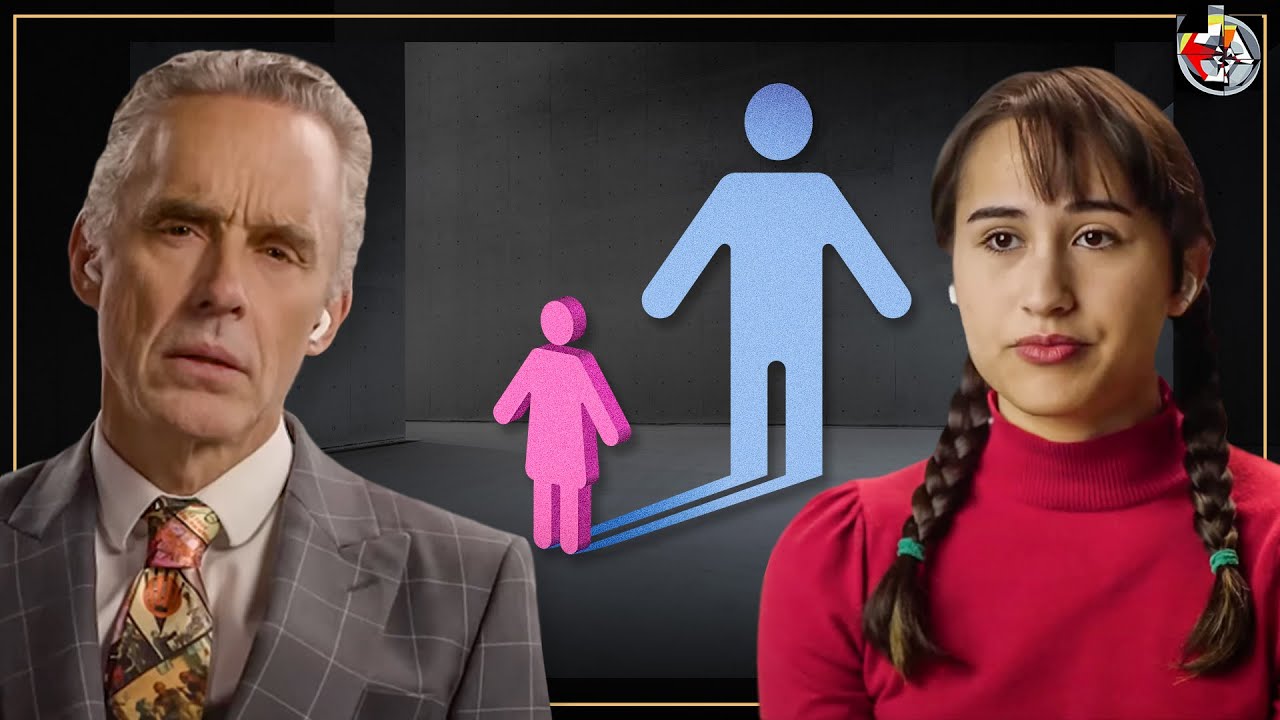
Male and female together And then separated into two separate entities Which then were forever looking to be rejoined And there's a very profound psychological idea there which is that the union of masculine and feminine produces a kind of perfect wholeness and you can think about that as being expressed biologically given that males need females and masculine needs feminine. But you can also think about it as different aspects of the psyche or between people or different aspects of the psyche within people. So whatever consciousness is it comes in masculine and feminine embodiments The masculine and the feminine embodiment are equally representations of God.
Which I think is quite remarkable Because there´s a whole line of feminist criticism of the Western tradition That makes the presumption that the whole structure is patriarchal And I don't think that's true. If it was patriarchal, it would have been man that was created in the image of God. And it is explicitly not that.
What feminine and masculine as well as being markers for gender behavior are also symbolic categories and the feminine symbolic category is the Genetrix of things, the matrix. Because the female is associated with the act of. .
. with the most fundamental aspects of the act of reproduction. So it's out of the feminine that new forms spring For example, new forms come out of what you don't understand.
That's the matrix of being and new biological forms come come out of a feminine substrate that's female creatures and so the masculine aspect is more seminal in the symbolic sense of that. The seminal idea is the instigator, so to speak, and it's also. .
. it also stands in mythology for a kind of logical clarity and cutting. Whereas the feminine stands for more like something that's whole and undifferentiated There's some suggestion in the story of Adam and Eve that the woman is the primary food sharer And I think that's associated in some way with her ability to make Adam self-conscious, which is exactly what she does she offers him something that makes him self-conscious and she becomes self-conscious also as a consequence.
Women make men self-conscious. You can't think of a truth that's truer than that and the reason they do it is because they're very selective and most men they reject 'Adam's shame' So God comes up and he's looking for Adam because he's used to wandering around with him and Adam's hiding behind a bush, which says something about Adams level of intelligence first, because, you know, God can see through bushes. But it also says something about his level of self-consciousness because what it means is that when Adam becomes self-conscious he no longer believes that the fact that he was made in the image of God is sufficient to give him stature and so God says well who told you were naked and this is where this is really Adam's fall, I think.
He says it was the woman He blames her which is really pathological the woman you gave me it was her fault. Yeah, she made you self-conscious Well, hooray. You know you woke up there's something to be said for that Now women torture men into being awake And I don't suppose that's always received with gratitude 'Paradise Lost' John Milton, he wrote Paradise Lost for two reasons.
One was to justify the ways of God to man. And the second rationale for his writing was to codify mythologies, stories that were in some ways peripheral to canonical Christianity, into a single coherent narrative. Here's a question he tried to answer, which was: Well if God was all-knowing why would he set Adam and Eve up to fall.
And Milton has a very sophisticated answer to that and it is that people truly have free will and even if God knew that they were going to fall, there was nothing he could do to stop that except deny them free will and free will is so valuable that that denial was not going to happen Dostoyevsky points out that freedom happens to be very important to people and even arbitrary freedom. Like people want the freedom to go to hell in a hand basket, even. They don't want constraints they're willing to put up with a lot to have their freedom and God's judgment is something like freedom is better than safety 'Why the snake' The snake in the Garden of Eden is a really interesting character.
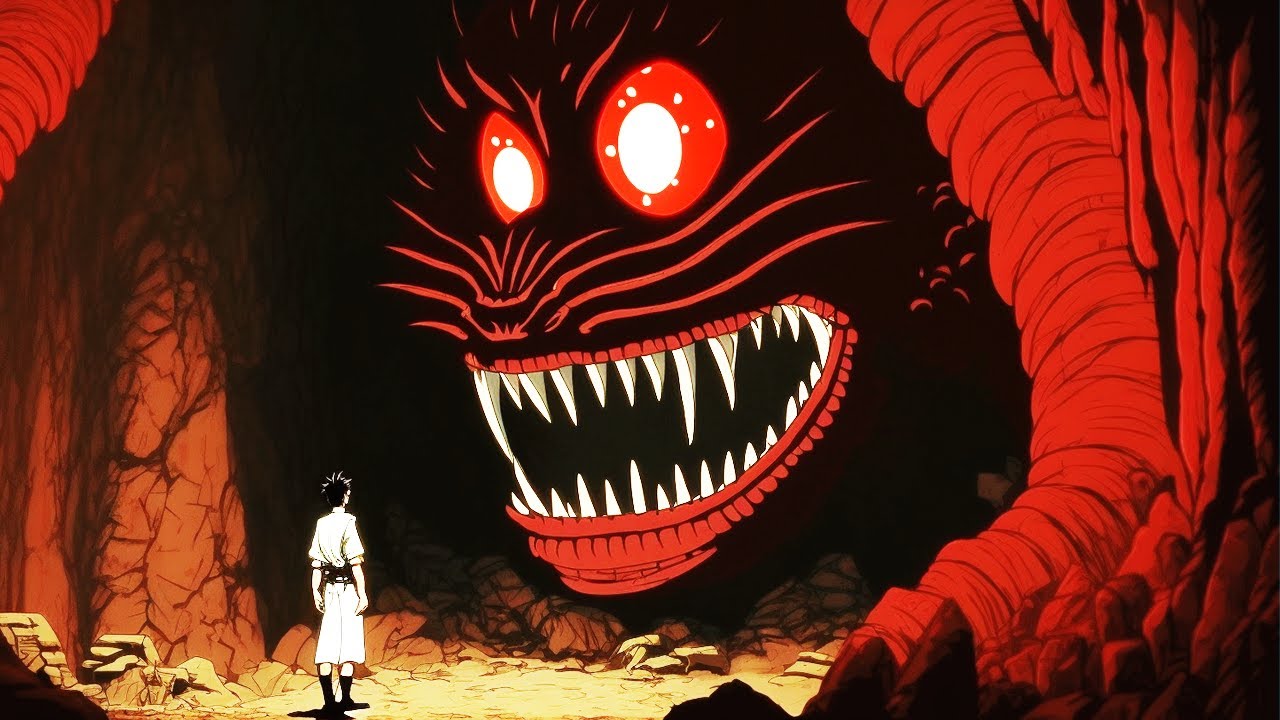
Human beings and their closest biological relative chimpanzees are innately afraid of and attracted to reptiles. They automatically trigger off responses in a part of the brain called the amygdala that's associated with anxiety And I think the evolutionary reason for this is that mammals and reptiles have been at war in a sense over ecological turf for something between 60 million and 200 million years Reptilian features, which are cold-blooded, piercing eyed, toothed lurking, nocturnal. Out there, out and unknown out where chaos is.
The snake is representative of the unknown in a sense and it's an ambivalent feature And you see that even it's use in mythology because for example the dragon in Western culture is a negative feature but in Chinese culture it's positive feature and so the unknown is like that, it's positive and negative The snake in the Garden of Eden is representative of all those things that lurk when you think you know what you're doing. And when you think you know what you're doing you've carved out this little Eden, this little paradise in which you operates. But there's always something that's lurking and that's all the things you're not paying attention to.
Well that's the snake and when that snake pops up people are. . .
We're wired. If a little snake pops out we might want to run away from it but, like, we're curious about that. We're going to go over there and investigate it right away Now, when chimps come across a Python in the forest they have a specific cry.
It's called a snake wrath. And the chimps, who don't like snakes, they don't run from it they back off. And then they watch the thing They cannot tear their eyes away from it And some of them will stand there and look at it for 10 minutes Other individuals will stand there for hours watching the snake The unknown is fascinating, we can't look away from it.
We have to encounter it even if it's terrifying. It's partly why you know, teenagers like horror movies. They're driven to look at the snake They're driven to interact with the snake In Genesis, of course, interacting with the snake means the end of paradise just like it does in life.
There are ideas that the serpent in the Garden of Eden was Satan and trying to destroy God's handiwork. People often look back in their lives and they say: Well, you know I got knocked out of my little paradise by, you know, this particular event. But looking back, it really made me grow up it really made me mature Whatever it is, that's the serpent in the Garden of Eden, it certainly plays that role.
It's a catalyst. Much of what's unknown is redemptive, much of what's unknown gives life savor. It provides the kind of excitement that justifies suffering.
The injunction behind religious thought, fundamentally, is that you should live your life in such a way that the suffering it has to contain because you're confined and vulnerable, is justified. 'Profane world' A profane world exists because paradise always falls apart And that's a catastrophe. That's the human catastrophe and maybe that's the original sin.
And profane life is characterized by suffering, intense suffering and that's a terrible thing I mean it's so terrible that the first two people to really inhabit the profane world, Cain and Abel. Cain is so disturbed by the nature of the world that he turns into a revengeful homicidal, resentful, fascist authoritarian. And the father of war Well that's how bad profane existence can be But if you keep going in the same direction you can get so conscious that the profane conditions of being are no longer tragic They're acceptable.
But you have to live well enough so that the suffering is worth it If you took advantage of every opportunity you had, if you crawl through every window that was open to you. If you lived as perfectly as you could your life would be justifiable on its own terms despite its suffering. And despite the tragedy in the world That's why Kierkegaard said that people are redeemed one by one and not in groups.
You know it's an individual project 'What's evil? ' I would say human beings are built to take tragedy but they're not built to take evil. The most unsettling thing isn't that a close relative dies of cancer, unsettling as that is.
The most unsettling thing is to be treated casually in a brutal manner for no other reason than the brutality itself That's what undermines your sense, your belief in human existence and in the value of human existence. That's what demoralizes and kills. Many social scientists in particular I would say, feel that the idea of evil is anachronistic The reason that evil is obliterated out of consciousness is because we don't have a theory to account for it We don´t have a framework within which it fits.
Our religious ideations certainly provides that kind of framework I also think that we dismiss evil because it's such a terrifying phenomena and whenever it crops up its head everybody runs around saying: Well who could have predicted this? Who could have predicted this? But all you have to do is look and you can predict it.
And the people who perpetrate it often say exactly what they're doing and why so the Columbine kids, for example they said something very much like: Well we've taken a close look at existence and it isn't worthy. It's not worthy because people are limited and vulnerable and there's way too much suffering and suffering, vulnerable things are kind of despicable and it would be better if they were just all wiped out plus I'm the guy to do it. And that's exactly, fundamentally, that's exactly what they claimed.
You might say Well, why would someone come to that conclusion? It's like: That's not a good answer. Everyone comes to that conclusion from time to time.
When they're disappointed or frustrated or when you know, their dreams have fallen apart or when someone near them suffers or. . .
They doubt the utility, not only of their own existence, but of existence itself If it's taken far enough. . .
Taken far enough that attitude engenders atrocity It's evil. And I think you can define it no problem, because people say well you can´t define evil. That's wrong Evil is the production of suffering for its own sake.