welcome friends in this class we are going to deal with the sketching of light we know the phenomenon of light the deflection and refraction I am going to explain how reflection and refraction completely different from scattering of light see here these particles in the atmosphere can be called as catalyst because the light rays when entered into the atmosphere then this particle scatter light and these particles can be called as catalyst and the phenomena of refraction can be called a scattering of light now see the definition when sunlight enters the Earth's atmosphere the earth atoms and
molecules of different gases present in the atmosphere reflect the light in all possible directions and this is called scattering of light let me explain more about scratching off light see here in the atmosphere you take a scatter when the instant ray incident on the particle then it will be scattered in all possible directions see here the particle is stationary it is not like that I am taking a particular instant for the illustration to be very effective in this molecule also moving as that of the other molecule in the atmosphere when sunlight enters into the atmosphere
then hits the molecule after that it will be scattered in all possible directions let me explain types of scattering depends on the initial and final energy of the light beam scattering can be classified into two categories one is elastic scattering and the other one is inelastic scattering when a beam of light enters with a constituent particle of the medium then it undergoes many kinds of scattering so we have to take into account the initial and final energy of the light beam now let us explain how elastic scattering takes place see here this is the model
of elastic scheduling you take a scatter plan initial energy even when a light ray of initial energy e1 interacts with this particle then if you calculate the final energy of the reflected ray then you can get a 1 equal to e2 elastic scattering is mathematically expressed as T 1 equal to e 2 that is the initial energy e1 equal to the final energy e2 this type of scattering can be called as elastic scattering but the reverse is the case in the inelastic scattering in the inelastic scattering if you calculate the energy e1 and energy e2
then it won't be the same there is some differences in the energy e1 and e2 in the case of inelastic scattering a reverse is the case that is this is the incident ray which possess the initial energy e1 and if you calculate the energy of the refracted ray it is e2 if you combine these two then a 1 not equal to e2 and this type of scattering can be called as inelastic scattering depends on the natural and size of the scheduler which results in different types of scattering they are called Rayleigh scattering mean scattering Dingle
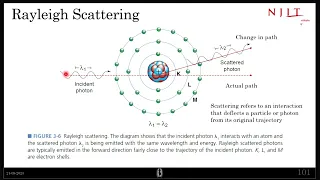
scattering undermanned stretching let us explain one by one with some illustrations and examples a ran is scattering when light rays incident on study room then it will be scattered in all possible directions this is same as the trough the definition of the scattering but Rayleigh scattering is expressed to be the mathematical expression and now let us define what Israel is startling see here Iran is scattering the starting of sunlight by the atoms of molecules of the gases in the Earth's atmosphere is known as perilous thirteen I'll read ants again the scattering of sunlight by the
atoms or molecules of the gases in the Earth's atmosphere is known as neural is getting under anesthetic can be explained with the help of a mathematical expression that is the amount of the scattering which is denoted as s is equal to 1 by lambda part 4 that is the amount of scattering of light is inversely proportional to the fourth power of its wavelength and this is the statement of Rayleigh scattering let me explain why sky appears as blue when sunlight passes through the atmosphere the blue color he started to a greater extent than the doctorate
color red color process longer wavelength but blue color possess shorter wavelength and the scattering causes the sky up you're in blue color I'll repeat once again when sunlight passes through the atmosphere only the blue color scattered to the great extent than the drop the red color and hence sky abuse in blue color this example will help you more to understand why sky appears in blue color you can say that the shorter wavelength colors are scattered much more than that of the longer wavelength colors blue color comes under shorter wavelength range and so scattered more than
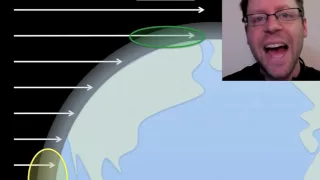
that of the other colors and hence the sky appears in blue color I'll explain why sun appears in red color during morning and evening at sunrise and sunset the light is from the Sun how to travel a larger distance in the atmosphere than at noon since most of the blue light or scattered away unleased scattered parrot is fast Dabu the color of the Sun is serrated sunrise and sunset and this station will be very helpful for him to understand mode during morning and evening the Sun dress from the Sun how to travel lawns a distance
in that pass beer but the tune it is not like that sunlight travels only sorta distance to reach the earth atmosphere so most of the blue light scattered away and one Li a red light reaches us therefore the Sun appears a rain during morning and evening next one is me scattering large particles in the atmosphere are able to scatter all wavelength of white light with us when our wavelength of white later started equally than me scattering is occurring mie scattering takes place when de diameter of the scatterer see here the diameter of the scattering is
similar to far larger than the wavelength of the incident light when the diameter that is d is equal to or greater than that of the wavelength of the instant light then Li scattering occur examples of me scattering white clouds appear white did you ever find the answer and I will explain you why it is happening and what are the reasons behind it when you compare atmospheric particles with that of the particles in the cloud then you can easily find that the particles in the cloud or larger than the atmospheric particles and we know some ladies
right that is combination of all colors when sunlight passes through the cloud the light rays scattered by water droplets almost equally or simply the scatter all colors equally and these again combine and produce white color but behind clouds we see blue color because the size of that mass Pyrrhic particles is smaller than that of the cloud particles and that's why the sky appears blue and the clouds appear white in color this is the important scattering Tyndall scattering we know that dust particles present in the atmosphere and also I will glue peaceful of this consider a
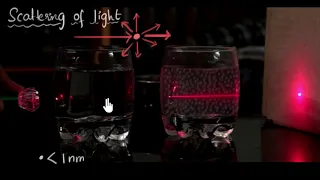
beam of sunlight can it enters into the dusty room through the window this is due to the phenomenon of scattering the dust particles present in that must be a scatter the beam of light and so they can easily observe the path of the length and this is Tyndall scattering or Tyndall effect you can expect the same phenomena in colloidal solution also you know colloid is a microscopically small substances that is equally disposed to throw out another material examples power milk ice cream smoke etc see here this is the true solution and the solution is mixture
of water and milk and when you pause a flashlight throw these two solutions then you cannot observe the path of the light in the true solution but it is visible in the case of the colloidal solution when you pause a beam of light then in this true solution you cannot observe the path rather in colloidal solution the path is visible this is due to the scattering of the colloidal particles with light and him's explains the Tyndall effect raman scattering is one of the important scattering effect raman one Nobel Prize in 1934 physics he discovered the
Raman effect besides discovering role and effect you studied extensively in x-ray diffraction acoustics optics dielectrics and colloidal solutions consider a beam of parallel monochromatic light here monochromatic means light of single wavelength less light is the best example for monochromatic light you take any medium which may be a gas or liquid or transparent solid when you cause monochromatic light beam then the light will be scattered by it was observed that the scattered light contains different frequencies or wavelength or simply we can say that the scattered light contains some additional frequencies other than the incident frequency and
this effect is termed as dormant effect or Raman scattering then what is Aaron align the spectral lines which are having same frequency as that of the incident tree are called as a rally Lane here you can see a Roman line suppose the scattered line contains frequencies other than the incident radiation then they are termed as a raman lines rally lines having the same frequency as the cup the incident radiation but Roman lines versus frequency other than the incident radiation so I an indicated the arrow mode with a blue color but if you look at Raman
line then the arrow marks are indicated with different colors that is yellow and orange and this indicates that they are having different frequencies other than the incident radiations now coming to Stokes lines and anti-stokes lines if you calculate the frequency then for Stokes lines then the frequency will be lower than that of the incident reconceive but if you calculate the frequency for anti-stokes lines then the frequency is higher when you compare with it of the incident radiation and so they are called as anti-stokes lines and Stokes lengths depends on the frequency or wavelength the lines
are categorized into two types bannister flanks and the other one is anti-stokes lines thank you for watching friends if you want to improve our promotion of more videos comment in the comment box and suggest us more and more to enlight the concepts in science thank you