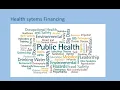
in this third lecture on Health Systems I'm going to talk about a very important function of a health system and that is how the health system is financed you'll remember from previous lectures that one of the primary objectives of a health system is to achieve Universal Health Coverage whereby all people receive the Quality Health Services they need without suffering financial hardship now Health fin ing is extremely important you'll notice in that definition there's a reference to not only people being covered by Health Services but them not being financially compromised when they access these services so
there is this aspect of Health financing built into universal health coverage and in recognizing this the World Health Report in 2010 produced by the World Health Organization specifically addresses this issue of Health Systems financing and if one looks at that definition of Universal Health Coverage you'll see it's fundamentally about Equity firstly that because it's Universal everybody should be covered nobody should be left behind secondly that the definition talks about health services being allocated according to need with some people needing more Health Services than others thirdly and this is the the financial aspect that Financial contributions
for paying for the health system are made according to one's ability to pay now if one combines those two elements you can see that the health financing is really about healthy wealthy people cross subsidizing the sick and the poor so what are the major challenges facing countries as they try and finance their health systems to achieve Universal coverage first of all that they clearly need to raise sufficient funds to finance the health system one needs a certain Quantum of financing and recent estimates suggest that around $887 per capita is required as an absolute basic minimum
to achieve Universal Health Coverage but secondly there's this vital element of risk protection Financial Risk protection so that people don't face Financial barriers which prevent them accessing the the health services that they need also that they don't suffer Financial ruin when accessing health services and the third major challenge is ensuring that one maximizes efficiency in the use of these resources and also making sure that resources are allocated equitably fairly now this whole issue of Health financing has been extremely contentious over the years and continues to be so across the world but the good news is
that there really does appear to be a consensus emerging now on how countries should Finance their health systems to achieve Universal Health Coverage the first point and very important ly is that market driven Health Systems which are privately financed never reach universal health coverage and this is a realization from countries across the world now instead there's a very high role for the state in organizing the way that the health financing system is organized particularly in forcing Healthy and Wealthy people to cross subsidize the sick and the poor this doesn't happen naturally in markets now achiev
this of course is inherently political because not surprisingly a lot of the healthy wealthy people don't necessarily want to cross subsidize the sick and the poor so this means that there is a very big role for the state in all the main functions of Health financing both in terms of raising revenues to pay for the health system in pooling of those revenues to create a big risk pool to buy services and in the allocation of those resources and the way that services are purchased now despite this big role for the state in in health financing
this doesn't necessarily mean there's no role for the private sector either in the administration Arrangements of of some of those financing Arrangements but also in the provision of services what we're talking about is public financing but when it comes to the provision of services this can be either done in the public or the private sector now other um areas where a consensus is emerging whether there's been tremendous controversy is in what are the best financing mechanisms to raise funds to finance the health sector the most obvious way to to finance a health sector is people
just paying for services as and when they need them through user fees but really this is a terrible way to finance a health system because it involves no pooling of resources and is grossly inequitable in that poor people are excluded from getting the care that they need and in fact the president of the World Bank has recently said that user fees are unjust and unnecessary now other people have been suggesting that maybe a way to finance through a health system would be through private voluntary insurance including community-based insurance which is a mechanism that's being piloted
in a number of developing countries but again the evidence shows that this isn't really a viable route to reach Universal Health Coverage because private insurance tends to be ineffective it of doesn't raise enough money it's inefficient it has extremely high Administration costs and it's also inequitable because it excludes the poor now what does that leave quite simply the best way to finance the health system is through public financing now here there are two major mechanisms firstly tax financing out of General revenues but then also through compulsory social health insurance contributions which in effect are a
tax on wages and you can see that the difference between the two is is is quite subtle and in fact what many countries are doing now is actually mixing those mechanisms of tax financing and social health insurance contributions but the key point is that they're compulsory and that they're publicly governed and another thing that countries are recognizing though is that where there are large informal sectors it's actually very difficult to get health insurance contributions from the informal sector and really if you want to cover the entire informal sector you've got to predominantly use tax financing
now as I mentioned this has been quite a controversial area over the years and there have been great disagreements about the roles of these different mechanisms but even people who 20 or 30 years ago were advocating a more privately financed health system and now recognizing that in fact public financing is better and in a recent lanet commission report called investing in health the authors of the 1993 World development report that we're advocating a more privately financed health system now acknowledge that public financing is best and in fact they a quote from one of the lead
authors saying that the path to Universal Health Coverage cannot work with Reliance on voluntary private insurance so there is this consensus now that public financing is best now given that how can countries increase their public financing and here there are a variety of uh methods that countries might look to do firstly to improve existing tax collection making sure people pay their taxes and clamp down on tax avoidance schemes but also of course introducing new taxes particularly in developing countries it's often difficult to tax people's income in which case it's a good idea to introduce new
taxes on things like alcohol and tobacco so-called syntaxes which actually these are products that adversely affect people's health so to tax them is a very good idea but also potentially taxing REM remittances sent from abroad or introducing a new value added tax like has been done in Ghana which is funding its national health insurance scheme largely out of this V8 Levy another way of course is for governments to reallocate funds within the budget from less productive and less useful areas for example in reducing military spending or maybe trying to reduce subsidies that don't make sense
either economically or for the environment for example in reducing fuel subsidies and the third major area where countries can free up more resources for the health sector is in in improving efficiency who estimates that that countries can realize efficiency gains in the order of 20 to 40% % and therefore get more health for the money that they have and here mechanisms can be reallocating money from specialist hospitals towards Primary Health Care Services and more costeffective Community Services um the area of medicines where there are tremendous savings to be made in switching from branded medicines to
generic medicines and improving procurement systems and reducing prices and also in adjusting the skill mix and for example in investing more in community health workers who are very effective at reaching people in remote areas now this is these are good mechanisms for for countries to follow but how might a country start off on this route towards financing its health system and a typical situation that countries find themselves in when they're starting this process is that the richest quintile of the population are covered maybe through social insurance schemes or they they they're so rich that they
don't mind paying user fees also governments often make an attempt to cover the absolute poorest Str of society maybe giving them a free health card but unfortunately these Services often tend to be very poorly financed and really not adequate for for people's needs but of course the major problem is that the majority of the population are still uncovered and this is clearly not good for their health status U but also politically it's not a good idea idea to leave these people in the cold now how do countries move away from this situation one approach is
to do it quite slowly and incrementally and from the top down maybe extends the health insurance schemes also from the bottom up one can perhaps be a bit more generous with these basic safety net uh schemes but unfortunately this process can take an awfully long time and leave a lot of people still uncovered and what a number of countries are finding for example in Indonesia and Vietnam and the Philippines is that about a third of the population remain uncovered now another approach is to move much more rapidly to basically cover the entire informal sector at
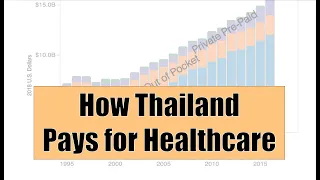
a stroke by injecting a large amount of tax financing into the system and not differentiating in the informal sector between the poor and nonpoor now this is a strategy that's been employed in many countries worldwide in the last 20 years particularly right across Latin America and in Sri Lanka and in turkey and one very good example which figures prominently in the world Health Report is in Thailand Thailand in 2002 had a situation where they hadn't reached full coverage and a large proportion of the informal sector were uncovered but on one particular day the government announced
they were going to introduce a universal coverage scheme and this at a stroke basically covered the rest of the informal sector and meant that everyone was now part of um the health insurance program this had the impact of increasing the utilization of services dramatically across the population and reducing unequal access it also had the impact of reducing out of pocket expenditure and medical impoverishment which went down 82% also satisfaction with this universals cover scheme increased from 83% when it started to over 90% now so you can see on all these measures of a health system
that we're tracking of utilization of services financial protection and satisfaction with the system this is a very sensible thing to do and it's this type of approach that other countries seem to be looking to as they move towards universal health coverage