Exiled Orc Was Crying, Sitting Alone in the Ruins — Until a Human Soldier Stopped Behind Her. There are places in this world where history died badly. Not peacefully in its sleep surrounded by loved ones.
But violently. Screaming. The kind of death that leaves stains that don't wash out even after centuries of rain.
The ruins of Ashenvale Bridge were one of those places. Once, this had been the most beautiful crossing in the borderlands — a masterwork of ancient engineering where orc stonework met human architecture in a rare moment of cooperation. Three hundred years ago, someone had decided that enemies could build something together.
Something that would outlast their hatred. They were wrong. The bridge had lasted exactly forty-seven years before the First Border War turned it into a graveyard.
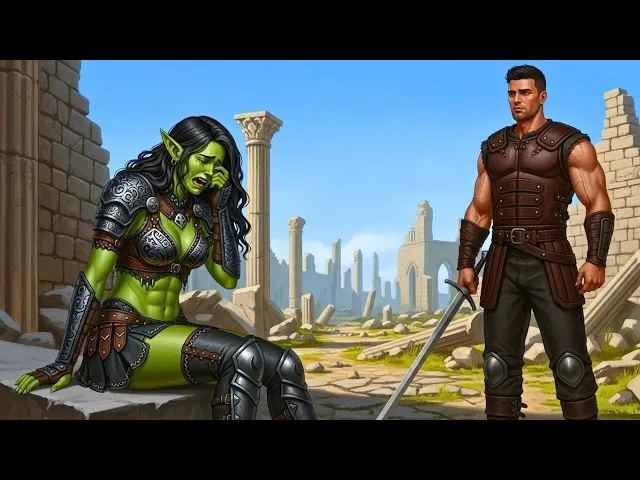
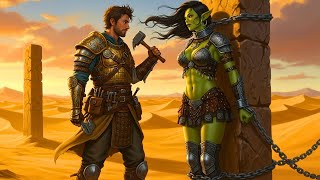
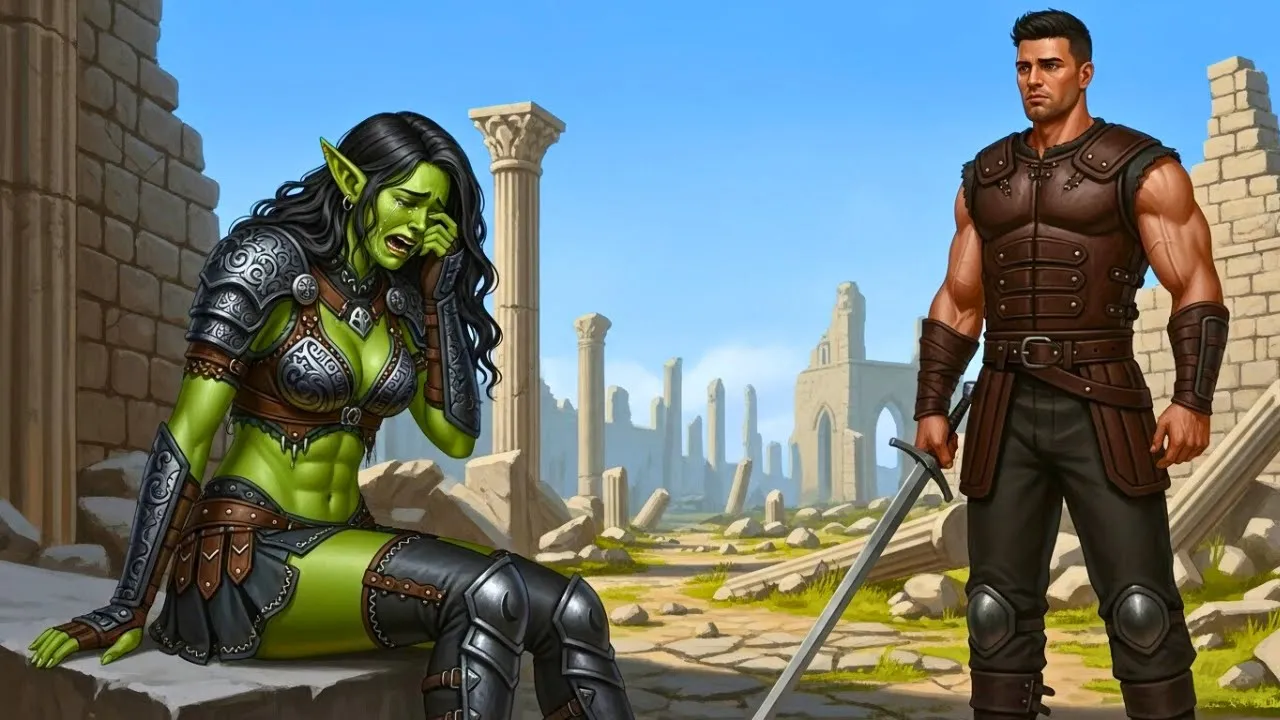
Now, all that remained were broken pillars reaching toward the sky like accusing fingers, half-collapsed arches that led nowhere, and stones that had seen so much blood they'd turned a permanent rust-brown that no amount of weathering could fade. This was where Shakka came to cry. Not because she enjoyed the irony of mourning her life in a place where thousands had mourned theirs.
But because no one else came here. Not orcs, who saw the ruins as a reminder of weakness — of the forty-seven years when their ancestors forgot that cooperation with humans always ended in betrayal. Not humans, who whispered that the souls of the fallen still walked these stones at night, looking for the enemies who'd killed them.
Perfect for someone who belonged to neither world anymore. Shakka sat on what had once been the bridge's central arch, now reduced to a platform of crumbled stone barely twenty feet above the dried riverbed below. Her back against a pillar that had somehow refused to fall despite having more cracks than solid stone.
Her legs dangling over the edge in a way that would have horrified her old combat instructors — never sit with your back exposed, never let your legs dangle where they could be grabbed, never, never, never put yourself in a position where you couldn't fight or flee in under two seconds. But that was the thing about being exiled. All those survival rules assumed you wanted to survive.
The broken warbraid sat in her lap. Fourteen inches of leather and hair and copper that used to be forty-two inches of pride. She'd counted.
Of course she'd counted. Just like she'd counted the three years, two months, and sixteen days since they'd cut it. Just like she'd counted the forty-seven steps from the main road to this exact spot.
Just like she'd counted the number of times she'd told herself this would be the last time she came here. Forty-nine times. Fifty, after today.
The crying started the way it always did — not with sound, but with the tightness in her chest that felt like someone was squeezing her lungs with both hands. The burning behind her eyes that she'd learned to ignore during the day but couldn't fight at night. The way her jaw clenched so hard her tusks dug into her lower lip until she tasted copper.
She'd gotten good at crying without making noise. Three years of practice would do that. You learned to cry the way prey animals learned to die quietly — because making noise only brought predators.
That's why she didn't hear him approach. Didn't hear the careful footsteps on stone. Didn't hear the slight scrape of leather armor against itself.
Didn't hear the almost imperceptible sound of someone trying very hard to move silently while carrying forty pounds of weapons and gear. What she did hear was the breathing. Human breathing.
Slower than orc breathing. Quieter. The kind of breathing you learned in military training — measured, controlled, designed to keep you steady when everything else was chaos.
Shakka went very still. The kind of still that combat veterans knew — the stillness before violence. Her hand moved to her hip, finding nothing.
No weapon. She'd stopped carrying weapons two years ago after realizing that having a blade only made you think about using it. On enemies.
On yourself. Better to have nothing. "I'm not armed," she said in Common, her voice rough from disuse and tears.
"If you're here to collect a bounty, you'll have to beat me to death with your hands. Might take a while. I'm tougher than I look.
" The breathing continued. Steady. Unchanging.
Not the breathing of someone preparing to attack. "I'm serious," Shakka continued, still not turning around. "There's probably a bounty.
Three-year-old bounty from the Bloodtusk Clan. Fifty gold for proof of death. They wanted to make sure I didn't come back.
Fifty gold is. . .
decent money. You could buy a horse. Good armor.
Maybe a week at a nice inn where they don't ask questions about the blood on your boots. " Silence. Then a voice.
Male. Human. With the kind of weariness that told you this person had stopped sleeping well a long time ago.
"The sword's not for you. " Shakka finally turned. He stood about twenty feet back, partially shadowed by one of the broken pillars.
Tall for a human — not quite her height, but close enough that the difference wouldn't matter in a fight. Dark hair going gray at the temples. Face that had been handsome once, before whatever had happened to put those lines around his eyes and mouth.
Leather armor that was well-maintained but old — the kind of old that came from being unable to afford new, not from sentimental attachment to vintage gear. The sword in his hand hung loose at his side. Not sheathed, but not raised either.
The position of someone who'd forgotten he was holding it. Their eyes met. There's a thing that happens sometimes when two broken people look at each other.
A recognition. Not of faces or names or even species. But of damage.
You see in someone else the same cracks you carry yourself, and for just a moment, the world gets very quiet and very small and very honest. "You were crying," he said. Not a question.
Not an accusation. Just. .
. a statement of fact delivered with the careful neutrality of someone who understood that sometimes stating the obvious was kinder than pretending not to notice. "I was," Shakka said.
"Your move. Are you going to pretend you didn't see it and walk away? Or are you going to do the human thing and ask me if I'm alright, knowing damn well I'm not, but asking anyway because that's what people do when they don't know what else to say?
" Something that might have been a smile flickered across his face. Might have been. Hard to tell in the fading light.
"Neither. I'm going to ask if you mind company. " Of all the things Shakka had expected — violence, pity, disgust, fear — this wasn't on the list.
This wasn't on any list. This was so far off the list that the list couldn't see it with a telescope. "You want to.
. . " She paused, trying to wrap her mind around the concept.
"Sit. With me. Here.
An orc. In the ruins. While I cry.
" "Yes. " "Why? " The human was quiet for a long moment.
Then he walked forward — slowly, carefully, telegraphing every movement the way you did with frightened animals or traumatized people. He sat down on the broken arch about six feet from her. Close enough to talk.
Far enough to run if necessary. He laid the sword beside him. Not sheathed, but out of hand.
A gesture. "Because," he said quietly, "I came here to do the same thing. And in three years of coming to these ruins, I've never seen anyone else.
Which means we're both either very unlucky or very smart. Either way. .
. " He looked out at the broken pillars. "Misery loves company.
And I'm tired of being alone with mine. " Shakka stared at him. At this human.
This enemy. This impossible, inexplicable person who'd just said the most honest thing anyone had said to her in three years. "You cry here too?
" "Every other week. Sometimes once a week if it's been bad. " "How long?
" "Three years, four months, eighteen days. " Shakka felt something crack in her chest. Not breaking.
Not exactly. More like. .
. shifting. Like ice starting to thaw after a long winter.
"Three years, two months, sixteen days," she said softly. He nodded. As if this made perfect sense.
As if the math of grief was something that could be measured in days and months and the weight of memories that wouldn't die. They sat in silence for a while. The sun was setting now, painting the ruins in shades of copper and gold that made the old bloodstains look almost beautiful.
Almost. "I'm Ellis," he said eventually. "Shakka.
" "Bloodtusk Clan? " Her hand tightened on the broken warbraid. "Was.
Now I'm. . .
nothing. No clan. No tribe.
No family. Just. .
. " She gestured vaguely at herself. "This.
Whatever this is. " Ellis reached into his armor, pulling out something small. A piece of metal that caught the dying light.
He held it out. An insignia. The kind captains wore.
The kind you earned through blood and loyalty and years of service. The kind you only removed when you were dead. Or when you'd removed it yourself.
The insignia was cut in half. Roughly. Violently.
The kind of cut you made with a combat knife when you were angry and heartbroken and done. "Captain of the Fifth Border Regiment," Ellis said quietly. "Was.
Now I'm. . .
nothing. No rank. No unit.
No purpose. Just. .
. " He mirrored her gesture. "This.
Whatever this is. " Shakka looked at the broken insignia. At the broken warbraid in her lap.
At the broken ruins around them. At this broken man sitting six feet away. "What did you do?
" she asked. "I obeyed orders I shouldn't have obeyed. Then I disobeyed orders I should have obeyed.
Then I ran. " His voice was flat. Empty.
The tone of someone who'd told this story to themselves so many times it had lost all meaning. "You? " "I broke the law of the Blood Hunt.
Refused to kill a human child who'd been captured during a raid. Eight years old. Skinny.
Crying for his mother. " Shakka's jaw tightened. "The Warchief said honor demanded blood.
I said honor demanded mercy. The clan disagreed. Violently.
" Ellis turned to look at her fully now. Really look. And in his eyes, Shakka saw something she hadn't seen in three years.
Understanding. Not pity. Not sympathy.
But the bone-deep understanding that comes from carrying the same weight. "They exiled you for saving a child. " "They exiled me for betraying what it means to be orc.
For choosing weakness over strength. For. .
. " She touched the broken warbraid. "For forgetting that humans are the enemy.
Always. Forever. No exceptions.
" "And what do you think now? " Shakka looked at him. At this human who'd sat down next to an orc.
Who'd shared his grief like it was something sacred. Who'd shown her his broken insignia like it was something precious. "I think," she said slowly, "that maybe the only thing I betrayed was their idea of what I should be.
And maybe. . .
maybe that's not betrayal at all. " Ellis nodded. Then he did something extraordinary.
He reached into his pack and pulled out a small waterskin and what looked like dried meat wrapped in cloth. "I brought food," he said. "Was planning to sit here and pretend to eat while actually just staring at nothing for a few hours.
But if you're hungry. . .
" Shakka couldn't remember the last time someone had offered her food. Really offered. Not thrown scraps.
Not left garbage where she could find it. But offered. Like a person to a person.
She took the waterskin. Took the dried meat. And when their hands brushed in the exchange, neither of them flinched.
They ate in silence as the sun died and the stars came out. Two exiles in the ruins of a place built by cooperation and destroyed by hate. Two broken people sharing bread in the shadows of a dead dream.
When Shakka spoke again, her voice was different. Lighter. Like maybe crying wasn't the only thing you could do in ruins.
"You know what's funny? I came here expecting to be alone. To cry by myself like I always do.
To maybe. . .
not leave. " She paused. "But now there's you.
And I'm thinking about next week. About whether you'll be here. About whether.
. . " She stopped, unable to finish.
Ellis smiled. A real smile this time. Small, but genuine.
"I'll be here. Every other week. Sometimes once a week if it's bad.
" "Same. " They sat together until full dark. When they finally left — Ellis heading east toward the human territories, Shakka heading west toward the borderlands where exiles lived in the spaces between worlds — they didn't say goodbye.
They said, "See you next week. " And for the first time in three years, two months, and sixteen days, Shakka walked away from the ruins feeling something that wasn't pain. It wasn't happiness.
Not quite. But it was the absence of complete hopelessness. And sometimes, that's enough to survive another week.
The weeks turned into months. And the months turned into something neither of them had expected. Trust.
Not the kind built in moments. Not the Hollywood version where one dramatic gesture erases years of conditioning and prejudice. But the slow kind.
The painful kind. The kind that grew like grass through concrete — persistent, stubborn, refusing to die even when everything said it should. Ellis told her about the orders.
About the village. About the women and children who'd been marked as "strategic casualties" because they'd been sheltering orc scouts. About how he'd watched his men burn houses while people screamed inside.
About how he'd told himself it was necessary. About how he'd stopped believing that somewhere around the seventeenth house. About how he'd finally broken when he'd seen a mother trying to shield her baby with her body, and he'd realized that the enemy looked an awful lot like the people he'd sworn to protect.
Shakka told him about the Blood Hunt. About orc tradition that said captured enemies must die to honor the warriors who'd captured them. About the eight-year-old boy who'd hidden in a supply wagon during a raid.
About how he'd cried so hard he'd vomited. About how she'd looked at him and seen not an enemy, but a terrified child who wanted his mother. About how she'd let him escape in the night.
About how the clan had discovered the truth. About how the Warchief himself had cut her warbraid with a ceremonial knife while the entire clan watched. About how Naksha — old, stubborn Naksha — had been the only voice to speak against the exile, and how she'd been silenced.
About how she'd walked into the wilderness with nothing but the clothes on her back and the broken piece of her warbraid that she'd picked up from the dirt. They traded stories like currency. Painful memories for painful memories.
Guilt for guilt. Shame for shame. Until the weight felt less like drowning and more like.
. . carrying something together.
On the seventh week, Ellis brought a worn book of poetry. Human poetry. He read aloud while Shakka listened, and she laughed — actually laughed — when he stumbled over the pretentious metaphors.
On the ninth week, Shakka taught him three words in Orcish. Strength. Honor.
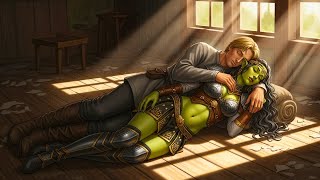
Home. He pronounced them badly, and she corrected him patiently, and when he finally got them right, she felt a strange warmth in her chest. On the twelfth week, they fell asleep sitting against the same pillar, and woke up at dawn to find that they'd somehow ended up leaning against each other.
They didn't mention it. But they didn't move apart quickly, either. On the fifteenth week, Ellis brought something different.
Not food or water or books. He brought a person. Shakka saw them coming from a distance and immediately stood, her body shifting into defensive posture even without weapons.
Old habits. But Ellis raised his hand — the universal gesture for wait, trust me, it's okay — and she forced herself to stay still. The person with Ellis was young.
Nineteen, maybe twenty. Human. Thin in the way young soldiers were thin before war put muscle on them or death took them entirely.
He walked like someone who'd learned to follow, and his hand never strayed far from the sword at his hip. "Shakka," Ellis said carefully, "this is Nolan. He was in my unit.
He's been. . .
struggling. I told him about this place. About.
. . " He paused.
"About you. " Nolan stared at Shakka with the kind of wide-eyed fear that she'd seen a thousand times. The look humans gave orcs.
The look that said monster. But underneath the fear was something else. Something desperate.
"You really let that kid go? " Nolan asked, his voice cracking slightly. "The one from the Blood Hunt?
" Shakka nodded slowly. "Why? " "Because he was eight years old and terrified and crying for his mother.
Because I'd been eight years old and terrified once. Because. .
. " She paused. "Because some things matter more than tradition.
More than honor. More than. .
. " She touched the broken warbraid at her belt. "More than belonging.
" Nolan's face crumpled. He made a sound that was half-sob, half-gasp. "I killed someone," he whispered.
"In the village. Ellis's village. The one we burned.
I killed. . .
she was defending her home. She had a kitchen knife. I had a sword.
She was forty, maybe fifty. And I. .
. " He couldn't continue. Ellis put a hand on the young man's shoulder.
Firm. Steady. "Nolan's been carrying that for three years," Ellis said quietly.
"Just like we've been carrying ours. I thought maybe. .
. maybe knowing he wasn't alone might help. " Shakka looked at this boy — because that's what he was, really, just a boy who'd been forced to do things that broke him — and felt something shift in her chest.
This was why Ellis had told him. Not to gather allies. Not to build an army.
But because misery might love company, but healing required it. "Sit," Shakka said, gesturing to the stones. "We don't have solutions here.
We don't have forgiveness. We don't even have answers. But we have.
. . " She looked at Ellis.
"We have each other. And sometimes that's enough. " Nolan sat.
They talked until dark. And when he left, he walked differently. Not fixed.
Not healed. But less alone. The next week, Ellis brought Vincent.
Forty-five years old. Hard as iron. Covered in scars that he counted out loud when he was nervous — a habit that would have been funny if it wasn't so sad.
Ex-commander. Now bounty hunter. Now something else.
"Forty-seven scars," he said, looking at Shakka with eyes that had seen too much. "Forty-seven fights. Forty-seven times I should've died.
And you know what the worst part is? I don't regret the fighting. I regret who I fought for.
" Shakka understood that. God, did she understand that. The week after that, Nolan brought someone.
A young woman from his village. Then Vincent brought a former soldier. Then that soldier brought her brother.
The ruins of Ashenvale Bridge, abandoned for three centuries, slowly filled with voices. Not an army. Not a resistance.
Just. . .
people. Humans and orcs who'd been broken by the same system that told them they were enemies. Who'd committed acts they couldn't forgive.
Who carried guilt that wouldn't die. They came to share their stories. To cry.
To rage. To sit in silence. To not be alone.
By the sixth month, there were twelve of them. By the ninth month, twenty-three. Not all orc and human — some were just orc.
Exiles like Shakka. Some were just human. Deserters like Ellis.
But all of them were people who'd chosen mercy over hate. And been destroyed for it. That's when Vincent asked the question that changed everything.
"What are we doing here? " They were sitting in a rough circle on the broken bridge, passing food and water like it was communion. The sun was setting, painting everything in copper and gold.
"What do you mean? " Ellis asked. "I mean.
. . we sit.
We talk. We share. That's good.
That's important. But. .
. " Vincent gestured at the group. At the orcs and humans sitting together in defiance of everything their worlds told them.
"We could be more than this. " "More how? " Shakka's voice was careful.
She knew where this could go. Revolution. Rebellion.
All the ways that good intentions turned into bloodbaths. "Not violence," Vincent said quickly, reading her tone. "I've had enough violence for three lifetimes.
But. . .
" He pulled out a map, spreading it on the stone. "Here. The borderlands.
Between your territory and ours. Unclaimed. Unwanted.
Empty. " "It's empty for a reason," one of the orcs said. "No resources.
Bad land. Nothing grows there. " "Nothing grows there now," Vincent corrected.
"But what if it did? What if. .
. what if we built something? Not an army.
Not a fort. But a. .
. " He struggled for words. "A home," Shakka said softly.
Everyone turned to look at her. She stood, walking to the edge of the broken bridge. Looking out at the ruins.
At this place built by cooperation and destroyed by hate. "They tried it once," she said. "This bridge.
Built together. And it failed. " "It lasted forty-seven years," Ellis said quietly.
"That's forty-seven years of people crossing. Trading. Talking.
Living. Maybe it failed in the end, but. .
. " He stood beside her. "Maybe that's forty-seven years longer than hate would have lasted.
" Shakka looked at him. At this human who'd become. .
. what? Friend felt insufficient.
Ally felt cold. Family felt impossible. "If we do this," she said slowly, "if we try to build something in the borderlands.
. . they'll come for us.
Both sides. Orc and human. They'll see it as betrayal.
They'll—" "They'll do exactly what they did to us already," Ellis finished. "Exile us. Hunt us.
Destroy us. Except now we'll be together. Now we'll have each other.
" Vincent stood too. Then Nolan. Then the others, one by one, until twenty-three people stood in a circle on the ruins of a dead dream.
"I vote we try," Vincent said. "Forty-eight scars. Might as well earn a few more for something worth fighting for.
" One by one, they voted. Not unanimous. Some were too afraid.
Some too broken. Some just wanted to keep coming to the ruins to cry, and that was okay too. But eighteen of them said yes.
Eighteen people who decided that maybe the answer to being destroyed by hate was to build something with love. The first three months were hell. The borderlands were called borderlands for a reason — too harsh for humans, too barren for orcs, too dangerous for anyone with sense.
The soil was rocky and mineral-poor. Water had to be carried from a stream three miles away. The wind blew constantly, carrying dust that got into everything.
But they worked. Ellis organized the humans, using military discipline to create structure without hierarchy. Shakka organized the orcs, using clan knowledge to build efficiently with limited resources.
Vincent scouted the perimeter, his forty-eight scars earning him a forty-ninth when he drove off a pack of dire wolves. They built shelters first. Then a well.
Then a storage pit. Then a communal fire pit where they gathered each night to share what little food they had and remember why they were doing this. Not everyone stayed.
Five left in the first month, unable to handle the hardship. Three more left when winter came and the cold bit through their inadequate shelters like knives. But ten more came.
Then seven more. Then three. Word was spreading.
In whispers. In rumors. About the place between worlds where exiles went.
Where orcs and humans worked side by side. Where the only law was don't be what destroyed you. By the end of the first year, there were thirty-two of them.
By the end of the second year, fifty-seven. And that's when the trouble came. Not as an army.
Not as a war. But as three riders on the horizon. Shakka saw them first.
She'd been reinforcing the well when she spotted the movement. Her blood went cold when she recognized the banners. Bloodtusk Clan.
She ran to find Ellis, who was helping repair a shelter roof. One look at her face told him everything he needed to know. "How many?
" "Three. Emissaries, probably. Not warriors.
" "Your clan? " "Yes. " Ellis climbed down from the roof, dusting off his hands.
"Then we meet them together. " They gathered the others. Not everyone — some were out foraging, some were too young to risk — but enough.
Twelve people, half orc and half human, standing in a line as the riders approached. The lead rider was female. Old.
Her tusks were yellowed with age, her skin crisscrossed with scars that told stories of a hundred battles. She wore the formal armor of a clan elder. Shakka's heart stopped.
Naksha. The old orc dismounted slowly, painfully. Arthritis, Shakka realized.
The years hadn't been kind. But Naksha's eyes were sharp as ever. They swept across the gathered group, taking in the mixed crowd, the crude buildings, the impossible collaboration.
Then she looked at Shakka. "Well," Naksha said in Orcish, her voice like gravel. "You've been busy.
" Shakka stepped forward, her hand instinctively touching the broken warbraid at her belt. "Elder Naksha. If you've come to demand I return for execution, you should know I won't go quietly.
" Naksha laughed. Actually laughed. A sound like stones grinding together.
"Child, I'm seventy-three years old. If I wanted you executed, I'd send warriors. Not myself and two younglings barely old enough to grow tusks.
" She gestured at the other two riders, who looked terrified. "No. I came to see if the rumors were true.
" "What rumors? " "That Shakka the Exiled had built a town in the borderlands. That she'd brought orcs and humans together.
That she'd accomplished in two years what the builders of Ashenvale Bridge took forty-seven years to achieve. " Naksha walked forward, ignoring the nervous shuffling of the humans. "I came to see if you'd actually done it.
If you'd built what I've been preaching for fifty years. " Shakka stared. "You.
. . what?
" "Did you think you were the first to question the Blood Hunt? The first to ask why we treat mercy like weakness? " Naksha gestured to the broken warbraid.
"I voted against your exile. Not just because I liked you. But because I saw in you the future of our people.
The future I'd tried to build and failed. " Ellis moved to stand beside Shakka. "You're saying you support what we're doing here?
" Naksha turned to him, her ancient eyes assessing. "You're the human. The captain who burned the village then deserted.
" "I am. " "Good. You should carry that.
Use it to be better. " She looked back at the settlement. At the mixed crowd.
At the impossible dream made real. "I don't support what you're doing. Support is passive.
I want to join it. " Silence. Complete, absolute silence.
Then one of the young orcs with Naksha spoke up, his voice shaking. "Elder, the clan will exile you too if you—" "The clan already failed to exile me once. They can try again if they like.
I'm old. I'm dying. And I'll be damned if I die still serving a system I stopped believing in fifty years ago.
" Naksha pulled something from her pack. A warbraid. Long.
Ancient. Copper and hair and leather woven together over decades. She cut it with her knife.
One swift movement. The sound of that cut echoed like thunder. Naksha let half the braid fall to the ground.
The other half she held up. "I'm done with them," she said simply. "If you'll have me, I'm yours.
" Shakka felt tears streaming down her face. She hadn't even realized she was crying. "We don't turn away exiles," she said.
"This is a place for people who chose better. " Naksha smiled. Then did something that made Shakka's heart stop.
She bowed. A clan elder. Bowing to an exile.
"Then let me stay. Let me help build what I failed to build before. Let me die doing something that matters.
" The settlement that had started with eighteen became fifty-nine. Then eighty-three. Then one hundred and forty-seven.
Word spread faster now. Not just whispers. But stories.
About the place between worlds. About Shakka the Exiled and Ellis the Deserter. About the town they'd built with broken people.
Some humans called it treason. Some orcs called it heresy. But more and more people called it home.
They named it Ashenvale Crossing. A deliberate echo of the bridge that failed. A reminder that failure was just the first attempt at success.
By the third year, they had crops. By the fourth, livestock. By the fifth, they had children — both orc and human, growing up together in ways their parents never could have imagined.
Not perfect. Never perfect. There were fights.
Disagreements. Moments when old prejudices surfaced and had to be fought down. Times when someone left because they couldn't handle the weight of being different.
But they kept building. And on every anniversary, Shakka and Ellis would walk back to the original ruins. To the broken bridge where they'd first met.
Where two broken people had shared bread and found something neither expected. Hope. On the seventh anniversary, they sat on the same stones.
Older now. Tired. But alive.
"Do you ever regret it? " Ellis asked. "Staying that night?
Not running when you had the chance? " Shakka looked at him. At this human who'd become her partner in building impossible things.
Her friend. Her. .
. "Every day," she said honestly. "I regret that it had to happen this way.
That we had to be broken before we could build. That we lost so much before we found this. " She touched the broken warbraid, now worn smooth from years of handling.
"But I don't regret you. I don't regret them. I don't regret choosing this.
" Ellis nodded. "Same. " They sat in comfortable silence, watching the sun set over ruins that meant something different now.
Not just a reminder of failure, but a foundation for trying again. "You know what's funny? " Shakka said eventually.
"When I came here seven years ago, I came to die. I thought I'd lost everything. That I had nothing left worth living for.
" "And now? " "Now I come here to remember how to live. " Ellis smiled.
That same small, genuine smile from years ago. "Same. " They sat together until dark.
Then they walked back to Ashenvale Crossing, where a hundred and forty-seven people waited. Where buildings stood that shouldn't exist. Where orcs and humans shared meals and stories and the messy work of building something better.
As they walked, Shakka noticed something. Ellis was limping slightly — an old war wound acting up. Without thinking, she slowed her pace to match his.
Without thinking, he reached out when she stumbled on a rock. Without thinking, they'd become people who caught each other when they fell. That night, as the settlement gathered around the communal fire, someone asked Naksha to tell a story.
The old orc was dying — everyone could see it — but she still had stories left. "Once," Naksha began, her voice carrying across the firelight, "there was a bridge built by enemies who decided to be builders instead. It stood for forty-seven years before hate destroyed it.
But what the history books don't tell you is this: in those forty-seven years, seven hundred and thirty-two children crossed that bridge safely to school. Four thousand, eight hundred and ninety-three people crossed it to visit loved ones. Twenty-one couples met on that bridge and fell in love.
The bridge failed. But for forty-seven years, it succeeded. And success is counted not in years, but in lives touched.
" She looked around at the gathered crowd. At orcs and humans sitting together. At children of both species playing in the firelight.
"We are building a new bridge," Naksha said. "Not of stone this time. But of people.
And it will fail too, someday. Everything does. But while it stands.
. . " She smiled.
"Count the lives. That's how you measure if something mattered. " Naksha died three weeks later.
They buried her in the borderlands, with her broken warbraid and a stone marker that read: "She chose better. " At her funeral, forty-seven people spoke. Orc and human.
Young and old. Each sharing how she'd changed them. When it was Shakka's turn, she stood before the grave and said simply: "You were exiled for standing with me.
And in the end, you built more by leaving than you ever could have built by staying. Thank you for showing me that broken things can still be weapons. But better ones.
" The settlement continued. Years passed. Shakka and Ellis grew old together — not romantically, but in the way two people grow old when they've built something that matters more than themselves.
Their hair went gray. Their bodies slowed. But their hands stayed steady.
On Shakka's sixtieth birthday, the settlement held a celebration. Two hundred and thirty-seven people now. Three generations.
Children who'd never known a world where orcs and humans were enemies. That night, Ellis found Shakka sitting alone on the edge of the settlement, looking out at the borderlands. "Hiding from your own party?
" he asked, sitting beside her with a groan. His knees didn't work like they used to. "Thinking," Shakka said.
"About the kid. " "Which kid? " "The one from the Blood Hunt.
The eight-year-old. The one who started all this. " She touched the broken warbraid, now little more than a worn strip of leather.
"I wonder what happened to him. If he's alive. If he remembers the orc who let him go.
" "Does it matter? " "I don't know. I saved one life.
One. And it cost me everything. My clan.
My identity. My. .
. " She gestured vaguely. "Everything I thought I was.
" Ellis was quiet for a long moment. Then he pointed at the settlement. At the lights.
At the sounds of laughter and music drifting on the wind. "You saved one life. That one life didn't start a war.
Didn't demand vengeance. Went home. Maybe told people that not all orcs are monsters.
Maybe that changed one person's mind. Maybe that one person changed another's. And maybe, just maybe, one of those people ended up here because they'd heard a story about an orc who showed mercy.
" He looked at her. "You saved one life. But you changed hundreds.
That's not a bad trade. " Shakka felt the tears come. She didn't fight them anymore.
Hadn't fought them in years. "I miss my clan," she admitted. "I miss knowing who I was.
I miss the simplicity of enemies and allies and clear lines. I miss. .
. " She couldn't finish. "I know," Ellis said softly.
"I miss my rank. My purpose. The certainty of orders.
But. . .
" He gestured at the settlement. "I look at this, and I think maybe certainty is overrated. Maybe the best things are built in doubt.
By people who aren't sure they're right, but choose love anyway. " They sat in comfortable silence until Shakka spoke again. "When I die, I want to be buried next to Naksha.
With my broken warbraid. And a marker that says. .
. " She paused. "I'm not sure what it should say.
" "How about: 'She chose people over pride. And built a home from exile. '" Shakka smiled through her tears.
"That's perfect. " Ellis pulled out his broken insignia — still carried after all these years. "When I die, bury this with me.
And let the marker say: 'He learned that desertion can be devotion. And that cowards who choose love are braver than heroes who choose hate. '" "Deal.
" They shook on it. Two old people making promises about their deaths while surrounded by the evidence of their lives. That night, Shakka returned to the party.
She danced — badly, because orcs weren't built for dancing and age made everything worse. She laughed. She held the children and told them stories.
And when she finally fell asleep, it was with the broken warbraid clutched in one hand and a smile on her face. Not because everything was perfect. But because imperfect was enough.
Years later, when historians would write about Ashenvale Crossing, they'd argue about the details. About whether it was rebellion or revolution. About whether it succeeded or failed.
About whether it mattered in the grand sweep of history. But the people who lived there — the ones who built it with broken pieces of themselves — they didn't care about history's judgment. They cared that for one beautiful moment, two species who'd been taught to hate had chosen to build instead.
They cared that children grew up knowing kindness before prejudice. They cared that every person who came broken left a little more whole. And they cared that in the ruins of a bridge built by cooperation and destroyed by hate, two people had sat down together and decided that maybe — just maybe — the third time would be the charm.
The bridge failed once. The settlement would fail too, eventually. Everything did.
But while it stood, seven hundred and thirty-two children crossed it safely. Four thousand, eight hundred and ninety-three people crossed it to visit loved ones. And two broken people became the foundation for something that shouldn't have been possible.
That's how you measure if something mattered. Not in the years it lasted. But in the lives it touched.
Sometimes the bravest thing you can do is sit down with your enemy and realize they're just as broken as you are. Sometimes exile isn't the end of your story — it's the beginning of a better one. Sometimes choosing mercy over hate costs you everything.
And sometimes. . .
that's exactly the price worth paying. Because in the end, blood makes you orc. Fear makes you human.
But love? Love makes you family. If this story moved you, if you felt the weight of Shakka and Ellis's journey, I need you to do something for me.
Hit that subscribe button for ORCBOUND TALES — because this is where broken warriors find redemption, where impossible bonds are forged, and where every story reminds you that choosing love over hate is the bravest battle you'll ever fight. Then leave a comment telling me what hit you hardest. Was it Shakka's exile?
Ellis sitting down beside her? The moment Naksha cut her own warbraid? I read every single one, and your words fuel the next story.
You made it to the end. That means something. That means you're part of this community.
Welcome to ORCBOUND TALES.