welcome to Farmer drama the channel where we look at the science of healthcare and Healthcare products in this video series we are going to look at differential scanning calorimetry or DSC differential scanning color entry is one of the most commonly used analytical techniques in the pharmaceutical industry in my opinion second only to hplc principally that's because hplc is used to separate compounds for chemical identification and quantification while DSC shows any phase transitions that a material might undergo as a function of temperature phase transitions include melting crystallization glass transitions water loss and so on in particular
the presence of melting or a glass transition shows whether a material is crystalline or amorphous respectively which is very important to know and while I know the X-ray diffraction is the gold standard technique for determining crystalline structure and always will be DSC allows determination of both melting point and Heat suffusion these values allow ideal solubility to be calculated and the relative stabilities of polymorphic forms to be determined and this information is crucial in selecting which physical form of a drug is developed because DSC studies solid samples it can also be used to evaluate things like
drug excipient compatibility and so it has a wide range of application across pharmaceutical development that means you really should know a bit about DSC if you want to get into the pharmaceutical field and if you become an expert in DSC you'll be in demand in this series of videos I'm going to look at DSC in some detail what it is is operating principles how you can design DSE experiments to get the most information on your sample and how to interpret the SC data I'm going to focus on pharmaceutical materials since that's my area of expertise
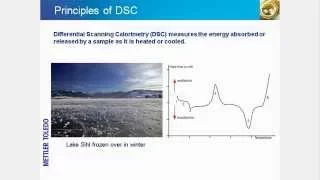
but the principles apply to all sectors so if that sounds good to you get yourself a drink I am of course in the lab and so drinks a band but you can have one and let's make a start [Music] let's start our discussion on DSC with the most fundamental question what does a DSC actually do simply put a DSC measures the amount of power needed to change the temperature of a sample relative to inert reference at a constant rate in other words we take a sample usually a white powder in the pharmaceutical world and a
reference using an empty pan and we ask the DSC please heat these two things between these two temperatures at a constant rate and tell me how much more or less power the sample needs than the reference for completeness I shall note that we can also call samples down and that is all there is to DSC but why is DSC such a widely used technique that's because by asking questions about how much more or less power the sample needs to be heated up we are getting thermodynamic information and as you may know thermodynamics governs everything since
almost all processes occur with a change in heat content and fear not I'm going to explain the difference between power and heat later in the series we can observe almost any change that a sample undergoes and that my friends is extremely important so that's what DSC is what about the how like most analytical techniques although it's easy to say what a DSC does there's a lot to learn to actually understand it and that's what this video series is for and before we get into the details if you think this is a useful series please hit
the like button as that helps the videos reach a wider audience and if you haven't done so already please consider subscribing as it really helps the channel right have you ever used a differential scanning calorimeter I always ask that when I start a lecture on DSC sometimes people have but more often than not they haven't if you haven't don't worry that's what this series is for let me ask you another question have you ever used one of these to cook one of these if you have then really you have done something similar to what a
DSC does the egg contains a lot of protein lecithin which at low temperatures is in its native form as a liquid as it is heated up the Lesser thin undergoes a phase transition and denatures turning to a white semi-solid in the process in other words in cooking an egg you have taken a material in one form and heated it up causing a temperature-induced change in phase in the case of an egg the denaturation is irreversible so even if called back to room temperature you won't get the clear liquid back again now if you had chosen
to measure exactly how much power the hob was applying to the pan and you'd compare that with an empty frying pan on another hob you would actually have made a basic DSC measurement of course a real DSC is slightly more sophisticated in how it works you'll be pleasing though all dscs have heaters that are used to raise the temperature of a sample material and an inert reference for some reason the heaters are called furnaces even though they are relatively small I think of furnaces as being huge but that's what the convention is so we'll stick
with that if the DSC has one furnace that heats both the sample and reference it is referred to as a heat conduction DSC and if the DSC has two furnaces one for the sample and one for the reference it is referred to as a power compensation DSC for now don't worry about this difference we will look at these designs in detail in part two of this series the sample and reference materials are encapsulated in pans hands come in different sizes and can be made of different materials depending on the temperature to which you will heat
them in the pharmaceutical world we typically use pans made of aluminum aluminum is light and conducts heat very well so it's an ideal material for use in a calorimeter it does however melt at 660 degrees Centigrade so I would suggest not using aluminum pans if you are heating to temperatures higher than that much better to use platinum or ceramic pans instead sample masses are quite small typically 5 to 20 milligrams and pans may have a lid or be left open whether you use a lid or not is absolutely quite important but we'll look at that
in more detail in part six of this series unless you're making detailed measurements on heat capacity the reference material can be an empty pan to make a measurement then we tell the instrument to heat our sample and reference materials from an initial temperature typically room temperature but it can be any value to a final temperature at a particular rate usually but not always the heating rate is constant say 10 degrees per minute it's important to choose the heating weight carefully so that you interpret the results properly and the heating rate doesn't have to be linear
it can be modulated by some mathematical function or it can be altered in response to what the sample is doing but again we will look at these effects in a later video once the instrument knows the initial and final temperatures and the rate it needs to get there it has all the basic information needed to start an experiment other information such as the sample Mass can be added but that is not needed to perform a basic experiment assuming the sample is being heated and it can also be called as I'll come back to in a
moment the instrument will apply power to the sample and reference through the furnaces and the temperatures of both will start to rise the instrument measures the temperatures of the sampling reference it has thermocouples under the pans and adjusts the power being supplied to each to raise them in temperature at the defined rate the data produced by the instrument is then the difference in power supplied to the sampling reference as a function of temperature it is also possible to cool a sample in a DSC again at a linear heating rate although it's harder for an instrument
to cool a sample than heat it heating is simply a matter of applying energy from the furnaces and to heat faster all that is needed is more energy cooling is more tricky as that requires energy to be removed the best an instrument can usually do is to turn off the power to the furnaces and let the sample and reference materials cool down naturally to achieve rapid cooling most instruments have a chiller unit a bit like those used in fridges and freezers set to a cold temperature such as minus 90 degrees Centigrade which would enable fast
cooling some may use liquid nitrogen cooling liquid nitrogen is at minus 196 degrees Centigrade which enables the fastest rate of cooling in any case the Chile unit keeps the instrument cold and the furnaces work against it and it's a good idea to use a chitter unit when running a DSC measurement we'll look at Cooling in more detail in part 5 of the series if you've chosen a sample that does absolutely nothing while being heated then the data will be very boring and look like a flat line on the other hand if the sample does something
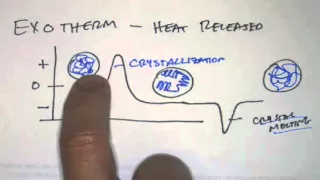
typically it will undergo some sort of phase transition then we will see a peak much more interesting assuming our sample is a nice crystalline solid then the most likely phase transition it will undergo is melting and we will see some data that look like this don't worry for now why the data look like this I will explain that in detail in part two for now I simply want to show you what information we can get from the plot the first thing we can determine is the temperature which the phase transition occurs we can report this
as either the first deviation from Baseline called an onset temperature or as a peak maximum called a peak temperature it doesn't matter which you use as long as you define what you are doing although I would note that when a sample undergoes multiple phase transitions it can be quite difficult to determine onset temperatures if they are close together and so overlapping the second thing we can determine is the area under the peak if we are careful with our units this will tell us the total amount of heat absorbed or released during the transition why must
we be careful with units we'll look at that in the next video for now trust me that the area under the curve can give us the heat change of a transition and if we added our sample Mass when we set up the experiment we can determine the heat change in units of joules per gram or kilojoules per mole DSC can measure both exothermic heat given out by the sample and endothermic heat absorbed by the sample phase transitioned finally the position of the Baseline tells us something about the heat capacity of our sample heat capacity you
may remember is the amount of energy required to raise a material in temperature it affects the position of the Baseline because the y-axis values are the difference in power needed to change the temperature of the sample and reference materials and the higher the heat capacity of one of those the greater the difference in power supplied I'll look at that in more detail in the next video for now remember that in DSC the temperature of solid materials is changed and any phase changes they undergo are shown as exothermic or endothermic Peaks we can determine onset or
Peak maximum temperatures for each phase transition and the area under the curve gives us the heat change the position of the Baseline is related to the heat capacity and that is that for this introductory video in the next video we will look at the difference between heat flux and power compensation instruments and how the data are measured but in the meantime thank you so much for watching and I'll see you again in a bit