The US wants to launch one of the biggest investment portfolios in the world. A sovereign wealth fund to rival Norway, Saudi Arabia, and China. But there's just one problem.
It doesn't have the money. No trade surplus, no oil windfall, no nationalized industries to pull from. So, how do you build a trillionoll war chest from nothing?
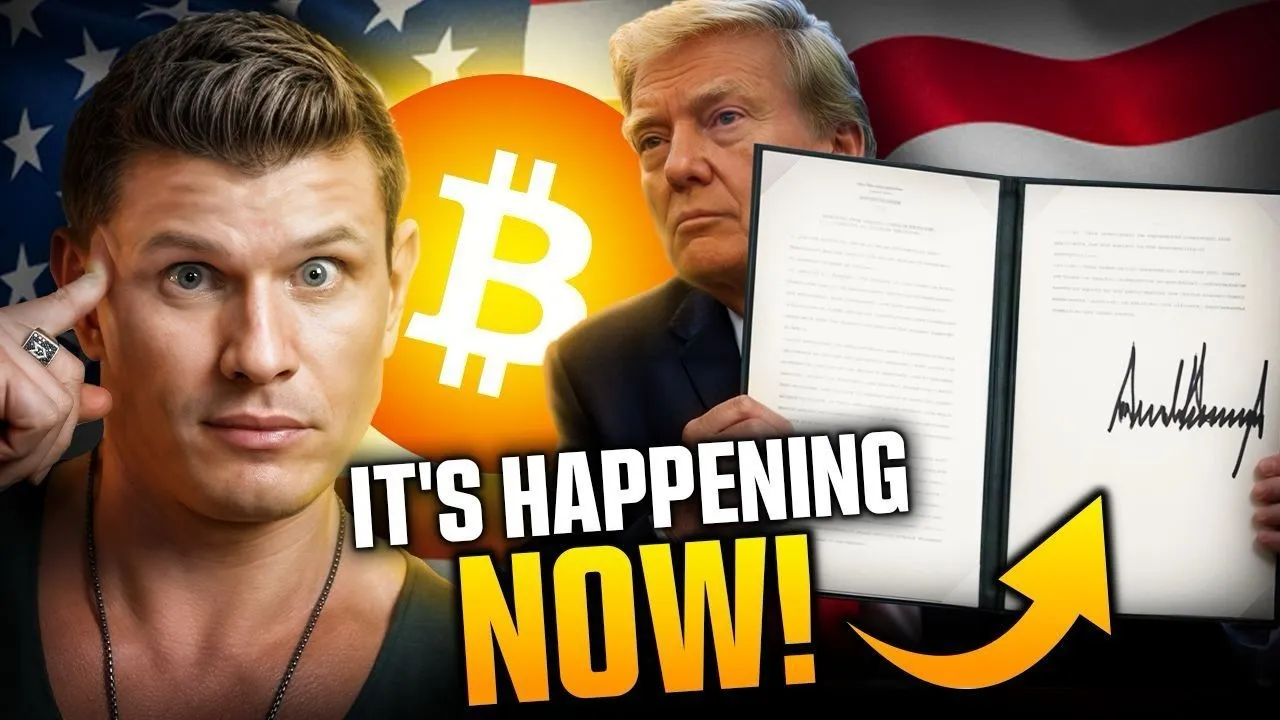
Well, you got to flip the script. Trump's already signed executive order. His team says they'll revalue gold, monetize federal land, and maybe even weaponize Bitcoin.
Yeah, you guys heard that right. Bitcoin, the asset built to fight government control, might now become part of America's financial arsenal. And if that happens, we're not just talking upside.
We're talking nationstate level FOMO. a constant bid and the beginning of a Bitcoinbacked future led by the US. In this video, guys, we'll break down what a sovereign wealth fund actually is, how the US plans to build one without a surplus, and what that could mean for markets, power, and the next era of Bitcoin.
So, without further ado, ladies and gentlemen, let's get into it. A sovereign wealth fund, commonly called an SWF, is a government-owned investment portfolio, usually funded by a surplus revenue from things like oil exports, trade surpluses, or asset sales. Countries use these funds to grow wealth over time, smooth out economic shocks, or invest in strategic industries.
But the important part is that these funds are normally built when a country has more money than it needs in the short term. The idea of sovereign wealth funds took off in the 1950s when Kuwait, flushed with oil profits, launched the Kuwait Investment Authority. It now manages over $1 trillion.
It was designed to save for future generations and still collect a slice of state revenue each year. By the early 2000s, the concept went global. Between 2000 and 2015, over 50 countries created sovereign wealth funds, not just to manage surplus, but sometimes just for show.
One study said the post208 boom in sovereign wealth funds looked more like a political trend than financial necessity. Today, sovereign wealth funds manage over $13 trillion globally, nearly 10% of the world's GDP. And while they fall under the same label, they're very different in how they run and why they exist.
Let's look at a couple of examples of how different countries have approached sovereign wealth funds. Let's start with Norway. Their government pension fund Global is one of the biggest in the world, managing over $1.
8 trillion. It owns about 1. 5% of the global stock market and helps fund 20% of Norway's national budget every year.
The fund invests only outside of the country and follows strict ethical guidelines when choosing assets. Then you got China's investment corporation or the CIC. This one started with the foreign exchange reserves and grew into a $1.
3 trillion powerhouse. The CIC plays a very strategic role funding key infrastructure for China's Belt and Road Initiative and making early investments in major tech firms like Alibaba. So we can see how a sovereign wealth fund when used effectively can add real value to a country.
In Nor's case, it helped fund a significant share of the national budget. In China, it's a tool for executing long-term strategic goals. Whether that's infrastructure, tech, or global influence, different playbooks, but the same core idea, turning national capital into national power.
But here's the common thread. They all start with money. And that's where the US story begins to stand out.
Sovereign wealth funds are usually built on surplus, but the US it's deep in the red. No surplus. The national debt is over 34.
6 trillion, and the government has run budget deficits every single year since 2001. So, how exactly would America fund a trillion dollar investment vehicle? Let's break down three main options Trump's team has hinted at.
Each one with its own trade-offs. Option one, raise revenue either through new tariffs or higher taxes. Trump has floated the idea of using tariffs as a funding source.
On the surface, that might sound strategic, but in practice, tariffs are just another form of taxation. The costs are usually passed directly to US consumers and businesses in the form of higher prices. And if that doesn't bring enough revenue, the only other path would be increase taxes, which goes directly against the administration's promise to reduce the burden of American families and small businesses.
Trump wants to cut taxes. So this option risk being politically, well, let's just say unpopular and economically regressive. Option two, borrowing money by issuing sovereign wealth bonds.
Another option would be to borrow the money either through regular treasury issuance or a new class of government debt specifically tied to the fund, sometimes called mega bonds. But here's the problem. Interest rates aren't low anymore.
The yield on 10-year treasuries is hovering between 4. 3 and 4. 7%.
Which means any money the US borrows to invest would carry real interest costs. That's a leverage position. taking on debt to gamble on market returns.
If the fund performs poorly, taxpayers could eat the loss. Even if the fund hits Norway levels of returns, 6% annually. The margin above current borrowing costs, it's thin, and that's a lot of risk.
There's not much room for error. And finally, option three is to monetize federal assets. That means selling, leasing, or even revaluing them.
This is the option Trump's Treasury team has been signaling the most. Monetizing the balance sheet. As Secretary Scott Bassant put it, they plan to monetize the asset side of the balance sheet for the American people.
The federal government holds about 5. 6 trillion in assets with nearly 1 trillion tied up in buildings and land. They also own 8,133 metric tons of gold officially valued at a whopping $42 an ounce.
Even though market prices are around $3400 right now, if gold were revalued to market rates, it could unlock nearly $900 billion in paper value without raising taxes or issuing new debt. That higher valuation would show up on the US federal balance sheet instantly, increasing its asset side. And with more assets comes more financial flexibility.
The Fed could issue gold certificates, internal creditbacked by the new gold value, giving the Treasury access to cash without selling a single ounce. In effect, it means the government could borrow more, issue new instruments, and fund strategic programs simply by revaluing what it already owns. But that would require congressional approval and risk being inflationary, much like a backdoor version of quantitative easing.
Beyond gold, other ideas include leasing public lands, auctioning off federal property, or selling portions of federal loan portfolios. But each of these open doors to legal, logistical, and political hurdles. In theory, all three funding paths could be mixed and matched, but in practice, none of them are actually easy.
There's no oil windfall, no trade surplus, no nationalized industry to pull from. Not yet, at least. just a balance sheet stretched very thin and a bold attempt to convert political will into financial firepower.
Because while other countries built their funds from strength, the US may be trying to build one out of necessity. If the US is serious about building this fund without raising taxes or issuing new debt, then monetizing public assets may be the most probable option left. President Trump's team has floated various strategies, including leasing out federal land and even acquiring Tik Tok to include it in the sovereign wealth fund.
This may sound like a whim, but Tik Tok is one of the most influential platforms in the US and the world. In fact, with over 150 million American users, about 50% of the population, owned by the Chinese company Bite Dance, its influence extends far beyond entertainment. In recent weeks, there's been a wave of videos from Chinese suppliers showcasing how easily they could reproduce US brands, sometimes at 90% lower prices.
It's not just social media anymore. Tik Tok is evolving into a communications tool that's starting to matter more than traditional media, shaping what people see, think, and buy. Its inclusion in the Sovereign Wealth Fund wouldn't just be a financial decision.
It would carry real geopolitical weight. And that's the point. This fund isn't just about managing money.
It's about being positioned as a tool of economic power meant to compete with the largest players on the world stage. President Trump has expressed ambitions for the fund to surpass even Saudi Arabia's $925 billion public investment fund. That kind of scale signals more than just ambition.
It's a push for strategic leverage, recognition, and long-term positioning. We've seen that China uses its sovereign wealth funds to finance infrastructure, technology, and expand its influence across Eurasia, Latin America, and Africa through initiatives like the Belt and Row Initiative. Norway's government pension fund globally passively owns around 1.
5% of the global stock market, quietly shaping the global economy through sheer scale. Now the US wants in the action. Globally the fund signals power but at home it offers something much needed.
A shift in narrative. Midterm elections are approaching and this kind of strategy doesn't deliver results overnight. But politically, it changes the conversation away from tax, debt, and spending cuts and toward national strength, ownership, and reinvesting in America's future.
This move goes beyond managing capital. It's a way to project a new image of what America is, where it's heading, and how it competes on the global stage. If this fund is meant to reshape America's financial footprint, and judging by how things are unfolding, it raises a timely question.
Could Bitcoin be part of the plan? While crypto isn't mentioned outright in Trump's executive order, some of the key players behind the sovereign wealth fund have long-standing ties to digital assets. Two names stand out a lot, and we talk about them here on the channel quite a bit.
You're probably familiar Scott Basent and Howard Letic both of whom appear strongly aligned with crypto. Basent is Trump's Treasury Secretary and one of the sharpest strategists in the administration. He previously ran George Doros's family office, managing one of the most powerful and well-connected funds on the planet.
Then there's Lutnik, Trump's commerce secretary and CEO of Caner Fitzgerald. His firm is a primary custodian of Tether's US Treasury Reserve. He's also a vocal supporter of Bitcoin, revealing that Cantor holds hundreds and hundreds of millions in Bitcoin.
I I can't say it cuz then people can figure out that how much I have. I I would say I have hundreds of millions of dollars. Okay.
Okay. Hundreds and hundreds of millions of dollars uh exposure to Bitcoin. With that kind of team behind the wheel, Bitcoin could find its way into the conversation, especially when you consider what other sovereign wealth funds are doing.
Bhutan, for example, their sovereign wealth fund holds over 13,000 Bitcoin. Mine through hydro power. How insane is that?
Now worth over $760 million. Norway's fund has indirect Bitcoin exposure, roughly $356 million, through equity stakes in companies like Coinbase and Micro Strategy. And the UAE's Mubarada has directly invested nearly $437 million into Bitcoin ETFs, giving it explicit exposure to the asset class.
Here's what makes the US position so unique. Every major sovereign wealth fund starts with a surplus. Oil in Saudi, trade in China, fiscal discipline in Norway.
That's not the US story. Instead, it holds something else. a dominant role in the global digital asset system led by Bitcoin.
US companies built the infrastructure. Coinbase, Fidelity, Micro Strategy, Black Rockck, and all the others. Circle, Kraken.
Pat myself on the back. I invested in a lot of those. US courts and regulators clarified Bitcoin's legal status as a commodity.
US institutions pushed adoption. In its decision, the court reaffirmed that both Bitcoin and Ether are commodities under the Commodity Exchange Act, making ETFs available to retirement accounts across the country. In other words, Bitcoin might be the closest thing the US has to modern surplus, not of oil or trade, but of influence, infrastructure, and belief in the protocol.
By anchoring part of its sovereign wealth fund in Bitcoin, the US could turn that influence into a new form of financial leadership grounded not in commodities but in code. So while there's no official mention yet, the possibility is absolutely on the table. And even if Bitcoin doesn't find a place in the sovereign wealth fund, it's going to.
Let's not forget the strategic Bitcoin reserve is already in motion. And not to mention everything else that we talk about on this channel. If you're not, guys, ladies and gents subscribe and watch the channel and follow along because this is the most insane thing happening right now with Bitcoin and digital assets.
And before we wrap up, let's be clear about one thing very important. People often mix up terms like strategic Bitcoin reserve, the sovereign wealth fund, and the strategic crypto stockpile, but they're completely different strategies with different goals. First up, the strategic Bitcoin reserve.
Trump signed the executive order back in March making it official. The idea is to treat Bitcoin like a digital gold, something solid to lean on during inflation or geopolitical chaos. The US already holds almost 200,000 Bitcoin, mostly from past criminal cases.
But the plan now is to expand that reserve. Bo Hines, who leads Trump's crypto advisory council, says the goal is simple. Are you ready?
Listen to this. buy as much Bitcoin as possible. This is directly from his mouth.
Senator Cynthia Lumis wants to go even further with a proposal to acquire 1 million Bitcoin over 5 years and never sell. That's 5% of the total supply, even more considering a lot of the supply has been lost forever. Clearly, this is the strongest Bitcoin strategy the US has ever pursued.
Then there's a sovereign wealth fund, a government-run investment vehicle designed to grow wealth over time. It's built to hold all kinds of assets, stocks, bonds, real estate, and even private equity. But Bitcoin definitely likely will make its way there.
But the goal is financial growth, not monetary resilience. And finally, the strategic crypto stockpile. This one's more about defense than dollars.
Holding emergency reserves with things like oil, medicine, or rare earth minerals. Bitcoin, it doesn't really fit there. It's not consumable or physical.
So, it doesn't check the boxes for this kind of reserve. In the big picture, three very different strategies, but only one already has Bitcoin at its core, the strategic reserve. and whether or not it shows up in the sovereign wealth fund, one thing is absolutely clear.
Bitcoin is already part of the US financial playbook. So, where does all of this leave us? The United States is attempting something bold.
to create a sovereign wealth fund in the middle of massive debt, rising global political tensions, and a rapidly shifting financial system. Most countries built their funds on surplus, oil profits, trade windfalls, decades of discipline. The US, by contrast, is trying to build one out of strategic necessity, turning federal assets into financial engine.
A move that, if successful, could help reshape America's economic footprint for decades to come. It's not just about making money. It's about the message, power, control.
And while the focus for now is on revaluing gold reserves, rethinking federal real estate, even buying companies like Tik Tok, with key figures in the administration aligned with crypto, it's fair to ask if the sovereign wealth fund could become the next frontier for Bitcoin. And we're not saying that it will kind of are, but but we're not we're not. But we've seen the playbook before.
First they ignore it, then they regulate it, and eventually they adopt it on their own terms. The idea of a sovereign wealth fund isn't new. But the way the US is going about it, well, that's something entirely different.
Whether this marks the beginning of a new era in US economic strategy or just another political headline, there's one thing that we can say for sure. This is a story worth watching.