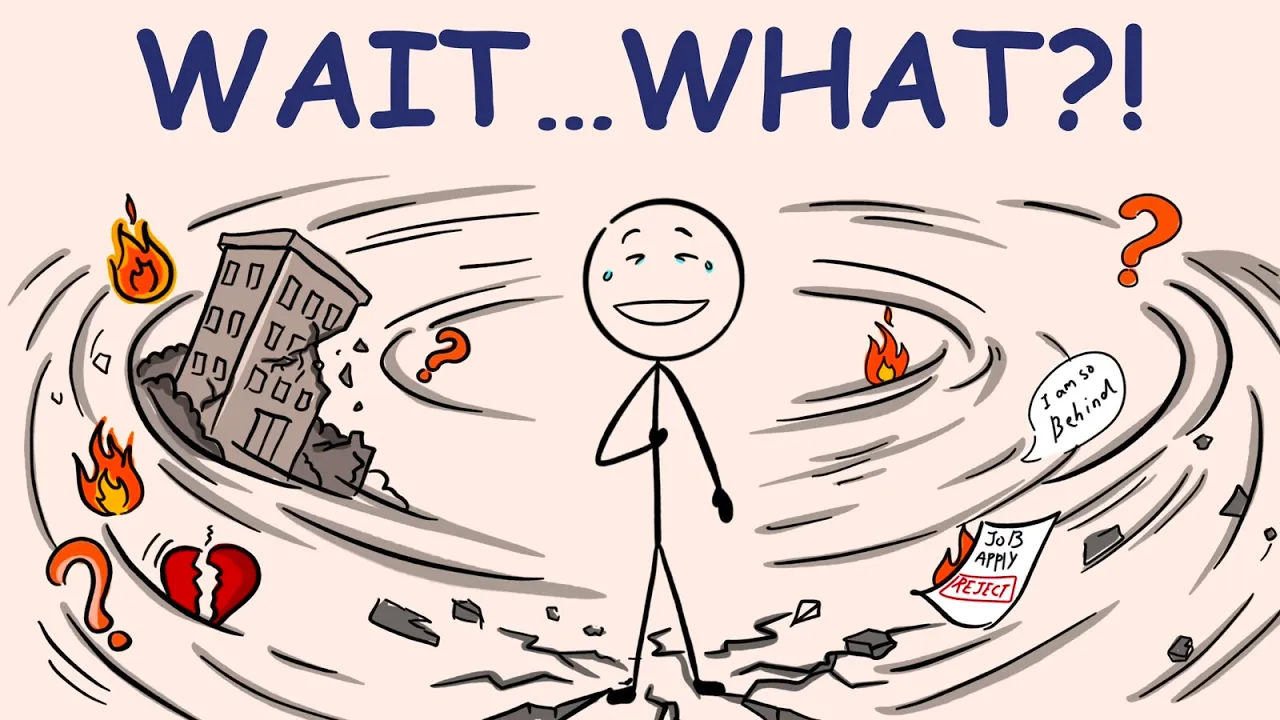
You've already watched yourself fail, in detail. You've seen the rejection email. You've heard the awkward silence after you tell people it didn't work out.
You've watched your savings drain, felt the embarrassment at the family dinner, imagined the one person who doubted you saying, "Well, I did tell you. " Your brain produced that entire film, casting, dialogue, lighting. A full documentary about a disaster that has never happened.
And you watched it, probably more than once, and you called it being realistic. But the one time you pictured it actually working, you caught yourself smiling and immediately shut it down. Okay, calm down.
Don't be delusional. That's the scam I want to talk about today. Because pessimism is also a prediction.
It's also a fantasy about a future that hasn't happened. It just feels smarter because it hurts in advance. So, today we're putting hope on trial, fairly for once.
I'll show you the difference between belief that builds things and fantasy that builds nothing. And I'll show you how to know when to keep going and when to change course. Because those are not the same question.
Let's start with an uncomfortable fact. You're already delusional. Just in the wrong direction.
Chapter 1. You are already delusional, just in the wrong direction. Nobody thinks of themselves as delusional, especially not the pessimists.
Pessimists think they're scientists. But look at what your brain actually does. It predicts poverty it can't prove, rejection that hasn't happened, laughter nobody has laughed yet.
It writes detailed disaster scripts with zero evidence. And you nod along like it's the news. Your brain is an unpaid screenwriter, and every draft is a tragedy.
And the wildest part? It has no sources. None.
It's just [bell] confident. Why does it do this? Because expecting the worst feels safe.
If you predict failure and fail, hey, at least you were right. There's your consolation prize. Being correct about your own defeat.
Congratulations. Negative predictions also create the illusion of preparation. I'm not scared.
I'm just thinking it through. No. Thinking it through produces a plan.
You've watched the same catastrophe 11 times. That's not analysis. That's a rerun.
And be honest about the real function. If failure's guaranteed, you don't have to start. The prediction isn't protecting you from disappointment.
It's excusing you from effort. Now, real preparation, backup plans, honest risk assessment, that's useful. Adults do that.
But treating the worst-case scenario as a confirmed booking, that's not realism. You don't need to stop imagining the future. You need to notice which future you keep rehearsing.
Chapter two. Why hope feels embarrassing. Here's a strange thing humans do.
We're ashamed of wanting things. Listen to how people talk about their own dreams. It's just a little side thing.
I'm not taking it that seriously. I'll probably bomb, whatever. Meanwhile, this person has watched 17 tutorials, bought the equipment, and quietly rearranged their entire room around this thing they don't really care about.
Sure. That's why there's a ring light in your kitchen. Why do we do this?
Insurance. If you announce you don't care and it fails, you're covered. Never wanted it anyway.
And if it works, you get to act pleasantly surprised. Like success just wandered in uninvited. The premium on that insurance policy is brutal, though.
You pay for it with your full commitment. You can't give 100% to something you're publicly pretending is a joke. Half your energy goes into the work, and the other half goes into managing how it looks.
And society doesn't help. Confidence after results is called vision. Confidence before results is called arrogance.
The exact same belief gets mocked on Tuesday and celebrated in 5 years. Everyone loves the dreamer retroactively. But here's the cost nobody calculates.
Every time you shrink the dream out loud, some part of you is listening. Say it's nothing enough times and you'll start treating it like nothing. Chapter 3, the difference between belief and fantasy.
Now, let me be clear about something because this is where motivational content usually starts lying to you. Belief alone will not save you. The universe is not a delivery app.
You cannot visualize a better life hard enough that it shows up at your door with a tracking number. Anyone selling you that is selling you a very comfortable chair and you'll still be sitting in it in 5 years. Fantasy says, "I deserve it because I want it.
I don't need a plan. Everyone who criticizes me is jealous. The details will sort themselves out.
" Useful belief says something different. It says, "This might be possible. I'm willing to work.
I'll look at the evidence even when it's insulting. I'll change my approach when it's not working. I can fail without becoming a failure.
" Notice the difference. Fantasy ignores reality. Belief negotiates with it.
Visualization? Fine. It has its place.
Athletes use it. It can calm you down, sharpen your focus. But a map is not a road trip.
You can love the map. You can laminate the map. The car still hasn't moved.
Here's the sentence I want you to keep. Belief is not pretending obstacles don't exist. It's refusing to treat them as the final answer.
The fantasy version of you already has the trophy. The believing version of you just has the next step and takes it. That's the whole difference.
One of them is busy. Chapter 4. Sometimes you look delusional because you're early.
Now we get to the part that I really need you to hear. Every meaningful thing looks pathetic at the beginning. Every single one.
A new business is a person alone at a laptop at 11:00 p. m. answering emails nobody sent.
A future athlete is someone getting winded on basic drills. A future creator is a video with 12 views and four of them are their mom checking if it's still there. Someone learning a language sounds like a confused toddler for a year.
Someone rebuilding their life still looks lost from across the street. From the outside, early effort and total delusion look identical. Identical.
That's the cruel joke. The only witness to the difference is you. Let me tell you about someone I knew.
He decided to learn design in his 30s. No background, no degree, working a warehouse job. Every night after his shift, he'd practice for an hour, sometimes two.
For months his work was genuinely bad. He knew it was bad. His brother found the tutorials on his laptop once and said, "You're a bit old for a career change, no?
" He kept going anyway. He applied for small freelance gigs and got ignored. Not rejected, ignored, which is somehow worse.
Around month eight, he almost quit. Told himself the brother was right. Took 2 weeks off.
Then he went back. Mostly because stopping felt worse than being bad at it. Somewhere in the second year, a small company paid him actual money for actual work.
Not a fortune, but real. Today, it's his job. Nothing about it was fast.
Nothing about it was cinematic. For over a year, believing in himself was technically irrational. The evidence said no.
The evidence just hadn't arrived yet. Now, honesty, because I promised you that. Being early doesn't guarantee arriving.
Some people are early to a place that never opens. You can believe and still have the wrong strategy. The goal was never certainty.
Certainty isn't available. The goal is giving possibility enough time and effort to produce an actual answer. But understand this.
When people call you unrealistic, they're often just reviewing the current chapter. They can't see the ones you haven't written yet. Chapter 5.
Your first job is to create evidence. So, how do you believe in yourself when there's no proof yet? Here's the trick.
You don't need full belief. You've been asking yourself for too much. Confidence isn't something you find before acting.
It's something you collect by acting. It's evidence. And evidence comes in small, boring denominations.
One kept promise to yourself. One finished small thing. One rejection survived.
You notice you're still alive afterward, which is useful information. One uncomfortable email actually sent. You don't need enough belief for the whole dream.
You need enough for the next 48 hours. That's it. That's the entire ask.
So, here's how it works in practice. Take the goal you keep dismissing. Now, shrink it.
Not the dream, the step. What's the version of it you could complete by tomorrow night? Not build a business.
Send one message. Not get in shape. One workout.
Mediocre is fine. Do that step before you discuss the dream with anyone. Write down what actually happened.
Not what you feared, what happened. Then pick the next step based on that. That's it.
That's the machine. Evidence in, belief out, repeat. And please, I'm begging you.
stop building the 5-year master plan before you've answered the email that's been sitting open for 6 days. I've seen people design the logo, the brand colors, and the acceptance speech for a business whose first customer they're afraid to call. The dream has a font.
It doesn't have a single completed task. Don't wait for evidence that you can succeed. Start creating evidence that you can continue.
Chapter 6, people will doubt you for reasonable reasons. Now, about the doubters. Motivational videos love this part.
They're all jealous, cut them off, haters everywhere. No, let's be adults. Sometimes people doubt you because they've watched you quit four things in 3 years.
That's not hate, that's memory. Sometimes your plan genuinely has a hole in it, and the person pointing at the hole is doing you a favor. Sometimes your mother isn't trying to kill your dream.
She's scared because she loves you and the risk is real. And sometimes, yes, someone launches a plan with no numbers behind it. And when a friend gently asks how the bills get paid, they diagnose the friend with negative energy.
The bills, unfortunately, do not respond to energy. So, here's how you handle doubt without surrendering to it. When someone questions you, run their words through a filter.
Are they naming a real risk or just a feeling? Do they have any experience with this? Have they built, tried, failed at anything relevant?
Are they attacking the destination or the strategy? Because those are different conversations. And are they trying to protect you, control you, or understand you?
You can usually feel which one. Then, and this is the part that takes spine, use what's useful and keep moving. Criticism is data.
It is not destiny. You're allowed to hear someone completely, adjust the plan because of them, and still not hand them the steering wheel. Two failure modes, equally deadly.
Quitting every time someone frowns and calling everyone a hater because they asked a fair question. Chapter seven. Know when to pivot without betraying yourself.
Okay, hardest question in this whole video. When do you keep going and when do you change course? Because never give up is terrible advice when the method is broken.
Persistence doesn't mean repeating the same failed approach until retirement. That's not determination. That's a loop.
Here's what almost nobody tells you. You can change almost everything about the plan without abandoning the goal. The timeline, the strategy, the format, the environment, the teacher.
Someone who wanted meaningful work can switch careers and still be chasing the same deeper thing. Someone who wanted to create can change mediums. Someone chasing health can throw out the unsustainable routine and keep the mission.
The destination survives. The route is negotiable. It was always negotiable.
So, how do you know the method needs to change? Watch for these. You're not learning anything anymore.
The same mistake keeps happening on repeat. Everyone gives you the same feedback and you keep filing it under they don't get it. The cost is turning destructive.
Money you can't lose, health you can't spare. Or this one, and it stings. You love the identity of the dream, but avoid the daily work of it.
You want to be the person who did it, not the person doing it. And how do you know you're quitting too early? Also simple.
You've barely tried. You're reacting to one rejection like it's a court ruling. You're comparing your month two to someone else's year nine.
You're embarrassed by being a beginner, which, by the way, everyone was. Or the process is uncomfortable, but you're still learning. Discomfort plus learning isn't a stop sign.
That's literally what growth feels like. Change the method when reality demands it. Don't abandon the possibility just because progress is slower than your ego expected.
Chapter 8. What if it actually works out? Now, come here for a second.
I want to ask you something and I want you to actually consider it instead of deflecting. You've imagined the rejection, the awkward conversation, the wasted years. You've given those fantasies hours of your life.
Free rent, full hospitality. Fear walks into your mind without knocking and you make it dinner. So, just once, as an experiment, let the other possibility in the room.
What if you get good because you finally let yourself be bad first? What if the rejection redirects you somewhere better than the plan? What if the work slowly, quietly finds its people?
What if the skill you're embarrassed about right now pays for your life in 6 years? What if this one decision changes what your kids think is possible before they even exist? What if you fail at the original target and still come out stronger, sharper, surrounded by better people, running a better life than the one you were about to settle for?
That last one is real, by the way. Some of the best outcomes come from pursuits that failed. The dream missed.
The person it built didn't. And here's what genuinely gets me. You demand nothing from fear.
No proof, no credentials, nothing. It predicts your failure with zero evidence and you treat it like a documentary. But hope, hope has to submit paperwork.
Hope needs references. Fear gets free housing in your mind. And hope is outside asking for a chair.
Neither of them knows the future. Neither. So, why does only one of them get believed?
I'm not promising you it works out. I can't. Nobody can.
That's the honest deal. But failure isn't promised either. Maybe you're not foolish for believing.
Maybe you're just standing at the exact spot where the evidence hasn't arrived yet. The challenge. So, here's what happens next.
Not someday. Now. Name the thing.
The one you keep calling unrealistic. The one you filed away with a joke. You know which one.
You thought of it 40 seconds ago. Within the next 24 hours, take one action that creates information. Send the application.
Publish the ugly first version. Practice for 30 minutes. Ask the person with real experience the question you've been rehearsing.
Reopen the project you buried too early. One action, not a life overhaul. One piece of evidence that you're someone who continues.
So, the title. Maybe you are delusional. But, understand what's actually happening here.
The people doubting you are making a prediction. You're making a prediction. They're predicting you can't.
You're predicting you might. And neither side has seen the future. Neither side has evidence.
It's two guesses staring at each other. The difference is what each guess does to you. Their prediction gives you a reason to stop.
Yours gives you a reason to work. That's the entire choice. Not truth versus fantasy.
Direction versus surrender. So, stop treating failure like confirmed information. Stop demanding certainty before you'll move.
Stop apologizing for wanting something real. And stop hiding it behind jokes so nobody can grade you on it. Believe enough to act.
Act enough to learn. Learn enough to adjust. And stay long enough to find out what was actually true.
Because maybe you're not delusional. Maybe you're just early. And the proof is still on its way.
Tell me in the comments. What's the thing you're finally willing to try? I read them.
And if this gave you something, the like and subscribe take 2 seconds. Then go take the first step.