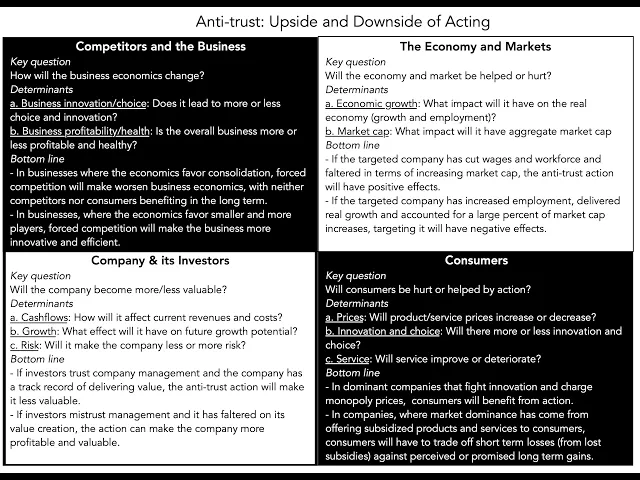
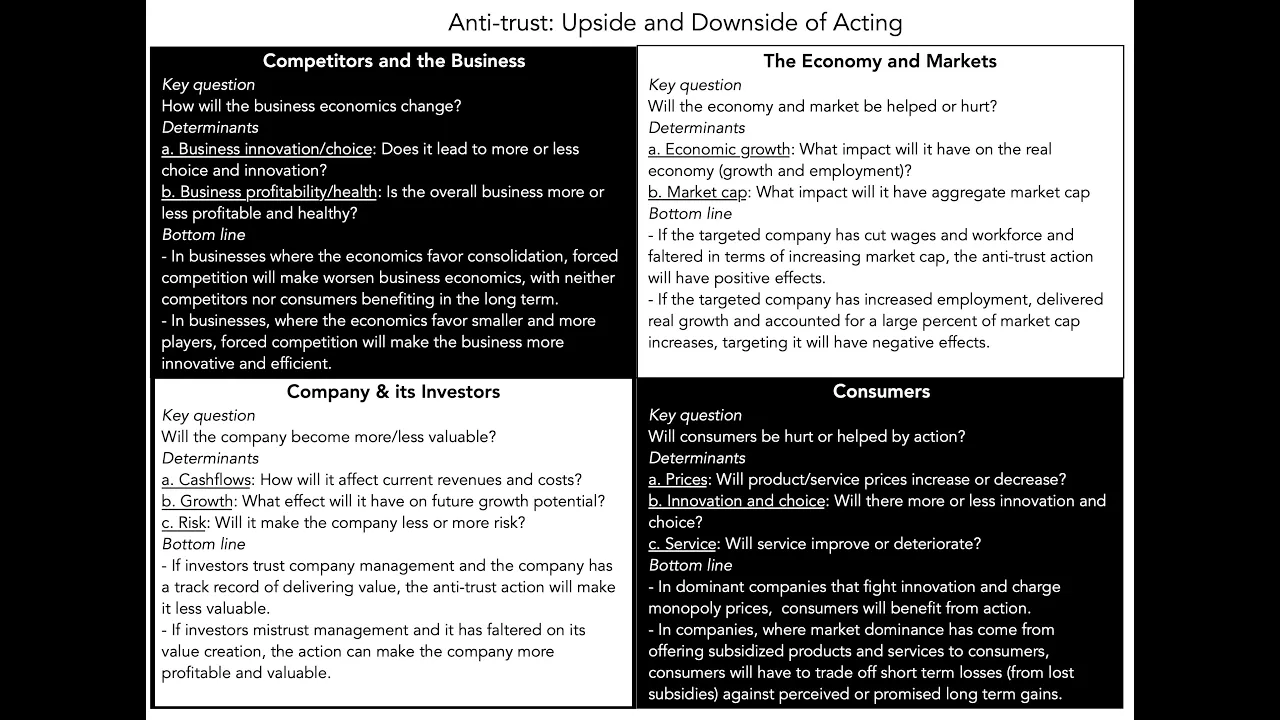
hi welcome if I asked you what you thought about big Tech my assumption is that you would say you don't like it it's too big it's taken over our lives and it needs to be brought down a notch that is the question I want to talk about today because that is very much on the table right now because a few weeks ago you know if you've read the news story The Justice Department in the US said that they were considering considering a breakup of alphabet with the that they make the company share its data with its comparators now this might all be negotiating that these are just threats to get the company to make concessions but that breakup threat's been on the table now for a while and it's not just alphabet that's been in the targeted it's been Microsoft and Amazon and apple and meta and what they share in common is they've been incredibly successful fairly or unfairly the answers that people have range the Spectrum politicians economists lawyers and I want to in this session look at bigte through the perspective of antitrust is it something we should be targeting with antitrust law and what are the remedies if we believe that these companies have violated that law now before I get started I have to make a couple of admissions one is I'm not a lawyer I don't want to be a lawyer and the second is I'm not a traditional Economist so I don't do the the big you know on the one hand on the other hand what I hope to bring to this process is understanding of business and hopefully how I think this will play out in finance and business now to understand antitrust law we have to go back to the beginning and that goes back to the late 1800s the US was making this transition from being an Emerging Market to one of the global large Global economies and it was doing it in three with three Industries leading the way steel oil and railroads and in each of these industries there was a person at the top a robber baron and they earned that title now who is trying to essentially take over the business in oil it was John de Rockefeller with standard oil now in steel it was Andrew Carnegie with Carnegie steel that he built up and eventually sold to JP Morgan who took it public as us Steel in the railroads it was different tycoons in different parts of the country Cornelius vandel J gold Leland Stanford all playing starring roles usually as villains now these were not nice men so let me be very clear they effectively wanted to control their businesses and they used the structure of trust to do it a trust was just a collection of companies in the same business but the companies got together and set production and prices to monopolize the business now if you build a monopoly a monopoly behaves like a monopoly and these monopolies did they um they crushed their competition they abused labor they exploited labor and they took advantage of consumers and eventually the backlash built up and in the US the backlash showed up in two forms one was a an act the Sherman Act that was passed in 1890 precisely to stop trust to stop them from monopolizing it was actually a very firmly worded act which said that any contract combination of conspiracy and Restraint of trade or monopolization should be should be illegal but then it also added the qualifier the Supreme Court did that that constraint that is put in should be unreasonable the law was short it was vague and initially the vagueness worked against the government in 1896 when the Government tried to break down the sugar business which had been monopolized the Supreme Court stopped it but eventually The Kinks get got ironed out and the following decade with Teddy Roosevelt as president he became president on the promise of busting the trust he saw this this act used to kind of to challenge companies in 1911 President Taft actually used the ACT to break up Standard Oil and we'll talk more about that breakup into multiple companies but the Sherman Act effectively was the first shot in the Anti-Trust battle as I said the Act was vague and eventually Congress came back to it and they and added some Provisions in The Clayton Act which kind of filled out the antitrust toolkit for the government it it extended the reach of antitrust to cover a whole whole host of activities that were anti-competitive mergers predatory pricing sales stes it also bought individuals from sitting on each other's boards if they competitors it also created the Federal Trade Commission to enforce the act more on that later and in the decade since Congress has returned and added Provisions the Robinson Patman act you know created price discrimination Provisions the Sellar Act of now filled in the merger provisions and the hards Scot redino Act of 1976 introduced a requirement that if you are going to do a merger that exceeded a threshold the threshold changes from year to year this year it's 111. 3 million you'd have to file a preem merging notification with the justice department wait 30 days and the justice department could challenge you if they felt that this merger was anti-competitive that's the background on anti-rust law now of course laws are only as good as the enforcers and over time the US government has developed an enforcement mechanism with for en trust built around the Federal Trade Commission the Federal Trade Commission actually states its mission is protecting the public from deceptive or unfair business practices and from unfair methods of competition through law enforcement advocacy research and education notice the focus on the word unfair we're going to come back to it because that is going to be the fulcrum around which we look at big big Tech and whether we should be challenging with antitrust laws in carrying on the mission the Federal Trade Commission is often relies on the Department of Justice which has said an antitrust division created specifically for this reason in 1919 now both of these Tred to enforce the laws but the US you end up in court it's the courts that finally decide whether the Federal Federal Trade commissioner of the Department of Justice's case has Merit now over the decades since these laws were put in place the laws the enforcement of laws have ebbed and flowed for lots of different reasons one is administrations change and different administrations bring in different ideological perspectives on the need for antitrust law it has also changed based on what the courts have have decided so you know sometimes courts have been more in favor of the enforcement other times there have been more of an impediment but the biggest reason for the shifts across time the es and flows is a fundamental question about what these antitrust laws are designed to do in fact there are two schools of thought that have evolved one is the school starting in the University of Chicago with Robert Bor who who argued that the original intent of the law was to protect consumers that competition for the sake of competition really made no sense conversely there was a different school of thought that argued that the endgame of the law is in fact to enhance competition not and and while consumers maded they were not front and center that tension has played out over the last few decades and we're going to come back to it because it is going to be Revisited now with the big Tech question in 2020 when Joe Biden became president he appointed Lena Khan and of course yet to be you know approved by Congress as chair of the Federal Trade Commission she's the youngest uh I think the youngest head but it's a background that made her interesting and perhaps LED people to believe that this was going to be a sea change in how antitrust laws were enforced she made her reputation on a paper she wrote while she was still a student at at Yale called Amazon's antitrust Paradox and in that paper she argued that platform-based companies and Amazon Apple Facebook Google all fit into that category put growth ahead of profits and then once they built the platform they used the platform size decimate competition she admitted that at least in the near term consumers were not hurt they were actually benefiting from freebies from these companies but she argued that in the long term once these companies these platform companies had complete domination they would lose the need to innovate and prices would go up so that paper essentially laid the foundations for hey bringing antitrust law to bear on B Tech so when she became chair of the FTC people assumed that tech companies would be targeted more now if you look at the actual numbers they don't show that change in emphasis this is actually on one dimension of what they have TC does it challenges merges you look at the number of merger challenges there hasn't been a big jump in fact there's been a drop off since 20121 both in numbers and as a percentage of the total merges happening out there now it is true that the FTC has become much more outspoken about its challenging of mergers and some high profile merges have been targeted you might have read about the Microsoft antitrust um the Microsoft Activision merger challenged by the FDC because the FDC felt that it was you know violation of antitrust law eventually microsol won that case but you know it's a it's when the FTC now challenges merges it's much more you can see that it's much more public now whether that is really to cover the lack of real change underneath I don't know but whatever it is it's clear that while miss Khan's original argument about the use of antitrust to restrain big Tech companies might have got a receptive audience among academics and legal thinkers and politicians it's not quite one over the courts now let's look at now that we've looked at the the the the law and the enforcers let's look at the remedies that the enforcers have in their hands as as potential challenges to companies the first set of Remedies are restraints and changes that the FTC can make force a company to make because they feel the company is doing things that are anti-competitive of course the the actions they're trying to stop or the behavior they're altering has to be unreasonable unreasonable being left in the hands of the court to decide and if to meet the rule of Reason threshold which is the anti-competitive effects have to exceed any pro competitive effects that's like sounds like legal Gobbledy go so let's see what it actually means within that air that grouping of of operating changes the first of fores merger challenges I talked about the heart rudino act pushing for you know mergers that happened above 111. 3 million the transaction value that the company the acquiring company would have to file a merg pre- merg notification with the justice department now the justice department in turn every year has to report how many merges are challenged and whether it succeeded or not so let me give the numbers at least for the 2023 fiscal year the most recent year the Department of Justice challenged 16 merges that's it 16 merges it had one win it had four consent agreements think of those as partial wins one ongoing litigation where you don't know who the winner is going to be and 10 abandonments or restructured complaints not a great winning record so far right now if you look at the mo the businesses that were most challenged at least the mergers were were most challenged these businesses and you look at the brick breakdown only about 7% emerges to challenge this one out of the 16 I guess was a tech company every other company was a more traditional status quo company so not withstanding Amazon's antitrust Paradox the original Lina con tretis the focus doesn't seem to have shifted much in the Department of Justice as what kinds of companies to challenge we'll come back to this later but that's the first the second is the FTC can push for operating changes in some cases it can force a company to devest itself of a part of the business because it feels at keeping it especially after a merger would result in less competition I'll give you an example in 2023 the FTC forced this Energy company called vistra which is acquiring another Energy company called Energy Harbor to to devest itself of a power plant in Ohio because it felt that if it did not do this vistro would have too much Market power in that in that part of the country in some cases um the FTC can push a company to bundle products differently or Price things differently this happened when amen last year tried to acquire Horizon and FTC because it feared that amen would use its large drug portfolio to get pharmacies to push Horizon's to Monopoly products the FTC secured a consent order where Ament could not condition its pricing or rebates on whether the Horizon drugs were prescribed in terms of corporate governance you know eq2 eqt was a company that tried to acquire Quantum there were competitors and FTC felt that because the companies were direct competitors giving e corporate governance rights over Quantum would reduce competition they forced e to devest itself of its shares and prohibit it from having a board seat so you can see that if it wants to the FDC can push for some deep-seated changes in a company and finally if the FDC feels it's your pricing that's a problem it can force you to change the price one of the most famous cases on this on this issue was Archer Daniels Midland in 1996 where the FTC essentially challenged the company and was found guilty of fixing prices for licing and animal feed in collaboration with Japanese and Korean companies it had ended up paying a $100 million F Executives went to jail pricing policies had to be changed more recently last year the FTC sued Real Page a property management company that offered landlords an algorithm that let them set rents because FDC felt that because they were all using that algorithm there was no competition in the rent Market something to think about is AI makes this algorithmic pricing more common so that's a first set of actions try to change the way the companies run its pricing Dev vestures Acquisitions the second action is perhaps the most extreme one that the FDC can take and force a company to break up we talked about the Standard Oil breakup in 1911 standard oil at that time the Monopoly Oil Company control by joh De Rockefeller was broken up into 34 companies you heard me right 34 companies eight of those companies still survive in a different form in fact you can trace almost every large us you know large Western Oil Company to its has its roots in that standard oil breakup Chevron Exon Mobile British Petroleum Marathon kico Phillips are all pieces of the original breakup there was a massive breakup when it happened and the pieces are still as I said around us the the second best known breakup and happened at the tail end of the century towards the 1980s was when AT&T Marbell the Monopoly phone company for the US was broken up into seven Regional Bells with their own names and AT&T was the long-distance company came broken up in eight companies but here's an interesting feature in the decade s and people you know at that time debated whether this breakup was going to make Innovation greater whether these companies would compete none of that really happened but if you look at these companies 40 years later guess what's happened they've reconsolidated saying why that happened I think it reflects the fact that telecommunications as a business is more efficiently run Consolidated than as with than with lots of competitors something we'll come back and talk about in the context of what is the right thing to do if you're the an anti trust Authority challenging a company and finally at the end of the at the last century it was the start of this one Microsoft was targeted and the justice department initially won a court case effectively requiring that Microsoft be broken up into an operating system company and an application software and browsing company that Court decision was set aside eventually the company settled agreeing to some fairly minor changes ultimately to settle the case right breakups don't happen that frequently but when they do they're big news there's a third choice that the anti trust authorities can use it's fairly rarely used in 1921 the Willis Graham act actually effectively allowed the phone business in the US to become a monopoly it allowed AT&T to go buy its competitors all many of whom were on their lost legs and trouble and create a monopoly and the argument was that the phone business was more efficiently run as a monopoly than as a competitive business they say this is terrible in return for granting AT&T Monopoly Congress actually effectively took away the pricing power essentially they required AT&T to earn only a fair rate of return which in corporate finance terms means you're earning your cost of equity Capital so there were monopolies without pricing power we can call them regulated monopolies and other utilities follow that that model water power but regulated monopolies now the argument is that these regulated monopolies can deliver more benefits for customers consumers that was the end game and even though they're monopolies they can't charge prices like monopolies these regulated monopolies also have buffers because they have don't have to worry about competition they can be required to do things like offer phone service to people that cannot afford it or provide Social Services on the side and they can do it because they can pass the cost through so so here's the end game if you're thinking as an antitrust enforcer what to do in a company you know you have to look at the consequences for consumers and for competitors which is the traditional trade-off but I'm going to bring in three other things into the equation making it even messier than it is today the first is within the context of competition you got to think about the overall business here and the question you're asking is will my antirust action how will it change the business will it make it healthier or less healthy will it make it a more efficient business or a less efficient business will consumers at the end of the process get better services or Worse services and the reason I bring that up is As I said some business are better Consolidated with only two or three big players rather than with 15 the notion that competition always makes things better is not true because it depends on the business so in businesses where consolidation is favored by is favored pushing for more competition Force competition will actually make the business less efficient consumers will be hurt companies will be hurt effectively you've created an unhealthy model in businesses where competition is in fact going to increase efficiency clearly know pushing for antitrust rules to have more competition will create more efficiencies helping consumers and the companies the second thing I want to I want to think about is how will this action affect the company itself the targeted company saying that's obvious they're going to be hurt investors are going to be hurt is that true though because one of the things about being a company that has pricing power Monopoly have a lot of surplus you can use the Surplus to subsidize other businesses now the argument the the justice department uses that is terrible that they're subsidizing other businesses you know who else might agree with them investors in those companies if investors in those companies agree that these subsidies are not going to deliver value long term as antitrust Regulators you might have investors on your side saying go ahead do it restrict the company from investing in new businesses make the subsidies go away so you got to look at the company's investors and if com investors don't trust a company you're more likely to have them as allies when you push for Change and finally companies are part of a market and presumably as an antitrust regulator you want the overall economy and the market to do well if you have a company that is creating e economic growth is creating employment paying good wages and its Market Gap is growing it is helping the economy and markets now restricting that company at least in the near term is going to mean you're going to give up some of that good stuff and maybe even in the long term so if the targeted company is cutting wages not dealing with its Workforce well is not doing well in terms of market cap then you know restricting it is not going to hurt the economy and the markets but if it's doing the opposite of all of those then it will so those are the tradeoffs that drive what to do with the company so now let's turn our attention to Big Deck now I think there are a couple of questions to ask one is how big is Big de and the answer is actually obvious and as you'll see it's clear that big Tech has become really big maybe even too big okay the second question is how did they get big because the fairness question comes up if the way they got big was by playing the game fairly then I think your task as an antitrust regulator becomes more difficult because getting courts to agree with you is going to get more difficult as well so let's start with the bigness of big tech there are number of dimensions in which you can measure the bigness of big tech let's start with the most obvious one this graph I look at the collective market cap of five big tech companies Apple Amazon Google Facebook and Microsoft I'm going to collectively call them the Fearsome five in 2009 The Fearsome fire had a market cap of about $720 billion by The End by the end on October 16th of 2024 the collective market cap exceeded $12 trillion think about that 12 trillion that's larger than the collective market cap of the second largest Equity Market in the world it's 20% market cap of all us equities and over the last 15 years is these five companies alone have accounted for almost a quarter 25% actually it's 23.
something per. of the increase of market cap of all US stocks and 6,400 US Stocks mind balding clearly big in terms of market cap it's not just the market cap that's big though these companies over the last 15 years have scaled up revenues they've grown revenues 19% a year on a compounded basis by itself you're saying so what lots of comp companes grow at 19% year not companies of the scale that these companies are at they were growing revenues of 300 4500 billion 20% a year that's almost unheard of and he here's the more even more impressive fact they were doing while they were growing revenues they were able to maintain these enviable profit margins gross margins operating margins net margins if there's a magic potion that allows large companies to grow quickly and be incredibly profitable these companies have that magic potion and finally there's a third dimension which you can measure how big they've become if you look at your daily life and in during Co I actually did this as an experiment through the course of a day I chronicled how much of my time I spent on the platform of one or more of these five companies the end of the day I discovered that I was in the grip of one or more of these companies for all but 15 minutes of the day that's because I don't take my phone into the into the toilet with me the rest of the day I was in one and often more than one platform New York Times article in 2020 a writer actually tried to live without big tech for 6 weeks and talked about how difficult it made her life clearly big Tech is a big part of our lives and as an experiment think about what would happen if you had to spend a day without access to any of the big tech companies so our big tech companies big absolutely but how do they get there well let's look at that let's look at the answer of the question first each of these businesses has a core business that they dominate for three of these companies that Core Business is a significant part of the revenue pip for Google and meta and Google and Facebook it's advertising these are primarily advertising companies we'll talk about the cloud business they're primarily advertising companies with Amazon it's retail there's there's an advertising slice and a cloud slice but it's retail we'll come back to the cloud slice as I as I said earlier apple and Microsoft are a little more balanced but apple is increasingly becoming an iPhone company you had the iPhones and devices you can see that computers have become a small slice of Apple's revenues Microsoft used to be a software company but if you look at it today it's actually more Cloud than software windows and office put together might have as much revenues as the cloud but the cloud business has become the dominant business let's talk about the cloud business because for three of these companies Microsoft being one of them but also for Amazon and for alphabet the cloud business has become a significant slice and it is not just of revenues but of profits as well which brings me to my second Point each of these companies has tried side businesses but for the most part they have succeeded alphabet remember it renamed itself because it wanted to draw attention to the bets I know right now they're saying I wish we hadn't done that because all you see the bets doing nothing except draining cash Amazon I've described as a disruption machine but that disruption machine not withstanding it's still primarily a retail company Apple has been more restrained but it's tried it's head and entertainment other businesses and meta had that ill you know bad badly framed entry into the metaverse remember that or the market punished it more on that later but most of the businesses that these companies have entered into have been more cash drains and cash hubs they've not dominated these other businesses the only exception of course is the cloud business for Amazon alphabet Microsoft the cloud business has become a contributor it's in fact a contributed revenue is an even bigger contributed to profitability for Apple the services business which is all the apps and the Apple Care and the other stuff they offer people in the ecosystem that's created revenues and profits but for the most part these companies side Ventures have not been money-making and the third common characteristic across these companies is how much they give their consumers in terms of freebies or cheap stuff I'm an Amazon Prime user I've I've often said this before there isn't another thing that I pay for in my day-to-day life where I get a bigger bargain for my buck and I pay that annual fee of 139 I get free shipping entertainment you know services that are well in excess of the 139 in fact Amazon's pretty open about how much it costs them to have Prime they make explicit the cost of shipping subsidies it's the tens of billions of dollars alphabet offers a whole range of products right Google Docs Google Maps YouTube is free 100 and if you're Facebook and if if you're a WhatsApp user clearly you you're not paying any charges of fees in return for using one of the most versatile apps on the face of the earth I know I know there's nothing free from Silicon Valley that they are collecting data in return but you don't pay an explicit price Apple and Microsoft have been a little more stingy about the free stuff but even they offer some free stuff so if you look at the three characteristics a core business with they dominate side businesses where the most part other than cloud and services for Apple they haven't made money on and consumer subsidies you have a description essentially of what makes for a big tech company now let's talk about it did they get there unfairly they're big you see what these companies are constructed but how do they get their dominance so if you look at the arguments I've heard against big tech companies here are the five that I've heard over and over first is that they subsidize their product offerings do they I'm sure they do is that bad for competitors probably is is it great for consumers yes so think about that trade-off they subsidize the product offerings as far as I know lots of companies do offer subsidies and products and for the most part it's part and parcel of running a business the second is networking benefits these platforms when they get big enough become so big that everybody wants to be on them let's take online advertising Google and Facebook have an incredible advantage in online advertising because that's where everybody is if everybody body's there advertisers want to be there they have networking benefits which then gives them this almost insurmountable advantage over the competition and the third is as I said in Return for letting us use their stuff we give them data and that private data can be used to Target their ads and make more money on their core businesses I'll tell you those first three points I accept are tough for competitors but they're the nature of the business Facebook and Google did not create the networking benefits in the online advertising business they just were the most successful at getting to those networking benefits and it seems to be perverse that you want to punish a company for being successful in a business if this is how you climb the ladder in the business the private data I know we have mixed feelings about but it's voluntary nobody forces you to give away your location data but you want to use Google Maps so you give it away there are two arguments where I think there's some relevance something you can hang on to the first is because you often have to go through these companies platforms as a competitor you have a piece of software that competes with Apple Mail you got to go through the App Store and apple collects 30% of your revenues that sounds a little unfair that you cannot get on and play without these big tech companies approving you the other is many of these big tech companies live off other people's content right you look up stuff on Google you're looking up stuff often that's on a newspaper or in a magazine or in a book and you could argue that Tech platforms have you know under have essentially taken advantage of content developers you seeing this play art now with the newspapers suing the big Tech compan saying we need a share but tech companies benefit from the content but they don't share the revenues they get from the content so those two points squashing Technologies and not paying a fair price of fair ones so if I were to look at this collection of arguments about fairness here's my conclusion for the most part big tech companies have hurt competitors they've been tough on competition but they've subsidized consumers so this is a classic of which side of that argument consumers are a competition are you going to go to the second is most of the sins that you see at these companies are prospective sins things that people argue they will do in the future if you read lenina Khan's criticism of Amazon she admits that customer right now benefit from Amazon Prime and other freebies but our argument is one day they will not that one day Amazon will get dominant enough that they will cut back on Innovation and charge you a higher price we have a word on that but really there's no evidence so far we'll talk about why this might not be happening that big tech companies exploit their their strength even after they've become pretty sure about that strength so with that lead in let's talk about the choices that the Department of Justice has with these big tech companies the first of course is it can go back to the Standard Oil and AT&T rule book and maybe the Microsoft rulebook and try to break up these companies I'll explain why I think that's not going to work or if it does work it's going to create cost vastly greater the benefits the first is the platforms that you know when you think of alphabet as a collection of platforms you might say why can't we separate YouTube from Google search boox from Google Docs or whatever the the other platforms are the truth is alphabet is an advertising company these platforms form an ecosystem same thing for meta Facebook and WhatsApp and Instagram are part of an ecosystem from which it makes advertising there's no easy dividing line where you can say these platforms can stand alone and in fact if they did they'd be less effective for advertisers and in the only business you could argue that in these companies you could split away is the cloud business and what will that accomplish first these companies dominance the cloud business at almost nothing to do with their success in the core business it's just a separate Venture and second even if you manage to split off the cloud business and make it a standalone business how is that going to change the networking benefits that allow these companies to dominate their core businesses so it'll create costs without any real Ben benefits so as I look at the tradeoff here I think breaking up big Tech is going to give you bad outcomes and almost every Dimension it'll hurt the companies it'll hurt the business there it'll make them less efficient and you know you'll push them your forcing competition on a business that should be Consolidated it'll be bad I mean I don't see how you fill a 12.