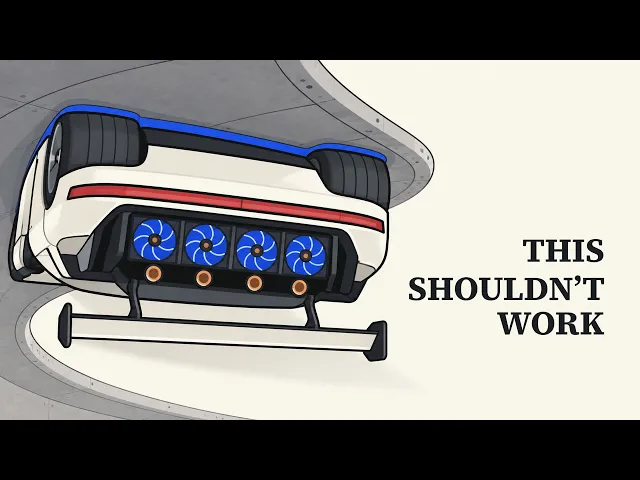
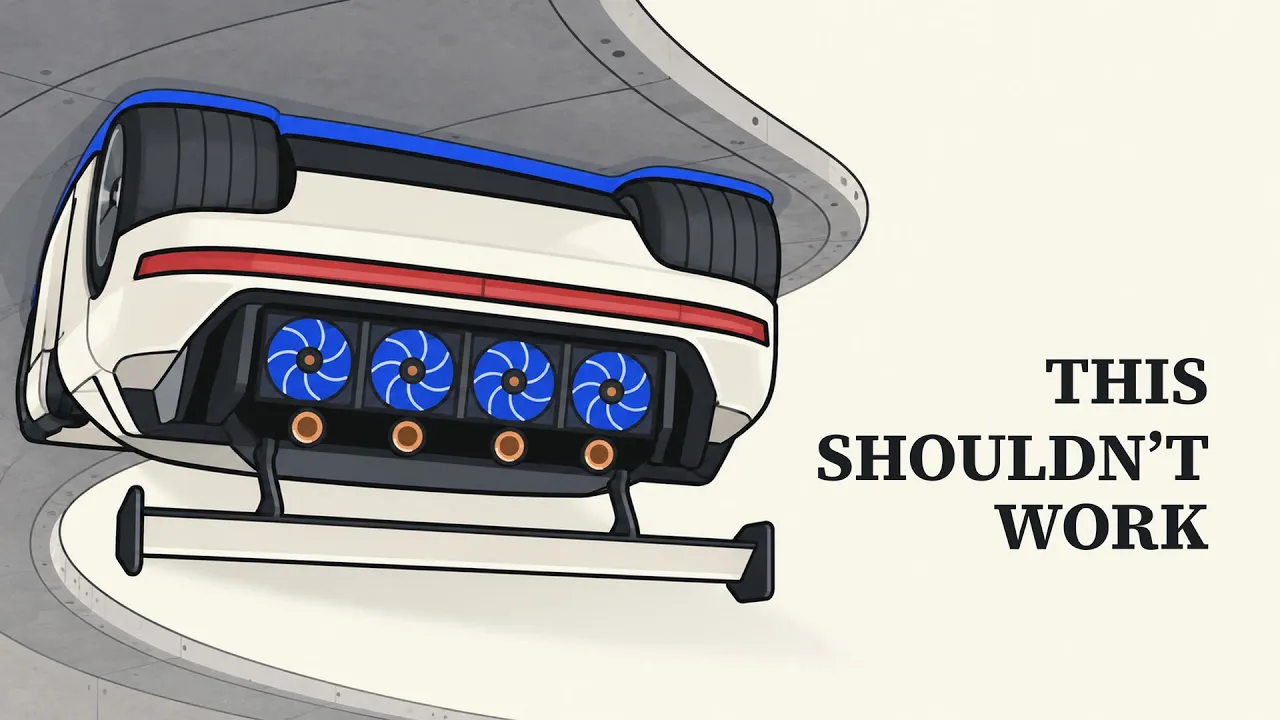
Tesla says its new Roadster can stay parked upside down. It's the car Tesla says can fly and it holds on with fans that pull it down. This week it drove up a ramp that curls over until it was upside down and flew off the top.
Then, with nobody driving, it flipped over five other Teslas. You'd probably credit the SpaceX thrusters. If you know cars, you'd guess downforce, but that only works at speed and this one isn't moving.
>> [music] >> So, why would a flying car need fans that pull it down? By the end, you'll know why. Strip the body away and the tail is a machine for moving air.
Four jets that push, four fans that pull. The fans only make sense once you see how briefly the jets can work. So, what do the jets run on?
Not fuel. Tesla calls them cold gas thrusters and [music] the gas is plain air. And they're strong.
Tesla's thrust figure for the rear jets is more than four times the car's own weight. Blow up a balloon and let it go. The air rushes out one way, so the balloon shoots the other.
These jets do the same with air squeezed into carbon wrapped tanks, the kind rockets use. Tesla says the tanks hold about 250 kilos of air. Let that out at normal pressure and it would fill a family-sized flat.
So, why doesn't it just hover like a jetpack? Because a balloon empties fast and so do these tanks. Even easing off to a hover, the rough sums say the air is gone in under 10 seconds.
About 2 seconds of air at full blast. So, the jets can't hold it up for long. In the air, their job is to turn the car and keep it steady.
Tesla says they adjust it in a fraction of a second. So, the height has to come from somewhere else. On the ramp run, it came from driving.
Tesla's ramp curls over at the top, so a car that climbs all the way ends up upside down. So, what stops it from dropping off? Wings need speed.
Tesla says this car can hang there without moving. Air presses on everything it touches from every side all the time. Normally, the pushes on a car's floor and body cancel out.
The Roadster's fans pull the air out from under the floor while a seal stops more air rushing in. So, the push on the floor drops and the push on the body wins. It shoves the car onto the ramp.
You felt this with a vacuum cleaner. Press the nozzle onto a rug and it grabs, but a rug can lift into the nozzle. A ramp can't move, so the car gets pulled onto it instead.
Tesla says the fans pull up to 2 G, twice the car's own weight. Fans don't need speed, so that pull is there even standing still. A vacuum cleaner the size of a car pointed at the road.
But, Tesla says it put the fans on for something every car runs out of, grip. Grip is the most a tire can push before it lets go. Press your palm flat on a table and push it sideways.
Press down harder and it's harder to slide. A tire works the same way. The harder it's pressed into the road, the harder it can push.
It isn't perfect. The grip grows a little slower than the press, but it's close. Tesla puts the limit for tires alone at about 1 and 1/4 G.
Ordinary tires have the same kind of limit, just lower. Brake too hard or take a corner too fast and past that point, the tires let go. Your tires hit the same wall.
So, to push harder, you have to press the car down harder. Adding [snorts] weight would press it harder, too, but then there's more car to push and the gain cancels out. Suction adds the press without adding any weight.
That's the fan's trick. That's why, with its fans on, Tesla says the Roadster can corner at more than 2 G. The idea is old and it works almost too well.
In 1978, a fan car entered a Grand Prix and won. The other teams complained, so its team withdrew it. But, even with the fans, every push still goes through the tires and Tesla wanted 60 mph in under a second.
So, for the launch, the jets come on, too. The Roadster's rear jets don't push on the road at all. They push on the car itself, the way escaping air pushes a balloon you let go of.
Fans under the car can suck it onto the pad, as well, so the tires push harder, too. And these jets throw their air out far faster than a balloon. Faster than sound, Tesla says.
Air that fast makes little shock waves that stand still in the exhaust. Tesla's [music] footage shows them as a row of bright diamonds. Tesla timed the run from standing still to 60 mph at 0.
81 seconds. That's an average of more than 3G, over three times your own weight pressing you into the seat. The jets push never touches the road, but a car that leaves the road still has to land.
Landing is where the jets earn their keep. On the ramp run, the car left the top still upside down. Out there, the fans have nothing to pull against.
This is the one moment they can't help. Upside down from that high, it would land on its roof. Instead, in midair, it rolled the right way up, its jets turning [music] it.
And in Tesla's own photo of that jump, jets at its corners fired downward beneath it, slowing it before it lands. It's no place for a driver, and there wasn't one. For the show, Tesla said, "The car drove itself, to make sure we don't kill anyone.
" It came down on its wheels. Nobody was inside. Four wheels down, nobody inside.
So, why would a flying car need fans that pull it down? Because the flying is the short part. By the rough sums, the air in those tanks [music] lasts seconds.
What got it up that ramp, upside down, was the fans' grip. [music] And that same grip, made without adding weight, is what lets it corner and launch. The [music] jets add the push the tires can't, and steer it while it's in the air.
The jets push, the fans hold on. So, next time a car leaves the ground, what will you see? The push in the air or the grip it had just before?
If you like this, subscribe to Made Ordinary.