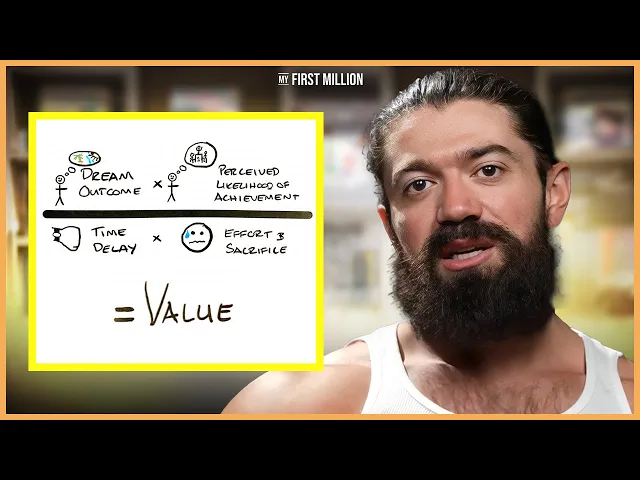
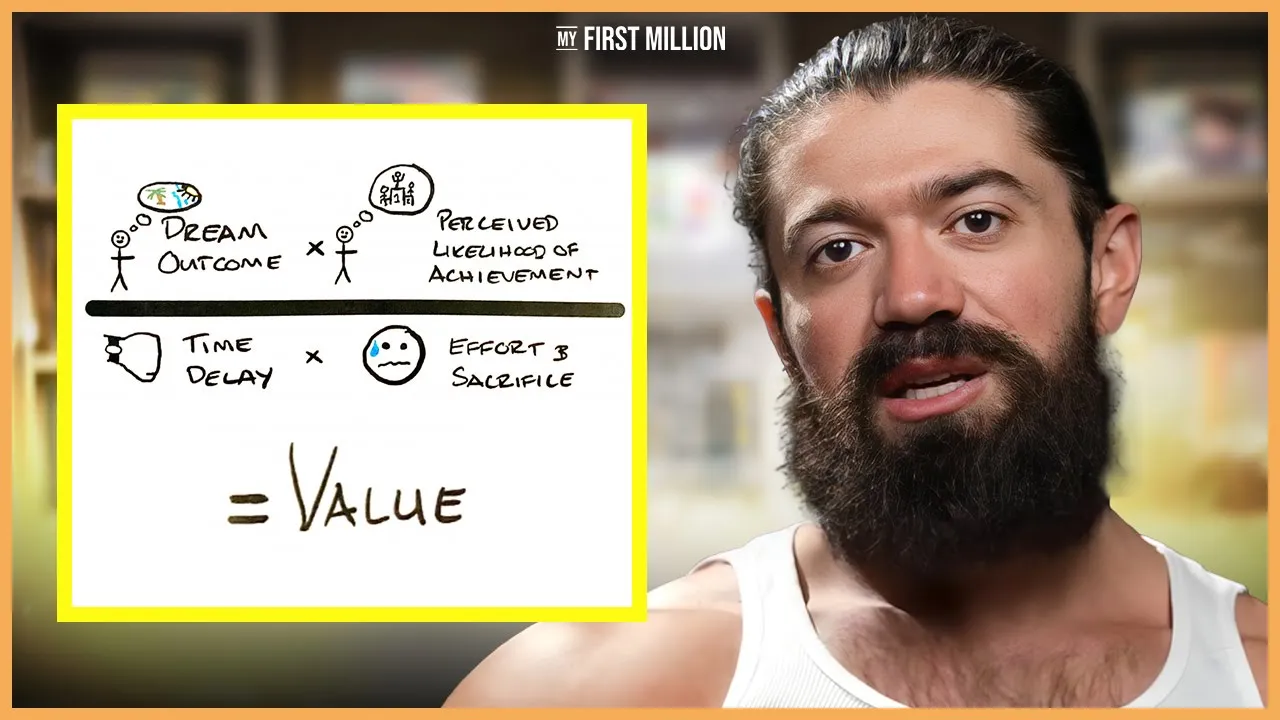
Fundamentally, you know, you think about like are there supply constrained businesses or demand constrained businesses? And I like going into demand constrained businesses cuz that's what I'm good at. So, the core if there was one framework in the book that it relates to, it's the value equation, which is that you have to understand how to create value so that you can charge as much as possible, right?
And obviously also convert as many people as humanly possible. And so there's four elements to that. One is the dream outcome, the second is the perceived likelihood of achievement, and then below that, so it's a fraction, so dream outcome times perceived likelihood of achievement, below that you have time delay, and then effort and sacrifice.
And so the dream outcome is what I would say separates whether someone's even interested in your category of offer or not. So it's you know, men in general probably want to make more money, women in general in general usually want to look better because both of those are more associated with status. So, okay, why is it that B2B offers tend to be more expensive than B2C offers?
Because it's more closely tied to ROI. Great. So that's the category one.
But within, let's say weight loss given the example we're talking about, if we're B2C, how is it that you can have a $5 PDF and a $50,000 liposuction thing? But they both fundamentally solve the same problem, which is that they don't like the way their stomach looks, right? What's the other three variables?
And so the next is perceived likelihood of achievement. So taking the liposuction example, if you're a surgeon or you're a girl and you're you're thinking about getting liposuction, uh and there's one surgeon that's uh just fresh out of medical school, hasn't done a surgery yet, and there's another physician who's got 10,000, you know, five stars or surgeries under his belt, who do you go to? The guy with 10,000.
Why? And and the crazy thing is is that it's the same procedure, but the perceived likelihood of achievement that you're going to get what you want is significantly higher, and so you pay for that premium. The equal opposite of this is risk, right?
And so how do we decrease risk? So you have this dream outcome, and you want it to be absolutely certain that you're going to achieve it. And so it's the category, and then there's things you do in the offer, like that's where guarantees come into play.
So how can I further decrease the risk associated with that? And then we have the bottom side of the equation, which is time delay. So how how far between when they buy and when they get?
And so to use the example of personal training versus the liposuction, personal training you got to arm wrestle somebody for an hour to get them to buy a $2,000 package of of personal training. And the reason for that is because they might get their six-pack, you know, 12 to 18 months later. Whereas if you do liposuction, you know, you're going to go to sleep and then you're going to wake up and you're going to be significantly thinner.
So the time delay is so much shorter, and so because of that, it increases the value overall. And then finally you have effort and sacrifice, which effort are things that you have to begin doing that you don't want to do as a result of a purchase. So in the personal training example, you got to wake up early, you got to be sore.
That's the effort side. You have to stop eating your Well, sacrifice is the things you have to stop doing that you want to keep doing. So it's like you got to stop Taco Tuesday, you got to stop sleeping in cuz you got to do it in the morning.
So it's both sides of the same coin, effort and sacrifice. And when you itemize all the things that a customer has to do as a result of a purchase, what are all the things that they What are the things that increase their risk? What are the things that make it take longer?
What are the things that make them start doing things they hate? And what are the things that we have them stop doing that they love? And then you create solutions for each of those categories, then you create an incredibly valuable offer.
And so from the weight loss perspective, many people think, "Oh, I'm going to have them lose weight. " But it's like, "Well, they're going to have to go grocery shopping differently. They're going to have to learn how to prep food.
" And so it's really getting granular about all the little steps that has to occur in order for someone to get a result. And so looking at what happens immediately before and immediately post purchase, uh all the little steps, and then trying to de-constrain each of those steps for them, and then including those things in the offer, ultimately creates a much more valuable A offer and B a higher converting offer. And this is where you get these massive stepwise increases in terms of company value because all of a sudden we can double the price or triple the price for offer and close at a higher percentage.
And so that's when these crazy kind of like Lollapalooza effects occur in the business where they go from two million to 10 in a year changing nothing but what the core offer of what they said was. And then we do these little enhancers that I'll add on, which is like you've got scarcity, which is limiting number of units, you've got urgency, which is limit number of time. You have um guarantees, which is things that we do to reverse risk.
They have There's four types of guarantees. You can do unconditional, conditional, zero guarantee, and then performance, right? So performance is what I call an implied guarantee.
Like if, you know, if you don't make money, I don't make money. Anti-guarantees, you lean into the fact you don't have a guarantee. For the type of person who needs a guarantee, this isn't for you.
Conditional is like, "I'll guarantee it if you do X, Y, and Z. " And then unconditional's unconditional. Like I'll I'll give you your money back if you ask for it.
Then you have bonuses, which are things that drive action in the short term, um buying decisions. And so a lot of those things that you can make an irresistible offer or a grand slam offer from the book is by looking at each of those problems and creating kind of a bonus stack that solves each of them. And so from a selling perspective hand to hand, the salesman doesn't need to say all seven of the things that you have.
And so the idea is that you make the ask on the initial offer, if they say no, you figure out what the constraint is, and then you plug that bonus in. And then maybe you need to put three bonuses in in order to get them over the edge. This also allows the sales team to stop doing discounts in order to close people.
We just add value rather than taking away price. And then post purchase, in order to make sure that ops is all the same, you then give them a surprise and delight with the remaining four. You say, "By the way, since you did buy, I want to give you these other things.
" And so if you get the fast buyer that doesn't need the bonuses, you just give them the bonuses and they love you. And if you got the somebody who needs all seven, then you give them the seven bonuses on the sales calls. And that's kind of how you can just get increased close rates without giving away discounts.
God damn. Yeah. Highly useful.
I feel pumped up, brother. I need to go read I need to go read the blue and the purple one. All right, if you like that clip, there's a full conversation with a lot more just like that.
Just follow my finger. It is right here.