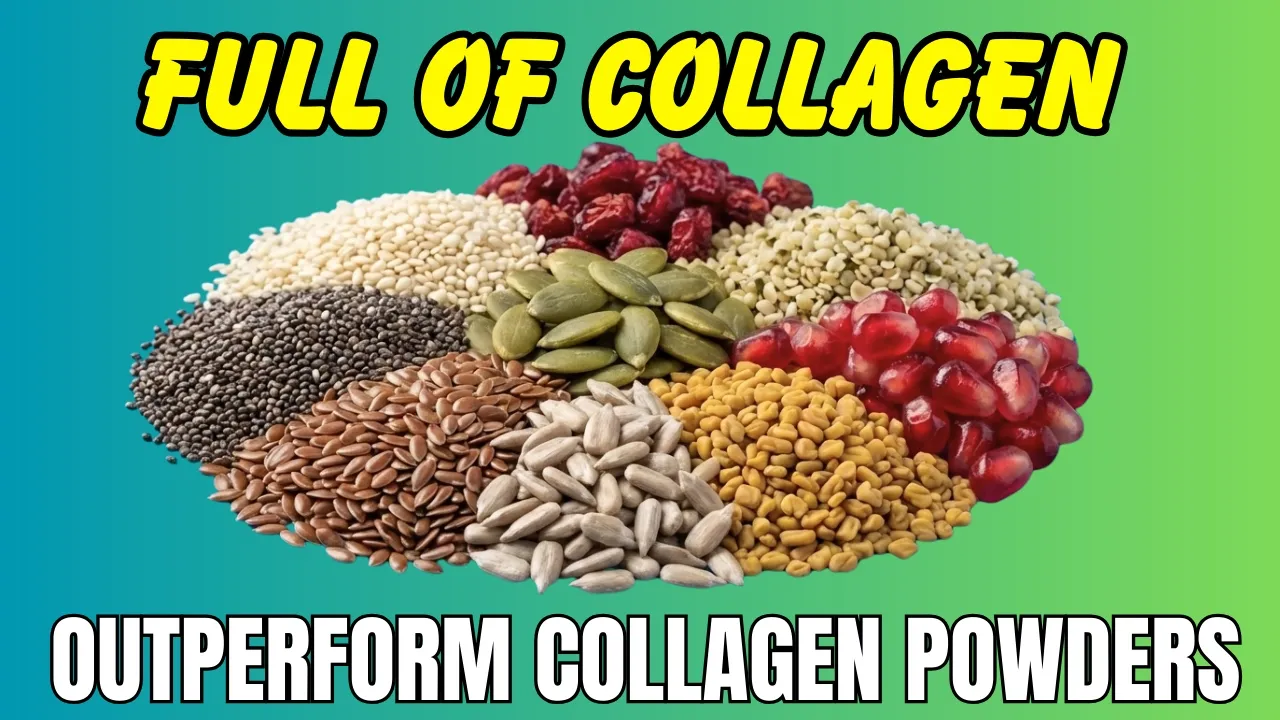
What if some of the most powerful collagen boosting foods for your skin are already sitting in your kitchen, yet you've been throwing them away for years? Today, we're talking about seven small but mighty seeds that can naturally support collagen production, improve skin elasticity, and help protect your existing collagen from breaking down. And trust me, seed number six surprises almost everyone.
It's one of the most potent skinup supporting seeds out there. Yet, it's commonly discarded without a second thought. Once you understand what these seeds actually do inside your body, you'll never look at them the same way again.
So, take a breath, relax, and let's get into it. Seeds may be tiny, but they're nutritional powerhouses. Each one contains a precise balance of amino acids, essential fatty acids, minerals, and antioxidants, all designed by nature to grow an entirely new plant.
When you eat seeds, you're giving your body those same foundational building blocks. Several seeds are especially valuable for skin health because they provide the raw materials your body needs to produce collagen and elastin. The proteins responsible for firm, smooth, youthful looking skin.
They also help reduce inflammation and oxidative stress, two major drivers of collagen loss. If you're serious about supporting collagen naturally and softening the appearance of wrinkles, I invite you to join our free collagen blueprint community. Now, let's walk through the seven seeds I recommend adding to your daily routine to slow visible aging and support healthy glowing skin.
One, chia seeds. Hydration heroes. Chia seeds are one of those quiet helpers that don't look impressive, yet they do powerful work behind the scenes.
I like to call them hydration heroes because so much of skin aging is really dehydration showing up on the surface. When your skin lacks water, collagen fibers shrink, fine lines deepen, and elasticity fades faster than it should. Chia seeds are rich in omega-3 fatty acids, which help protect the skin barrier.
Think of your skin barrier like a roof on a house. When it's strong, moisture stays in and damage stays out. Omega-3s calm inflammation, which means less collagen breakdown over time and a smoother, calmer complexion.
What makes chia seeds truly special is their gel forming ability. When soaked, they absorb many times their weight in water and form a soft gel inside your body. This gel helps slow digestion, improve hydration, and support steady nutrient absorption.
Well hydrated skin holds collagen fibers in place. helping skin look plumper and more elastic rather than creased and fragile. Soaking chia seeds also changes how well your body can use them.
Dr seeds can pass through too quickly, but soaked seeds release their nutrients gently, making them far more effective. The simplest daily habit is one tablespoon soaked overnight in water. Drnk it in the morning, add it to smoothies, yogurt, or enjoy it as chia pudding.
Small habit, visible results over time. Many of us notice improved softness within weeks when hydration finally reaches our skin cells. Two, sesame seeds.
Ancient beauty seed. Sesame seeds carry a kind of quiet wisdom. Long before modern skin care existed, these tiny seeds were used in Asian and Middle Eastern traditions to support beauty, strength, and vitality from the inside out.
And when we look at the science today, it's easy to see why our ancestors valued them so deeply. Sesame seeds offer a rare and powerful combination of zinc, copper, and selenium. Zinc helps your body create new collagen, which gives skin its firmness and structure.
Copper supports elastin, the protein responsible for stretch and bounce. If collagen is the strong fabric of your skin, elastin is what allows it to move without tearing. Selenium then steps in as a protector, guarding both collagen and elastin from damage caused by stress, pollution, and aging.
Many of us focus only on collagen, but youthful skin depends on balance. Without elastin, skin may feel firm but look stiff. Without protection, newly formed collagen breaks down too quickly.
Sesame seeds support all sides of this equation, which is why they help build long-term skin resilience rather than quick temporary results. What I love most is how easy they are to use. A spoonful of tahini drizzled over vegetables, a sprinkle of sesame seeds on salads, rice, or stir fries.
These small habits quietly nourish your skin day after day. Over time, this consistent support helps skin feel stronger, more flexible, and better able to withstand the years ahead. Three, flax seeds.
Flax seeds are often called Botox seeds, not because they freeze your face, but because they help your skin behave more youthfully from the inside. They work by supporting elasticity, smoothness, and firmness in a very natural, respectful way. Flax seeds are rich in omega-3 fatty acids and lignens, a special type of antioxidant.
This combination is powerful. Omega-3s calm inflammation, which slows the silent damage that weakens collagen over time. Liggens act like bodyguards, protecting collagen fibers from free radicals.
Free radicals are unstable molecules that chip away at collagen, much like rust slowly eating through metal. When collagen is protected, skin stays firmer. When inflammation is lower, skin looks smoother and more even.
Many people notice that their skin feels softer and less creepy when flax becomes a daily habit. This is elasticity being preserved, not artificially forced. Now, here's the non-negotiable part.
Flax seeds must be ground. Whole flax seeds often pass through the body undigested, which means you miss most of the benefits. Grinding releases the nutrients so your body can actually use them.
Flax seeds are also sensitive to heat. High temperatures can damage their delicate omega-3 fats. The best approach is simple and gentle.
Add ground flax to oatmeal after cooking. Mix into smoothies, stir into yogurt, or sprinkle over salads. Used consistently, flax seeds help your skin age with strength, flexibility, and grace rather than stiffness and fragility.
Four, pumpkin seeds. Collagen Champion. If I had to choose one seed that truly earns the title of collagen champion, it would be pumpkin seeds.
They're not flashy, but they are incredibly effective, especially as we get older. The reason comes down to one key nutrient, zinc. Zinc is often the limiting factor in collagen production.
Think of collagen like a brick wall. You can have plenty of bricks, but without cement, nothing holds together. Zinc is that cement.
Without enough of it, your body simply cannot assemble strong new collagen fibers, no matter how healthy the rest of your diet may be. Pumpkin seeds are one of the richest plant-based sources of zinc. And they don't stop there.
They also provide vitamin E, which helps protect existing collagen from damage. Magnesium, which calms the nervous system and reduces stress related inflammation, and protein, which supplies the amino acids collagen is made from. This matters because stress and chronic inflammation are two of the biggest collagen destroyers as we age.
When stress hormones stay elevated, collagen breaks down faster than it can be rebuilt. Pumpkin seeds quietly help counter that process, supporting both repair and protection. The best way to eat them is simple.
A small handful of raw or lightly roasted pumpkin seeds. Sprinkle them on salads, soups, or blend into smoothies. What you want to avoid are heavily salted or flavored versions.
Too much sodium pulls water out of your skin, working against everything you're trying to achieve. Five, sunflower seeds. Vitamin E powerhouse.
Sunflower seeds are one of the most overlooked skin protective foods. Yet, they play a crucial role in preserving collagen. They are one of the richest natural sources of vitamin E, a nutrient your skin relies on to stay strong and resilient over time.
Vitamin E works like a shield. Every day, your skin is exposed to oxidative stress from sunlight, pollution, and even normal aging. These stresses create damage that slowly breaks collagen down, making skin thinner and less elastic.
Vitamin E helps neutralize that damage before it reaches your collagen fibers, allowing your skin to hold on to what it already has. Sunflower seeds also provide zinc and selenium, which work alongside vitamin E. Zinc supports ongoing collagen repair, while selenium adds another layer of antioxidant protection.
Together, they form a quiet but powerful defense system for aging skin. You can enjoy sunflower seeds as a simple snack or use them as an ingredient. Sprinkle them over oatmeal, yogurt, or smoothie bowls for an easy boost.
Used this way, they blend seamlessly into your routine without feeling like a treatment. One important caution, avoid heavily salted or flavored sunflower seeds. Excess sodium draws water out of the skin, leading to puffiness and dryness.
Artificial flavorings add unnecessary stress to the body. Choose raw or lightly roasted versions whenever possible. When used gently and consistently, sunflower seeds help your skin stay protected, supported, and better equipped to age with grace.
Six. Watermelon seeds. The shocking one.
This is the seed that surprises almost everyone. Watermelon seeds are usually the first thing we spit out or throw away without a second thought. Many of us were taught they're useless or even bad for us.
But the truth is, these tiny black seeds are one of the most nutrient-dense and collagen supportive foods you can eat. Watermelon seeds are rich in magnesium, a mineral that plays a major role in skin barrier strength. When your skin barrier is strong, it holds onto moisture more effectively.
Think of it like sealing the walls of a house so heat and water don't leak out. Better moisture retention means collagen fibers stay plump instead of collapsing into fine lines. They also provide zinc, which we've already learned is essential for collagen synthesis.
Without enough zinc, collagen formation slows down and skin loses firmness faster. Watermelon seeds quietly refill that supply. What really sets them apart is their protein content, especially an amino acid called arginine.
Arginine helps improve circulation and send signals that support collagen production. Better blood flow means nutrients and oxygen reach skin cells more efficiently, supporting repair and renewal. Watermelon seeds also contain iron, which helps carry oxygen through the blood.
When skin cells are well oxygenated, they naturally look brighter and healthier. This is where that glow from within comes from. It's not makeup, it's circulation and nourishment.
The best way to eat watermelon seeds is to lightly roast them. Just a few minutes in a dry pan until crunchy is enough. You can snack on them, sprinkle them on salads or smoothie bowls, or mix them into homemade granola or trail mix.
Once you start using them, you'll never want to waste them again. Seven, hemp seeds. Complete protein source.
Hemp seeds are a beautiful way to finish this list because they address one of the most overlooked parts of collagen health, protein quality. Hemp seeds are a complete protein, meaning they contain all the essential amino acids your body needs. Something very rare in plant foods.
Three of those amino acids matter deeply for your skin. glycine, proline, and hydroxyproline. These are the exact building blocks your body uses to make collagen.
Think of them as the specific letters needed to spell the word collagen. Without enough of these letters, your body simply can't form the structure, no matter how hard it tries. Hemp seeds also offer a balanced ratio of omega-3 to omega6 fats.
This balance is important because it helps calm inflammation instead of feeding it. Chronic low-grade inflammation is one of the biggest drivers of skin aging, quietly breaking collagen down over time. Hemp seeds gently push the body back toward balance.
What makes hemp seeds especially friendly is how easy they are to use. Add a spoonful to smoothies, sprinkle them over salads, or stir them onto avocado toast. They have a mild, nutty flavor that blends effortlessly into daily meals.
simple, nourishing, and deeply supportive for aging skin. Here's the most important thing I want you to carry with you. Collagen loss is not inevitable.
Aging is natural, yes, but rapid breakdown is often a signal problem, not an age problem. Food doesn't just provide calories. It sends biological messages that tell your body whether to protect, rebuild, or break down tissue.
When you protect collagen and supply the building blocks to rebuild it, visible results follow. This isn't about perfection or doing everything at once. It's about consistency.
Small daily choices done with care matter far more than shortcuts. And again and again, natural foods outperform quick fixes when it comes to lasting skin health. Your body still knows how to rebuild, protect, hydrate, and firm your skin.
It simply needs steady support. These seeds aren't magic, but they are powerful when used consistently because they work with your body, not against it. A small daily habit can quietly change how your skin ages over time.
If this message helped you, please like this video, subscribe to the channel, and share it with someone who cares about their skin and health. And stay close. We're building a supportive community here.