$790 billion US. That's how much the world spent on digital ads in 2024. And no surprise, it's projected to go up.
I'm Max, the original flowmer, and this is the studio, the show where I share the stories of flowgrammers across NIDN's global community. Obviously, when you're spending money on ads, you want to make sure that they're performing well, that you're not wasting money. But the performance of the ads that you're running is constantly changing based on a bunch of different variables.
Some you control, some that you don't. Ads can get stale over time. As people see them lots of times, they get bored of them.
They become less effective. Things can be happening in the world that makes that message less relevant. Things that your competitors did.
Cost per clicks can suddenly go up. In short, happens when you're doing paid ads online. As you can imagine, there's a lot of folks interested in applying AI to solving this monitoring and performance problem since obviously that's a lot of manual work, checking all these different campaigns, making sure they're all working, analyzing for all these different variables.
And a lot of this work, it's pattern matching stuff. Any one of these specific checks that you're doing aren't particularly difficult themselves. You just kind of got to be doing it basically.
And that's my segue to today's guest, Ashley Gross. Ashley is using an NN AI powered workflow to automate that monitoring of the various campaigns that Sue is running because at any given moment she's advertising over 30 courses that she offers as an AI expert. So that's 30 plus ad campaigns that she's paying for from her own pocket and if they start performing poorly, she's losing money.
There's a few things that are cool about this use case. The first one is she's solving her own problems by herself and at end that's our whole mission. So we love that.
The second one is that the workflow is not particularly complicated. So, she's solving a real painoint for herself without investing dozens of hours on building the use case. And the third one is it's not a perfect workflow.
It's a real workflow when you're solving these kinds of immediate business problems that you have. And that's why I love it as well. Look, if she was administering millions of dollars of spend or have thousands of campaigns, there's some things I could recommend that she change on the workflow.
But what I love about this is it's very representative of what a real workflow that you might be activating in the next month if you're checking out Naden. And so I'm showing this one as an inspiration that your workflows don't have to look like these crazy behemoths with all these different validations and checks that you might see on YouTube. So let this be an inspiration for you and a motivation to get off your tukus and go flow something else.
Anyhow, enough blah blah. Let's hear from Ashley herself. Hey Ashley, how's it going?
Hi, good. How are you? I'm doing really well.
First off, thanks so much for coming on the show. Thanks for having me. I'm excited to be here.
Absolutely. I'm excited for this use case. But before we get into that, would you mind introducing yourself to everyone?
Sure. My name is Ashley Gross. I am a tenure marketer turned founder and CEO of an AI consulting company, which is just a fancy way of saying I live, breathe, talk, and teach all about agents, automations, and optimizing generative AI tools in your tech stack.
Very cool. Definitely speaking my language. And I'm curious before we get into your use case, you're in AI consulting.
When did you get into that to give folks a context on how long you've been in the space? I've been a marketer for 10 years. I stumbled into generative AI in 2020.
And I realized that if you think about generative AI tools, it's just another tool in our tech stack that is meant to optimize our workflows, which really means like it makes us efficient and we save money and time that makes us more productive. So, I started using generative AI tools back in 2020 to condense my work week from 40 hours to 15 and completely maintain that quality output that I was getting from a 40-hour work week. And I'm not technical at all by nature.
I found out I was going to be a mom and I was like, "All right, we need to consolidate our work week right now. " And I did that and then I went on to implement it into an enterprise pre-Chat GPT. And I found that again taking that same lens of this is technology.
It's meant to make our lives easier, not harder. How can we make our tools actually work for us to solve business problems that exist every single day in every business? That really paid off.
Back in 2022, I was actually able to tie AI implementation to revenue. But within 3 months of implementing AI into an enterprise, we actually overachieved our annual pipeline target of 90 million and we hit 115. And I think that's really when I was like, I'm not technical, but I'm going to stay here.
This is I'm on to something here. This feels good. And I've never looked back.
And it's been really rewarding. That must have been like a fantastic journey so far. And I can imagine from 2020.
So you I mean you're a veteran, especially in your domain and niche. This is fantastic. I'm really excited for this one.
I'm curious since you've been in the space for a while and I think also as having domain expertise in marketing with that lens, what are you excited about in 2025 around AI for marketing specifically? Probably multimodal agents because we're so close, but again like it's a workflow problem. So I've got my favorite automation tools and my favorite agent tools and my favorite generative AI tools that I can't have them all in the same place and there's not one tool that fits all my needs.
And so I think just the idea of how do we combine this technology to actually work for us and be even better. That's something that I'm really looking forward to. Very cool.
I talk with very technical people. I talk with less technical people. Sometimes the technical folks can get too stuck into the technology and like the optimize this token or the how it works.
When you're trying to solve a real problem, you are trying to get yourself 25 hours in your schedule. You can spend more time with your family. That's going to drive probably different decisions and outcomes if you're looking at it from that lens than purely an engineering lens.
Absolutely. That's the whole meaning behind my use case specifically is again like I've been a marketer. I will always be a marketer and have that lens first and foremost.
And I hate attribution. I truly truly hate attribution. I wish that I could just disrupt all of it and make the idea of it go away and just teach people how to think about it.
And so I knew whenever I was building my business framework, I wanted to set up a system where from day one, every single course I taught, I knew if the ads were converting, like down to the nitty-gritty details and what specifically they were drawn to. And I wanted all this information to flow really well and mean something to me and not just live in a tool where I have to spend hours researching and analyzing it. So that was really the why behind this use case because I mentioned I create courses.
That's how I get a lot of my clients actually. So, I have 30 different courses on my domain. There's no nice way for me to be able to see like, okay, I'm paying for ads here.
Are these folks converting on an ad? And if they are, what's the ad they're converting on and what's the course they're taking? That's really why I created this use case so that I could have all of that at my fingertips in ways that mean something to me.
First off, that was like a beautiful natural segue that you did. You're an expert, a professional. What was the manual world looking like before you implemented the automation?
What does that look like now that you've implemented an automation to solve that? The manual world was brutal and I never want to go back to it again. I don't know how many allnighters I pulled, but there's been quite a few.
I would say the norm for in the last year before automating this probably two allnighters a week was normal. It was just my schedule. This isn't hyperbole.
I know that you have a following online. You're not doing the influencer. This is like two.
Yeah, absolutely. Because it is. It is because I set up as a true marketer does.
I set up my funnel to compensate me at every single touch point in the customer journey. I speak at conferences and I hold executive workshops and that's my top of funnel. And then my middle of funnel is these courses.
And if there's over 30 courses, I need to be able to see what's converting and and whether or not it's actually leading to the decision phase, which is my AI enterprise consulting. It was taking me hours to not only find all of the ad information, but also like mapping. Mapping is a horrible manual experience.
The properties that exist in Stripe versus HubSpot versus Google Ads. None of them except for maybe three actually correspond without you having to do anything. So you're having to build custom properties, test over and over and over again like whether these are actually running the way that they need to and parsing the way they need to for an output.
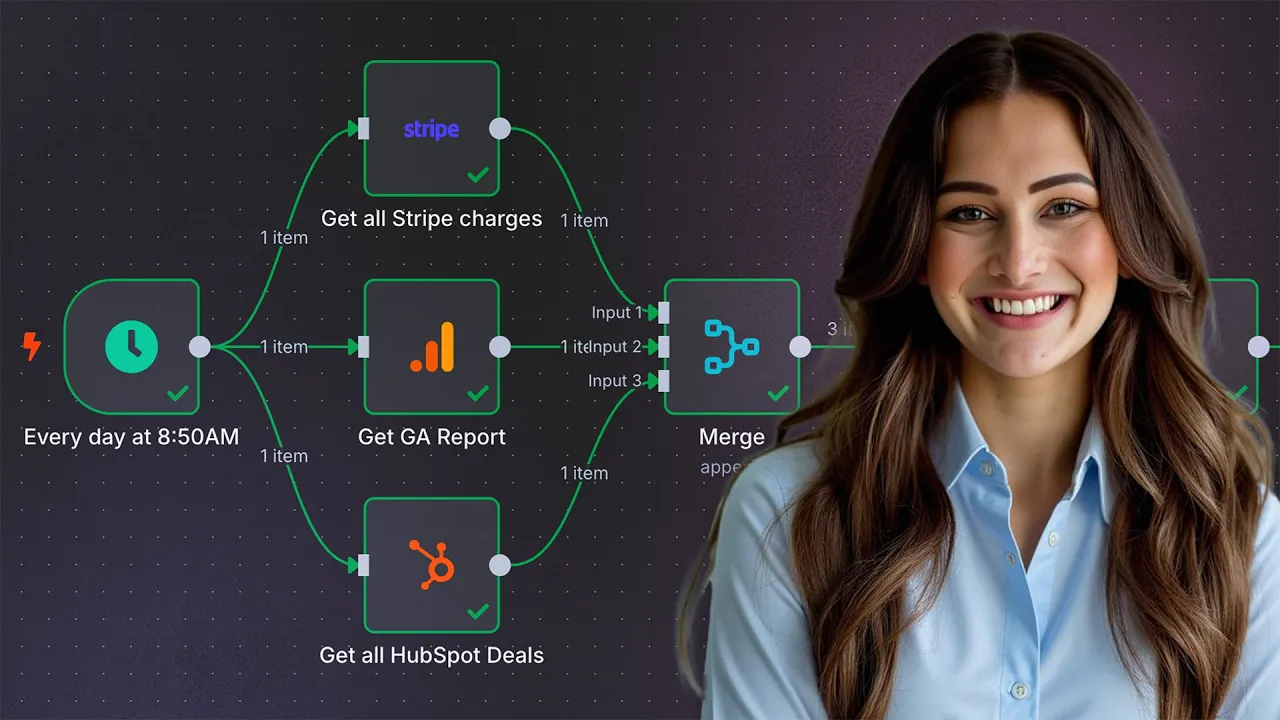
My whole entire flow starts with every single day at the same exact time it starts a trigger and then in that trigger it's pulling data from Stripe, from Google Analytics and from HubSpot to get deal information and contact objects. And specifically what I mean by that is did any of the contacts that I was trying to get in front of, did any of them see my ad? And did any of them click on the ad and that made them go to one of my course pages and either think about it, spend a minute there, actually convert or sign up for a subscription.
And I wanted to know all of that information aggregated, but then also I wanted to log it into almost a business case template like a Google CSV sheet. But then I also wanted all of it to go back to my HubSpot. But then I also wanted all of it to be sent to me in an email that every day I have this nice little summary.
I'm very type A if you haven't gotten those. No, I get you. I get you.
That motivation, right? Like like how are we doing today? Yeah.
Yeah. Yeah. Exactly.
I wanted some small wins, but I also wanted to make sure at the end of the day everything's still logged in my CRM that I don't have to worry about it. I have this nice little business use case CSV sheet of, okay, here's our hard metrics. And then I've got this simplified email template that breaks everything down for me.
So I'm just being communicated with the way that I want to in multiple different ways so that I can remember cuz I think it's so easy to get so hung up, especially in automations even. You can tinker around for so long. Guilty.
Guilty is charged sometimes. Yeah. Yeah.
I think it's easy to get caught up and you need to remind yourself, no, you're good. You've got what you need. Is it working?
Do you get the insights that you need from your data? Okay, move on. You're good.
Overstand that. overstand that we've got your workflow open here. This is the workflow that basically handles that automation.
Can you walk me through the key steps and then maybe we can take a look at what that would look like, what that solution looks like. This is the schedule trigger and then it's pulling the edit fields. What I specifically mean by that is every time it's triggered, it is giving you the date of the week, the day of the month, the hour, the minute down to the second if you really wanted it, which I did.
And then what it's doing is it's actually sending those fields to Stripe, to Google Analytics, and to HubSpot. And this is where I talk about those different properties. Here's all the IDs for just Stripe that I would have to manually go in and map.
And then same thing for Google Analytics, source medium, the campaign name, the sessions, and then HubSpot has all of their objects logged in here as well. And what it's doing is it's pulling all of these reports and it's merging them. The next step is a code.
And in this code, it's actually just reformatting them, which I again don't come from a technical background, but there's just a node that you quite literally click plus action and add to. What this code node is doing is it's actually taking all of the information from these three different places with all of their different objects and property names, reformatting it into just these columns because this is really when I talk about ads and wanting to know what is driving the most revenue and converting. These are really the metrics that I care about.
This would take me so many hours to manually grab those different data points and reformat them on my own. This is doing it at the same exact time every single day and it's putting it in communication words that I actually understand as a marketer. Why is this data important here?
What decisions does it let you make? If you could explain it to us who aren't professional marketers. This specific sheet is telling me how much per ad my ads are converting to my courses.
And what I mean by that specifically is it's telling me how many sessions, how many times did folks get into click on an ad that I put out and then go to that URL for the course and view it or have a session with it or actually pay for it. And then once they paid for it, if they did, were they leads as a direct result of clicking on that Google ad and seeing it at maybe it's the right time, maybe it's the right copy. Either way, I want to know.
And then what is the revenue coming every single day from these courses so that I can actually see like the full ROI and then the conversion rates and my cost per leads and my cost per purchases. We severely underestimate sometimes in the marketing world how much things cost. It's nice that I can find similarities within my algorithms where I could say, okay, on February 26th that cost me $38 per lead.
So much cheaper than a LinkedIn ad would cost me. Like so much cheaper. That's probably like the cost of a LinkedIn ad in one day.
I just like having this almost like a use case for myself to say, "Okay, Google Ads still working, still great. We don't need to mess with anything. We don't need to update what we're doing or where we're going because it can be really hard not to be in all places all at the same time, but it gets really expensive.
This stuff can change, right? Like I've heard of ad fatigue and stuff. So just because an ad's doing well this week, like next week it could start performing worse.
" So you want to monitor this because otherwise I don't know it could be ROI negative really inefficient or you need to deploy that finite capital somewhere else to another campaign or got you okay and the idea of this is if it's day overday then I can look at was it just something going on was it a holiday and numbers were just down or did I actually like AB test my copy that day or did I change my ad because then I don't want to wait until like my bidding strategy is run out in order to tell whether or not something I did change that I made my ad was ineffective. I want to know like immediately as soon as it starts to tank so that I don't waste my money. Makes sense.
Okay, got you. So, we post it in the sheet. You've got in here, you've got this like source of truth.
I mean, then what happens next? Okay, so then what happens? It goes in through OpenAI.
So, OpenAI again the idea with the code was it reformats all of the JSON data into those column headers from the Google sheet. And then when it goes into OpenAI, it reformats all of the data from the JSON and the Google sheet to actually just give me an email that I like in my own marketing words. And this is actually what the template looks like because obviously I can't show real numbers, but this is quite literally the email that I would get every single day is just my own little dashboard for all my AI agent courses.
Overall performance, all of the headers that we saw in the Google sheet, but then it would also as part of that opening step give me a campaign breakdown. So, a Google ad campaign breakdown and then I could also click on the full report. The idea is like within one second I can go through this and be like, "Okay, great.
This was really nice today. " But if I see something that's off because I have all of this data from a daily basis. So, like when I get these emails, I'm certainly going to see if something is tanking one day from the next, the idea is like, okay, I want to be able to go in there and click immediately and see what is going on and fix it before it gets really expensive or I lose more money.
Very cool. I like the progressive disclosure of info here. in your inbox or you probably have on your phone, right?
Or desktop, you can check it, but then you can drill down and zoom in. And this is a pattern I'm noticing across the board is anyone who's creating dashboards and stuff, they keep this database, the copy of what they're doing. So you have your snapshots.
And I think for all of us right now, and Ashley, as someone who's been in Gen AI for a while, but if you have historical data for a while, future agents, future deep thought, this is all going to be great data. There's probably insights they'll be able to just give to us. But it all starts from having nice, clean, organized data, which which you're doing with this use case.
Yes. I'm glad you mentioned that too because I almost forgot. So I set up my own email domain that just sends this daily email and it saves the CSV into its own Google share drive.
So I'm starting my own knowledge base essentially and this email just is in charge of all things marketing and the knowledge base is just the Google Drve with all not just because it's a lot of information but just the Google Drve with all this information and it's sending those daily reports. So in the future, not too far away, it will be able to act as my marketer and go through all the historical data for any net new events, campaigns, initiatives in general. That is super cool.
Ashley, I was wondering, could we take a quick peek also in that open AI step just to see how you got that rigged up. So this is like the message that you're sending to Open AI writer to format it. What was your strategy in doing this?
I know some folks are using AIs to write these things, but how did you go about getting this done? I knew what I wanted to look at. I just didn't necessarily have the coding skills to run this in my own terminal.
I used this essentially after the code to pull all the JSON because I'm not very technical. So I don't understand like where it falls in the schema. I'm not great at mapping things.
So I just looked at historical tests that were run dynamically and pulled the data through and plugged it into where I wanted the information to be and that was really it. I can't take any credit for anything technical cuz that nen made it very easy. Thank you very much.
Look guys, we're not paying Ashley. She came for her own valition. Thank you Ashley for being candid about your technicality cuz one thing we were saying off camera is na you don't just have to be a developer to use it.
Of course developers can do wild things with it but I think Ashley's showing here like she's solving real problems for herself. You're using this every day. Has this solution yet identified some trend that help you drive action?
Oh my gosh. Yeah, absolutely. I ended up changing so many things.
Oh my gosh. What are some fun things that I changed as a result? So because I am mapping through NADN all of the ROI and metrics, I actually have historical segments.
So fun little fact in Google Ads, if you want to segment your audience, you have to have at least a thousand contacts. Historically with measurements in order to segment them using your own data and I have that because of all the logging that I've done. So, whenever I'm bidding and putting together like a keyword strategy and audience segmentation, I'm using my own customers because I was able to gather all that information.
And that has shown ROI in every aspect of it. Just another fun little workflow as a result of this one. I'm able to dynamically through a different automation actually update my YouTube title and description based off of that segment in Google Ads and based off what keywords my historical contents, pardon me, contacts are clicking on and are currently searching for and then predictably what they will continue to search for.
Developers watch out. I'm not saying but there's domain experts that are experts in their niche. They're getting the tools where they can implement stuff like this.
Ashley, this is wonderful. I'm so appreciative for you showing this for me. I'm curious.
Most flow programmers, you get a taste. You go down the rabbit hole. What's next for your kind of automation journey?
What would you like to automate that you're doing manually right now? Oh, I have I'm a tinkerer of tools, so this gets me in trouble because I will spend hours. I really want to find a way to automate every single time somebody fills out a general interest form on Cowanly.
I wanted to prepopulate those answers, but then based off of those answers, what's your company name, title, LinkedIn URL? I want to populate my agent to actually enrich the leads and find their PR, how they feel about AI, how they feel about automations, but they'll manually log all that back to HubSpot without me having to create all those properties cuz those are all that's what I'm looking forward to doing. Yeah, I I think that's going to be relatively straightforward to getting it going.
If you do do that, please do let me know. I'd love to see that solution. If people like what they saw today and want to follow along your journey, where can they go ahead and do that?
LinkedIn. Absolutely. LinkedIn.
I am sharing things every single day. There's there's going to be links to where it depending where you're seeing this. Above, below.
You know the drill. Check it out. Go show Ashley some love and following her awesome journey, especially if you're into marketing.
And I think a lot of us, be it a side hustle, what even if you're not a marketer, a lot of us have to do marketing. Learn from the experts. Save yourself some time and get some hours back.
Go do some other human stuff that only you can do as a human. Exactly. That's the point of it all.
Ashley, thank you so much for your time. Love to have you back anytime and have a beautiful rest of your week. Thank you.
Thank you so much for having me. My pleasure. Bye-bye.
[Music] Thanks so much, Ashley. I really appreciate you taking the time to come on the show and share your use case. In particular, it was so inspiring to hear how your sort of genesis story for getting into AI and automation was so that you get more time to focus on the things that are important, especially in your personal life.
That's the promise of AI that I subscribe to. This is kind of an official unofficial call out of all those people using NN to generate pretty crappy AI slop posts on LinkedIn. Please stop.
The world doesn't need more of that. And you're really killing social media before our eyes. You know, go solve some real problem that you have.
And yes, you may need leads for your small business. But generating a bunch of slot posts, even if it works in the short term, I don't think your personal brand is going to thank you some years out when everyone goes, "I hate the internet because of Genai content. " So just get inspired by Ashley.
She actually needs to monitor the money that she spends on these ads because she loses money. That's a great thing to automate. Probably no one needs your regurgitation of what Sam Alman said last week.
I'm Max. This is the studio. You're awesome for watching this video and happy flowing.


![How Nate Herk's AI Agent Is Revolutionizing Lead Response Times [With Human In The Loop]](https://img.youtube.com/vi/fnaTZa0-S30/maxresdefault.jpg)




![n8n Just Released Native MCP Trigger and AI Agent Tool [Official Walkthrough]](https://img.youtube.com/vi/45WPU7P-1QQ/maxresdefault.jpg)

![Automating Gong Sales Call Analysis with n8n and AI [n8n At Scale]](https://img.youtube.com/vi/AIiJ29hEn80/maxresdefault.jpg)