Listen to this statement made by India's Defence Minister, Rajnath Singh. [“We’ve maintained a ‘no first use’ nuclear policy until now. ”] [“But it might change depending on what the future has in store for us.
”] You might think it’s unimportant and I’m wasting my time discussing it. But let me tell you something —this statement has the potential to redefine India and Pakistan's relationship. Rajnath Singh made this statement in 2019 when he was on a trip to Pokhran, India’s nuclear test site.
You might not be aware of it but this statement evoked a controversy. Ever since India became a nuclear state, it has adopted a 'no first use' policy. [“India will never be the first side to use a nuclear weapon.
”] What does it mean? It means that in a situation of war, India wouldn’t attack any country with nuclear weapons first. India would only use nuclear weapons if attacked first.
This is what India’s nuclear policy has been for the past two decades. The policy has remained the same under the leadership of Atal Bihari Vajpayee, Manmohan Singh, and Narendra Modi. Then what about Rajnath Singh’s surprising statement?
Fellow BJP MP Subramanian Swamy agreed with Rajnath Singh’s statement. The former head of Pakistan's nuclear program wrote that Pakistan shouldn't worry because it was a political statement made in order to flaunt India’s macho nuclear arsenal and impress the voters. But not everybody agrees with this.
Some experts believe that this can have serious repercussions for India. On the other hand, some experts support this change, citing the cause of the country’s safety. It’s because India is not only threatened by Pakistan but by China as well.
So, why is India changing its nuclear policy? This is what I want to discuss in this video. But keep in mind that if you like the video, please subscribe to the channel.
Only 25% of you’ve subscribed to our channel. If you find this video meaningful, please subscribe to the channel. First, we need to dive into the history of the two nations to understand why they developed nuclear weapons in the first place.
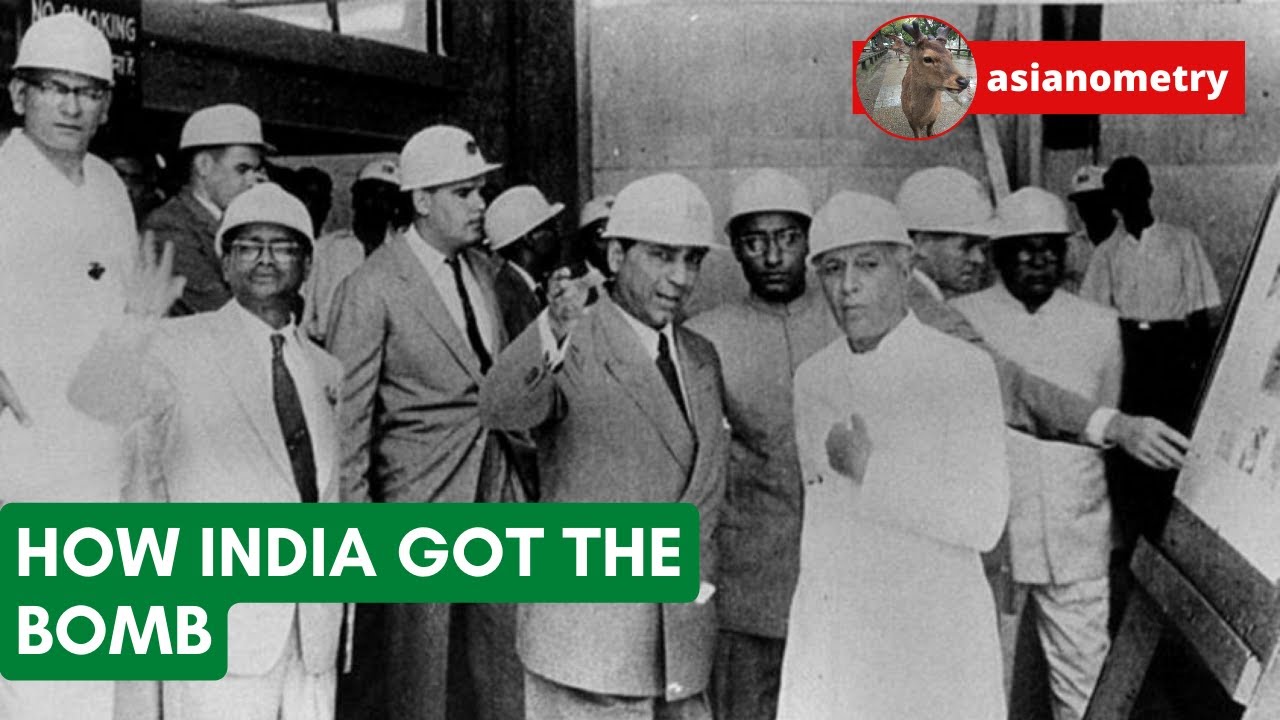
Take a look at this picture. Do you know who this person is? He is Homi Bhabha, a celebrated Indian nuclear physicist who is often referred to as the "father of India's nuclear program.
" It’s believed that he was instrumental in convincing Jawaharlal Nehru to start a nuclear program in India. He believed nuclear energy was crucial in fulfilling the country’s energy needs. At the time, both Nehru and Bhabha sought to use the nuclear program for nuclear energy and not for the development of nuclear weapons.
In 1957, Jawaharlal Nehru said in a speech in Lok Sabha that India wasn’t building nuclear weapons, but if the need be, it could. So, what made India develop nuclear weapons? The 1962 war against China.
The war exposed India's military weaknesses and demonstrated the potential threat posed by China. This changed Homi Bhabha’s ideals. He realized that it was necessary for India to develop nuclear weapons.
In 1964, when news emerged that China had conducted its first nuclear test under the leadership of Mao Zedong, Bhabha claimed that India too could test its own nuclear weapon in 18 months. Although India couldn’t conduct a test for another 10 years, it became quite clear that India was developing nuclear weapons. News emerged that Pakistan too had started working on its own nuclear program.
It had established the Pakistan Atomic Energy Commission as well as an institute for nuclear research by 1963. However, it wasn't entirely clear if Pakistan was pursuing nuclear energy or nuclear weapons. But by the time war broke out between India and Pakistan in 1965, things became evident when Zulfikar Ali Bhutto made this statement.
“If India builds a nuclear bomb, we will eat grass or leaves, even go hungry. . .
but we will build a nuclear bomb as well. We have no alternative. " Following the war, PM Lal Bahadur Shastri authorized the development of nuclear weapons.
He said this was done as a deterrence against China and Pakistan. His successor Indira Gandhi maintained that India didn't plan to join the nuclear arms race and was only interested in its own security. In 1974, India tested its first nuclear device.
It was codenamed "Smiling Buddha". Raja Ramanna, who took over the Indian Nuclear Program after Homi Bhabha, called PM Indira Gandhi after the test and said, “The Buddha has finally smiled. ” However, this test didn’t intend to prove that India possessed nuclear weapons.
Rather it was a peaceful nuclear explosion meant to show the world that India could develop nuclear weapons if necessary. Keep in mind that all this was happening during Cold War, the time when America and the Soviet Union were up against each other in their quest for world domination. Developing nuclear weapons was quite difficult.
Thus, following the nuclear test, the US, Canada, and Japan imposed sanctions on India. The United States suspended all economic and military assistance to India and imposed a ban on the export of nuclear-related items to India. The test had tremors in Pakistan.
Pakistan sought China’s help to develop its own nuclear technology. In 1976, Bhutto signed a secret agreement with Mao Zedong for Chinese assistance in developing nuclear weapons. India continued to develop its nuclear capabilities, and it conducted several more nuclear tests, leading to a further intensification of international sanctions.
And then, in 1998, India witnessed this: [Today, India conducted three underground nuclear tests in Pokhran. "] Under the leadership of Atal Bihari Vajpayee, Pohkran II tests were carried out, which consisted of the detonation of at least three nuclear devices. These tests established India as a nuclear weapons state, a country capable of developing and deploying nuclear weapons.
The world was stunned as during the time there existed an international ban on the testing of nuclear weapons. India had defied this ban and carried out nuclear tests. This was the headline in The New York Times: The New York Times had been criticizing India fiercely.
The US government imposed sanctions on India as well. But, ten years later, the US went on to sign a civil nuclear deal with India. How how did the US go from imposing sanctions to signing a nuclear deal in ten years?
If you want to learn more about this, I strongly recommend you this audiobook available on the KUKU FM app. The book explicates the challenges India faced both domestically and internationally while trying to get this deal signed. In fact, the UPA government was set to collapse due to this deal.
KUKU FM is an app that allows people of all ages to listen to informational books. The best part is that you can listen to books while taking a walk or commuting. With the app, you can also make notes about important parts of the book.
There’s a Republic Day sale for you where you get a discount of 60% for the first month. This sale is valid for three days only. Use code FREEMDOM60 to avail a 60% discount.
The link is in the description. Following India's nuclear tests, Pakistan conducted a series of its own nuclear tests in response. ['Today, Pakistan successfully conducted five nuclear tests.
"] By the end of May 1998, both India and Pakistan were nuclear states. This is how India and Pakistan became nuclear states. But what are their nuclear policies?
Let’s discuss India first. Look at this document. What might seem like a simple piece of paper actually defines India's nuclear policy.
It was officially released to the public in 2003, although it's believed to have been formulated in 1999, a year after the Pokhran II tests. India wanted to assure the world that it was a responsible nuclear power. How did India achieve this using the policy?
-By using two things. If you look closely, you’ll see this phrase: No First Use. ["India will never be the first side to launch a nuclear weapon.
. no first use. "] What does it mean?
As we said before, it means that India will only deploy nuclear weapons if attacked first by any country. This policy was first articulated by PM Jawaharlal Nehru in the 1950s, who believed that the use of nuclear weapons would lead to a catastrophic loss of life, thus, it was important for India to use them responsibly. Nehru’s successor, Lal Bahadur Shastri, held the same belief.
He said that the possession of nuclear weapons should be used to deter other countries from aggression, and not as a tool for being an aggressor itself. The strategy was formalized in the 1998 Pokhran-II nuclear tests by PM Vajpayee. ["India will never be the first side to launch a nuclear weapon.
. no first use. "] Since then, India has been headstrong in upholding this policy.
Even PM Narendra Modi called No First Use part of India's "cultural heritage". Another important aspect of India’s nuclear policy is Credible Minimum Deterrence. ["It's has been our nation's policy to have minimum deterrence with a credibility.
"] What does it mean? Let me explain. Credible minimum deterrence means maintaining enough nuclear arsenal to make the potential aggressor think twice before it could attack you.
This term has three important words. Deterrence means to make a potential aggressor think twice. What does the word ‘minimum’ mean in this context?
It means having a limited number of nuclear arsenals. Let me explain this to you using a simple example. Imagine your neighbor wants to break into your house.
To stop him from doing so, you don’t need an AK-47, pistol, rifle, or drone. Even 1-2 guns would be enough to deter your neighbor from breaking into your house. This is what India wants to achieve with its nuclear policy.
And that’s the reason why it’s not developing nuclear weapons in large numbers. It costs a lot of money as well. The third word is ‘credible’.
It means whether you’re being truthful or not. A country’s Minimum Deterrence Policy is considered credible only if it meets these three criteria: First, it must have the ability to survive a first strike and still have enough weapons left to launch a retaliatory strike. Second, it must have the ability to deliver those weapons to its targets in a reliable manner.
The weapons should be relied upon to work effectively. Third, the country has to convince the potential aggressor that it’ll indeed use the weapons if the need be. If India meets all three criteria, then it is said to have a Credible Minimum Deterrence policy.
In simpler words, it’s to make a potential aggressor think twice before attacking us. This policy was formalized in 2003, but its roots were planted decades earlier. Haja Ramanna once said, "possessing nuclear weapons is like carrying an umbrella.
" "You hope you never have to use it, but if the need be you at least have an option of using it. ” While India has been transparent with its nuclear policy, Pakistan has been secretive. Why?
To grasp this, we need to understand the various fears of the early Pakistani leaders. Since its independence, Pakistan has been insecure about its safety. Both countries competed to claim several princely states, including Hyderabad, Junagadh, and Jammu and Kashmir.
The claim over Jammu and Kashmir led to a deadly war between the two countries. Pakistan believed that India has never accepted Pakistan's identity as a separate sovereign state. It continued to believe that India wanted to occupy its territories.
This had been the mindset of Pakistani leaders since independence. Moreover, Pakistan witnessed internal political instability. It witnessed many civilian governments and military dictatorships.
Since the beginning, the military has been a crucial part of Pakistan’s politics. That’s why security has been a pressing concern for Pakistan. Due to the perpetual danger, Pakistan decided not to reveal its nuclear policy.
It wants India to remain oblivious to its power. Pakistan believes that if India remains obvious of its true power then in case of war it’ll become difficult for India to discern Pakistan’s strategy. Now, Pakistan’s nuclear policy might not be public but that doesn’t mean it doesn’t exist at all.
Many experts have tried to make sense of Pakistan’s nuclear policy. For instance, Pakistan has never specified that it follows the doctrine of ‘no first use’. This means that Pakistan can use nuclear weapons without being aggrieved first.
If you think from Pakistan’s perspective, this is logical. With India’s economy improving, its military powers are growing as well. If India and Pakistan go to war, India has several ‘non-nuclear’ ways of defeating Pakistan.
In the situation of the Indian military completely dominating the Pakistani military, Pakistan would assert back its dominance by using nuclear weapons. This way India will think twice before attacking Pakistan. In 2001, Pakistan revealed details that specified situations in which it could opt to use nuclear weapons.
It contained four conditions—spatial, military, economic, and political. Pakistan claimed that it would use nuclear weapons if it lost a large part of its territory; if a large part of its military is destroyed; if its economy is under threat; or if its internal politics faces subversive conspiratorial threats. In 2002, President Pervez Musharraf stated that Pakistan’s nuclear weapons are aimed solely at India and would only be used if the very existence of Pakistan is at stake.
It means a situation in which there will be doubts regarding the survival of Pakistan as a sovereign country. Many believe that Pakistan too acts responsibly in its nuclear policy. Because Pakistan doesn’t claim that it’ll attack India first for territorial gains, but it’ll opt for using nuclear weapons when the nation is under threat.
This brings to mind an important question: If India and Pakistan’s nuclear policies are stable and sensible, why did Rajnath Singh give that statement? ["It might change depending on what the future has in store for us. "] Why does India want to change its nuclear policy?
Indian diplomat Pankaj Sharma stated in 2020 that India is committed to following its nuclear policy. However, many don’t agree with this as there’s an incongruency in the statement given by some politicians. Before Rajnath, in 2016, the former Minister of Defence, Manohar Parrikar, said this: So, why is India’s nuclear policy ambiguous?
Let’s try to understand the arguments put forward by both sides. On one hand, there are people who believe that India shouldn’t adopt a ‘no first use’ policy. They think that this policy works against a smaller military power like Pakistan's but not a bigger one like China's.
Why? In the past five decades, China’s economy and military have undergone a drastic transformation. This means that the Chinese military can outmaneuver the Indian military without using nuclear weapons.
And as India has specified in its policy that it’ll only use nuclear weapons only if it’s attacked first. ["No first use"] With its stronger military, this can lead to China violating India’s territorial sovereignty without fearing nuclear retaliation. In fact, security expert Bharat Karnad suggests that this is precisely why China is being so aggressive in Ladakh.
Thus, some experts suggest that Indian should adopt a nuclear policy similar to that of Pakistan i. e. an ambiguous nuclear policy which could mean India using nuclear weapons without being attacked first.
They suggest that India should adopt a different nuclear policy called "escalating to de-escalate". What does it mean? It means that if China threatens India with a military attack, India should warn China of nuclear retaliation.
This basically means responding to a threat with an even greater threat. Fearing an escalation, China will avoid attacking India. This ends up preventing the attack.
This’s why it’s called ‘escalate to de-escalate’ i. e. , to maintain the status quo, and warn your enemy of serious retaliation.
This is the same tactic Russian president Vladimir Putin used when he threatened the West with a nuclear attack unless it stopped helping Ukraine. But security experts believe that India should only use this policy against China and not Pakistan. Let me explain why.
For instance, Pakistan’s current policy is that it’ll only use a nuclear weapon in case of a grave existential threat. Let’s say India carried out a surgical strike. Now, a surgical strike is indeed a threat but not so great that Pakistan ends up using nuclear weapons on India.
Now, say, India tells Pakistan that it’ll use nuclear weapons first. What’ll this lead to? Here’s what could happen: India carries out a surgical strike.
Pakistan retaliates with a surgical strike as well. India sends military planes into Pakistan’s airspace. Pakistan sends military planes to India as well.
India carries out another attack and so does Pakistan. This cycle mounts tension between the two countries. In the former scenario, Pakistan is quite certain that India will abide by its ‘no first use’ policy.
So, it doesn’t feel the need to use nuclear weapons. But in the latter scenario, Pakistan is left to guess if India will use nuclear weapons. Given this ambiguity, Pakistan could opt to use nuclear weapons first.
So, in the first scenario, Pakistan could only use nuclear weapons under grave existential threat. But the ambiguity of the latter scenario could make Pakistan attack India to save itself from India. That’s why security experts suggest that it’s very crucial for India to maintain a ‘no first use’ policy against Pakistan.
But with China, India should adopt an ambiguous nuclear policy. On the other hand, some believe that such policy against China won’t be of much help. It’s because China is assured that India won't use nuclear weapons if a war broke out.
China believes that India does not pose a credible nuclear threat. It means that China believes that India could just be bluffing. Let me tell you why.
Well, first, China doesn't recognize India as a legal nuclear state. This is because India has not signed the Nuclear Non-Proliferation Treaty (NPT). It’s because India finds this treaty discriminatory.
The NPT is an international treaty whose objective is to prevent the proliferation of nuclear weapons. Only three countries in the world - India, Pakistan, and Israel - haven't signed this treaty. As a result, India can’t join the Nuclear Suppliers Group.
Thus, it’s difficult for India to obtain raw materials for nuclear weapons. When you're a smaller military fighting with a bigger military… and tell China that you could carry out a nuclear attack first, the threat could only sound credible if you have enough nuclear weapons to face a retaliatory attack by China. If China retaliates, India might not be able to fight back.
Experts believe that, currently, India doesn’t have enough nuclear weapons to carry out a nuclear attack on China first and then sleep peacefully. There’s another reason why some don’t want India to change its nuclear policy —India’s reputation. Ever since Independence, Jawaharlal Nehru and his successors have tried to show the world that India is a responsible nation.
If India suddenly changes its policy, it could create a blotch on India’s hard-earned reputation. It’s noteworthy that the Indian government is focusing more on China than Pakistan. But it’s not clear whether India could change its nuclear policy credibly.
India has been trying to join the Nuclear Suppliers Group. Hopefully, India could succeed. But you and I have to hope that no matter what happens, India remains a responsible nuclear state.
Here's why: If you found this video informative, please SUBSCRIBE to the channel. I’m sure you know a lot about Pakistan, but what about Nagaland? Perhaps, not as much!
So, do check out this video. And don't forget to check out the KUKU FM app. It's offering 60% off under its Republic Day sale.