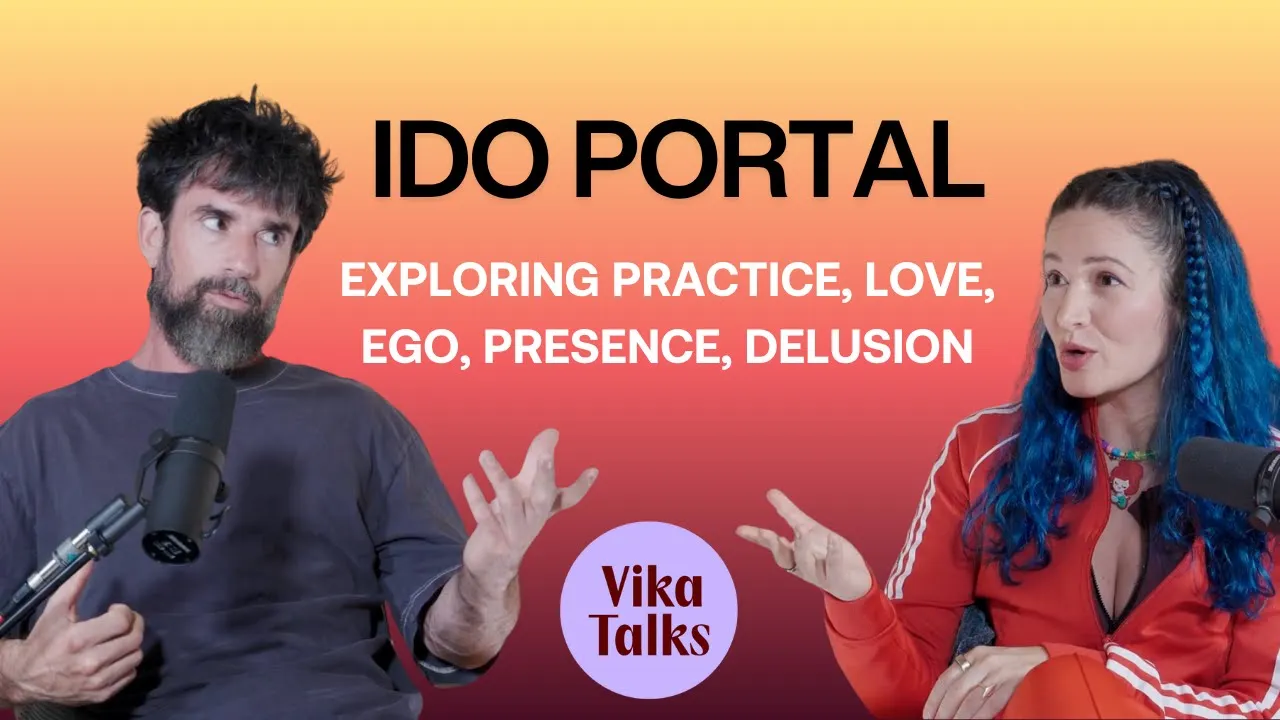
Hello wonderful weirdos. I am so thrilled to bring you another episode of Brave New Story. My name is Vika Talks and I am here with the inimitable Ido Portal. I have trained with him for a year now and this training has fundamentally transformed me on every level physically, mentally, emotionally, psychologically and I feel so lucky that for the last two weeks I got to participate in his European movement intensive. Now Ido has been training the greatest athletes of our time. most of which he can't even say, but some are Conor McGregor from MMA, NFL, NBA
champions, and this guy does stuff that 007 would be jealous of. So, it is my great honor to introduce my teacher, my friend Ido Portal to the show. >> Thank you, my dear. >> Thank you for coming back for round two. Round one was a frenzy on YouTube, and I Thought we would start really small, like a little amuse bouch for appetizer. So I ask you one question to begin Ido. What's the point of life? [Laughter] >> One little question. Um well think we talked about it last time a little bit. Maybe maybe to answer
it from a place of answer is not the best not the best approach or the most honest approach. Maybe better to answer it with a question if you could choose not not if you could um go with your desire a certain desire but if you could choose wisely almost like zooming out of yourself what would you want it to be about or what would it make sense that it is about and when I ask myself the question And in that way life is life is a school. Life is about an opportunity to transform Something to
transcend or else there is very little that makes sense here. But the change itself is so evident in everything around us that it would make sense that uh at least uh through the current prism that I have that this is what it's about. >> That's exactly what I was what I was pointing to is the word practice. Most people don't understand what that word fully encapsulates. And over the last 2 weeks when we were putting in 13-our days and 2-hour lectures, I started to understand that wow, practice is life and life is practice. And with
practice, all things are possible. And without practice, you're is a direct quote I took in my notes. >> And so, can you share what for those that have no concept of what practice is? explain it like you would to a 5-year-old. >> It's a process. It's not um a fixed entity or an end or a goal even or an end result or but it's a flow. It's a river which you you don't really enter but you recognize that you are in. >> We are processes. We are in practice. We are a practice. We are unfolding
unfoldings. Um and the practice as an approach is is a realization of that essence of life. We're we're not fixed. We're constantly Transforming, becoming and realizing and changing. But we tend to think of ourselves in some kind of a fixed way which provides that being in space and time. If I wouldn't have that fixed way, I wouldn't realize time and I wouldn't realize space as well as a result. So it's a product of memory. It's a product of you know having a past and a future. The practice is present. Is that present moment of unfolding
and changing which is never fixed, never stable. That's why we cannot grip grip it, have a tight grip on it. While the past we can relate to and we we can feel like there is a grip into it. Um like observing what happened to the past. It's it's a it's a it's a movie. It's a flick that we can watch and maybe it transforms but there is a certain sensation of like I've watched that before. I know that. And the future is An extrapolation which is also like kind of fixed. I I I create that
I project that and I have a relationship to that entity. The present is untouchable and the present is that practice. Then when you realize it, the next layer would be okay. If that's the nature of things and if I'm not fixed and I'm becoming um then let me enter and align myself with the concept of becoming Now being now living now not just existing and and having that as a primary interface to who I am. M and this primary interface to who you are, the practice being at the core of everything. What happens when we
try to say we're above the practice or we can control the practice? Well, that that's the that's the source of many of our illusions and and Unnecessary suffering and a wasted suffering and and uh we do have some kind of again we take that illusion of a fixed entity of an eye of um who we are what we are what we think we are of having a past which doesn't sound bad, but then we are we are our past only and and and that of course immediately, you know, has a terrible price to it. And
then a future as well which is no less um problematic. So yeah, that that leads to all those illusions instead of being like a child again. But with a core difference of an intellectual understanding, a deeper emotional connection and even an embodied connection to the concept of being in process, being in school, being in practice where a child it is a reality that is not like self-realized. It is there. It is present. That's the experience. Now when we reflect back to childhood, we realize that that is what was there. But then at the moment it
wasn't accessible to a certain to certain faculties inside of us. So not to be realizing that is limiting is narrowing down. It's um it creates expectations and broken hearts and disappointments and terrible agony and suffering. But not the direct suffering the ones the one that is so important For everything around but more of a man-made fabricated suffering this maya this illusion of all not the deep sense of the maya the illusion of the senses the the deep layers of the of the illusion which are also there but more the illusion of the human mind of
the of the discursive mind. >> Yeah. the ways in which we lie to ourselves was one of the themes that kept coming up. You know, I I went through 46 pages of notes yesterday and What I noticed was there was this uh kind of understanding that the ways in which we lie to ourselves frame our reality. And so for instance uh right before this intensive 5 days before I broke off with my partner and it was because he was self-d delusional and you know Alend Bhutan says on a first date we should ask in what
ways are you crazy and to that I say no on a first date we should ask in what ways are you self-d delusional because your Self-d delusion will ricochet and affect my perception of reality but the irony is we're not self-aware. aware enough to understand how we're self-d delusional. So what would you recommend as a path for heightened awareness of our self-d delusions and deeper understanding of the ways in which we are perpetrating the self- lying mechanism. >> It's a it's an investigation um maybe not investigation outvestigation. >> Mhm. uh also in also out maybe
both direction at the same time in the sense that we cannot we are the deluding entity we are the liars we are the lie and we are the ones being lied to >> all at the same time. So it's not as easy as you think even when you start to work with this concept because you keep on Yeah. you keep on making the maze more and more Difficult as you are attempting to solve it. >> Yeah. Um and hence this this starts to go into first very basic concepts of what we believe we possess or
have that are starting this whole process together. For example, like having a life. So maybe it's not the best to assume that you you are alive or you know you or you wake up from sleep. Maybe it's not the best to assume That you actually woke up. Maybe you're in a different dream. >> Or having stability like to say I represents that maybe you shouldn't. And there are actually very simple practices like that like not to say I for a period of time and some some traditions practice that and some took take it to very
extreme measures and um and having free will which is again like a big you know a big thing now more and More recognized and like supported also by the scientific side of things and Uh so all of these are related to the inability to come out of the lie and to see the lie to see the im the price of imagination. Um and and a practice is the discovery of all that is the empowering of things beyond you is the changing of your interfacing with the flow around you. Instead of like that those decision makings
that we we think we take and Those actions that we think we take you are becoming much more of a observer quiet observer but while remaining functional in the way that you were functional before and more. Not to say that it is functional, but to say as functional as you were before those realizations and inner workings and more uh capable of uh seemingly producing Capable of seemingly conducting a a chain of decisions and achieving certain goals. In reality, this is not what's happening. But by becoming more and more quiet and more observant while not disengaging,
not stopping, not trying to divert the the flow of the river, the current of the river, not to accelerate it, not to decelerate it, not to try to row upstream against improbable, You know, currents, but by staying afloat also. So not drowning in some kind of ways and and that allows us to start a deeper investigation and to put the foot in the door and to start to create the space between you and the inner lies. >> The outer lying is we are more aware of we the inner lies are much more trickier to work
with. >> Yeah. One of the things that comes up when you talk about that is this attachment also that we have to those lies. It's like a flavor of the week. Like which suffering do you prefer most? Uh do you prefer the suffering that you claim you've inherited from your family or your culture or your society that you can't break out of? And so can you give us an example of a moment where you recognized you were caught in a self- lie that you were Attached to this suffering it was feeding you and then you
cut it because you actually realized how toxic and unhealthy it was. >> Yeah. Uh for me it um maybe a big one was related to achievement and doing since the world around me through my choices again not real not real ability to choose or not not a real represent representative of a free will or a capability of doing but a a fake one a pseudo one. It gave me in the relationship to the outer world the feedback that I'm successful that I'm capable that I am achieving those things that I I'm capable of achieving physical
skills intellectual skills money financial freedom um relationships or or yeah whatever I was pursuing. So that became a very difficult lie and a and a deception to to work through uh because if I wasn't capable of There would be a certain you know at a certain point there is a certain moment that you say okay enough something is not going on here and investigate. On the other hand, when you are successful, you don't get to see that so quickly. Things are working. You gain momentum. You keep pushing in the same exact way even more. The
lie grows. The advantage is At a certain point with enough of these goals ticked and success achieved, you will realize the truth. Sometimes it it happens quicker to some people, sometimes not. I'm not always clear what is the in special ingredient that uh allowed me to see at a certain point and not stay further in this game. Fame, fortune, attention, it just stopped working. H >> it just it wasn't scratching the itch anymore and and and I was in that momentum. So it was it was there everything was calling for it. First thing that I
did in this time I stopped I became silent. I moved away and then I saw many things crumble to dust and many others. First I had to go through very difficult time where you're still lying to yourself in all kinds of the old ways But you are already operating in a new way in this silent way. >> Mhm. So then the pain increases and uh it pulls you back to your old doings and your old illusions and then if you work through that of course you get to see the other side eventually and you get
to be rewarded by not not that that is the thing but these rewards are almost like a calming medicine. It's not the goal, but it allows you to make another good correct effort on the chain To realization to to awaken from that slumber. >> That resonates a lot because I think like you, I was raised to be excellent. Um, it's the story of many immigrants especially who come to America for the American dream. And my mom used to say, "Vika, don't use the word try. What is this stupid American You either do it or you
don't. You do it excellent." And so my value was I got to be Successful, but I got to be extraordinary. I got to I got to be the best, the best, the best. And then I realized at a certain point when I had won all the awards and made all the money, there was this hollow emptiness. And so I I left and I backpacked the world for 28 months and I I got to work at orphanages through Southeast Asia. I got to really see perspective and I I started to think, wow, perspective is the real
medicine. On the drive over Here, you know, I was prepping and I was nervous and I look out the window and there's the Holocaust memorial in Berlin and I was like, "Oh, like those are our ancestors. We are their wildest dreams come true right now." And so what I found on the other side of chasing success was meaning. And I feel like that's what you're alluding to. But even in the training with you, I remember I was trying to do like a roundhouse kick and And I couldn't get it right. And you looked at me
and you were like, "Stop chasing success. Be a craftsman." So can you talk about that shift because it really helped me understand it's not about the accolades, the fame, the fortune. It's shifting from the mindset of success to the mindset of a craftsman. >> Yeah. Um well, in the beginning of that shift, you only know that your your relationship To an achieved outcome. So even though you change the outcomes, you're still relating in the same way. It's still the same interfacing. M >> so and then this kind of a mentality of facilitating conditions sharpening one's
sword not again not winning any battles sharpening one's sword or this craftsmanship idea or or you know you there are many names for it Many many ways to look at it This is starting to transform your relationship um to the practice and uh it is it's like a breath of fresh air when you when you start to get it. It's you you let go. You're not under the pressure anymore of the end result which is not up to you. Hence, it's an improbable, impossible pressure to take over you, which is not necessarily the bad thing
about it. I'm All about unachievable goals. It is about the fact that it is achievable potentially. The real trick like Bor says in in the shape of the sword or the form of the sword. Um he says um improbable or impossible goals are the only goals of any interest to a gentleman. Right? And that but but that's not that's not should not be distorted into difficult goals >> which is what we usually do in our culture. Those grinders, hard workers that are important. It's an important phase. We all have to pass through it. But if
it's just stays there, that's not what it is. That's not what is really the the gist of it, the heart of it. It's about relating without any expectation of reward. >> That is dismantling love to be capable of loving. That is dismantling practice or living to be capable of you know Being alive of doing. Doing without doing. By letting go of doing you become capable of some doing which uh is revealed to you etc. Yeah, let's let's talk about this grind hustle culture, the suffering for the sake of suffering that is actually quite devastating to
the psyche. What I really enjoyed when we were training was doing the horse stance and how you said the more you release, the more meaning you find. And why do You think that this movement of you got to grind, you got to kill yourself, you got to run 50 miles a day has infected the psyche of so many people. And what can we do to say suffering for the sake of suffering is not great, but suffering for the sake of self-development and meaning, that's what we should aim for. How do people make the switch from
one side of the spectrum to the other? It's related to all that we've discussed and it's a it's a minefield. All that You've just described now is a minefield. We got to really be careful when approaching this so we don't distort it in a new way but actually stay with the old way underneath the surface. Suffering for the sake of suffering. That's not what the grind culture will say they're doing. >> They're suffering for a very clear goal. For example, self-improvement which is not that much different than what we're discussing seemingly on the Surface or
suffering to become resilient or all kind but those are still goals and the example of the horse stance was such that I was offering it because there was no reward on the other side actually because many people take the horse stance and they offer the reward but Here I was physically on the layer of the physicality on the layer of that I disconnected it from the reward. Even though there might be some possible rewards physically I specifically didn't Engage with it nor mentioned them. And then I this strat I still connected um somewhere else to
a concept of working with suffering and with pain to discover to unravel something in oneself. I'm very careful not to say to improve oneself. >> Meaning can be fabricated this as a side effect but it's not for meaning. Um and that is a purity like a child playing with something and there is no winning there. There is just discovery. There is just craftsmanship. There is just play. It's pure. And then maybe but maybe not there would come some rewards in high layers like meaning self transformation transcendence maybe but it's very important for me not to
engage with it directly not to mention it even >> h so we might develop that pure connection and pure interface to that thing and our culture is uh not there. So everything seemingly is connected to some kind of an end goal and a result and everything is explained actionable bits and we've reached a place where suffering is acknowledged. We need suffering. Well, they don't quite use that word the same way that we do, but like for example, you hear neurologist like my friend Professor Huberman mentions limbic friction as a needed, you know, element or or
mentions all kinds of aspects of neurological development when you are doing something that you don't want to do. But if you do something that you do want to do to a certain extent that you connected it to a goal like I'm going to go to the ice bath and I'm going to get this. You will not get the same depth of discovery. Again I wouldn't say reward I'm I'm very careful not to say development that Maintain a purity that sits in the heart of the practice. So we must sever the ties uh that don't allow
us to engage in that way. Practice deeply should have no reason. That is that is something that most people are not ready to hear. So they must start by something like evolution of oneself discovery. But the the real depth of it is it Should have no reason. It it it shouldn't be this is one area one concept that should not be tied to the rest. And that is what empowers it to empower you back. >> It is not of this earth. It is not of this universe. It is not of this realm. It comes from
somewhere else. Hence it empowers you. That is what we had of that ancient primordial god. But we've made this god more and more human more time passed. And the same we did to Our religions and practices and science which is a new god a new face of god as as na said you know like we are orphans. We've killed God, but we haven't replaced him with something remotely ascapable to to to to provide us on the way like science. And um yeah, that that is that is an area that I try to keep very carefully
for myself and and to to to cultivate that that purity. H I think that really speaks to how obsessed we are as a society with Directing. And in reading my notes, they said the more you practice, the less you'll have to direct. And so what practice is to me is a physicalization um of the process. We can practice in meditation. we can practice with breath and the practice that we've engaged in has been very physical. And so when you gave the example of the parable with the chariot, you talked about why it was so Important
to connect the emotions through the body, could you walk us through that importance? >> First, regarding physicality, physicality is uh when we think of physicality, we think of it as a as a as an aspect of >> actually I believe this is a distortion. Physicality represents a totality. Physicality is more honest than saying Mentally. >> Mhm. >> Where is the mental faculty resides in the body? What is the brain part of the body? What is the nervous system part of the body? Maybe it manufactures certain layers which are you know of finer quality. But for
me this concept of physicality has been dumped down by the smart. The smart that are actually stupid >> that the smart that actually did not Understand the depth. Cartesian separation that as if hints that because we can distinguish between these qualities that they are separable. >> They are two different things. The ability to distinguish this is my knee conceptually but to know that realistically there is no knee. It is part of a a bigger thing. There is no separation >> or a muscle. I I take a biopsy and I say Here is a muscle. I
take a biopsy. I say here is a tendon. That is not a binary truth. That is not a black and white scientifically. It's a flow. It's a flow. So it's a certain percentage of muscle that we say okay we call this muscle because it's above 90 whatever percent muscular by definition by the quality of the cells but we don't we it's a it's a flow there is no place where it's pure tendon this is pure mus so our separatist state of mind have Deluded us into thinking we have a control over the pieces and that
they are you know they are isolated ated and the same thing happened to us on the level of our thinking or feeling um and the body physically. So physicality represents for me everything. Everything is physically. While here on this planet, your thinking, anyone that was involved with any heavy thinking knows how physically taxing it is, sweating, Burning calories, accelerated heart rates. You know, it's physical for me. That's what the practice is. It is about action. total action without any delusions of separation or isolation. And then especially because of this time and age and state that
the modern people come into, I take them into more and more Bodily oriented things to show them that their isolation has been misguided. to say you think you are capable of thinking let's have a look let's dismantle thinking and to show that in the in a certain aspects when the body is you know the battle's neck you are exposed for not being able to think as you do or being purely associative or you know otherwise or emotionally to show, oh, you feel emotionally stable. You're not in the mad house. You're stable. You're normal. And to
show how that thing crumbles very quickly within a certain physical setting, whether it is slowing down your breath or getting punched in the face or having to resolve a mathematical, you know, problem while other people in the room are competing with you for it or or disc or receiving words of criticism. them but in a certain aspect of the body where You cannot just say I got you. You got to show me I got you. And you can't show me I got you because you don't get it. >> So it's like you're incapable of solving
the coordination challenge or whatever. And I understood that from relatively young age, first intuitively and then later more and more that I don't want to be lied to by my own brain and I want that skin in the game to quote Taleb and I want that I want that feedback of the tasks the Problem solving and uh and life itself that is what is living about we have a different concept of living. We we've created this concept but living is about that. It's a heart pumping blood. It's like cut it open. What are you going
to see? Or another example, we think of life as butterflies and you know blue hair and you know great outfits but underneath the surface you know we are making excrements. We are pumping liquids, Lymph and all kinds of stuff and or take a take a puddle of water and take a drop of it and put it under the microscope. What do you see? Hearts and unicorns. No, you see everything fighting everything. You see the turbulence, the cha, but then you see also within through it some kind of a higher order, right? like some kind of
an appearing cosmos as the the Greek would say. Um and I think that that is where the the physicality question comes up or Sometimes I work with corporate people, big companies, people who people who are multi-millionaires and billionaires also sometimes and and I I tell them no this is a much more real way to engage. This is going to this is much more practiceoriented way to engage. Don't get it wrong. It's not about doing handstands or, you know, doing push-ups, but they can be used to tie together a lot of skill and a lot of
uh possible discoveries that you're Going to escape in the modern way and state of mind. controlling what you eat an interfacing and and a and a challenge that is almost always present. I never I never took too much stock into those who could not show a control over that. Not a control, not a not a some kind of a you know totalitarian control, some kind of a willingness to interface with that with the difficulty. I never took stock in those that were not offering some kind of an effort to Resist the illusions, the self illusions
and the lies. >> Wow. There's a 14 different directions I could go from here. Um, so one of the things that that we talked about in class was homeostasis. And when you're working with these high performers or you're working with your students, all of us share this basic biological mechanism of homeostasis. How does the practice prepare us for understanding how to maintain Homeostasis internally while we're operating in a world of poly crisis? >> Yeah. It's it's not just about maintaining homeostasis. That's not and that was something that was discussed and mentioned by the early researchers
and the ones who conceptualized this and the work of Hanselia etc. But actually what I believe in it is very important to come out of homeostasis. >> There is no discovery there is no evolution there is no there is no Movement there is no deep change without coming out of homeostasis. And homeostasis is not a fixed point. It is a a boundary. It is a buffer. And still you you got to sometimes come out of it in order to formulate a new homeostatic point which is more different and and and allows certain areas to to
to be revealed that were not capable of before etc. So the practice is both about achieving homeostasis, regaining homeostasis, but also Destroying it just as much. And that is why it's confusing for people. And we've received these like pseudo practices like the practice of longevity, the practice of health, the practice of success, whatever that success is, the practice of physical skills, the practice of football, the practice of yoga, the practice of whatever. But then actually when you observe it, these are just establishing a certain homeostasis That gets you stuck eventually. and and you become a
slave to that field. So I'm becoming the best football player in the world but limiting my humanity. >> Not that football is the evil. You can use football to become fully realized person but you should realize which football practice is that it's very different practice. So or business success business world can be a microcosm Of a true evolution but you know we don't usually use that cuz it's a high stake thing. There is emotional demands there is bodily demands. There is um interpersonal communication demands. There is focus and mental of course qualities. It can offer
a lot. It can be a a practice, a good practice. Baking bread can be a good practice. But we become corrupted by the goals and we become better and better successful in the field but Actually less and less successful in being ourselves >> in the deeper sense of yourself. And homeostasis is related to all of this. When people achieve a certain homeostasis, another word more grand word is equinimity. Mhm. >> And then that equinimity become it can become a tool or it can become the worst trap, >> the last escape door from the real path
just before you actually get into the The deeper end of things. And you escape there through this door by being aquinamus. And the sign of it is of course there is clear physical signs. For example, the body is being neglected many times because you are beyond the body. You're aimous. And then certain doings, capabilities of doings are also becoming not present. You disengage. You don't need to do. You don't need to Achieve. And it's true that there is a lie in the doing and achievement but by interfacing with it there is great discoveries to be
had. So an example a good example of that is my mother who is quite economous as you know you know her personally yet at the same time uh being in her mid70s she is still coming to this crazy events sleeping sometimes two three hours a night she had some she has sometimes insomnia while traveling or you know Just the difficulties of older age and still pursuing things with a huge green on her face. I know a lot of people who pursue but without a green and I know a lot of people with a green that
don't pursue. But the two together that's a huge inspiration for me. And that that that smells to me of the real equinimity, the real homeostasis, the real resilience that enables one to challenge oneself even more versus escaping the challenge. As many of our Awakened people, spiritual people present that image. There is no pursuit. There is no need of anything. There is no no need to push. All is good. So if all is good, enjoy what you've been given here, this opportunity. And the opportunity here is an opportunity of interfacing with all this beauty and do
it in the best possible way or disengage altogether, move on to the next life. M >> but there is something that speaks to me of that last escape door When you are not doing that and when it becomes equinimous but also not related to any doing or capable of absorbing and transforming suffering >> right >> which is what we are mechanisms of the transformation of suffering >> mechanisms of the transformation of suffering. It's hard to talk about about success or suffering without talking about ego. And there is this movement that the ego is the enemy
which I don't believe and I don't think you believe. I think ego keeps us alive. Too much ego, anything out of balance is a disease. So it it feels like what we're actually aiming for through practice is a a diminished sense of ego. Can you talk more about that? Yeah, I I also don't believe in that. I think also it's a it's a oversimplistic state of mind. First, the ego is a division. It's a division that was used and and conceptualized by Freud. And there are many ways to divide the cake. So, it's like we
take this cake and we say here is a piece of the cake. It could be shaped very differently. >> This is just a way that you cut the cake. But if it's cut like that and offer to you, you might not see that. >> So the ego is some kind of a division, some kind of a part of us which is relating to functioning actually. That's The that's the functional side of it. Or else how would it catch us so much in such big traps and in these nets that it does catch us? It is
because it is a very important functional bit that has to react to various perception and inputs that are coming in and it's tied together with it and it is supposed to do that. you take a breath in um and you stay alive and you you know you do all kinds of instinctive Functions also because of the ego and again the division of it might not be that Freudian division but I want to offer it because it it it does teach something why am I breathing in why am I taking another breath there is a suffering
that arises. Science will tell you CO2 levels are rising and that creates the need to inhale more or right now. That is a certain interaction of the System. Right now you are cellularly unpacking things. certain cells are dying and others are you know reproducing and we're clearing byproducts and moving how all this magic is happening there is a program that has to run inside of you just like on that layer there are these programs running with full autonomy right you're not busy right now managing the cellular cleanup >> you also have the same functionality happening
on a psychological ical layer And that we call ego. >> The realization of oneself, the protection of oneself, the ability to shrink and to expand, the ability to interface with other entities and create multiplicities or to separate and become more mobile and more and less um costly unit of operation. The ego is related to that. So the diminishing of ego is a concept which has in its in its source like in like truth and and and well the word truth is Not good but it has some kind of um an observation in the heart of
it which our egos these divisions took over and became dysfunctional units. It's not it's not anymore about Vika being functional. The personality of Vika is an important coat. This ego is an important code that makes you functional etc. But now we replaced that and we think that this personality is our individuality >> that it is our true sense. And these words are different. They are touching one another. The example is you put these clothes on and they they are not you in some kind of way but they do take the shape of your body >>
which I can see and then we confuse and we say that's me >> because they take the shape of your body but actually they're not you. Your body underneath Is shaping the outer layers. Those personality layers. Your true individuality is something that we don't even know is something very deep inside of us that is surrounded by this ego and personality and takes a certain shape. Like for example, you can see in my eyes or on my face my individuality. It is expressed in the physical form and in the way that I use words, expressions etc.
But this is also interfacing with functional Layers of personality and ego which are also touching it. So that's part of the practice is to to discover what is what and to see you know if we can distinguish and dissolve certain nonfunctional bits that must be let go must be dissolved destroyed that are not contributing to us but we've created narratives around it I that's why I'm successful that's who I am or the question comes if that's not who I am Then who am I? I'm lost at sea. Instead of seeing the beauty of that I
who am I? I'm lost at sea. We become afraid. We go back. We hold on to that lie to that fabricated thing. But it's at least give us the illusion of a fixed thing. >> It's the disease of nostalgia as you talked about. >> Definitely. That that's that's one that's that's an example of why we love to become nostalgic and to hold on and we hold on to our memory to our past. I Am not my past. I am not my memories. I am now here >> and process unfolding. But we can't feel that. That
scares us. Who am I? Who am I? I can't touch it with the the same intellect. So I prefer to revert back to that poor thing which is my past, my personality, my ego, etc. >> How much of that do you think has to do with our inability to navigate uncertainty? >> Yeah, very much a good point because as I mentioned, if those areas were not functional, >> right, >> we wouldn't be caught in them. So the the turbulence of life and the need to remain functional and to operate within chaos and with within uncertainty
forces us to use the ego. When we use the ego, it tends to take over as it is it is only capable of helping us to remain functional because it has the ability to take over. It has the ability to lead the whole ship but then it doesn't give its control away again. So the more under stress and duress you are the more difficult it is to see beyond the ego and to and to work beyond it because it keeps you keep that resource and and you got to learn how to use other resources to
work with certain difficulties etc. which relates to a lot of the things that we were doing physically this week. It's like do it, But it's not just about how to do it. That's the Instagram, the social media problem. It's all about the what what what everybody is looking at what. But actually the the how is not how. these tutorials or these, you know, quick advices or these slogans or these podcasts, they seemingly talk about the how, but it's actually a what, a distorted what that became the how. The how cannot be transmitted there. So, it
is not Present. It's just a whole new world that we fabricated in a certain transmission. I now when I'm next to you and I smell you and I see your facial expressions and I feel some kind of a vibratory thing maybe and there is this interpersonal space and there is an exchange and we spend two weeks now being in effort together in shared agony and shared laughter together. Now there is certain transmission possible without it. Don't lie to Yourself. This transmission is not the same. And we totally replaced this basic layer of being here with
that layer without realizing the cost. >> It keeps on corrupting us. It keep pulling us back towards this direction and telling us there you go. Here's another like. There you go. Here is some attention. There you go. Here's another dollar. There you go. Here is a sweet treat. And we kind of were programmed to work With it. We are programmed for that. But then we we stop interfacing with something like meaning. >> I have no meaning. It's like I'm getting all this stuff. I keep scratching those itches. But then certain other layers which are supposed
to be the base are totally gone. So the pyramid is upside down and we're standing in a very shaky and shady place where we seemingly make progress as human beings. This is just a technological progress and as human Beings doesn't look like we've made a lot of progress. If you look at the state of war, state of the world, state of how we treat each other, state of, you know, deep realizations, we're not there. But it looks like we're peeking behind God's shoulder and looking at his notebooks and we're about to discover, you know, we're
about to create just as that that creative quality can. And we we are totally on the opposite direction in my eyes. >> Yeah. I agree. It feels like death by a thousand distractions. And you were saying how it's all of these innocent small things that are robbing us of our lives like the Harry Potters deeply entertaining, but then we don't make time to read Bour. Can you talk more about what are the ways in which we're being robbed by these thousand tiny paper cuts? Yet the big ones, the big the big evil things are easily
conceptualized and some places and Cultures and people are suffering from those. But then in the enlightened world, we should be careful from something much much more present. Those these little innocent things that are robbing our attention, our focus and our meaning. I don't do any wrong by you know putting something on Instagram and getting my likes and interacting like this. But in reality we are Destroying ourselves the next generation. We are robbing ourselves from very basic skills that seemed innocent but are related to the ability to live our life to the fullest. we have used
technology in all the wrong ways because we we are corrupt. So is a very quick slippery slope in that regard. And I think mentioning it in relation to the innocent things is very tricky because people are kind Of willing to accept the big bad, you know, villains in the story, but they're not willing to accept that they're little innocent vices seemingly or not even vices. That's the thing. It's like it's not even a vice. But that's where a lot of the suffering comes to our own and the ones of others. And this indifference is much
bigger evil. And that's the opposite of love, not not hate, right? So yeah, I think there is a personal Responsibility there that has to be applied and practiced. It's not something that okay, I heard you. I know I'm going to make a change. It's more in relation to how am I going to practice my way out of this to be able to see deeper into the not so innocent distractions and you know yeah meaningless things. >> What is something that you've given up that has been an innocent thing? >> A lot of things. first I
don't I have never had a TV really since childhood you know so that is one area where it's it was just like it wasn't there and then a lot of since I was 15 you know for many decades now I've been controlling what I eat in some kind of a way not overly controlling but not underly controlling never releasing in every meal there is some kind of an interfacing even when I fell down and chose wrongly there was an immediate you know uh Realization of that so that's I've been doing most of my life and
great working with my laziness and with my great fatigue people have no idea how much I have been struggling with with working against my own laziness and fatig fatigue because I've been doing it for so such a long time and I've been able to be functional in a positive in a relatively positive productive way when compared to the world around me. So they they assume That you know there is not much struggle there. But these are things like my laziness is there present every day even after all this time and incredible fatigue and difficulties and
darkness and and addictions addiction to you know it's a concept that is applied everywhere. I I was never into the addicted to drugs or I never drank alcohol or smoked but addictions appear in many places and even the addiction to the body and the you know and uh ident Over identification with the body that's an area and and I can go on and on and on and it's it's always a struggle and it's always a struggle of realization or and observation first and then working you with it. >> What I appreciate most about you as
a teacher and as a human is that you show your humanness. You don't want to be pedestalled. And so, thank you for for sharing that because I think people see you and they think, "Oh, he's a god. He Has no struggles. He has no flaws." And actually, this practice is your way of navigating all of the things that make you entirely human. Thank thank you thank you for saying that I I I could not do that. Um, and maybe I'm incapable of doing that as deeply as I wish. And many times I simply forced myself
to do that in some kind of a way. Which means it wasn't a decision that I took just out of, you Know, like for example the white hair or the wrinkles or, you know, not to not to do that, not to hide that, not to not I I made it a point to show that or my aches or my pains or my uh or my or the tiredness of my eyes or whatever it is. Um I it was important to me to force myself to first to fake it until I make it to show my
weaknesses to speak of my struggles to it. It it wasn't easy. It wasn't something that I I just decided And I did with a full heart, a full ego, right? Not a heart. But uh with time, the more time it passed, it it it gave back to me and it took away of a lot of the wrong people around that were not really interested in the truth as I see it, in the practice as I see it. They were interested in some kind of an immature super picture. Um and yeah, it it gave me it
gave me a Lot back, but it it was a struggle. And so, thank you for acknowledging that, for whatever part I am to be acknowledged for. Yeah. >> Yeah. Well earned. We'll be back for part two after this brief commercial break. What would it feel like to tell a story in a way that pulls people in? What would it feel like to feel comfortable in your skin when expressing yourself? What would it feel like to know that you had the right story at the Right time to the right audience? It's all possible with training. My
name is Vika and I am the founder of Brave New Story Advisory where I've been helping executives and entrepreneurs for years craft and tell narratives for impact and influence. I have a course coming up and I'd love for you to check it out. So go to bravenewstory.com and send me a note. Looking forward to it. Welcome back to Brave News Story, where Part two is going to go a little off script of what you would typically expect. We're going to talk about the stuff that I live for. Words, language, narrative, love, and relationships. This is
going to be about the intersection of relational intelligence, emotional intelligence, and narrative intelligence. So, here we go. Ed, last year you did something that was such a gift to me. You let me share my teachings with you. And the response was That people wanted more of that. And so I was wondering if we could do it again because what I've noticed in practice is that we're pattern-making machines until we disrupt the pattern. And so much of the stories we tell ourselves are delusional and they're not true and they're really devastating to the psyche. And so
today we're going to go through a process that I do with my students and sometimes it's executives, sometimes It's entrepreneurs, but it's always people that are seeking for something beyond the known. And so this process is really about recognizing just like nature, there's creation and destruction and it's always going in a cycle. Instead of staying static in our stories, instead of creating this complacency of, well, that's the way things have always been, what if we could take a story and bury it respectfully, be grateful it happened. And by killing that story, we're actually giving birth
to a brave new story. And so I'll do this exercise with you because I'm gonna put skin in the game. So on one sheet of paper, go ahead and write at the top. This is the story that's going to be buried today. Okay. And on the other paper is if you imagine your life to be a garden and you've just pulled out this weed of a story that's been sucking out vital Nutrients in the soil of your soul, there's this gaping hole and imagining that this ephemeral creature, your ancient elder, taps you on the shoulder
and gives you a little seedling, a brave new story. What holds that seedling? What story are you going to put in the soil where the weed used to live that is going to grow with your attention, with your focus, with your dedication? This is your brave new story. Beautiful. All right, you want to go? >> Yeah. Uh, I actually pulled a trick this time because it's a somewhat of an important trick. uh something that I also had quite a few discussions with my mother this past few weeks. So um what I choose to bury is
the story itself, the concept of the narrative of I am a certain narrative or I am the storyteller or even the narrative is more me than I think. Than what I think is me >> because it wouldn't make sense to keep on replacing stories again and again and again at a certain point you see beyond it and then the other the brave new story it cannot be a story so that's a that was a made me wonder you know and thank you for that you know because then I could have left the page open. That
was one thought. And then I thought maybe that's a copout. And then I said maybe the question mark is would be >> a replacement of that because both the emptiness of the page and the question mark are not really narratives or cannot function as narrative which is what I want to achieve. But then I chose this um this symbol combination of symbols which I kind of changed slightly from um Uh from a concept of language that contains only one symbol. Um and the idea here is the circle represents observation. The marking of something as separate
separation and the act of observing observation itself is a circle within a circle. And that's a concept that um has been developed and And worked on in a book called the law of forms by um certain mathematician that uh worked on it and it impressed me when I saw it. He doesn't use the the mark of a circle but he uses the different mark some kind of an angle but which I see the benefits of but for the sake of simplicity I use circles and I created the circle within a circle observing the act of
observation itself equals Nothing >> nothingness the fullness nothingness the the shunata the that kind of a and that is really the only acceptable story that that I wish to interact with and that I wish to to possess. It puts the responsibility into the observation but it disarms the illusion and it shows how it gives rise to illusions and that is something that I wish to take over the narrative. And to to die as a narrative and to be born as a as a witness or to be born as an observer and and and one must
die first in order to be born. We discussed this the last time. So maybe that's more suiting and that's a pursuit of the whole lifetime really and something that I wish to interact with. >> Mic dropped. the show's over. That was, you know, you said something that uh all the models I worked with were were wrong, but they all worked. And I think About that with storytelling. The more I teach storytelling, the more I teach communication, the more I realize it's actually the invisible. It's actually not about definitely the top 10 hacks to be a
better storyteller or even the deeper versions of identity level stories. It's how do we disengage from the attachment to always make everything a story and and you captured it so beautifully. I'm uh probably a few decades before you in in my releasing Statement. But um for me the narrative that I would like to bury today is that I will be devastated by this breakup and it will take me years to come back to myself. Uh it's very hard for me to open my heart and I'm having um an experience where I I realize that if
I if I don't see the wisdom in the pain, if I don't see that there's a tremendous amount of lessons, I'll just shut myself down again. And so the brave new story is that I trust myself in love. I trust myself to love and I trust my discernment in finding who will love me. And that's not something that I could have said 11 years ago when I was in a fairly abusive relationship. And so that that feels like a more generative narrative to live by. Um yeah, so that's mine. >> Great. Great. I love it.
I love it that it's also pragmatic and honest and Humble and what you and you know it's it's we're all works in progress like under construction and and um that sounds like a still a letting go of as long as the hand opens and something can fly out of it instead of grasping for a more elaborate story, more detailed story, you're on your way. And I think like also also what I mentioned it's it's not uh to to easier said than done. It's uh to to to put it there is one thing but uh to
apply it every moment And you know to apply it in into my days that's a that is the real thing that is the real task that is the real practice. It it feels monastic. It feels almost impossible which you said is the highest goal to attain. And I wanted to ask you what is an impossible goal for you. >> The monastic side takes it into the possibility. I believe it's beyond the monastic. >> Okay. >> I believe it's to be the monk in the city. >> To be the monk. >> To be the monk in
the to be the monk period is achievable. Okay. that it's a hard thing to do but it but I am I have glimpsed to for myself that a more suitable thing would be to remain in life um or or to be of life but not to remain in life >> or you there are many ways to say it. There is one version by Oshu and there are other more ancient versions of that. But understand it however you wish but it is it is not to disengage with the the currents around us and with what is
unfolding. It is not an escape route. It is not a copout. It is not a changing of the outside scenario but it is an obligation to observe in a passive active way. Not in a Passive way purely as we usually understand passive. There is some kind of an interaction with the opposites. There is the oxymoron that you become because it's full of activity. It's actually very active much more active than directly engaging with the activity >> and I think it's just um represents of the practice. Yeah. For me. So it's something that I wish to
declare even if I'm not capable of or maybe I'll never be capable of maybe It's not something like you said it's not something that one can be capable of but I wish to devote to I wish to cultivate in >> Thank you. It feels like the image that comes to mind is yourself as an empty vessel with all the floating outside of you. Yeah, there is a there is the emptiness that enters within you and also again there is a fullness in that emptiness and you're becoming a conduit and you're A transmitter for sure. You're
allowing things through. >> Yeah, >> you're not doing but you are still actively allowing things through. You are becoming transparent gray on gray. >> Yeah. Yeah. So, the thing that really struck me was your your kind of lovehate relationship of words. On the one hand, you love Bores and he's a master at the craft of words. And on the other hand, you acknowledge that words are incredibly limiting. They're like blunt force objects, rocks that we're supposed to eat with. And the language is all we have. So how do we navigate the limitations of words as
we try to understand ourselves and understand each other through the process of language? >> First Bores was one of those who realized that a man of words who realizes the danger of words and was Warning us against it as Yuki Mishima as others as well. Um you know this has been discussed by philosophers and authors etc. philosophers of language this is one thing but to be an author to be a you know and to warn against words that's another um so it's not something unique to me by any means it's something that I took on
and understood and I think it all starts by realizing the danger >> realizing and respecting the danger of language and words how they took the center stage of our being that not much exists in our day-to-day moment to moment perception besides words and that's a devastating thing and then we keep on empowering them more and more and more and moving into that direction. So that I think is the first part and you know again one more place When I prescribe non-verbal experience bodily experience action behavior modifications observation all these tools that are nonverbal non-discursive or
at least they point at that direction and they facilitate conditions in which less prisons are being constructed by your words and your concepts. Um that's then that's I think the starting Point is to realize that to educate oneself to see the the the true nature as Mishima says that the true nature of words to reality is not that of the nitric oxide, the nitric acid and the copper plate. where both of them are extracted from nature. But words and reality have a different relationship. They are more like the stomach acids and the stomach itself. >>
They are extracted by the stomach but they are capable of destroying it. And as reality gave birth to words, words have a certain power to corrupt it and to destroy it. And that that I think is a very important warning from a prodigy of words, you know, from a prodigy of language. And Bores does the same in, you know, many of his uh short stories and, you know, his work with the concepts. >> So words are flawed And stories are flawed and language is flawed. Flaws, flaws, flaws, everything's flawed. How do we come out of
the the broken systems that we are given? >> They're flawed. Everything is flawed which is not wholesome. >> Yeah. >> It is not a wholesome entity. So we cannot replace reality with a partial entity. So they're not any more flawed or less flawed than other things, but They are now much more present and take precedence. And so their flaw is becoming more and more painful, more and more generative of evil in its true sense of the word and you know etc. So how can you interact with something else? Well, more wholesome interactions >> becoming more
balanced in your interfacing with things with reality. becoming more observant of other layers inside of you. Giving them room, giving them place To arise, giving them reasons to be there and not just hammering oneself with words endlessly, ideas, you know, and then of course realizing that you are becoming emptier and emptier in the bad sense of the word, lacking of meaning, depressed, distant, uh or capable of distracting yourself from seeing that still by all kinds of modern means but deeply devoid of any Essence. >> It makes me think about essence in another way. Uh when
you were giving me good sage words about my breakup, it seemed like you had a totally different perspective on romantic love. So, I want to segue into kind of from the intelligence of words to the intelligence of relationships. You have a beef, it seems, with romantic love, or at least in the way that it's prescribed in modern society. >> Yeah, we talked about it last time quite a lot. You you you asked me about it and I think we've romanticized love just like as we romanticized everything else. So it's it's not a unique thing romantic
love is we romanticized a lot of things we extracted and isolated these things and um this is not in a deeper sense of the word any love we are not seeing the truth of that romantic love >> right >> you know it reminds me of the all children's question the the the the riddle the childrens ask themselves and I'll ask you you know and and it's it's so simple yet it it points at something. Does the fisherman loves fish? >> My dad was a fisherman. Uh yeah. Yeah. He really loved his fish. >> So why
does he catch them? >> Because he likes his pleasure more than He likes his fish. So >> your first answer is not >> okay >> and our romantic love is >> mostly stands on that place >> right possession >> that's one aspect of it >> and there are others and we want to it's just an extracted pleasure for ourselves. This is not but but we know other flavors. The the most common flavor, not everybody knows it, but it's pointing the right direction, is the love of a mother. That is not representative of the same thing
you when it is there, when it is because what does the mother wants the perfection of her daughter or or son. >> Yeah. Well, that is often again distorted. She Wants her concept of perfection. >> But in essence, if you take it into the black and white, the love of a mother should represent I want you to perfect yourself. >> Mhm. >> Well, the perfection might never be achieved, but we can say discover yourself. >> Yeah. discover deeper essence, evolve oneself, >> understand oneself, >> understand more oneself even if not totally. That is more of
a concept of love that I wish to stand behind. I I'm I'm not confusing the fact that my my dick stands up for romantic love and I shouldn't confuse my romantic love with that concept of love >> and there are three different entities and all of them we can use the word love to connect to even the first one we put the words sexuality or attraction but it's physical expression of a certain Type of love. The second one is a emotional love. We shouldn't even it has been romanticized but it is an emotional one and
it is related to the gratification of one's emotion not for the other. And the third one is what we should actually use the word love period for. Now we don't know that. So you know or we know it but we don't. We aspire for it somewhere back in the back of our head but we actually interact with Something else. So we never choose to love really which is essential these two words choosing and loving and we are still bound by that corruptive you know concepts. Um now the good news the coming news is it doesn't
have to be ex exclusive. So you can have a certain rising of emotional content you know emotional love and you can have physical attraction but without the conscious choice on top Of it those will be totally corruptive and disruptive become possession become hate very easily. So our real work is to choose to love whether it is accompanied by those other layers or not or whether it precedes it or following it. But at a certain point you must address this in your life. Love is nothing without choice. And romantic love the last thing that you have
there is a choice. the last things that you Have there and very very quickly he turns into the fisherman that we say clearly yeah fisherman loves fish but actually he he kills the fish you know and uh and that is um that's not really you know again it's oversimplistic >> I don't want to I don't want to present it as the full picture but I think it's an approachable way for people maybe to relate to >> so this makes me curious have you ever Chosen love. >> That's that's part of my practice. Yes, that's part
of my practice. And uh I'm trying to engage with it all the time to love the people around me um to love my partners, to love my you know my teachers, to love my students, to love my mother, to love my my father, to love my you know siblings, to to love to love the the person at the shop, to love the the person who did harm to me. So this this is actually one of the most Profound gifts you gave us in class. Your practice of loving those who have harmed you. Can you share
that gratitude practice? It really like blew my mind. Uh yeah it's it's um it's a practice that one has to engage with gradually and I believe it is more advanced phase but you start by cultivating the love as a choice which means I choose to feel love now and I cultivate this entity inside of me just like a switch just like a muscle contraction that I'm Capable of bringing it about. It's not just the romantic love but it is meta that that loving kindness kind of a thing which is a lot more pure and then
I direct it in order to to ignite it. I use the the connection between the thinking faculty and the emotional faculty which is some kind of an imagery right imagery is very well suited to connect these two entities. If I'll think feel love, feel love, feel love, nothing would happen. But if I bring about some kind of a an impression, some kind of an image, then I am actually capable of maybe starting something and this is a lot of practice. This is not happening the first time times that you're doing it. You got to do
your time, devote your hours. Then you're capable of directing it into simple objects, familiar, friendly objects. Maybe it's a baby, a baby's image, holding a baby in your hands and Seeing his face or a puppy. These are often the the the way that it is being taught within a Buddhism, for example. Then from there you start to direct it to more complex objects that you have more complex relationship with eventually into those those people that you don't have any potential negative interactions with. From there you take it on to people you do love but you
have potential inter Like romantic partners that's even more complex. From there you take it into the indifference or people you like. You can take another substep people you like whatever that means not love. And then from there to people you are indifferent to the the shopkeeper and from there to people who did harm to you. And that's where the the real power of the practice of this gratitude practice shows its real face because That represents of a real choice and of a real dissolution of some part of us which has been harmed has been rigidified
has been contracted and that opens up a big space and even I try to take this practice into the people who do harm. harm to me still. So that's even more like that is still going on. There's still somebody wishing bad for you and damaging you. And of course this decreases tremendously your own engagement with wrongdoing towards Others naturally by realizing how much effort and how much pain you're experiencing there and cultivating love towards that. And so this is a practice. This is a very powerful practice. It's not something that you do and you finish
and you you you you engage with it. You do your due diligence, you know, you you interact with it. You you go on retreat. Sometimes it's whole retreats of doing this. Take 10 days and you you practice this 10 12 hours a day and then you you Still do it in your daytoday to a certain extent and and on and on. >> No, it's it's absolutely incredible. You said like it won't happen in the first hundred times, maybe the first 300, but a thousand times of giving gratitude to those that have harmed you, you'll see
a shift. Yeah. The practice teaches you that, you know, that without having all those simple practices throughout my life, I wouldn't have had the understanding and the belief that one Can cultivate such a gratitude. But the practice teaches you everything is practicable. Everything is malleable. Adaptation happens on all layers. >> So I have a bone to pick with you and you said it early on after your mom quoted something brilliant. The most egotistical thing you can do is bring a child into the world. The least Oh, that was you. The least egotistical thing you can
do is raise it. >> That was her. >> That was her. Okay. So, it was it was a sandwich. Um, and and then you very openly shared how you're not even sure if you can wrap your head around bringing life into the world until you're at a specific place. And the reason why that struck me was, holy you're one of the people that should be bringing life into the world because you do so much deep work on understanding yourself. And second, one Of my best guy friends in Lisbon, Russ, echoed the same thing a week
ago. And so I was like, "Oh, this is becoming a pattern amongst very intelligent people that I really respect." Which is ironic because people are having kids left and right when they don't even think about it, but the people that are really thinking about it are terrified of it. So can you explain that paradox? >> I like that second part. I I I don't I Cannot accept the first one. I I'm not I don't view myself as one who works on oneself more than you know more than others in in or see some kind of
a an even an advantage in that. I don't think this advantage should be any motivating factor nor do I sense it. I am I am uh as everyone in in in the in the I interact in my way the way that I view things, but I'm not superior to anyone in this interaction. And I'm I'm not Trying to pump something up or to or to speak in any kind of tricky way that actually means something else. I really mean that. I really mean that. But but to but the second part that you said is more
humble and more like true and that is if a lot of times people bring children into the world haven't devoted a large process to that it is in the momentum of life. certain pressures, biological pressures, Uh certain timings, age, certain behaviors, growing up in communities, your your own parents, etc. And I think that is um not a good place to involve another entity into. I'm willing to sacrifice a lot of myself, but I'm not so quickly will do that with another entity that I'm going to bring about here. And until that is not resolved and
that remains an open question and an inquiry from me, I Prefer to take the burden of not bringing a child and maybe even missing a window of bringing a child but remaining honest with that side of things. That is not a decision. That is a decision not to make a decision >> which is making a decision >> which is making a decision but it is a decision in the present moment. >> It is not a decision that is fixed. >> It is an open thing that until it remain open I cannot act as if it's
not an open thing. I will not. I will not. And that is maybe the only difference in that regard that I've I've put some thought and idea into it. And maybe, you know, maybe it's my own weaknesses that allow me to do that easier than others. Maybe that's just my orientation. But it has satisfied a certain calmness inside of me, certain and and I've and I've I remain with that inquiry And that openness. For the record, I think if you do decide to be a dad, you'll be a phenomenal dad. And I'll basically >> Thank
you. Thank you. >> Um, one of the things that surprised me about the practice is how deeply interpersonal it is and a lot of work on reaction, a lot of work on being able to create the space between the impetus. You know, Frankle talks about this and And just sit with it, observe the self, and not have a knee-jerk reaction. And I I found myself doing this with my mother and you you with your mother. It's it's the ones that we feel the safest with often are the ones that we react the strongest to, which
is a shame because they take they take it and they shouldn't have to take it. So, so can you talk to me about how the practice focuses on non-reaction and observation as a means of building deeper relational Intelligence? >> Yeah, non-reaction maybe big thing. Definitely that's the direction but maybe we will never achieve it. Maybe this is a bit misleading to but let's say delayed delayed response modulating the reaction foot in the door. I like to say foot in the door. Um when you conduct such a relationship you are good to go. You're in process.
You you don't need to look for a certain Achievement. You need to continue to unfold that process whether it will achieve non-reaction nonattachment. You know that is great. I don't know if it's achievable physically in this world. I don't know if it's achievable on any layer. But I know that delaying the response is enough to modulate it and for good things to come out of that discovery, you know. So I think that we have a lot of redundancy in our system. We have a Lot of entities running parallel. All of them are capable of leading
the whole system and taking over. The reason is we live in a volatile world reality. We are also encapsulated beings of a sort. We are connected but we're also separated. This means that we have an inner environment and there is the outer environment. The inner environment means that we have to maintain homeostasis. We have to protect the inner environment Because the outer environment is representative of change chaos. In order to do that we need many systems. So if one system fails another system will take over. This give birth to redundancy compensatory systems. That's a very
quick way but condensed way. I put a lot of concepts in there. Maybe people need to hear it a few times or write it down or make a mind map for themselves to get it. Now this is our situation redundant containing of many Different systems running parallel capable of leading the whole entity and taking it somewhere. For example, emotionally I can be touched and this takes me one direction. But then with the intellect I can sometimes catch it take into another direction and then you know the body and there is instinctive functions and all kinds
of things that take over and do things. So I'm I'm much more complex than what I think I am especially in relation to the word I. That's the lie. There is no I. There is man is a legion. So there is multiple things happening taking over and no stability because redundancy. Now you understand reaction. Now we can start to understand reaction. All these systems are connected to the outside through input. When something happened, they should be able to respond to that input. They React. These systems are protecting something on a very immediate and shortterm thing.
Some of these systems are incapable of mod modeling something more complex, long duration, you know, our lives, our philosophy, our what, our why, our how. So, they're just all the time jumping and reacting, jumping and reacting. You hurt my feelings. Boom. Actually, if you think about it, even Something as simple as you hurt my feelings. If what you said is correct, I should take it and work with it. This is great. I shouldn't be hurt. If what you said is then I shouldn't be hurt by it as well. So why am I getting offended? This
represents of a certain reaction. It doesn't make sense. If you look at it, it does not make sense. The same thing happens with all kinds of unpleasant things inside of us. They they do not have much more use or Meaning than modulating a certain behavior in the immediate sense. I am uncomfortable sitting on the chair. I shift to a more comfortable position. I become comfortable again. >> Mhm. No, we are now shifting in the chair endlessly with no relationship to the discomfort. We are all the time uncomfortable. This is the hijacking of reaction instead of
placing reaction where it Needs to be. This immediate thing. Why am I offended? So I can correct something. I feel offended and then I see the truth in it or not the truth in it and I move on. We got stuck on being offended. Why am I worried? I think I left the kettle back home. So either I stop the interview, I go home and I turn it off or I leave it and I say when I'll get home, I'll see what's there and I'll take care of it then. But if I got stuck on
worrying, This serves no purpose and I can keep going. This way we can dismantle any unpleasant thing in our life almost and this is tied to the reaction. >> Yeah. And it's it's the disease of woke culture, the offensiveness, the inability to say I I I remember you somebody said something to you, you're like, you're right. You know, like what if you could just diffuse that offensive moment, be like, sure, you're entitled to your perspective. >> We got to construct a practice. >> It's the same antidote. And and this can be individualized but but we
can also start from more general templates. But first things that is needed observation. If you're not in if you're not on your guard, if you're not waiting there watching, you're not going to catch that worry. It's going to be activating. You're going to be reactive to it. So we got to start by observation and Cultivating a practice of observation. Not in relation to worrying maybe yet but in relation to observation as a general concept. From there we can start to find those areas. So for example after a person cultivated the certain observatory practice official and
unofficial. For example I'll advise and I'll build with my students that's what we're doing. I'll build an observation that is um It's bounded by a certain length of time 10 20 30 40 50 60 minutes. You got to sit there and you got to observe. You cultivate non-action, non-choice, choiceless awareness. You're just observing. After this period of time that you spend each day, you can call it meditation, but it's not really meditation. You must be able to recall and report if needed what was going on there. If you come out of those 60 minutes and
you don't know what the hell was going on, you were not observing. You should be able to say, "Yeah, in the beginning the physical aches were bothering me and my mind was wondering about this uh thing I have with the bank." And then you should be able to more or less map that period of time. With time watching starts to modulate what is coming and and you realize the power of just Watching of course but that shouldn't be expected should treat it that's why I don't advise it as a meditation or mental development or any
kind of concept like that but I advise it as an observation. You become an observatory. You do this but together with this I'll build with the person a more unofficial observation. This is happening throughout the week and the month and this is not binded by any period of time and after that week or that month there Would be also a report there a more generalized and more loose report less detailed what was going on during the week. For example, we can create certain markers for the five most common unpleasant things that are going on inside
a person. Maybe it's a boredom, h agitation, worry, and jealousy or whatever you choose. And then you can give a mark to each one of them >> in the end of each day just to pull it down to numbers and to pull it down to something graspable. And that means just by engaging with this task you have to observe. So because I'm coming in the end of the month in the online platform and I receive a report and I say Vika this is not a quality report. So go back another months do it again bring
me back more details. >> Yeah. >> Or if I'll watch and I say this doesn't make sense. From one hand you said that this is going on but then there is something that doesn't make sense to and like this we start to work on it >> observing these are two beginning practices to start to build observation then later as we practice this one months 3 months 6 months a year >> you have a catalog >> wow >> and you started to build an observatory and actually you don't need to do I I don't need to
direct direct your actions, you will dissolve what needs to be dissolved and you will be working with whatever needs to be worked with. Now, this is what I'm offering both officially and unofficially. When I send you to do a practice alone in the park, that is what is arising there. So my way of doing it was partially to offer Officially these directions and to talk about it in my monthly lectures but then to also put the responsibility on the people to actually engage with it and not map everything there. But many people are do not
did not understand and that is really what the heart of the transformation of the practice and you can see it if you look around at the more advanced experienced practitioners this is clearly seen in the events you watch someone like Andres >> of course my mother Odellia you know other people who are coming in and they're transforming they're transforming even you this event. You came in and you're not as experienced as many of those people, but very capable still and very, you know, potentially very loaded like you have a lot of potential potentialities and you
were for example not engaging with talk in the same way that you have In the past. There was a lot more observation on your side which showed maturity cuz it's very easy for you to to to play that game to talk and but you chose differently. There were other examples and and this starts to create modulation of those reactions and allows you a you know to start to take over your life your self transformation not in a directive hard way. I'm not going to give you the end result. This is the Good man that you
wish to become. That is not up to me to say, not up to anyone to say. Um, but it is about a process that will unfold it naturally inside of you. >> Yeah. Wow. It brings me back to this moment when, and thank you for the kind things you said. I really do feel that this has been the most transformative year of my life. Whether it was moving to Lisbon or starting to train with you or or the confluence of two of those, um I have never felt so aware of my reactions and have a
greater capacity to create space. Like for instance, yesterday I I was coming out of the spa. I was in a great place and I got a text from the ex and it immediately triggered this like like frustration and pain and rage like I asked for 6 weeks of peace. You couldn't even honor a simple request and then I heard you. It's like eido is on my shoulder and it was if you react you are A slave to your emotions something of that sort and I just thought I am not going to take the last two
weeks of hard work and throw it down the toilet. I have agency over how I choose to interpret this. How can I cultivate compassion? He's also hurting. And and this happened in the span of minutes. By the time I got in the taxi I was fine. I was back to my note cards. And so that's when I saw that this practice is not what many people think which is, oh, I'm Going to get fit or it's just, you know, primal moves or it's actionable bits. No, no, no, no. This reaches you at the core of
your self. It it enhances your essence and it teaches you who you really are if you commit and and totally hand the reigns over. So, uh you know I I recognize how easy it is for people to start something and quit. But I have made a commitment to do this for the rest of my life because if this is what is possible in a year, I can Only imagine what is possible in 10 years. It's not it's not easy work as you know it's always difficult but it's it's rewarding when when you put in that
honesty and and it's not nothing to do with me or you know like it's it's about I I'm I'm just like trying to facilitate certain conditions in which people can interact with that concept of a practice and share around something and work with it honestly and I want to create an unescapable able space as we often Mention um where the the work of our lives can be started or for God's sake let's just start at a certain point stop just drifting around in between things and this is just one such space um I think it's
unique but I think it's not unique in any style you know I think it's unique in the essence that Stay, stay, stay. You know that thing that is so difficult for people that like loyalty is loaded and and this is Loyal and they keep on drifting around and switching and changing and there is not a lot of voices that say stay there is something here you it's you when are you going to say stay with myself like I'm going to and that that's very rewarding and powerful much more than our concept of freedom diddly do
freedom which is the real jail. The the real freedom comes from the shekels that we we are exploring by placing ourselves in the Shekels. We say enough with the illusions of freedom. Now here the illusion of a shekele >> and then actually researching the possibilities of real freedom, >> right? when the illusion cancels the illusion, >> you know. >> When was a moment that you felt most free? discovering this uh these concepts and uh by by well I I always intuitively Were directed somewhere whether it's some something higher than me some intuition my upbringing um
or my even my weaknesses I don't know that in some way I was able to work with or turn or they turned me or whatever whatever it is and then slowly slowly con like realizing constructing that conceptual structure and then reaching the place where it has Been constructed well enough. It's never fully constructed, but it has been constructed well enough that I can rest into it and I can say now I have the mechanism that will continue to propel me forward whether I like it or not >> and I don't want to work from the
like or the dislike. So that was the freedom. I don't need to like it or not to like it. Now I have built it. They will come. It it is. >> Yeah. It is the true essence of that That saying. >> I love that so much. You've had one of the most storied careers of any practitioner could have. There's there's nothing you haven't done from performing capoera at 15. >> There's a lot. But yeah, >> so that's my question is is >> I hate to use the word bucket list, but what would you still like
to do? Not really in that sense of the word. I I like for example I stopped traveling the World. I just stopped. I stopped doing impressive movement. I stopped interacting with the social media by certain ways. I stopped taking my shirt off. I stopped I stopped a lot of things not because I was forced to stop them. I chose to stop them because that is not a real interaction that I wish to have. So the bucket list is more in relation to the application of these concepts. I don't need to be in any specific place.
I don't need to find a partner or have a Better partner. I don't need to have another physical skill. I want to have this superpower. This is so the application is in my honesty towards the concept of a practice. >> I don't need to make any more money. This has freed me but I have remained in great effort. I have remained in great practice. I don't also want to disengage with that. That that is a risk. That is a danger that when you disengage You you you actually sever the actual mechanism that brought you there.
The suffering is useful for me. The effort is useful. the right effort, not effort per se, not sadocistic suffering, but the ones that I use as food for working on myself, for you know discovering myself. So the bucket list is related to the how and not so much to the what anymore. >> Mhm. >> And and I I lost taste for that. So So I'm I'm still traveling. I will I will go I will do work with people and I will research things that are interesting to me but sometimes I get into the place where
I'm being blocked by something something is not and in the past I would have just like hammered through it like I got to get there and nowadays it's like oh this is blocked no problem because my work continues anyways and I just like very easily you go somewhere else like For example I went to study a lot of different subjects with many teachers and and some places you know like certain teachers they they don't want to teach you there is a complex relationship when you are a known figure when you earn a lot of money
or something as they have these like ego themselves and so in the past I always found a way to somehow learn or extract information nowadays when I get like the wrong attitude I'll just say, you know What, you might be the best. You might have something very unique, but that's not what's important here. And I'll just turn and go somewhere else uh without a second thought about it. Realizing the true essence of my practice is does not rely on that achievement or this achievement. And the actual mechanism of it is not there. My work is
somewhere else. my work is somewhere else. It brings to mind this quote you said to share your Teachings generously because they will only land with the right students. >> If it's the true teachings, >> they they cannot be taken in the wrong way. They can they can be distorted into something else, but that's not the teachings anymore. And then you should you know secret secrets are there to facilitate the conditions in which secrets are not needed. It's a >> it's an oxymoron. It's the the secrets Are important because they serve the transmission. They empower they
load the currency into things. But ultimately there are no secrets. you can spill the beans and if the person can take it, if he's engaging with the right action to actually take the teachings, he's already the right person. >> And if he's not the right person, he cannot take it. He can hear everything And it does it goes from here comes out of there or being distorted into something else. So that's a very complex relationship. Like some things I value their secrecy, but some things are best hidden in plain sight, you know, and and when
they're left there, they're even more powerful. >> I'm going to throw a totally unrelated question because I think for those Watching, this affects their day-to-day life. Um, why is dating so broken >> dating? >> Yeah, because we're talking about relational intelligence and and I feel like we really wound each other in the beginning of dating in our adolescence through our 20s, especially now with these apps. It's become a minefield of instant gratification, which takes away from the actual point of connecting and creating meaning with each other. Well, the whole thing is distorted. Dating is based
on so many different concepts that we already distorted in the past that by the time we reach dating, the whole thing is a monstrous, you know, twist and then modern dating is even more twisting, more twisted. Uh so I I think it comes from there and a lot of the things that we covered and then the intentions you know like what is really it can be about certain inclinations inclinations of the flesh Certain chemical compatibility certain conceptual compatibility and most importantly one related to practice. Those are the important basis for dating for proper successful dating
that will reach something functional healthy representative of love because the chemical compatibility is hard to overcome. You might at the end of the road be capable of overcoming it But it's it's not going to be easy. So you might be more realistic, pragmatic and honest with yourself to where you are that you engage with the proper compatibility and then compatibility of an of ideas is also very important because especially in relation to practice because if I feel like I'm a finished product and I want you to accept me and but I'm not a finished product.
If the other person thinks I'm not a Finished product, I'm not perfect and I'm not looking for someone to accept me as I am. I'm looking for someone to share the journey with me of becoming. That's a very substantially different state of mind and it will result in problems and you must see where you are. for example from you. I still hear the flavor of you wish to be accepted but I also hear other flavors coming from underneath the current and you will Have to make the peace in between these sides because you're not satisfied
with yourself. That is why you make such big efforts. So you must be honest also with that. Now it doesn't mean that you want someone not to accept you which is what is can be twisted into that's not what I'm suggesting but it's I'm suggesting that this is not the primary prerequisite for you. >> Yeah. >> But more what you're looking for is someone who looks to work on oneself as well. >> Yeah. >> Now what will be the result? Someone that accepts you. So we just resolve the problem. Do you not know this? But
it's different. It's different essentially in flavor. And you must cultivate the same with yourself and be honest towards it. It's like people make mistakes. They're not finished products. And you must be able to also see the other person and their struggles to become and actually share the journey. And then chemical sexual compatibility. And then this together boom this is the highest chances you can have versus all kinds of other factors which are mentioned in this field which are you know some kind of a romantic emotional compatibility. Exactly. Not like opposites actually attract in that regard
many times and many other Examples that were kind of like or for example political in inclinations. If you're open in this way of becoming political inclination, different political are not an issue never will become an issue. There are higher grounds that we need to be aware of. I hope that helps. I'm not a big expert on dating. >> That's why I ask you because you you bring a different perspective to it. And I and I think one of the greatest Perspectives that you brought is that practice is about problem solving. And when you are a
couple, you're constantly going to be navigating problems. My mom says to me, "Vika, you must find the man who solve more problem than he create." Like, ma, you want to find me a unicorn like but but that's really it. Can I trust you at the level of critical thinking that I trust myself and more or am I always going to have to be leading and pulling you up and when when Hits the fan, it's all on me? And I think that's what I'm looking for is is to find someone. I I created this matrix. All
models are broken, but it helps me. I want to feel met intellectually, emotionally, spiritually, and erotically. And you know, as my friend ET says, you can't ask one person to fulfill all your needs. But what I think is important is there's there's seedlings in each of those quadrants. How do you interpret that model? >> It's I I see why you're trying to do it. You're trying to safeguard yourself to bring something to compatibility for this action of like you know interaction this interfacing that but it's too cumbersome and and I prefer to go to the
root of all these and maybe take one or two seedlings and that's it. So like spiritually you know what does that mean? When we start to take it apart, We'll discover it's so what what do you mean spiritually compatible? You mean two hippies or you know that's not going to serve you. >> You can be dating a mathematician which will be the most amazing partner for you for the rest of your life. It does not depend on this factor. So what I'm what I've suggested is something more clean. Are you intending to work on yourself
or do you view yourself as a finished product? Are you in practice >> or not? First requirement. Second, what you called erotically or sexually or chemical compatibility that I must acknowledge the flesh is talking as well, you know, and yeah, it can be overcome by choice. There are such practices actually in this event this last two weeks. There was a person I won't mention the name and he's been involved with some extreme practices and that's how he got to us And one of those practices was an experimental group who did some kind of psychological practices
and one of the practices was he had to marry a woman and live with her for 3 months who is not compatible to him and he's not compatible with her. They moved into the same house. They were sleeping together. Wow. Now, when I heard this, I was I was like, "Right on." Like, "Wow, I take my head off. That's a practice." Now, don't get me wrong, I might be incapable of That practice, but I value it because it offers tr. And you know what he said? He learned from it that he can burn. >> That
he can burn. >> Wow. >> That he can stay burning. >> Yeah. >> And be okay. Be alive. But to burn. That's the only thing he But but that's that doesn't mean that the practice is Wrong. That doesn't mean that that was just three months. But those were the most difficult three months he had. And I love that perspective. Not because I'm going to do it or engage with it or recommend anyone to engage with it, but because it carries a deep truth of a real practice. It shows us the black and white. We don't
need to go there, but we need to start by being with someone who is not perfect, who doesn't click all the ticks, and it's the same essence. >> We cannot be 100% attracted sexually. So, it's always a challenge. And there is something that is not 100%. And there is always you see a better option. It's the same. So they're not essentially different than this situation. We're not always with the person who is intellectually most stimulating, etc., etc., etc. So yeah, I I I value that. And I said, "Right on, man. It's like very valuable Experience
you've had. I'm sure you burnt. I'm sure you suffered for it. But I'm sure there is a learning in it that is not just enough to hear the story, but you got to go through something like this. And I I went through similar things in different practices to know the value of extreme practices. But again, not always to to in what they produce, but in what they point at. the capacity to to stay in a space where you're always Learning no matter what's happening around you. >> Beautiful way to to look at it. You just
to stay stay. It's uncomfortable. Stay. What? Don't change the outside. Don't change the person. Don't change the environment. Stay so you'll change yourself. >> Right? >> That's that's the right way to look at it. So few of us want to stay because these apps make it very easy. You have a Little disagreement, I'm three swipes away from sleeping with someone new. So how do we how do we stay when our environment is encouraging distraction, distraction, distraction? >> You got to pay the price. You got to pay the price. And the price is the price is
paid. Everything costs and must be paid upfront with hard cash with our suffering. And and I I know it sounds bleak or bad or it means when I'm saying I'm not going to use this app or or I'm going to I'm going to interact differently with the app or I'm going to we are suffering. We are suffering and you got to pay with your decision- making. when I'm listening to this podcast and not watching some kind of a reality empty reality TV show. When I'm reading Bores and not reading, you know, a tale of five
balloons, Whatever it is, I'm paying with my choices. And that is how we don't allow the environment, the technology, the easiness of switching everything around us to take away from us the actual transformation of ourselves. And it's worthwhile to pay with your real hard cash, not counterfeit money, not fake method, not pseudo teachings, and then you shall get rewarded. What has been an unexpected reward you got from suffering from a place of enjoying And looking forward to the suffering? It's not so much enjoying shouldn't be turned into enjoying but more enjoying the concept of you
know working with transformation of suffering and difficulties and challenges and practice and and the the biggest reward is the of course the total freedom the calmness of living your life of having every bad thing happen and having an invincible cape Being tired, being sick, uh losing people, losing things, losing money, uh aging, losing skills and capabilities, uh wars back home, you know, and still having some kind of a freedom and a leverage over it by this interaction with practice. It makes me think about how people used to come to me in my advisory and they'd
say, "I I just want to be powerful. I just want to be powerful." And over the years, it's shifted to, "I Just want peace." Peace is the new power. And you've worked with some very powerful people who probably have very little peace. And people who have a lot of peace that are not known to have power in that way. So how do you define power now versus maybe 15 years ago? >> Yeah, this word power is like takes many angles, has many flavors, many shades and you know peace is power. >> Peace is power. >>
Yeah. Like power without peace is not Power. It's a some kind of a distorted capability or skill out of proportion. The the peace is the calmness. Nothing needs to be changed. Hence, I am extremely powerful because all my resources are now available to me. >> But if something needs to be changed, I have to change something, I am already wasteful in my resources. knowledge, power and love comes into some kind of an interaction. One cannot be capable of real love without power and without knowledge. But also vice versa. >> Mhm. So they are kind of
some kind of a reciprocal entity, some kind of a you know they they superimpose one another and and and that is how they get developed. And maybe it's unclear in the beginning why but the ability to consciously love requires tremendous amount of power. You're not going to do it out of a weak state. >> Yeah. And then knowledge how to navigate this. You need the knowledge to how to ne how to even get to this idea, navigate the minefields around it. And then to gain knowledge, how you going to get gain real knowledge? Real knowledge
is power. It's actually power. It's not knowledge. It's understanding real knowledge. >> Knowledge in the head is nothing. That's What we're missing. And that takes love to be able to choose to interact with things and with people etc. in that way. So they're very close entities actually even though they sound so far apart in our language. >> It makes it makes a lot of sense. And and when you said that knowledge in the head is nothing. It brought me back to this moment like a a light slap on the wrists when I I named dropped
Krishna Murdy and you went vika named dropping Again. And I I realized that I don't have an understanding yet of how to balance consuming knowledge with creating my own interpretation and really digesting it. And so all of us are guilty of name dropping. It's this knee-jerk reaction. Oh, he said something that sounds exactly like Joseph Campbell or Krishna Mury. But that's where we don't really know how to learn. And without that unlearning of the old way of education, how are we to Evolve to a new way of understanding? Start. I I give you a very
pragmatic thing. First, the name dropping is related to the externalization to for you saying Krishna Morty said this and that. Maybe you could have thought it but shouldn't have said it, >> right? >> Because it didn't serve nothing by you saying it. But it might have served something by you thinking about it. Second pragmatic thing, >> when you create an analogous thing and you connect one model to another in an associative manner, look for the differences, >> not for the similarities. >> Ah, >> because if you already created the analogous, >> you already saw the
similarities. So now start to look for the differences. >> Look for the unobvious. >> The unobvious. what is different about This and then it will inform you. So two things one shut up don't say but keep it to yourself unless it serves something. >> Yeah >> to for example as a teacher maybe I would have said also Krishna Morty mentioned this and that and then if I thought it would have served >> but as a student it it risks off the ego that wants to say I've heard something Similar before and we all have it.
>> I'm smart too. Yeah, I I also know and we and we are well read and we are investing in it and we are emotionally invested in our intellect and that's that's obvious. I I have the same and then the other thing is to look for the differences and that those two things are very pragmatic way to start >> to move beyond the associative quality. Named dropping is a style of it is one of the flavors of it which controls our Thinking process that became our thinking. That is a very sad thing. All our thinking
is is this chicken egg and that is like almost like unacceptable like you should feel like it's unacceptable that this is what our thinking is. >> Yeah. >> Flipping of switches. >> It's it's pretty terrible. If you could give a book to somebody who wants to stop flipping Of switches, what would be the first book you'd give them? There is no one book that I would give some hypothetical person because each person stands on a different place very unique place of interacting with these ideas and this cloud and one book can be devastating for a
person that for another it would be excellent for and I don't think even a book nowadays would serve the purpose I think it's more of a a more wholesome experience that I would Provide and that's what I'm actually trying to provide in the events. >> It's immersive. >> Yeah. >> Trying to do that. >> I was so moved by the fact that you turned down six figure offers for a book deal >> because it's not true to your teaching. You are iterating as a teacher. The practice is iterating. The teachings are iterating. So I agree
with you that Actually the best thing someone could do is immerse themselves into the container of the practice. >> Yeah. It's it's it's not I'm I'm not judgmental of anyone that writes a book or puts a course or something but it is not where I wish to start from my teaching and I've I've been busy investing myself in other modes of teaching and one of them is this event slightly longer duration events which became the norm for what I do. I do a Lot less events than before, but they are longer duration, very demanding, and
represent some kind of an island in people's lives that they can start to manipulate into changes. and then to provide the support for the continuous selfwork where nobody's going to stand there and do it for you but there is still support monitoring and communication and lectures that are monthly pumping this but you got to you got to keep your own momentum and Together I I I found that this is the best medium to induce change in people who are actually going to practice those who are not they will find always they will have more excuses
than a pregnant nun. They'll find out why it's not working, why it's not the best. They'll write articles about they make videos. So, okay, good. Everyone is entitled for their opinions, but the proof is in the pudding and I see the the the the practitioners who are engaging and I'm I'm happy with what I see. So, I I remain with that. >> Yeah. I used to go to Burning Man and I considered that, you know, in my 20s that was like the height. I was like, "Oh, it's like a birthday." And now I I realize,
oh, that was actually really because to dedicate myself 13 hours a day to this inescapable space. This is the birthday. This is the death and rebirth every day. Uh so I I wish that for people burning Man serves its purpose. This is a completely different iteration of self that will take you to a completely different level. >> Yeah. Yeah. It's burning man is an experience. It's a very rich and but but as a as a you know manip as a as an inducer of change of deep of course this is not what it's meant for.
>> Yeah. >> You know some people use it as if but it's kind of like using a screwdriver to Put a nail into the wall. It's meant for screws. It's not meant for nails. and and that would not be honest, right? To so there are processes which are targeted towards that. >> Yeah. What does it feel like to consistently know that you are changing people's lives at a very real level? I I don't really I'm not really engaged with that knowing. >> But even even like the the gratitude Book, you know, I was putting it
together and it's like >> something inside of me is not fully grasping that or seeing that in its totality. something is protecting me from becoming smugged with it or and I I try not to numb it as well at the same time and I I view it as a very pragmatic thing like is there a use for me to to being uh interacting with it Deeper emotionally or I I'm I'm trying to be useful for the people and useful for self and uh there are some moments where they are very touching you know people come
in the end of an event or people write a message I I get daily messages from around the world like you've changed my life you know I've never met you you know it's it's so overwhelming for one human being to even the little that I received that there are people who receive a lot more than That and have done a lot more but it's so overwhelming that I don't think we're we're fully equipped for that, you know, like it's not something that is we can unpack. [Music] >> Who of your teachers do you feel like
you wish you could have a meal with them and tell them how much they impacted you? >> Um I I do have those meals. >> You do? Yeah. >> Of course. Of course. Of course. With my teachers like Dudy and my my teacher. and I uh have good interactions in last years um after we've we've were apart for a long time physically and like life also and then you know you know my my boxing teacher and mentor Jacob and and my mother of course a lot of interactions and I have continuous relationship with with those
people that are I I have the the opportunity to yeah to continue to to be in their Presence and to receive and to give thanks as well. >> One of the things that I appreciate most about you is you would never call yourself a master. A which is the sure sign of a charlatan. B you are an even more voracious student than you are a teacher. And I think the real teachers have to be more voracious students because by doing that you never tell the same lecture twice. You're always ahead of us because you need
that engine to Drive you. >> Definitely. It's not it's not coming from an altruistic place but it is just a reality like >> I'm teaching because I am practicing and not vice versa is I can teach I can share something because I've glimpsed it and I am a work in progress and that is what gives me the the permission to share and to teach and if I'm not I have dried up and I'm I shouldn't be in this position. Um and definitely I think of Myself first as a student not definitely not as a master.
There is not something that I I wish to interact with. It's a sad thing like the student have all the fun as well. It's like that's the exciting part, right? Like why should I be the master, you know, to shrivel up, dry up, you know, like I'm I'm done. I'm in the end of the road. I want to be on the road. I want to be in the discovery. I want to be in the excitement. I want to be in the hard work. So I don't view It as, you know, something great. And if people
become, you know, like ass kissers or whatever. This is another thing like sometimes people think that you know the community around me is has that flavor. It's like take a few looks, take a few deeper looks. People, my my students don't even protect me. Actually, I I I I tell them like don't and most of them are not engaging in Anything. So, any kind of criticism or something like this, I say, "Do do you think do do I look like I need protection?" Just do your thing. Just keep going. don't don't work with that at
all and I haven't cultivated that around me because it tricks on a certain short duration you might feel great and elated by it and maybe in the past I've committed that sin because I started to teach very young but very quickly it turns into hell and nowadays I live with My students I live with my partners you know I live with my teachers some of them so I don't wish to believe in such a fake thing, you know. >> So, I I'd like to end on a very sincere note. What are five actionable bits people
can take away? >> So, we talked about we joke, >> but we actually talked about more than five actionable bits and this time I made it a point >> to make these like interactions. We did It in relation to romantic love and dating and partnering. We did it in relation to one's own practice to cultivation of the body why the body and physicality is important so many actionable bits but usually what people look for is protocols right like mentioning of like numbers and this and that is >> what's your morning routine >> exactly and that
has to be that that's empty people want to take it Home and go to their cave but when they get to their cave they took a bunch of water in their hands the water all slipped between the fingers and that's what we have in our culture these kind of tricks and hacks and uh if somebody is truly interested in developing these ideas the only thing I can promise is a lot of hard work and suffering on the way to do it um if whether they choose to do it in one way or another whatever way
but that is the only thing that is Promised for the practitioner. Well, last question. What question do you have for our next guest on Brave New Story? >> For the next guest. So, having not not really know much about the next guest or knowing the field or what would be an interesting question. Well, there is a question that I like the way that it's formulated. Um, my friend Dan uses it sometimes. So what have we gathered here today for? >> Oh >> this is the question and and that today >> is not the day of
the interview only. >> Yeah >> and that gathering is >> another way to ask the meaning question right but but I like how it's formulated. So what have we gathered here today for? So that that's an offering. It's a really good one because I think the questions are the clues and we don't ask complex questions enough. So, I like the riddle that's woven Inside that. It reminds me of what Prince said. Ladies and gentlemen, we're gathered here today for this thing called life. Was very fun. Thank you for an incredible, meaningful deep dive, >> a
conversation that has marinated inside of me for a year. And I feel so lucky to be able to to transform and to grow under your guidance. And I know that this is just the start of something wonderful. >> Thank you so much. >> Thank you. Oh, come in. Thank you, darling. Hey, I'm coming to you from the future where a year out right now, I've just wrapped my third conversation with Edido. So, if you enjoyed this second talk, you're absolutely going to love the third one. It covers new topics that have never been covered from
our first or second conversation. And if you subscribe to the channel right now, as Soon as it's out, you'll know. Can't wait to hear your thoughts. Hope you enjoy.