you welcome to this webinar today I will be presenting the topic managing your first project what you should be doing what you should not be doing sit back relax and enjoy we're gonna see a whole lot of contents mainly I'll be talking regarding the implementation process but also I will be talking about some general principles that you can use in order to win your first opportunity and win your first console customer so let's get started first I will be talking about the things that you should be doing and the first point would actually be work
with your Account Manager so me personally I'm also an Account Manager and this is definitely the first step I would like to give you basically your account manager is your first single point of contact and they are there to help you win potential projects and customers also you can use your account manager as a support layer where you can actually ask questions from your customers so also they could help you with some commercial advice in order to give you tips and tricks in how you can actually win your first opportunity so we definitely take this
into account and make sure you make use of this service from your account manager secondly what is also important is that if you do involve your account mentor in the sales process this might actually give your customer some reassurance that odoo is also behind you and that there's actually two layers of support so first of all there is you'll as the partner who will be helping with the implementation and providing all kinds of services to your potential customer and secondly there is the account manager and go to itself that is backing you up and supporting
you while doing this implementation so definitely take this into account and use make use of this support from from our side from odoo also this could help you involving the account manager could help you to introduce although Enterprise as a part of the whole solution because basically do Enterprise the account mentor can be explaining what the different roles are and what the partner is responsible for and what you can do with odoo itself for exam the purchase of the licenses the account manager can make this clear to your potential customer as well and not to
forget last but not least the economizer might help you to increase the sales potential for your potential opportunity and as you know on our website you could purchase a monthly or a yearly contract while actually with your account manager there's also the possibility to go for a multi-year contract and of course this provides some additional benefits for example an additional discount for your customer which basically results in a win-win situation both for you as a partner and your customer the customer will pay less per year for their subscription while the partner will be able you
as a partner will be able to log in a log in a bigger Commission because you get a commission for those multi years immediately in one go so regardless of what the customer decides you'll be able to get that commission so just to give you a quick summary work with your account manager is definitely a tip which we would like to give you as a partner and which will help you to close more opportunities and get that first customer on board secondly let's continue a good demonstration this is definitely something which you've already seen in
previous webinars we have a lot of content about doing a good demonstration or eLearning already so I will not go too deep into detail on this but I will stress a few key factors so first of all I would definitely recommend to follow the guidelines which we already have on our e-learning platform on how you can do a good demonstration I think even a few weeks ago my colleague has done a webinar about this definitely check out this webinar for detailed information on how you should do a good webinar regarding some of the main aspects
of why you should do a good demonstration well it's important to note that your demonstration is basically a key success factor to the sale we always say that a good demonstration is already 50% of the sale only one-third of your presentation should be on slides and to two-thirds of the presentation itself should actually be the demonstration and we actually recommend our partners to sell you Enterprise at the beginning of the project so before doing analysis before doing the migration itself the implementation you should sell or do enterprise because you as a partner will need access
to the bug fixing service and the customer will need access to the software as well so definitely sell your enterprise at the beginning of the project now regarding a good demonstration itself some key points key aspects there is also to have a good flow of your demonstration for example if I'm going to demonstrate the sales application it might be interesting to start with the CRM application then smoothly go over to the CRM to the sales application and then go to the invoicing application so if you have this clear flow in the structure of the demonstration
it will be less chaotic for your customer and easy to follow so have a good flow think about this in advance so that you can have a good demonstration and manage to convince your customer also know who you are talking to what we mean by this is that the position of the person that you are talking to doing the demonstration for I might be different so for example your approach should also be different because if you are talking to a salesperson he might be more interested in how he manages his opportunities and how he can
actually bring the money in for his company well if you're talking to a team manager it might be more interesting to see some reporting opportunities and some data about how his team is actually doing at that moment so he might be more interested in seeing those reporting possibilities so know who you're talking to an adapter approach and your demonstration towards those persons also prepare demonstration database this is definitely an important point so for example if I have a potential customer in the bike industry and they are selling bikes then it might be interesting to prepare
a demonstration database and put some products from specific bikes in the database already this will create some extra relation and attachment with the customer and he will feel attached to the software already which you are showing you will want to start using the software already in self and last but not least start with the basics I mean you as a partner you of all people should definitely know that there are so many functionalities in odo Enterprise now so some people some partners might forget to so the basics first and this is actually very important because
we have a lot of powerful basic features which you can show in the beginning of the demonstration for example the main menu for example the notes the activities the different views the different reporting possibilities if you show this at the beginning that would be a very strong introduction of the product while if you are going more complex into the specific demonstration what you are showing the specific needs of the customer this might come back in the demonstration and again it will create a feeling of familiarity because the customer has already seen those basic features mmm
all right now to get into the real content the main topic of today is gonna be how you manage your first project so we're going to be talking about the implementation methodology that we recommend our partners to apply so I'm gonna give a first a short introduction about implementation methodology why we apply this strategy then we're gonna go in detail on the audio methodology itself and then we're going to be talking about the different implementation phases that you're going to be going through with your customer so let's start off with a short introduction odoo is
not like the general competitors that you might see in the software ERP market we are not sa P we are not mine Microsoft Dynamics we are trying to do things differently so basically what we strive to do is get our customers on auto enterprise with easy implementations and limited developments which we obviously normally result in a lower budget required for doing the implementation next to that our product itself is also market revolutionising or disrupting just so to say because our product is fully web-based and is also extremely user friendly so take this into account because
the product which we are selling auto enterprise it actually impacts the methodology in how you're going to install the software we have so many functionalities we have user friendly software we want to limit the developments so we want to strive for that easy implementation and that user-friendly flow if you do choose to apply this methodology which I'm gonna go more in-depth on in the next couple of slides then that might allow you as a partner to become a sir hissing and consulting companies so try to limit your development department and focus on providing services and
consultancy to your customers that will be your main source of active income while you will also have a source of passive income what will be your source of passive income well you will build an existing customer base with existing auto enterprise contracts on which you get big yearly or three yearly or five yearly Commission so you have the active income providing all those services plus you of the passive income of all those contracts from your existing customers that are being renewed so this methodology which I'm going to explain right now allows you as a partner
to become a servicing and a consulting company mainly so let's go more in detail on the specific auto methodology the key concepts the main rules in the methodology in the implementation first of all you will be defining your goals and what will be your main goal well your main goal will be to define the customers needs that will be your first goal what did what is it my customer is looking for what are his specific requirements you're gonna be analyzing their workflows and make sure you have as detailed as possible description of what they're specifically
looking for your next goal will be to apply the right balance between the customers satisfaction and the timing and the budget of your customer so you gotta keep this in mind of course you want to have happy customers but if your customer is asking for very specific features and you think there is a better way or it will impact the timing and the budget of the project too much then you should be saying that to your customer and make sure you have the right balance and the right approach and keep that balance intact now what
are the main roles in an auto implementation that you will be having in your company as a partner well mainly there will be project managers there will be developers and there will be some other people also involved in the project what do we mean by other people will by other people we mean for example a cloud solutions architect or some business analysts we do always say that you should limit having too many of those job people on the project because less is more basically now what you can also use and for example if you need
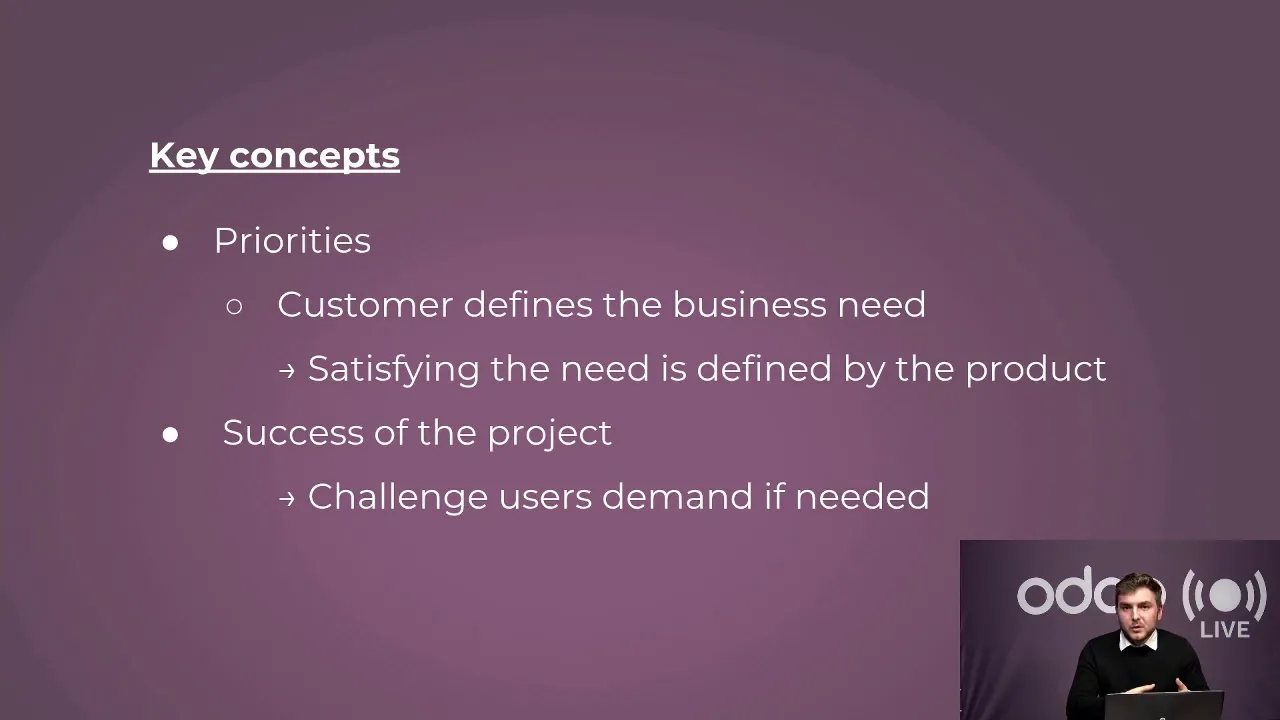
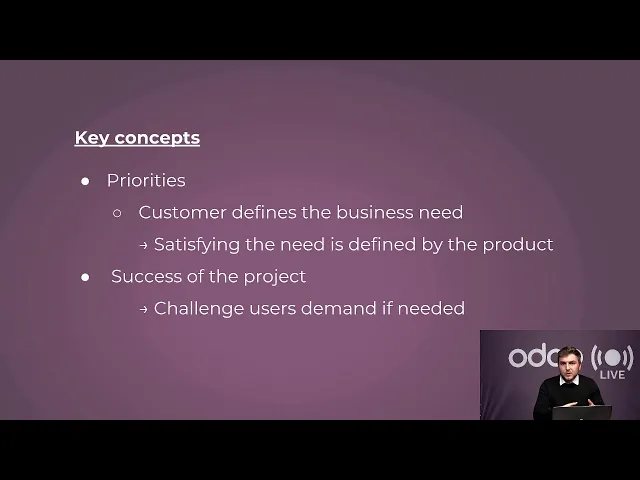
some extra assistance in the implementation of the project you have the possibility as a partner to acquire a partner success back feel free to google that on who do the partner success fact we can have a dedicated business analyst helping you with the project so that's also a possibility and extra product we are actually providing to upon us to help them have successful implementations so what are some of the key concepts I've actually basically mentioned this already in the previous slide your main priority will be defining the business need what is it my customer needs
what are the exact requirements and satisfying this that need will be defined by the product so you will analyze that need and you will analyze those workflows of your customer and you will try to see how those fit in overdue enterprise what is all you capable of what is only not capable of yet so you will define that business need and make sure that you can fit it into perfectly also a key concept will be the success of the project success of the project is key so as I said in in my previous slide you
should have the right balance between customer satisfaction and the timing and the budget so don't be afraid to challenge the users demand if needed if you think that this will have too much of an impact on the timing or on the budget of the customer you should not be afraid to say so to your customer and provide an alternative solution so let's continue to the next slide the next slide is another key concept which Otto is striving to achieve in our implementation methodology and that's keeping things simple what we want to do is deliver software
which covers all business flows and 80% of the business features of the expected business features in a few weeks not months so you want to have that short implementation phase and a very easy implementation that's what we strive to get in the audio methodology what's also important and what's also key concept is that your project managers the project managers that are working on your project on the implementation they should be able to configure and customize who themselves that's actually very important because they will be the ones analyzing the business processes of the customer and they
will be the ones making product decisions so you want them to be very experienced in functionally in knowing the product very because they're gonna make important decisions which will impact the efficiency of your project and of your implementation and last but not least we've said this before avoid custom developments as much as possible it was too much of an impact on the budget and on the timing of the project and you wanna be focused on becoming a servicing and consultancy company now if there are specific features that the customer is looking for and you think
it's not possible in the standard version of Odle right at first to manage this feature or develop and implement this feature with voodoo studio because any feature you add to a loose to audio in which audio studio will actually be very easy to migrate to the next version so that's also another tip or trick that we I would like to give you as as a good clip and trick to the partner now let's go over the main responsibilities well first of all we always say as we said the success of the project is always key
so you need to take responsibility over the project the responsibility the responsibility of a project failure or success always belongs to you not the customer so take responsibility think very well about implementation decisions about product design decisions because they impact the success of your project you should be able to guarantee the success of the project so also refused to take a project if you think you cannot make it happen you don't want to damage your partner name by having an unsatisfied customer and you don't want to damage the oda brand either so always guarantee the
success of the project and if you think you cannot manage it on your own ask for help we have the partner success back we can help you our dedicated business analysts are ready to help you with the implementation of the project so let's go over some of the key roles of the project managers as I already said in in a couple of previous slides the project managers are a key success factor of any implementation they will be the ones making important product decisions and saving you time and solving problems and next to that you have
two top odoo experts so what we are referring to here or again the dedicated business analysts which can be acquired through a partner success pact those are actually external to your project and at critical steps of the project they might be able to review the work that your product manager that your project manager has done so that you are sure that the project manager has made the right decisions and that you don't make any mistakes or wrong analysis in terms of the implementation of your project so now that we've seen all those key our responsibilities
and those key concepts we're gonna go over the different phases that you're actually going to be going through with your customer during the implementation of the project so let me quickly sum them up and then I will explain them a bit more in detail the first stage will be the scope analysis the second stage will be the full-featured prototype the proof-of-concept the third stage will be the data import and specific development the fourth stage will be the validation and the training the fifth stage will be the first deployments the stage where your customer goes lies
and a sixth stage will be the second deployment so let me elaborate on that right now so as I said the first stage and we've seen this before is the scope analysis he'll here you'll be compiling the business needs from your customer they'll be analyzing the workflows and you'll make sure you have a very specific analysis of the requirements of your customer so what will be the final deliverable in this stage you'll get a prototype specification so Spiritist specification of your proof of concept of the prototype and you'll make a gap analysis now what is
a gap analysis you might ask well a gap analysis is basically a simple document and an analysis of the workflows to see what workflows can be fit into all your standard and what workflows would actually require some development so you'll look for the gap in the software compared to the requirements of your customer and again if you have made this analysis if you have the prototype specification and the cap analysis then you can actually challenge those again by a topo to experts by acquiring the partnership suspect and making sure here we've used the work you
have been that the word that you have done so the next steps will be an estimated planning facing and budget you'll be defining the different stages you'll be going to and you'll be defining the budget of the of the products project let me continue with the with the second stage that you'll be going through in the implementation and that's actually the fully featured prototype so the proof-of-concept also named and in this stage you'll actually configure and customize fudou to cover all the business flows so what you want to get or what will be the result
of this stage it will be the maximum you can get from standard solution with some customization but without any development now what will be the deliverable of this stage you might wonder what the deliverable is in this stage well it will be fully configured software covering 80% of the flows and features plus you'll have a demo of the software to the key users plus you'll have an updated gap analysis now after having this stage after having the proof-of-concept there might still be remaining developments and it's important for you as a partner to split those developments
in two groups the first group will actually be the developments that are absolutely necessary to happen before going into production so without these developments the workflows and how our operates will not be working properly so those are absolutely necessary you'll be doing that in the next stage will be developing those in the next stage while the second group of developments will actually be the developments that are not really crucial to the project so those can happen at a later phase at a later stage so the third stage will be the data import and the specific
development just to repeat in the previous stage we've configured we've developed a fully functional proof of concept we have a final solution which can be demonstrated now if we have done these steps if we have done this properly then we can actually start training the key users on audio now you might be wondering why is it important to start training the key users on odoo already well they will actually be the ones validating and testing the proof of concept so you want a preform concept to be tested by those key users to make sure if
everything has been done properly evolve the workflows fit into order and if you've not make any mistakes because if there were any mistakes you want to fix those ASAP now what will be the next step so you'll launch the following three phases in parallel in parallel meaning at the same time so you'll start importing all the data you'll start the specific development in the from the first deployment so the developments we've talked about in the first group which which I described in the previous slide and you'll also do the third party software integration now you
might be wondering what do I mean with the third part software into integration well there there might be customers who are not willing to leave another software package behind for example there is a customer having an e-commerce shop which is being run on Magento and he does not want to run ecommerce on hoodoo so this way you will have to build a connector from odo to Magento and he said well this is what we mean by third-party software integration so now what will be the result of this stage you will have complete software with all
the customers data so then we come to the fourth stage in the fourth stage you'll start the validation and the training so what you'll do in this stage is you'll train all the users in the company so all the users all the employees from your potential customer should be trained on you do there's many ways you can do this first of all you can refer them to our e-learning the functional videos have now been updated so they are very up-to-date and they provide a lot of content to new users on audio so I would definitely
recommend sending those users to our e-learning platform and the second option would be a training on site so you can organize and training on site for all the users in your in the company of your customer or you can actually make our business analysts using the partner 6 aspect we can actually organize a training on site as well for your customer so there's many different possibilities and just to get back on the e-learning option this is also something you can discuss with your account manager if we are talking about allowing you to have more sales
potential there is also the possibility that's on a multi-year contract the e-learning has been provided as an additional benefit for that so keep that into account and discuss that with your Account Manager is it it seems interesting for you and your potential customers now what you'll want to do in this stage as well is verify the result with the customer compared to the initial analysis and you'll want you'll want to wait for the green light to go into production so you want to check what has been achieved what has been implemented already you'll want to
check that and see if there's not any issues because if there are any issues again we need to fix them as soon as possible so again just a repetition what are the deliverables in this stage your customer will do the final validation before going into production and your project manager or anybody else in your company but we recommend your project manager can do the training for all the end users of your customer now we come to the fifth stage and you were already kind of far in the project right now so congrats basically this is
the stage where your customer can start going live so all the users can start using hoodoos Enterprise now what's important in this stage as well again as we've said before your project managers and your developers should analyze what the work that has been done and if there are any issues they should solve them ASAP so what are the deliverables you'll fix all the issues and you make sure your customer starts going live and start using o2 Enterprise now what's the six phases six is the sixth stage is the final stage this is actually the second
deployment and in the second deployment usually happens around one month after the first deployments what you'll do in this stage I don't know if you remember I hope you do but what we said is that you would split the developments in two groups so this is actually the stage where you will start reviewing the second group of developments the ones that you haven't done yet because they were not crucial before going into production this is where you'll start reviewing them and start developing those extra features that were wanted by the customer so the deliverable in
this stage is an iteration a review on the developments and the deployments so now we've actually seen all the stages now what you'll see on the next slides is actually a visual overview of how you can this process and this planning and how you can do that for yourself as well so this is actually what I'm talking about as you can see this comes straight from an excel file and as you can see the the the different boxes in the document depend on the length of the face so you can start configuring this for yourself
as well once you're doing the analysis you can make a visual overview like this just to keep track of every face and how long it actually takes now we've actually seen all the things that you should be doing to manage your first project successfully and to win your first customer successfully as well now we'll go over all the points that you should avoid and what you should not be doing according to the odo methodology so first of all you'll see that a few of these points that I'm listing or actually the opposite of the first
points that I've been discussing so first of all I would not recommend doing the first project by yourself some partners they claim or they say that they don't think they need help to deliver their first project and in some cases this might be true but this is not the recommendation we would give we would actually save from OD we would say let's secure your first project together let's collaborate and let's make the bow do your o do success story your old partner story let's make that a success and if the support the assistance you're getting
from your account account manager is not sufficient if you need some technical support then again you could acquire a partner success pack because the partner success fact actually consists of getting a dedicated business analyst working on your project having training and coaching we can review the request for information together and formulate a reply for that we can do code reviews and many more things and now this last point which you are probably seeing on the slides actually you're not completely seeing it let me see you this is actually a very important point because this is
something which partners forget and which stops them from acquiring a partnership suspect but actually the services acquiring a partner success back this should actually be part of the projects budget so it shouldn't be you Department paying for this kind of service you could be acquiring a partner success pack for the project itself so that your dedicated business analysts helps with the project with the implementation helps with the analysis and your customer should be invoiced for this service it should be part of the projects budget so here we are again let's move on to the second
point which is actually neglecting the power of a good demonstration so we've had partners in the past that say I prefer not to go through an audio demonstration with my prospects and this is again not something we would recommend and there's many different reasons for that I'm gonna go over a few of them first of all a good demonstration is worth a thousand slides as I explained before in the earlier slides fifty percent of the sale is a good demonstration for you at least and if you succeed if you plan to do a demonstration and
you actually apply the right method meaning you start with a good qualification then you will personalize the database you will include some products make sure that the customer feels attached to your to your software it will create this wow effect so you will immediately get this relationship with the customer and make sure you start the sale in a in a in a proper way and have a great chance of success second point is actually that a lot of our competitors only use slides and regularly that's really boring to do I mean in my personal example
I've only been using slides as well but obviously I'm not doing a demonstration so the third point would actually be which I've already said as well if you do a demonstration you put your prospect in contact with the solution already plus you get your audience excited then they feel attached to the software and also you set the expectations right because you will be able to show what is possible in your enterprise and what is not possibly know to enterprise they will be able to ask questions maybe if your functional knowledge is good and we hope
so you will be able to show how it works in order immediately after getting the questions and if it is not possible you can show the studio application or you can say that it requires a bit of development and last but not least mostly when you are starting when your customer is doing a selection process for for an ERP package there might be a long list of potential software packages that they're reviewing maybe five six or eight potential vendors now if you do a good demonstration and you follow the instructions that have carefully explained and
also the instructions that you can find in our previous webinars about how to do demonstration then it will definitely help you to get shortlisted and to get on the shorter list of vendors for example three potential vendors and get that second conversation so next point which we want to avoid is our partners having the wrong price strategy and what we mean by that is that you should think very carefully about your value proposition and that starts with believing in the value of the enterprise contracts because the value is definitely there the value of the enterprise
version is clear and I will quickly explain in in a few short points why the values there well first of all you have the free migration so any auto enterprise customer on a previous version can request a free migration we will migrate the database for free to the latest version with all those additional features so that's a very powerful selling point in terms of the enterprise contract secondly all our enterprise customers have unlimited free functional support meaning that our helpdesk is always ready to help them so if your customer has any questions regarding how the
user interface works or he feels that there is a bug in the software we can just create as many tickets as they want hopefully not too many but basically there is unlimited functional support for our customers available and the Third Point would actually be the enterprise features and this is a huge point I'm not gonna go too much in depth about that but basically I'm not sure if you've seen the visual I don't have it in this presentation yet but how you can see it is that all the community is the heart of PO do
it is the the first the first layer of all while the enterprise version is basically a circle around it with all the additional features so for example you have the studio application in enterprise which is not available in community and studio application is obviously a very powerful tool and also in other applications there's also always some additional features added in the enterprise version so keep that in mind in your value proposition and realize the value of that enterprise version and mostly all those benefits which I've just summed up will lead to a better customer satisfaction
now regarding value proposition and having the wrong price strategy we would also recommend our partners to avoid fixed price project so if you're doing the analysis and you're defining the budget for the project avoid to have a fixed budget you don't want to have a fixed budget because then if the eventually the implementation of the project exceeds that budget that might lead to some unsatisfied customers which as we've previously explained we want to avoid this as much as possible so what we would recommend is having a mixed approach what we mean by a mixed approach
is for example that you have the fixed cost for development and then for the other services for example the analysis the implementation itself you actually base your hours on time and materials so in you invoice your customer on time and materials having this mixed approach is definitely something we recommend regarding the implementation process a report fourth point will be your business strategy so we have had partners which actually say it is easier to develop than checking the functional scope of Oulu well this is not what we would say we say that knowing the functional scope
is definitely powerful and you should only develop and need it so you want to limit those developments at all times this will help you to have the right balance between business services and developments so we prefer to have be focused on those business services and try to limit the developments as much as possible this will allow you to see the full potential of Oulu so try to train yourself as much as possible because it will help you to make better product decisions and also save budget and time for you and the customer and not to
forget if you do decide to limit the developments it will reduce the maintenance costs in a very dramatic way which is always a very positive factor for your customer the next point is actually I'm going to let you read it is the standard audio approach versus heavy development this is actually the case which we've experienced multiple times in the sales office we're actually two partners are competing for the same project and one partners is having our methodology they are going for the standard audio approach trying to limit developments as much as possible focusing on the
services while the other partner is going for heavy development so all the features that his customer is asked they want to go for this heavy development now guess who wins this project and we've seen this in the past and most of the times the ones the partners that actually are applying our standard methodology the methodology we recommend actually win the project or at least have a bigger chance of winning the project and last but not least try to become an expert in a specific industry if you have a specific customer in a very specific industry
and you are making some developments for that customer then maybe try to focus on that vertical on that branch because it will help you to differentiate yourself from other partners and it might help you as well to get more customers in that specific industry so that's also something we would definitely recommend our partners to do and the last point is actually avoiding the Big Bang approach I don't know if you've ever heard about the Big Bang approach but the Big Bang approach basically is meaning sending a huge quotation for all the users and all the
applications that the customer is ever gonna need we would recommend to start small and expand bigger what we mean by that is your customer can start with a restricted number of modules he doesn't have to go for the full scope in one go you can start with there's number of modules and as the customer grows as their business activities grow and they can actually expand their scope over time and add additional applications in their subscription they will always be invoiced pro-rata temporis so they will only have to pay for the remaining duration of the contract
and if you apply this method it will also lower the risk for the customer because the scope is going to be less likely to change also it will fit in a smaller budget obviously because the cost for the customer will dramatically decrease and it will allow you to close the deal easier obviously it's always easier to sign a small quotation than signing a huge quotation and what we also say or what we refer to is the easy getting approach for example you have a specific customer and they are not really sure whether to go with
odo for their full scope but just want to go start with a few applications for example only HR related applications then go ahead and implement although only for HR because if they are already using the software the chances in that they will eventually have other applications and install other applications in their database so you're already without put inside of the company so you have a bigger chance of expanding the project there as well and have a long-term scalable business with this customer and last point will be that odo is a modular solution so as I
previously explained as well the customer can scale as they need and they only pay for what they use we have many different applications but our customers only pay for the applications they are currently using so that will be it for this presentation I want to thank you all for watching I hope you've learned a lot and you will implement and use these strategies and tips and tricks doing your daily or do business thanks again so now we're going to go over some of the questions which have been asked in the webinar so let me quickly
see if there are some questions which I can answer so I do not see any questions if there are any questions don't hesitate to ask I'm here to answer your question so feel free to drop any question related to oh dude preferably to auto enterprise in the chat box and I'll be happy to to answer that question okay I guess if there are no questions I guess everything is clear if you do change your mind and you do have an additional question you can always drop me an email send me an email my email address
is mxv at oh do calm so don't hesitate to drop me an email and I will help you there bring you in touch with the right Department or answer any questions you have related to the enterprise again thank you for watching and hopefully I will see you in the next webinar Thanks you




![STUDY WITH ME at NEW YORK PUBLIC LIBRARY 📚📚 | [ LIVE 24/7 ]](https://img.youtube.com/vi/MunU0Myn83o/mqdefault.jpg)