Okay, so you should be coming from part 13 of the series. These videos are part of a topical series and should be watched from the beginning in order if you're going to understand what is being presented. So please, if you have not watched from part one, stop this video and start back from video one.
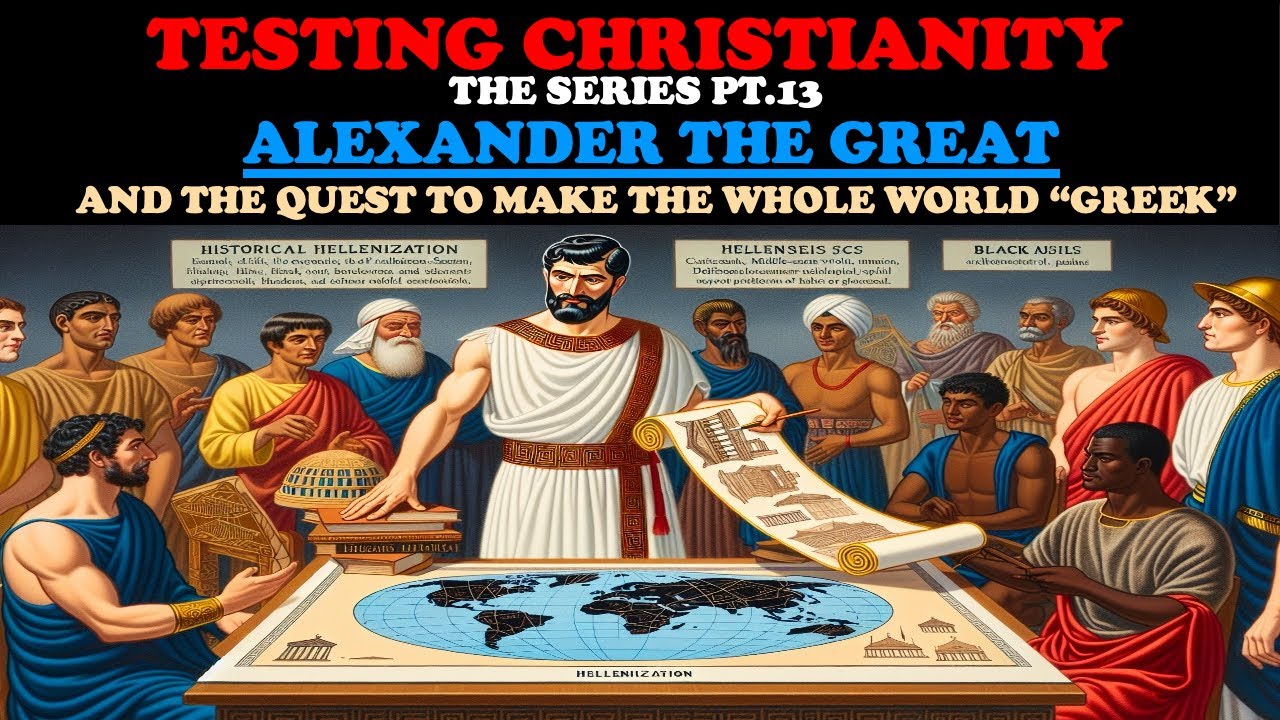
Okay, so in the last video, part 13, we went over the period of the start of Hellenization with Alexander the Great. Many people want to look at that period as the time of Hellenism, and that would not be a wrong assessment; but what that does is it does not allow us to know that we are still in that period of Hellenism. The culture of the Greeks is still being spread, except that it just evolves through our modern culture.
And though we are under the influence of different empires, from the Romans to Masonic England, the culture of the Greeks has never stopped being spread. Yes, the culture of men changes with time, but it's all based upon the foundation of the ways of the Greeks. But here's the thing: though the culture of the world evolves and changes, the ways and law of Yahweh are never changing, which is why Satan desperately wants us to reject it.
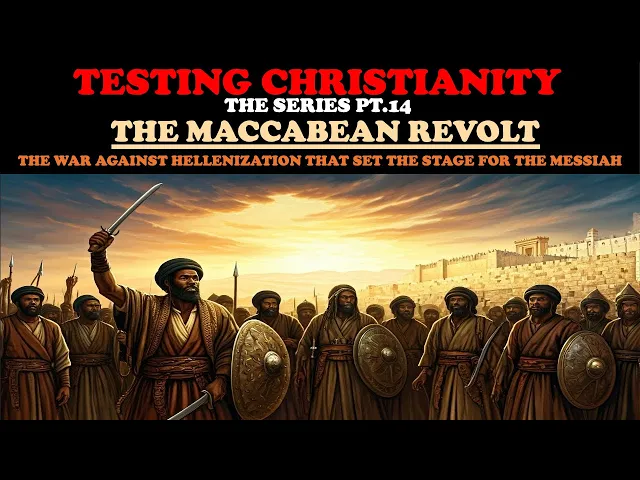
Now in that history, as we began to go over Hellenization and how it affected the Yahudim, I had to stop because we were coming to a period where there was resistance to Hellenism, and this was from the Yahud in Judea. This is a period of time that is very important to the world; you must understand: without these events, the Messiah would not have had people to come back to that would follow him. Yahweh used this time to preserve this people, and it is a great deal of history that provides an example of how we should be in this world.
It's precisely why they did not put the book of Maccabees in our Bible. Now I'm going to go over this history, but in case you want to study and research this on your own, I want you to know the sources that I'm using, which are from the book of Maccabees, as well as Solomon Grail's book *The History of the Jews* and also Flavius Josephus's work *Antiquities of the Jews*. If you want to understand this history that I'm sharing and research it for yourself, these are my sources.
Okay, so let's deal with it. This video is actually long overdue. As I explained in part 13, the 3rd century BC was a wave of Hellenism that was taking over the civilized world.
Everything began to adapt to the ways of the Greeks; even their old gods were given Greek names. The Yahudim were surrounded by a changing world, all becoming Greeks. Those who took part in this new Greek wave were taking part in a great movement of prosperity as trade began to open new markets.
The Yahudim in Judea did trade, but they could not keep up with that of their neighbors who truly adjusted. You see, the Yahud in Judea remained steadfast in their own faith and manner of living. They were not attracted or enticed by the lawless and cruel gods of Olympus.
Looking at all the culture of the Greeks, from their Greek games, their bathhouses, and their festivals, the Yahudim saw lawlessness and immorality. The Yahudim who stayed in their land of Judea never came in contact with the highest Greek civilizations, like Athens, not even with the Greek culture from the surrounding areas, like Alexandria. This point right here is extremely important to understand, but most people just don't get it.
Even if they had met the real Greek culture and learned about the famous Greek philosophers and the poets, the Yahudim would still have rejected all of it as inferior to their culture of being Yahud. Why? Because they knew that they were the only people in covenant with the Most High, Yahweh, the creator of all.
Those who truly worshiped Yahweh had no business following the ways of the other nations. This was commanded by Yah to be holy and set apart, and so more than ever, the Yahudim began to stick out and be different from the rest of the other nations. The rest of the world was becoming Hellenized, and they were sticking to their culture.
Now, in regards to economics, based on what was going on in the world around them, the Yahudim in Judea at that time were considered peasants. Remember, they were rebuilding; they only possessed one city worth mentioning, which was Jerusalem. The majority of its population—the farmers, the small merchants, the artisans—they were all content to remain as they were.
They were good with their heritage, and like I said, they had no desire to blend in with the outside world. Now, the devil did find his way in there, though. There were families of the upper classes in Jerusalem, the chief families among the priests who lived in Jerusalem, and the exporters and importers doing the trade who were Judea's great merchants.
They associated with the upper classes of the other nations that surrounded them, and they began to think in terms of economic prosperity. They wanted to make Jerusalem a great trading center, but this was impossible as long as the other people around the world looked at the people of Jerusalem as strange, foreign, and barbarous savages. The upper-class Yahudim didn't want to give up their faith; they just wanted to make the Yahudim externally resemble the other nations around them.
They argued that dressing in Greek fashion, encouraging the young to play in Greek games, or reorganizing the politics of Jerusalem to a Greek constitution. . .
Would do no harm to their way of life as Yahudim, and it might lead their neighbors to look upon the Yahudim as people very much like themselves. They wanted to blend in; basically, they were trying to do the same thing that got them a king in 1 Samuel in the first place: they were trying to be like the other nations. Now, it's said that the main advocates of this Hellenization in Judea were members of a family which may have traced their origin from Tobias the Ammonite, whom Nehemiah in his day had difficulties with; you could read about this in Nehemiah 13.
Now, this family, known as the Tobiads, for two centuries, though they were not originally Yahudim, identified with the Yahudim and intermingled with the family of the high priest. They played an important role in the politics of the land. So, basically, after they came back to the land, some Gentiles intermingled with the Yahudim, and they began to have influence with the Yahudim.
So, about the year 230 BC, one of them, Joseph Ben Tobias, brought from the king of Egypt the right to collect the taxes from the entire District of Syria, which consisted of Judea and all of its neighbors. Okay, so Joseph and his family took great advantage of this and used the power that they gained and added it as an opportunity to permanently change the economic position of Jerusalem by diverting trade to it from other parts of the area. He was trying to bring in new business—basically, a new entrepreneur—and it was this power that brought in the problems later to come.
So, understand something here: this is a very different time period from the times written in the Old Testament and the times written in the New Testament. This history is not spoken of, but it is wildly important to understand the context of the people whom Yahusha came to and then also how the religion of Christianity began. This brings us to the Maccabean Age.
The Maccabean Age is something that is known today, but it's not overly taught. Just last week, everyone celebrated Hanukkah, but most people don't even know what they're celebrating. This is a period of time around 200 to 150 BC, extremely important.
Now, remember, the Greek Empire was split between the Ptolemies and the Seleucids. During this time, the Seleucids had an ambition of reuniting all of Alexander's conquests. By the year 198 BC, Antiochus III, called the Great, took the first step in that direction when he forced Egypt to give up Palestine.
Now, when the Seleucids tried to realize their ambitions of reuniting the empire, one group of Yahudim favored the annexation of Judea, and then another group wanted to remain part of the Egyptian Empire with the Ptolemies. Of course, Hyrcanus, son of Joseph Ben Tobias, was on the side of Egypt because he was getting the tax money. The thing, though, is that the common people of Judea did not care because it made no difference to them whether it was the Ptolemies or the Seleucids taking their taxes.
But as soon as their way of worshiping Yah became involved, this is when things started to change, and the common people began to take sides. So, this is where things heat up. The side of the Yahudim who sided with the Seleucids, the side of the Seleucids, would also be known as Syrians.
These Yahudim revealed to Seleucus IV that much money belonged to his opponents in Egypt, which was stored in the temple. Seleucus, being anxious to lay his hands on more money, sent out one of his officials, Heliodorus, to confiscate the money in the temple. Now, it's said that when Heliodorus went into the temple, he was confronted by a man on horseback who beat him to within an inch of his life.
Heliodorus was scarcely able to leave, and he left without taking any money. So, this pro-Hellenistic group of the Yahudim, this was their first attempt to gain control of Judea, and it was defeated. But from this, there was a major rift because the Yahudim saw how these Hellenized Yahudim would stop at nothing to achieve their goal of gaining control.
I mean, they sent Gentiles into the temple to rob it; it's crazy. Now Seleucus IV died and was succeeded by his brother Antiochus IV, and this is the real problem—one that is written about in the Book of Maccabees. Antiochus also desired to conquer Egypt and reunite his empire, and he hoped to achieve this by means of attaching the various provinces to himself as the embodiment of Greek culture.
He gave himself the surname Epiphanes, which means "the visible God"; in other words, he was declaring that he and their god Jupiter were to be considered identical. Judea was important to Antiochus to have a loyal Hellenistic population, but it didn't matter because Judea was the one that made the least progress in Hellenization; they resisted it. So, when a group of those sellout, Hellenized Yahudim came to him with a proposed plan to speed up Hellenization in Judea, Antiochus was eager to take part in it.
The plan was to remove the high priest that was already there and put in their Hellenistic brother in place, and then in return for a sum of money, Antiochus promised to grant Jerusalem a Greek constitution and the right to coin money, which would help the city grow commercially. This was all about business. Okay, so the plans were carried out, and they replaced the high priest with their sellout version, and the common people of the Yahudim were outraged.
It was the first time since the Yahudim's return from Babylonian exile that a non-Yahudim government had interfered in the. . .
Succession to the high priesthood was a major office, but it was treated as if it were nothing more than ordinary governorship, and worse than that. Now that the Hellenized Yahudim had full control of Judea's government, they began to build gymnasiums within Jerusalem, in which young people were encouraged to spend a great deal of time. The young priests began to neglect their duties in the temple in order to play sports.
This new culture that was being introduced to them was distracting them. The Greek styles and dress, the Greek names, and the Greek language became stylish in Jerusalem, and worst of all, the Hellenized life brought looseness in the application of the Torah, as well as the well-known looseness of morals of the Greeks. Now, listen: though things were changing for the sellout Yahudim, they were not changing fast enough.
They were trying to get their business going. The Hellenized Yahudim aligned with Syria; they were not happy with the pace of Hellenization, and they complained to Antiochus that Jason, the high priest whom they had put in place, was not moving with enough purpose. They promised Antiochus an enormous sum to appoint a radical Hellenist to the high priesthood.
So this high priest Jason was forced to flee, and this time they appointed Menelaus. Menelaus was not even a member of the high priestly family; he was a man without sympathy or care for any of the Yahudim's ways. He just desired power.
Now, to Antiochus, the way he saw it, the unwillingness and rejection of the Yahudim to embrace Hellenization and come to Greek culture was something that he couldn't comprehend. Basically, he was annoyed by the nerve of these people to resist. And since he did not respect Yahweh and the Yahudim, he resolved that if it was the way of the Yahudim that stood in the way of reuniting his Greek Empire, then the way of the Yahudim must be destroyed.
He gave the order to destroy the culture and practices of the Yahudim and force them to be Greeks. He outlawed the Torah. So, he sent an army, and part of the Syrian army marched into Jerusalem to support Menelaus and his policies.
Many of the inhabitants were killed, and others escaped to the hills. This happened on the 25th of Kislev. Only the known Hellenists remained.
Orders were given making it illegal to observe the Sabbath, the feast days, and circumcision. They forced them to eat unclean meats like pork. In the temple, above the altar, was placed a statue of Jupiter, bearing an obvious resemblance to Antiochus.
They even brought pigs to be sacrificed on the altar before the statue, thereby straight-up defiling the temple. The common people of Judea watched these things in horror. They looked at it all as a result of the influence of Hellenism and the abandonment of the principles of the Torah by the upper classes.
Basically, these upper-class individuals abandoned the Torah, and this is what happened after that. So, a group began to emerge that resolved that there were only two courses that remained: either they die fighting or they die as martyrs. This group was known as the Hasmoneans.
They were the lower class among the Yahudim, and they were not organized as an army. They were resolved that they could let themselves be slaughtered for their ideals, but they could not lead in fighting for them. Now, an interesting point to note is that among the Hasidim, there is a group known as the Haredim.
Where I grew up in New York, there were a bunch of them. They belong to a special movement within Orthodox Judaism, a movement that, at its height in the first half of the 19th century, claimed the allegiance of millions in Eastern and Central Europe, perhaps a majority of the Eastern European Jews. To this day, they wear traditional clothing styles from the 18th century in Eastern Europe.
For example, Hasidic men often wear black coats and big furry hats, while Hasidic women dress very modestly and cover their hair in public with a wig or headscarf. This group has taken on this name from the Hasmoneans, but they would like people to believe that they are the actual group that has existed since the time of the Maccabees. But no, this is a movement that originated in Eastern Europe in the 18th century.
The craziest point is that the founder of this movement, Rabbi Israel Baal Shem Tov, a Jewish mystic and practitioner of Kabbalah, is also known as Baal Shem Tov, which is said to mean "Master of the Good Name," someone able to work miracles using the secret name of God. If you dig into who these people are, it truly exposes itself as right in plain sight. So when you see them, know that they are merely those who took over the name of this group of Yahudim who stood for the Torah.
It's just another part of hijacking our culture, and they want the world to believe that they are truly following Yah. But this group was founded by those who practice Kabbalah. I thought that would be an interesting point to share, but enough of that; let's get back to the history.
So when the way of the Yahudim was declared illegal and the soldiers of Antiochus spread their net over Judea, those who persisted in being Yahudim and living according to the Torah faced martyrdom. Men, women, and even children gave their lives rather than violate the Torah. I'm going to read about it from the sefer in the book of Maccabees: "And having subdued them, he established a decree that if any of them lived according to the Torah of his country, he should die.
" And when he could by no means destroy their obedience by his decrees. . .
To the Torah of the nation, but saw all his threats and punishments without effect for even women, because they continued to circumcise their children, were flung down a precipice along with them, knowing beforehand of the punishment. When, therefore, his decrees were disregarded by the people, he himself compelled—by means of tortures—everyone of this race by tasting forbidden meats to abjure the Yic faith. That's Four Macabees 4, verses 23–26.
Then, in the next chapter, the Greek Antiochus tortures a well-known old man of Yahuda, Elazar the priest. But in chapter 8, this is what really got me: then indeed, vehemently swayed with passion, he commanded to bring others of the adult Hebrew, and if they would eat of the unclean thing, to let them go when they had eaten; but if they objected, to torment them more grievously. The tyrant, having given this charge, seven brethren were brought into his presence along with their aged mother—handsome and modest, well-born, and altogether comely.
Whom, when the tyrant beheld, encircling their mother as in a dance, he was pleased at them; and being struck with their becoming and ingenuous mien, smiled upon them. Calling them near, he said, “Oh youths, with favorable feelings; I admire the beauty of each of you and greatly honor so numerous a band of brethren. I not only counsel you not to share the madness of the old man who has been tortured before, but I do beg you to yield and enjoy my friendship.
For I possess the power not only of punishing those who disobey my commands, but of doing good to those who obey them. Put confidence in me then, and you shall receive places of authority in my government if you forsake your national ordinance and, conforming to the Greek mode of life, alter your rule and revel in youth's delights. For, if you provoke me by your disobedience, you will compel me to destroy everyone with terrible punishments.
By tortures, have mercy then upon your own selves, whom I, although an enemy, compassionate for your age and comeliness. Will you not reason upon this, that if you disobey, there will be nothing left for you but to die in tortures? ” Thus speaking, he ordered the instrument of torture to be brought forward, that very fear might prevail upon them to eat unclean meat.
And when the spearmen brought forward the wheels, the racks, the hooks, the catapults, cauldrons, pans, finger racks, iron hands, wedges, and bellows, the tyrant continued. That's Four Macabees 8:1–2. What happened was that each one of them resisted, from the oldest child to the youngest child, all the way to the mother; they all resisted, refusing to eat pork and go against their Torah.
This is what they were about. They all went down the line and dealt with the tortures so that they could stand for Yah. This is what was happening to the Yahudim.
So, as this was happening, thousands abandoned their homes as the news of the Greek soldiers was coming to enforce the edict of the king; they knew they needed to get out of there. They fled to the hills where they hid until the soldiers departed. And worse, the Heniz Yahudim began to snitch and inform the Greeks who the Hasadim were, that were portraying the people.
Furthermore, the Yahudim of Judea hated these Heniz Yahudim. Now, the Hasadim did not put up a fight, and they died as martyrs, but many other Yahudim put up a fight. They did not permit themselves to be slaughtered without resisting, but the Heliz Yahud knew how to get around them because, as long as they were under the influence of the Hasadim, they would not defend themselves on the Sabbath.
So the result was that these wicked Greeks learned to wait until the Sabbath in order to attack these Yahudim and destroy them. The end of the Yahudim was in sight. Now, among the Yahudim were some peaceful farmers, northwest of Jerusalem, in a little town of Modin.
Among the most respected were the descendants of a priestly family called the Hasmoneans. The head of the family at this time, under Antiochus, was an aged Matathias, who had five sons: Simon, Eliezer, Yahuda, Yannan, and Yanthan. Matthias and his sons were increasingly dreadful, thinking about the time when the Greeks were going to come and deliver their royal edict, and the moment soon came.
In the marketplace of the little town of Modin, the Syrian soldiers put up an altar. The men of Modin were assembled there; a pig was produced which the soldiers had brought with them, and Matathias—being a priest and elder—was ordered to sacrifice it to Jupiter in honor of Antiochus. Matathias did not move from out of the crowd.
A young Yahudi stepped forward who, judging by his dress, was a Heniz. He asked to perform the sacrifice. There was no doubt what would happen next, but other Yahudim would be asked to eat some of the sacrificial meat, and those who refused would be executed.
So the zealot Yahudim approached the animal. The soldiers were standing side by side on one side of the altar, and the Yahudim stood there watching the performance. Then, suddenly, everything changed, and the entire scene was transformed.
The aged Matathias, standing closest to the captain of the troops and to that sellout Yahudi, snatched the sword out of the captain’s hands and ran it through the body of the traitor. As the captain quickly moved forward to stop him, Matathias stabbed him too. Obviously by impulse, his sons rushed at other soldiers before they could even realize what happened.
The other Yahudim ran to aid them, and the soldiers were killed, and their altar completely destroyed. Matathias said, “Whoever is for Yahweh, let him come. ” Unto me, the call echoed over the land, across the hills of Judea, and in the caves wherever the Hasadim were hiding.
Matathias and the rest of the people of Modin were themselves compelled to abandon their homes in the face of larger forces of Syrians who had come to avenge the death of the first group. They needed to go, but they didn't go just to hide; they regrouped and formed a strategy. The band of Matathias began to attack small troops of soldiers or communities in which the Helist Yahudim were strong, and the Yahudim rallied behind Matathias in hopes of preserving themselves.
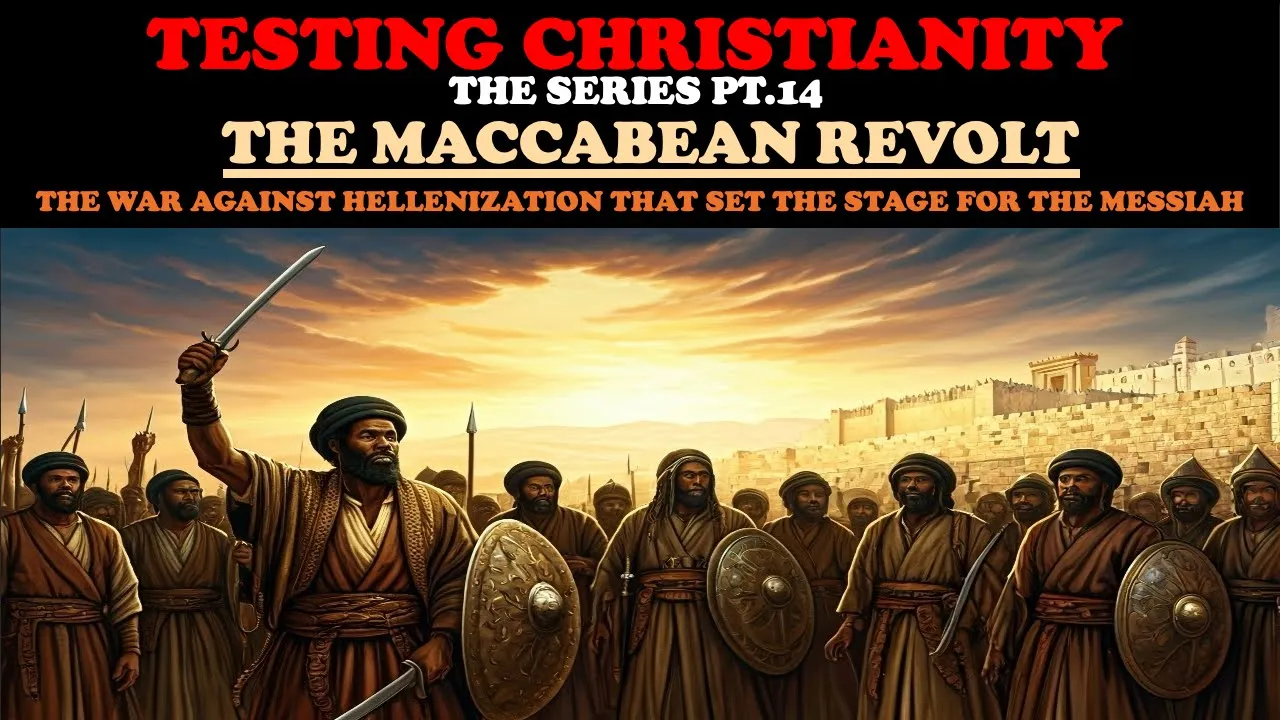
Eventually, living in the hills became too much for old Matathias. Before a year was up, around 16 or 7 BC, he died. The leadership went to his son, Yehuda, who distinguished himself above all the others.
For some reason, he acquired the surname Makabe; some say it derived from ‘maet,’ the Hebrew word for “Hammer. ” Either way, under Yehuda's leadership, the Yahudim began to win against the Syrians. This Maccabean army was small in number but mighty in power and quality.
In time, as the size of the forces increased, Yehuda Makabe felt emboldened to measure his strength against the larger groups of the enemy, and so he went right at them. The local Syrian commanders gathered their forces, including the Helen Yahudim, and each time they thought that they had Yehuda and his camp cornered, the Maccabeans prevailed. Now, Antiochus realized he had a full-scale rebellion on his hands in this province.
It was obviously necessary for him to suppress it. Fortunately for the Yahudim, at that same time, the Parthians in the Northeast also rebelled against Antiochus and sought independence from the Seleucid Empire. Antiochus hurried off to fight them and appointed a general by the name of Lysias.
He gave him full power to stamp out the Judean revolt. Now, like those before him, Lysias underestimated the strength of the Maccabean forces. Instead of sending a full army to crush the rebellion in Judea, he dispatched two subordinates with smaller groups.
Yehuda, being familiar with the country and the mountains, was able to surprise and annihilate the Syrians in the dead of night. This was called the Battle of Emos, and the great result of this victory was that the road was now open to Jerusalem. In high spirits, with songs of praise, “Hallelujah,” on their lips, the Maccabean army approached the sacred city, which had been in the hands of the enemy for almost three years.
The high priest Menelaus, the Hellenized Yahudim, and the new Pagan residents fled from Jerusalem just three years from when they first started their campaign. The simple peasants, whom the love of Yah and their freedom had turned into soldiers, now dropped their swords in order to do what they had really been fighting for: cleansing the temple and reestablishing their worship. They removed every sign of paganism; they took part of the altar that had been defiled by pagan sacrifices and put aside its stones.
They erected a new altar in its place exactly three years after the desolating abomination had been introduced into the temple. They destroyed the statue of Zeus and Antiochus into dust and rededicated the temple to the worship of Yahweh, beginning on the 25th of Kislev in 165 BC. They celebrated the dedication feast for eight days, which is why it’s called the Feast of Dedication, what we all know as Hanukkah.
From this victory, the Yahudim were able to preserve their way of life, the worship of Yahweh, and continue to live as they were called to by Yah. We even see Yahusha celebrate this in John chapter 10. It says, “And it was at Jerusalem the Feast of Hanukkah, and it was winter, and Yahusha walked in the temple in Solomon's porch.
” That’s John 10:22-23. You see, many people don’t understand the celebration of Hanukkah, and for me, as I'm relearning our heritage, I am relearning this time as well because I don’t want to do it in any way that the current Rav 29s do it. So, I’m relearning this myself, but I do understand the reason for the celebration.
Now, if you understand this history that we just went through, I hope you understand it now as well. You see, three years earlier, the Yahudim were killed, and the temple was desecrated and made unholy by Antiochus and the Greeks. Three years to the day after it happened, the Yahudim who revolted won back their freedom to worship Yahweh, and through the power of Yahweh, they rededicated the temple and recommitted themselves to Yahweh.
If this did not happen, we would not have been able to have our Messiah come and fulfill prophecy. It all leads to Messiah because without this event, the Yahudim would have been fully assimilated into the Greeks, very much how it is today. Antiochus wanted to wipe them out; he wanted to get rid of all worship of Yah and remove them all.
Because of their commitment to Yah, they did not allow this to happen, and this is exactly why they kept this out of the book. They recommitted themselves to Yahweh and rededicated the temple that was desecrated back to Yahweh. This is what is celebrated.
This is not the worship of gods but a celebration of rededicating themselves back to Yahweh. Again, without this event, Yahusha would not have had a place to come back to, and his ministry would not be possible. Yahweh used the smallest people that truly loved Him, and He gave them power to defeat a great foe.
When you read about this in the Sefer, you can see why they removed these books from our Bibles, because history can provide us a great deal of influence for. . .
Us. I know whenever I read it, I get revved up. We know that if we serve Yah, nothing can come against us and we win.
We know that our people took great sacrifices to live according to the Torah, that the majority of people today want to say it doesn't matter. We know that the history of the Heniz Yahudim is something that's not truly understood because we only know about it from a Heniz point of view. We only look at the Heniz Yudin scattered around Asia Minor, but we don't look at it from the people that were actually in Judea, who were there when Messiah walked the Earth.
They hated these Heniz Yahudim; they were not respected and they were hated, and they called them Greeks and Gentiles because they did not associate them with the Yahudim any longer. You see, when you remove this history, it allows other people to create other doctrines and not truly understand the times that followed when the good news of Messiah began to be spread. The Heniz culture was a problem for the Yahudim, and if allowed, it would have replaced them and removed the Yahudim and the potential for Bible prophecy to be fulfilled.
But these events are why we are here talking about Yahusha, and we are blessed by Him. Without understanding this history, it's why people can embrace Heniz and act as if the blending and assimilating with the Greeks was something that was accepted. Do you realize what they went through over this Hellenization?
People were killed! I mean, it was just really bad. Imagine China taking over the United States, and hundreds of years later, you're learning about American history from the point of view of the Chinese.
This is how people treat the Bible. Yes, of course, among the Yahudim, there were sellouts, and they tried to enforce the selling out and spread the selling out, but the true people guarded by Yahweh did not allow this culture of Heniz to go forth. And so, for us, we should have no tolerance for Heniz because Heniz was only put forth in order to push away the Torah and the influence of Yah's people.
And it still is being used in the same way today. It's just that the Hellenists are in abundance, and they are uneducated and indoctrinated, and they don't even know that they're Hellenists. Christians are the Hellenists of our modern day, and their movement seeks to do the same thing as the Greeks of the time of the Maccabees.
It's why they're called Christians and not Messianics. They identify with Christos of the Greeks and not the Messiah of the Hebrews. They adopt the ways of the Greeks.
Now, there's a lot more to say about this, but I wanted to make sure I covered this because as we discuss Christianity, if you have no context of what happened before Messiah came, there are certain things you will not understand later, and this is why there's so much confusion today, because this history is just not taught. So, now that this is understood, there should be a clear understanding of the separation there is between the Greeks and the Yahudim, and it should be understood why there is a rejection emerging of Greek culture in with the faith of Yasharel. If you don't get it by now, you don't want to.
The Yahudim fought a major war to reject the spread of Heniz. They hated the Greeks, and that's why they rejected the Yahudim all around Asia Minor. And if you need proof of that, let me show you.
Remember when Yahusha said He will go to a place that they cannot follow? Let's go to John chapter 7. It says, "Then Yahusha said to them, 'I shall be with you a little while longer, and then I go to Him who sent me.
You will seek me and not find me, and where I am you cannot come. ' Then the Yahudim said among themselves, 'Where does He intend to go that we shall not find Him? Does He intend to go to the dispersion among the Greeks and teach the Greeks?
What is this thing that He said, "You will seek me and not find me, and where I am you cannot come? "'" That's John 7:33-36. You see, they assumed He was talking about going amongst the dispersion of the Greeks.
Think about it: they thought He was going to a place that they couldn't come, and they instantly thought it was about the sellouts. Why? Because they did not get down with them, and there was a complete rejection of them.
And this is why you keep hearing about Paul: there's no difference between Yahudim and Greek, but everyone today thinks he's talking about the pagan Greeks. It's absolutely ridiculous; that's not who he's talking about. You see, because we don't know this history, we now want to accept Heniz and rationalize and say, "Because the only manuscripts of the New Testament are written in Greek.
" Now, not that they were actually all written in Greek, but that that's the only manuscripts that we have that are in Greek. Because of this, we believe that they should erase the history of the people and conform to a different culture. Again, it's like the story of let's say Donald Trump, but China takes over America.
It becomes the dominant culture in this world. Now they change Donald Trump to a Chinese man; they make him look Chinese, and they adapt his ways to Chinese culture, and they say, "Hey, it's okay because China is the main influence now. " That's absolutely ridiculous!
But this is exactly what people do today: they change a Hebrew Messiah to Greek, and they give Him a Greek name; they make Him look a whole different way, and they say that you're wrong and a part of a. . .
Cult, if you go back to the Hebrew root, which makes no sense, this is the kind of thing that people allow with the Messiah, who they claim is their God. They changed the culture of the people and adapted it to the Greeks, even though the Greeks were the absolute enemy of the Yahudim, and they hated everything about them and their ways. The overall majority in Christianity adapted their faith to the way of the Greeks rather than the way of the Hebrews.
Matter of fact, there is a major rejection of the Hebrew roots, even though everything about the scriptures is rooted in the Hebrews. Everyone who speaks against the Hebrew roots speaks against the actual faith that they say they have. This is able to happen because people don't know this history, and they don't understand the truly set-apart culture that our Father led His people through, which is why people argue to be called Christians according to the way of the Greeks and reject anything about the Hebrews.
Though this faith, again, is actually rooted in the Hebrews, I'm going to keep repeating it. Now you know the Greeks were against the faith of the Hebrews, and they tried to make their influence known. If it were up to the Greeks, you would not have the Messiah.
Now that we understand this, I'm going to go to the times of the church fathers and break down how they blended the Hebrew scriptures with their Greek philosophers, and that will lead us to the Trinity. So we will deal with that next. In the meantime, please remember that Christianity is a religion that, on the surface, seems biblical, but when you dig deep into the doctrines, it is not a doctrine of service to our Father, but a doctrine of abusing grace, editing covenants, rejecting the way our Father actually chose to reach humanity, and making it only about the way Christians want to receive Him.
It lacks the love, obedience, and reverence for our Father that He deserves, and in the end, it does not prepare those who follow it to be ready for what our Father plans to do in the last days. If you desire to be ready for our Father and His plan for us, you must come out of this religion of tears and come to our Father in truth. Please move to part 15 in this playlist, and we will discuss the early church fathers and break down how they blended the Hebrew faith with the Greek philosophers, creating Christianity.
Click the link to the next video, and let's talk some more. Be blessed! Hallelujah!
Praise Yah! Okay, thanks again for watching. If this has blessed you, please like this and share it with your family and friends.
This video series is highly important for those trying to be ready for our Father. This is part 14 of the series. Click the link or just move to the next video in the playlist.
As always, I want to thank all who donate and contribute to this ministry. This series would not be possible without your support. I thank you sincerely.
Be blessed! Okay, thanks again, everyone, for watching. See you in part 15.
I love you all!