HLC is considered to be the world's most popular analytical tool. Yet, very few people understand how it works. They expect this to be complicated because, let's face it, there's some complicated stuff going on.
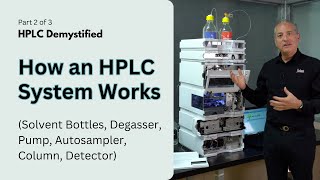
It's mechanically complicated and also chemically. Now, the mechanical stuff I've already covered in the operations video. You want to check that out if you want to see the nuts and bolts of the HLC.
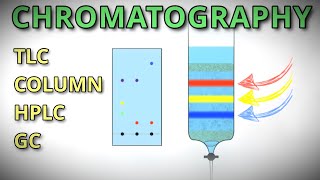
But now, let's talk about the chemistry. We're going to talk about the thing that most people consider to be unattainable in term in terms of understanding, but I'm going to prove to you that you could understand this separation. So, first we talk about chromatography as a separation tool.
We're going to inject a mixture and we're going to separate the individual components. So, we ask the question, how does separation occur? Well, it's all a function of how much the analyte likes the stationer phase versus the mobile phase.
Now, you've probably heard my analogies of the shopping mall. The shopping mall involves uh me going to a mall with my sister. The mall is filled with a bunch of fashion stores.
So, we we go through the mall. We're in the moving sidewalk and it's transporting us through the mall. If we like the store, we get off the sidewalk, spend time in the store.
So, the first store is a dress store. My sister spends time. I keep moving.
She comes out. I'm 100 feet in front of her. Next store is an accessory store.
Hats and gloves and purses. She goes in and spends time. I keep moving.
Now I'm 200 feet in front of her. Finally, we come up to a shoe store. She goes in.
Um, we call this irreversal absorption because she goes in and never seems to come out. So, at the end of that mall, who's going to come out first? Who's going to be standing there looking at their watch waiting?
Well, I'm going to come out first because I have very little affinity for the stores inside the mall. The same thing happens in HLC. The analytes move through a column.
If they like the stationary phase, they'll stick. If they don't like the stationary phase, they'll keep moving. So that's the basis of separation in HLC and GC.
But HLC we have another layer and that other layer makes it more complicated but makes it a lot more versatile and that is the mobile phase itself. Back to my shop mall analogy you have to suspend your disbelief a little bit and in this case the moving sidewalk has its own attraction has its own affinity and maybe that moving sidewalk is really nice and you want to be there and maybe it's terrible uh you don't want to be there. We do have what we call repulsive mechanisms in HLC where we make the mobile phase so repulsive that we force the analytes on the column.
They really don't want to be there but they'd rather be there instead of in this terrible mobile phase. So in LC the moving sidewalk itself has its own attraction. So now we ask the question not how much does someone like each store in the mall but how much does someone like each store compared to the moving sidewalk.
So here's uh my analogy for HBLC. We go to the shopping mall. This time the shopping mall is here in Chicago.
It's the middle of the winter and the power is out. So the heat is off. It's freezing cold.
It's dark. It's dusty inside the main part of the mall where the moving sidewalk is. But or all of the stores have heat.
So the first store is a dress store and you have a choice. Do you want to freeze to death in this mall or do you want to spend time in that store staying warm? So at this point, everyone in the mall is going to go into that first store, that dress store.
You can imagine the people walking around the store have different affinities. Some are there just to stay warm. I'm never going to buy a dress.
Some are there who are looking for dresses. They're shopping today, but they're not going to buy one. And someone is there who's going to a prom tonight and they're not leaving until they buy their dress.
So you get the idea. We have different levels of affinity. So then an announcement comes over that allows you to hear and it announces that the heat is fixed, the lights are on, so feel free to walk through the mall.
The moving sidewalk is now nice and warm. So what's going to happen? some people who didn't really want to be in that store to begin with, maybe myself included, we're going to leave that store and we're going to enter the nice warm mall because we had a choice.
Do we want to go shopping for dresses? Do we want to stay warm? We'd rather stay warm.
So then 10 minutes later, another announcement comes out of the loudspeaker. And this says, uh, to make up for the fact that we had no heat this morning, we're going to offer free lunch, free pizza and beer to anyone standing on the moving sidewalk right now. So now imagining imagine you're in the dress store and you're interested in dresses, but you're more hungry than you are interested in dresses.
At that point, you're going to leave the store and go enjoy the free lunch. Now, some people have a higher affinity for dresses that uh that that person is going to their prom tonight. They're going to stay there until they until they get their dress.
But you can imagine more people have now left the store and go into the mall into that is the mobile phase. Um, and then another another announcement comes over the loudspeaker that says, "We're going to offer a free gold coin, $3,000 worth of gold to anyone who stands on the moving sidewalk right now. " At that point, almost everyone's going to leave the store and enter the moving sidewalk.
Um, so what I just described there is a gradient in HLC. That means we start with a very weak mobile phase, right? We have mobile phase and stationary phase.
The stationary phase holds on to all the analytes. The mobile phase is very weak. It doesn't compete very much.
And then as the mobile phase gets stronger, it's a stronger competitor and it draws more things off the column. So in GC, we have separation based on one thing, the relative affinity to the stationary phase. In LC, we have two things.
How much they like the stationary phase versus how much they like the mobile phase. So we can change now in two dimensions. I talk about GC is like driving a car.
LC is like flying a jet. So let me teach you how to fly a jet. Let me explain how the separation works.
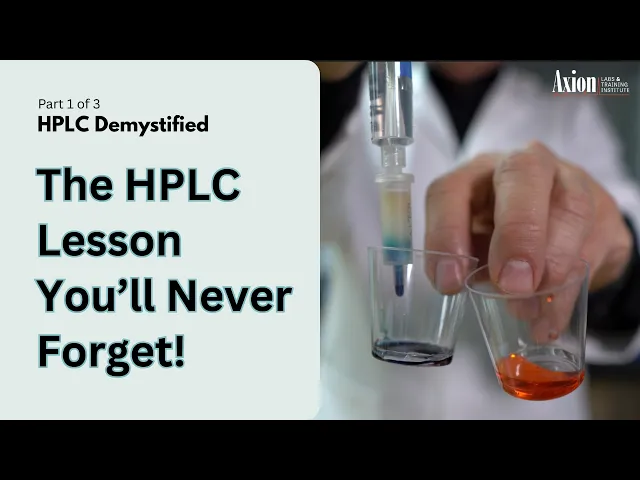
For this to to work, I'm going to explain the most complicated thing in in the analy chemistry world, and that is the chemistry behind HLC. But to do it, we're going to have a little bit of fun, and we're going to need a little bit of help. We're getting uh some help from our friend uh uh Kool-Aid.
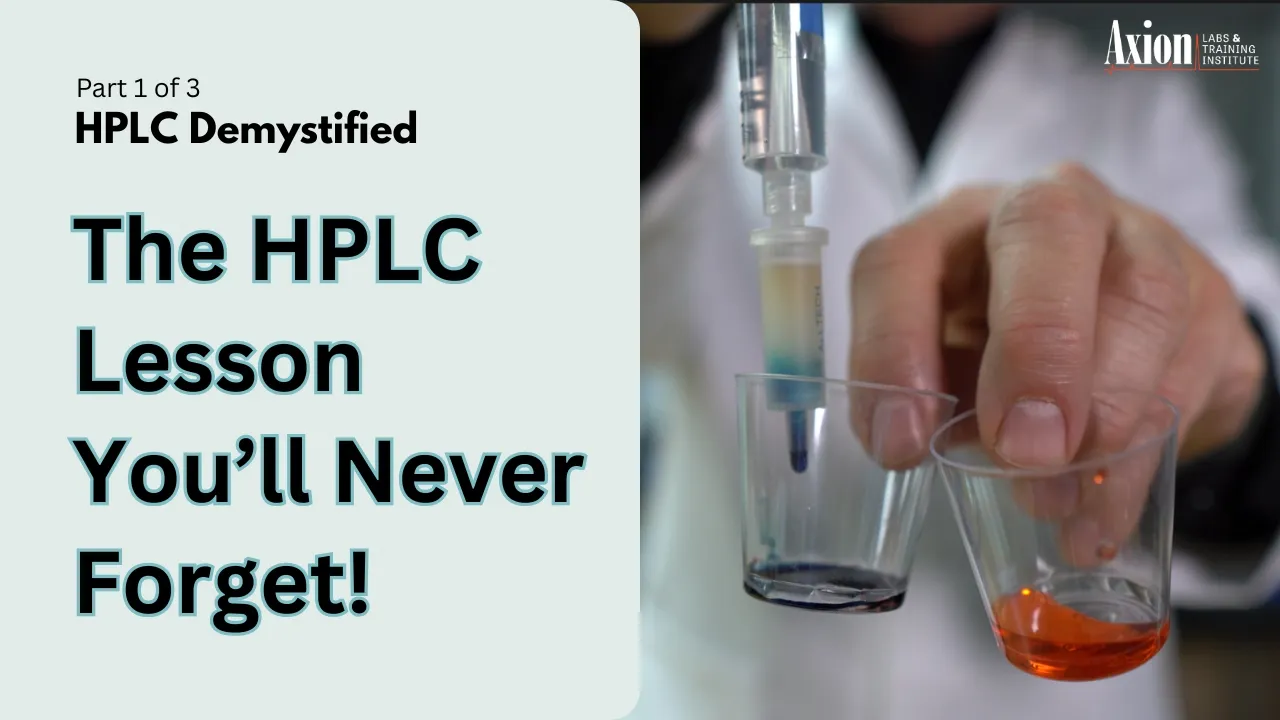
And this is grape Kool-Aid. And what we're going to do is we're going to separate the various color components from grape Kool-Aid. So, you probably all know what this is.
You've played with this before when you're a kid. You get to drink this stuff. And um let me start off by saying there's nothing natural in here.
This is artificially flavored and artificially colored. Hopefully I didn't burst anyone's bubble by telling you that that there's no grape juice in here. There's chemicals that are mixed together to look like grape juice and taste like grape juice.
So if there are colored chemicals in here, we should be able to separate them by chromatography. So the first question is, what color is grape Kool-Aid? And the answer, it's purple.
Some people say grape. Grape's a flavor. Purple's a color.
Let's establish that. So, it is purple. And it turns out in the United States there's only six colors you can add to food.
Purple is not one of them. So, either this is illegal Kool-Aid or it must contain a blend of colors that make it appear to be purple. So, let's go out and separate those various color components from grape Kool-Aid.
To do that, we're going to use a liquid chromatography column. And uh what I'm using here is a solid phase extraction cartridge. And you see these in use a lot in uh in sample prep.
In fact, it's one of my favorite sample prep approaches. Uh this little cartridge allows us to do a pre-eparation. So uh we could remove the matrix and keep the analytes.
We could remove the analytes and keep the matrix and uh and anything we want in this cool little cartridge. But this cartridge is a fully functional HLC uh column. Now, it's a small column and it's packed with really large particles.
And if you've sat through my LC theory video, you know that the smaller the particle, the better. In this case, I've got big particles, 40 micron. So, this is not super high efficiency, but this is great to do simple separations.
So, um, let me explain the chemistry. This is the part that people expect to be complicated, but bear with me here. I think you're going to find out that this is really understandable.
So, this cartridge is a C18. That is the most popular mobile phase, I'm sorry, stationary phase in all of HLC. a C18 stationary phase which means it's 18 carbons.
It's a very nonpolar material. So let me explain polarity. Polarity is very important in chromatography.
We use the term we use it in chemistry. It's probably the most important term in biochemistry. Yet professors may take two years to explain polarity because they have to talk about electron orbital theory and electron density and that kind of stuff.
I'm going to give you a two-minute version of polarity. You ready for this? Water is polar.
Anything dissolved in water must be polar. We say like dissolves like. So, if something dissolves in water, it is polar.
If something does not dissolve in water, it is non-polar. There we go. That's all you need to know about polarity.
I know I can hear you laughing out there, but let me We're going to give you a little quiz and see if you really understand this. Um, in the kitchen over there, I have some sugar, some table sugar. What do you think?
Is that polar or non-polar? It's polar. How do you know it dissolves in water?
I got some table salt over there. What do you think? Sodium chloride.
Polar, non-polar? It's polar. How do you know it dissolves in water?
How about um I got some olive oil I like to use for salad dressing. Olive oil. What do you think?
Polar or non-polar? Non-polar. How do you know it does not dissolve in water?
So that is the world of polarity. If it's water soluble, it's polar. Not water soluble, it's non-polar.
And then of course we have, you know, gradations of that in between. So this stationary phase is a C18. It's very, very non-polar.
The mobile phase we're going to start off with is water. It's very, very polar. So the molecules have a choice.
Do you want to hang out with the polar mobile phase or the nonpolar stationary phase? Okay. So this column uh has been equilibrated.
So I've been equilibrating this with water. And when we study HLC, we're going to learn uh how important it is to do equilibrations. Uh it takes five column volumes.
You learn that in my other videos. But in this case, I've been passing water through here and I'm pretty sure that it is now in equilibrium. So, in other words, there's water moving through.
There's a stationary phase in there. It's a C18. And now I could introduce my sample.
My sample is grape Kool-Aid. And I made it up just like the instructions say. So, in in this case, um, this grape Kool-Aid is going to go through the cartridge.
And remember the colors. They have a choice. They can stick to the nonpolar cartridge or they can elute in the polar mobile phase.
So at this point I want you to make an observation. I'm about a third of the way through this syringe of Kool-Aid. And the colored compounds, what have they chosen?
Have they chosen the nonpolar stationary phase? Are they stuck to the cartridge or are they eluding in the polar mobile phase? Do you see purple drops coming out?
And the answer is yeah, they've stuck to the stationary phase. So, tell me something about these colored compounds. Are they relatively polar or relatively non-polar?
Considering the fact that they're stuck onto a nonpolar stationary phase, your answer, yeah, they're non-polar. Um, how do I know that? Well, look, they're not coming off in the water.
They're sticking onto the cartridge. So, um, with water is my mobile phase, these analytes have chosen the creatine. No question at all.
They love C8. But I've got to get the molecules off the cartridge as well. So if water has no hydrophobicity and methanol has a lot, ethanol is a lot.
I'm going to go to a blend of ethanol and this is 10% ethanol. And what I'm going to do here is as I start to push this through the cartridge again, I give the colored compounds a choice. Do you guys want to stick to the nonpolar creatine stationary phase or do you want to start to elute in the 10% ethanol?
Well, when I gave the molecules a choice of water versus creatine, all the molecules chose creatine. But at this point, you can make an observation. My first question is, how many colored compounds are in grape Kool-Aid?
Um, and the answer is at least two. And what are those two colors? Uh, red and blue.
Remember what you learned in kindergarten? Red and blue make purple. Yeah, you learned something important in kindergarten.
Okay, so now we're at a point where um the red is coming close to coming off. So I'm going to switch containers here. Pardon me.
I'll come back here. And now what you can see is I am eluding off the red chemical. So of these two chemicals, the red versus the blue, which one is more nonpolar?
Which one is more hydrophobic? Uh, and the answer is the blue is more hydrophobic. How do we know that?
Because it's stuck further onto the cartridge. Um, it doesn't want to let go. So, we have this term polar non-polar.
In chemistry, we like the terms hydrophobicity. Hydrophobic is non-polar, right? Afraid of water.
Hydrophilic is polar. It loves water. So, at this point, we're seeing that the red is more hydrophilic than the blue because the blue is stuck to the Cotene cartridge.
This is wonderful. So, we're seeing these separation occur before our eyes, but that blue stuff is uh it's pretty stubborn. It's pretty non-polar.
It doesn't want to leave the cartridge. So, instead of 10% ethanol, I went from 0% ethanol to 10%. Let's go up to 75 1.
5%. Why 75 12? Well, uh, this is a food grade experiment.
This is, uh, anyone who knows how to convert percent to proof. This is 151 proof. Yeah, this would be Bikardi 151.
So, as I start to push this through the cartridge, what you're seeing is the blue will start to move. So clearly the red is moving easily and quickly like it was before, but this time we're seeing the blue begin to move. So this was a gradient in HLC.
I started with 10% then I stepped to uh uh 75% 75 and a half% in order to elute the two different compounds. So, with a little bit of luck, I could collect pure red in one. And I'll switch.
Yeah, you can tell what happened. I dropped one. Okay, here we are.
We're back. And I'll switch this to the blue. I don't know.
It's a little harder for me to do. Oops. So, as you could tell, I've now separated the various components of grape Kool-Aid.
Uh so if I reach back over here, we now have uh three containers. The first one is polar. The second one is semipolar.
And the third one is non-polar. Now, I know what everyone's thinking. Well, there's nothing in the polar one.
I can't see anything. Well, just because you can't see it doesn't mean there's nothing there. Um I don't recommend you drink anything in the laboratory, but being an experimentalist, at some point, you know, I had to I had to drink this up.
This is really sour. This is the polar stuff they put in Kool-Aid. The citric acid, the the the tart stuff that makes it sour.
Uh if there were sugar in here, this would be sour and sweet because the sugar is very polar. Now, of the other two fractions, if you take a little sniff of each one, I know you can't smell this, but boy, this one really smells like grape. I mean, it smells like concentrated grape flavor.
So, the grape flavor ended up in the blue container. Now, it's a coincidence. The blue chemical is not grape flavored.
I really have no idea what they use for artificial grape flavoring, but I know this. It's pretty non-polar. How do I know that?
It showed up in the non-polar fraction. So, in real life, I've used this exact same thing to tackle the million-dollar problems. It goes something like this.
We just made 10,000 pounds of stuff, and it smells bad. And it's not supposed to smell bad. We can't sell it to the customer.
Why does it smell bad? We fractionate polar, semipolar, non-polar. See which one smells.
Non-polar smells. Run that by GCMS back. There's your uh there's your smelly compounds.
So, uh, I used solid phase extraction in order to demonstrate chromatography. That's real chromatography. There's no tricks or party tricks in that.
That's real chemistry. So, what you're visualizing there is what's happening inside the HLC. The chemistry is identical.
So, here is my $75,000 version and here's my $5 version. Same chemistry. I have a C18 cartridge in there, C18 column.
I have methanol water up top that I'm using for my my mobile phases. And in this case, instead of using my thumb uh to drive the solvent, my thumb's pretty good, but it's not good enough to pump 9,000 PSI. That's why I need the expensive pump.
Now that I have a nice constant flow going through the pump, well, I can introduce a flow through detector to monitor the colors, the compounds coming off exactly monitoring not just that they're coming off, but their exact concentrations. And I have my auto sampler to inject the exact same amount of sample every single time. And then my column oven to keep the column at constant temperature.
So all we're doing is we're taking this simple concept uh and just mechanizing it to look like it's really complicated. So that is the world of HLC chemistry. That's supposed to be the most complicated thing out there.
And hopefully you'll agree with me that gosh, I totally understood the great uh Kool-Aid experiment. That is HLC. So, if you want to learn more about HLC, catch the other videos on the operation on the nuts and bolts.
Um, and, uh, check out the rest of our videos or come visit us here at Axion Labs. We'll see you the next time.