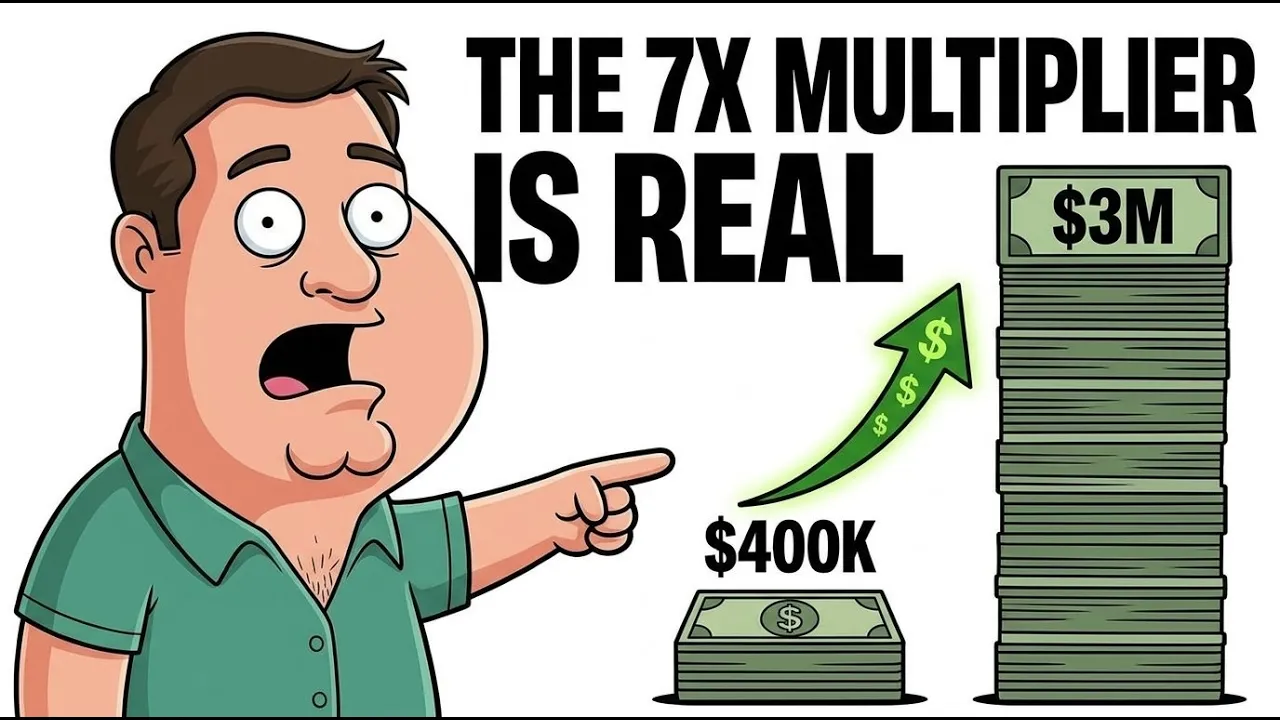
Half of all retirees following conventional withdrawal rules end up with significantly more money than they started with. Not slightly more, double, triple. Some nearly quintupled it.
A man retires in 2007 with $612,000 in his 401k. His financial adviser gives him the number $24,480 per year. Don't exceed it.
Adjust for inflation. Never touch the principal. 16 years pass.
2023. He's 79 years old. He shows me his schwab app at a coffee shop.
1. 8 million. He spent money for 16 straight years and ended up with three times what he started with.
That part you could have anticipated. Here's what you couldn't have. I spent months after that coffee shop conversation digging article you've ever read.
But first, the origin story of the 4% rule matters here because how it was built tells you almost everything about why it should never have been applied the way it is. William Ben, financial planner from California, 1994. He publishes a paper in the journal of financial planning called determining withdrawal rates using historical data.
He runs portfolio simulations across every rolling 30-year period in US market history going back to the 1870s. His question, what is the highest annual withdrawal percentage that would have survived every possible 30-year retirement in that entire historical That's the difference between $24,000 a year and $34,500 per year. $10,500 additional dollars per year.
Nearly $900 per month, every month for the entire rest of your retirement. That is not a rounding error. That's the Amalfi Coast trip.
That's flying the family in for the holidays. That's the woodworking shop you've been planning since you were 43. And the inventor's own revised math says it was always safe to spend it.
Now, some people hear that and immediately say, "But what about sequence of return risk? " This is the legitimate risk in early retirement. If you retire right before a major market crash, you're forced to sell shares at their lowest price to fund your withdrawals.
Those shares can't recover And I want to be careful here because this isn't a conspiracy. It's an incentive structure which is actually more insidious than a conspiracy because it operates automatically without anyone choosing it. Most financial adviserss managing retail assets are paid a percentage of assets under management, typically around 1% per year.
If you have a million-doll portfolio, your adviser earns roughly $10,000 a year. If you spend that portfolio down to $500,000 over 15 years, which is the entire purpose of a retirement portfolio, your adviser now earns $5,000 per year. Their income just got cut in half.
Not because they underperformed, not because markets moved against them, because you used your money as intended. By the way, hit subscribe if you like the content. Otherwise, YouTube's algorithm may never show you my videos again.
Now, the data, because this is where arguments stop and evidence starts. Black Rockck, the largest asset manager on the planet with over $10 trillion under management, published a report called To Spend or Not to Spend. They analyzed real client retirement accounts, not simulations, not back tested models, actual human beings with actual portfolios making real spending decisions in real time over nearly two decades.
What they found approximately 40% of retirees had 100% or more of their original principle remaining after 17 to 18 years in retirement. Another 8 to 10% had between 80 and 100% of their Most of the time, the compounding wins by a significant margin. The 4% rule doesn't protect you from running out of money.
It protects you from spending your money. Those are not the same thing. I want to introduce someone here who I'll return to in the second half of this video.
I'll call her Carol. She retired in 2012 at 64 years old with $420,000 in a rollover IRA. She had a small pension paying about $1,800 a month and planned to begin social security at 67.
Her financial plan was built on 4% portfolio withdrawals, $16,800 per year alongside her pension and social security. Comfortable, not lavish. She drove the same Honda for 11 years.
She'd spent her working life being careful and intended to carry that into retirement. Carol had a dream. She wanted to spend a year living in Lisbon.
go along with advice that doesn't serve them. That answer is older than modern finance. The endowment effect.
Once you own something, your brain assigns it significantly more value than what it could be exchanged for. A $420,000 IRA balance feels real, safe, concrete. The Lisbon year it could fund feels abstract, almost frivolous, like spending principal rather than using a tool designed for exactly this purpose.
Your brain literally registers the spending decision as a loss. Even when the exchange produces more measurable well-being than the balance sitting on a screen ever would, even when the historical data shows you'll die with more than twice what you started with, Okay, two quick aides because I genuinely cannot help myself. Imagine being William Bangan at a major financial planning conference in 2022.
The room is full of adviserss who have built entire careers on your 4% rule. It's embedded in their planning software, their onboarding materials, their client conversations going back decades. You take the stage and say, "I've updated the math.
The rule is probably 50% too conservative. Everyone may have been systematically underspending for 30 years. " That is a particular kind of legacy.
Hi, I'm Bill this is where it gets really interesting because the math tells one story and the actual arc of human experience in retirement tells a different and more complicated one. Real retirees don't spend flat. Researchers who've studied actual retirey spending patterns consistently find that spending follows what's called a smile curve.
Early retirement roughly 65 to 75 spending is highest. You're healthy, mobile. You want to do the things you spent 40 years building toward.
Then spending naturally drops through your mid70s and early 80s. Most people slow down. They travel less.
They want less. The appetite for new experiences that drove the first decade fades naturally as energy and mobility framework I use when I think through retirement spending because it maps to how you'll actually live rather than how a 1994 paper models you living. Level one is the survival floor.
Housing, food, healthare, insurance, non-negotiables. For most retirees with average social security, this level is largely covered before the portfolio does anything meaningful. Know this number precisely.
It is almost always lower than people assume. Level two is quality of life spending. Travel, experiences, hobbies, gifts, the reasons retirement exists as a concept.
This is what the portfolio is actually for.