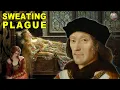
When you think of deadly diseases, you probably don't think of names like Sudor Anglicus, English sweat, the sweat, the swat, the new acquaintance, and stoupe knave and know thy master. Yet these were all names for the same terrifying sickness, one that took out its victims in 24 agonizing hours. Today, we're going to take a look at the plague that made you sweat to death.
But before we get started, be sure to subscribe to the Weird History Channel. After that, take a moment and please leave a comment to let us know what other plague-ridden topics you would like to hear about next. OK, everybody, let's sweat to this oldie.
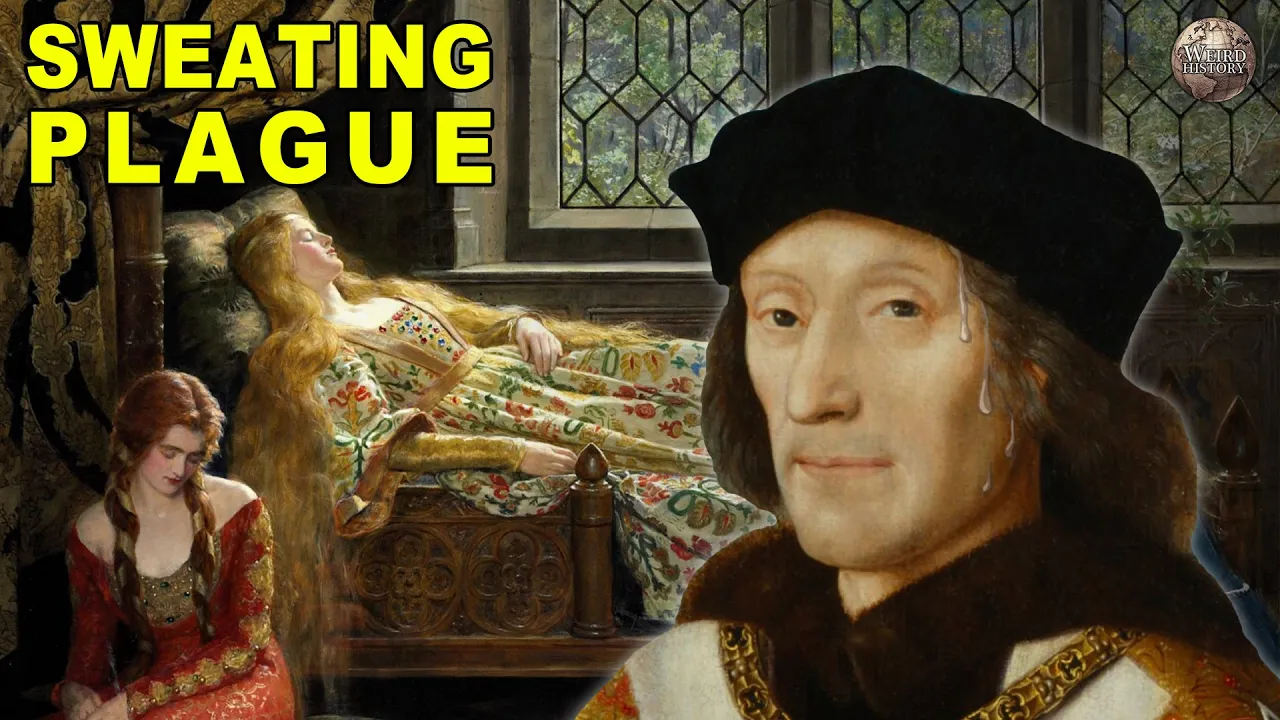
Beginning in 1485 and lasting into the second half of the 16th century, a plague of sweating sickness swept through England. This epidemic, whose symptoms and causes baffled contemporary medical practitioners and are still the subject of great debate today, eventually made its way to the European continent in 1528. Reminiscent of the Black Death, the sweating sickness was lethal, terrifying, and incredibly unpleasant.
However, unlike the Black Death, surviving sweating sickness was no guarantee you wouldn't get it again. There were several major outbreaks over the course of a few decades. And by the time all was said and done, it would take the lives of thousands and thousands of people.
The War of the Roses-- no, not the '80s film with Michael Douglas and Kathleen Turner, which is pretty good-- it's worth a look. But the War of the Roses we're talking about is a civil war that rocked England in the latter half of the 15th century and was fought between the House of Lancaster and the House of York. This decades-long conflict was a major inspiration for the political and military struggles in George R.
R. Martin's Game of Thrones where the Lancasters were renamed Lannisters and the Yorks became Starks. Fought in August of 1485 between Henry Tudor and Richard III, the battle of Bosworth Field was the last important military engagement of The War of the Roses.
The Lancasters won, and immediately after the battle, Henry was crowned King, thus beginning the Tudor dynasty. But it may have happened differently if not for the sweating sickness. Thomas, Lord Stanle was one of Richard III's biggest supporters.
On this occasion, however, Thomas held his troops back because of what he called "the sweat. " This is one of the earliest recorded references to the disease. Shortly after that, however, Thomas sent his troops into action, only on behalf of Henry instead, an act that turned the tide, defeated Richard, and ended the Plantagenet dynasty.
At the time, the shift was believed to be more about Lord Stanle's changing political loyalties, but there is evidence that an outbreak of sweating sickness was likely a real factor. Historians point out that the disease is known to have been present in London only six weeks after the battle, right around the time Henry's victorious troops would be returning to the city. As early as September of 1485, deaths from sweating sickness were already being reported in London.
Thomas Forrestier, a French doctor who had been working in the city at the time, recorded the symptoms. He said, it came on with great sweat, redness of the face and body, a continual thirst, a fever, and a headache. By the end of October, merely a month later, the English sweating sickness had killed 15,000 people.
Sweating sickness wasn't just deadly. It was downright weird. Based on reports, sweating sickness, unlike many other epidemics, didn't affect young children or the elderly.
There are literally no existing accounts of children suffering from the disease. Equally as strange was that this epidemic seemed to specifically target members of higher social classes and the wealthy. In 1485 alone, London lost two lord mayors, three sheriffs, and six aldermen, and that was just the beginning.
In 1502, Arthur Prince of Wales died from what may have been English sweating sickness. In the 16th century, several members of Henry VIII's court fell victim to it, including Anne Boleyn. And a letter she wrote indicates Lord High Chancellor Thomas Wolsey had the disease as well.
Henry was rightfully paranoid of getting it himself. A record of 1529 states that the king ran off in great haste to a distance of a dozen miles when a chambermaid came down with sweating sickness. The record stated, "This disease is the easiest in the world to die of.
" Sweating sickness first appeared in 1485. But that wouldn't be its last appearance. Reports indicate additional outbreaks that occurred in 1508, 1517, 1528, and 1551.
Each time it struck, it killed thousands of people. The outbreak of 1528 is alleged to be the worst, spreading through all of England except the north and Scotland and had an extremely high mortality rate. During this period, Henry broke up the court, got out of London, and changed his residence about as often as he changed his socks.
And he changed them a lot. In 2007, this infamous outbreak was depicted in the "Message to the Emperor" episode of the hit show The Tudors. It was also the sole instance of sweating sickness jumping across the English Channel.
During the outbreak of 1528, the sweating sickness, which until that point had solely existed in England, was transported by ship to Germany. Thousands died, including 3,000 people in Danzig alone. Mother.
After that, the sickness spread to Poland, Scandinavia, and parts of Russia. In a stroke of luck for Western Europe, it never reached Italy or France. The cause of sweating sickness was unknown in the 16th century.
Doctors then thought of it as a form of influenza. The truth is still a matter of debate today. Some modern researchers suspect it may have been the hantavirus, but others have made cases for different culprits, like anthrax poisoning.
Regardless of the specific agent behind it, doctors both then and now strongly suspected poor sanitation and contaminated water supplies likely played some role. A similar disease known as the Picardy sweat sprang up in the Picardy region of France in 1718. Attributed to fleas on field mice, this disease presented with many of the same symptoms as sweating sickness and seemed to follow the same seasonal patterns.
However, the Picardy sweat also included a rash that was not one of the recorded symptoms of the English epidemics. As such, it is unknown whether this epidemic had the same cause as the older ones or whether it was a distinct disease. Movies make it seem like people of the Middle Ages were a bunch of superstitious bumpkins who thought every disease was caused by some sort of moral evil.
OK, for once, movies are right. Indeed, every time the sweating sickness reappeared in England, it was followed by a public panic and general fear that evil, in some form or another, was at play. An English physician named John Caius even wrote a book about the sweating sickness in 1552 called A Boke or Counseill Against the Disease Commonly Called the Sweat or the Sweating Sickness, which attributes the infections to evil mists and exhalations drawn out of the ground and impure spirits in the body.
Despite attributing the spread of the illness to these more metaphysical causes, Caius believed an individual could avoid contracting it through ordinary factors like diet, exercise, and moderation. While modern researchers probably wouldn't agree, Caius's theories were highly influential at the time, he would go on to become the official physician to Queen Mary in 1557 and co-found Gonville and Caius College at Cambridge. Say that 10 times fast.
Gonville and Caius College at Cambridge, Gonville and Caius College at Cambridge, Gonville-- Gonville and Caius College. Sweating sickness typically followed a very specific pattern. Each time it appeared in England, it showed up during the spring, killed its way through the summer, and slowly faded away in fall.
It struck suddenly, and the first symptom was a psychological feeling of foreboding, which, when you think about it, was a pretty reasonable way to feel anyway. Those infected would then began to feel very cold and get the shivers. After that, they would develop a pain in their shoulders, back, necks, and head.
And obviously, they would then begin to sweat, like, a lot, a lot of sweat, Richard Simmons in a sauna amounts of sweat. This was punctuated by bouts of nausea, and that's just what happens in the first few hours. The sickness might make its victims feel cold at first.
But within a few hours, they would start to feel very hot. This would lead to the titular sweating as well as delirium with an elevated pulse. Some also reported stomach aches, liver inflammations, and heart pains.
John Caius pointed out that the sickness wasn't merely a sweat, as its name implied, but was actually a fever that would last 15 to 21 hours. Caius felt the sweat was actually how the disease was eliminated and that it should be provoked with herbs and warm drinks. Noting that affected individuals often experienced extreme fatigue, which could lead to a coma or sometimes even death, he also recommended preventing the afflicted from falling asleep.
If the individual survived, they could expect the whole experience to be over in 24 hours. For his part, Caius recommended that survivors put on warm clothes and try not to move for two full days. Many epidemics, like the Black Death for example, produce an immunity.
That means, if you survive them once, you never get them again. Sweating sickness, however, offered no such guarantee. An individual could easily get it multiple times.
That still beats the alternative, though. Those that didn't survive died fast, and the speed at which the disease killed has held interest for generations of researchers. How fast was it?
Well, one contemporary report described people dancing in the court at 9 o'clock that were dead by 11 o'clock. Edward VI was the son of Henry VIII. He studied at Cambridge University along with his good friends Charles and Henry Brandon, who were themselves the sons of the Duke of Suffolk.
Charles and Henry's father had once been married to Henry's daughter, Mary, which made the whole family a pretty big deal in the court. Charles and Henry distinguished themselves as scholars at Cambridge. But in 1551, they both contracted the sweating sickness.
They would die at the home with the Bishop of Lincoln in Huntingdonshire on the exact same day, July 14th, 1551. Charles was believed to be 13 or 14 years old at the time. Henry was 16.
Upon their deaths, their title, Duke of Suffolk, which had originated with their father, became extinct. Sweating sickness's emergence was sudden and not well understood. Its disappearance was the same.
The outbreaks of 1508 and 1517 caused thousands of deaths in London. And later outbreaks in 1551 and 1570 were increasingly localized to places like Devon, Exeter, and Colchester. Though no clear understanding of how to prevent the sickness was ever reached and it never lost its highly contagious nature, the disease began to slowly disappear after 1551.
While there have been similar diseases with similar symptoms in the centuries since, nothing has ever quite duplicated the extremely rapid and highly deadly nature of the English sweating sickness. So what do you think? Would you out sweat the sweating plague?
Let us know in the comments below. And while you're at it, check out some of these other videos from our Weird History.