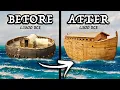
[Music] If the world was about to be flooded, I know exactly where to run to. Kentucky, home to a life-sized Noah's Ark. It's a biblically accurate ark.
Well, except for the dinosaurs. I'm sure you know the story. A worldending flood, a righteous man, and a giant boat filled with animals.
But what you may not know is that this exact plot shows up in an earlier myth. this time from ancient Babylonia. You see, there are many different versions of the flood myth, plenty of which predate the story in the Bible.
In this video, let's explore the story of Noah and investigate the historical roots of this ancient flood. The story of Noah appears in the opening chapters of Genesis, covering the first few thousand years of biblical history. It documents a pretty rough start for humankind.
Adam and Eve are banished from paradise. One of their two sons kills the other, and now their wicked offspring are multiplying rapidly. They've even started breeding with the angels, creating a race of giants known as the Nephilim.
They are some of the most mysterious creatures in the Bible and are so massive that humans seem like grasshoppers in comparison. We're only six chapters into the Bible, and God is already regretting creating humankind. Watching their corruption spread, he decides that the best solution is a total reset.
What better way to start over than by flushing humanity away with a giant flood? Forsake around and find out. But what about the innocent animals or the good people left on Earth?
Fear not. God has that covered. We're going to need an ark and I know a guy.
The rest of Noah's story unfolds in Genesis chapter 6 to9. In the spirit of being biblically accurate, let me read to you excerpts from the original story. And God said to Noah, "I have determined to make an end of all flesh, for the earth is filled with violence through them.
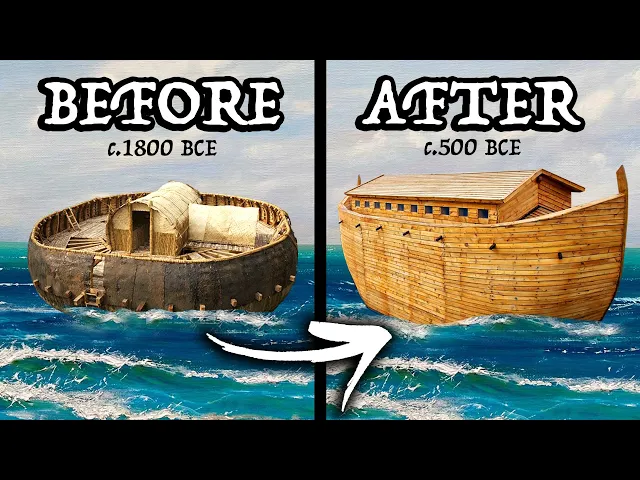
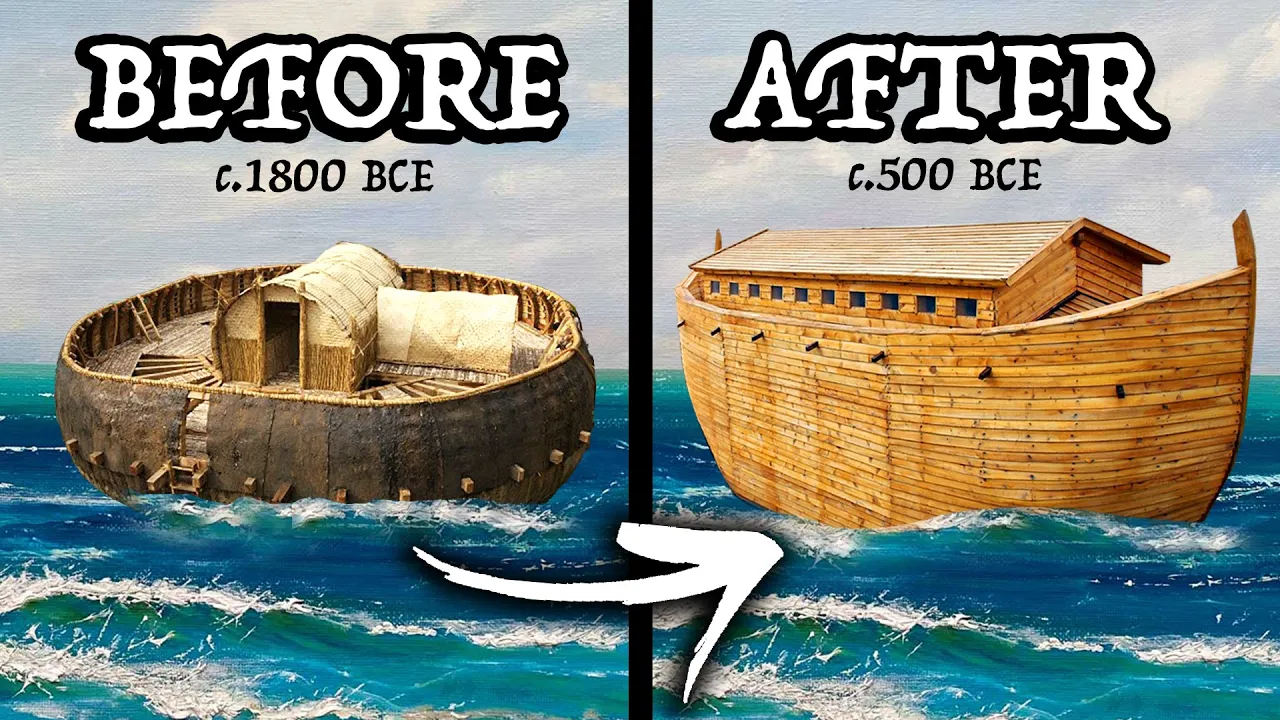
" After this, God commands Noah to build a boat, or an ark, as we call it. The word originally refers to a kind of chest, likely a reference to the cargo this vessel is meant to carry. In any case, God gives Noah detailed blueprints for what the ark should look like.
This is how you are to make it. The length of the ark 300 cubits, its breadth 50 cubits, and its height 30 cubits. Make a roof for the ark and finish it to a cubit above and set the door of the ark on its side.
Make it with lower, second, and third decks. A cubit is an ancient unit converted from biblical, the ark would have been about half the size of the Titanic. Still massive by today's standards, let alone the ancient world.
That said, if the ark carried all the world's land animals, it's hard to imagine how they could all fit inside. Some estimates say that Noah's ark would have needed to have been 100 times the volume of the original ark, far larger than even the world's biggest super tankers. Despite being 600 years old, Noah gets to work and unquestioningly builds this massive boat with his sons, after which God tells him to gather the precious cargo.
They shall be male and female, of the birds according to their kinds, and of the animals according to their kinds, of every creeping thing of the ground according to its kind. After sealing the entrance, it begins to rain, and the windows of the heavens were opened, and rain fell upon the earth 40 days and 40 nights. Below the surface, every living thing is swept away, from murderers and thieves to deceptive copper merchants.
Aboard the ark, Noah and the animals hunker down inside the massive floating chest, riding out the storm, quite literally. But God remembered Noah and all the beasts and all the livestock that were with him in the ark. And God made the wind blow over the earth, and the waters subsided.
At the end of 150 days, the waters had abated. The ark came to rest on the mountains of Ararat. Noah opens the hatch to find a world covered with water.
To check for dry land, Noah sends out some birds. First a raven and then a dove. Yet both were unable to find anywhere to perch.
He waited seven more days and again set the dove from the ark. When the dove returned to him in the evening, there in its beak was a freshly plucked olive leaf. Then Noah knew that the water had receded from the earth.
In a move that would seal this bird's positive PR forever, a dove with an olive branch is still a symbol for peace. Ravens, however, never more. Noah and the animals disembark from the ark.
To show his gratitude, Noah offers some of them as a sacrifice. Pleased with this, God delivers a final message to Noah. I will establish my covenant with you.
Never again shall there be a flood to destroy the earth. I have set my bow in the cloud, and it shall be a sign of the covenant. And so we're left with cheerful images of rainbows and animals, forgetting, of course, the many millions that perished in the flood.
Many have seen the story of Noah's Ark as just that, a story. But that is until a remarkable discovery, one that would change the way we look at Noah's Ark forever. In 1872, George Smith was translating an ancient clay tablet.
As he worked through the text, he made a shocking discovery. According to onlookers, he was so excited that he began to remove articles of his clothing. You see, Smith had made a shocking revelation.
On this ancient tablet from Nineveh, there was a story of a great flood and a man chosen to build a boat to save life on Earth. It was a flood story that predated the Bible. In the years that followed, many other Mesopotamian texts surfaced.
In one version, the epic of Atraasis, the reason for flooding humanity is rather strange. Humans have become too noisy and the god Enil can't sleep. In frustration, he orders an apocalyptic flood to silence them.
But the version most similar to the biblical story is that of Utnap Pishtim found within the final chapter of the Epic of Gilgamesh. In it, the god A learns of this divine flood and secretly warns the humans about this coming disaster. Tear down the house and build a boat.
Abandon wealth and seek living beings. Spurn possessions and keep alive living beings. Make all living beings go up into the boat.
The story even gives the boats dimensions. Instead of a long rectangle, it's a perfect circle. This type of vessel is known as a coracal, and it was used to navigate the rivers of Mesopotamia for centuries.
Rounded on all sides, it's nearly unsinkable, ideal for surviving a raging flood. Bunapishtim then loads the coracle with his family and all the beasts and animals of the field. Then the storm begins.
It's so fierce that even the gods are terrified, cowering like dogs in heaven. As the floodwaters recede, the boat finally comes to rest at top Mount Nimush. And just like Noah, Utnapishtim sends out birds in search of dry land.
First a dove, then a swallow, and finally a raven. He then descends to build an altar. The smell of burnt offerings is so enticing that even the gods swarm around it like flies.
But then the story takes a strange turn. Instead of being pleased, the gods are angry. Just then, Enlil arrived.
He saw the boat and became furious. He was filled with rage at the gods. Where did a living being escape?
Fortunately, the god A steps in and admits that it was he who secretly gave Utnapishtim a heads up. To compensate him for the trouble, Enel rewards Utnap Pishtim with eternal life so that he can live happily forever after. When read alongside Noah's ark, the story of Utnap Pishtim is remarkably similar.
Even tiny details like the boat landing on a mountain to the specific birds sent in search of dry land. No wonder George Smith was so excited. There was no doubt that these stories were connected.
But how? Well, maybe they both trace back to an original flood, one preserved in the mythologies of the ancient world. As we've seen, many ancient myths have their own version of the flood.
It's almost as if they're retelling the same event, and these myths extend well beyond Mesopotamia. In both Greek and Hindu mythologies, we find stories of people tasked with building boats in order to survive a great flood. The similarities in these story beats are striking, and that's why many have speculated that they may be describing a real historical event.
Over the years, there have been many attempts to find a historical flood, and a number of them have been located in the flood plains of the Tigris and Euphrates rivers. Now, they're called flood planes for a reason, and it's more than likely that there was once a freak incident where the inhabitants were washed away into the Persian Gulf. For those living to watch the destruction, it would have surely felt like the end of the world.
In the generations that followed, people likely wondered, "How could anyone have survived such a disaster? " And it's here where a story began to emerge, one where a man is told by the gods to build a boat. Judging by the age and frequency of the literary evidence, this myth likely originated in Mesopotamia and its popularity helped it spread to nearby cultures, including the Hebrews to the west.
The biblical story of Noah is like a branch on this larger mythological tree. A tale about the world flood given new life by the biblical writers. But this version stands apart.
The focus here isn't on eternal life or the fury of the gods, but on the morality of humankind and on a single god who ultimately regrets taking such drastic action. And it shows that humanity, despite our flaws, is ultimately worth the trouble. The fact that Noah's story has endured for so long shows the power of a good narrative, and it's captured the imaginations of all that read it.
Even today, expeditions venture onto the slopes of Mount Ararat in Armenia, hoping to find the remains of the lost ark. And no, not that one. The story may have originated in Mesopotamia, but it was refined and perfected in the biblical version.
What George Smith uncovered would reshape biblical scholarship as it demonstrated the connection between the Bible and the ancient cultures that surrounded it. Noah's Ark is just one of many stories in the Bible. And despite the world ending flood, humanity's misadventures in Genesis are far from over.
After the waters recede, people are again causing trouble. This time with a giant tower. Watch here to find out what happens next.
Hey, thanks for watching. I really hope you enjoyed this one. If you like this video and want to see more, why not subscribe?
A like and a comment also go a really long way. Shortly before I released the Babel video, YouTube rolled out an autodubbing feature. So, in an unusual twist, even I can speak different languages.
I'm so glad that so many of you enjoyed that video and wrote a unique comment. I think I lost count after 40 different languages. Anyway, I look forward to seeing you next time.
Goodbye.