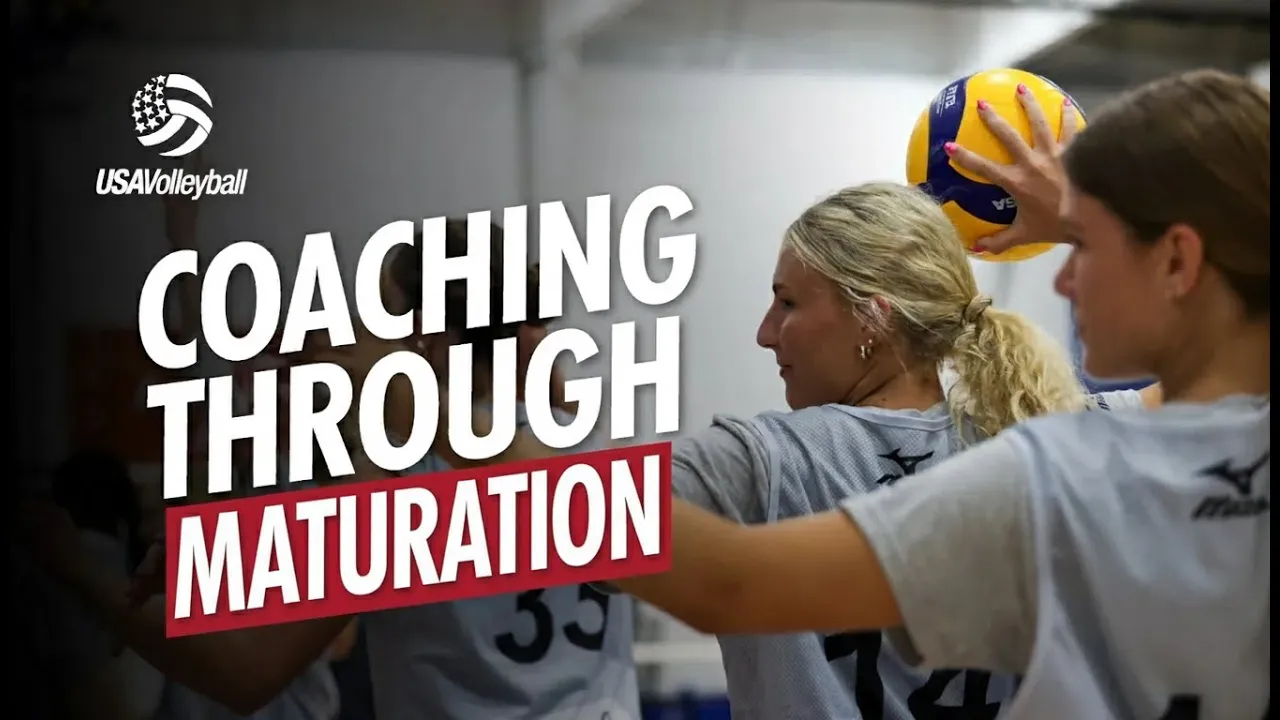
Hi everyone, I'm Lauren Walker, the manager of athlete development here at USA volleyball. And today I have the privilege of being joined by Tim Po, who is the senior strength and conditioning coach at the USOPC. Um, so Tim is here to join us today to talk a little bit about the maturational development of our young athletes as they move through those club years.
Um, so pre-colgiately, what do we see with our athletes in terms of their physiological development? What type of physical training do we need to take into consideration during this age and time period? Thanks for joining us, Tim.
Oh, >> thank you for having me. I'm looking forward to the topic. >> So, let's get into this.
As we think about athletes entering into the club volleyball world, oftent times we see them enter in that 12 13ish um time period for a male and a female athlete. They might be hitting starting to hit maturation if they're on the female end. might not yet be there with the males, but as young athletes enter into club sport, maybe for the first time, what are some key physiological considerations or maybe physical competencies that we need to think about as a coach?
>> This is such a big topic, Lauren. Um, and it's such a great topic to be discussing. Um, and it's not to sound too uh cliche, but this is like the onion and you just the the layers to this topic.
Um, you brought up the the idea of a youth and the idea of developing a young person in sport. Um, I think to get started in this is that when you think about an animal, let's say a cat or a dog, and they're born and then they grow to be adult size. And how long does that take?
It takes a dog 6 months, eight months, and they're full grown. Their limbs are full grown. Um, and after their limbs are full grown, they can start having really good awareness because now they can they know how long their legs are.
They know the coordination that it takes, the tasks that they do. They can create some spatial awareness, some kinesesthetic awareness. A lot of things just to begin with is that the human body is very different and we mature and we grow at a very different rate.
And so what happens is as we make our way through the prepubesscent years, the three to five and 5 to 8 and 8 to 11, 11 to 13, depending upon our genetic disposition. Um, also depending upon the things that we we as humans, the the tasks that are asked of a person are going to have a big impact on a person's coordination. When uh the body changes its length, when arms and legs and torsos change the rate at which they grow, it throws everything out out there.
It's like a yard sale when it comes to developing coordination and and just being aware of where the body is in space. Um we can dive a little bit further into that, but I think that's probably the first maybe first part that I would say. It's it's a challenge, but coordination is something that is the of the most significance.
>> Absolutely. When you think about those young athletes as well, one thing that coaches do need to take into consideration is the different timing of maturation and that is something that we do see different with boys versus girls. So, as you think about that, maybe the first maturational hit you're gonna >> you're gonna have if you coach girls is going to be probably in that introductory time period.
So, how do you advise a coach balances thinking about the effect that maturation is going to have with court skills and learning court skills? >> Great point. I think uh when we think about the body, the body is made up of lots of systems.
Uh the body is made up of the muscles uh which is one system the muscular system. The body has a neurological or a nervous system and you put them together you get the neuromuscular system and then you have the skeletal system which is the bones [clears throat] and I think uh just for the sake of learning and really easy understanding the brain is responsible for all tasks. The brain is is the one that tells the body, hey, squeeze your hand, stand up.
And the brain sends the signals through the nerves and the nerves then tell a muscle what to do. I like to think about it like a speaker. You know, you have a a head unit or a receiver and the receiver is the brain and the brain sends the the music signal to the speaker.
And so what I think needs most people need to think about is that as athletes age and as they grow um different systems develop at different rates of time. The muscles uh are completely different system than the nerves. And sometimes muscles mature and grow um at a different rate than the nerves do.
And it and the bones will also grow at a different rate than the muscles do. And as a result, if everything grew at the same rate at the same time, things would be really coordination wouldn't change when somebody grows three inches. You know, you think about the young puppy or the the I go back to thinking about like a young giraffe and it's moving around and it's highly uncoordinated.
Well, what can happen? And I have kids. My my daughter is 11 and my son is 14.
So, I'm in these years and I've worked with their sports teams growing all the way up from four to five to six. And prior to my current role, I spent a lot of time in the youth development world working with volleyball players and track athletes and baseball players. And you'll have an athlete at five and six.
Again, that's really, really young in the grand scheme of things. But the reality of it is in this day and age, we're asking kids are being participating in these types of sports at really young ages. You'll see a five and six-year-old gain coordination quite quickly depending upon the repetition and the exposure of that stimulus that they have.
And then as you might see somebody who looks really really coordinated prior to a growth spurt, they can hit a growth spurt. Their leg their their legs get long, their their arms get long, which means the weight of that lever changes, which means the speed of movement changes and torque changes. But just because a bone grew a/ an inch doesn't mean the nerves also grew a/ an inch.
In order to control that extra half inch and the extra load associated with that, the nervous system is the one that creates the control of that lever. And so if the nerves haven't spawned or haven't haven't uh not mileination is a different conversation but if there hasn't been a proliferation of nerves also then there's not going to be the control and they will somebody who was really well coordinated can lose their coordination and it doesn't nec it's not a it's not a linear progression. Um so I think the the idea of we think in in our space when we think about athletes and we think about physical preparation number one is athletes we want to keep them healthy.
We want to keep them safe. Uh and sometimes that means protecting them from sports as much as we want them to play sports. Um, but to answer the question, I just think uh there is to your point, girls mature at a faster rate than boys do, which means you're going to start to experience some of these situations where you might find that an athlete may lose coordination or they don't have control of their body.
And then when you bring them, back to your question, back to bringing them to the court. If somebody doesn't have control of an ankle, of a knee, of a hip, of a back, of a shoulder, and we're asking them to do tasks that are quite complex, you're asking somebody who can't swim, and you're throwing them in an 8ft deep pool, and it's and it they can't do it. And then when they can't do it, do we have a system to to help them with feedback, with correcting, or not even correcting, but just showing them a a path on how they can acquire those tasks.
Because if you're doing it in a group setting and you have 20, 30, or 15, and you see that there's this athlete and this athlete and this athlete aren't getting it, but these eight are, that is where great coaches can come. you know that's some differentiation that needs to take place in some of the coaching this task is too complex they are not getting it and that's where I think uh whether it's girls and boys as you had mentioned girls do hit those maturation ages earlier but even in that all girls might hit it within one or two they're not all at nine years old all girls do this and so there has to be great coaches there h coaches need to be empowered um and they need to have the right lens as the way that they look through um how they're looking at athletic movement um and task specific movement. I think we get it to the point where we think about volleyball specific context.
Can they do this task? Can they do this task? Can they do this task?
And those tasks are usually in the volleyball space so hyperfocused into volleyball specific movement. And maybe those movements are we're trying to get the athlete to get into those movements, but they can't because they don't have just general coordinated ability. We're asking them to do really complex tasks.
And sometimes the volleyball skills are really complex. And if there's not a breakdown, a systematic regression of how to get to do those tasks, we could just be um shooting ourselves in the foot as good co as coaches could do. I really love that point that you were just making because it really forces a coach to stop and think.
One, acknowledge that volleyball has some complicated motor tasks, right, for the skills of execution on the court. Um, and two, back it up a little bit. Think about what is the base movement that is required in order to facilitate this more complex task.
So, if I'm a coach who's coaching within this age group, this younger age group, what are some general recommendations of exercises I might be able to incorporate into practice that would work on some of those base movements or skills motor-wise that are going to support the complexity? >> Well, I think when we think about uh I mean volleyball requires the body to use the physical infrastructure. It requires the use of all joints and muscles and in order to use those um we need to have the when people use the word strength this is creating common ling lingo here strength in this concept context is not strength and let's move let's go to the weight room and work on strength strength is defined by being coordinated in any sort of tasks there are people boys, girls, adults that don't have strength to do a body weight squat.
Now, that's strength. Now, it's not weight room strength. It's just the ability to be coordinated under our own system, our own mass.
And I think the sport of volleyball is really amazing because it is so complex. When I think complex, it requires a good volleyball, good skills require the ability to use knees and full ranges of motion. We have to drop and dig.
We have to sprawl. We have to pass. We have to get our lower our center of gravity down low.
We have to move lateral planes, linear planes. We have to move in all context in all on all degrees of motion. And often times athletes who lack the ability to be coordinated under their own weight to go into those positions are the ones that are most at risk for injury.
They're the most at risk of faulty technique earlier on in a practice and earlier on in a game and they're most at risk of I say technique but that leads to poor motor patterns poor and then we start to grind in and imprint poor patterns and it's not because they don't know what they need to do because the brain learns and the competency the sorry the uh competency of our brain pain is very different than our physical competency. And so just because they know what they need to do doesn't mean they can do that task. And if the neurological system is exhausted, even though they know what they want to do, they may not be able to do it to support the movement.
But your basic movements and this is it sounds really silly but we we have accelerated youth and their development in in the in the United States and in other areas of the world where we just go straight into these really complicated tasks these comprehensive task uh in sport without saying hey can we actually actually and we say can you lunge and can you squat not for the sake of doing strength training but as a way of looking at knees. Does the knee have stability as we go into a lunge? Do they know how to have control of their trunk as they do different movements?
We look at the technical attributes or the technical skills of hitting and passing. And coaches can just, you know, they can literally dial in and like like a microscope and watch movements of shoulders and watch movements of hands and platforms. But if we really want to be better coaches in how we teach volleyball movement, we have to be better at understanding the whole system and what those volleyball movements stand on.
Does the knee stable? Is the hip stable? Are we doing these positions with poor upper body posture which then throws extra stress into the spine in the back?
In volleyball players, for kids, the lower back is really one of those we talk about knees and jumpers knees a lot and ashgood slaughters that happens in these 12 to 13 and 14 year olds because these growth rates of these tibas and and the tendons just again the tendons haven't caught up. The rate of growth of a tendon doesn't change as fast as the rate of growth of a of a bone. And so these attachment points create lots of pain.
Uh and when there's pain, guess what? you're not going to go into that range of motion because it hurts. And so then we now create weakness.
And so it kind of hides weakness, which then is going to impair an athletes ability to be free form, move in multiple ranges of motion, and be able to get down low when they need to dig a ball or or whatever position or pass low. Um, so yeah, lots of things to talk about. >> Absolutely.
What I really love is just being able to take yourself out of a hyper specific and back up to get a little bit of a higher view. So don't just look at the athletes platform. Look at how the athlete is standing.
Look at the entirety of how their body position is on the court and what is it telling you on court. Um as you think about that trajectory, we said, you know, our female athletes are going to probably hit that maturation much earlier than our male athletes. One of the things that I think it's important to remind our coaches is that in that growth period where all of these body systems are trying to catch up to each other, you know, in this, we can't make good assessments of that person is going to be the next April Ross, that person is going to be, you know, the next CCH.
We can't do that in this time period. So, what is the way that our out our coaches can think about helping athletes progress in the sport without making any sort of judgment based off of where they're at in maturation? >> Well, this is real.
That's that's such a challenge, uh, Lauren, especially in these clubs where you have people fighting for places, roster positions, and not only roster positions, but maybe I want to be on this team within our club. I want to be on the top team. And so in order to do that, if somebody going back to maybe you can't pick an April Ross or a CCHC because they're in that ugly duckling phase is what I like to say.
Go back to that story where hey you're the ugly but then you become the most mighty, the most powerful, the most beautiful. Um just because you're in this time of uh neurological challenge, neurological coordination, your system is just in is in utter chaos. the whole internal like the nervous system just doesn't have it figured out yet.
And it's kind of like tuning an engine that sounds a little pop pop pop pop and over you know you do a little bit more tuning and the the cylinders start to become in harmonious and the nervous system starts to come together and now synchronization of movement happens and then it's these coordinated tasks become awesome. And that to your point, at 13 you may see the ugly duckling, but and that engine might be popping and sputtering and spitting, but then by the time they get 16 and 17, that that that person and that nervous system could be firing really high rate and super high performing. And the hard part is when coaches are selecting a roster for this next tournament that's coming up next weekend, they're not thinking long term.
And unfortunately for those athletes, you kind of have to talk to them. And a parent has to be, this really gets, sorry, this is going to get a little bit into the weeds to this point, but parents and coaches, parents need to be patient, but coaches can't just write them off because that's what happens. You can't do these tasks.
You're not good enough. So, you didn't make the roster. You're not part of our club.
You didn't make the team. What does that do to the confidence of the athlete? >> Right?
The confidence of the athlete, they don't want to play anymore. So now you've lost the ugly duckling who's never going to be back in that sport again, but that actually person might come back if they were nurtured in a way. They actually might come back in three years and just dominate.
The question is you just don't know. And it's really hard and without having this this perspective, but unfortunately in our space, money runs youth sports. And it's really it's unfortunate and we're if we're in it, we understand it, but we don't like it.
It's not the ideal situation for all athletes. But a coach who can recognize when somebody's going through a difficult task, motor tasks, and has a progressive and a regressive teaching system. You might be able instead of cutting somebody off, you might be able to actually help a couple of those people who struggle with some things and give them a couple tools that could then come back and fill in some of their gaps to let give them some confidence because I think we're talking about the physical side of stuff, but at the end of the day, if somebody's not physically uh attuned or in comparison to other players on a court or on a field, they're not going to feel good and they're not going to want to come back to practice.
Um, and so you have to find ways to create a situation that they want to come back to. And if they come back to it, then you have the physical progression that allows them to start feeling better, which then gives them confidence so that they can kind of start doing some things. >> Yeah, >> it's really big.
No, I like how we have gotten into some good specifics here. And if we take that, you know, 20 foot view of it, what we're really saying here is, hey, coach, if you're dealing with our young athletes, if you're coaching these athletes who are in the middle of this maturational process, you can do a few things on the court. One, you can look at how they are moving in the entirety rather than just skill focus.
Two, you can admit how complex some of the things we're asking them to do on the court are. Three, you can see whether or not they're struggling with coordination, and maybe that's a good indicator for you that they're in the middle of this match process. >> And four, you can kind of take a step back and say, "Hey, I don't need to identify the next Olympian today.
>> I need to be supportive of my athletes as they go through this process. " try to help them as they adjust physiologically >> because they might cycle back around and I want that athlete still in the sport when they do. >> Yeah.
>> Perfect. Well, thank you so much for joining us today, Tim. Really appreciate all of your expertise.
>> Yeah. Well, thank you so much. It's such a great topic to talk on and it's fun to talk about it.
So, thank you.