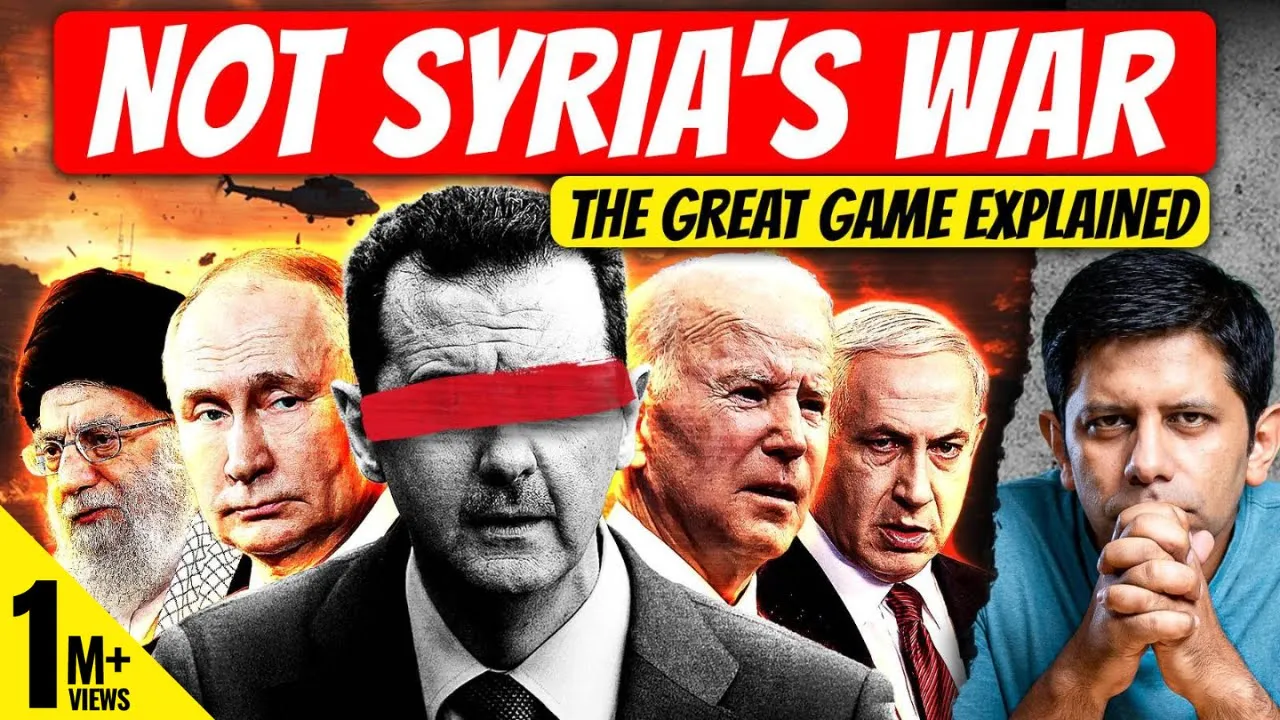
100 years ago, Vladimir Lenin, the founder of Soviet Russia, said something interesting about politics. That sometimes nothing happens in the world of politics for decades, then some weeks come in which the events of the whole decade happen Last week, something similar happened in Syria. In a blink of an eye, the regime of the decades-old dictator president Bashar al-Assad ends.
Damascus is now captured by rebels and terror groups. And now HTS, which is on the list of terrorists of many countries and the United Nations, waves its flag in Damascus HTS's leader, Abu Muhammad Al-Jolani, now has the power of Syria in his hands. What will happen to Syria after this?
Nobody has a clear answer. Until last week, President Assad was controlling more than 80% of Syria. Then suddenly, a rebel blitzkrieg happens and Assad is unable to survive for 7 days.
This rebel offensive starts in late November, the same day when there is a peace treaty between Hezbollah and Israel A few hours after the ceasefire in Lebanon, the news of the new offensive by the rebels in Syria begins to come. In the end of November, Aleppo is captured and within a week, a terrorist army reaches Damascus, palace of Bashar al Assad But by then, the dictator has already fled to Russia with his family. We have to see and understand a lot about Syria.
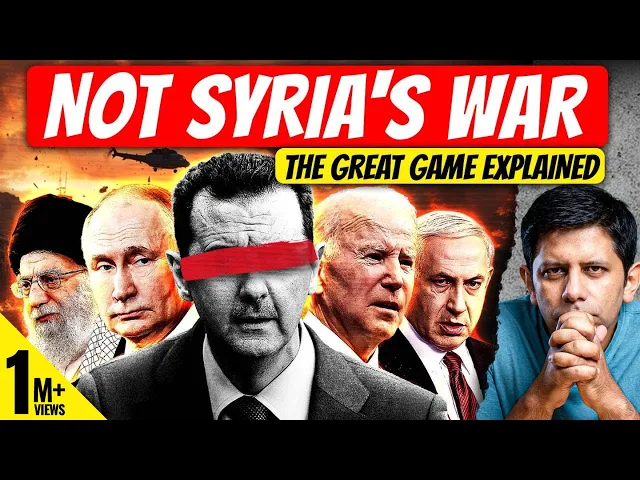
This is not a story of one country. This is a story of a great power politics. Religious extremism is being seen.
The dictatorial tendencies of the leaders that we have come to see in the last few decades Along with all this, many questions still remain with Syria. The first question is, how did the regime change so quickly without any warning? The second question is, Bashar Al Assad who won the Syrian civil war in 2016, how he gives up so easily and flees?
Number 3 - Groups like ISIS were wiped out. Russia and Iran backed the Syrian government. How did it change in a week?
Why did the big powers back off? How did the rebel groups gain so much power and confidence? Was it a spontaneous internal domestic uprising?
Or is it some other great game going on here? In today's video, we will do a deep dive into the situation in Syria and will find out what is the story of this civil war, what are the major powers involved in this? After the Assad's departure, problems can get even more serious for many countries, including India, that how the problem increases with the situation?
Syria is a unique case study in itself through which you can clearly understand how global politics works And how some countries use their people like pawns for their interests. They play a chess game. By winning that chess game they get money power and energy resources What we have seen in Syria till the end of 2024, it all started with a small protest in 2011.
That protest has now become a global geopolitical shockwave. The sudden regime collapse can have some serious implications not only for the Middle East, but for global politics, order and energy trade. But before that, a quick thanks to our episode partners today.
Growth School, which helps you to take steps towards a stable and profitable career. It's a very simple task. You have to attend their 3-hour hands-on training workshop on AI.
You will get the link in the description. This is a paid workshop by Growth School, but for the first 1500 Deshbhakt subscribers who use this link, this workshop is free With this AI training, you can make yourself 10x efficient, you can make yourself irreplaceable in your job, you can secure your future. Today, learning AI is as important as learning a computer 20 years ago.
So, how can you do all this? You will get to know in this training that you are in the tech sector, non-tech, sales, finance, HR, freelancer, entrepreneur, founder. Whatever profession it is.
. . AI can help you find a job.
You can put very complex data in an Excel sheet and use it. You can tell unique resume building skills, how to present, and much more. But you have to hurry.
This class is tomorrow and day after at 7pm. Book your slot. First 1500 people.
Absolutely free. There is also a WhatsApp group. Join it.
You will get all the updates of the free workshop here. Back to the story. First of all, the fall of Assad's regime opens a new political vacuum in the Middle East.
Here it is important to understand who is benefiting from this vacuum Russia has a big setback. Putin had made Syria his strong ally. But Putin has to re-evaluate his strategy after this sudden fall Russian airstrikes in 2015 helped Assad to secure his position.
Russian intervention actually revived Assad's regime. But now, Russia has to adopt a new strategy. This is an important turning point for USA.
USA had made efforts to topple Assad. So, it is a strategic victory for USA. But this sudden collapse is a surprise for them too.
US President Joe Biden has stated that Assad's exit from power is a historical opportunity for Syria to pursue peace. Ironically, the HTS group that is going to remove Assad has actually sprung out from Al-Qaeda. And who is Al-Qaeda's biggest enemy?
America. Who can forget 9-11 attacks? But Biden still feels that the group that came out of Al-Qaeda, which is considered to be a US-officially terror organization, can go towards peace.
Biden has a fakiri too. Anyway, let Biden go. .
. . he is counting his last few days in the White House.
Donald Trump, who is the future of America for the next four years, believes that whatever is happening in Syria, America should stay away Put a fire in a country and then sliding away is old habit. . .
Vietnam, Iraq, Afghanistan, Syria It is important to talk about Iran in this geopolitical chess, as it is a major loss for them Iran provided military and financial support to Assad. . their Iranian revolutionary guard was active there In 2018, Iran had deployed its forces to Syria in support of Assad's regime.
Now that Assad's regime is falling, Iran will have to redefine its Middle East strategy. By the way, Iran is not doing well. We have already explained how Israel is weakening Iran's pawns We also saw that Israel's attack on Hezbollah is bringing changes in Lebanon and Syria.
Now, Iran has nothing but nuclear threat. So, we have seen a big shift here Besides this, there have been many changes in regional dynamics. Saudi Arabia, which was against Assad, now has to reconsider its strategy.
Saudi Arabia supported the opposition against Assad in 2011. And now, it wants to guide its allies UAE, on the contrary, which was normalizing its relations with the Assad regime. This situation is interesting Because in the overall Middle East, the Syrian president was treated as a victor in the civil war that was going on for more than 13 years.
And the Gulf nations were normalizing their relations with him. Because of this, Assad was given a place in the Gulf Cooperation Council. now, a historic change has happened.
All these changes can have a big impact on global trade and economy. The pipelines of Syria, which were under Assad, are now under the control of the rebels. This can disrupt energy market.
Global oil prices can be impacted. World bank has also warned that the instability of Syria could disrupt regional oil trade. So, from the geopolitical angle, this event could redefine the power structures of the Middle East.
On one hand, Russia, Iran and Turkey with its own interests. On the other hand, USA and its allies and their own strategy. This political shift will create a long-term impact for the region Let's understand how.
Before understanding the story of Syria, you need to understand the geography of Syria. Syria is a part of the Levant region of Asia. Syria, Lebanon, Jordan, Israel, Palestine are all included in the Levant region spread on the east coast of Mediterranean Sea.
This area was historically full of cultural and religious diversity. In ancient times, it was considered as a crossroad between trade routes and empires. In the 16th century, the Ottoman Empire took over this region.
Syria was a loosely governed area at that time. In that era, the local politics of Syria was quite decentralized. But overall, due to the central Ottoman rule, there was stability, internal prosperity and autonomy.
The first major twist in the history of Syria comes in 1918. After World War I, the Ottoman Empire collapses. After that, under the mandate of League of Nations, Syria is put under the control of France.
And this is where the mess begins. In the 1920s and 1930s, anti-colonial movements started to take place in Syria. And in 1941, major revolts against the colonial rule of France.
France gave independence to Syria in 1946 But the political landscape of Syria was unstable. A few decades before independence, the country was struggling with internal instability and military coup. From 1940 to 1960, there were at least 7 coups in Syria Political leadership changed a lot.
In 1963, Ba'ath Party came to power. It is the main ruling party in Syria. The ideology of Ba'ath Party was based on Arab Socialism, Pan-Arabism and Secularism.
A major turning point in Syria's politics was when General Hafez Al-Assad took power in 1970 under the corrective movement. Assad made Syria an authoritarian state, opposition was crushed and military rule centralized Hafez Al-Assad made Syria a strong centralized state but along with that, human rights violations and political repression increased dramatically. In 1982, Hafez Al-Assad was blamed for Hama massacre in which, the government literally buried the residents of the city.
More than 20,000 people were massacred to suppress the voice of opposition. After Assad family made a place in power, Syria got long political stability in Syria. But the price to pay for that stability was too high.
After the death of Hafez Al-Assad, his son Bashar Al-Assad took over the presidency in 2000. Bashar, a doctor, was expected to be a modern reformist leader. But Bashar went beyond his father to silence the opposition.
In 2011, when protests were going on in many countries during the Arab Spring, public anger in Syria also increased People wanted a democratic reform, to end corruption and to give people political freedom. It's not a big deal to ask for this. These protests were initially peaceful but when President Bashar al-Assad started crushing them with brutal force, these protests turned into violent opposition Government forces targeted activists and civilians, hundreds of unarmed protesters were killed This is where the story of a long civil war begins.
In 2012, these protests were already turning into a civil war. Initial rebel groups who raised their arms were called the Free Syrian Army or FSA This was a group that initially wanted democratic reforms and wanted to remove Bashar al-Assad's regime. You can also consider this a group of defectors of the Syrian army, The leaders of these groups were progressive, secular, wanted a democratic Syria, wanted to end the Assad dictatorship.
But as the war continued, the ideologies of the different groups became stronger. There were extremist groups among them, whose influence increased rapidly. The most prominent name among them was ISIS or Islamic State of Iraq and Syria.
They took control of many cities of Syria around 2014. You may remember the time when black flags of ISIS were seen on TV day and night, terrorists on SUVs waving their guns and their executions were shown in pictures that were heart-wrenching. ISIS main goal was to create a pure Islamic caliphate.
They took advantage of the political chaos in Syria. Syria was a major part of ISIS's control. Its brutal tactics were shocking the world on a daily basis.
Another extremist group was Al-Nusra Front. It was formed by Osama Bin Laden's Al-Qaeda from Syria chapter. This group was active in Syria with a Jihadi agenda and they started a war against Assad's regime.
The objective of Al-Nusra Front was to establish a radical Islamic state which had no place for democratic reforms In the coming years, some militias were also formed to counter ISIS's terrorism. One of them was Syrian Democratic Forces, which later was supported by US forces. More than one crore civilians were displaced due to this civil war.
More than 5 lakh people have lost their lives in this long drawn conflict. This was the time when Assad targeted his opponents through his army. When the civil war got more intense, Assad adopted chemical weapons.
In 2013, chemical weapons were used in Damascus outskirts. Global shockwaves were created due to this. US accused Assad of using chemical weapons like Sarin gas, which led to loss of innocent life US President Barack Obama, taking the matter seriously, directed the forces for military intervention.
All over the world, attempts were made to sanction, isolate and condemn Syria. US and European nations also secretly supported a faction of rebels to topple Assad, which is now known as the Syrian Democratic Forces. Seeing this, Russia and Iran, who were Assad's allies, started to provide their military and financial support to help the regime.
This was the time when great powers entered the civil war It was the game of Syria. But the chessboard is being moved by some other people. Russia's military support, especially air support, gave the Assad regime a chance to strengthen its army.
Russia's air strikes weakened the rebel forces and helped Assad to restore control. As crucial as the Russian air support was, the diplomatic backing given to Syria by Russia in the global forums was equally crucial. Russia used its veto power to save Assad from international sanctions Russia's military presence in 2015 was not only to support Assad but also to put pressure on the US and Europe.
Russia's intervention in Syria was to establish a new geopolitical order. After that Assad's regime got a boost and captured other major cities of Syria in 2017 and 2016 This turned the war around and Assad's control over the country started to recover. And because of Russia's direct military support, their regime could not only survive but also restore its power base.
But the days of Assad happiness were also about to end. In 2022, the Ukraine war started and Russia started diverting its military and financial resources. Russia's air strike and artillery support, which used to be crucial for Assad, now gradually its frequency, the frequency of help and supplies were decreasing Along with Russia, Iran was also supporting Assad closely.
Iran had provided military aid, weapons and financial support Iran had also sent its proxy Hezbollah to fight in Syria. Hezbollah supported Assad's forces by being active in the form of ground forces, which included soldiers of the Iranian Revolutionary Guards The intervention was crucial because the presence of the Iranian Revolutionary Guards was providing manpower to the Assad forces Hezbollah and IRGC not only ensured the safety of Damascus, but also fought in Aleppo and favorably tilted the war for the pro-Assad forces. Iran aimed to establish Shia influence in Syria, which was there in Iraq and Lebanon Iran had seen Syria as its regional strategic partner and had made its military presence long-term.
Now, let's come to the other side of the Great Game. USA was playing its game Syrian protests started in 2011. US took a stance against Assad regime.
Barack Obama's administration started giving political and financial support to Syrian opposition. So that Assad regime can be toppled. This support was first given in the form of non-lethal aid.
Which included communication equipment and medical supplies were also included Reuters reported in 2013 that non-lethal aid was planned to be sent to Syria but along with that lethal aid like anti-tank missiles and small arms were also planned to be sent. The main goal of this was to remove Assad from his power and make rebel groups strong to change regime Obama adopted this strategy because he believed that Assad's regime is so brutal that it is necessary to remove it. It was also said that long-term stability and democratic reforms can come from the downfall of Assad in that region.
But in US-supported rebels, there were many groups like Al-Nusra Front, which gradually moved towards extremism. USA was indirectly strengthening it, who later contributed to the rise of ISIS. This is called geopolitical fakiri.
USA has kicked its own foot many times. Then, when Donald Trump became president in 2017, he made a major shift in his Syria policy. Trump shut down CIA's covert operation to train rebels in Syria The intention was to restrict US military presence in the region.
Trump's decision is important because he openly said that US interest in Syria should be limited and that US should prioritize US first policy Recently, Trump has clarified that USA should not interfere in Syria's affairs and they should solve their own problems. The last player in Syria is Turkey, which was supporting the opposition. Turkey started military operations in 2016 targeting Kurdish groups.
Because they felt that these groups were a threat to Turkish security. Turkey's intervention was direct. They sent their armed forces to the northern border areas of Syria, where Kurdish militants were active These militants have always been a serious security threat to Turkey.
Turkey's military operations like Euphrates Shield and Olive Branch targeted Kurdish strongholds in northern regions of Syria These operations were not only addressing Turkey's security concerns but also pushing Kurdish groups back. By the way, they were part of US backed Syrian Democratic Forces. So, you can see where all the wires are connected in this global chess game.
In such a complicated battlefield, a player who was consistently gaining ground in the last 8 years, how did he suddenly lose in a week? How did this sudden collapse happen? Was it a local military failure?
Or was it a big geopolitical game? First of all, it is important to understand that foreign backing is necessary for such swift and effective offensive. This was not an attack of an ordinary opposition group.
This was a well-coordinated military campaign which was not possible for local opposition forces. According to reports, opposition groups got support for modern weapons and logistics which they did not have before. Suspicion is going to Israel and Turkey but nothing can be said officially Israel has already conducted military operations against Assad's regime.
But in the past weeks, IDF has increased its presence in northern regions of Syria. This is a speculation but some reports suggest that the Israeli military airstrikes targeting Hezbollah weakened Assad's position and gave the opposition a big opportunity to take advantage of it. Now let's talk about Russia's role.
When the news of the collapse of the Assad regime came Russia's position also became questionable. In 2015, Russia gave full support to Assad But now, when the Ukraine war has started, Russia has changed its focus. Russia has significantly reduced its military involvement in Syria and opposition forces have taken advantage of it.
Did Russia deliberately withdraw its forces? Was it a planning or a strategic move? There were internal issues of Russia itself.
But, it is also a speculation that Russia's withdrawal gave a huge momentum to the opposition. Russia's withdrawal made Assad vulnerable. And, there is a hidden player, China, who is being talked about very less.
In the past years, China has shown a huge economic presence in the reconstruction projects of Syria This is also a speculation that China indirectly supported the opposition considering its long-term strategic interests. After understanding this whole matter, one thing is clear. The Assad regime lasted for so many years and then it was finished so soon not because of internal military failure but because of a complex geopolitical game.
This was a process in which global powers played a role in balancing their influence for their long term interest. When Assad's regime went towards its collapse, all the major players of the world played their own game to achieve their goals. We saw one version of what is happening in Syria in 2021 as Taliban took over Afghanistan in 2021.
In both the cases, the established regime collapsed. In 2021, Taliban captured Kabul without much resistance. In the Assad regime, the regime was unexpectedly destroyed.
In both the cases, the involvement of foreign support and external players was crucial. Withdrawal of the US and NATO forces accelerated the movement of the Taliban. After the US withdrawal, Taliban swiftly expanded their territory and captured Kabul in a few weeks.
We see the same scenario in Syria. As soon as the powers supporting Assad's regime like Russia, Iran and Hezbollah become weak, the powers supporting Assad are pushed back. Suddenly, the offensive starts and Assad is forced to flee In Afghanistan, the Taliban's takeover brings a clear shift.
There are human rights abusers, especially against women. The issue of international recognition is also the most problematic In Syria, when Assad's regime falls, the Islamic hardliners who are now threatening human rights violations, especially women's rights. Will the internal displacement and humanitarian crisis in Syria increase like Afghanistan?
We will find in coming days. So, the final question is, what's next? When Assad's regime was toppled, will rebel groups show their true colors?
HTS leader Abu Mohammad al-Julani expressed his ambition in front of CNN Al-Julani said that HTS's aim is to create a government with institutions and a council which is elected by people. A system that is institutional, not one ruler can make arbitrary decisions. He said this in 2018 when HTS cut off from Al-Qaeda But there is a real challenge.
HTS' image is still in the form of a terror group. USA, Turkey, UN all see HTS as a terror group. And because of this, it will be difficult to establish their global recognition and legitimacy.
In the existing control areas of HTS, they have made a quasi-state model. There are government structures, taxation and healthcare systems Al Julani says that his focus is not to increase sectarian or ethnic divisions, but to make an Islamic government. Julani has also advised that the public institutions that are left, like hospitals and police stations in the country, should not be damaged.
But there is a difference between what you say and what you do There is no guarantee that Syria will not become an absolute, fundamentalist, extremist state like Afghanistan. The future of Syria is uncertain. The economic crisis has increased after the collapse of Assad's regime.
In the coming days, whether Julani will declare himself a theocratic leader or not, is to be seen. Will more doors of instability open? At the same time, Syrian Prime MinisterMohammad Ghazi al-Jalali has talked about free and fair elections.
But if Julani and his HTS come to power, then they may not like the idea of elections. But if Kurdish-led Syrian Democratic Forces or SDF come to power or their support is formed, then it is possible that Western powers will get a force to influence the future outcome. This means that political, strategic and moral flux will continue in Syria.
And HTS will try to go for a new model of theocratic governance It is uncertain who will start and who will end Finally, what will be the impact of this Syrian crisis on India? India has had a long-standing interest in Syria, whether it is geopolitical alliances, energy security, or humanitarian aid. India's relationship with Syria has been historically friendly.
India has also started infrastructure projects in Syria, including many Indian-Syrian joint ventures in the field of energy, healthcare and education Energy security is also a crucial aspect. India has some oil and gas investments in Syria. Like, Indian Oil Corporation started an exploration project in its oil fields in 2010 Energy supply routes and oil pipelines can also be at risk due to instability in Syria, which will be an important concern for India Whereas, if a terrorist extremist regime is set up, security challenges are even more.
India will have to immediately interact with this new regime, secure its interests, secure its investments But the whole situation of Syria tells us how a dictatorial regime can push a peaceful country into instability for decades. At the first hint of instability, major powers of the world jump into the area to increase their influence. And before you know it, the whole war is being fought with global political rivalry.
Religious extremists take advantage of this. leaving people after a dictatorial regime at the mercy of an extremist ruler. We saw this in Afghanistan and now we are seeing this in Syria.
The point is, which will be the next country to get caught up in this great game? This is what we need to see and understand this great game being played by the big countries and when will we stop them?