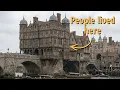
London in the 1600s was already one of the largest cities in Europe with a population approaching half a million people. It was a dense fast growing metropolis shaped by trade, river traffic, and constant movement along the temps. In this video, I use modern AI tools to bring historic paintings and engravings to life, allowing us to shift perspective, change camera angles, and move through the same scenes in ways their [music] original artists never could.
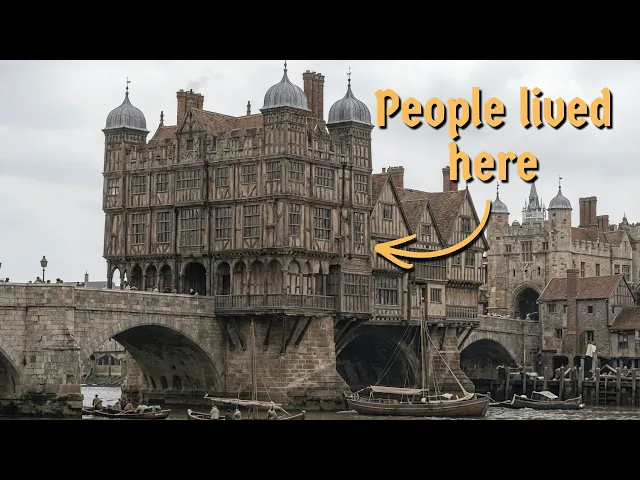
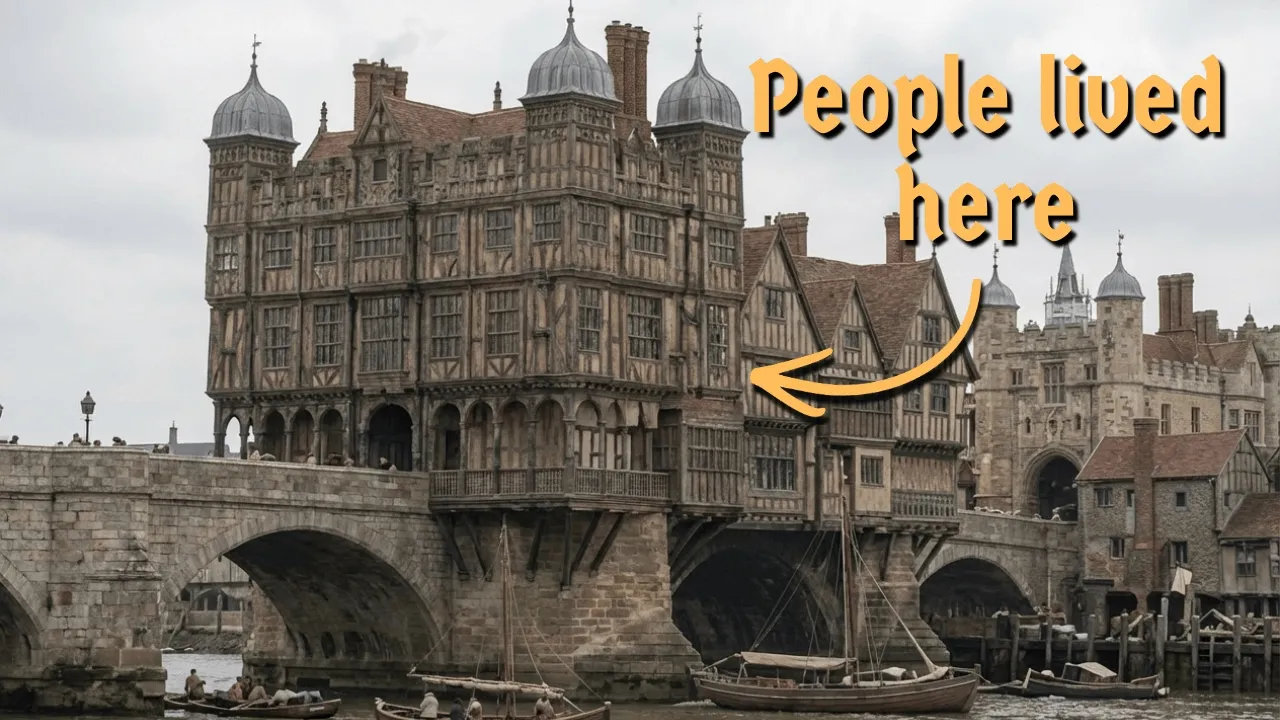
First, I want to talk about what we now call the old London Bridge, a structure I didn't know nearly enough about before starting this research. By the 1600s, old [music] London Bridge was far more than a river crossing. It was a densely built street suspended [music] above the river temps, linking the city of London to Suk.
Houses, shops, warehouses, chapels, and gateouses lined the bridge so completely that from a distance [music] it appeared less like a bridge and more like a continuous neighborhood spanning [music] the water. The bridge rested on a series of narrow stone arches supported by massive peers. These constricted the tidal flow of the tempames [music] beneath them, creating powerful currents that made navigation hazardous.
[music] River traffic attempting to pass through the arches faced strong surges of water and accidents were common. The buildings on the bridge rose several stories high. often projecting outward over the roadway.
And residents lived above the constant movement of carts, horses, and pedestrians below. Fire was a constant danger. Congestion [music] was unavoidable, and yet people continued to live and work here for generations.
Crossing Old London Bridge meant passing not only through a commercial [music] artery but beneath visible reminders of authority and control. Below the tempames functioned as London's primary highway. Barges, [music] feries, merchant vessels and smaller rivercraft crowded the water carrying [music] grain, timber, coal, cloth and imported goods.
The river [music] connected London to England's interior, to Europe, and to the wider Atlantic world, making the [music] bridge a point where local life and global trade intersected. In severe winters, the restricted flow beneath [music] the bridgeg's arches could contribute to the river freezing. During these rare periods, the temps briefly transformed with people walking and gathering on the ice below the bridge.
A striking contrast to the danger the river usually presented. This view shows the northern entrance to the bridge approached through the area beside St. [music] Magnus the Martr's Church visible to the left.
By the mid- 18th century, the bridge had deteriorated so badly that officials decided to clear and remodel it. And between 1756 and 1762, the buildings that had crowded Old London Bridge for centuries [music] were gradually demolished. Although the painting dates from the 1700s, it depicts a crossing that had already shaped [music] London for centuries.
Remarkably, this is a site you can still visit today. What makes old London [music] Bridge remarkable is not only its engineering but its endurance [music] as lived space. It functions simultaneously as infrastructure, marketplace, neighborhood [music] and symbol.
Kings and commoners crossed it. Traders and laborers worked [music] upon it and newcomers arriving in London first encountered the city at this narrow [music] crossing. Old London Bridge was crowded, dark [music] and often unsanitary.
It slowed traffic, bottlenecked [music] trade, and posed constant risks to those who lived and worked upon it. Yet for centuries, it remained indispensable. Until the 18th century, it was the only permanent crossing [music] of the Tempames in central London, making it unavoidable for movement north or south across the city.
Sometimes [music] I wish I could step back and experience this place as it once was, even just for a single day. For now, I guess this AI reconstruction is as close as I can come to that dream. This is Buckingham House in the late 17th and early 18th century.
Long before it became Buckingham Palace, originally built as a private townhouse on the western edge of London, it stood away from the city's crowded core, surrounded by open land and gardens. At the time, this area marked the boundary between urban London and the countryside beyond. A reminder that even as the city grew denser, its limits were still clearly felt.
In September 1666, London was struck by one of the most devastating fires in its history. What began as a small blaze quickly spread through a city built largely of timber, its narrow streets and crowded buildings, turning the fire into an unstoppable force. The first image shows Lgate [music] in flames with old St.
Paul's Cathedral visible in the distance, its square tower already threatened. Soon even this massive landmark would be consumed. The second view looks across the tempames near Tower Wararf on the evening of September 4th.
London appears as a continuous wall of fire. [music] To the left stands London Bridge, while to the right, the Tower of London narrowly escapes destruction. Old St.
Paul's burns at the center of the skyline. In just a few days, much of medieval London was reduced to ash. Yet, the fire [music] marked a turning point, clearing centuries of dense construction and forcing the city to rebuild, [music] reshape, and begin again.
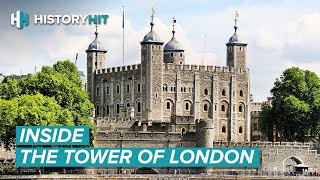
[music] Rising above the rivers, the Tower of London in the 1600s stood at the center of royal power. By this time, it functioned as a [music] fortress, an arsenal, a treasury, and one of the most notorious prisons in England. High-profile prisoners accused of treason were held within its walls.
The tower also housed royal records, weapons, and even the crown jewels, reinforcing its role [music] not just as a place of punishment, but as a cornerstone of the English state. This scene shows Cheapside in 1638. one of London's most important ceremonial streets during the procession of Marie de Medici as she entered the city to visit her daughter Queen Henrietta Maria and King Charles I.
Cheapside was not just a commercial thoroughare [music] but a stage for royal display lined with conduits, crosses and temporary structures for public events. At the center [music] stands the Cheapside Cross, a familiar landmark and gathering point. While soldiers, officials, and crowds [music] fill the street beneath the pageantry, moments like this reflected growing [music] political and religious tension as Henrietta Maria's Catholic faith and foreign origins unsettled a city already drifting towards civil war.
Today, this same stretch [music] survives as modern sheepside in the city of London near St. Mary Leau, a place where the street remains even as the medieval landmarks have vanished. This image shows the political and religious complex [music] of Westminster in 1647.
Viewed [music] from across the river tempames at a moment when England itself was deeply divided. On the left stands the [music] old palace of Westminster, the seat of Parliament and the center of political [music] power. By the mid-7th century, it had become the focal point of growing conflict between the [music] monarchy and Parliament, especially during the years of the English Civil War.
Just beside it rises Westminster Hall, one of the oldest and grandest surviving parts of the palace, used for courts [music] of law, state trials, and major public gatherings. Its vast roof symbolizing royal authority long before it became a stage for challenging it. To the right dominates Westminster Abbey, the spiritual heart of the nation.
For centuries, it had served as the site of coronations, [music] royal funerals, and the burial place of kings and queens, reinforcing the sacred dimension of monarchy. In 1647, the abbey stood uneasily between tradition and upheaval as religious divisions reshaped England's institutions. At the center of the scene are Westminster stairs, a busy river landing where travelers arrived and departed by [music] boat.
In an age before bridges and paved roads dominated travel, the tempames functioned as London's main artery, carrying politicians, clergy, messengers, and citizens directly to the doorstep of power. This etching shows the Palace of Whiteall in 1643, then the largest royal [music] residence in England and the primary home of the monarch. From these river-facing [music] steps, kings and courtiers arrived by boat, underscoring the tempames as London's main route of travel and power at the heart of the Stewart Court.
Stretching along [music] the tempames, Whiteall was not a single palace, but a vast [music] complex of halls, chambers, and administrative buildings where royal government was conducted. Most of Whiteall was destroyed by fire at the end of the [music] 17th century, and today only the banqueting house survives, standing as the last remnant of what was once [music] the center of royal life. This is Richmond Palace in the 16th and [music] early 17th centuries.
One of the most important royal residences outside central London. Originally rebuilt by Henry VIIIth on the site of a former medieval manor, Richmond became a favored [music] retreat for TUDA and early Stewart monarchs, offering cleaner [music] air and space away from the crowded city. It was here that Elizabeth I spent her [music] final days, dying at the palace in6003, marking the end [music] of the Tuda dynasty.
Over time, the palace fell out of use [music] and was gradually dismantled. And today, its grounds form part of modern Richmond with only traces of its walls and layout, [music] surviving beneath the streets and riverside paths. Standing here, looking back at these moments, it's hard not [music] to feel how close the past really is.
These streets, these buildings, these events shaped the world we live in. And through [music] these reconstructions, we get just a glimpse of what it was like to be there. If there's another city, another moment in time, or a historic scene you'd like to see brought back to life, [music] let me know in the comments.
I'd love to keep building this journey into the past with you. again.