Well, it is great to be back with you today. Chris Larson didn't want to introduce me. He saw it as a mercy, so that you wouldn't contrast our heights and—it is great to be with you again, and through the years I have given Chris Larson a lot of grief for titles he's given me of lectures.
I've had to lecture on statism. I mean, what do you do with that? One national conference, my title for one of my addresses was "Part Two.
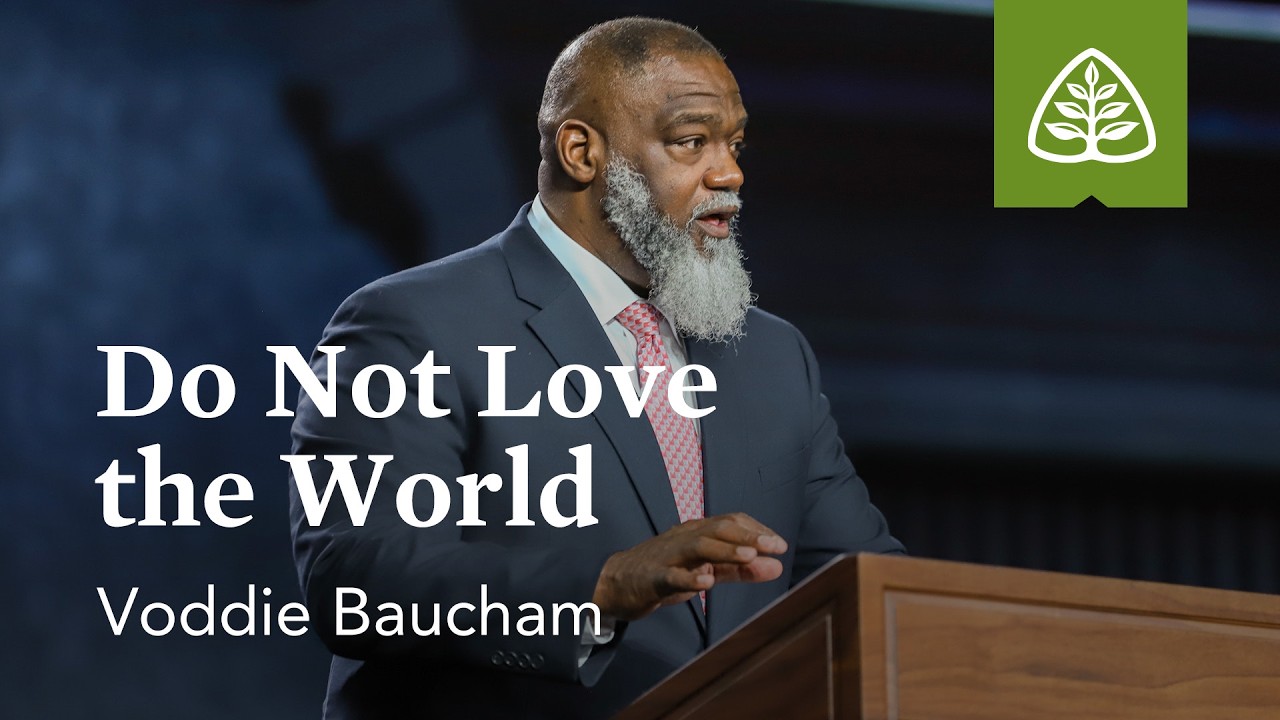
" Really? But I love the title I've been given today. "Do Not Love the World.
" And I love that it's part two, following on what Derek Thomas began for us so marvelously this morning. I was looking over the titles given to others to see if there was something I coveted. And I noted that mine is the only imperative, and I think that's great.
"Do Not Love the World. " That is such a great title. That is such a great biblical quotation.
That is such a great message that you would probably be better off if I sat down now, but I'm not going to. But I would ask you to turn with me to I John 2, where the apostle John gives us that imperative, and I want to read with you the three verses beginning at I John 2:15, and let us give our careful attention to the reading of God's Word. "Do not love world or the things of the world.
If anyone loves the world, the love of the Father is not in him. For all that is in the world—the desires of the flesh and the desires of the eyes and pride in possessions—is not from the Father but is from the world. And the world is passing away along with its desires, but whoever does the will of God abides forever.
" Amen. Let us pray together. Oh, Lord, we do acknowledge before You that the world is ever with us, around us, and within.
And the love of the things of the world so easily captivate us and distract us and lead us astray, and it is so easy to desire what the world desires rather than what the Father desires. And so, we pray that as we continue to reflect on these things, Your Holy Spirit will be with us to open our ears, open our eyes, open our hearts, that we might be helped to see where we are loving the world and where we need to repent and change by the Spirit of God, where we need to be more and more conformed to the image of Christ. So, come Holy Spirit and help us, and build us up in the faith, and purify us for we pray in Jesus' name, amen.
This is my fortieth year of teaching. I started when I was five. It's amazing how fast the years go.
But one of the dangers for an audience like this, when you have a professor come to speak to you after forty years, that he's very unlikely to begin with an examination question. So, here's your examination question to begin the hour. If I begin a biblical verse, can you finish it?
Here's the verse. "Have you considered my servant . .
. " AUDIENCE: Job. GODFREY: Well-done.
R. C. was first.
He's fast. "Have you considered my servant Job? " And God goes on to say to the evil one, "Have you considered my servant Job?
There is none like him on earth, a blameless and upright man who fears God and turns away from evil. " I do not want to pause over the awkward question, could God say that about us? I want to look at a very different servant of God with you today: Have you considered my servant Samson?
I went to the opera. Derek Thomas would like this. I went to the opera to see Saint-Saëns' "Samson and Delilah.
" And in the opera notes—I kind of knew the story, I didn't need to read the synopsis—but the San Diego Opera is significantly supported by a lot of Jewish donors, and so the director of the opera, who's a very clever man and a very clever fundraiser, asked one of the leading rabbis of the city to write some notes in the opera program. So, I read them with great interest, and what the rabbi had to say was—this is a summary, a paraphrase—"Samson was a bum. " "And the story of Samson in Judges 13 to 16," the rabbi said, "is not used in any synagogue liturgies.
His story is not read in synagogue because it is not edifying, because he was not a righteous man. " And I thought as I read that, here is a fascinating contrast between pharisaical religion as preserved by the rabbis, and apostolic religion that records for us that Samson was an example of faith. Now, Samson is not an example of faith as one blameless and upright before the Lord keeping all His commandments.
Samson is an example of faith in terms of a sinner saved by grace, of one chosen by God before his birth and set apart to a mission, of one whom God preserved in that mission in spite of his sin, of one whom God rescued from the depths of degradation and made useful in His purpose, and whom God glorified at last. And I want to think with you about God's servant Samson, not at all to encourage you to walk in his ways. In fact, after—I realized, after reading those opera notes, I didn't know as much about Samson as I thought I knew.
What do you know about Samson? It's interesting, when we think about Samson, we often think about animals and animal parts. We think about a lion that he killed with his hands and the jawbone of an ass.
A fresh jawbone. That's what the Hebrew tells us. I guess old jawbones are brittle, but I fear that fresh jawbones are gooey, and – So, we think of Samson and the jawbone of an ass.
We think of Samson and the lion that he tore apart with his hands. Maybe we think of Samson as a dumb ox grinding grain in prison. We always think of Samson and Delilah.
Do you know we're told that Samson was a judge for twenty years? He is the last judge in the book of Judges. He is the twelfth judge in the book of Judges.
He's the judge who has the longest story in the book of Judges. He beats out Gideon by just an eyelash, but he does beat out Gideon. And he's the most deplorable judge in the book of Judges.
The book of Judges is a record of Israel's decline, a decline that we can see in the decline of the judges. All the other judges led Israel. Samson is described as a sort of rugged individualist that has almost no relationship to Israel in the story.
He's not a leader, even though he still is something of a savior and preserver of Israel, we're told in the text. He's a very curious figure. In Handel's great oratorio about Samson, one of the Israelites records this observation about Samson.
"He is a mirror of our fickle state. " I love that line. I don't love the reality it describes, but I love the line.
I love that word, "Fickle. " That's a nice word, isn't it? But it's not a nice reality.
Unreliable, changeable, not dependable. That's too much what Samson was. Of the twenty years that he was judge in Israel, we are given chapter 13 and 14 about the announcement of his birth, his birth and his marriage and his call to be a judge at the beginning of those twenty years, chapters 13 and 14, on into 15.
And then we're told about his relationship with Delilah and his death at the end of his being a judge. And his whole twenty years are summed up for us by one little incident at the beginning of chapter 16 in Judges. Whole twenty years summed up.
"Samson went to Gaza and there he saw a prostitute, and he went into her. " Then it goes on to say how they tried to capture and kill him and tried to lock him in the city, and he burst out and went forth, carrying the gates of the city. And in three verses, we have his twenty years summarized in this one snapshot.
And as I was studying this, I thought, you know, I'm from the Dutch Reformed tradition that very much encourages the regular reading of Bible verses at the table after meals, and I'm thinking, "What kind of verse is this to read to the kids at the dinner table? Samson went to Gaza and there he saw a prostitute, and he went into her. " He's a bum.
Do not love the world. Do not fall into the desire of the eyes. Chapter 14 of Judges, "Samson went down to Timnah, and at Timnah, he saw one of the daughters of the Philistines, and he came up and told his father and mother, 'I saw one of the daughters of the Philistines at Timnah.
Now, get her for me as my wife. '" His mother was a godly woman, so was his father apparently. And so, they respond, "But his father and mother said to him, 'Is there not a woman among the daughters of your relatives or among your people that you must take a wife from the uncircumcised Philistines?
'" They knew the covenant of God. They knew the call of God for Israel to be separated from the nations. They knew the warning of Joshua on his deathbed as we find it in Joshua chapter 23, that they must not marry into the nations.
They must remain separate as the people of God. And they remind him, Samson, of this covenant responsibility. And how does Samson respond to the godly advice of his parents?
But Samson said to his father, "Get her for me, for she is right in my eyes. " After the story of Samson, there is no longer a judge in Israel, in the book of Judges, and everything tends to degeneracy and to chaos, and what are we told? The people did what was right in their own eyes.
Here it starts, or at least here it's recorded for us in the judges themselves. Samson insists not on doing what's right in God's eyes. Chapter 13 begins with familiar words.
Israel was doing what was evil in the eyes of God. Israel's not doing what is right in God's eyes. Samson is not doing right in what is God's eyes.
Samson is doing what's right in his own eyes. He saw a pretty woman and he wanted her, and he was not listening to any other advice. What's remarkable about this is—and this is the kind of thing students pay a lot of tuition money for in seminar and you're getting it, well, not exactly free, but at a discount.
Now, are you ready? In Judges, chapter 13 comes before chapter 14. Write that down.
That's really important. What I think is so often forgotten about the Samson story is we have a whole chapter about Samson before Samson's born. A whole chapter of instruction from the angel of the Lord to his parents about how Samson is to be raised, what Samson will be, what Samson is to do.
And the angel of the Lord sets the stage for Samson. He doesn't say a word about Samson being strong. It's very interesting.
We think of Samson, one of the first things we think about, the strong man. The angel of the Lord didn't say anything about the strength of Samson. He says, "Samson will be set apart like a Nazarite.
" Remember the Nazarite vow? Nazarite's just the Hebrew word for "separate. " I don't know why we translate it "Nazarite" because that's not a translation.
Samson was to be set apart by a vow of separation to serve the Lord. That's what was said of him before his birth. That was the promise given to his parents before his birth by the angel of the Lord.
And that's who Samson most fundamentally was. He was washed. He was sanctified.
He was justified. We're told that as a young man growing, the Spirit of the Lord stirred in him. We have evidences of faith in Samson.
He's a man of prayer. The prayers are a little selfish. Not quite as selfish as they appear at first glance, but he prayed after killing all these Philistines with the jawbone of an ass, for the strength of the Lord, and the Lord by his Spirit strengthened him and really commissioned him to be a judge at that moment, I believe.
And then when he's in the prison, blinded, suffering, he prays for the Lord to restore his strength that he might do justice as judge of the people. So, he's a man of prayer flowing out of that faith which was given to him by the Spirit that stirred within him. That's why Hebrews, or at least that's one of the reasons I believe, that Hebrew says he's a man of faith.
He's an example of faith. He's not primarily a bum. He's only secondarily a bum.
He's primarily a man set apart by the electing grace of God, by the regenerating Spirit of God, by faith in God. So, what went wrong with Samson? I half wonder when John penned the words of I John, and the Spirit inspired him to warn the church against loving the world by following the desires of the flesh and the desires of the eyes, if John maybe had Samson in mind, because what led Samson astray, not altogether from the Lord, but from the path of faithful consecrated service to the Lord, what led him astray was his eyes.
Too much of his life he lived by sight and not by faith. And here is one of the great spiritual struggles that every Christian wrestles with probably every day. Will I live by the Word of God or will I live by the sights of the world?
Will I live by the unseen or by the seen? Will I live by that world that is always around me and squeezing me? Or will I live by that Spirit of Jesus Christ that He's given me that stirs within me?
And Samson I think is recorded at length for us amongst other reasons to be a warning to us as the people of God not to be conformed to this world, not to love the world. And in a certain sense, I would like to propose now as a historian a little more than a preacher, I would like to propose that Samson might be regarded as the patron saint of Christianity in America today. He's a rugged individualist.
He does his own thing. He lives by sight. He's apparently strong.
But in the truths of God, he is sadly weak and distracted and led astray. It's very interesting in that first chapter. If you don't have chapter 13 carefully in mind, don't read it right now.
You should be listening to me. But go back and read that because one of the very interesting episodes is the angel comes to his mother. We don't have her name.
She's a kind of Hannah-like figure. She's not been able to have children. Unlike Hannah, there's no record that she prayed for children.
She seems like Israel, so dejected, so down, so discouraged, that she can't even pray about these things. And the angel comes as a complete surprise to her, says she's going to have a child. This child will be consecrated to the Lord as a Nazarite.
He will be separated to the Lord from birth, and she is to see that he carefully follows the words of the Lord to be a Nazarite. The mother, a pious woman, goes and immediately tells her husband what has happened, and the husband, apparently with great piety, prays earnestly that God would send the angel again so they might have further instruction on how to raise this child. What a pious prayer.
And then the angel comes back, and the angel says, "You are to raise this child as a Nazarite according to the commandment of God. " The angel gives them no more information. And I think the subtext of this is, "Look, you bozos.
" That's a paraphrase. "I have given you people plenty of information. Don't, with a cloak of piety, say to me, 'I need more information.
' The information is all right there. The question is, what are you doing with it? " The law of Moses said, Joshua said, "Don't marry the children of the nations.
" Samson didn't need more information when he saw this Philistine woman in Timnah and wanted her. He needed to pay attention to the information he had. I think this is very much the state of the church in America today.
We're constantly restless, wanting new things. And what we need is the Word of God in our hearts and in our minds, in our church services. Is the Word of God permeating our lives?
The reason the Dutch Reformed read the Bible at every meal was so that they'd get up from the table with the Word of God in their minds and in their hearts. Presbyterians did that, too. I don't want to claim this an exclusive.
Apparently even Israelites did that. But, anyway. It's not that we need something beyond the Word.
We need the Word. Samson had the Word, didn't he? He had the Word in the tradition of his people.
He had the Word from his parents. His problem was not a deficiency of the Word. His problem was he didn't listen.
He didn't listen. He looked. It's not incidental.
It's not surprising that at the end of the life, Samson is blinded. The Philistines do that to mock him, to weaken him, to control him. But the blinding of Samson is the moment at which the Lord says to Samson, "Be now truly what you've been.
You've been blind. You've been blind to the truth of My Word. You've been blind to the path in which you should walk.
You've been blind to follow your eyes in the standards of this world. So be blind. " It's really rather tragic.
He had followed his eyes. That's one of the first concerns we all need to have as we think about not loving the world. We're besieged with advertising, and what is the purpose of advertising?
To make us dissatisfied and want to buy more and more. One of the ways in which we're conformed to the world, John says is by the pride of possessions. "Look what I've got.
Look what I've been able to buy. I'm better than you. My car is bigger.
My tie is oranger. " I wore this tie for Mr. Thomas.
She's Irish, you know, and Monday is Saint Patrick's Day. And so, in loyalty with the Protestant cause and Ireland, I wear an orange tie, anticipating, and I arrive eager and proud of my possession. And there I see Mr.
Thomas, all in green. Life is difficult, difficult, difficult. So, it's the eyes.
It begins with the eyes. John says Samson shows us, allowing what the world shows us to trump what God has said to us. And here is where we have to dedicate ourselves, where our churches need to be dedicated.
There's a little book written some years ago, I don't think it was widely distributed at all, called "Many Verses. " Not sure it was a great catchy title. The advertisers might have been able to do better.
The point was, this little book was asking, how many verses of the Bible are functioning in your life? How many verses of the Bible are read in your churches? You know, we used to, in the good old days—I hate that, the good old days—we used to read, maybe a couple of chapters of the Bible in a church service.
Now, we read maybe a verse or two. How is the Bible going to just be in our minds and in our hearts and in our lives, and in our fundamental reactions? Samson should at that early point have said with shock and dismay, "Of course!
How could I have forgotten the words of Moses and the words of Joshua and want to marry a daughter of those uncircumcised Philistines who are not in covenant with God, who are idolaters, who turn every day against the Lord in rebellion? How could I want to marry one of them and fail to be separated under the Lord my God? " But that was not the word that reverberated in his mind and in his heart, because he allowed himself to be driven by the desires of his eyes.
But that's by no means the worst of what we find with Samson, because Samson, having lived a good deal of his life by his eyes, comes at the end of his life to give his heart away. The story of Samson plays out really in four acts that revolve around four women, and that's kind of appropriate way for the life of a womanizer like Samson to be described. There is his mother, his godly mother, and then there is his Philistine wife, and then there's the Gaza prostitute, and then there's Delilah.
And what we see in these four women is a decline in the life of Samson. At least with the Philistine wife, he did the civilly honorable thing and married her, even though he disobeyed the law of God by marrying a Philistine woman. But then we find him in the midst of his life as a judge going into a Philistine prostitute dishonorably.
And then at last at the end of his life going to Delilah, a flatterer. We don't know a lot about Delilah, but we know she did not love Samson. We know she didn't care anything about Samson.
However their relationship started, it ended up she was just a high-class prostitute, because the lords of the Philistines, so eager to get this Samson under control, came to her and offered her a vast sum of money to find out the secret of Samson's strength, and she accepts. In most of the artistic representations of Samson's death, the—including in Saint-Saëns' "Samson and Delilah," we have a scene of the Temple of Dagon, and there is Delilah to observe the mocking of Samson, and Delilah dies with all the lords and many people of the Philistines in those great scenes. It's a great dramatic moment.
It's just not biblical. As far as the biblical record goes, from the moment Samson is arrested, Delilah takes the money and runs. We never hear of Delilah again in the story.
She doesn't care about him. She doesn't care what happens to him. It's part of the tragedy of the story.
In Handel's oratorio, he has Delilah say to Samson, "To fleeting pleasures make your court. No moment lose, for life is short. The present now is our only time.
The missing that our only crime. " There's the siren call of the world. "Grab this moment.
It's all you've got. Enjoy it. Enjoy it as the world talks about enjoyment.
" But Delilah's like the world. She's not there in a crisis. She's not there at the end.
She didn't care anything about Samson, but Samson, we're told for the first time in the story, is in love. He loves Delilah. He loves Delilah, we discover, with all his heart, with all his soul, with all his strength.
What's happened to Samson? What's happened to Samson is what's happened to Israel through the whole book of Judges. He's fallen into idolatry.
You know, it was one thing for his eyes to lead him astray, to desire the things of this world, to allow his eyes to overwhelm his faith from time to time. That's one thing. But in chapter 16, we're told it wasn't just his eyes he gave to Delilah, it was his heart he gave to Delilah.
He loved her. He thought he could control that love. And so, as she comes questioning him, he doesn't say, as Humphrey Bogart said in Maltese Falcon, "I won't be a sap for love.
" He was a sap for love. He knew it wasn't right to be telling her his secret covenant with the Lord. The Lord hadn't pledged him to secrecy.
But he knew that in the questions Delilah brought, he was facing a struggle of the direction of his heart. That's why he knew he shouldn't tell her because he knew in telling her, he was betraying the Lord from his heart. And so he resists.
Samson also seems to have a pretty short memory. Doesn't he remember the Philistine wife coming to him, wheedling, questioning, asking for information as to the solution to the riddle about the lion and the honey? There are comic elements in this story that I think are intentionally included to highlight the tragedy, because you can't help at moments laughing at Samson.
Chapter 15, now, see, we're so pious, and I'm generally pious—we are so pious that we read the Bible with such respect and reverence, that sometimes we miss the comedy, because, you know, Calvinists are not usually a really fun group. "Boy, those Calvinists. We had a really fun time last night, and it was just one laugh after another.
" You remember this. Chapter 15, verses 4 and 5. "So Samson went and caught three hundred foxes, and took torches and he turned them tail to tail and put a torch between each of the tails.
And when he had set fire to the torches, he let the foxes go into the standing grain of the Philistines to set fire to the stacked grain and the standing grain as well as the olive orchards. " Now, that's a funny scene. Trying to grab three hundred tails, and presumably tie the tails together, two by two, and stick a torch between the knot of the tails, and send the torch—I mean, this is a funny scene.
And since Samson is the patron saint of the American church today, this scene should inspire someone to write a book. "Serving like Samson: Tips on Brightening a Corner Where You Are. " First chapter, be innovative, try something new.
Second chapter, use materials at hand. Chapter three, take risks. Chapter four, don't think small.
Chapter five, use many helpers. Chapter six, focus on felt needs, bread and oil. Chapter seven, challenge dependence on bread and oil.
Chapter eight, show them how to live without bread and oil. Chapter nine, expect resistance. Chapter ten, persevere.
That book will sell. No one will see the comedy. But underneath the comedy, we're quickly led back to tragedy, and to sadness in this story.
He has all these blessings from the Lord. He has all this strength from the Lord. And he fritters it away by following his eyes rather than by following his faith, by following the world rather than by following the Word.
But it becomes worse and worse with Delilah because now he's giving his heart away. He's giving his love away. He resists her for a time.
He won't answer the questions honestly for a time. But just before he tells her, she basically says to him, "Do you love me more than God? " I mean, that's not what's in the text, but that's what's implied there.
"Do you love me more than God? You say you love me. You say you've given me your heart.
Give me your all. Tell me the source of your strength. " And Samson becomes an idolater.
Delilah is the new god of his life. Now, we're Calvinists. We know he hasn't fallen from grace.
We know the Lord hasn't abandoned him. We know the Lord will not fail to achieve His purpose in him. But at this moment, Samson's heart is far from God, for he's loved this world.
He's let the desires of his eyes and the desires of the flesh and his arrogance in possession control him, and lead him away from serving the Lord His God. And isn't it interesting that it is the love and the heart and the strength of Samson that are given to Delilah, instead of loving the Lord His God with all his heart, with all his mind, with all his strength, and tragedy comes quickly upon him? There is any number of intriguing verses in the Psalter.
One of them seems to apply particularly here, Psalm 99:8. They are speaking of Moses and Aaron and Samuel as intercessors before the Lord, but this could apply every bit as much to Samson who in his prison will also become an intercessor. And Psalm 99:8 says, "O, Lord, our God, You answered them.
You were a forgiving God to them, but an avenger of their wrongdoings. " There's a solemn verse. There is a Word of God to pause over.
Here is a verse that reminds us grace is never cheap. God is always to His people a forgiving God, but He is also a chastising God to sanctify us, to draw us back from the world, to draw us away from our eyes, and back to our ears and what we hear in His Word. And that's exactly what happens to Samson, isn't it?
Samson has his eyes put out when the Philistines arrest him. It's interesting, they don't kill him. They just want to humble him.
They want all of Israel to see that their great, strong judge has met his match, and that the lords of the Philistines are stronger. That's what the world always wants to say. "We're stronger than you are.
We're better than you are. We're wiser than you are. We're more successful than you are.
Why do you fail to see that what you're committed to is not going to succeed? " And so, they carry Samson off, and blinded, he's forced to grind grain in the prison, utterly humbled. But his hair begins to grow.
There's nothing magical about this. It's a reminder to Samson of the truth of God, of the covenant of God, of the purpose of God, the promise of God. And then the Philistines decide, "It's time to lead Samson in triumph.
It's time to let the clash of gods be made manifest. We'll bring this savior of the Israelites in chains, humbled, to the Temple of Dagon. And there we'll show the triumph of Dagon over the Lord God.
These Israelites with their proud monotheism, with their claims of the special place in the heart of their all-powerful God who made heaven and earth and all things visible and invisible, we'll show them that it's Dagon who is God, and Samson and all Israel will be humbled before him. " And so, they bring him to the temple. They bring him to the temple.
And we know that story, that dramatic story. Samson prays. He doesn't pray for sight.
He doesn't pray for release. He's humbled before the Lord His God. He acknowledges the justice of God's chastisement.
He prays for just one thing, that there might be a moment of justice in which his work as a judge is demonstrated to have been true to the Philistines, a moment of justice in which the strength of the Lord God over Dagon is displayed. It's really a rather humble prayer, and the Lord grants that prayer. And the Lord is victorious in His servant.
But that's not the end of the story. We often rush over the ends of stories to get on to the next one. But Judges 16:31 says, "Then his brothers and all his family came down and took him and brought him up and buried him between Zorah and Eshtaol in the tomb of Manoah his father.
He had judged Israel twenty years. " He died in the Temple of Dagon but was buried in the land of promise. He was set apart in his death as he had been in his birth.
He was buried with his fathers. He didn't lie with the uncircumcised Philistines in his death. Now, there's been something shocking at this conference.
There is an important anniversary we should have taken note of this year. This is the four hundred and fiftieth anniversary of the death of John Calvin. Now, we celebrated his birth just five years ago.
Apparently, he only lived five years. And—maybe that's why we're not—we're maybe a little Calvin-ed out. But this is a moment to remember the great and faithful, though, by no means perfect, service of John Calvin to the Lord.
And I was thinking about that—kind of weird things historians think about. And I remembered that the last commentary Calvin wrote, the last book that he finished, was a commentary on Joshua. He started to write his commentary on Joshua in November of 1563, already quite sick and probably already aware that his time was short.
He would die in May of 1564. And he worked on this commentary on Joshua until probably March or April, so within a month or two of his death, he was still working on this commentary, when he could no longer preach. He preached his last sermon in the pulpit of St.
Pierre in Geneva in February of 1564. And he continued to dictate his commentary on Joshua from his deathbed. And the ministers would visit him, led by Theodore Beza, his close friend and the man who would be his successor as the leader of the Reformed church in Geneva.
And the ministers would plead with him not to work so hard and to rest. He was wearing himself out with his dictation from the bed. And Calvin's response was, "What?
Would you have the Lord find me idle? " It's interesting, as you read the last chapters of his commentary, he's beginning to move faster as if he feels his strength waning. The commentary becomes a little sketchier towards the end.
And at the end of the book of Joshua, there's a number of verses on various people dying and being buried, and Calvin, almost as if he doesn't have enough strength to write more than a sentence left on these closing verses, writes, the last words of his last book: "With regard to these burials, we must hold in general that the very frequent mention of them in Scripture is owing to them being a symbol of future resurrection. " Last words from the pen of John Calvin in a book, future resurrection. That's what he was thinking about as he faced his own death.
That's what he was thinking about when he thought about Joshua's death. That's what he would have been thinking about if he'd written a commentary on Judges and thought about Samson's death. Samson was buried in the land of promise because of the hope of a future resurrection.
Samson, for all his sin, points us forward to Jesus Christ without whom Samson would not have been perfected, would not have been acceptable, but in Jesus Christ, for all of his weakness, for all of his living by sight when he should have lived by faith, for all of his giving his heart to Delilah when his heart should have remained given alone to the Lord His God, he was a man chosen by God. He was a man regenerated by God. He was a man used by God.
He was a man chastised by God. He was a man restored by God. He was a man saved by Jesus Christ.
And that's why the apostles say, "Look to Samson. " Look to Samson in your weakness, in your battle with the world. Be warned not to be like Samson, but be encouraged that even Samson, as a man of faith and repentance, is saved.
If Samson can be saved, you can be saved. If Samson can be drawn back from his love of the world, you can draw back by the grace of God from your love of the world. Samson encourages all of us as Christians to think, "How am I letting my eyes and what I desire in this world that I see run my life and run me away from God?
" And Samson encourages me to ask, "Am I giving my heart away where it should be given to God? " God is serious with His people and gracious with His people. And He calls us, "Do not love the world.
" Why should we not love the world? I John 2:17, "The world is passing away, along with its desires. " Those Philistine women don't look so good today.
Thought about that? "The world is passing away, along with its desires. But whoever does the will of God abides forever.
" Do you want everlasting blessings? You'll find them in Jesus Christ and in His perfect will. Samson has not passed away with the world.
Samson abides forever. And in the future resurrection, he'll rise up from that tomb and all who are in Christ, however weak and sinful they've been, will rise with him, by the grace of God. But don't conclude, "I'll love the world and be weak, and still get raised.
" Do not love the world. Because those who really love the world, don't belong to God at all. May all of us find our refuge and our strength in Jesus Christ so that we'll all rise together on that great standup morning.
Thank you.