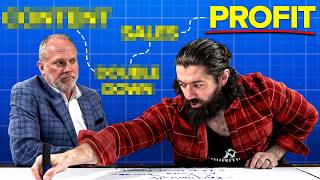
AI probably occupies half of my time right now um in terms of like what I'm thinking about within the business and so okay okay so from a beliefs perspective right like one of the big shifts that everybody here has to make is shifting away from thinking about rolesbased growth and expansion towards workflow-based automation. So, imagine that you're you're like, I want to hire I want to hire an editor. All right, I'm just making this up.
I want to hire an editor. This is how we used to think about things. I need to hire an editor so they can do XYZ.
The way that we all have to think about our businesses now is that this editor really was going to do these four or five things, right? And each of these things should exist in a workflow like the reason that like and this is the editor does this one and they're doing this one in this workflow and maybe they're doing these three in this workflow. And so basically you have to go more granular to the level of like because every single business if you really think about it can be connected at the most intricate level of like this action to this action to this action to this action all the way through.
It might be 120 actions that go from inbound lead to dirt, you know, turf, whatever, right? And it's getting granular. And this is the thinking that most people won't do, which is why they will lose and why I think a lot of people are going to get [ __ ] But if you have a little bit more horsepower and have a little bit more time to think about things, that's where instead of saying, I need to hire an editor, you say, I need an agent who just does this, and I need an agent that just does this, and an agent that just does this.
And so it's switching from um again roles to workflows and everything just has to be organized in workflows. And so it's like a very fun project is thinking like can you actually draw your entire business in one linear workflow because it does happen and if you can't draw it how the [ __ ] do you have a business right but it really starts with like like the business for us for example starts with an idea. It sounds silly but like it starts with an idea.
So how does an idea come to happen? Well, but what is the workflow around an idea? For us, it would be like okay um I check our school community and I look at what's happening.
Okay, that is a workflow which is uh search you know search this database which is school but it could be you know trends. com or you know one of 10. com whatever um where you look at what things are outperforming in this particular market and then it says okay then it gives you this list of the outperformers and then there's going to be a match between this list and our competency so it's like I have a list of things that I like talking about these are list of things that people want to hear about This is the intersection between those things.
Great. What does this look like in terms of uh uh scripting, right? So, it's like, okay, we're going to have some sort of scripting around this.
So, I want uh templated ideas. AI does this. So, it gives us um okay, this is a sevenst step whatever.
And it has each of the steps underneath of it. And we like great, now that the scripting is done, we're going to go into packaging. All right.
What is gonna be the headlines? What are gonna be the thumbnails? this is an AI workflow and then we're going to get into production, right?
And so all of this is broken down just so that we can get one thing to happen which is a click, right? But every single element of the business can be broken down into the into its constituent workflows. And so I think the mistake that a lot of people are making right now with AI is being like, well AI can't do what a human can do.
Well, which is obviously [ __ ] but like you have to train it the way you train a human. So saying like, well, I'm going to bring this this human in and tell them nothing and expect them to do a good job is ridiculous. But we're somehow we like believe that a machine should be able to do that.
But instead, it's thinking, okay, this editor or videographer or whatever it is, um, actually does 16 actual activities and each of those activities we have to take one at a time and we can have an agent that's trained on that thing. And so like right now, I know Maddox is working super hard with Julian on this, but like we have so I do like my hormones hotlines. And so I do a hotline and then that then goes into um basically an AI thing that does uh that breaks down the the transcripts.
That's like step one. From the transcript, it then says, "Okay, notice when there's different speakers. " All right, so it has to do that two times.
One is notice when it's Alex versus the other person. So it's ab imagine I'm A. But then it eventually switches to AC ac A because there's new person that I'm on the phone with.
So it's gonna say segment first between when it goes from AB to AC. So great, now we have 10 underneath clips. From there, uh it'll run a separate script that's like look because it's like what would an editor do?
The first thing it do is clip out the individual portions. Okay, there's 10 different conversations Alex had. Okay, now that we have those 10 conversations, look through this and try to find the highest tension moment.
And so it'll read the words and say this is the highest tension moment and be great. Start the clip with the highest tension moment and then get into the rest of the clip. What else do we want?
Remove all ums and a's. Great. Now from there what are the um what data is required in order to have the insight that Alex delivers only these four points.
Great. Collapse the rest. Now export final file of that.
That's the workflow. And so it's really just building this on a consistent basis and continuing to update that prompt which is literally just like updating the training for a human being of like actually do this too just like you would with an editor but doing that across every function of the business. So that is like that is the future.
And the nice thing is that with there's a lot of businesses that like agencies for example have been a notoriously shitty business to run. Um, but in the future I think they'll be incredibly lucrative businesses for the people who are really good with AI because the demand for more customers is infinite. And so there's like no one's like, "Hey, what's product market fit for an agency?
" You don't have to ask. People want customers. It's not hard to like you don't need to ask for product market fit.
The issue is that the ops around being good at getting customers is significantly harder. But if you can operationalize each of the flows, it becomes much better. And this is why like like I'm built for this movement because it's all about being black and white with observable behavior.
And that's like what I geek out on. And so this is where vague language like machines do not understand like vague language. Also, neither do [ __ ] humans.
Um we just nod our heads because we've been reinforced for doing so. But this is where being very specific about like, hey, I need you to be more charismatic means nothing. We have to say, I need you to raise your voice in this way.
I need you to talk faster. I need you to raise your head when you're speaking. I need you to nod when the other person's talking.
We have to break it down to what someone would do. And so, um, as though you were teaching a toddler, you have to work the same way with the machine, but the machine never forgets. Hopefully that answered the question.
>> It does. >> Okay. But yeah, this is what I'm thinking a lot about.
>> Yeah. >> So, it starts with the clear process map or workflow map of every action. >> Exactly.
And I would I would start like start with the big ideas first. So, it's like, okay, I do I I I have an idea and then I make a script and then I uh I shoot it and then I, you know, then we we export the clip and then we edit it and then we post it. Okay, that's the that's the big picture.
But now, underneath of each of those, there's probably six or seven things that actually happen in order to post it. It's like, so I actually go to this page, I look at the schedule of what was, you know, last posted. I add three hours to it.
I like you just have to like one word turns into six six actions and it's just continuing down until there's you can't reduce it anymore and then that's what you automate. >> Do you have a special AI implementation team to build? >> Oh yeah, we have a full dev team.
Yeah. >> Yeah. >> Yeah.
So I think I think many of you especially those of you who are online an amazing high leverage hire is just an AI like an AI automation person. um they will not lack for work to do. Like they can just sit next to teams and just watch what they're doing and then just say like I can automate that, I can automate that.
I can automate that. >> Is that something that we should do right now? >> Yeah.
>> Yeah. If you have the cash flow for it. >> Depends on how good they are.
I think though, as Lindsay Lohan said, at best the limit does not exist. So, like there there's a there's a there's a price tag for every level of skill you want. But even just somebody who I would just consider like a hacker, and I say hacker like loosely, like somebody who just duct tapes tools together, it's probably like 150 grand a year.
>> And in terms of prioritizing for us, would you focus on the delivery side first? I think that you getting um the elements that we walked through specifically around the expectation setting number one um I think CAC expectations number two and then the controllables around brand like the brand controllables I think that should be largely automated um because it is automatable it's literally pattern detection which is like machines do it better than humans do anyways and so what what humans do shitty at is giving the pattern to recognize and So that's like in terms of like what skill will you need to be get good at is when someone says look this is off brandand be like what the [ __ ] does that mean like tell me indescribables so that otherwise how am I if you can't tell me how am I going to know >> so it has to be in black and white language >> yeah I think for like home services and brick and mortar a lot of um basically all administrative work should just not really be a thing like you know invoicing matching billables like back office for sure is like that's already there like that's like now um receivables that's like now like you don't need to there's nothing there lead nurture that's now like you don't like a lot of that stuff's already already kind of done the advantage that um you all have for in person is that like I don't know how horses will respond to robots so you probably have a little bit of you probably have a little bit of security you know like [laughter] otherwise you're getting, you know, mule kicks into the the side of the stall. Um, uh, I think that from a landscaping perspective, there will be kind of like once Optimus comes out and you can teach it how to like mow lawns and [ __ ] like that'll be a thing for sure.
>> Um, >> yeah. >> Yeah. I mean, it can do it.
Um, there'll also be, I think, like job specific ones, but most likely I think the biggest proliferation is going to be around generalized humanoid robots because the world is already built for us. And so, as much as it's like, you know, I'm sure you've seen like the like the Zumba of lawn careers. I'm sure you've seen those things where it's like you drop them around, but like I haven't seen anyone really take off with that.
At least I haven't seen it. And I think it's just because like there's too many unique scenarios. It costs too much.
Like the cost doesn't make sense yet. Maybe in three or four generations it'll be there. But in the meantime, the skeleton key for the world is just the way the human body works.
Door handles, everything's already built for that. So it's like, as silly as it sounds, it's like the world's already, we already built the world for ourselves. If there's a robot that can fit underneath the door, we could make a special purpose robot that does that.
But it's like, you'd have to do that in every door in every building. Or you just build a [ __ ] human robot, which is what everyone's doing. Yeah, I think I think you're fine for the short term.
the the stuff that you should be focusing on from an automation perspective is going to be back office. >> Yeah. And there's and the thing is it's great at that.
It's [ __ ] awesome at it and you should totally use it for that. >> How about you AJ? >> Would that be something like using AI >> right now?
Voice is almost there. This is supposed to be the year of voice. >> Um it's close.
It's not. There's a lot of tools out there. I won't make any recommendations because like they change all the time.
Um I would say voice is very close. Text is there. >> Yeah.
I [snorts] was thinking about like off hours having like a voice like auto. >> Yeah. I went to a gym that was local here.
It's a it's like a very exclusive like whatever. I think it's like 10 grand a year or something like that. It has like 400 members and that's the deal.
Um, pretty interesting model. But I went to the site and it was just a chat interface and it just said like what do you want to know? And so I was like hours and it was like here's the hours.
I was like what else do you want to know? And I was like membership prices. And it was like here's the membership prices.
What else do you want to know? I was like I mean it should have asked me for my information but it's not perfect. It was not well trained enough.
[laughter] Um but like I was like this is pretty slick. >> Like why navigate when it just already has the answers? Not to get very odd for you guys, but in the next, I would say 12 to 24 months, a lot of like the UX is going to disappear.
Like, we're not going to be clicking things like the mouse. Like, what brought computers into mainstream was a mouse. Like, that was the big innovation was having a mouse you could point and click and then all of a sudden people were like, "Oh, I just want that thing.
" It's like click. And it worked. And so nothing's really kind of happened in the computation world besides speed and power and all that stuff, but it's all been um more of the same.
The next phase shift is that UX disappears, which is that you just have an agent that you just talk to, right? And you say, "Hey, you know, what did we do in cash flow last month? " And you just text it or you say it and it just answers.
And like the world of CRM is going to like this is this is the next 12 to 24. >> Yeah. >> Yeah.
Don't you think that we are very into it but 99% of people are still >> Yeah. Oh yeah. I mean there are legal firms that use fax machines now.
And so there's this idea that like oh my god the whole world it's like no just like always humans plus technology will beat humans with inferior technology. And so if you learn how to use the tech you'll do better. But there will be people who still have law firms and use fax machines that will make money.
That's just there will be people who don't use fax machines that will make more money. So, I'm not like an AI alarmist. I think it's going to take a while.
But, um, I do think there's I won't even get into that, so I'll just stop.