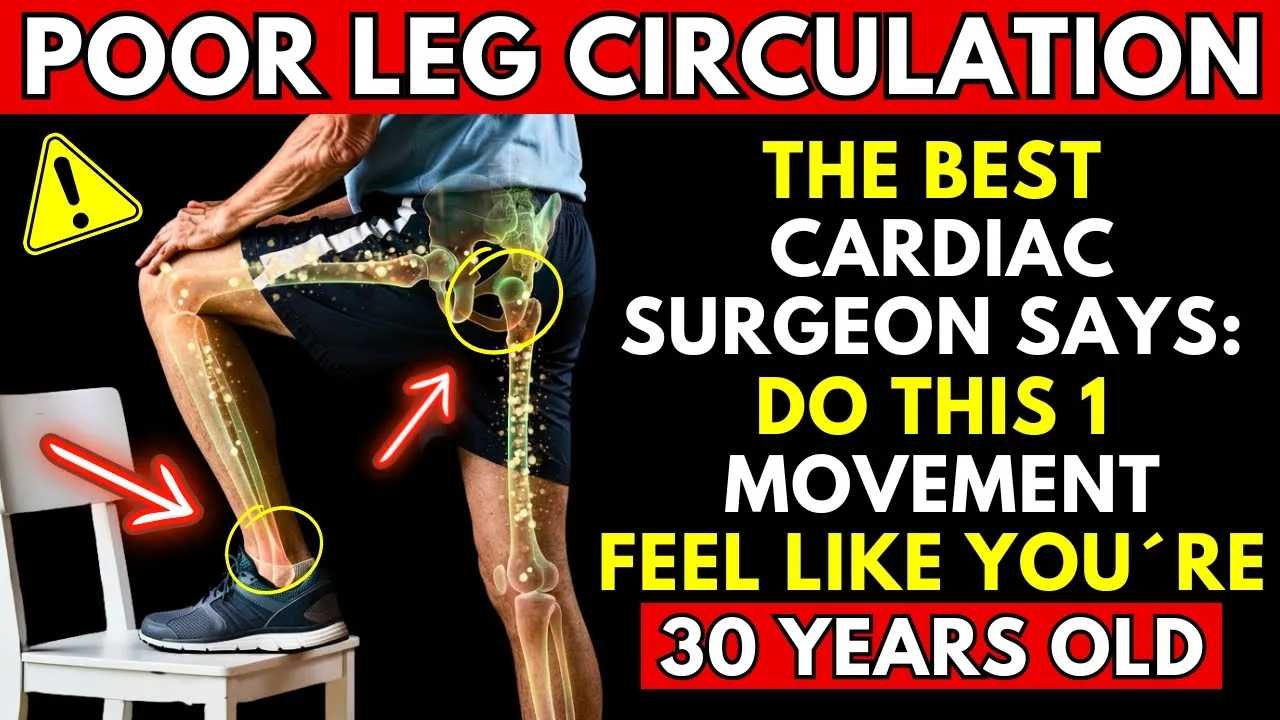
After more than 40 years studying why people over 60 lose mobility, strength, and stability, a surgeon and medical researcher made an alarming discovery. Poor circulation in the legs is one of the most dangerous, underestimated, and silent causes of physical deterioration in older adulthood. What is most concerning is that most people do not notice it until the damage is already serious.
Heavy legs, cold feet, tingling, cramps, swelling, and loss of balance appear when circulation has been failing silently for years. And this is where everything changes. Although walking is considered healthy, it does not activate the deep vessels responsible for nourishing muscles and tissues.
In other words, it is not enough. However, there is good news. There are specific clinically validated exercises that can reactivate deep circulation, awaken inactive vessels and restore strength, stability and independence in a matter of weeks.
And that is why in this video five surgeon approved exercises are revealed to improve circulation after 60 and number two is so powerful that it can reopen the deep vessels responsible for muscle regeneration and strength recovery. The problem of poor circulation goes far beyond simple discomfort or occasional fatigue. When blood flow begins to decrease, the body enters a silent but progressive process of deterioration.
The arteries lose their ability to dilate and contract properly, a phenomenon known as endothelial dysfunction which reduces the delivery of oxygen and nutrients to the tissues. At the same time, profusion pressure decreases and the smallest capillaries which are responsible for directly nourishing muscle fibers and nerves are the first to collapse. That is why the initial symptoms are not usually intense pain but seemingly harmless signals, numbness, tingling, a sensation of cold, weakness or clumsiness when walking.
Over time, this lack of irrigation causes muscle atrophy, loss of reflexes, decreased proprioception, the body's ability to know where its limbs are, and a reduction in neuromuscular response speed. All of this explains why many older adults begin to lose balance, trip easily, and develop an unconscious fear of movement, which further accelerates deterioration and creates a vicious cycle of immobility, dependence, and loss of autonomy. The good news is that this process is not irreversible.
Studies in vascular physiology, rehabilitation, and aging medicine have shown that specific exercises designed to force blood flow into the deep layers of the muscles can reactivate circulation even in people over 60 years of age. Unlike general exercise such as walking, these movements generate changes in intramuscular pressure, activate the venus pump, and stimulate the production of nitric oxide, a key molecule that allows blood vessels to dilate and become more flexible. Research using Doppler ultrasound and functional resonance has shown that this type of stimulus can increase blood flow in a matter of minutes, reduce peripheral swelling in a few days, and improve postural stability in weeks.
In addition, when blood begins to circulate properly again, angiogenesis is activated, the creation of new capillaries that permanently improve tissue oxygenation. This not only translates into stronger legs, but also greater endurance, better coordination, and a notable recovery of confidence when walking. In other words, it is not just about moving the legs, but about reprogramming the circulatory system so that it functions again as it did when it was younger.
Exercise five, heel raises with progressive hold technique. This exercise, although it seems simple, is one of the most powerful for reactivating circulation in the legs because it directly stimulates the so-called second heart of the body, the calf muscles, especially the gastromus and the solius. In vascular physiology, these muscles function as a true peripheral pump.
Each time they contract, they compress the deep veins and push blood back toward the heart, overcoming gravity. With aging, this muscle pump loses efficiency due to loss of muscle mass, reduced neuromuscular activation, and stiffness of the blood vessels. That is why when the calves are not properly activated, blood pools in the legs, swelling appears along with a feeling of heaviness and persistent cold in the feet and ankles.
Heel raises reactivate this natural pumping mechanism and immediately improve Venus return which explains why many people feel warmth, tingling or relief within a few minutes. It is oxygen rich blood reaching areas that had been poorly irrigated for a long time. What turns this exercise into an advanced therapeutic tool is the progressive hold technique.
By maintaining the contraction at the highest position for several seconds, a controlled increase in intramuscular pressure is generated that stimulates the vascular endothelium promoting the release of nitric oxide. This substance is key because it improves the elasticity of the arteries and allows blood to flow more easily. In addition, studies in exercise physiology have shown that this type of sustained tension triggers a phenomenon known as metabolic stress, one of the main drivers of angioenesis.
the formation of new capillaries. In older adults, this means creating new routes for blood to reach muscles and nerves, improving oxygenation in a lasting way. Clinical research has observed increases of up to 40% in Venus return when this exercise is performed correctly and consistently.
Unlike other movements, it does not require impact equipment or special spaces, which makes it ideal for people with joint problems or limited balance. With regular practice, it not only improves circulation, but also walking stability, muscular endurance, and fall prevention, making it one of the most effective and accessible exercises for vascular health after the age of 60. Exercise four, lateral leg raises.
Lateral leg raises are one of the most undervalued exercises for circulatory and joint health in people over 60 years of age. Despite their enormous physiological impact, this movement directly activates the hip abductor muscles, mainly the glutius medius and glutius minimus, which play a key role in pelvic stability, balance, and walking efficiency. From a vascular standpoint, these muscles surround important blood vessels that supply the pelvis and the upper part of the legs.
So, their activation generates a deep pumping effect that facilitates circulation to areas that tend to become inactive with age. Studies in biomechanics and rehabilitation have shown that when these muscles weaken, the body compensates inefficiently while walking, increasing energy expenditure and reducing blood profusion in the lower extremities. Lateral leg raises when performed in a controlled manner, reactivate these muscular patterns, improve tissue oxygenation, and reduce excessive pressure on the knees and the lower back, making them a key tool for both prevention and functional rehabilitation.
From a scientific perspective, this exercise is especially effective because it combines sustained muscle contraction with neuromot control, two fundamental stimuli for improving circulation and stability. By lifting the leg laterally and holding it for a few seconds at the highest point, an increase in intramuscular pressure is generated that favors Venus return and stimulates the release of nitric oxide, improving the elasticity of the blood vessels. Research in exercise physiology has shown that this type of controlled isometric activation contributes to angioenesis, that is the formation of new capillaries that allow better long-term irrigation.
In addition, since it does not involve impact or compressive loads on the joints, it is a safe exercise for people with osteoarthritis, hip prostthesis, or a history of chronic pain. At a functional level, strengthening the hip abductors significantly reduces the risk of falls since these muscles are responsible for stabilizing the body during single leg support while walking. Many older adults report notable improvements in balance, greater confidence when climbing stairs, and a reduction in knee and hip pain after just a few weeks of consistent practice.
Overall, lateral leg raises not only improve deep circulation, but also rebuild the muscular foundation that supports mobility, independence, and quality of life after the age of 60. Exercise three, wall squats. Wall squats, also known as wall sits, represent one of the most effective and safe ways to improve circulation in people over 60 years of age because they take advantage of a littleknown physiological principle, sustained isometric contraction.
Unlike traditional dynamic exercises in which the muscle shortens and lengthens, isometric contractions keep the muscle active without joint movement, generating constant compression on the blood vessels that run through the thighs. This controlled compression momentarily reduces flow but when released it produces a powerful rebound effect known as reactive hyperemia in which blood flows more forcefully to the tissues. Studies published in journals of applied physiology have shown that this mechanism can improve capillary profusion more efficiently than moderate aerobic activities in older adults especially in those with joint limitations or a low level of physical conditioning.
In addition, by involving large muscle groups such as the quadriceps, glutials, and hamstrings, a considerable volume of tissue is activated, creating a metabolic demand that forces the circulatory system to respond even in very small vessels that normally remain relatively inactive. The true power of this exercise is amplified when rhythmic pumping is incorporated, such as small heel raising pulses or controlled contractions during the held position. This dynamic component adds rapid pressure changes that push blood through the narrowest capillaries, improving oxygenation and facilitating the removal of accumulated metabolites that often cause cramps and fatigue.
Research in aging medicine has observed that the combination of isometric and rhythmic stimuli promotes the release of nitric oxide, improves endothelial function, and reduces arterial stiffness, key factors for healthy circulation. At a practical level, many older adults who regularly incorporate wall squats report within a few weeks a notable reduction in nighttime cramps, greater endurance when walking, and a general sensation of lightness in the legs. In addition, this exercise strengthens the muscles responsible for stability when sitting down, standing up, and climbing stairs, which translates into fewer falls and greater confidence in daily movement.
By not requiring impact or equipment and allowing multiple levels of adaptation according to each person's ability, wall squats become a comprehensive therapeutic tool that not only improves circulation but also restores strength, control, and functional autonomy in adulthood. Exercise two, bicycle. The bicycle is one of the most powerful and safe exercises to improve circulation in the legs, especially in people over 60 years of age because it almost completely eliminates the effect of gravity on the vascular system.
When performed in a supine position, Venus return is naturally facilitated, allowing blood to flow more easily from the lower extremities toward the heart. From a physiological standpoint, this position reduces hydrostatic pressure in the leg veins, a key factor in swelling, the sensation of heaviness, and chronic fatigue. At the same time, the cyclical pedaling movement activates the main muscle groups of the lower body in a coordinated manner, quadriceps, glutials, hamstrings, and calves, creating a continuous pumping action that mobilizes blood in both the superficial and deep veins.
Studies in cardiovascular rehabilitation and gerontology have shown that this type of exercise can significantly increase peripheral blood flow within minutes, even in people with compromised circulation, peripheral vascular disease, or reduced mobility. What makes the bicycle especially effective is its ability to stimulate endothelial function and improve the elasticity of blood vessels without generating joint impact. Research published in the field of exercise physiology has shown that rhythmic and continuous movement favors the release of nitric oxide, a key molecule that allows vasoddilation and improves the ability of vessels to respond to the body's demands.
In addition, by alternating phases of slow controlled pedalling with brief moments of greater intensity, pressure variations are created that stimulate microirculation and promote angioenesis that is the formation of new capillaries. In practice, many people report a notable reduction in swelling in the ankles and feet, fewer nighttime cramps, and a sensation of lightness and energy after just a few weeks of regular practice. Another key benefit is its functional impact by strengthening muscles without loading the joints.
It improves stability when standing up and walking, which reduces the risk of falls. For these reasons, the bicycle is widely used in neuromuscular and cardiovascular rehabilitation programs, being an ideal tool to recover circulation, strength, and confidence in movement in a progressive and safe way. Exercise one, walking.
Walking is considered the most powerful exercise for circulatory health when performed consciously and strategically, especially in people over 60 years of age. Various studies in patients with peripheral arterial disease have demonstrated improvements of up to 65% in blood flow after structured walking programs, even surpassing some pharmacological interventions. From a physiological standpoint, walking activates a complex network of muscles that are rarely adequately stimulated in sedentary daily life.
Deep glutials, hip stabilizers, intrinsic foot muscles, and posterior muscle chains. This activation generates alternating contraction patterns that create pressure gradients within the vascular system, pushing blood through arteries, veins, and capillaries that over the years tend to become rigid or inactive. In addition, the controlled impact of the foot's contact with the ground stimulates plantar mechano receptors sending signals to the central nervous system that improve the automatic regulation of blood flow and coordination between the heart, vessels, and muscles.
This process not only increases the amount of blood that reaches the legs, but also improves the quality of profusion, optimizing the delivery of oxygen and nutrients to tissues that had been chronically undernourished. When elements such as toe taps are added to walking, the effect multiplies noticeably. This movement generates what specialists call a vascular discharge.
A phenomenon in which blood accumulated in the lower extremities is rapidly redistributed thanks to pressure changes and the assistance of gravity. From a scientific perspective, this discharge favors the metabolic cleansing of the vessels, facilitating the elimination of cellular waste and improving endothelial function. In addition, walking requires balance, attention, and coordination, which activates brain regions related to motor control, memory, and autonomic regulation.
Studies in the neuroscience of aging have shown that this type of exercise improves communication between the brain and the circulatory system, training the body to better regulate blood pressure and blood flow, even at rest. At a functional level, people who walk regularly report clear improvements in stability, a reduced risk of falls, and greater confidence when moving in their environment. But perhaps the most transformative benefit is subjective, a renewed sensation of lightness, energy, and vitality that many describe as feeling younger.
This is no coincidence. By improving circulation, cerebral oxygenation, hormonal balance, and metabolic efficiency also improve. For all these reasons, walking is not just a physical exercise, but a comprehensive tool to restore circulation, mental clarity, and quality of life in adulthood.
When these exercises are practiced together and consistently, they do not act as isolated movements, but as an integral system of circulatory and neuromuscular reprogramming. From the science of aging, it is now known that the deterioration of circulation in older adults does not occur solely due to visible obstructions, but because of a combination of loss of muscular activation, arterial stiffness, endothelial dysfunction, and poor communication between the nervous system and blood vessels. Each of the exercises presented targets one of these causes from a different angle.
Heel raises reactivate the peripheral venus pump. Lateral leg raises stabilize the hip and improve deep flow. Wall squat stimulate microirculation through sustained pressure.
The supine bicycle optimizes Venus return by eliminating gravity and walking integrates the entire system under real functional patterns. Together these stimuli generate measurable changes in hemodynamics, increased blood flow, improved vascular elasticity, greater release of nitric oxide and activation of angioenesis. that is the creation of new capillaries.
Studies in applied physiology show that when the body receives varied but complimentary stimuli, the circulatory system adapts more quickly and more durably than with a single type of repetitive exercise such as walking without intention or progression. Beyond circulation, the true impact of this combined approach lies in its effect on functional independence and brain health. Circulation does not exist in isolation.
It is intimately linked to balance, coordination, strength, and mental clarity. By improving blood flow to the legs, the sensory information traveling from the feet and muscles to the brain is also optimized, strengthening the neuromot circuits responsible for stability and reaction to imbalance. This explains why many people not only feel lighter legs but also greater confidence when walking, less fear of falling, and a progressive recovery of bodily confidence.
At the cerebral level, rhythmic and coordinated exercise improves cerebral profusion and stimulates neurotrophic factors associated with memory and cognitive function, something widely documented in studies on the neuroscience of aging. In addition, by reducing systemic inflammation and improving muscle metabolism, a healthier internal environment is created that favors daily energy and nighttime rest. In other words, these exercises do not just move the blood, but restore the lost dialogue between muscles, vessels, nerves, and the brain.
Practiced regularly, they represent one of the most powerful, accessible, and safe strategies to slow age- related physical deterioration and recover a real sense of vitality, control, and quality of life that many people believed was lost forever. After seeing all of this, one thing is clear. Loss of circulation is not an inevitable sentence of aging.
It is a sign that the body stopped receiving the correct stimuli. These exercises are not random movements. They form a system designed to awaken dormant vessels, reactivate forgotten muscles, and return to the body the natural ability to nourish itself, repair itself, and stay strong.
Science is conclusive. When blood flow improves, balance improves, cramps decrease, swelling is reduced, and that feeling of lightness returns that many believed was lost forever. And most importantly, no gym, expensive equipment, or exhausting routines are needed.
just consistency, attention to movement, and the decision to start today. Each repetition is a signal to your legs that they are still alive, capable, and ready to respond. Now, the question is simple.
Are you going to keep ignoring those silent signals that your body sends you? Or are you going to give your legs the opportunity to regain strength, stability, and independence? If this content helped you, like the video, because that allows us to keep creating science-based information for real people.
Subscribe to the channel and activate the notification bell so you don't miss the next videos where we go deeper into how to strengthen your body after 60 in a safe and effective way. And write in the comments where you are watching us from and which of these exercises you are going to start today. Your body and your health will thank you.
Thank you for watching this video and we'll see you soon.