In 2025, I decided to start building my personal brand. Up until that point, I had always been the character behind the camera, not in front of it. And in the first year of building this personal brand, we grew the audience to over 265,000 people. More impressively, I would say, is the 44,000 people that we were able to get on our email list. Now, a lot of people share these cool aspirational Numbers, but what a lot of people don't do is they do not introduce you to the characters who are behind the scenes helping make this
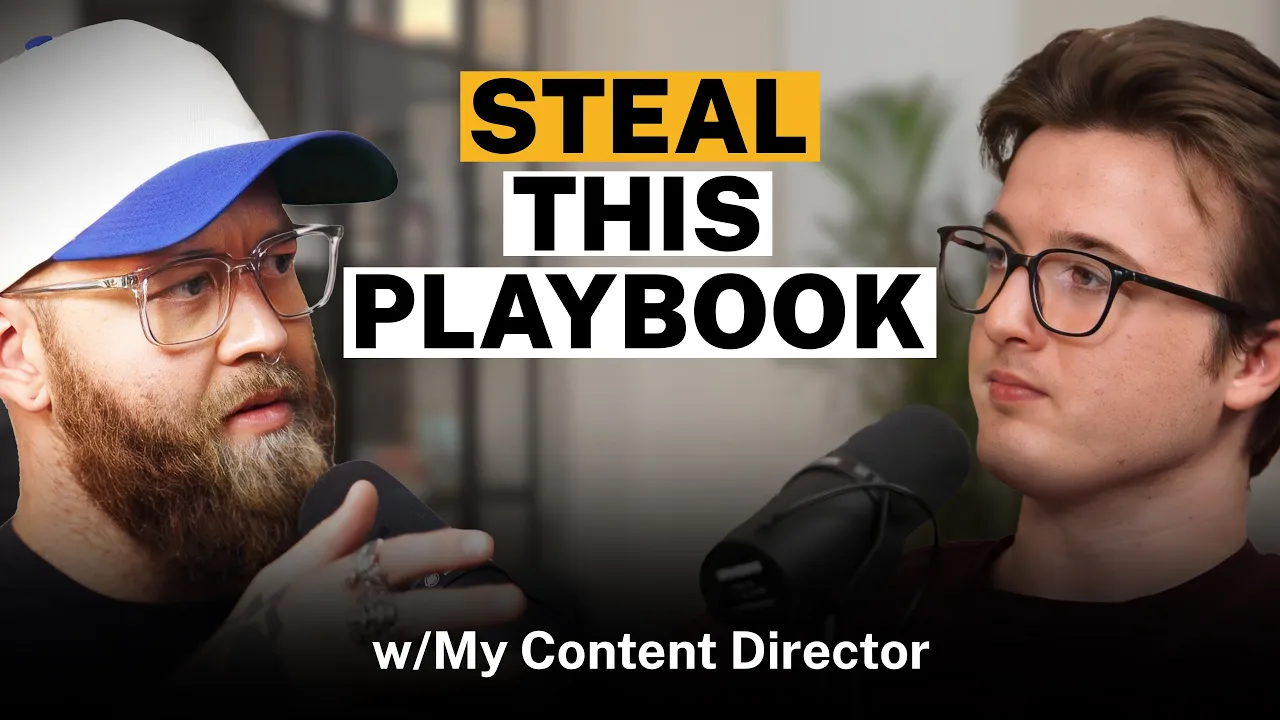
actually happen. And so, what I wanted to do in this special video, this special episode, my first podcast ever on my channel, is introduce two characters that have been helping make this happen. First, someone you've heard me reference quite a bit, my content director, Trevor Odum, and also uh my dog Bugsy. He's going to be Hopping in and out probably throughout this, maybe even chiming in with his opinions on how to build your personal brand. But what we wanted to do is go month by month. And so, we want to start at the very beginning,
which is January. And the thing that I want to start with, which was really funny for me, is I've been doing this, this is like 17 years now. But I remember I turned to Trevor the first week and I was like, dude, I know exactly what I would say to any Client, anybody that we work with, anybody who asks me how to start their personal brand, but for some reason with my own, and I'm sure a lot of people can relate to this, I I felt too close to it and I didn't know what to
do and I wasn't exactly sure where to start. Do we shoot photos? Do we like So, kind of walk me through and remind me really like where did we start with all of this? Basically, my first few tasks was like, "Okay, we have a limited amount of Content of you already out there." >> Yeah. Very limited. >> I think it was what, three podcasts that you had done, >> including one that was like seven or eight years old from when I was on Team Gary. >> I remember it was like in the conference room, I
think, or something at Vayner. Yeah. >> I remember uh basically I took all of that content. one of my in the first few Days I built an AI database of just content cuz like having worked with you for 5 years I know what you talk about but at the same time you starting your own personal brand I had no idea all of the like the breadth of the talking points like I know you're going to hit heavy on personal brand you're going to go deep into content but what are those points and what are those
main pillars that you're going to stick to like >> I think the you you had the brand Journey framework you had the brand journey framework I didn't even know I don't even know if that's what it was called back then. >> But like, >> so all of these things I'm kind of learning for the first time after I I mean, I've been working with several other creators to now transition completely to somebody who's starting new. I'd never actually started a personal brand before. I have Been on a team >> that's been pumping hundreds of pieces
of content out a week, but I've never actually started one. My first few pieces of priority were I needed to build an AI database of all of your content, transcribe all the content that you had out there. Uh a speaking gig, like everything that you had done, which was only a handful of pieces, >> a couple like voice memos and stuff like that that I had recorded on walks to try And give you a little bit of ammo and stuff like that, but not a lot. Not a lot. >> So, we did that. uh that
gave me some ideation points of like cool he's going to talk about the these select few things and this is like this is what we can start making our short form content on this is what we can start building long form content off of. Um so and then from there I developed kind of like systems to stay organized and basically Keep us on track. It's funny cuz we come from teams that are much bigger. >> And so it it kind of sounds silly that we're like we're going to we're going to build our project management
board for all of our content that doesn't actually exist yet and we're going to organize our Google Drive a certain way and have a file structure like a file naming convention and everything. But like in the back of our heads, I remember we Were talking about this. It was like we're going to want to stay organized. might not be us forever and it's going to be helpful for when [ __ ] actually does start happening. So, one of the another thing that I started doing was I set up our Google Drive. Uh I think we
purchased a few different pieces of equipment like one FX3 and >> yeah, this main a cam here. That's what we had bought >> an FX3 and I think a lens, a tripod and Like a light. >> Yeah, >> that might have been what we purchased in like the first >> uh few weeks there. And then from there was organizing a project management board which is something like I was speaking to a uh like a creative manager on a team yesterday actually uh who is oddly in a very similar boat to what we're doing and like
>> what my role is which is he has never Done this before >> and he's coming in >> doing everything >> and he's coming in and he's doing everything. I had not done that before. After a year of this, I'm like, I have a few pieces of advice for you, buddy. Like, and one of the first things I told him to do was open notion, a sauna, Monday, whatever it is, and get yourself a project management board. um set it up as a board view. Go left to right. Your You put your content in there,
all this all your raw footage that you film, you can have Google Drive links, whatever. And you move it left to right of like this content is for review. This content is ready for review. This content is already reviewed and approved, ready to be captioned and posted. You have a con you have a calendar view of all of your content. So that like this is something that a a lot of teams we work with don't have like in place when they come to us. And it's one of the first few pieces that we did and
we tell people to do is like jump in, get organized, and make sure that you can stay on track. >> And the beauty of it for the person who's on camera too, the talent, is they get a bird's eye view of where everything's at, right? Like I I know for years the amount of entrepreneurs I've talked to that have gone and filmed a vlog or filmed a bunch of shorts and then they're wondering What is the status of all that epic [ __ ] we just filmed and invested a lot of my time into like
where's the status on that? And what's cool is when you have that system and you maintain that system, then the talent is able to actually take a look and see where everything is in in the status, right? And so I think that's really helpful. One thing that I'll I'll just quickly hit on that I I focused on and then we can move on to February is this was the First time where I was really taking what I did naturally and just felt inherent to me, my way of operating and learning how to distill it into
bite-sized chunks for people to learn from. And so the thing that I was really focusing on in January was like, how do I develop my my natural ways of operating into frameworks? The way that my brain thinks and analyzes things. How do I develop this into a framework that the audience can follow and makes it Easy? And that was a very interesting transition because I've worked for some amazing individuals who are wildly gifted communicators and incredibly good at teaching people things. >> So I think I had a little bit of a leg up from observing
them. But January was really me focusing on figuring out how do I communicate these things, right? And then actually one other thing that we should hit on really quick is the first video we did, we Decided to do an introduction video, right? >> We decided to introduce >> your career. >> Yeah. It was like, do you mind walking through just a little bit of like what that video was and what the goal was? >> Yeah. I mean, I think I don't even know whose idea I It was just kind of like the easiest lowhanging fruit
that we can do for our first YouTube video is we can make a video about what you've done in Your career. Shocker. like it's like the lowest hanging fruit that we that I think that we thought of and it was like um going back through your actually I remember seeing a ton of uh old clips of you and Drock when I was going through all the old footage of you transcribing all that stuff and it was like huh there's been a lot of things you've done and like I think a lot of people would want
to be reintroduced to who Caleb is now that you've done this for what 16 Years. Yeah. Um, and so we kind of just laid out your career. Uh, I remember we whiteboarded it. We probably a f you we have photos because I remember you started taking you're like doc starting to document the process. >> Yep. >> Um, and we whiteboarded out for a whole day your career all the positions that you have been in >> and then uh one or two lessons from each of those like high it's like it's very High level but it's
also extremely tactical and extremely important. It was like and I think it ended up being like a 50 minutee long video for your for your first video >> which is crazy. And the kind of the takeaway for people is you should assume that nobody knows who you are, right? And obviously for the majority of people that seems obvious, right? I've worked for some high-profile individuals. So maybe it would have been Easier for us to go into this assuming that some people knew who I was. That'd be kind of bold. But what we did is we
decided, okay, cool. We're building an audience. We need to frame how the audience is going to view me. And so for a lot of people who are starting or restarting their personal brand, I think something that is wildly effective is to create an introduction video that gives the credentials as to why you are somebody who should be listened to on The subject matter you're about to speak to in your content, right? And like I think you know some of the people which again it's not a lot but some of the people that knew who I
was before we did this they were aware of some of the characters that I've worked with in the past but maybe they didn't know about the time that I spent at Constellation Brands working on prisoner wine company high west whiskey right like they didn't know about my first job at Logos Bible Software where I learned a lot and was able to develop skills of how to work on software and make you know software that might be kind of seemingly boring for a lot of people. Look cool. So, I I think it was a good moment
for us to share a little bit more of who I was, but to your point, if it was just a list of my resume, that'd be boring as [ __ ] and nobody would give a [ __ ] But we tried to tie in an applicable lesson for everybody watching. And I I think Another side note, I'm going to keep doing that because this is a podcast where we're given as much gold as we can. Um, one thing that Trevor did a really good job on on that video is taking really good note of what
I was saying and asking me follow-up questions, helping to make those piece of the pieces of advice that I was giving more practical, not just not just high level, but also in the dirt so that people could actually act on it. >> I appreciate that. >> Yeah, absolutely. It was great. Before we go on to February, something that I realized I didn't do at the top is I didn't really list off all of the amazing credentials that Trevor has. And I want to do it because he's not going to do that. He is a humble
character and uh kind of like myself, he's not going to want to tout all of those things. Uh he'll feel awkward doing that. And so I'm going to do it for him. So in Addition to Trevor being one of Bugsy, my dog's best friends, uh he freaks out every time that Trevor comes over. Trevor and I have actually been working together, like he said, for five years now, which is absolutely insane. And before he was my content director, Trevor actually led all of the short form for two very prominent entrepreneurs and creators in the business
creator space. Uh, I'm talking like billions of views a year kind of Level and hundreds and hundreds of shorts being produced every single week overseeing many different editors also editing himself. Um, that was another interesting thing that I thought was really cool going into this year was I've watched you go from being an individual contributor, right? You're you're the editor making the short form clips to being a manager where you're overseeing other editors and you're reviewing all of the clips and you're The one in charge of the short form process and the quality or sometimes
lack of quality and then quickly adjusting and improving it. You oversaw all of that and then now you're going into this role where you are a director. And in the beginning it was director of nobody but very quickly for our second project we hired somebody on to help with the motion graphics and now we just recently brought on a contract editor that we absolutely love that you're Overseeing. We've worked with a couple other freelancers on other various projects. And so this is now an a time where you're not just focusing on short form, but actually
oddly enough, Trevor was most experienced on short form. And what did we not do for the first year? Shorts. We focused on YouTube. And so I think that brings us perfectly to February, which is when we shipped the first YouTube video that we talked about that intro. We don't need to talk about That. Let's talk about the course. like not only my second video that we're doing on YouTube, this is your second video that you're filming, leading, and editing >> for YouTube. Like, let let's talk through like take take it from the beginning here. What
what was the process for making? And real quick for context, uh if you're not familiar with it, no reason that you should be. Uh we produced a 6 and 1 half hour free course On YouTube called How to Build Your Personal Brand. Uh it's absurd. I think it's really really high value. It's long as [ __ ] but I think a lot of people have gotten an insane amount of value. It's at I don't remember. It's somewhere over 750,000 views at this point. It's insane. Nobody is more surprised than me. But yeah, Trevor, let's let's
walk through kind of that process. That seemed to be like the biggest focus in February. >> Mhm. I mean, as our second video, well, I kind of reverting back just a little bit. Like we filmed our first video end of January. I remember we booked like some it was a decent like Airbnb. It was just like a small setup. We used we used a a Sony and a Canon and just we we just kind of we just started um >> used what we had available. >> Mhm. And then essentially I it was I remember this
because you've actually Had this idea for a while. You've told me that you've been eyeing this idea of how to how to build a brand or a personal brand for a very long time in past roles too. >> Yeah. Um, but in during that film session, I remember we were probably midfilm session and you turned to me in the kitchen and you were like, "Wouldn't it be crazy if we did like some mega like free course that we released on YouTube as like like super soon?" And we And I was like, "Interesting." Yeah. Like that
would be kind of cool. And I think, funny enough, I brushed it off at that moment, but I think you immediately went back after that film session and started writing it. Right. >> Two days later, I Yeah, that was on a Thursday that we filmed that video. >> Mhm. >> And that Saturday, I woke up and felt like a fire under me and felt like I I I felt compelled to to put all of this, You know, to paper. It was a very quick like let's set a deadline for this when this is going to
go live. Let's let's book a space for this. Let's like it. I think it all happened within a matter of a couple weeks where you went from this would be a funny thing that we that we should do like this would be helpful for us and people would would get a lot of value from it to I think a couple weeks later we're booking the space. I'm looking at spaces uh in LA to film. It's Like a we I found a warehouse. >> Yeah. Talk about that. Like how did you find the space? >> I
wanted to do this for our first video because I remember I saw like screenshots of like Harley's in the background of this warehouse and I was like >> we can put your bike in the back and we can like >> that was the main motivating factor just to be very clear is the fact that we Could put the Harley in the set. >> That was the selling point. Um but no it looked like a dope they don't shoot I remember the the studio manager whatever was like we have never had anybody like shoot audio in
here. There's like it's a place where basically rappers in LA go and film all their music videos. What What's the rapper? >> Kevin Gates and YG were in there two days filming a music video. Uh separately, not together, separate music Videos days before we were there. It was insane. >> So I >> And then there's us. >> Yeah, there's like us. We show up with like a truckload of like some rented gear. We rented like half the gear. I remember cuz the studio manager was like, "How many people like is it going to be like
a 20 person team that's going to come in? you guys have a truck that we're going to have to back in. And I Was like, two people. They were like, are you sure? We charge if the party's over five. And I was like, there's two of us. There's two people that just show up. >> It wasn't us trying to sneak people on set. That's for sure. >> Um, but yeah, we we booked that space. I had found that on I think it was like Pure Space or something. >> Pier Space. >> Um, >> shout out
Pier Space. >> We booked that. I picked it cuz there were so many different scenes that we could do three different scenes. I also picked it because like we liked it because it looked very different from almost every like course or anything that you've seen is like >> again rappers use this space and there's graffiti on these like walls and we're like it would be cool to set up a chair and a green backdrop and literally film Our course in there cuz it's just so like it's super cool. But I remember you invested a lot
for like >> for our second video. >> For our second video, it was a lot to book that space for three days. >> Um, and I don't even know if you finished writing the video until like two days prior. >> Dude, what's crazy is we were never really done because remember the night before our first day of filming, we were Up until probably 2 or 3 in the morning finishing and rewriting a section basically. And then we continued to do that every evening after filming >> because what we would do is, you know, this was
our second video ever that we were doing. So we would learn from the film session. We immediately would go back to the Airbnb. I remember we would order um >> Oh man, I I can't remember what you're talking about. Yeah, I can't remember The name of the restaurant, but these awesome burritos and we would get that and I always made sure to have my 805 curvea and we would then rewrite the next section taking into account the things that we learned, right? Like lines that maybe I had written that >> read really well when you
would read them, but when I would go to say them out loud, it just like felt weird and stuff. And we actually, if I remember correctly, we after the first day Rewrote the second section so that it was not as many lines but more bullet points because I quickly realized >> I'm a terrible reader. Uh, just for context for everybody, I don't read books. I just listen to audiobooks. And so what we quickly discovered is it does not work well for me to have predetermined lines. for an intro. Sure, we'll script it pretty heavily, but
everything else is bullet points to keep me in line. Hey, you're here because You're investing all of this time, money, and effort to build your personal brand, and you're not seeing any results. You might be seeing your views going up, but often times sales aren't matching. It reminds me of one of the clients that we worked with this year, highle media team, absolute gangsters, yet they hit a plateau. See, from a views and subscribers perspective, they were growing like crazy. But from a business perspective, all of this new Attention was not converting into leads. It's
because they thought they were making educational content when in reality they were making entertainment content. So, we walked them through our principles and tactics of how to make educational content, not entertainment. Their previous average per video was 4 to 5,000 leads. This video got over 20,000 leads. And even though they weren't optimizing for this, that video ended up being their number three video Of the entire year with over a million views. This is why we created Rson Select. Click the link in the description below if you want more information. Now, let's get back to the
video. Let's talk through. Okay, we we picked a location, Pure Space. It was really sick. It was really cool. It was very very expensive, but it was worth it, right? We did that. How did we go about setting everything up? Another question is why did we do different Setups, >> right? Like there's four sections to the course, right? We got brand, content, team, and then a very, very quick monetize section. Why did we make them all different settings? I think there's probably a few reasons to why we did that, ranging from we want to get
a bunch of different shorts from this and it allows us to go, you know, for you to switch outfits, for you to get shorts so that we can Distribute that on the short form platforms a little bit easier. Um, one other thing which we never ended ended up doing, but like we also had the idea at one point to actually split those into four different videos after we posted the course and posted them as individual sections. we should maybe we'll actually do this year anyways. >> Kind of like what we're doing with this series this
month. >> Yeah. >> Mhm. Which when we're actually testing it now. We had the idea last year. But um doing that it's also and this is something I think we realized after I think for you you actually like the change of environment and change of pace I think refreshes you a little bit when and this is not something I don't think I planned when we had the idea to like switch this up. >> But it was like you actually do really good if you have like a reset >> and you go into a new scene
and it looks nice and it's like okay we're refreshed. We also shot this over three different days. I think it was three days, right? It was like three and a half days or something like that. >> All right, buddy. So, like that also. I mean, it just makes it easier for us to swap every day. I think we did a new scene. Yeah. >> Up until I think >> we did I remember we did brand and we Did team together. >> Then we did content in one day and then we did monetize on the half
day. >> Last day. Yep. >> Yep. So, it was two and a half days. >> So, those I mean that's probably a there's definitely a few reasons why we did that. Um mainly it's also just because we we thought it was cool to show off all the scenes in the warehouse because it had so many cool scenes. But like >> the other thing too is we made the assumption that if anybody was going to be crazy enough to watch all this stuff, they're probably not going to watch it in one sitting. Shout out to the
individuals who have watched it in one sitting. That's pretty crazy and I'm eternally grateful to you. >> People do that. I I literally I have gotten DMs of people that are like, "Yep, I woke up this Saturday and decided my Saturday is dedicated to That." What I was also thinking about is like people are going to come back to this video. And so we almost tried to treat each section like it's its own video in this massive self-contained thing, right? And and that way if they did come back, it would kind of re-engage them. to
your point, it re-engaged me filming it. But also, the theory was maybe this will help re-engage people on some pretty heady, deep, long [ __ ] >> bumping into the table. Bugsy is just trying to find a spot right now. Hey, you can you can sit down. You can sit down. He's a golden doodle. He's 2 years old. >> He's the sweetest. I know there's going to be comments about him, asking about him. So, moving on from that and and I want to be careful because we're spending a lot of time on the course, but
I think it was like, you know, >> the biggest probably arguably the Biggest thing we did. >> Oh, definitely. Yeah. Yeah. So, I think it it it bears uh a little bit more attention. So, the next thing that we do is after we're done filming, how did we handle post-production? Like I I feel like one, you know, we can talk about hiring Michael, bring him on, but yeah, I'd love to talk through a little bit more. >> Yeah. I mean, like I said before, you you and your ever knowing wisdom knew That if we didn't
set a date for this thing and actually like get it done, we were going to procrastinate the hell out of it. It's >> true. >> Um, and it's just such a massive project. We would have spent months doing this. But from like start to finish, what what do we determine was like a month and a half or something? Yeah. >> From start to finish, from idea to Posted was less than two months. >> I started it on February 1st and we published it on April 4th. Mhm. I mean, as soon as we got back, we
went into post-prouction. I wanted to take a pass at the cut. We had three camera angles. We did a simple like we did a basic three camera setup. It was nothing fancy. The lighting was nothing fancy. >> Okay, Trevor, you're saying not fancy and basic, but I want to real quick interrupt you here. Most people at most Do two cameras. >> It's true. And real quick, he's not going to say this because we're going into post-production, but real quick, a shout out to Trevor on the production. Trevor was managing three cameras, the audio, and he
was running the uh the outline. So, basically, we we have a 55 in TV that we put right below the camera lens, and he was scrolling through the outline because, you know, you zoom into it, and you can only get a couple of Lines before boom, we're on to the next section. So Trevor is managing audio, camera angles, making sure focus, lighting is all good, and making sure to keep up with me on the outline, but please continue on the post-production, >> Mr. Simple. >> I appreciate that. Before we even shot it, we actually had
a few calls with a few different uh motion designers. Yeah. Because one thing that uh we wanted to do was like there's a lot of people who Um like there some people are very visual and like they draw on a whiteboard or something like that. Um I asked you you're like I'm not a I'm not I don't draw. >> I suck at drawing you guys. My handwriting is horrible. It looks terrible. Maybe one day but not not in the first year that's for sure. And one of the things that we also noticed with a lot
of these, like the whole idea for This course came from looking at the industry, looking at the niche that we're in and doing the opposite of that. Everybody does paid courses, we do a free one. Everybody does 2hour masterclass courses and we do six hours. It could have been more. We cut it down. I think we had 14 hours of raw footage. Um, so like everything that you're hearing, like we just took a look at what everybody else was doing and we're like, you know what? >> Which would become a very staple piece for us
later in our in our content. But um the the motion design basically uh nobody does that. Nobody has motion graphics throughout their courses. Like a lot of the times like we wanted professional I am Yeah. custom. No, no like Mgurts or anything like that. For all the editors out there, you know what a Mogurt is. Um, but we wanted custom motion graphics in our style. Our green, uh, our tan Stuff like that, our opal mist color. >> Love our colors. Um, so we wanted to do that. So, we had a call. We actually hired somebody
before we did the project. The the thing was I was going to do the I was going to cut it, swap the cameras, color grade it. Everything was going to be done. And then I'm going to ship it off to this motion designer. And this is all going to happen in like four weeks that we shot it. We shot it >> even less cuz you were going on a trip. >> Yeah, I flew to London like the I had to finish it by a certain day in like I think I had less than two weeks
to cut it and actually like and this is a six and a half hour cut it and then you and I review it. So like I I think it was like a 5day edit where I'm just I'm cutting this thing down from 14 hours down to 6 and 1/2 or something like that. um making notes in the timeline, grading it, doing the audio, doing a pass on the audio, and then we actually One of the things we wanted to do was review the whole thing together before we shipped it off so we could have a
bunch of notes for um this is actually a really good workflow that we do a lot of the times. First off, we we almost always do an A-roll cut so that you can review it, especially when you're working with contractors and stuff like that. Oh, I was talking to somebody yesterday who was like wanting to know how this like workflow. They're like, I'm giving a lot of notes and we're doing like V5, V6, V7. And I'm like, you want to know how you can avoid that? Something that we learned early on, which was we review
an A-roll cut or somebody reviews an A-roll cut. So, we did that together for this one. Um, we can jump into that in just a second, but uh you do the A-roll cut and then you leave a bunch of notes on frame from that A-roll cut of like I'm picturing this here. I'm thinking this here the Road map I'm thinking can be something like this and you can actually draw on frame so that when the contractor comes in like I had a hundred something notes for Michael of like motion graphic here something here this lower
third for the workbook that we included in the course that needs to have a motion graphic that I think so when Michael sat down to film it I could go on a on a trip to London because he had all that he needed in a frame folder ready for ready to go for Him. >> Shout out Michael Moyes. We're going to link him in the description. He's an incredible motion graphics uh artist. If you want to hire him, I I highly recommend him. He's [ __ ] awesome. >> He killed it. He killed it. And
he took a bet on us. >> Yeah, absolutely. >> Really early on. >> Um which was really cool. But we reviewed that together and that was Probably the biggest thing we did in that post-p production process is we sat here in this living room actually for 14 hours or something. >> Yeah. Uh, we cut the intro. We actually changed it, like completely changed the intro. >> That's right. That's a big point. Actually, we had scripted an intro and I'm going to be real. I thought it was a good intro and I still think it was,
but when we were watching it back, there was A moment, the way that it starts right now is you're on one of two paths. >> Mhm. >> And that was originally probably about 30 to 40 seconds into the video, >> over a minute. Yeah. >> Yeah. And we decided in post to cut that opening and go right to that. And uh it turns out apparently it was good because there's a lot of other individuals who are using a very similar intro which I love that I that is the best compliment That you could ever give.
But it it was something that was not planned. >> A happy accident. >> Yeah. Yeah. Bob Ross moment big time. Okay. So you're you do the edit, you pass it off to Michael. What did that look like? I imagine, and this is a moment for all of the the creators, the people who are on the actual production team, like what were the details there? How did you hand off a 6 and 1/2 hour file, but more than that, right? Because You still have to have the source media, you have three angles, you have all the
different cuts. Like, walk through a little bit of what that looked like. So basically the handoff for that project was the the workflow was that Michael was going to do transparent on alpha likeov files for all of his motion graphics so that he can actually just upload those onto a Google drive and then I can actually I believe I downloaded them and placed them in I Want to say. >> Yeah, you did. Yeah, you were you were doing the placements. >> I think I was. Yeah, >> you got all the lossless or not lossless the
alpha channel files. >> Mhm. >> Yep. >> So that was the workflow there. But like I said, he had that whole frame folder to basically go through and he had very little questions for me. I had very Little text from him when he was actually go he's like he read through it all. He's like cool no I have no questions like I know what I'm going to do. We gave him a lot of creative freedom on like the style. I don't know. I'm not a I'm not a motion graphic. I do remember we sent him
one example and it was a a really cool video with Arthur Brooks and it was on Harvard Business Review on their YouTube channel and there was some motion that they did on That that I loved >> cuz I remember he was asking for a reference and I was like I don't I don't know this is our second video. >> Yeah. And also like I could tell you all of the stuff that I didn't like what the majority of the people in the industry were doing for their motion graphics. That was like what I wanted the
opposite of. >> And so, and man, he did an amazing job matching that. >> I bas I mean, I remember I was like, I'm picturing something like this here, but like I don't know how you're going to execute this. I give you full creative freedom. And I think it actually bred like some of the coolest [ __ ] that like I remember we were reviewing it, we were like, "Yes, >> damn." >> We were like, "Holy shit." >> The heads were nodding hardcore. >> Yep. Yep. Um, but that was that Workflow. We we I think
for the footage, it was so much footage and we had so little time. I actually shipped them an SSD and like overnighted it. Yep. >> UPS, by the way. What the [ __ ] It's like $300 to overnight a little >> 4 TB. >> I did not know that. That's wild. Okay. >> Sorry. No, >> that used your card. >> That was that was kind of the process there. It was like a little bit of back And forth. There were a couple different versions I think that I was reviewing back and forth. >> So then
after we're doing all of that, we're placing them in. We're reviewing it. We're stoked about it. One note actually off of what you said that I think is really important for people. If you're going to hire somebody, now I this shouldn't be a qualifier that I have to add, but I'm going to add it. They need to be good and they need to Have a portfolio to show you that they're good at what they do. >> But if you hire somebody who has a portfolio that shows you that they are good at what they do,
trust them. You're bringing them on. If if you hire somebody and then you tell them exactly what to do, um at least in the creative world, I think you're kind of defeating the purpose, right? Then you're hiring a robot, not a contributor. And we we literally I remember telling Michael Like, "Man, we want you to flex your muscles here and show us like what you would do, what you think would be cool in this instance, what you think is different than what other people are doing." And Michael had done a wide variety of different projects
in the back. Like in his portfolio, it was a lot of stuff that wasn't this, which was also really appealing to us because it showed that he had a a different edge or angle he was coming from. He wasn't like It wasn't that he had been doing motion graphics for all of these talking head videos on YouTube, right? Like he from what I remember, I didn't see a lot of that in his portfolio. >> I think he was like a gaming like editor. >> Yeah. >> I Yeah. For like Twitch streamers and stuff like that.
He killed it for like and it's so sick and we saw that and we're like, "Oh, that's that could be a Cool unique approach here." So, yeah, you know, we're we're giving Michael a lot of love. Highly recommend check him out. Uh his [ __ ] is linked in the description. Please, if you need a motion graphics artist, uh as a freelancer, he is an amazing person to hire. So, uh, >> real quick, actually, >> yeah, >> I I kind of want to hit on that cuz you >> you talk about leading a team with
Trust, and I think that that's what you taught me to do >> when I was working under you in my previous role, and I think that that's how we've kind of ran teams for a while. Um, now and I think that's how you've always led, which I think is really cool of like even the latest this video and the video, the few videos before this, I was just reviewing them last week um from our contract editor, Max Gangster. Shout out Max. >> Shout out Max. >> Love him. I'm not going to try to say his
last name because I wouldn't know how to say it, but >> apologies Max. We we don't mispronounce so we just won't say it. >> That's the That's the key. But that is a huge like there have been so many we did this the other day where we're on frame Max is leaving us and I'm first of all I'm never demanding anything in frame. I'm always asking questions. >> Do you think that this would be cool right here? >> Yep. >> Do would it be possible if we did this right here? And then I'm also including
them like we were having a discussion I think it was the other night or something where it was like let's ask Max. >> Yep. It was I think like I think it was if we were going to include this podcast in the full course uh upload. >> Spoiler alert. >> Yeah, that's >> which is awesome. No, no, no. It's good. If you're in at this point on the podcast, we're going to take all the videos that we have uploaded in January, pack them together into one mega course on how to start your personal brand. But
we haven't decided whether or not we're going to include this. >> And we brought we're bringing it like I'm going to shoot a Slack message over To Max and be like, "Hey, what do you think about this? is this good enough? Like you're gonna you're gonna edit the footage and see it more than anyone else. Like and bringing in that level of trust and asking your team um it doesn't have to be like major decisions like hey what do we want to do with this offer or something like that but like bringing them in those
creative decisions giving that creative flexibility. Like Max asked several questions to me uh in this Latest upload on this frame link and I was like uh I think we could do this but what do you think? And one thing I tell Max is like if you make a good if it's not going to be like I kind of separate my notes from like gamebreaking notes to like this is a preference of mine and I state that in this is like I love this >> but I'm also open to this. >> Yes. >> Um when I'm
looking through notes and giving notes to editors uh to designers Whoever it is on a creative team. >> Um and this is this all just comes back to trust of like um what do you think of this? Like I'm asking Max more questions of like, oh, I remember what I was going to say. Like I told Max, um, if you make an argument for it, I'm probably going to go with you. There's a 98% chance if you make a good argument. And he did it. He was like, I think we should include this and leave
this in because it's kind of a Humorous moment that shows Caleb's side of like create like little little funky side of Caleb. And I was like, cool, heard. Let's do it. I I trust you. >> Love that. Yeah. Yeah. It's a really big point. I think the other thing that I would say and then we should move on to March is your team if they're the right characters and again that's a stupid qualifier that I have to put in because a lot of people don't realize that if you hire the right People and you give
them that level of trust they will rise above the level that you are bestowing that trust at. Like I I've seen it time and time again. So it's it's a really good point. I'm glad you brought that up. moving into March, uh, we went psycho mode and we had just filmed this video, uh, middle to end of February. And then I think about two or 3 weeks later, we're like, you know what, let's do another course level video. And so I wrote the how to Lead a media team. I can't remember what the title is
on YouTube right now, but the video is like how to lead an already existing media team. And uh we I think within three or four weeks of filming the course, we went out to Joshua Tree and filmed for an entire day. Was it a full day? >> Yeah, I think it was one full day. I think we did. Yeah. >> Sunrise to like way after sunset cuz I remember you jumped to the pool at the End when it was freezing. >> [ __ ] cold. Yeah. So, we went into that. I think some interesting things
to talk about here are the location and the outlining process. You you mentioned when we were talking about and planning for this podcast and talking about what we were going to go over, you mentioned something that was really interesting, which was that I chose the location. Can you speak to that a little bit? It's so interesting Because a lot of people think that like when you bring on a a creative director and you're just starting your brand or whatever, like they know everything and like they will handle all the decisions and stuff. And I think
actually contrary to probably what a lot of people are thinking anyways like about my role and what I'm doing for you is uh it's it's actually it wasn't like that and it still isn't. I actually had this conversation yesterday and I remember I Told this certain it was a creative manager that I was talking to was the one that I said was was starting in a similar role. >> I was like, you know, I'm actually still being onboarded one year into this role. >> I'm still being onboarded. >> Um cuz you mentioned like you picked
the location at this point. Three months in I I did pick the location for the course, but that was like a mutual kind of like one-off thing. But >> you nailed it. Um, three months in, I actually had no idea your taste and what you um what you actually preferred in your locations. And I sure as hell could not write for you. Like you keep mentioning that you were writing these videos. I wasn't actually involved in the writing till I think month five or six, right? >> Yeah, I think so. >> I think it was
like the three stages videos when we started it. Yep. >> And then now we write videos together. >> Uh, which we'll talk about in a bit, I'm sure. But like at this stage you were writing the videos a lot of times you were picking the locations and like sending them to me like what do you think can we what what is the setup you're thinking here I have some contribution to that I think a lot of people would expect that I am doing those things and I'm writing your videos and I'm doing all that things
but two Months in it is interesting because it's actually the opposite and it wasn't until month five or six that that started happening and people do things differently and I think we advise different things for different teams but for us specifically speifically I think what's made the content the best so far and why it feels so authentic and it's so deep and so like is cuz actually you're at the you're still so close to it right now >> which is really key especially if you are starting out >> in your first year making content with
your personal brand >> and it's the most frustrating thing for people to hear too because one of the most common things that uh you know one of the most common I should say conversations that we've had with clients this year is a lot of them wanting their team to handle all of it. And I I love the thinking, right? Because it's like we don't have a ton of time. We're trying to spend as much time on focusing on the business as possible. We don't have a ton of time. A lot of people, I mean, me,
I don't have as much time to write content as I did when we started, right? The business has gotten a lot busier. Thank God. That's an amazing thing. I'm so grateful for it. But that means that I have less time for it. But I still fight to be involved in it because the thing that I literally Was just having this conversation with somebody today. Um, if and I mean this with all due respect to everybody who is behind the scenes behind somebody, but if your team was capable of writing this [ __ ] just as
good as you would, why are they not the ones on camera? Right? At a certain point, maybe that'll happen. That's starting to happen now. you're starting to come on camera and stuff, but like it still needs to come from me at some level. Now, what we're going to Be working on, and we we'll talk about this later, is like this year we're going to start working on you getting the outlines to third base, right? And then me rounding it home. But if we didn't have the year of the first half of the year, me writing
it and then the rest us writing it together, right? Because that's how you delegate. you demonstrate, you uh duplicate, I believe is what what I always talk about. Something like that. You do it together, And then you have the other person do it themselves, and you observe that. And that's the phase that we're about to go into, and we can talk about that later, but I think it was a really good point to call out because it's an expectation a lot of people have when they hire a content director that they're just going to write
everything for them and make everything magically happen. But, you know, we've known each other for a very long time. You have a lot more context On me than most people do starting this position. And even in that scenario, we had to do this. Um, and we could have done it the opposite way, but then it wouldn't be my words and it wouldn't be me, right? It'd be an outsourced version of me. And so I think we we need to calibrate. And that's what a lot of people need to do is they need to go through
that calibration phase, which is one that a lot of people want to skip, which I think is interesting, >> super crucial. Yeah, I think it's but yeah, that was so we we went in we shot that video >> only like a week prior having posted our first video. So we we recorded almost three videos before ever dropping one of them. I feel >> yeah which is crazy and actually we would not advise that. A big thing that we preach is uh you want to use posted content to inform how you make the next content. And
the thing that I always Talk about, which is so funny, is the last thing you want to do is batch content too much because then you have that sunk cost fallacy of like, well, we we filmed all day, we might as well post all this. But what if you learn that what you did in the film session was completely [ __ ] and it ruins the rest of the videos? Well, then why would you keep posting it, right? But, you know, we uh we worked with the reality that we had and the reality that we
had. This is the real godhonest answer. I was [ __ ] motivated and I was stoked and we took advantage of that instead of spacing everything out. It was like in the matter of two months we filmed three three videos, no four videos. We filmed that intro video. We filmed the course. We filmed the media team video. And then in April, >> Mhm. >> in April, we filmed the uh if you struggle with making content, watch This, which was a completely different format than the first three videos that we filmed. Now, we're saying this, but
the video I'm describing that if you struggle with making content, please watch this. That was the third video we released. This is moving into April. Now, can you kind of share why we did that and why we approached that video the way that we did? So, let's tackle the order of upload because we filmed the media team course and then We filmed this, but we uploaded them differently. Explain that. >> Uh, I mean, the media team course was a two two and a half hour video. We was going to need more time in in post-prouction.
Um, especially cuz I was handling the post-production entirely on that video. We weren't outsourcing to a contractor or something like that. And that's something you'll kind of notice. Hi, buddy. That's something you'll kind of notice for um all of our like we did One video every month of our first year only one video >> which to some I mean when they look at the run times on those some it's impressive and to others it's like one video only >> um but that is the resources that we had um on a solo team >> and the
cadence that we felt like I could stick to. >> We wanted to do something that we would do the entire year. sustainability going Into uh the if you struggle video. That was the biggest thing for that video is you I remember when uh in the first few weeks it was like wouldn't it be cool if we started doing some crazy [ __ ] like uh we got a a car mount and we did a video on my bike. All of you'll notice this is a theme. All of our videos come from like one of us
being like, especially especially Caleb being like, "Wouldn't it be crazy if" and then we actually do it and we set we set a date and we Actually do it. Um, but the the biggest part of that video was sustainability. It was we wanted to make a video that we don't actually know if it's going to do well or not, but it's just something completely different. We That video was a shotbyshot uh just it was that was scripted. It was completely shotlisted, 100% shot listed. Um, and that was our first video that we actually did that.
>> It was insane. The other thing too is I Remember we were about to upload like we were planning on doing the media team video and then we were like, "Oh [ __ ] our first video was 54 minutes. Our second video was 6 and 1 half hours and if we upload this next, our third one is 2 hours." We're setting the expectation that we only upload mega videos, which if you look at our channel, a good percentage, I'd say there's three. There's three mega, no, four, four mega videos now. So, of the Eight videos
or 10 videos that we released in 2025, I'd say four of them are pretty beefy, long videos, but we didn't want to set that expectation that that's all we were going to upload. I remember the other thing that we talked about was like I wanted to see how many different styles can I do >> like and this might I'm going to share this this might sound a little egotistical um but I promise it came from a place of Not knowing and there was no ego involved here but I wanted to see like can I show
the audience that I'm capable of communicating in multiple different ways in the very beginning of me communicating to people. That was insane. Like I remember we every single every shot is planned, right? We're resetting the camera, either you on the [ __ ] Ronin or the tripod, resetting it in public with traffic, with other Humans, like everything. There was a moment where we're filming in a gas station and I'm literally like thanking the lady at the checkout and then I turned to the camera and started talking with her right there and I'm she I gave
her a warning but she was definitely like what the [ __ ] is going on? This is so weird cuz it was very weird. We're in this wasn't in like downtown Vegas or anything. We filmed it in Vegas. Uh but this was on the outskirts of Vegas. This Was this is closer more to like you know the mountains and Red Rock and everything like that. And so they were looking at us like what the hell is going on? But that was an interesting one because this was the first time that we learned a lesson that
we'll learn again and we'll share with you again in this. But preparation. >> Yeah. We ended up shooting this video over 3 days wanting to get it done in one. Like we Flew out your best friend Jordan um to drive the truck while I hung out the back and grabbed uh rolling shots of you on your bike. >> Yeah. And to be very clear for all the law enforcement individuals watching, he was secured with a seat belt in the back, >> a singular strap that was like I remember Jordan looked at it and he was
like, I don't know if that is actually going to work, but Do you feel safe? And I was like, "Yeah, I feel we're okay. >> Safe enough." >> I remember realizing really quickly when I'm setting up these cameras, like we the first time we tried it, we said we shot listed this whole thing. We had a very loose shot list. >> Rough idea. He had not. And then I think the lines were there, but I think the shot list the lines that you wrote were good. The shot list was just like uh Probably a medium
shot somewhere in this gas station. >> Uh and we didn't I don't even know if we picked the gas station. >> No, >> no, we just like saw it. >> We just were driving and found the coolest looking one on our route >> and we got to the sun was starting to go down and we had maybe we had our rolling shots and I think that was it. We barely had any >> I remember we literally there was a moment where we were trying to figure out the next shot quickly and we realized this is
not a good idea. We should just lean in fully to rolling shots. >> Mhm. Which I which was an amazing pivot. I think that was your pivot on on the fly. I think it was just out of I think we were all getting frustrated that like this is not going very well. >> Yeah. >> And it's cuz we didn't prepare. >> Um and this is a lesson. Spoiler alert. We'll learn again a little bit later, but like pouring dozens of hours into a video that's 10 minutes long is essential. Like for this video, we then
went back to the drawing board and I think Jordan had to fly home. We had to do it on a separate day and I think we recorded two other days. Um, but we went back and we spent a handful of hours shot listing this every Shot, shot by shot. This is going to be here. we are going on Google Maps and we're doing satellite images and like this is the gas station that we want and I'm thinking that this is the setup and this is the shot. We know where we're shooting exactly where we're shooting
it. Um and we took a whole another day. We went back out um and shot at a bunch of different places. >> We had already gotten the rolling shots, the shots of me looking at the camera And talking while I'm riding with my helmet on, which by the way, those are actually moments where I am literally saying the line. We re-recorded it in post for most of them because the audio was a little tough with uh my 2021 Harley-Davidson Road King special. As loud and as aggressive as it is, we had to re-record them. But
like a lot of those lines I'm saying and looking at the camera as we're writing. But anyways, now we're going to film the Talking [ __ ] >> So we go out and we're going to all these locations and doing this. We're filming in public. Like you said, we went to a restaurant. The the um waitress was unbelievably kind. The manager on the other hand was not so stoked. I don't know if you remember that. Yeah. >> At the end. At the end. But I was like standing on a booth getting that top down shot
of you just like and the Waitress was super cool there. I wish we had a behind-the-scenes photo because you would look into the booth and you would see I'm sitting there eating and on the other side of the booth, Trevor is literally just standing on it with the the Ronin and the camera like to get those high angles and I mean, we probably looked absurd to anybody, but um but we did it. And one little tip actually that I'm going to throw out there that I've never mentioned ever Before is for anybody who is trying
to film publicly around other humans where they're going to be looking at you. I'm telling you, sunglasses are your best friend. You'll notice that in both of the videos that we've done like this, the one in Vegas on the Harley and the one that we'll talk about later probably walking around London and talking to the camera, I'm wearing sunglasses. If you're going to film out in public and have people look at you and you're Embarrassed by that, some people are not and I envy those people, but I am not one of those. Like, a lot
of the comments on those videos are like, "I can't believe you did that. I can't believe you said that in the convenience store." Like, with people around you. And the reality is is I am probably more terrified of what other people think of me than most of you watching or listening to this. That is a very real like real reality is I am very uncomfy Talking to a camera when there's other humans around. It makes me squeamish. I do not like it. But what I try to do is I just try to completely ignore them.
I used to play basketball in high school and for better or for worse I would just completely black out. I mean there was literally one time where I remember I was going for a wideopen layup and I'm like why the hell am I so wide open? Turns out it was the other team's basket. And my whole team was yelling at Me, "Bale, Caleb." But I couldn't hear. And so I try to channel that kind of same energy when I'm filming in public. It's like, how do I just completely ignore the fact that that dude over
there is looking at me very puzzled? Cuz the reality is is it doesn't really actually matter. And more often than not, they're thinking about it in the moment and then seconds later they're driving and they're paying attention to the road or their kids screaming in the Back and they don't give a [ __ ] But I thought that was a very interesting video because you got to exercise some interesting skills that you have not ever in the past, which is you probably did, I think we could comfortably comfortably say 30 different camera setups >> in
like >> 12 hours. >> Yeah, like 10 or 12 hours. Yeah. >> Yeah. Which was insane. Real quick Before we move on, let let's talk about that real quick. Like a lot of people in the comments on that video ask about what was the film setup. I some people think that I filmed it myself. Um which that is wildly impressive on those walking shots, but talk to us about that. Like what was that like? >> We've had to get very scrappy. And also in the past year, I think my my actual production skills have leveled
up so much. I used to do it all the time when Like I filmed quite a bit at uh at my last role but all sit down talking head stuff and then before that I did some commercial work and and some stuff like but nothing crazy like nothing like super but like it's been interesting that we have some ideas like you also have this one idea of going to New York and filming in the back of a taxi cab and I actually have like in my head how I'd shoot that and how I do that
with like GoPros and stuff Like there's been Some interesting production setups, but uh for this one particularly in like in particular, I think we rented No, we bought we bought a Ronin a Ronin uh RS4 or something like that. Um >> RS4 Pro, >> I think. Yeah, it was an RS4 Pro Ronin. So, knowing that like we have to basically be in and out, uh this this restaurant or this convenience store will kick us out if we're not if we're there for more than two minutes. And we Officially got permission, but they still they were
like, "Make it quick." >> Every It's funny because like when you walk around with a phone and a camera, you're like, >> "Yeah." >> Which is something you can't you can get a phone. Honestly, it's something we we should have considered is a phone stabilizer and just shot with with an iPhone. That would have been probably a little bit more inconspicuous. But we Did a full RS4. I had wired earbuds and then I had you lapped up um with I believe the DJI Holyland mics like some something like these wireless mics. The audio isn't the
best like the audio quality but for running gun like everything that we're doing right now it's not like a it's not like a wired Sennheiser mic or anything. We're going for speed. Like I remember you telling me I know you haven't like you haven't done this much before but like we're Going to need to be in and out. You need your white balance. It's like I think sometimes I even did auto white balance cuz I'm not going to sit here and like fumble with the settings. Like you need to be in and out for a
lot of these different shots. And you also >> I'm going to say something here real quick. It was a little bit more dramatic and intense than that. There were at the gas station. I literally turned to Trevor and I was like, "You have two Shots, two takes for each of these scenes. I'm going to walk up, grab a Red Bull, and you have two attempts to get it and then we're moving on." Like I I it was a little intense. I was like, "You have two tries and if we [ __ ] this up, we're
moving on." >> It It was It was very stressful. But I'd say by the time we got to the London video, I had it mostly dialed. Like >> Oh, yeah. >> You can tell I'm in a whole different world and I'm like But like we had the pre-production dialed, but that that was the setup. It's the most basic like what can go wrong. I'm on autofocus. I have like auto settings. Like anything that I can eliminate going wrong in those scenarios, I learned that like we need to do it. We also just had a certain
amount of daylight and so setting up I think was that the video that we had a monopod for? No, that was a London Video. >> Yep. >> Um but we had very quick we've I I almost very rarely I think used an actual tripod. >> Yeah. >> And I went handheld >> with the gimbal just like this. I mean and just sitting there >> like shot like the we're going to do a top down shot. Cool. Holding the gimbal right here like and we're going to go And roll. Um, very interesting production challenge, but but
like that's how we did it. And we're scrappy with it, too. Like I think we taped a mic to the inside of your helmet and that's how we recorded the audio there when we drove down. Like I just had you roll through the neighborhood on your bike and we recorded audio a different day and I just like taped a mic into your helmet or something. And we wanted it to sound real, But we also wanted it to be hearable and legible or not legible, but hearable, understandable. You know what I'm saying? And so what we
did for the the real nerds out there is we did not record that audio on the same bike. We actually I'm kind of a weirdo and I have a couple Harley-Davidsons that I love. And we picked my quiet one, the Panam, which is it sounds like a sewing machine basically. And so it would still have the sound of being on a motorcycle but Wouldn't be quite as intense as the Road King. And then in post, I remember you added but more like you had control to separate my audio from the bike audio, but you added
in the road king so that it was authentic. So like if you are a Harley nut and you watch that video, all of that [ __ ] is real. We recorded all of that folly. Like when I take off and you hear the exhaust get louder and loud, like we recorded all of that on the third day, I think, right? Yeah. >> All planned with pre-production. all and like this is how I'm going to tackle this and how this is how we're going to do it. And that's probably the biggest lesson that month. We all
I think we also launched the course. >> Yep. >> Yeah. April 4th we launched the course and it didn't do that much in the beginning. Like it did better than we expected by all means, but compared to what you guys see now, that first month Gave us no indication that it was going to take off and go in our world intergalactic, right? like we did not see that. So we go from April into May and May was interesting. There was a lot of different things, but I think the cool thing that we could talk about
is there's there's two things. The second thing will be this is the month that the course did start taking off. But the first thing that I think we should talk about Gary Gary Vaynerchuk uh if you Don't know who Gary Vee is, what rock are you living under? Um this man pioneered the whole space of being a entrepreneur who's creating their personal brand online and making content at scale. Like he pioneered the whole thing. All these individuals that you probably watch and learn from right now that you admire, they are here because of the trail
that he blazed. And Gary for the last couple years has been focused, as far as I understand, far More on V friends and Vayner Media and really operating those things. and he wanted to do something really [ __ ] cool in May for V friends. They had a massive release. They partnered with Topps, the card like playing card collector card maker Topps. And I'm a little ignorant on this world, so please excuse my ignorance. Anybody who's really in it, you can roast me in the comments, but Topps has a limited edition uh version of their
cards called Topps Chrome Cards, I think is something like that. and V friends was doing a Topps Chrome release, which as a side note, y'all, is [ __ ] wild. It was not that long ago that Gary was drawing these characters on a piece of paper and had this idea and within less than 5 years, that dude is doing a partnership with the number one card maker. I I could go on. I I really admire Gary. I love him to death. He's the best. But he wanted to document that month of Releasing that by bringing
back Daily V, which was a series that he did, a vlog series on YouTube where for a very long time he was uploading almost every single day, a vlog from the previous day, usually literally just 24 hours prior cuz the team would stay up all night, edit it, and then release it. Bunch of savages. And he wanted to bring that back kind of like a nostalgic play to document the whole process. And in doing that, he invited all the OG Characters that had been videographers over the years, which was so cool. Like, uh, I know
that Justin Dalres came back and filmed, uh, David Rock, obviously Tyler Babin, Jason Marina, right? Dustin Lee did an episode. I did an episode. It was awesome. Stfan did an episode from Ask GaryVee Days. Like, it was it was awesome. It was so cool. And I felt really honored to uh be invited, but then I felt a little insecure because I have not edited a video in years. I mean Years. I've cut maybe like a short here and there and stuff like that. I did a couple of shorts edits, but for the most part, I
hadn't done any editing. And we were the plan was like, we're doing quick turnarounds. I have historically that one of the things that I I think I tried to build my editing brand on when I was an editor is like my speed. I was really fast, but now I am not. And I wanted to deliver for the man, right? Like Gary's asking me to come out and Stuff. And so we tag team that. >> Mhm. >> And that was really cool because you've been a Gary fan for a while now, right? >> That's how I
got introduced to you was through a fellow uh I was >> doing internesque work for uh it Tyler Babin, >> Gary's original videographer after Drock. >> Yeah, he came in after Drock. right after I was doing some work for him back Years and years ago. >> Um, and that's how we actually connected. But yeah, I literally grew up 16, 17. That's why I'm doing what I'm doing right now is because of Gary, which was a very surreal being in a car with him. And yeah, that was weird. >> That was so cool. And so what
we did is we tag teamamed it. I filmed and then I was giving you the footage and you were editing. But let's be real, in addition to that, Trevor was also helping me. Cuz Again, I have not I haven't been the person on the go filming in a long time. And what people don't realize, that man is a mutant. He has energy like I have never ever seen. If he has coffee or he doesn't have coffee, the man is electric. It's crazy. He's go go go go go. To this day, he's still that way. Right.
>> I saw it. I witnessed it. I had heard stories you had on like at on our last team you so many times were like I've Been in this scenario trust me with Gary and like bro Gary would have me up for three days straight and I'm taking a private jet flight trying to sleep and edit at the same time like I didn't like I heard it and I was like yeah yeah like yeah you worked hard but like I don't know if I realize the extent of how this man moves until I'm traveling cuz
you I was editing But I was traveling with you while while we were going. >> Yeah. Like Trevor was helping me carry The bag with all the [ __ ] camera batteries and stuff like that. Like you were helping me with that. You were helping me grab headphones. Like all kinds of things. I mean, I remember we were standing in the auditorium where the the convention was happening and I hadn't eaten in like 9 hours. And I I have a fun little thing where if I don't eat for a super long time, I get like
low blood sugar, shaky, and I end up fainting. And so Trevor like ran and Grabbed me food and stuff like that. Like that was super helpful. Back in the day, I didn't have that. I would just grab like a, you know, my blood sugar was low, so it'd be like, "Oh, there's a Snickers bar in the green room. Cool. I'm just going to down the Snickers bar real quick." And one thing that I want to mention that to be super clear here, it wasn't that Gary was demanding these things. It's that I respect that man
so much. And I would see time and time Again, we'd have a full day where he's, you know, shaking hands and answering questions for hundreds of people. And then immediately on the next, you know, 4-hour flight, he's on his phone working the whole time. And it's like, God, how can I not, you know, I remember at the time, I think when I was working with him, I think he was like 44, 45, and I was, you know, 24, 25 or something like that. And I was like, this dude's almost double my age and he has
triple the Energy. This is insane. I'm at the point in my life where I should have the most energy and be the most willing to stay up and scrappy and I was. But it was wild. And so the the thing that was really cool though is you got to edit two different daily V's, >> the series that I watched in high school. Yeah, that was cool. >> That was an amazing moment. And and one thing that was really cool, too, is I think um we got to work with team Gary As team Gary is now.
And that was also really cool. I mean, like Sid obviously great individual, great human. Uh, did a great job of corraling all of us crazy characters cuz you know, Stefan, David, Tyler, like myself, we all have things that we're doing, right? Like we either have jobs or we're building our own businesses. And the fact that Sid and the team were able to help corral, Nura, everybody was able to help corral all of these moving parts and make this Actually happen, right? Like um shout out Victoria like awesome EA like that was super helpful. Aaron on
the team managing YouTube like gangster like that was it was so fun but it was also so interesting for me to see how things have evolved right as they should but that was that was kind of an interesting moment but it was cool for you to see some of the behind the scenes of the stories that I've told and stuff like that. You know the war stories. >> It was all true. He just moves. He just doesn't stop. He is awake 3 hours like I remember we did like five cities in 3 days or something
like that. >> It was wild. >> Uh like uh somewhere in Canada to uh >> somewhere else in Canada. >> New York. Yeah. To somewhere else in can Toronto, New York, uh Orlando, Atlanta, back to V. Like insane. And he just moves. He just doesn't stop. Don't meet your heroes. But my respect for him only Grew. Yeah. >> Of just like seeing him interact. Like he always makes time for people. He never stops. at that booth. I remember he never Who walked by when we were at the at the booth? It was um >> Oh,
[ __ ] Why am I blanking? >> I know. I know. The rapper. >> Yeah. Waka Flocka. >> Waka Flocka just walked by the booth and Gary doesn't go and talk to Waka. Like Clearly I think Wo like wanted to like like hang out or do something but like he just >> they had talked backstage. They had connected. Wa was like yo I'm going to stop by the booth at some point. and Gary was in the middle of a conversation with somebody who um was in a I'll just say a wild scenario and uh this
would have been a really good moment for Gary and for V friends and he could have easily stepped aside taken the photo and Then come back but instead he focused all his attention on this person who uh was going through a wild scenario and really looked up to Gary and got a lot from him and I remember like both of us that like was a a crystal clear moment. The thing that I noticed too is, you know, we've been able to work for some great people. We've been able to work with some incredible characters this
last year and a lot of them have huge personal brands and are talked about a Lot online. But there has never been a human that I've walked through a public place with, not one person, who has more people stopped to ask for a photo, but even more than that, people whispering being like, "Oh my god, that's Gary Vee. I don't want to bug him, but wow. Like, I've been watching him since I was in junior high. I've been watching him since I was in high school. Like, incredible to see. And I think for me, it
was a moment where this was about Halfway into us building my personal brand. And I just remember I never have ambitions of ever being at Gary's level, nor do I think that I'm capable of doing that. That man is on a different level. But I remember thinking, okay, with the audience that we're building, I really want to act like Gary and do what Gary does, which is put the audience first above his own self-interests at times where it is so clear how much it would help him, he still chooses the Audience. And I just I
I thought that was so cool. And that's something that we've tried to take into the content that we make, right? Is like putting the audience first. Like for example, we got my dog here who's kind of disturbing things and stuff and we didn't have really any time other than now to film this podcast and it's a little distracting and this is your third podcast and you've been doing this despite him being like in the background And that's distracting. See that's distracting. But we're still trying to do this because we've never done anything like this. We've
never shared this kind of information on our approach to growing my personal brand and it's a tiny little way. It's an insignificant example comparison to what Gary has done, but it's it's one way that we're trying to apply and live that out in what we're doing, which I think is the coolest thing. So May was fun getting to Work with Gary again and hang out with him and travel with him and seeing him in action. It was really [ __ ] cool. Trevor also edited those daily V's. We got done with that trip and like
he said it was like five cities, six cities, something crazy in a very short amount of time, like 3 days. And we were exhausted and I turned to Trevor, I'm like, "Oh man, I'm so excited to go home and get cozy in my bed and sleep." And he's like, "I'm so excited to go home And get cozy with the editing." Cuz he still had the videos to edit. So, shout out to Trevor and shout out to all the editors that uh don't get mentioned but stay up all night editing content for the people who are
in front of the camera. Um you deserve more acknowledgement in my opinion. But beyond that, uh we go into June and this is when like May is kind of when I felt like things started picking up because the other thing that I forgot to mention That we'll just hit really quick is in May is when the course took off. May 1st, the course was at 49,362 views. Um, so that was after a little less than a month of being up and it for a while there was looking like it was actually flatlining on YouTube. >>
And to be clear, 49,000 views in the first month is [ __ ] absurd. We never could have dreamed or imagined. >> Yeah. Like uh so that's where it was at as of May 1st. Uh as of May 31st, it was At 165,161 and climbing every day. I mean, to this day, we're still getting anywhere from like 2 to 4 thousand hits a day. Like, that's where the curve absolutely took off and this thing just took on a a mind of its own. And I think with that, uh, also put the, uh, because we made
a workbook associated with this course. >> Um, I don't know if we've actually talked about that. >> Uh, it was completely free. All you Needed to do is just add your email. We actually ended up growing our email list. Like right now I think we're at like 44,000 people on that email list mostly from the course alone. But that was when I think up until this point we've been we've been spending a lot of our time in uh pre-production production for our YouTube videos and having fun. And this is I think to where I think
you're about to go with this. Like this is where along with that video things Started to change. >> Yeah. I'd say up until this point, probably 65 to 70% of my time was spent on the amazing clients that we partnered with from the very beginning. And that was awesome. And then like Trevor said, we not only were racking up all these views, but there was a lot of people, a high percentage of the viewers were downloading the workbook. And with that, we were also getting a lot of people going to the homepage on our site
Applying to work with us. Like in the first year alone, we got over 800 companies that applied to work with us. Like that was insane. We had so much demand. And I remember we got to a point where I started to feel pretty like a little freaked out cuz I didn't know what to do. And I had all these people being like, "How are you not sending emails? How are you not doing this?" D. And I had so many people, which I'm grateful for. These are like gangsters In business that for whatever reason care about
me and what we're doing and are giving me advice on what we should do. But it was a lot of different voices with a lot of different ideas. And I just remember end of May or no actually like beginning of May, I'm like I need help on the operation of this. And what I thought I needed was an EA. And so I think it was in May when we posted that I was looking for an executive assistant. and I started running Interviews and everything like that. Well, come June um or actually really end of May,
I was conducting quite a few of these interviews and one in particular really stood out. Uh I interviewed uh Kate Padoba and I won't go into all the details to to spare her privacy and everything, but it was [ __ ] unbelievable. Like I had a lot of good interviews and a lot of the people that I talked to I loved and it was amazing. Like I was so grateful at The quality of individuals that were coming through, but Kate stood out and I remember uh we ended the conversation basically being like, "This isn't going
to work out. Um I'm not going to be able to figure out how to afford you." All of those things. And this was the craziest part. I remember later that evening, Kate followed up via email saying, "Uh, totally understand that this isn't going to work moving forward and everything. I love what you're doing. Um, I remember You mentioned that there's all these new people coming into your life and you're having a tough time managing all these relationships. You want to check in with people. You want, you know, if it's their birthday, you want to send
them a text or you want to send them a card or a gift or just different things, right? I was just suddenly getting an influx of humans in my life. And you know me, I'm pretty introverted. And so, like, I don't necessarily naturally have the Gift of doing that. And so, she said something that I uh built for the executive that I work for right now. uh is this simple Google sheet, but it was incredibly useful. It was the relationship database that she used to manage all the different people in her exec's life and whether
they were professional, personal, whatever, family members, all of that. And she sent it to me and she said, "Feel free to duplicate this and customize it to yourself. Any Good EA will know how to use this." And I remember I probably texted you within seconds of seeing that. I was like, "Fuck, I got to figure out how to get Kate." And through a series of meetings with my CPA and coming up with how we were going to make this work, we determined that uh we didn't just need an executive assistant. We needed a chief of
staff, somebody to help with the operations of everything, right? Not just the operations of my Life, both personal and professional, but the operations of the business. Because now it was turning into a business. Before it was kind of like I had a cool job and you were helping me make content to get more jobs. This was the moment where we started turning into a business. Now, mind you, I'm not saying we're like some big business or anything like that. I hate when people pretend to be something that they are not. We are not that. But
it was way More serious than what I anticipated in the first year. And so, we brought on our chief of staff, Kate Padoba, and that's when I feel like things started to get a lot crazier. June is kind of the moment. And I remember turning to Trevor cuz I didn't I don't think we filmed anything in June. I didn't really have any time. Like I I'm looking here. Yeah, we had nothing that we filmed. Um I in June I went on a long motorcycle trip, like a Weekl long motorcycle trip. That's something that I've never
been able to do in my entire career. So as a side note, the really cool thing about this year is not only did we do a lot with the business content, but I also got to live, which was [ __ ] wild. It was a crazy first time in years. >> Yeah, it was so crazy. I just spat everywhere. Like it was it was amazing. And so June was a little bit slow from a content perspective. We didn't have a Ton that we were working on, but things were starting to ramp up with the offers
we were working on and the plans that we were building for what we were going to do for the second half of the year. So, June, I'd say the biggest thing is we hired uh Kate. That was awesome. She is the [ __ ] best. We're so grateful for her. Moving into July, we went to Mexico. We went to Cabo and I spoke at I loved that little dance move right there. Yeah. We'll we'll we'll give that >> I did have a few curveas. >> You just kept seeing that. >> It was my favorite in
the card. Just I remember for a month after that trip you >> just one more please. One more. Yeah. I mean there's there's something about sipping a Corona with lime in Mexico that just hits a little bit different. But we went there uh to do my first public speaking moment ever. I had spoken in front of like teams internally uh at the companies that I've worked For, but never done anything publicly like this. This was the first time that I was going to like talk on like a stage and it was it was crazy. And
it it wasn't like it was a massive group, right? Like it was it was talkies like it was a group of like a hundred people and I was freaked the [ __ ] out. Uh, I remember really trying to hide my anxiety as much as I could, but there was no hiding it. But let let's talk through that because that was an Interesting trip because not only did we capture that talk which we uploaded, which was a funny moment where I thought I completely bombed it and then I watched the footage and I was like,
"Oh, that wasn't half bad. That was actually kind of decent." But then the second thing which was interesting is we developed a very interesting view that now I preach as like gospel. But in the hotel room, I remember we were jamming and working on something and that's Where the whole contrarian take came. Do you remember that? >> Yeah. I feel like we we get some gold when we go on trips. >> It's funny. I've discovered like when we're traveling uh for all these shoots because throughout the year we basically have shot I think like what
two videos in Vegas itself and the rest has been Airbnbs and Joshua Tree and Utah and all these different places that we go for some reason. And I think it's just cuz We're in the same room together. That's where we come up with, I think, some of our best ideas. One of them was like we were analyzing why uh you were talking through why certain brands or personal brands can blow up when others don't. And I think that's when you discovered the uh the three levers of brand positioning. >> Yeah. The contrarian take, the delivery,
and the wrapping paper. And the most Important being the contrarian take. We were just like looking at the the clients that we've worked with this year who was having crazy results versus like mediocre results cuz that's the reality. Not everyone was like a [ __ ] banger this year by no means. Um and the big unlock that was so wildly clear was all the ones that were doing a really good job had a contrarian take. Either a belief they held that was fundamentally different than the other people in their Industry or a contrarian action. Right?
like they were building a luxury treehouse hotel in a world where like luxury and outdoors is not typically associated, right? They were they viewed that you could build a strong business and manage a big business effectively while also prioritizing your family and spending time with your f like these were contrarian takes and we were starting to notice like oh man these things are really standing out. Then I Started looking at people that I've worked with in the past or worked for in the past or other creators that I admire from afar and started looking like,
whoa, all of them came onto the scene with a wildly different view than a lot of others. And at this point, like you mentioned, we were starting to have some success with our content, and it was way more than we could have ever imagined in our first year. And so we're like, why are we having success? What is it that Is like, you know, I I tend to be self-deprecating. I like that kind of humor. I'm trying to work on it to be a little bit less self-deprecating. So, you might notice that, but I've never
thought of myself as a really articulate and clear communicator. Now, a lot of people are DMing me and saying that in the comments. I appreciate it. And I'm really trying to like let that sink in and really receive that, but up until this point, I did not think that was the Reason why anything was working. And I do believe the main reason why is because we came onto the scene from the very beginning talking about optimizing your personal brand around trust, not virality. In a world where every other video that was served on the right
side of our videos suggested, every video competing with us on the homepage was talking about how to go viral. And not that there's anything wrong with that, but I don't think that's the way to Optimize. That was our contrarian take. But to your point, I think an interesting thing that we've recognized is we need to be sometimes in different environments in order to get new ideas. And so that's something that we have operationalized. It was something that happened. It was a happy accident. Back to earlier your Bob Ross reference. >> It was a happy accident
that we recognized, but it puts us in a different environment. I find that we Think differently. And also, I'm going to be real. For me at least, I [ __ ] love my little family that I'm building here. my girlfriend, my dog, and I really find that if I don't go away to do some of the really deep writing, I get pulled not because they're pulling me, but because I want to go hang out with them. And so sometimes I think it's really nice to carve out time where I'm not going to and I don't
like I prefer not to call my Family a distraction. I I used to think that way and I think that's a real interesting way of thinking. Uh, family is wildly important, but I am more prone to stepping away from the writing process if I'm at home. And so, something that we have done is we got Jesse's big ass calendar, which is [ __ ] awesome. Shout out Jesse. Shout out Taylor, who runs all that [ __ ] She's a gangster. Big ass calendar. Highly recommend that you purchase this. Uh, we planned out our film sessions,
our writing sessions, and writing retreats. To your point, we're going away for a week next week, but we're not just doing that next week. We're doing that several times throughout the year because we noticed that was something that led to great insights and new concepts, right? And so I think the lesson for everybody here is it's it sounds so weird. Observe yourself in your process. If you are doing something That leads to something great and it happened by accident, turn that into a process. Operationalize that [ __ ] Right. So I think that was very
interesting. >> Huge. No, I mean that's what it is. Like all year it's been constant iteration not only on the content of like those little things of like oh we can we operate better this way or we like to do things this way that's constant iteration there also constant iteration On the concepts and things that you were talking about in the content. Yes. >> Every podcast that you've done I've watched you articulate better and better the brand journey framework. like all of these different things that you talk about articulated much more clean like uh you
were talking about the levers of brand positioning in the last few podcasts that you've done and the latest one was so much better than the first time you talked about it cuz you're Constantly iterating on that content and that's probably something you'll see like the number one thing that I can give us props to I think this year is just the constant iteration like we we set a date we did it to our point earlier and we iterate on it after that after we've done it and after we realize we like to do things a
certain way. You like to do things this way. Like this is how I learned how to book lo I I pick our locations now for filming and Everything. How I learned was I picked a location and Caleb didn't like it. It was a really ugly studio. I was trying to be cheap. Um and Caleb was like, "No, I get more reinforcement being uh in really dope filming environments." So, I'm like, "Cool. Oh, got it. Now I can pick locations for you." Something that I had to learn the hard way is a lot of times creatives
and me when I was more immature and younger and and earlier in my career, I viewed What now I call iterations and how you're calling it, I thought it was like indecisiveness. I thought, you know, people that I've worked for, I thought they were constantly just changing their mind and just couldn't make up their mind. But in reality, they were pinballing, iter iterating their way to the ideal end product. And that's what we do massively. And something that I think is a good takeaway for two different groups Here for the person who's behind the scenes,
the the creative who's making the content, uh, be more flexible. Understand that that is crucial. And why would you want to be in an environment where everything is always staying the same? Like you want to constantly be improving and constantly be getting better. And two, for the talent, I would say I would urge you make real changes after each film session. Take note of what you liked, what you didn't like. Put those into place. But also have some empathy for your team to know that, at least this is the way my brain works. I've been
thinking about this for a long time and they're just hearing about this. And so, yes, the team needs to adapt. Like, when I come to you with a crazy new thing that I want to do, you do need to adapt to that, but you do a good job of doing it quickly. But I also think, at least I think, I try to contextualize it for you. I try to Address the fact that I know I'm changing my mind. I said the exact opposite last week. This is completely different. I know this is a pain in
the ass. I know you've already sunk 12 to 15 hours into this project, and I'm telling you, we're doing it completely different or we're scrapping it all together. And that's [ __ ] painful. But I think if both parties have a little bit more empathy for each other and a little bit more understanding that ultimately both Are wanting to make the best product, it will be viewed less as whiplash and more just as you said, iterating. I think that's probably the number one takeaway so far in this entire podcast is like if you can operate
like that for your first few years of your personal brand, you will grow. Like I take notes when we do this thing. I'm I'm taking notes and we're iterating and we're just like those things time and time again. If you do one, two, three things better on Every every shoot that you do, you eventually get to a place that's really you're in a really good spot. >> I agree. I completely agree. So, stop staying stagnant, everybody, and stop doing the same things over and over, right? What is it? Uh definition of insanity everyone talks about
is doing the same things over and over and thinking you're going to get different results. Like stop doing the same [ __ ] over and over if you want different Results. >> Hey you watching this video right now. I know that this is overwhelming and a lot for you to take in. If you want to go deeper in a slower paced environment, we designed something specifically for you. Rston Select is your one-stop destination to not only learn, but to actually implement. We're talking pre-production, production, post-production, and platform strategy all through the lens of educational Content.
Click the link in the description below if you want more information. Now, let's get back to the video. Moving into August, we have two things that we should cover. The August video that we released, let's talk through that one. Do you remember which one that was? That was the respecting the audience's time. >> Ah, we learned our lesson. This is what we teased earlier. Learning our lesson a second time. >> Yeah. >> Uh, yeah. We had we'd filmed footage with a client of ours earlier in the summer um getting B-roll behind the scenes. Our idea
was to make a what we were literally just talking about of like I know how to show up to shoots with Caleb. I know what to bring. I know all these different things. Uh we have a whole like SOP on that internally for uh how to film with >> It's a pretty hefty playbook actually. Huge like everything we've learned over the past few years, everything you've learned, especially over the past few years of filming with different types of talent. And our plan was to make that into a video using that B-roll footage and everything. Um,
it was yet another I think lesson where I like I booked I think I booked a shitty studio. That was the first time that I did that because it was my first time picking the location after the course. Um, we went Into it. We were like, I think both I develop like a series of questions to ask you. Um, and then it was like we're going to loosely follow the SOP and like that's going to be the video and we show up to film. He's leaving out the fact I did zero preparation for this. Every
other video leading up to this I had done at least 10 hours of pre-production on minimum way more for most of them. And this one I did zilch. >> This is where we're like starting to You'll hear me talk about this in a minute. Like this is where we're starting to get stretched very thin. This is why we're bringing on the chief of staff that we just did like a month ago. Like this is where things This is why uh the month prior we actually didn't film a direct to camera video. We had to film
at the Talk More event and use that as our video which actually did surprisingly well. But like we're starting to have to be more creative and We need but the thing we forgot is like we still the the 12 hours of concepting this intro or this hook for this YouTube video. We forgot like all this pre-production, all this work that we put. That's what made the first few videos so successful for us. And I think I don't >> I got cocky. That's what it was. I thought I could show up and do a better job
off top cuz I think I Please hear this through a humble tone. I think I do a decent job on podcasts and I explicitly tell the host, "Do not send me the questions ahead. It's all off the cuff." So I thought, well, we'll just rip a podcast. We prepared more for this podcast than we did for that [ __ ] video now that I think about it. Actually, >> we didn't even do packaging. We didn't even talk about packaging before we were going to do it, >> which is never the case. We literally Never do
that. >> Well, we learned our lesson. Yeah, we're just so busy and we're we're diving into things. But that we sat down to film that and it was very clear after an hour of not getting anything that I'm sitting here like, "Oh god." I mean literally I was getting frustrated with myself because I just he would ask me a question and I was just not answering it well or maybe some of the questions to be fair I was like ah I don't know if I Love that like and I remember there was one point where
I am a big fan of the Wimhof breathing and I literally was like I'm just going to stop and right there with the camera rolling with Trevor right there I just closed my eyes and turned on YouTube and put on the Wimhof breathing to try and calm myself down and get myself into the right headsp space. And that didn't [ __ ] work. And we >> It did. >> What? >> I think it did. >> It calmed me down a little bit, but we still tried to do the video. And it was still like >>
that I think that that brought about the pivot >> which was like, >> good point. >> You know what? We're not getting this today. Like we are not we're not going to get this video. Not to the We can get A video. It will not be something we want to release. >> Yeah. >> At all in the slightest. not nowhere near the level of the first five or six videos that we've done. Um, so I think you like I think you had the idea to pivot into, you know what, here's what's happening. You turn to
the camera and you were like, I just tried to film a video and if I had tried to put this video out, I wouldn't be respecting the Audience's time. Um, and it was like a one minute insert of just talking about that and talking about how like I'm not going to put this on you. This is me. I promise I'll show up better than the next one. And that was the video. It was like a minute and 30 seconds >> and we posted that for that month. We wanted to stick to that goal of one
a month >> and that month was a one and a half minute video. >> Me admitting that I had not shown up and I had not respected the audience's time. I chose my time over the audience's time. And it was a moment I remember so distinctly too just pounding into my head as I was sitting there in front of the lights with nothing to say being like this will never happen again. I will not make this mistake again. >> Yeah, that was a it was a big lesson for us. We have not made that mistake
since and we have promoted like we have we Have dedicated so much time now into pre-production. We're like I think the next video or maybe it was the one after that. I think I want to say we put 12 hours into just the intro of just like beating up this intro for a whole day of >> the next one was the the brand strategies video. >> Oh well that one was like a full day and a half >> which we filmed like two and a half weeks after this moment. >> I remember that. >> And
I had spent before. So we we um rented an Airbnb a sick one that you chose cuz the studio was like a a boowbo. Yeah. studio was Bobo, but the next location was [ __ ] sick. I remember I walked into that Airbnb. I wish we had that on camera cuz I was like, "Oh my god, oh my god, oh my god." Like it was so cool. And uh leading up to us being out there, I had probably written put maybe like five to eight Hours into the rough outline, like the overview, not details, right?
just an overview because we did not have that much time. Like Trevor said, I was really [ __ ] busy. This is a point where like things started getting crazy and so I didn't have enough time to be able to do this. But I put enough I put like an evening and a Saturday morning into it. And then I think we went out on a I want to say like a Wednesday night or something like that. Thursday morning We woke up and what were we doing? >> We wrote the whole video. I think we just
rewrote it. >> Rewrote it. >> Yeah. That's actually a a trend. We have >> big trend. >> We've like you've taken like the first stab at it and then we sit down from this moment on. I think we've done that with almost every video which is like you do like a rough draft at it and then we have a full day or two of sitting Down and actually writing the video together. >> Like scrapping the original version, be like, "That's dog [ __ ] Cool. And now that's out of the way, we can actually write
the video." >> Looking through our wrapping paper library, coming up with the packaging beforehand. Like lessons all learned, but like that's that started now. Like to my point earlier of like I'm still being onboarded. It's only month six Now. I think that we're now sitting down and we write these videos together and I'm seeing your process and how you structure the videos and how you like to flow and the disclaimers you like to add in certain areas. Y >> all of those things now start to happen with this video. But we wrote that video in
>> it was like a long 14-hour day. >> Yeah. 14-hour day in that Airbnb. Uber Eats for meals so that we wouldn't take A moment away from riding. Like, yeah, plenty of Red Bulls, that's for sure. Like, that was But it was fun, too. Like, we love those. My favorite days. Yeah, they're the best. >> But we did that. Wrote it in 14 hours uh on Thursday and then Friday >> we filmed it >> in 14 hours, I would say. Probably like 12 to 14. >> That one was like 8 hours of raw footage. I
remember. >> Yeah. This is where my brain now starts to come back to me like this at this moment in time. But yeah, that was like eight hours of raw footage. Our second biggest video that we had done. I think the video ended up being 3 and 1/2 hours. >> Yep. >> Yeah. So 8 hours down to three and a half hours. So we did that. We did the multiple scenes like we had done in the other videos. Um and then we also made a Workbook that went with that. So that was really cool. You
made that workbook. the one that we did for the um personal brand course that we released in April. I wrote that and then Vin Vin Calibrizzy, an amazing designer gangster uh did that. And then for the brand strategies video, you did an amazing job of taking all the exercises that I walked through in the video and translating that into a workbook because again I I didn't have any time. But we Knew that we wanted this was like, you know, we were talking about zero to 100K, 100K to a million, million to 10 million. There was
a lot of actionable [ __ ] and so we wanted to give people the ability to actually take action. And so you did that whole thing. You created it and designed it. All of that. We put that out in August. No, no, that was released in September, right? >> I think it was released the next month. >> Yeah. >> But yeah, that was like the first time I'd actually written like something in your voice, too. Like that was like it was your it was your words, but it was >> Oh, but those cover letters, like
the intro letter, you wrote that. You 100% wrote that. I read it. Maybe made a couple tweaks, but like this is when I remember this was the first time cuz you had submitted some like LinkedIn posts before and stuff and they would get close, but I I never felt like it was Like there. This was the first time where I read something that you had written for me. I was like, "Oh [ __ ] that sounds like me. I'm good with that." So that was cool. >> Took six months. But that's that's what it like
now you're not like this is the moment where I'm starting to like come online. I almost feel like of like you are getting busier. Oh, I know how to pick locations now cuz I have [ __ ] up picking a location. >> I know how to write like we've written a workbook now. I can take this and like I understand our workflow. I understand this is video number six. Um I understand now a lot of these things and I can actually dive in and get my hands dirty. >> Yeah. And then uh we're about to
get to September, but the last thing that I thought was really cool in August was I and we've been talking mainly about the content, but this was a cool thing with A client that I I figured I would share. Uh I went out to one of our clients and did a content workshop and that was [ __ ] awesome. That was so much fun. I think we kind of revamped the way that they went about making content. uh helped improve some some efficiencies around their normal content flow, but also introduced a couple of really fun
variations of how to make content and pair it with something that you really enjoy, an activity, a hobby, whatever. Um, but then the other thing that we worked on, uh, which I didn't expect going into it, but we actually rebuilt their editor onboarding plan and what usually took two to three months to get an editor up to speed now takes them two to three weeks, which was incredible. That was really fun. Um, and I remember on that trip, it was another moment where being away from home and being in another environment. I got a couple
of really good points and ideas that we Later end up talking about in the content. But yeah, let's go into September cuz things start getting a little crazy. September, Trevor got the greatest bicep workout of his entire [ __ ] life. Talk about filming the career advice video in London. So, this was similar to the if you struggle with video that we did a few months prior. We like I think we enjoyed that so much we decided to do another one. We're in London with a client. >> Yeah. >> Um doing doing some It was
so fun. How can we get a video out of this trip? Like um like could we do a vlog? Oh, we're with the client most of the time. Like let's give them our full attention there. But we had a free day. To be clear, the free day, it was one day >> was one day, the day after we had done the flight from Vegas and we arrived to our hotel rooms at 11:00 p.m. And the next morning, we're getting on a train At 6:00 a.m. And I don't fly internationally that often, so like jet lag
was [ __ ] real. >> It was crazy. You had the you had like a a nice seat, too, that you could sleep in. >> Yeah. Yeah. >> I don't know how you I don't literally was, shout out to KM, you can actually a full 67 human can lay out completely flat. It was amazing. >> Crazy. Yeah, we did that and then we Took a train into London cuz we were staying up north. Um, and we took a that morning we took a train ride, the B&M B&M. >> Yeah, our horrible accents. >> Yeah, we
took a train out to London and our goal was we have one day to film this. We can't re-shoot this. not like the first video where we were basically condensing what we did with the first video in 3 days and we're like let's do it in one day cuz we've we're better at This now. >> And not even like like not like our normal like 12 to 14 hour days like we had like 10 hours. >> We were finishing the last scene for that on the plane. >> I wrote the shot list for that. I
think one of the scenes on the plane going there cuz this is still at a time where like >> we I think in recent months have gotten much better at 2 months prior starting Production uh pre-production on a video but right now we're in the thick of it. We're still like Kate's being like Kate's brand new onto the team. We're in the thick of it right now. Um so we're we're writing we're still finishing videos the day before. But we did that in 10 hours. We went to five different neighborhoods in London. We're filming uh
on the on the tube in the tube. >> Yeah. >> We're filming >> front of Big Ben. >> Big Ben. >> Yep. Uh Piccadilly Square or Piccadilly Circus. Sorry. >> All those things. And I mean we we learned our lesson. Same like this time we like we just went like gimbal or monopod and we were just running around the city setting up shots really quickly. Audio was a very big uh issue with that shoot that we had to reorder some some new mics. Um, but yeah, that Was an insane, but we got a video out
of it. >> To be clear, the lesson that we learned from it was uh maybe next time, don't try and jam like a wild video to shoot with many different scenes in one day after you have a really long flight in a city that Trevor had been to once and I had never been to. >> I think one of the only like things that made that possible was like 3 months Prior I was there. Yeah. >> So, I knew roughly where we wanted to shoot. >> So, I was like, >> I know that we could
shoot it here. I don't think we're going to be able to like in front of the palace. It's all gated off, but um yeah, we shot that all in one day. It was a bit too much, but we got it done. I remember we ran out of time, so we had to film the last scenes at the train station. >> Yeah. >> And we were just You were falling asleep. >> I was shot. >> You were just It was gone. I was in pain. I was in pain. >> Trevor was physically ill. I was mentally
ill. Like it was it was wild. There's so many other things that people don't realize that you're managing in that. Like you have, you know, every once in a while security coming up and Being like, "What are you doing here?" Right? And I then one of us has to navigate that conversation. Um I'm trying to remember these lines and say them correctly. And then half the time the audio the [ __ ] mic that we were using the and Holllands are great but not when you're out in the wild with a distance between you because
those were cutting out constantly. I mean there was so many times where I'd be across the street, not that far across the street And I would deliver the line and Trevor would be like running again. And I was like oh my god. >> I could see the frustration. >> And the thing that sucks is like that's not Trevor's fault. That's neither one of our faults. I remember it was so bad at one point you were like considering trying to find a camera shop to buy a new lav like a new mic. Yeah, that that was
wild. But it was fun. We had a blast. I think the lesson though is we Would probably spread that out over two days next time. >> We did learn our lesson of of pre-production from this hence forward. We never had an issue with that and we kept getting more and more like this was finished the day before. We keep getting more and more in advance of the video actually finishing the video. That was that. But we got a video out of it. It in this season, you're still in this season really. It's getting very >>
difficult to find three days to go out to Joshua Tree and film a giant 6-hour video. How can we come up with what can we do to get content on the fly? >> Yeah. Which brings us perfectly to October because in October we started writing the December video. This is the true moment where we started being two months ahead. Let's go. We wrote this together. What what was the video? Let's let's start there. >> The December video was uh what uh Basically how you went about creating the course, right? >> Like why we did it
for free and all of that. >> Yeah. And we wrote that together. This is the one that you mentioned earlier. Uh this is the video that we spent 12 hours on the intro. >> I actually think it was the London video. editor Max, you can leave that moment in, please. That was a great moment. As A side note, thank you, Max. That >> that though, like I remember we started dedicating I think we dedicated a couple days just to that one. And that one's a smaller video for us. >> Yeah. Yeah. We reworked that intro
quite a few times. Probably not as much as 12 hours, but it we went into it knowing it was a shorter video, but we wanted it to be really tight. And the other thing that we were trying to focus on is having this be the video where I am the Most myself. >> Were there a couple of things that we did intentionally to try and make that possible for me? >> It's it's interesting now I think that we're getting so in the flow of things that like a big thing that we I think wanted to
start showcasing is this like this silly personality that you have. Um, I think when we're filming direct to camera videos, I think it's harder to to like to get a sense of who this person Is. And I think everybody who's watching YouTube videos right now is like, "Yes, I can agree. This person sounds like a robot." Like how do we inject more personality into our videos and start like you want to enjoy the videos that you make and you want to show those sides of you and like we talk about uh 70 255 70% deep
content, 25% n or nichewide content and then 5% personal content is kind of the rough ratio that we like to do especially in the first Year or two uh with our clients and that's what we did. But the 5% injecting that into your content that doesn't need to be it can be right like I mean Kendall Jenner makes probably 70 to 95% personal content but like it can be a carousel on Instagram that you like here's my Harleyies and you've done that too and we've we're starting to get more intentional about that stuff or a
little selfie video that you just toss up but also that 5% can be injected into the Content itself of like how can we make how can we show off Caleb silly side well delivered ing this this this deep educational video. We ordered like a a green Wasn't it a green bathrobe? We You didn't You didn't wear that for the video. You wore that for the ad. You wore that for the ad for the lead magnet with it. >> Yep. Uh you you wore that. You You got a like a Bob Ross mug. >> Um we
set up like a cozy by the Fireplace. We actually rented out a spot in Big Bear, California. >> And we >> Cabin vibes. >> Yeah. We got this cabin vibe fireplace. I'm having to stop every 20 minutes and stoke the fire, which is something I've never thought I'd need to do in >> dog slippers. >> You had the Yep. We ordered you dog slippers. So that like I don't know if I saw a comment on the dog slipper. >> Yeah, shockingly I don't think I've seen anybody call that out which is wild. People texted me
about it, but >> your feet are up. Maybe that maybe that's it. But um yeah, it's injecting like at this point we have a cadence, we have a flow. Now it's like talking about iterations. we want to start injecting more of that 5% throughout our content. Um, >> and that's where I think that was the first video we did it on really. >> And it was an environment where I felt like because of the almost coziness, I guess, of the environment, like I could bring out the silly little isms, right? Like my my more gregarious
side, the the way that I'll say something and then comment on what I just said. And I think we've we've left that out in some of the the content leading up to this moment. And some of it is I don't I haven't brought that out as much in the filming. It's Not even that we've cut it out. It's just that I've been more in I guess teacher Caleb mode. >> And I remember Oh, this is actually a really great point. I forgot about this. I remember telling you >> there was one person in particular that
I was making that video for cuz I was trying to convince her I want her to do this in 2026 on her YouTube channel. And I was focused on her. And I remember telling you, I want the vibe to feel Like we'll see if I can accomplish it, but my goal is to feel like more like I'm sitting down for a nice warm cup of tea by the fireplace, talking to her about why I did it, the success that we've had with it, and how I think she could make it even better than mine. And
I think having that frame really helped and it's something that I want to try to do with every video, which is determine what is the the vibe really that I want. >> How do I want the viewer to feel? Do I want them to feel like they're in a classroom? Like the course, right, and this January series that we're releasing right now like that? I want it to feel more like a classroom. I do want it to feel very much like this might be a little self agrandizing but like Professor Caleb vibes, right? But then
that video, that December video, the one where I'm sitting by the fire, I wanted it to feel like we're just sitting down And having a conversation. And if you, and I'm not saying that anybody needs to do this, but if you were to go watch it, I never say you guys. I don't generalize to the audience. I don't generalize to everybody watching. I talk to you specifically. I always say you you're probably thinking this like I really was intentional with that language and every time that I would say you guys or speak to the group,
I would stop myself and resay the line so that I was speaking to The individual person. And I, you know, that's very specific and granular, but I think it's really useful for people. If you can pick somebody in your life that you know that needs this information and you picture like you're sitting down to give it to them, it's amazing. The other thing, and then I think we move on, but the other thing is going back to some of the other videos that I've made, I do pick somebody that I'm making the video for. It
hasn't been For the same reason, right? But in the course, for example, a really good friend of mine that I I love and adore, Dustin, he was starting a new role. And so it was like, "Okay, cool. I am making this for Dustin because I think some of this information is going to be really crucial for him and he's going to want this, right?" And so when I was [ __ ] exhausted and felt like blood was coming out of my eyeballs and my throat was going to dry up from talking more in a Single
day than I probably did in the entire year leading up to that moment. I just kept thinking this is for Dustin cuz I am not internally motivated. I am motivated for others. And so by making it for somebody else that caused me to push through those tougher moments where I just wanted to say Trevor, let's [ __ ] call it a day. Having somebody in mind when you're making this video is crucial to like how you even it's crucial into the language that you're Using in that video. And I remember when we were filming that
video in December, this was the first time I saw you very intentional about the use of like you guys versus you. Um the audience versus you again on those iterations. You were also like the camera's inverted. So you're also like when you when you go from like left to right, you actually have to go right to left, right? Yeah. And that is another thing that you're picking up on and you like >> shout out to talking more. He texted me about that. >> All these little micro iterations. It's just it it just keeps coming >>
ginormous. Yeah. Yeah. That is a really good takeaway from the entire podcast is that is the meta theme of our year was iteration. >> I don't think I realized it till till right now. >> Yeah. What a cool what a cool thing. So, now we're moving into November, and Outside of the content, this is when I roped Trevor. Really, October and November is when I started roping Trevor into some cool projects that we're working on that are releasing this year on this really cool offer that we're building that I think is [ __ ] insane
that him and I are putting an insane amount of of time, effort, and brain power into. And I started having you work on that. And so this is like a moment where, and I'll speak for Trevor Here, where he's now having to navigate a wildly new skill, which is how do I do the stuff that I know how to do and do all the time, but then also a big portion of my time is starting to be like client delivery or this new exciting offer that we're building at Rston, right? And it's like the interesting
thing is two points for November. We start writing this series that's coming out right now. That's the two videos that have been released right Before this one and the video that comes out after this one. We started writing that, right? And in writing that, knowing all the work that you were going to be doing in Q1, the first quarter of the year on this exciting project and this amazing offer we're putting together, we knew you didn't have the time to edit the January series because at this point, spoiler, not really a spoiler, we have only
released one video a month for the first 10 months of Making content. and January 2026, we decided to release four videos. We didn't have really probably capacity for that regardless of them working on this special project. Now that you're working on it, it was impossible. So, what did we do? >> Yeah. But I So, the last like four months of 2025 have been like I'm progressively hopping into more and more on the client side. I'm trying to like I'm doing uh I'm involved a lot more in Pre-production, production. I'm doing the production, the post-production, all
these different things. Um, and we're realizing as of like I'm like I'm jumping into this like I think the month prior I I was like helping redesign the website for this offer that we're like coming like my brain is being pulled in so many directions and the first thing of like when we talk about hiring right hiring off constraints or off of bottlenecks Like the first thing that we started and this was a conversation long time in the making but finally in November I think it we kind of turned to each other and it was
like >> the last straw. >> It's like honestly there's no way unless I get no sleep um that we're going to be able to go more than one video a month at my capacity with all the different things that I'm doing. We zoomed out for a second. We're not focusing on short Form this year. And that's a great decision that we made pretty early on. Yep. >> Um after learning our lesson and trying to go more consistent on shorts. It was like we're going to be our primary focus is on YouTube this year. >> Yep.
>> Until we get some help. The help came in November. Um, we decided the most amount of my time was going to editing these long forms, right? We've now had to hire At this point a couple different contractors to help with motion design because I just don't have time. Uh, because the next week we're flying to London and we have to go shoot this video that like there's no time for this stuff. And so that's the biggest constraint that we had at that moment. And so we knew that we needed to hire an editor. So,
we did editor tryyous actually for like finding an editor. We I think it was like in two weeks we put All the footage together. We prepped everything and we got like this funnel ready. You went on Instagram, you announced it and you're like, "Hey, we are looking for an editor." Our kind of process for that, which we've which I've seen you do in the past, but this is the first time I got to lead it. >> Yeah. >> Um was this editor tryyouts >> in Rston Slack? Like I mentioned, we actually have a playbook that
walks Through all of this that you can get, but I'll give you a high level overview. Basically, you use your own socials if you have a decent following to uh be able to attract editors. And what you want is you want all of these editors to edit the same footage so that you can see who fits what you are wanting to do the best. Um, but you should promote this in multiple places. So, not only did we promote this through social, we also did a job posting on ytjob.co, Um which I talk about quite a
bit to people and you know to be fair there's a lot of different characters on ytob.com and that's something I know they're working on refining and and and helping to make sure it's really clear who the best are and and who you know maybe the the early individuals in their career are. But we promoted it over there as well. And we got incredible candidates through socials, but also some incredible candidates, including the one That we ended up bringing on as a contractor, Max, through ytob.co. >> Hundreds. There was like a few hundred people. We went
through >> a lot. Shout out to Trevor for going through all of that. But the point being is that a question I get a lot of times is like, how do I go about finding these people? And I think you need to start going where they are living. And a lot of people go to ytjob.co. I'm not sponsored or affiliated with Them in any way. I get no money for this. I'm just trying to help y'all out. That is a place where a lot of creatives go to find gigs. And so we also decided to
post on there. It was a moment where I was like lacking ego, right? It was like, "No, we might not find exactly what we're looking for in the right scenario through just my socials, even though I have a ton of creatives that follow me." Right now, we got a fuckload of really good individuals that were Awesome and amazing, but something about Max just kind of stood out. His editing style was incredible. We loved it. Blah blah blah blah blah. Max, you're incredible. You're awesome. We love you. >> He's editing this video right now. >> That
was amazing. And we did that ahead of time preparing because as we were writing the series, it just started to morph into more and became bigger and bigger. Basically, the original idea was like a 20-minute video, a 20-minute Video, an hourong podcast, and we combined those two things into roughly an hour and a half to 2-hour long video. And as we started writing this, it just grew and grew into a much bigger project. I rewrote it three times. And then on the fourth rewrite, we did it together. And that's where it got crystallized and dialed.
This was the first time where I started seeing comments, but also messages from people. Not a lot. It wasn't like high volume. I Mean, there was probably like four or five. And most of the time, I ignore if it's just, and I want everyone to hear this correctly, if it's just the audience giving feedback and they're not proven customers, I try not to take too much direction from that. I try to take more direction from customers than just viewers, right? I love viewers and you are wildly important, but I'm trying to build a business here,
too. And so, I optimize my content around what the Customers need or want more of. >> But this was a moment where I saw some feedback from the audience that was saying, "Hey, uh, you're using the same examples over and over. It it's a lot of the same stuff." And that is kind of my point, right? Like I really believe that you should consistently say the same [ __ ] over and over in different ways. I believe that's how you build a strong B brand is consistently pairing yourself with those concepts. Then you get known
As being somebody who delivers those concepts and solves those problems. But I also knew that I could come up with different examples and I had a couple other frameworks in my back pocket that I had not shared that I had been maybe working on, mulling over, whatever. And so this was the first series where we took that feedback and I was like, my goal is to have at least 60 to 70% of this be brand new [ __ ] that I've never shared. And so that was another cool Thing and another fun exercise for us,
which was like, okay, I've given the Nike and Michael Jordan example a million times. What's another way that I can illustrate this that not only might help sell the point to people who have heard the Michael Jordan analogy, but also will connect with different people that don't give a [ __ ] about sports, right? And so we use the Apple and Johnny Ives example, and I'm not going to explain it here. You got to watch the Video if you haven't to to get it. But we we tried new [ __ ] and it was the
first time where I I felt like I really pushed myself to I had come up with new concepts for other videos, that's for sure. but share things that I've said before in a new light. And something that I think we'll probably talk about a lot more in future videos this year is like how do you continue to solve the same problems over and over in new and interesting ways with variety. It's Actually something we were talking with one of our clients about literally this morning. What happened in December? Uh it looks like we hired Max
and onboarded him. Let let's talk through that. We'll we'll hit on filming the January series, but I think the most important thing in Janu or in December, sorry, is how you onboarded Max. >> Like even he called it out, right? And I'm trying to give you as much permission to toot your own horn here Because Trevor did an incredible job. But please like let's walk through how you did that. I think that's the most valuable thing that we could share from December. >> Yeah. Uh first and foremost when you I mean anyone who has started
in a role knows the pain points and knows the like and Max is is a contractor right now but I still consider like anybody who we're bringing into our team to work on something like I consider them in a way A part of the team. >> Um and so I want to treat them as as though they are part of the team as though they are like at any in any point >> we don't view them as just a contractor. >> Yeah. Yeah. But we shout out how many times have we mentioned Michael this entire
video? >> Mars who who edited uh the three stages video >> and did a phenomenal [ __ ] job on it. >> Um so we brought him in. >> Mars is also linked down below as well. >> Every person that we bring in I like to make it as clear as like so I have an onboarding call with him where I'm going through. We had the videos filmed and this was a real unique situation. The reason we were in like a two-eek crunch to hire this person is because right as I gave him and sent
him the contract is uh is when I'm like the next day, hey, the footage is uploaded for you on a drive. Um it is neatly organized for You. Uh here is a sheet of >> What does neatly organized mean? >> I'm separating all this stuff into a cam, bcam, ccam at times sometimes. I don't know if I did it for this, but I'm labeling all these things. I'm also creating a Google doc pointing out all like there was an audio issue towards the end. The camera lost f or cam lost focus for 20 minutes and
I actually couldn't I couldn't get to it cuz it was on the other side of the room. Um all of These things I'm noting I'm noting like we filmed ads here and the ads are going to be in this this and this and this is how we want it. Like same thing with that frame folder that I mentioned at the very beginning. I did that here too which was the first thing I told him to do was like hey don't bother jumping into this like this is your first video with us by the way absolutely
nailed it and na like absolutely nailed the style of these videos in one version but I was Like give us get us an a-roll cut first don't worry about cutting [ __ ] out unless you feel like it's really not valuable give us this a-roll cut and that's the first thing that we're going to work on I will give you notes from there and I will actually like I guide you through the project from there. Um, you have all of these resources. I have a neatly organized Google Drive folder of all the Mgurts that actually
Mars I think gave us a bunch of mgurts for >> shout out Mars the past jewels. Yeah. >> Um, I have those in a folder. I have our branding colors, uh, guidelines, brand style guide, everything in a folder. anything that this person like zoom out when you're onboarding somebody like this like what are the things that they're going to ask for and provide it for them upfront and it sounds simple but I remember yeah Max is like oh thank you like it's ready to go like I'm ready to hit the ground running and if you
Want to s like and then I have a 2hour call with him walking through all these things and I'm like if you need me here's this we set you up with a Slack channel and I'm going to be as fast as I can at responding to you all these things just help even in a contract scenario, but especially with a with an actual hire. This is how you do it. Like you give them all the resources, you give them all the materials, and you give them a lot of your time at the Beginning as well.
Even though the goal was to save me time with this project, and it did, I'm still dedicating a lot of time to doing this A-roll cut, to organizing this folder, to doing all those things. Um, but it just set them up with like, >> yeah, here's here's how we roll. And I mentioned this before, but the trust factor still plays into even the contractors that we hire, right? Like 20 minute of our call was here's exactly How you're going to see notes from me. >> I'm never going to demand. I'm always going to ask. I'm
always going to trust you first and I'm always going to like please and if I give you a note, I'm going to give you a reason for why I'm giving you that note. This is extremely important when you onboard editors, designers, anyone. The thing that you do with your feedback is you provide feedback and then you provide the reason why you are giving that feedback. >> Oh, huge. >> When I was hiring this editor, all of the people in the interviews asked me like, "What is the number one thing you're looking for?" And I'm like,
"Communication." Somebody who knows how to communicate, somebody who like I can give feedback to and they jump on it immediately and understand it. And how does somebody understand something? It's explained to them. It's shown to them. It's like, "Yeah." So, every note, this Is I'm explaining this to to Max. I'm going through I am like I'm going to explain every single note why I'm doing this if we should do this in the future or not. >> That is the playbook 100 fucking%. Uh it's actually a playbook that again I'm sounding now like I'm pushing it
but that is a playbook that we offer in Rston Select. Like that is how you do it. So uh you can either do that or just literally list out scratch down Everything that he just said cuz he just gave it all away right there. There was two other things that I wanted to briefly call out for December. One is we filmed the January series. We went out to an Airbnb and sprinted through that. Again, it was another like gnarly 12, 14 hour day. That was fun. That was awesome, but it's also exhausting, right? Like I
don't want to pretend here. Like they're very fun and it's some of my favorite days that that's Like some of my favorite memories, but it's also exhausting. So, we did that. That was awesome. That was really fun. Uh, side note, we rented an Airbnb that had more windows um than there are Starbucks locations in downtown Seattle. It was absurd. And we had a couple reflectors and flags or whatever, but like we didn't have that much to cover it. But we went to Walmart and bought just a bunch of black sheets, like king-size bed sheets, and
probably to The neighbors looked like we were cooking something illegal. won't mention what that is, but it looked a lot like some of the homes in the area where I grew up. But anyways, out in the country, we covered all of those windows with uh blankets, and then we took moving boxes that we grabbed from Home Depot, cut them up, and shoved them into the skylights to cover the skylights. >> Here's the uh here's the front door. >> We're keeping the zombies out is what We're doing. >> Yeah, it was it was a very interesting
setup. very very scrappy working with what we have, but we made it happen. And I I think that's another like big thing that I would encourage everybody is I'd say very few times has everything gone according to plan when we show up at an Airbnb, an uncontrolled location, all of these things, right? Uh shifting light, uh a terrifying spider in the the couch. Yeah, that was >> I think you have the video of that. >> Yeah. getting attacked by a ram. >> Yeah, >> almost. We didn't get attacked by a ram. >> No, but almost
got attacked. I mean, we got intimidated by a mountain goat. That was [ __ ] freaky. Um, but yeah, I I think the the big thing for us has been adaptability. We've done a really good job of, you know, maybe getting frustrated for a second and be like, "Fuck, this light is impossible to work With." And then be like, "Well, we could go get sheets and cover it." And is it going to completely cover the light? No. But it gives us 95% control, and that's what we need. What's really interesting on that point just real
quick I'll hit it is it's the the stepping stones to that of like we have now started controlling the light in our locations for film sessions. We didn't care about that nor did we have the means or the time or the Headsp space to think about that when we filmed the course. When we film the course actually the light changes throughout the entire course. I don't know if people noticed it or not, but like sun up to sun down in that warehouse still had windows and like >> those windows were like 20 ft high >>
in in LA. Sunny LA like I don't know if it was sunny, but um this like we don't don't try and bite off more than you can chew is I think a Great lesson here of like we're only doing that. We're only starting to control light in our setups. Like we have like here we have blinds actually which is really nice. But um we're only now starting to shift and buying another light to light some other spaces and we're starting to get little uh batteries for the cameras so that we don't have to actually plug
like all these things. I think it just goes back I you're I'm going to sound like a Broken record here that iteration but like don't try and bite off more than you can chew in the beginning and start stairstepping. Like you'll see even what we did for our first or second video was probably too much for somebody who's just starting out to actually handle in their first like the three camera setup is ridiculous. >> Yeah. Like let's be very clear here. When we started this, it was my first time making a video for me, but
I had Been doing this for 16 years when we started this, right? You had been doing it for what, like six or seven years? >> Yeah. Yeah. We all come from production backgrounds. >> Yeah. We we definitely had a little bit of an upper hand on that than your average bear. And even us, we selected what we would focus on knowing that down the road will improve that. But right now, that's not what is necessary. >> It's it's choosing the things in the Beginning that have the what is going to get you the biggest bang
for your buck. I actually we were just talking about this before this podcast. One of the things I was talking to somebody the other day, they were asking for advice on this editing workflow because they're like, "It's taking me a really long time here." Um, and like the h these I'm really having a tough time like going through and picking music or picking LUTs or whatever it is. Like I this is Something you could do both for editing production workflows, but also just your content in general. I feel like is a priority list when you're
attacking projects and content is in order of priority. I actually asked this person the other day. I was like, "Okay, so when you're tackling an edit, what's the biggest what will move the needle the the furthest for this educational video and spec like specifically they're like, well, it's The it's the cut. It's all the content in it and like choosing ch like how the video flows and the structure of the video." And I was like, "Amazing. That's our first priority if we get nothing else done in this video because we are all strained for time
and all strained on resources. Like that is huge. I was like, what's the next thing? Well, the next thing's probably it's like honestly it's not motion graphics. It's actually audio. Like audio is actually a huge Part. And I was like I I completely agree. I don't know if I'm missing something, but like I agree. So that's like and you can do that with content in general. You can do that with your workflows. And I think you can do that with your brand. like what are the things that move the needle the furthest and like attack
those first. That's what we did with the course is we're prioritizing. We hired somebody for the motion graphics too. >> Yeah. >> But the first thing we're prioritizing is like >> we pre-production that's actually that's before the editing. That's pre-production is the is on top of the checklist. And what is pre like the packaging uh the idea the concept the structure of the video all those things get attacked beforehand. Like I don't know if I'm going on a tangent here, but basically I think that huge thing of Just that priority list helps with [ __
] like this. Helps with like the controlling the lights to be honest is at near the bottom of that list for educational content. And I don't know if it changes for any other type of content, but for educational content in particular, it's like, no, there are 10 to 20 to 30 things above that that I would actually focus on before you tackle like, okay, in this shoot now, we should get batteries for the cameras That attach to the tripod in a really fancy way. But that's just that priority list is so key and so crucial.
>> I completely agree. Well, it's fun. I feel like we've gone into a lot of granular detail. Maybe so much that maybe uh we bored Bugsy to sleep here. He's finally sleeping. He's been so active during the whole thing and then now that we're nearing the end, he's just like just chilling over there. We wanted to very briefly talk about what We're focusing on in 2026. And there's going to be a ton. And I'm sure what we share will change within 3 days, but as of right now, what is kind of your area that you're
focusing on for 2026 with our content specifically? >> We spent the first year being very intentional Maybe we didn't know what we were doing at first, but we got very intentional very quickly and iterating so quickly on that. Like we've been very intentional Over this past year of building the foundation, building the sustainability aspect, >> how you're going to stick with this. >> Yeah. >> How I'm going to want to stick with this. >> Yeah. 100%. >> Finding the holes in everything, finding out uh where we're best at, where we need to improve. um getting
this cadence down, getting These workflows down, getting organized, getting set up, bringing on an editor for our first constraint. Like we've spent the first year being very intentional with building the foundation, I'd say, of your personal brand. And I think next year especially, it's now I mean, everybody talks about scaling like I think it's not not necessarily scaling that. I think that the the media team will stay very lean even into next year. But next year, uh, I want to sp like we're we have the goal of doubling the amount of YouTube videos at the
same quote unquote quality, um, for lack of a better term there, um, going into next year. So, we're going to double that output. doubling that output and I now am going to have more time and attention to focus onto another primary platform because we have support now going into Instagram and short form content. Like we've been repurposing that's been our strategy and it's not Something that you want to do, but like like I've been making podcast clips for you here and there. We've been making some uh promo pieces for our YouTube videos and stuff like
that, but now it's time to get serious. And now it's like, okay, I actually cut my teeth on short form content for years and years. Now my brain is starting to open up and to be able to do that. Um, so that's my biggest focus is turning the the eye of Sauron, as you like to call it, to Another platform. Um, getting that up and running, cutting my teeth again, and getting getting a lot sharper in that area while still maintaining and actually doubling our output in other areas. So that's that's been huge. >> That's
a big one. I mean that that that is no simple task, right? That that's a lofty goal. But I think we we did a really good job at the end of December of sitting down and planning out our year and what it'll look like and and Saying, "Okay, if this is our goal, these things have to be true. How do we make these things true?" Well, one of them is we need pre-production time. Well, then we should probably plan that on the calendar in December for all of 2026. And of course, it'll eb and flow.
It'll shift. We'll have to move things around. Things will come up. But it gives us a plan to operate off of that we can then break. If you have no plan, there's nothing to break other than Yourself, right? And so it's like I love breaking the plan, but you got to have the plan in order to break it. It's like breaking the rules is great, but you can't I remember Ruben Evans, uh, my director when I worked at, uh, Logos, the software company. I remember him telling me, he goes, "Great editors break the rules all
the time, but they're only capable of breaking the rules because they know the rules." And I think it's very similar with having a Plan. You're always going to need to be able to break a plan and change a plan. But you can only change or break something if it exists. And so us carving out the time at the end of December to do that and plan that out, I think, was huge. I think a big one that I want to focus on that I wrote here, I'm reading it real quick. There's two things. One, I
think I've just scratched the surface of my ability to take problems that customers bring us, our Solutions, and then create frameworks for the audience to be able to utilize in their content. I'm just scratching the surface of that. A lot more that I can do. I can get a lot better at that. And so, that's something that I'm going to be pushing myself on. If you look at my calendar, which none of you can cuz that would be crazy. But if you saw my calendar, you'd see a huge portion of my time this year is
dedicated towards writing. I I've I've put, you know, Probably if you were to add it all up, there's probably three entire weeks, maybe even four entire weeks out of the whole year just for writing, which I think is really cool. So that's the first thing. And the second thing is what we started to what we were talking about for the December video. I want to bring more of who I am as a person, my silly isms, my quirks, the things that are going to make the way that I communicate attractive to some people And turn
off a bunch of other people. And that's okay. I just want to be unbelievably me. I think for two reasons, and this is how I want to end this. The two reasons why I want to be unbelievably me in the content. One, AI content is very much prevalent and at scale. And the only way, in my opinion, to stand out is to be human as [ __ ] I was texting a buddy of mine uh the other day. I think that would be such a cool brand as a side note to build. Human as [
__ ] I don't have the time. It would be a distraction. If anybody wants to take it, do it. But I think that is the way to stand out amidst the ever growing amount of AI slop. And depending on when you're watching this, it's only getting worse and worse and worse. the beginning of this year, there wasn't that much of that [ __ ] on my feed. I rarely saw that. I didn't see the panda, you know, vlogging like I saw midway through the year. It has gotten [ __ ] crazy. So, Being unbelievably human
is a great way to stand out. And two, to the point that we've hit on, probably second most to um iterating in this podcast is sustainability. It's really hard to be a caricature of who you are. It's really hard to pretend to be somebody that you think your audience wants. And if you are one of those unique characters that can keep that up for a long time, well, here's another motivation for you. The moment that you meet somebody who Watches you online in real life and you are not that way, boom, game over. You have
ruined trust with that person. And if that happens enough, your personal brand starts changing and the way that it is interpreted changes. So, the more that you are who you actually are, not who you think your audience wants, I think the longer you'll stick with it and the more you will actually stand out. >> That was great. That was great. >> This was fun. Thanks for doing this. >> This is super fun. >> You killed it. >> Oh, you killed it. This was great. And that is what we do after every [ __ ] film
session. As another note, there's another piece of value for you guys. The moment that you get done with filming, somebody on your team should [ __ ] come up and dap you up and say, "Great job." Uh, with that, I think the next video that people should watch is going To be somewhere right here in the middle. They should click on this somewhere right here. Uh, you'll get a lot of value from it. Hopefully, if you got value from this, we would love to know what your favorite moment was. Cuz let's be real, there's not
a lot of you here. And so, we're not getting that much traction off of sending you to another video. So, the more interesting thing is actually if you can comment with either your number one question Because we said all this [ __ ] and it revealed a bigger question that you have or the number one point that you took from this. I'm looking forward to all three of these comments. Appreciate you all. You're the best. Peace.