The spreadsheet has 43 tabs. You know, every cell, every formula, every risk. 31 of them you built yourself.
The rest belong to people who burned out before you. [snorts] It is 6:47 in the morning, Tuesday, February. You are already here.
Everyone else is not. Meridian Capital Partners, 2. 1 billion under management.
A respectable, forgettable machine. Here you are rewarded for being correct. You are never rewarded for being bold.
Your badge says senior analyst. Three words that mean you are useful and going nowhere. You have held this title for three years.
The same desk, the same badge. Three years. You model risk.
[snorts] You build the maps that other people use to walk into rooms you cannot enter. You flag exposure. Red cell note filed.
Process complete. Nothing changes. You flag the next one.
You write 40page reports. Partners read the summary box. Clients read nothing.
The work disappears. You are 29 years old and with a clarity that has become quietly corrosive, you understand. [snorts] You are an intelligent gear, sharp, precise, capable of more than it is ever asked to do.
A well-maintained gear, shirt pressed, badge straight, models clean, everything exactly as required. but a gear, a component, a part of a machine that does not know your name. Then the call comes not to your desk, not to your firm email, to your personal phone.
Unknown number 7:02 a. m. His name is Voss.
The moment you hear it, your hand goes still against the phone. He doesn't say which Voss. He says it the way people say names that require no clarification.
He doesn't need to. You have seen what the name leaves behind. You already know what it means.
Two sovereign debt restructurings, a 340% return in Eastern Europe, a short position that preceded a bank's collapse by 2 weeks. He says he has 15 minutes. He says he has read your work.
The timer starts now. Not your firm's work, yours. He is not calling Meridian.
He is calling you. He names a footnote. 8 months old.
Duration mismatch in midcap pension allocations. A detail no one else noticed. He says the footnote was right.
He says the partners buried it. Your hands tighten on the phone. He knows because he called one of your partners.
The conversation you were never part of already happened. He is building something. He wants you at the table, not producing reports, making decisions.
The minimum commitment is 12 months. You feel the weight of that calendar stacking in front of you. He says nothing about salary.
The blank space where a number should be is louder than any figure. He says only this. Your upside is real.
The work you are doing now is not. He hangs up. The line goes dead.
15 minutes. No pleasantries. No followup.
Done. You sit in silence for a moment. The phone is still near your ear.
The office is still dark. Then you open a new tab, not for the firm, for yourself. You start running the model again.
You want to know if the thesis holds. You need to test it before you believe it. It does.
The model confirms. The output cell turns green and you stare at it without blinking. It holds by a margin that makes your hands go slightly cold.
This is not a close call. You email your resignation by the end of the day. One paragraph, no drama.
The door closes quietly behind you. 3 weeks later, you are in Mayfair. Navy suit, new desk, a room that expects more from you.
12 people, four Bloomberg terminals. One whiteboard so dense with risk architecture that it looks like topology. Voss Capital Management 11 months old.
340 million in committed capital. Two LPs you will never meet. Your title is portfolio risk director.
What it means is this. Voss trusts you to tell him when he is wrong. He is wrong approximately one time in seven.
You begin keeping track before anyone asks you to. You learn to identify not the errors but the conditions that produce them. The pattern beneath the pattern.
When he is overconfident, it is always after a clean win. You watch the expansion in his posture and you know when he is underexposed a macro thesis is still forming. The hesitation is the signal.
You write it down. You start documenting the behavioral map alone, late in a notebook no one else will ever see. Not for leverage because the fund's performance is now for the first time connected directly to your own wealth.
By month four, your carried interest on a single position is worth more than your entire annual salary at Meridian. The position is in subordinated tranches of a refinanced infrastructure bond in Southeast Asia. Every other shop passed on it because the documentation was in three languages and the political counterparty risk looked opaque.
To them, not to you. You read all three versions of the documentation, every page, every clause, every footnote, every version. The political risk is real, but it is quantifiable.
You put numbers where others saw only fog. The trade pays 340% over 18 months. You stand at the terminal and feel nothing performative.
Voss looks at you across the whiteboard and says nothing. The silence is the most precise thing he has ever communicated. Two days later, you are in every meeting.
Not because you asked, because no one questions it anymore. Not as an analyst, as a decision maker. The distinction is everything.
You feel it the moment you walk in. The shift happens faster than you expected, slower than you feared. You had planned for both.
You were ready for neither. You stop asking permission to model trades. You start presenting them as executable thesis.
Nobody asks why. Voss pushes back hard the first three times. Every session a controlled test of structural integrity.
Not because you are wrong. Because the process matters. He needs to know how you think when pressure is applied.
Whether you hold the line or fold when he uses his voice. His voice is a precision instrument. You hold the line every time without raising your own voice, without moving your hands, without looking away.
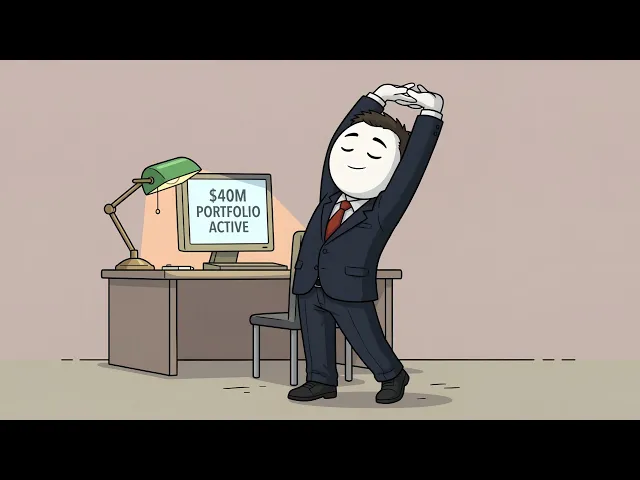
By month seven, you have discretionary control over $40 million in liquid alternatives. The word is discretionary. By institutional standards, 40 million is not a large number.
You know this. You keep the perspective deliberately close. But this number previously only existed in reports you wrote about other people's capital.
Now it is yours to move. You stop sleeping as much, not from anxiety. You are simply running on a different frequency now, not anxiety.
The metabolic cost of thinking in larger units. The mind is upgrading itself in real time. It requires fuel.
The mind recalibrates. It takes energy. You stand up from the desk for 30 seconds and then you sit back down.
The fund closes year 1 up 28. 4% net. The benchmark returned 4.
1. The gap speaks for itself. The LPS don't just reinvest.
Three new ones arrive. They come to you now. The direction of travel has reversed.
AUMum crosses 900 million. Two new portfolio managers join. Both of them report to you.
Without a title change, you are running the risk of the architecture of a fund controlling nearly a billion dollars of other people's capital. The ethical edges start appearing, not as dramatic choices, as quiet gradients. The spectrum is always there.
You begin to see it. An LP who sits on the board of a company you are building a short position against. You note it.
You say nothing. A dinner, a central bank official. Something was said about forward guidance that is not yet public.
Your probability distribution adjusts silently. It isn't directly actionable, but it colors everything. The model shifts.
The thesis sharpens. You did not ask for the information. You don't trade on it.
Your hands are on the keyboard. The cursor is on execute. You do not press it.
You document that you didn't. Date, decision, reason. The law grows one entry at a time.
Armor being assembled. You understand that documentation is a form of armor. Every filed record is a plate of protection against a future you cannot see.
And armor is something you wear because something might one day try to hurt you. In this industry, something is always trying. You are 31 years old and you are a capital controller.
The badge with the old title no longer means anything. By year three, Voss Capital manages 2. 6 billion across three offices.
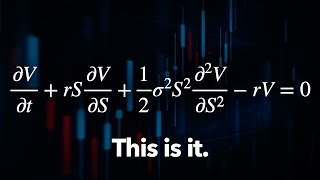
The macro overlay strategy is entirely yours. The strategy is not elegant. It is a composite of currency positioning, sovereign credit spreads, and commodity linked volatility instruments, dense and functional.
But it is yours. You built it from nothing over 14 months. You put your hand on it and claim it quietly.
It survived two separate liquidity events that turned other funds red quarters into green ones. The strategy earned its ugliness. The partners of two institutional investors you have beaten three quarters running begin circling.
They are watching. They are waiting not to compete to allocate. They come to the table with capital and open body language.
You receive them from the head of the room. The isolation is real. You notice it the way you notice a shift in yield curves, not as an event, as a reconfiguration.
Your social world has contracted. The radius now contains only people who work in finance or need something from people who do. The friendships from before are not broken.
They are simply no longer loadbearing. The bridge is intact. It carries no weight.
You attend a wedding. You spend 6 minutes calculating the macroeconomic backdrop of the catering industry before catching yourself. The reccalibration goes deep.
You are not unhappy. You are operating on a different substrate than the people around you. The first time you move a market, not participate in a move, but initiate one, the world feels different afterwards.
A coordinated unwinding of 480 million in EM debt. time to coincide with a scheduled IMF commentary. You built the clock.
You correctly predicted the commentary would be more hawkish than the consensus expected. The consensus was wrong. Your model was not.
The currency moves 1. 4% in 40 minutes. You watch it happen on the terminal in complete silence.
You feel something that is not quite pride and not quite fear. There is no existing word for what it is exactly. It is recognition.
The market responded to your action. You initiated. It moved.
These two facts have met inside you and settled. The market is not abstract anymore. It is responsive.
It has weight and temperature and it reacts to what you do. Your fingerprints are on it briefly. Then the market closes over them and continues forward without a record of your presence.
You understand for the first time that influence is not ownership. The lesson is quiet. It will not leave you.
You shaped the wave. The wave does not remember you. It never did.
It never will. It simply continues. By year five, Voss steps back from day-to-day operations.
The distance between you grows into something structural and final. He doesn't retire. He becomes chairman, rain maker, political conduit.
He operates in a different layer of the same system. The fund's operational architecture is yours. Every strategy, every workflow, every risk framework traces back to a decision you made.
The AUM is 4. 1 billion. The number is on the wall and you stand in front of it without performing.
You have hired people who are smarter than you in specific domains. You have learned to manage that without ego. This took longer than everything else.
You carry interest across four strategies simultaneously. Four separate lines of return connecting your decisions to your personal wealth in real time. You are by any reasonable definition financially independent.
The number in your accounts means the game is optional. You know this is not entirely true. You could stop.
The thought arrives in a quiet moment and you sit with it. Empty hands, no keyboard, no document, no phone. The number means you never have to work again.
Not in any sense that the word work usually implies. The chain is gone. You don't stop.
The hands return to the keyboard. Not urgently, deliberately. The choice made in silence, without announcement, without fanfare, not because of greed, which is what you expected.
Because stopping means leaving the architecture and you are not sure you can do that. The architecture is not something you built. You understand this now.
It is something you became. The difference is everything. The fund without you is a different organism.
Not worse necessarily, different. The system reorganizes around every absence eventually. The market without your positioning does not suffer.
It simply reconfigures. It was always going to continue. You were always going to be temporary and someone else steps into the geometry.
A younger figure, a light blue shirt. An unknown number is calling at 7:00 a. m.
That someone else will be wrong more often than you. You know this with the quiet confidence of someone who has kept the record. That wrongness will cost people, real people, pensions, endowments, and institutions with names and obligations downstream of your decisions.
You tell yourself this, you believe it. You also understand that every person in your position tells themselves this and that the telling is part of the machinery. There is a position building now, a new thesis, sovereign credit, a mid-tier economy.
The model is 6 weeks old and still forming, the debt to GDP trajectory, the political succession timeline, the IMF dispersement schedule, three independent variables converging toward a single window. The window opens in approximately 90 days. It is narrow.
It will not stay open long. Timing is the entire strategy. You have been modeling it for 6 weeks.
Six stacks of iterations, each one sharper than the last. The work is deep. The thesis is clean.
Six weeks of complexity resolved into a single clear diagram. One entry, one outcome, one direction. The downside is bounded.
You know the floor. You can live with the floor. The floor is not the concern.
The upside is asymmetric in a way that makes the room go quiet when you present it. No one speaks for several seconds. The position, if fully sized, will be $620 million.
You sit in front of the number and let it exist. If right, it is transformational. Not just a return, a category change.
The fund becomes something different on the other side of this trade. If wrong, it will not break the fund, but it will break the narrative. And that is the harder thing to rebuild.
In finance, the narrative is loadbearing infrastructure. The reputation beneath the returns is what holds everything above it in place. You have scheduled the decision meeting for Thursday.
The calendar entry exists. The commitment to decide has been made. The clock is running.
You are powerful. and you are not safe. Power and safety have never occupied the same space in this industry.
You are influential and you are replaceable. Somewhere a younger version of you is already building the model that will make this true. You are wealthy and you are not free.
The number is real. The architecture that surrounds it does not care about the number. You own the architecture and the architecture owns you back quietly, completely in a way no legal document will ever describe.
The terminal shows Asia opening. The markets activate one by one. The world does not wait for your decisions to be final.
The yield on the target sovereign's 5-year is moving a small arrow on a screen and everything sharpens immediately. It is moving in the direction you predicted. The model and reality are aligning.
The six weeks were not wasted. You pull up the model. You update the inputs.
You check the math. You begin to consider whether Thursday can become Wednesday. Someone somewhere is already on the other side of your trade.
A different desk, a different city, the same yield curve. They are also confident. The same set jaw, the same level eyes, the same six weeks of work behind their certainty.
One of you is wrong. The outcome floats between you, unassigned, patient, belonging to one of you and neither of you. Yet the market will decide as it always does without sentiment, without memory, and without any interest in which one of you deserve to win.