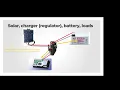
so this is a part D I'm talking about regulators and solar panels and let's go to the next slide solar panels are usually the best option for keeping your system working all year round they're relatively inexpensive but usually you wouldn't use those unless you don't have access to AC Mains power close by it needs to be sized and built in a manner to be sustainable all year long solar panels are rated based upon an output of a thousand watts per meter squared so what does that mean well um thousand watts per meter squared is the average Sun around noon in the summer so and with a clear day so that's where you know it's kind of like the highest Sun that you'd normally expect to see so um to size our panels we need to know a few things the loads we intend to sustain like we mentioned earlier the average of the solar panel in Peak Sun so what its output at a thousand watts per meter squared Illuminating it and the hours of Peak sign available for the site so we know how many how much uh how long that will produce that amount of power so as we saw this picture before [Music] um the uh the charge regulator protects the battery of course and then uh it the solar panel takes over the load all those things we learned about before so the Sun comes in goes to the battery I mean the the loads and also charges the battery we saw this before and then at night it comes out of the battery and goes back in to keep the system running the uninterruptable power supply so this system should be a multi-year lifetime since the batteries keep the system going at night and during storms and when the panels are shaded okay and we already looked at this a little bit so we'll just review this we've got the battery uh carrying the load at night the Sun rising taking part of the loads equilibrium positive amperage in the battery when the solar panel produces more energy the load thus recharging the battery then the regulator starts slowing it down when the battery gets near full the battery trickle charges to try to top it off watch out for the storms it will uh it will be like a night time right in the middle of the day it will just have to be carried by the battery in those times and this is one of those things that I told you about that the the regulator smart regulars can do they have this Q loss accumulation so you can pull it out so during the night when the energy was coming out we were losing power from the energy uh battery and we were integrating that and summing it up then the sun started coming up so it flattened out here a little bit and this started really charging heavily so it started dumping power to the battery full full bore as much as I can then it started backing off a little bit when the sun uh when the battery is getting close to its its lead and it almost like got back down to full charge around you know two or three in the afternoon but then that cloud came over and it had to pull the energy back out of the battery again so I started going back up again then I kind of leveled out again and started recharging a little bit but then it was partly cloudy so it was just kind of barely carrying the load or something and then it went into night time and so in this case over these two day periods this battery uh ended up being 4 amp hours down out of the seven or however many were in that particular battery where this data was created so it's kind of interesting if you know the the battery capacity of your system and you can compare with your Q laws you can kind of get an idea of how deeply discharged your battery is now we mentioned the ps200 ch201 sensor and charge regulator combination the features are has a little bit higher capacity than our previous models it does have a low internal drive it only draws uh zero point zero zero zero six amps when it's trying to check the voltage and stuff some of the some of the other manufacturers have a systems that draw 10 milliamps out of their battery just to check their battery voltage and so that can actually be kind of a load on your system that you have to kind of calculate in the smart charger of course gives you these low measurements and solar panel verification that is working can tell you the battery condition and you can get some remote Diagnostics which is kind of handy so one of our customers called me one time and said we have these um these repeater sites and uh and environmental impact study sites that we're measuring and the one repeater it's got a 50 watt panel on it but it's only showing uh five Watts coming in instead of 50 and what could be wrong so we talked about some of the possible problems could be told to me although there might be snow or or dirt or weeds or a nest or something on the panel and or it could be that the um there was a nearby lightning strike and that partially damaged the charge regulator or could be the battery just does not want to take more than five watts of power maybe the battery is bad a sulfated or something so we didn't know exactly what it was but he was taking a helicopter flight out to all these sites to do maintenance and he thought well I'll just take an extra solar panel battery and and regular with me just in case so we planned ahead and it's because he had the remote Diagnostics telling him that there was a problem he got to the site first thing he did was swap out the solar panel and look at the data and all of a sudden it jumped up to 50. so the solar panel had been damaged somehow or was a faulty they put the new solar panel in it jumped right back up to 50 watts and he was good to go again so he knew ahead of time the problem the system didn't die all the way so he was able to solve the problem before it became a big problem so the smart charger can be helpful in remote Diagnostics as well and it saved him another helicopter flight which was way more expensive than the cost of the of the ch200 cs201 regulator and sensor it handles the temperature extremes and you can actually put a thermocouple on your Data Logger and send that temperature of a remote battery box where the batteries are up to the regulator with the Data Logger and then it can it can change its charging voltage according to the battery temperature not the temperature of the enclosure if you happen to have those separate um it does have this mppt function as well and this is called maximum PowerPoint tracking and usually only maybe 10 percent of the people I talk to know what that is but let me just describe that to you a little bit so you can know what that means the maximum PowerPoint tracking is the voltage versus amperage I for amperage V for voltage is a curve so here's an example of a curve now on the left axis is the amps on the bottom axis is the volts and this particular solar panel looks like it's producing around 4 amps at 17 Volts for the maximum PowerPoint which is kind of on the knee part of this curve right here okay and these solar panels have something called a short circuit current now that sounds scary usually you want to stay away from short circuits right and you would not want to do this on your plug on your house or on the battery in your car or something like that because you would melt start melting metal or something but on solar panels since they're limited and how much current they can produce in the full sun um and it's usually less than a multimeter you can actually use a Multimeter to measure the short circuit current of the um of the panel in full sun in the middle of the day so in this particular one on if you have a thousand watts per meter squared you're going to get about 5 amps but it will be at zero volts right you'll be down here at zero volts and five amps and so your wattage is basically zero you can have open circuit voltage this is another rating that's on those enclosures I mean on the solar panels on the back of the solar panels and that's one where you just hook up your multimeter in the bolt position and just measure the voltage one that's in the Sun and that might be around 20 volts but that's not throwing any amps because the amps are zero over here so but somewhere in between there you're at your maximum power production and so let me show you uh another another graph on that here's a here's another graph from a slightly different solar panel it's pretty similar to the other one it's around four this one's four amps instead of five amps and the knee curve is right here and 20 volts at open circuit and the blue line is on the right side here that's the wattage the power and P is equal to I times E from Ohm's law and uh e being the voltage voltage down here and the eye of the current over here so the current is uh is four amps but the voltage is zero you got zero Watts the voltage is 20 but the current is zero so you've got uh zero Watts there but it goes up from there on this curve and it gets up to a height of about 65. Watts at this point right here now this is at a thousand watts per meter squared of course right now uh that would be a 17 volt production now most batteries aren't 17 volt batteries they're 12 volt batteries so I think they did this because in the morning you know or just before noon you might have 800 watts per meter squared and maybe there's a curve like this for 800 watts and maybe there's one like this for 600 watts and maybe there's a curve like this for 400 watts and maybe there's one early morning maybe there's one for 200 Watts and the maximum PowerPoint right here would be pretty close to the 12 volts of the battery so um I think they're trying to design them so they work in the morning as well as in the middle of the summer but wouldn't it be nice to always get this maximum power out of your panel so there's a smart guy that said well why don't I take the power at whatever Watts let's say it was 52 watts in this case and take it in at this voltage and this amperage and then let me store that into some kind of a like a coil or a capacitor of some kind and then pull it back out and use a DC DC converter and to deliver it up here at a much higher amperage and just the right voltage for the battery so they're taking this energy here and storing it momentarily and pulling it back out and putting it in up here so if you did that even if you had a 90 efficient DC to DC converter you'd get 47 Watts out of your panel instead of 36.
so 47 is bigger than 36 so you benefit from that technology that lets us get more out of our panel when we when we need it now the problem of course with this is that we're designing systems to last two weeks or so 10 days two weeks so any given day we're only going to be down by 10 percent our battery is 90 full in the morning so the Sun comes out and uh it's topped off at uh you know an hour later or an hour and a half later so there's no there's not really a big benefit to having mppt except in the recovery so if you've had a storm that went really long you can recover a lot faster because you're doing this mppt when the sun does come out so it helps you to recover more quickly so that is um maximum PowerPoint now let's talk about the panel sizes if you have a location where you've got lots of sun you just need a little tiny panel and you will be able to top off that Reservoir really quickly the battery if you have intermittent Sun or a low Sun you might need a large funnel if it was water or a large solar panel if it's a sun to try to refill that system okay thank you so how do we know well here's a graph from nrel and there's locations that have really good sun in the worst you know December which is probably the worst month of the year for most locations but you'd need to check that but like Arizona New Mexico Texas Mexico they probably have pretty good sun and so they would probably not need that big of a panel because they have so much extra Sun but Poco so a little bit of suns lacking sun in in parts of Canada the the west coast up by Washington Oregon Alaska other places like that maybe around the Great Lakes so those would be cases where you would need a much bigger panel to try to generate as much as you can in the weak Sun so let's talk a little bit about Peak sun and what that means here's a graph from um I think this is actually from my house and around the 15th of November a sunny day and it was approximately nine hours of daylight it came up around eight went down about five and but you know it was there's not any dips in this curve so it was a nice sunny day probably felt really nice on that day but notice that it doesn't reach the Thousand watts per meter squared and only got up to about 500. and so but the specs for the solar panel are a thousand watts per meter squared so how do I uh get the equivalent out of those two uh those two measurements or that measurement versus the solar panel requirements well we kind of have to squish the curve together until it rises up to the Thousand watts and then we have to determine how wide is that thousand watt uh graph and it turns out that it's 3. 1 Peaks on hours so um even though there was nine hours of daylight it wasn't a strong Sun during those times so it didn't produce as much as it would have if it had been at a thousand so we just have to do this adaptation to take the Sun that was there and integrate it and divide it by a thousand watts per meter squared to get that so how do we convert normal sunlight into Peak Sun hours from the morning and evening during summer days and all day long in the fall and winter and spring well we can sum up the hourly averages from a nearby weather station and then divide that by a thousand watts per meter square and we get the 3.
1 that way or we can find the mega joules per meter squared per day from a nearby weather station and divide that by 3. 6 and that will convert it back into kilowatt hours per meter squared per day and the so there's the formula if you have mega joules per meter squared per game okay so there's uh there's several ways to do that here's another website that's saying the same thing you know you just have to figure out how wide it would be if it was a rectangle instead of a curve uh to get it up to a thousand watts per meter squared and uh here again as those uh those days whether we had the uh the the storms and stuff like that and so when I averaged out all of these sites I actually got about 1. 5 the extent hours for Logan Utah okay you could also measure this by um writing a program this was written for a 1 000 Data Logger several years ago and I used a constant in my code to set the scan interval to be one second because I needed to use that scan interval in my calculations down here below I measured a CS 300 pyranometer I think we have the cs301 or the 320 or three some other different models now this is a an earlier version from apogee but we make the measurement on the voltage measurement on this sensor if it's below zero like it's night time and we set it equal to zero and then we take those millivolts and multiply them by the scaling Factor their correct scaling factor for Mega joules is this number right here but that has to be Times by the scan interval in seconds so this turns out to be solar megajoules per meter squared per second and then I can use something called totalize which we haven't really used uh very often in the class but we could we could then have uh megajoules per meter squared per day by totalizing in a table that was designed to collect the data for the whole day and integrate over the whole day but then we can take this Mega joules per meter squared per second and divide it by 3.