Hey, welcome to week five students. Uh, Christian ethics. We're going to be looking at Christian decisionmaking and complexity. In other words, we're going to start dealing with our conscience and the moral struggles that we have in this world. Uh, but before we do that, let's uh let's pray. Father, we thank you that Jesus is Lord. We thank you that he is king and that he rules our hearts. as we learn about ethics and making decisions within the systems that God has set up. I pray that you would conform our hearts and that we would act
in faith. So, we thank you and we pray in Jesus' name. Amen. All right, let's uh let's think through a few things first and that's this. We really need to have a reality check in our lives. Um most of the ethical decisions that we make that actually shape shape us are not clearly labeled right or wrong. In other words, they go right, wrong, right, and there's signs on them. Boop, boop, boop. But that doesn't happen. In fact, uh there are there there are many times in this world that we live in great what what I
call grace spaces. And that's things like some things are good. Not all things are good, but some things are good, some things are better. There's pressure in our world, in our environment. Uh there's timing issues. And then there's the consequences of of our actions. And uh scripture does doesn't give us a a verse for every decision we face. Isn't that too bad? That way we could just look. But then if the if the Bible gave us a verse for every every issue, we wouldn't learn how to be led by the Holy Spirit. We wouldn't learn
to be led by God. We wouldn't learn to build our faith or to walk in faith within the guidelines that God has given us, the general guidelines. And so that really isn't a weakness in the Bible because God is forming wise people, not merely producing correct decisions. In other words, God totally understands that he needs to form a people. And that would be us. He's forming us. And he's not just making automatoms. He's forming individ individual peoples that have will free moral agency that can make decisions with inside the guidelines. In other words, he doesn't
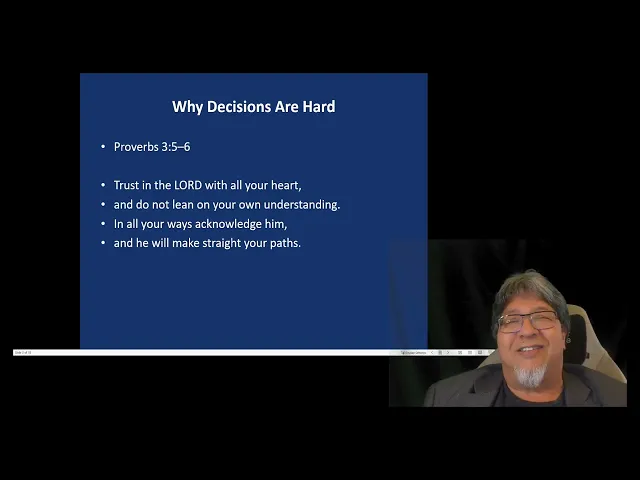
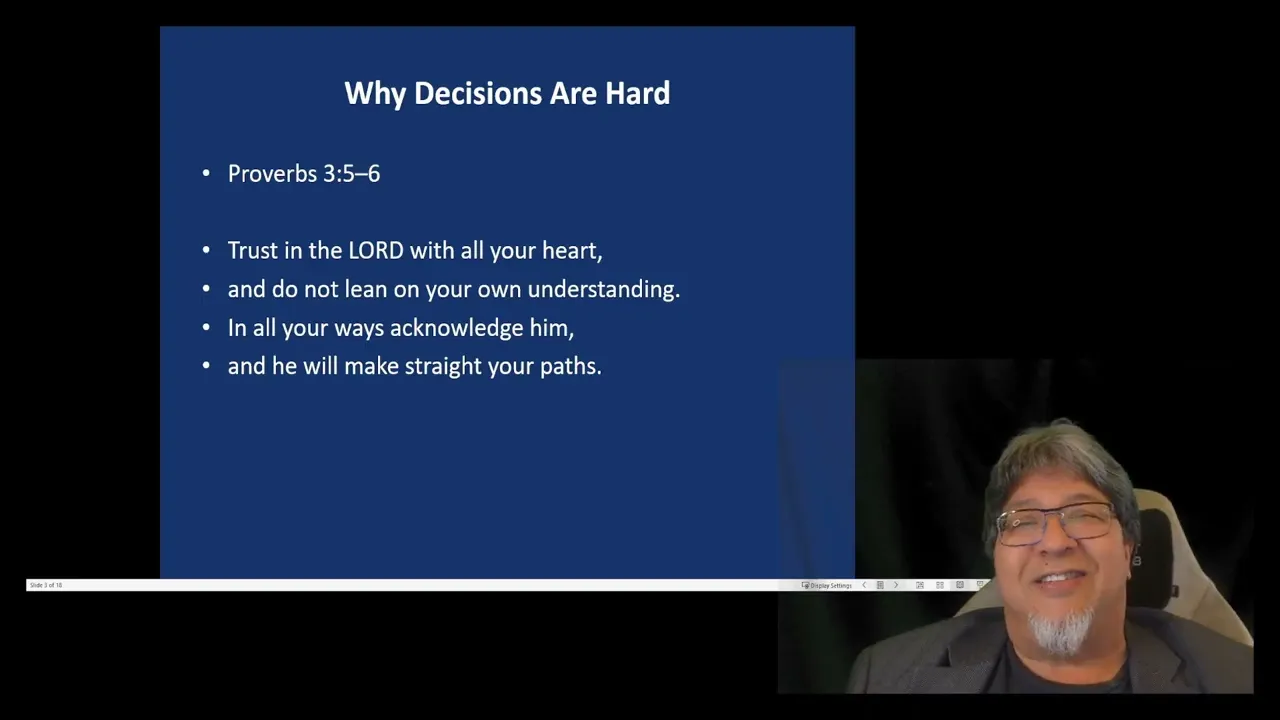
give one 2 3 four for everything in the world. The book would be so big that we we couldn't even read it or or have time to read it at least in this life. And so that leads us to a really interesting question. Why are decisions so very hard? The Bible says in in Proverbs 3:5 and 6, "Trust in the Lord with all your heart and do not lean on your own understanding. In all your ways acknowledge him and he'll make your path straight. He'll give you straight paths." The Bible does not require full understanding
for trust and obedience. The Bible does not require full understanding for trust and obedience. Trust means we refuse to let limited human understanding become our final authority. We don't allow the world, circumstances, other people to be our authority. In other words, these great philosophers such as Aristotle or uh Senica or even uh people like Nichi or whatever you have been reading over the course of your life even Christians you don't they don't become the final standard the final authority God is the final authority and for Christian ethics faithfulness often begins when certainty is no longer
demanded before obedience. That's really hard because we want to know before we do. I used to I grew up in in a place called New England uh and it's very cold during during the winter and we used to like to ice fish and we would play hockey and behind my house there was a pond and we just didn't run nilly willy onto the pond when we wanted to to to skate or to play hockey or even to ice fish. We wanted to make sure that that water or that ice was thick enough and safe enough.
That's the human condition. We want to know before we we go. We want to know before we go. But the Bible never presents trust as the reward for understanding everything. Trust that isn't a reward because we understand. In fact, the book of Proverbs assumes that our understanding will always be partial. I don't understand. Now, let me share some history with you. I am a Korean orphan and my mom was a prostitute. I was very, very badly abused as a child and then I was adopted. I was put in an orphanage and then I was adopted
to the United States. If I told you that I understood that, I would be lying. I don't understand why people suffer. I don't understand why my adopted dad died right in front of me, literally in my arms when I was 11, almost 12. I don't understand that. But the command is not to gain more insight before trusting God, but to refuse to enthrone my insight as the ultimate insight. In other words, God is saying, "Your insight isn't as important as my insight, and you need to obey cuz my insight is better." And decisionmaking becomes really
difficult when we believe that we must fully understand outcomes before we can act faithfully. We must fully understand what's happening before we can really act. And many Christians struggle here because they confuse wisdom with certainty. But in the Bible, wisdom is not having all the information. It's knowing where the authority belongs. It's knowing who has the information, that God has the information, all the information. So when human understanding becomes the final authority, when we say that I have to understand and that and let we won't move until I understand or that's the authority, obedience is
then delayed. and faithfulness is stalled, we won't develop. Scripture repeatedly shows that God calls his people to move before all questions are answered. He called Abram out of the Caldes and he sent him to a land and he said it's yours. He promised them descendants and his wife is barren. God repeatedly calls people to move before they understand, before all their questions are answered. Now, I'm going on. I'm going to be 70 this year. And I want to tell you that I have more questions now than when I was 30. I have more questions now
than when I was 50 or when I was 60. Questions are always going to be part of the equation. But faithfulness begins at the moment when [snorts] certainty is surrendered. In other words, faithfulness begins when you can say to God, I don't have to know all the facts. Because that's not reckless action. That's recognizing our limits. I have limits of what I know. So I trust in God's word. I trust in choosing alignment and trust in God's character when even the full picture is not available. I trust God's character. And so what we have to
understand is we're not always going to understand. And so there are ethical decisions that we will make using God's word that we will not totally understand, but we do it anyway because the Bible said God works in Romans 8 all things together for good to those who love God. In other words, God said, "Hey, I will enter in." That that verse means God enters in and he makes all things move towards his honor and glory. So we have to acknowledge God and we have to submit to him in our decision making in our our ethics.
In other words, submit to God. And this is more than just agreeing with some kind of theological idea that we have. Trust becomes visible when God is invited into actual choices, not just affirming them belief. In other words, when we begin to act in in ethics, we invite God into to the process. We got we invite God into the decision making. We ask his holy spirit to empower us. That does not mean he'll give us total understanding. What it does mean is that he will be with us and he will work all things out to
his good and we must stay within the guidelines that he has laid out. Now, Proverbs moves out of [snorts] a kind of abstraction into lived reality. In other words, it's not just a thought or a theory over here. It's we acknowledge God not merely to correct things about ourselves or about him, but to place our decisions under his authority. And this is where we struggle. This is where ethics struggles because people affirm God in belief but exclude him from decision-m. In other words, we say yes, God is real. God is all powerful. God is this
or God is that. But then we exclude God from the decision-m process. And we probably would go that would be another course. But we have to acknowledge God's presence and we have to acknowledge God's word and we have to allow those to shape our choices about direction, about timing, about relationships, about conflict and about restraint. In other words, we're restrained by God's word and we everything about conflict that God talks about forgiveness and those type of things, we allow his presence and his word to shape all those ethical decisions that we we do. So trust
becomes visible when decisions mirror God's word. Trust becomes visible when decisions mirror God's word. In other words, when God is acknowledged and choices begin to reflect submission rather than control. Again, another story that I take from my own own life. Um, my oldest daughter is 45 years old and when she was born, she wasn't supposed to live. Now I had been living in fairly good disobedience to God. In other words, God had called me into be a pastor, into the ministry, to be a teacher. And I was resisting that because I in my mind I
wanted to make a lot of money and I wanted I was studying chemical engineering. And when um my daughter was 4 years or 4 days old, we had had to put her in Yale, Connecticut neonatal intensive care unit. Um I got a call and in that call it said, "Mr. Mr. Kraton, you need to come down here. Your daughter will not live through the night. We're having some real problems. We don't think she'll live through the night." So I was living in New London, Connecticut. And I got in my car and I started heading down
towards New Haven, Connecticut. And when I was in in the car, I asked God, I said, "Okay, now that you have my attention, what is it that you want?" And God spoke to me. I didn't hear any verb, but God said, "Hey, I want you to go into the ministry." And I'm thinking to myself, if I do that, I have to leave my good pay because I had a great paying job with Fizer. I have to leave my job. Where am I going to live? How am I going to support myself? What's going to happen?
There were all kinds of questions about control. But I had to submit myself to that call of God because God calls us to obedience. And so I had to commit myself to ethical faithfulness. And I will tell you that God provided for us every step of the way. And here I am 69 uh which is some 50 years later and uh God is still with us providing for us. So ethical faithfulness is revealed not in what we claim to believe but in how we decide when the cost is real. Okay? Faithfulness is revealed not in
what we claim, what we say out of our mouths, but what we do. And even if the cost, it costs us something something. You see, God's promises, God's direction don't always come with explanation. The Bible teaches that clarity often comes as obedience unfolds. In other words, clarity for me came as I began to obey God. And as I began to obey God, he started pushing me in the directions. He gave me the things that I needed to live. He did all those things. The clarity began to unfold for me as I began to obey. And
in as as an ethical Christian, the path will only become clear after we begin walking it. Okay? And so the promise is often misunderstood stotood. Uh God does not promise to explain the path in advance. He promises to make the path straight as it is walked. And so in your mind you were thinking you get on the path and you don't see it. But as you walk down it, the Lord opens the door, the path becomes straight and clarity begins to emerge for us. And God guides those who move in trust, not those who wait
for perfect information. And this doesn't mean we don't we just act nilly willy without discernment. Oh, I just do anything. No, it it means refusing to be paralyzed because fear and uncertainty paralyzes. See, when God called me to the ministry and I'm leaving this good job, there was a lot of fear. I don't have insurance. I I don't make a good living. I don't know where I'm going to live. There was uncertainty that couldn't paralyze me from obedience. And as I've gone over the years, I've pastored some really large churches. And then I've left that
to to go into church planting and plant churches. And when I went into church planting, the same questions. How am I going to make a living? What if I fail? what what what's going to happen over that time. But the pro the promise that Proverbs 35 and 6 gives us is not comfort about guidance because God commits himself to directing those who submit their steps to him. See, ethical clarity is not downloaded. In other words, we don't get clarity. It doesn't download like we do this on the computer. It's discovered. Ethical clarity is discovered as
we faithfully obey God over time. So to wrap this up, um trust comes before understanding and biblical trust does not require full understanding. Uh faithfulness begins when certainty is no longer demanded. We don't got demand of God, I must know before obedience. Let's uh let's [clears throat] go to something that most people don't think through at all when they're talking about Christian ethics or ethics in general, [snorts] and it's the role of conscience. Uh Acts 24:16 says, "I always take pains to have a clear conscience toward both God and man." So there's some things that
we have to understand. And number one, our conscience operates in two directions. Responsibility before God and integrity towards other people. In other words, here's what here here's what we're having. We're having two things or two two tensions if we could use the word tensions in our life. One is God and how our conscience is towards God. And the other is how we have integrity with our family, with our church, with the people around us. So Paul frames conscience as something that lives inside of relationship. It's not isolated. In other words, there isn't a little box
in our head that goes, "Ooh, this is conscience. Uh it's it's it's not isolated. It lives our conscience has to live within our relationship to God. And a clear conscience is not measured by private feelings before God. And it's not measured by outward reputation before people because again it exists in both directions at once. So ethical faithfulness requires us to align with God and then to align with others. In other words, we have to have a good conscience with God and we have to have a good conscience with people. And this matters because ethical failures
happen when one direction is emphasized. In other words, if it's your conscience with people is the most important thing, then you won't have a good conscience with God. And obviously, a conscience with God is is the most important, but there has to be a balance because when there is a good conscience with God, there will be a good conscience with people. When there's a good relationship with God, let me put it this way. When there's a good relationship with God, there's a good relationship with people. So, we have to maintain uh respectability in our faith.
We can't ignore faithfulness before God. And uh Paul refuses uh both options. In other words, conscience has to answer to God's authority and to the real impact of one's life on other people. Biblical conscience then isn't self uh referential doesn't refer to itself. It becomes relationable relationally accountable to God and to one another. And decisions aren't weighed only by any internal comfort but whether our decisions are ethical decisions that the and everything is ethics believe me. uh whether they honor God and preserve our integrity with other people. Now, here's the problem. Conscience, our conscience has
to be formed. See, a clear conscience requires intentional formation. It it it doesn't develop automatically. Paul said, "I take great pains." And that that language actually really matters because a clear conscience is not accidental. It's the result of attention, discipline, and ongoing formation before God. Scripture does not treat conscience as a flawless [snorts] inner guide, but something that can be strengthened or weakened, something that can be shaped or ignored. And so, conscience has to be formed. Obviously, formation comes through your spiritual life with God. without formation. Conscience often reflects the habits of culture. In other
words, uh something other than God will shape your conscience. It could be your own self-interest instead of God's will. And this is why people need to feel at peace while doing harm. People feel at peace while doing harm because their conscience is towards themselves. So there's no there's no guilty feelings. There's no pressure of the Holy Spirit. So they act like they haven't done anything wrong. Our conscience as human beings have to be trained within the relationship to God's truth and presence. It has to be trained within the relationship to God's truth and presence. Ethical
living requires requires. Okay. Effort. Ethical living requires effort. So, we're not trying to silence our conscience. We're trying to sharpen our conscience. In other words, we're trying to align ourselves more clearly with the word of God. And a clear conscience is not absent of struggle. In other words, for us to get a clear conscience there, we're going to have to struggle through that because we'll we might have to relearn some things or we might have to give some things away. In other words, we not we might have to put aside uh some things and discipline
ourselves. So to get a formed conscience, there has to be alignment in our relationship to God. And through time things happen like repent, repentance, obedience and humility. So ethical living includes accountability. What we want to do is we want to live our lives without accountability. But in Christian ethics, there's always accountability for how decisions affect others. Paul's concern for conscience is highlighted when he says toward man. If you go back and read what what he said, you know, he said I take pains I take great pains. And so we have to understand he says I
take great pains pains to have a clear conscience towards both God and man. And he's not putting man first but he's taking very very great pains to make sure that his formation is towards God and then that formation is towards man. In other words he learns to live within the context of God's world within the context of obedience to the living God and in that context he creates a clear conscience uh with the people around him. Now, this doesn't mean living under a constant fear of approval from God or approval from man because that's not
God h that's not how God works. Even [clears throat] when we fail, God loves us and he continues to bless us and he doesn't send us to hell. Even when we're failures, we don't have to live in constant fear. But we do have to recognize that there is a responsibility that goes beyond our personal intent. There's we have to understand that the Bible consistently links righteous living with concerns about our neighbor, our community, and our witness. In other words, we we have to not we have to not just live our lives in this bubble, but
we live our lives in relationship to God and in relationship to one another. In other words, God wants us to be in the world and to be a light for him. Our job as Christians is to reflect the glory of God into the world. And that's a broad statement and then we can start narrowing them down. But when we get to Christian ethics, that narrows that down. What is the glory of God? Well, it means God's character, God's God's kindness, fruit of the spirit, love, joy, peace, patience, gentleness, longsuffering, these things. We we reflect those
into the world. So we have to form our conscience and we we ask two questions. Can I do this? But what does this what does this do to others? In other words, when we're making a decision, whether that's be whether that be to [snorts] uh buy a new TV or to spend extra money going out to eat. Those are just small decisions. Or buying a new house or renting a new apartment or buying new clothes. We always have to bounce that off. Can I do this? But what does this do to other people? And as
we grow ethically and more mature, what will happen is we'll begin to answer those questions honestly with inside the context of God's word, our relationship with God, and our covenant relationship with God and one another. So, a clear conscience reflects a life lived with awareness of its impact on others. But here's a problem. Our conscience can be weak. That's unfortunate. But our conscience can be we be weak. There are times that people they have weak consciences or they can at least you can talk yourself almost into anything when your conscience is weak. Right. I I
am forever on a diet because over the years I I I've gotten [clears throat] a little chunkier than I used to be. And so when I go past um ice cream shop or McDonald's or something, I can talk myself into going in there even though I know that I shouldn't. Not all people possess the knowledge that they need to have. In other words, not all people possess the knowledge of God's word or God or have the knowledge that we have within the church society. And so their conscience is weak. And when a weak conscience happens,
it becomes defiled. 1 Corinthians 8:7 says, "However, not all possess this knowledge. Their conscience being weak is defiled." So we just have to have a warning. I just want you to be warned that conscience can be weak and we have to guard against that. But conscience can also be sincere but that doesn't mean the conscience is accurate. There's a difference. You can be extremely sincere and not be accurate because your conscience can be misinformed. Let's say uh you are reading have read only little parts of your Bible. Well, you will have some knowledge but on
a lot of things you'll be misinformed. And see, Paul acknowledges that some believers and some people act according to conscience. Yet that conscience is shaped by an incomplete understanding of the Bible, an incomplete understanding of God, an incomplete understanding of covenant. And I keep going back to covenant because we're covenant people in relationship to the living God. We live within relationship. And even though people can be absolutely sincere, people can abs, you know, there are there are religions that are absolutely sincere. Muslims and and Mormons, but that doesn't mean that they're right. Right is always
balanced against the word of God. Sincerity does not guarantee moral clarity. A person can honestly act and still act wrongly. Sometimes people feel that it's okay to steal. It's not okay to steal. Well, I have to feed my family or myself. It's it's it's stealing is not okay. And so we have to be careful about conscience and conscience has to reflect your a good conscience will reflect good formation. And this is crucial for Christian ethics. It really is. If you don't get this, you're going to miss it. Scripture never treats conscience, your conscience as infallible.
The word of God is infallible. The word of God is perfect and has absolute authority for life and practice. But the person must be informed, shaped and corrected by truth that is lived outside of the community. In other words, there is truth that transcends our understanding. There is truth that transcends our world. There is truth that transcends our uh culture. And that is obviously for us the word of God. Moral confidence without proper formation. In other words, if if you're very sincere, but you don't have good confirmation, if you don't have good uh confirmation, yeah,
if you don't have good uh uh conforming to God's word, if if uh you don't have formation, that can often lead to harmful things even when intentions are good. So Paul isn't concerned about about Paul's concern. Well, let me put it this way. Paul's concern is not to shame the weak conscience, but to recognize its vulnerability. That's why we don't put our children in situations that they need to make adult decisions cuz they haven't had the proper formation. The same is true with ethics. It requires humility about our limits and our understanding. And it requires
submission to God and to his word. So moral weakness often results from incomplete formation and formation matters. Paul doesn't describe the weak conscience as rebellious but underdeveloped. It's kind of like going into the gym and uh you uh go in and you put on four or five plates when you're only capable of lifting the bar. You are undeveloped. You're not ready for that heavy weight. Weakness isn't moral laziness. It's lack of formation. It's lack of understanding. We haven't been formed. We're not moving ourselves in the image of Jesus Christ. And that leads to a sincere
but a wrong conscience in sometimes. And so Christian ethics have to take formation very very seriously. Your formation, your growth, your formation in Jesus Christ is critical. And we have to grow in moral discernment. And that requires time and teaching, patience, and relationships. In other words, no one grows overnight. Your children, even though my children are all grown, and it seems like just yesterday they were uh little and we were going fishing and before that I was changing diapers. But the time went by quickly, but now they're adults. And over that time, they've learned. There
was teaching involved and patience. And there was relationship. They had relationships with mom and dad. They had relationships with their teachers. They have relationship with their professors. They had relationships with their mentors as they in jobs. And so we're not asking for formation to happen overnight. We can't rush maturity because when you do that often damages rather than frees and Christian ethics has to consider how our freedom cuz we do have freedom affects others. I mean the argument is that we possess freedom, we possess knowledge but that doesn't remove our responsibility. In other words, I'm
not removing your responsibility from how you behave towards your wife, towards your other students, towards your professor, towards your teaching assistants, whatever. You might get annoyed with me or your teaching assistant or your wife. [snorts] Just because you have freedom, that doesn't mean you're free to be destructive. Uh you're not free. Again, you we have to understand covenant and living inside that relationship. So when we have good Christian ethics, those ethics are shaped by love by loving God and loving our neighbor and that love restrains our personal freedom. And that's okay because the good of
others is what we're here for. When God gives us spiritual gifts, whether that's preaching or teaching or understanding, those aren't for us. Those are for other people. So if we're going to be ethically mature, we have to understand the measurements not by how much freedom that we can claim but how wisely we use the freedom for the good of others. And so that means that we have to have some wisdom. In fact, James 15 says, "If any of you lacks wisdom, let him ask God." And so we have to understand that God really wants to
give us wisdom. And so wisdom is received from God. I it is from God and it's not wisdom isn't something that we naturally have. I mean we we have street smarts some people and we know things but wisdom is how you use knowledge. Paul begins by James begins by naming lack not failure. Scripture assumes that human human beings will face situations where insight is insufficient and wisdom in biblical ethics is not the product of intelligence though it's important. I'm sure I'm not saying we're not supposed we're supposed to be unintelligent, but it's not the product
of intelligence or experience or effort alone. Wisdom in Christian ethics is something that is given by God. And this matters because many ethical struggles come by trying to reason our way out of complexity without reference to God. Let me put that another way. Many we get in trouble because we try to reason ourselves out of a difficult situation instead of referring back to the Bible or our relationship with God or our covenant relationship with one another. So when wisdom is treated as something that we generate that we have then our decision making really becomes anxious
and self-protective instead of being confident in the knowledge that we have in God that God is good. Here here's a perfect example. I pastored for years and I wish that I could say I led uh thousands of people to Jesus. I probably have led hundreds, but not thousands. It's not my job to save anybody. It's not my job to to um to make sure someone gets to heaven. My job is to give the word of God to people. God made a promise in Isaiah that his word would not come back to him void. So, what
I have to do is simply give the word of God out. I've done my job. Now, I have to trust what God has. I've got to trust what God is doing. And that's one of the things that we struggle with. So, we have to begin with humility and recognize that we don't possess enough insight in our own. And we have to receive direction from the outside from God. And that comes obviously as we know through come known Jesus our savior we have we baptize with the holy spirit we have the word of god and the
holy spirit speaks to us teaches us we learn god's word and we act out of the knowledge of god's word and that's very very important so god invites us to depend on him rather than to shame us. Bible said James said that is generous and he's not reluctant to give you wisdom. So, so many times people come to me and they go, "Oh, uh, Pastor Mark or Professor Mark, they'll say,"I just need wisdom. I just I need wisdom in this." And what they're really looking for is for me to answer to give them an answer,
for me to answer their problem and tell them what to do. And I usually I don't do that. I ask them and I take them to the book of James and I read, "If any of you will lack wisdom, let him ask God." and goes on to say, "And God will give to him liberally." And they go, "Yes, I believe that's true." And so I go, "Well, let me ask you one question. Is God a liar?" "No, God's not a liar." I said, "Is God uh is God dependable?" "Yes, God is dependable." Uh is God's
word true? Yes, God's word is true. If God's not a liar and God is dependable and his word is true, he's going to give you wisdom. Have you asked for wisdom? I have asked for wisdom. Now you need to rely on what you believe about God. That's Christian ethics. About the word of God, about your relationship with God. You need to believe that God is true. And make your decision in faith. Make your decision in faith knowing that God gave you the right wisdom. People come back and said, "It turned out horrible." The promise isn't
that life would turn out beautiful. The promise is that God would glorify himself. All things work together for good. That's the promise. Here's here's the problem. Your fantasy. You have a fantasy. If I pray and if I act in wisdom, X, Y, and Z will happen. I will be rich. I will get the most beautiful wife. I will have no problems in life. That's not that's the fantasy. That's the problem. In this world, you will have tribulation. Be of good cheer. We forget that. You see, because we haven't had the formation or aligned ourselves ethically
the way we should. So [snorts] God invites us to depend on us and he doesn't shame us. And frankly, if you want to be wise, if you want to make good ethical decisions and you want to have good discernment, it starts with prayer. See, James places prayer in a very important position. He said, "Let him ask God, and God will give him wisdom." Prayer forms our hearts to listen before the choices are made. Prayer slows our impulses down. Prayer is not a last resort resort after we've analyzed things. Prayer is the first thing we do
before we analyze things. Oh, I'll do I'll do an analysis and when the analysis is exhausted and I've made my decisions, then I'll pray about it. No, that we pray first and prayer forms the heart to listen before it chooses. And that's really important because frankly we're very impulsive people and we often reim reorient our desires to our impulses instead of to to the the absolute word of God. So in scripture, wisdom is found not in control but in attentiveness to God's leading in prayer where the attentiveness begins. In other words, we talked about formation.
This is exactly how we're forming the good conscience. But here's our problem. We have desire. James 1:14 says, "Each person is tempted when he is lured and enticed by his own desires." And I have, we all have desires. I I have many desires. You have desires. And here's our problem. Desires shape our direction. Our desires shape direction. And so our desires shape our moral choices. So then you have to ask the question, what are my desires? See, James places desire at the center of mor at the center of moral actions. He's enticed by his own
desires. He he acts on his own desires. Ethical decisions do not begin with rules or opportunities, but with what does the heart want. And that was the problem in Eden. The heart didn't want the things of God. The heart wanted its own thing. I remember someone told me, "The heart wants what the heart wants." Oo, that's very dangerous because the Bible says, "The heart is deceitful and desperately wicked." And who can know? It says that in Jeremiah. So, ethical failures often surprise us. And they surprise us because we don't understand our desires. We have to
be careful about our desires because the Bible teaches that what we want shapes what we choose. And the question I have for you today is, do you want Christian ethics? Do you want the things of God? You see, temptations arise from within. There can be things looking out there, but the temptations arise from within when we begin to practice idolatry. And so James removes the excuse of external blame. He goes, "No, don't don't don't blame the golden calf. Blame the internal temptation. Blame the desire within." Now I'm not going to deny the reality of external
pressure [clears throat] because but I want to clarify responsibility. External pressure external pressure clarifies responsibility. As we get in the heat, as we get in the crucible, as we get into the ethical struggle, we will begin to clarify in our minds who we're responsible to. Are you responsible to God and in in a sense to the good of your community or are you just responsible to yourself and your own desires? We don't really understand ourselves too oft too too much. uh and if you're not aware of the inner pull and the outer pressure uh you
will fail and your moral vigilance will always be shallow. In other words, you're always going to be tripping up. So, if we're going to really form ourselves ethically as Christians, we have to we have to examine [clears throat] our desires. And if the desire shapes the choice, then what is your desire for? You're going to have to look into yourself and ask that question. I'm not asking you to condemn yourselves, but I'm just asking you as Christians with the ethical formation that we have and when when we find out that the inward desire begins to
push us, what is our inward desire? It's not self- condemnation. It's just to be truthfully aware of what's going on. And scripture invites you to ask for wisdom. And scripture invites you to ask God, is this allowed? And scripture invites you to ask God, why do I want this? Because once you do that you if you find that desire is wrong it can be redirected reshaped and the desire can be actually healed over time. In other words the desire for drugs or the desire for uh sexual immorality can all be healed over time but you
have to go back to your relationship go back to formation. Go back to self understanding. We don't like the word sin, but no one wants us, no one wants to look at that as Christians. Sin, that's what someone else does. No, that's what I do. And the sin is always at my door. [snorts] And God said to when Cain killed Abel, sin is crouched at your door, but you must master it. And we have to do that through formation. In other words, we master it through formation. We master it through understanding covenant relationship. We master
it through understanding God's word. We master it through prayer as we look. This this is all self-discipline. This is all disciplining ourselves. But who likes to do that? Because we're lazy. I'm lazy by nature. You're lazy by nature. So now we look at something very interesting. the role of community because in formation it's not just you and God. It's you and community. You are not an independent player. You are within the community the the covenant community and you have covenant life together. And there is a role for community. Look Proverbs 11:14 where there is no
guidance a people falls. You know what we have to understand is discernment is shared through community. Wisdom is strengthened through shared discernment. In other words, when your pastor who may be an old man like me said, "I've seen this before and I know what happens. It's probably a good idea for you to listen and do what he says." Proverbs frames wisdom as something that grows inside of the community. the more you're within the community of Jesus. That's why it's so important to live your life within the church community, within the Christian community. I'm not saying
that you're not to be in the world. You you should isolate yourself, but what I'm saying is wisdom comes through shared discernment in community. And so the Bible never presents moral discernment as a purely private exercise. It's shared discernment. And shared discernment helps expose blind spots. I have blind spots. And a lot of times my wife or my children or the people in my church will point that out and say, "Hey, by the way," and so it's it's really interesting the how community works. Now, I want you to understand isolation uh increases vulnerability. Uh the
proverb is pretty clear. Without guidance, if you are isolated, people fall. Isolation removes the protective presence of correction. Let me give you an example. If you're driving down the road, whether you live in California, New York, Arizona, and the speed limit is 75 and you look around and there's no there's no nobody there, and you're running 10 minutes late, you might go 80, 85, maybe 90 by yourself. But should a policeman be there or you have somebody in the car with you, the policeman's presence is going to say, "Slow down." Or the person in the
car with you, my wife or my kids are going to say, "Dad, slow down. Honey, slow down." Because there has to be guidance within community. somebody in your church, your pastor, one of your elders, they have insight, they have years of discernment. You can't live in isolation. In in counseling, one of the things I always tell people is when pain is not shared, pain leads to isolation, which leads to destruction. We have to share our lives with one another. That's ethical. An ethical failure accelerates an isolation because there's no external voice to challenge you. God
it's it's great. I God has the Holy Spirit. The Holy Spirit speaks to us but God also put us with inside community to have so those ethical voices would be there and we need to think about them and think through that. So what happens is your community protects your faithfulness. It helps you in your weakness. It guards your life so that you can live ethically. Faithful people help one another remain aligned with God's purposes. How? Through counseling, through prayer, through conversation, through eating together, through relationships. The Bible community does not eliminate responsibility. It strengthens it.
So when believers walk together, faithfulness becomes shared work rather than a solitary burden. So ethical maturity, our formation grows inside the community when we stay in there. And there is strong guidance and there's strong protection. And this teaches us that Christian ethics is sustained not by independence but by covenant life together. And so I want you to understand this. Faithful direction is better than perfect certainty. [snorts] And this is the heart of biblical ethics. Not perfect certainty, but faithful direction under God's care. Faithful direction over perfect certainty. Psalms 37:23 says, "The steps of a man
are established by the Lord." Look, we have to have direction over certainty. We have to understand that we can trust what God says. So, so God shapes lives through direction over time. God doesn't just hand us over a complete map of life. I wish he did. It speaks of steps. The steps one, two, three are established by the Lord. Only if we trust the Lord. Only if we're in covenant with God. Only if we're in covenant with one another. That's how God establishes our steps. Let me give you an example. When I was younger, I
was pretty quiet. I was in fact I was in voted quietest kid in my class. Now you're going to look at me and go, "Not you." But yeah, I was. But there were people in my Christian community that looked at me and saw something in me that I didn't see in myself, which is you're a leader and you can communicate and you have skills. I'm going not me. But that's how God establishes our steps. The steps of a man are established by the Lord. What are the what what how does God do that? Well, living
in community, understanding God's word, reading God's word, loving God's word. So we have to learn to delight. Earlier in Psalms 3 says 37 it will say delight in the Lord who give you the desires of your heart. Well because when you delight in your L the Lord the desires of your heart will be the Lord's desires. It so I guess the question is this doesn't seem like ethics but it's very an intrical part of it. Your delight is going to kind of guide the ethic. [snorts] Is your delight in God, in the people of God,
in the things of God, or is your delight in sinful things? It's not about emotional enthusiasm, but it's about is your orientation settled? Is your will settled? Are you resting in God's character? Because eth ethical clarity will increase when desire is aligned not when desire is left to go wild and we will have our desires clarified and sharpened as we continue in the formation in this community. So we have to be careful about our desires. So we need to faithfully trust God with the outcome. In other words, we have to give up our fantasy. In
Christian ethics, we give up the fantasy of what we want and we submit ourselves to this is what's happening. It's not always looking like it sounds good. But to to say that the Lord establishes your steps is to release control over the results. And that's our problem. We want control over the results. I I'm going to make this decision. And then when we said, "Well, I've prayed about it. I asked God for wisdom and I didn't get a good result." I said, "The results aren't your issue. The issue is what were your desires? Was the
formation was your formation within the community? Did you pray? Did you ask for wisdom? Now the rest doesn't belong to you. Belongs to God. So ethical faithfulness involves surrendering outcomes to God while we remain responsible for obedience no matter what the outcome. Think through of the Christians that were in concentration camps or were killed by Hitler in World War II. That wasn't the outcome they were looking for. But they surrendered themselves to God and they remained faithful. Corey Tenboom, if you get a chance to read any of her work, that's a perfect example. So trust
doesn't eliminate risk, but it relocates confidence. Trust doesn't eliminate risk. It relocates the confidence to God, which is where it belongs. So we walk forward trusting that God is faithful even when the results are unclear and even when the results don't match our fantasy. All right, here's [clears throat] our homework. I want you to read Proverbs chapter 3, James uh chapter 1, and Psalms 37. And uh I'm going to add another uh thing in there, which is uh uh Proverbs 11:14. I want you to read those. I want you to reflect, write some notes for
you, for yourself, and ask yourself uh these questions. Where uh where are you demanding certainty from God? Uh where are you practicing trust? And how has faithfulness shaped your response? Just write these for yourself. Uh just reflect on these. Obviously, you're going to have a a quiz. You'll have to do that. Uh this is week five. So next week, remember there will be midterms and we will continue the lecture series. Uh I am praying for you that God blesses you, that you're learning, that you're being blessed and kind of walking through this Christian ethic. So
God bless you and I will see you next week. Keep working hard. Pray, okay? Pray. Make yourself accountable to God. Make yourself accountable to your community. And uh keep walking forward and put away our fantasies and trust God for the outcome. All right. God bless you. I will talk to you in a week. Get ready for your midterms. It's going to be fine. It's going to be great. You're going to do all do great. I'm looking for everyone to get an A. [snorts] All right. God bless you.