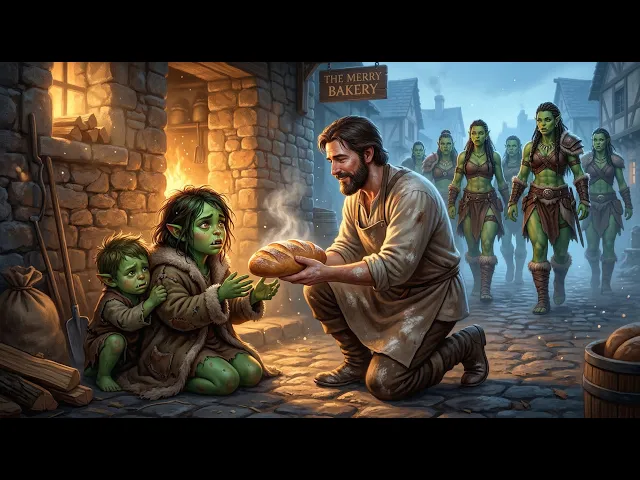
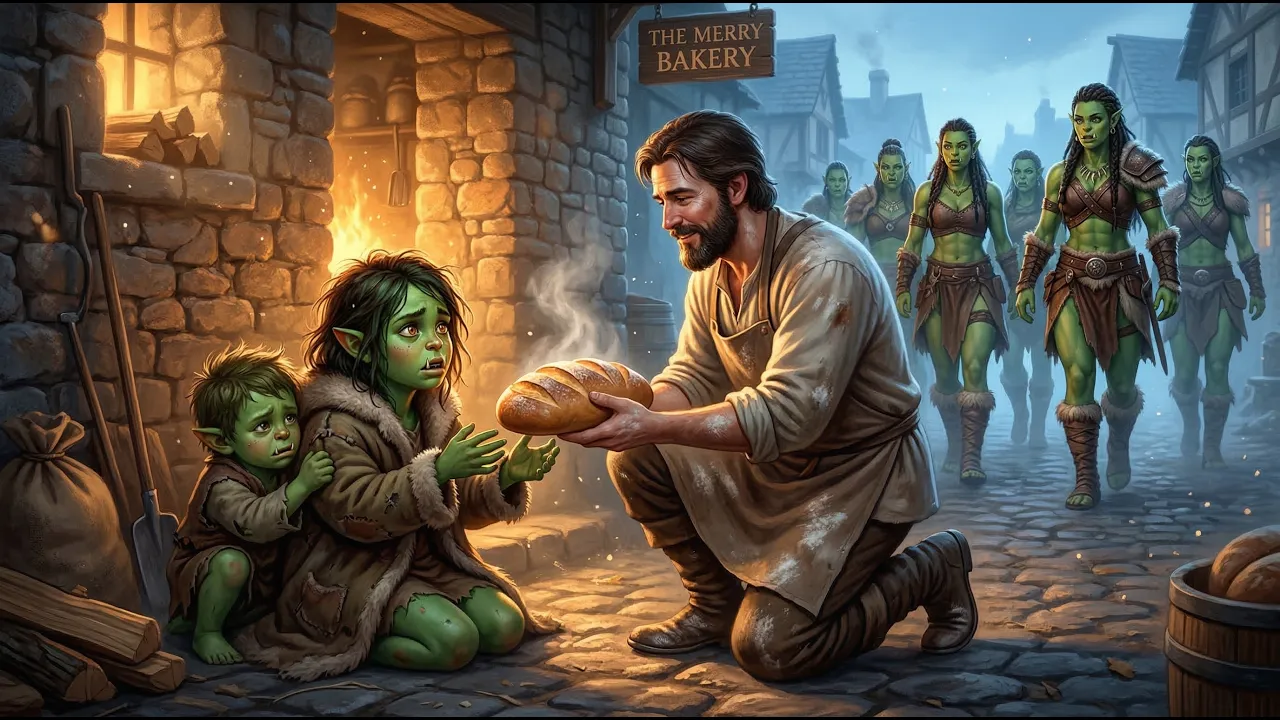
He gave bread to starving orc child. One week later, 15 orc mothers stood at his door. The first loves came out at 4:00 in the morning. This was not unusual. This was every morning. The dark outside the window absolute, the oven already warm from the banked coals. Dean had fed at midnight out of habit, and a body that no longer needed to be told when to work. He had been waking at midnight for 11 years. the first three years because Ma had asked him to, because she said the bread tasted different, when the oven was
brought up slowly, when the heat had time to become even and committed rather than sudden and aggressive. After that, he woke at midnight because his body had accepted it as a condition of being alive. Mar had been gone for 8 years. The bread still tasted better this way. He couldn't argue with that. He worked the dough the way she had shown him. Heel of The hand, not the fingers. Pressure forward and down a quarter turn. Repeat. She had stood behind him the first time and guided his hands, and he had been terrible at it, and
she had laughed, not unkindly, the laugh of a woman who found incompetence in the people she loved genuinely endearing rather than frustrating. He had never been as good at it as she was. He was by now compet the bread was good, not the same as hers, but good. Customers said so. the Few customers he still had said so. The bakery sat at the edge of town where the main road thinned into the track that wounded north toward the settlement ridge. This had been strategic when they'd chosen the location. Mar's idea always Mar's ideas because the
morning foot traffic from the settlement workers would pass his door before they passed anyone else's. For 5 years it had worked. The bakery had been loud and warm and full of people who left flour Handprints on the counter and argued about whether the seeded loaf or the plane was better and came back the next day to continue the argument. Then the settlement workers had been redirected. New contracts, new roads, the north track had gone quiet. He had considered moving the bakery closer to the town center. He had not moved it. The reasons he gave himself
were practical. the lease, the oven size, the established delivery rotes. The actual reason was That Ma had chosen this location, and the walls still had her handprints in them, faint now, in the places where she had leaned while thinking, and he was not ready to leave walls that still held the shape of her hands. This was not something he examined directly. It lived in him the way old injuries live, present, defining, not thought about unless pressed. He shaped the loaves at 4 and set them in the oven and went to the front of the bakery
and unlocked the Door. He always unlocked the door before the bread was ready. Ma had insisted on this. A locked door tells people they're not welcome, she had said. An open door tells them something's coming. He had kept that habit, too. The morning air was cold and damp, the particular cold of early autumn that had not yet decided to be winter, but was making its intentions clear. The street was empty. The north track stretched away into dark. He went back to the oven and Waited for the bread. He found the child on the third morning
of October. She wasn't at the door. She was at the back of the building on the east side, where the oven wall radiated heat through the stone, and the ground stayed dry even when it had rained. She was sitting with her back against the warm stone and her knees pulled up and her arms around her knees. And she was not sleeping. Her eyes were open. She was just sitting in the heat. The way a person sits in the Only warm place available when the alternative is cold. She was small, eight perhaps. Orc, clearly the gray
green skin, the beginning of something at the jaw that would become tusks in five or 6 years. She was wearing a coat that had been large for someone else and was enormous on her. Her feet were in shoes that had been repaired with wire. She saw him and went absolutely still, the stillness of an animal that has been found and is deciding whether to run. He Looked at her for a moment. He went back inside and cut a half loaf, the seeded one, the one Ma had always said was better than the plane, and she
had been right. And he came back out and set it on the ground beside the child, and went back inside without saying anything. He heard nothing from outside. After an hour, he went to check the east wall. The bread was gone. The child was gone. He went back to work. She came back the next morning. Same place, same wall, Same enormous coat. This time there was a smaller shape beside her, a boy 5 years old approximately, with the same gray green skin and the same watchful eyes and a quality of silence that was not frightened,
but deliberate. Like a child who had learned early that being noticed at costs, and had decided sensibly to limit his noticeability, Davin looked at them both. He went inside and cut two half loaves and brought them out and set them on the Ground. He went back inside. This time he watched from the side window. The girl, the older one, picked up both pieces. She gave the larger one to the small boy without looking at it, without measuring, without the hesitation of someone making a sacrifice. Just gave it. The way you give something to someone when
the giving is not a decision but a reflex. When it has been done so many times, it has become the only thing that makes sense. The boy ate With the focused intensity of someone for whom eating was not a pleasure but a project. He held the bread in both hands and worked through it from one end methodically, missing nothing. The girl ate more slowly. She watched the street while she ate. She was Daran realized keeping watch 8 years old and keeping watch while her brother ate because one of them should be ready to move if
moving became necessary. He went back to the oven. He cut extra the next morning Before he knew he was going to. By the end of the week, he knew their names, not because he had asked, because the boy Soti had at some point decided that the man who gave bread without conditions was someone whose name he needed in exchange for his own, and had offered his inner voice barely above a whisper, while accepting the morning peace, and then looked at Davin with the specific expression of a child waiting for reciprocity. "Daven," he had said. Soti
had nodded as if filing this information for later use and gone back to his bread. The girl's name he learned from the boy Pin. Soti said it the way you say the name of someone whose authority you acknowledge without question. Not differentially, just factually. That is Pin. Pin is in charge. Pin herself had not told him her name. She watched him from the wall with the eyes of someone conducting a longterm evaluation that was not yet Complete. She accepted the bread every morning. She had not yet decided what she thought about him. He found he
didn't mind this. He understood the value of a judgment not rushed. On the seventh morning, she spoke. He had just set the bread down and was turning to go back inside when her voice came flat and direct with the particular cadence of a child who has been spoken over enough times that she has learned to make her voice carry or not bother at all. You Burn the bottom of the second batch. He stopped. the bottom of the second batch. He turned and looked at her. She was not looking at him. She was looking at the
bread. I can smell it from here. You load the oven different the second time. The heat's uneven. He stood in the cold morning air for a moment. She was right. He had always loaded the second batch differently, a habit from the early years when the oven had run hotter than expected, and he'd compensated by Spacing the loaves further back, and he had never entirely corrected the habit, even after the oven had been adjusted. The bottom of the second batch was always slightly darker than it should be, not burnt, but close. He looked at the girl.
"You've been smelling my bread for a week." She looked at him for the first time directly. She had amber eyes, the kind of amber that was almost gold, and they held the expression of a child who has assessed something and found it Acceptable, but is not yet ready to say so. The good batch smells different, she said. More even. He looked at her for a moment. Then he went inside and adjusted the loading on the second batch. The bread that came out was the best second batch he'd made in 3 years. He cut an extra
piece and took it to the east wall. She ate it without comment, but her chin lifted the very smallest amount in the way a person's chin lifts when they have been proven right about Something and are being dignified about it. He did not think about what came next. This was he recognized later the thing about small acts of consistency. They did not ask to be planned. He gave bread to two children in the morning because they were there and the bread was there and the east wall was warm and they had wire repaired shoes and
enormous coat between them. That was the whole of the logic. It required nothing more. He did not ask where they came From. He understood the north track, the settlement ridge. He had heard about the land restriction two months ago from the mill supplier who came Tuesdays and talked while he loaded council development order the foraging grounds north of the ridge the settlement that had been living off that land for four generations told that the land was now allocated for quarry expansion. He had thought then that it was a hard thing. He thought so still. He
gave the bread Every morning and adjusted his second batch loading and went back to work and pin and soot so he ate against the warm wall and pin kept watch and so he ate methodically from an end to the other and the week passed the way weeks pass when nothing dramatic is happening but something is. They came on a Tuesday. He was at the front counter when he heard the gate. He looked up through the window. 15 women stood in the street outside his bakery. orc. All of them Different heights, different ages, one very old,
one perhaps 20, most somewhere in between. They stood in the particular formation of people who have arrived together, but are not exactly a group. Each one a separate entity, each one having made her own decision to come. The 15 decisions happening to coincide. They were not threatening. They were not performing. They were just standing there outside his open door. with the patience of people who have walked a Significant distance and are prepared to wait a reasonable amount of time before the walk becomes pointless. Darin set down the cloth he was using on the counter. He
went to the door. The woman at the front was the kind of woman whose age was genuinely unclear, not because she looked young, but because she carried herself with a quality that made age seem beside the point. She was broad, shouldered, her green skin darker than pin. Her hair pulled back with the Efficiency of someone who had decided long ago that anything which needed managing twice was not worth the time. She had the eyes of someone who had made a significant number of accurate assessments and was in the process of making another. She looked at
him the way Pin had looked at him, not hostile. Evaluating I am Oser, she said. These are women from the ridge settlement. He waited. A child from our settlement. She looked at him steadily, came home last Week and said a man on the south road gave her bread and asked for nothing. He said nothing. That is unusual also said. In our experience, I would guess so, he said. She looked at him for another moment. Then at the bakery behind him, the oven, the counter, the shelves, the open door. Her eyes moved over it the way
a person surveys a thing they are considering the structure of. We would like to understand the arrangement, she said. There isn't one, he said. Her chin Shifted. Not skepticism exactly, more the expression of someone encountering a category they don't have a box for yet. She came to the wall because it was warm, he said. I gave her bread. That's all. Why? He thought about this. Because it was morning and the bread was there and she was there. He looked at the 15 women. A woman behind Osa had a child on her hip, very small, perhaps
2 years old, roundfaced, watching Darin with the enormous, focused eyes of a toddler who Is cataloging everything. Because the bread is not doing any good sitting on a shelf, he said. Osa looked at him. Then she looked back at the 14 women behind her. Something passed between them. Not words, not signals, just the specific economy of people who have known each other long enough that full sentences are rarely necessary. She turned back to him. We have children, she said. Since the land order it has been, she chose the word carefully insufficient. I know About the
land order, he said. Our settlement does not accept charity, she said. The word came out cleanly without apology. This is not how we are built. He understood that. All right, but we can work. She said, some of us have skills that may be useful. If the bread is available, we would like to know what the cost is so we can decide if we can meet it. He looked at her, at the 14 women behind her, at the child on the hip who had now reached out one small Hand toward Davenin with the specific toddler logic
of I see a person, therefore I will attempt to grab them. There's no cost, he said. Os's jaw tightened. That is not an arrangement we can accept, he thought for a moment. Then he looked at his counter at the oven at the second batch loading that he had been doing wrong for 3 years. Can any of you bake? He asked silence. Then a woman near the back, mid30s perhaps, with flour already on her hands, which Meant she had been baking that morning before she came, raised her chin slightly. "My mother taught me," she said. He
looked at Osa. "The arrangement," he said, "is bread for work. If someone wants to help in the mornings, I have more bread to give. If no one comes, I give what I can. Either way, the children eat." Osa looked at him for a long moment. Then she stepped through his open door. The 14 women followed. The bakery had not held 15 People in 8 years. It was not a small bakery. Mah had insisted on space, had said that a kitchen which felt crowded made the people in it impatient, and impatient people baked badly. But 15
women filled it with a quality of presence that Devon had not felt since the years when it had been alive. They moved through it with the assessing eyes of people cataloging a new space, touching nothing they hadn't been invited to touch, which was everything. They looked without touching, which was a kind of discipline. Pin was there. She had come through the door with the others and stood near the oven, not near Devon, watching him with the amber eyes that were still evaluating. Soti was not with her. She had come alone, which meant she had known
this was coming and had decided the morning's errand was her responsibility. The woman with flour on her hands, her name was Fen, she said it quietly when Devon looked at her, came To the work counter, and looked at the dough that was resting under cloth. First, rise, she asked. Second, he said, "It's been an hour." She looked at the cloth at the shape of the dough beneath it. She pressed two fingers to the surface through the fabric gently. Testing. It needs another 20 minutes. She said the room's cooler than where I work. He had not
noticed that. He looked at the oven. The front corner of the bakery did run cooler than the back. He Compensated for it automatically. Had been doing it for years. Had never said it aloud. You're right. He said, she nodded. went to the counter with the ease of someone who was in a kitchen and understood kitchens and didn't need to be told where things went because things in kitchens generally went in the places that made sense. Osa had been watching this exchange. She came to the counter. What needs doing? She asked. He looked at her at
the bakery at the 15 women Finding their places in it the way a current finds a riverbed. Not forced, not directed, just seeking the natural path. The flower barrels, he said the delivery came yesterday. They need rotating oldest to the front. She went to the flower barrels without further exchange. By the time the second rise was done, and Fen had shaped the louavves with a technique that was different from Davverns, but produced a result that was, he assessed honestly, Slightly better in the year of the crust. The bakery had organized itself around him the way
bakeries organize around someone who knows what they're doing. Not his bakery anymore. Exactly. not theirs, something in between, a working thing. He had not felt a working thing in 8 years. He stood at the oven and felt the shape of the morning and thought of nothing in particular, and let the bread rise. Pin came to stand beside him. She was the right height to Lean against the oven counter with her chin just clearing the edge, which she did, watching the loaves through the small oven window with the focused attention she gave to everything. You changed
the second batch loading. She said he had It's better now. He had noticed. She was quiet for a moment. Behind them, the bakery moved. Osa directing the flower rotation with the efficiency of someone who found disorder personally offensive. Fen shaping the Morning's second batch with those flour dusted hands. Two other women washing the breakfast boards. The toddler installed in a corner with a piece of dough to occupy herself. doing so with the absolute focus children bring to tasks that are not important. Where is your brother? Davin asked with the others. The younger ones stay with
Meritt when we come down. Is Meritt good with them? She is very loud, Pin said. But she knows what to do. He almost Smiled. How long has the food been short? He asked. She considered whether to answer this. He could see her considering it. The slight angle of her head, the eyes going briefly inward. since the land order, she said. Two months before that, it was sometimes short. But not like this. Not like this, he said. No. He looked at the loaves. Then at the counter, at the recipe card in the frame above the flower
shelf, Mar's handwriting faded now. The card Itself warped from years of steam. He had never moved it. He could not have told anyone why. Except that it was hers and this was her bakery. And the card above the flower shelf was where she had always kept it. Because that was where you needed it when you were measuring. He had it memorized. Had not needed to look at it in 6 years. Still had not moved it. Pin had followed his eyes. She was looking at the card. What is that? She asked. A recipe? He said for
the Bread? Yes. Who's writing? His hands moved. He picked up the cloth from the counter and set it down again. It was the particular restlessness of hands that have been asked something and do not know where to put themselves. My wife's, he said. Pin looked at the card for another moment. Was she a baker? She asked. No, she just loved bread. So, you bake for her? He was quiet. The oven ticked. Fen was talking to one of the other women in a low voice. Something About the shaping technique. A question about fermentation time. Osa had
finished the flower rotation and was looking at the shelf arrangement with the expression of a woman who had identified another inefficiency and was deciding whether to mention it. I think so, Davan said. Yes, Pin was quiet for a moment. The toddler in the corner had eaten half her dough piece and was beginning to lose interest in the other half and was looking around for new Projects. My father loved bread, Prin said. She did not say it carefully. She said it the way she said most things, flat, direct, as if the words were the simple weight
they were and did not need to be made lighter. He got sick. Two years ago, Dvon looked at the counter. He was finishing slicing the morning's first batch, the motion automatic, the knife moving in even strokes, the bread falling away in clean pieces. He got to the end of the loaf. His hand stayed on The counter, not performing stillness, just still. The stillness of a man who has just heard his own grief in another person's voice and has recognized it with the specific shock of recognition that is not unpleasant exactly, but is not comfortable either.
The shock of not being alone in a room you thought was yours alone. He picked up the end piece, the heel of the loaf, the piece that was always slightly denser, slightly more itself than the rest, and he set it in Front of Pin. She picked it up. She did not say thank you. He did not need her to. He went back to the oven. Osa came to stand beside him at midm morning. The first rush was done. The settlement children had come in two waves. The first with their mothers, the second in a loose
group of older ones who had come down the north track alone with the independence of children who have decided they are old enough for things and have not yet been proven wrong. They Had eaten. The bakery had moved through it with a competence that surprised Devan, though perhaps it shouldn't have. 15 women who had spent 2 months managing insufficient food knew how to make food go far and move fast. Osa stood beside him and looked at the oven. "Your system is inefficient," she said. He looked at her. "Not the baking," she said. "The distribution. You
are cutting individual pieces at the counter. If the loaves were precut and arranged by size, the Line would move twice as fast." He thought about this. He had always cut at the counter. Mar had done it that way. She had liked it, had said it. Let her see who she was feeding. I know, he said. Osa looked at him. But I'll keep doing it this way. She accepted this without pushing. He had the sense that she filed it, that she was building in her systematic way, an understanding of which things about him were practical and
which were something else. The Settlement, he said, the land order. Is there an appeal? She was quiet for a moment. The kind of quiet that means yes, but the yes is complicated. We have appealed, she said, through the proper channels. The council clerk, she said, clerk with the flatness of someone who has learned to keep their actual opinion out of certain words, has scheduled a hearing. When 6 weeks, he looked at the flower shelf, the recipe card, the loaves on the cooling rack. 6 weeks is a Long time to be insufficient, he said. Yes, he
thought of Ma. She had been a person who, when she identified a problem, moved toward it rather than around it. She had not been patient with waiting when action was available. He had been more patient. She had sometimes called this wisdom and sometimes called it slowness depending on her mood. He thought she would have had something to say about 6 weeks. Come tomorrow morning, he said to Osa. She looked at Him. As many as can work. Tell the others. I'll increase the quantity and the cost, she asked. The work is the cost. The same as
today, she looked him for a long moment. The same evaluation, those steady eyes that did not look for what was missing, but what was actually there. All right, she said. The council complaint arrived on a Thursday. It was delivered by a young man who worked for the administrative office and had the slightly apologetic manner of someone Who did not agree with the message he was carrying, but had decided the messenger's culpability was limited. He handed Devon the envelope with a specific look that said, "I am neutral in this and went away quickly." Davan opened it
at the counter. Formal complaint. Unauthorized distribution of food goods to non-registered settlement residents. Breach of commercial licensing agreement. Section 14, paragraph 3. The bakery's license was Issued for retail sale to registered town residents. distribution without charge to non-registered individuals constituted unlicensed charitable operation which required a separate application a separate fee and the approval of a committee that met quarterly. The last committee meeting had been 3 weeks ago. The next was in 11 weeks. Councelor Fetch had signed it. Davin knew Fetch by reputation. a man who was not cruel in any obvious way, But who had
a very organized relationship with rules that made him in practice produce outcomes indistinguishable from cruelty. He set the letter on the counter. Osa was at the flower shelf. She had reorganized it on Tuesday, had done it quietly, efficiently, in a way that was genuinely better, and that Davin had not argued with. She had also identified that his delivery schedule was creating a gap on Fridays, and had suggested a solution That cost him nothing. and fix the gap. He had begun to understand that Osa experienced inefficiency as a personal affront and solved it with the focused
energy of a woman with a great deal of competence and historically insufficient scope for it. She had read the letter from across the room. He had not shown it to her, but she had seen his face. She came to the counter. He handed her the letter. She read it. Her face did not change. This was he was learning not A sign that she felt nothing. It was a sign that she had assessed the situation and was moving directly to what was useful. Section 14, she said. Retail sale to registered residents. Yes, she set the letter
down. If we pay, she said, then it is retail sale, not distribution, he looked at her. We have things, she said carefully. We cannot pay in coin. But we have things, skills, material. He thought about this. You've been working in my bakery for 3 days, he Said. That is a commercial exchange labor for goods. She looked at the letter. Is there a record? No, we need a record. She said it simply. From now we need a record. Labor and goods. Properly looked at her. He had not expected this from her, this particular quickness. The way
she had gone from the letter to the solution without passing through the space between them where most people spent their time. "You've dealt with this before," he said. She looked at Him. Something moved in her face, not quite a smile. the geological predecessor to a smile. "The settlement has been dealing with councils for 300 years," she said. "We have learned to give them what they need to feel satisfied. It costs us less than it costs them to fight." He almost laughed. He hadn't almost laughed in a long time. "All right," he said. "I'll write it
up," she nodded. "I'll also need your rates," he said. She told him. He wrote It down. She looked at what he wrote and corrected one number upward without comment. "Fair," he said. It is the actual rate, she said. What labor is worth, not what we are offered. He had not argued with the first number. He did not argue with the correction. Counselor Fetch came on a Saturday. He was a narrow man with a narrow face and a coat that was slightly too formal for the time of day and the address. He arrived at 10, which
was the middle of the Morning rush, which was Daran suspected deliberate. He stood in the doorway of a bakery that held 11 women, six children, and a toddler who was aggressively offering him a piece of dough with both hands, and he looked at it the way a man looks at something that was supposed to be simple and has turned out not to be. David came to the door. Counselor Fetch looked at the bakery, at the children eating, at Oser at the flower shelf, who looked back at him with the equinimity Of someone who has learned
to look at authority without effect. I received your response to the complaint. Fetch said the labor agreement. Yes. He looked at the letter in his hand. Davin's response filed the previous day. Labor exchange commercial transaction recorded and signed. This is Fetch said carefully. A somewhat creative interpretation of the licensing terms. It is a straightforward one, David said. Retail sale to registered residents is One line of the business. Labor exchange is another. Both are legal. Fetch looked at the bakery again, at the children at Pin, who was watching him from beside the oven with the amber
eyes that evaluated everything and the stillness of a child who has decided that the man at the door is a problem that is not hers to solve, but is worth watching. The original complaint, Fetch said, was filed by a concerned resident. He did not say which one. Daven did not ask. The concern was that the bakery was, he chose the word with precision, becoming a gathering point for non-resident populations. Davan looked at him. It is a bakery, he said. Fetcher's jaw moved slightly. It is a bakery licensed for a specific commercial purpose. The purpose is
bread, Davin said. People come for bread. They work and I give them bread. That is the purpose. The licensing has been complied with, Davin said. I filed the response yesterday. You have it from Behind him. Osa's voice. She did not move from the flower shelf. She had the voice of a woman who understood exactly how loud she needed to be. Counselor Fetch, she said. Fetch looked at her. The settlement appeal is scheduled in 6 weeks, she said. We will be presenting documentation of the foraging lands use value and history at that time. Her hands were
on the flower shelf, steady, unhurried. We will also be presenting documentation of the commercial Relationships our settlement has established with registered businesses in the interim period. As evidence of economic participation, Fetch looked at her. As evidence, she repeated that we are here and we work and we do not take what is not offered. The toddler had given up on Fetch and was now attempting to give the dough piece to the doorframe, which was equally unreceptive. Fetch looked at the letter in his hand. He looked at the bakery. He Looked at Davin. "This will not be
the end of the process," he said. "I would not expect it to be," Davin said. Fetch left. The door was still open. It was always open. Pin came to stand beside Dvon at the door and watched Fetch walk up the street, his formal coat collecting the morning dust. Is he coming back? She asked. "Probably," Darin said. She looked at Fetch's retreating figure. "He walks like something's chasing him," she said. Darin looked. She was right. There was a quality to Fetch's gate, the forward lean, the quick step, the way he moved as if stillness were dangerous.
Pin went back to the oven. Daven went back to the counter. 3 weeks into the arrangement, the bakery had changed in ways he hadn't directed. This was how it happened with Mara. She had not rearranged things dramatically, had not announced new systems. She had simply over days and weeks put things in the places they Belonged. and he had come in one morning and found a kitchen that worked better than it had before. And when he looked for what had changed, he couldn't point to any single thing. Everything was slightly better. Everything was slightly more itself.
Fen had the morning dough. She came in at 4:30 with the flour still on her hands from whatever she had baked at the settlement before coming down, and she took the first rise without discussion. Her bread was better than His. He knew this and had known it since the second day. He had told her so on the fourth day and she had looked at the louavves for a moment and said it is a different technique and he had said it is a better one and she had not argued. Oser ran the distribution. This was not
a role that had been assigned. It had been as Davan was learning the nature of Oser. She arrived at a system. She identified the most efficient path through it and she occupied that path. Children came in the morning. They went to Osa. Osa had somehow without drama established a knowledge of every child who came, their names, their ages, their preferences, their allergies if any. The fact that Soti could not eat the seeded loaf because something in seeds gave him stomach pain, and he had never said so, but had always given the seeded piece to Pin,
who had started requesting the plane for him. She had figured this out in 5 days. Devon had not figured it out In 3 weeks. He said so. He pays attention to his feet when he's eating something that bothers him. Osa said she said this matter of factly the way she said most things. He looks down. Children look down when they want to hide something they can't hide. He thought about that. He thought about Pin who had looked at the recipe card on the shelf with the amber eyes that evaluated everything. He thought about 8 years
of baking for a woman who wasn't there to Eat it. He was at the counter in the late morning. The rush done. The children dispersed back up the north track to the settlement. He was cutting the remaining bread into pieces for the end of day basket. The bread that didn't sell he left at the door in a basket in the evenings, had done this since Mar's time, and it was always gone by morning. He had never seen who took it. He had not tried to find out. Osa came to stand near the counter. She was
looking at the Recipe card. "Yours?" she asked. His hands were in the motion of cutting. He did not stop. My wife's he said she was here. She was for a time. How long have you been here alone? 8 years. Osa was quiet. She looked at the recipe card and she looked at the bakery, the oven, the counter, the flower shelf, the order that was two people's order now instead of one. It is a good bakery, she said. He cut the bread she would have. She paused, which she almost never did. She Did not choose words
carelessly. When she paused, it was because she was choosing correctly. she would have found this a right use of a thing. He set the knife down. He looked at the recipe card. At Mara's handwriting, faded, but still there, still in the place she had kept it. He thought about the bakery. He thought about what Ma would have said standing in this kitchen with 15 women moving through it and 30 children eating and the second batch loading finally Corrected and Fen's better bread on the cooling rack. He thought she would have had something to say about
it. Something quick and clear. She had always had something quick and clear. Yes, he said she would have. He picked up the knife and went back to cutting. Osa went back to the flower shelf. Sot spoke on a Wednesday, not to Daven directly to the space near Devan, which was Sot's method of communication. He directed his words at the middle distance and allowed them To land where they would, which gave him the technical option of claiming he had not been speaking to anyone in particular if the response was unfavorable. He came in that morning before
Pin, which was unusual. He stood near the oven, his usual wall, and looked at the loaves cooling on the rack with an expression of concentrated thought. Davin was at the counter. There is a kind, Soty said to the middle distance. Devon waited with the seeds on The outside. Soti continued. The kind Pin likes. He paused. She doesn't have the outside kind until she's given me the inside kind first. Davin looked at the cooling rack. The seeded loaves, the seeds on top, the interior plane. So, she's been eating the part she doesn't prefer. He said, "Soti
did not confirm or deny this. He was still addressing the middle distance. She said both kinds taste the same." Soti said. He said it without inflection, which meant it was Significant. Devon had learned in three weeks to listen for the things Soti said without inflection because those were the things that had taken him the longest to decide to say. Does she think you don't know? Darin asked. Soti was quiet. Yes, he said. Dan looked at the seeded loaves. He looked at the plain ones. He cut a piece from the plain loaf, the interior bread, the
dense soft part, and he cut a piece from the seeded loaf, just the top crust separated from The base. He set both pieces aside on the small board. he used for end of day pieces. Soti watched this. He said nothing. He went to the wall. When Pin came in, Davin set the board in front of her without comment. The crust for her, the soft plain piece, the part without seeds wrapped in cloth for Soti. She looked at the board. She looked at her brother. Soti was examining the oven with the focused attention of a child
who is looking at something that is not The thing he is actually thinking about. She looked at Daven. He was already at the flower shelf. She ate the crust. She ate it slowly. The way you eat something that tastes better than you expected or that you have been wanting for longer than you knew. She did not say thank you. She said something else quieter. Not quite at him in the manner Si had. The good batch smells better today too. She said he had adjusted the oven loading again that morning. A further Refinement. He had not
mentioned it to anyone. I noticed. He said the appeal hearing came in 6 weeks as scheduled. Devan went. This was not something he had been asked to do. He simply arrived at the council hall at the appointed time and sat in the back row with the heir of a man attending something he belongs at whether or not anyone expected him. Oser presented the settlement's case. He had not known what to expect. He had thought of Ma quick And clear and thought that Osa was not quick in the same way but was clear in a way
that went deeper. the way a well is deep rather than a river. She stood at the front of the council chamber and she laid out 300 years of foraging practice in 7 minutes. Not dramatically, not with appeal, with the flat specific weight of fact, map, dates, usage records, the names of families, and what they had taken from the land, and what they had put back, and for how long. She made the Council understand without raising her voice that they were not looking at an inconvenience to be managed, but at four generations of practice being severed
without consultation or compensation. Then she laid out the commercial record, every transaction from the bakery documented labor rates, goods received, signed. The council looked at the records. One of the younger counselors, not fetch, a woman with the look of someone who had been doing this job long Enough to have opinions about it, leaned forward. These records show a functioning commercial relationship, she said. Yes, Osa said with registered businesses. Yes, for 6 weeks. For 6 weeks, Osa confirmed. We work. We are present in this economy. We are not asking to be given anything. We are asking
to have what was ours returned or fairly compensated so that we may continue to work and be present. The chamber was quiet. Fetch had his papers Flat on the table before him. He was looking at them with the expression of a man who has arrived at a destination that was not on his intended route. Dan sat in the back row and looked at the woman he had found standing outside his bakery six weeks ago, who had come to understand the arrangement, and had proceeded to understand it into something he had not anticipated, but recognized the
way you recognize something that was supposed to happen. The hearing took 2 hours. The ruling came the following week. Partial restoration of foraging rights pending a 12month review of the quarry expansion's actual footprint with the three easternmost quadrants of the original land restored immediately. Not everything, but more than nothing. More than most people had expected. Osa had expected it. Davin knew this not because she said so, but because she received the news the way she received most Things without drama with a quick internal accounting, moving directly to what came next. She came to the bakery
the morning after. He was at the oven. She stood at the counter. The arrangement, she said, he waited. We will keep it, she said. What we have been doing, the labor, the records, not because we must. She looked at him directly, those steady evaluating eyes. because it is working. Because Fen's bread is better here than it would be With less to work with. And because she paused again, that careful choice of words. Pin comes down the north track in the morning now without checking behind her. She did not do that before. He thought of the
girl against the east wall, the enormous coat, the watching while Soty ate. All right, he said. Osa nodded. She went to the flower shelf. The shelf in the back of the bakery had been Mar's shelf. It held small things, a jar of dried herbs she had used in the Savory loaves, a worn measuring stone, two clay cups she had bought from a market in the second year of the bakery, because she said they held heat better than tin. Davan had not moved any of it. He had not used any of it. He had dusted the
shelf every week with the care you give to things that are not yours to change. Pin found it on a Thursday. She had been exploring the back of the bakery the way she explored most things quietly. systematically touching Nothing, cataloging everything. She stopped at the shelf. She looked at the jars, the measuring stone. The cups. Whose are these? She asked. My wife's, he said. He was at the counter. He could see her from there. She looked at the cups. The particular attention she gave to things she was building an understanding of. Did she bake in
here? Pin asked. Everyday, he said. Pin picked up one of the cups. She held it carefully, turning it over in her hands. The way she had held everything she'd been given with the attention of someone to whom things being given was not ordinary. She set it back on the shelf exactly where it had been. "You keep it the same," she said. He looked at the shelf. "Yes, does it help?" He thought about how to answer this. He had not been asked this before. He had not asked it of himself exactly, not in words, not directly.
He had known that moving the shelf would mean something he was not Ready for it to mean, and he had not moved it. And that was as far as the thinking had gone. Some days, he said. Pin looked at the shelf for another moment. When my father was sick, she said, I used to save him the piece I liked best because he liked what I liked. She was quiet. When he died, I kept saving the best piece. For a while, he said nothing. Saving it for someone who isn't there, he said. After a moment, it
doesn't feel wrong. No, she Said it feels like they're still here. And then one day it starts feeling like they're still gone. She came back to the oven side of the bakery. Davin looked at the shelf. He looked at the recipe card above the flower shelf. Mar's handwriting. He had baked for her for 8 years. Had kept the card in her place and the herbs on her shelf and the cups where she had put them. And every morning the bread had been for her, and she had not been there to eat it, and The bread
had been eaten anyway, had gone to the end of day basket, and disappeared by morning into hands he had not seen. He looked at the children eating at the counter. Soti eating methodically from one end. Pin watching the street. He thought of Mara. Her laugh. The way she had stood behind him and guided his hands on the dough and he had been terrible and she had been laughing. The way she had said a locked door tells people they're not welcome. He looked at the open door. He took the recipe card off the shelf. He carried
it to the back shelf, Mars shelf, and he set it between the herb jar and the measuring stone. in a place where he could still read it if he needed to, and where it was with her other things. He stood at the shelf for a moment, then he went back to the oven. He did not feel that she was less present. He felt instead that she was more exactly where she had always been, in the recipe, in The bread, in the way the second batch loaded, in the open door policy that had let in 15
women and 30 children, and a toddler who was still periodically offering pieces of dough to inanimate objects. Still here, he thought, just here differently. He shaped the afternoon loaves with the heel of his hand, not the fingers, pressure forward and down, a quarter turn repeat, the way she had taught him. The fort was Sot's idea. This was surprising to everyone, Including Soti. He had proposed it to Pin in the particular Soty way, addressing the middle distance with an idea and allowing it to be attributed to whoever wanted it. And Pin had looked at the back
corner of the bakery's small yard and said the ground was level there and then looked at Davin. He had looked at the back corner of his small yard. He had said there was lumber in the shed. He had not built it himself. He had shown Soti where the lumber was and Shown him the tools and Soti with the focus competence of a child who had been watching adults work for long enough to have absorbed methodology had begun. Pin had assisted with the precision of someone who found imprecision physically uncomfortable. Fen's eldest son, 11, quiet with
hands that were already learning to be careful, had come down the north track one morning and joined without being invited, which was the best way to join something. The fort Grew over two weeks. It was crooked in several places. The roof had a gap in one corner that let in light and would eventually let in rain. And Soti had been informed of this and had looked at the gap and looked at the roof and looked at the gap again and said he needed to think about it. He was still thinking about it. Davin did not
fix the gap. He waited to see what Soti would decide. This was he had been learning the correct approach with Soti. The boy Arrived at things on his own schedule and the schedule was not to be rushed. He had Pin's amber eyes and none of Pin's directness. Instead, he had a quality of internal processing that was total. He did not halfink things. He thought them completely and then delivered the result which was always worth waiting for. Davin was sweeping the yard on a Friday when Soti came to stand beside him. He did not look at
Davin. He looked at the fort. The gap, He said to the middle distance. Dan waited. If the gap faces east, Soti said, then the morning light comes in. You can see inside in the morning. He paused. If the gap faces another direction, it just rain in. He walked to the fort. He looked at the gap. He walked around the fort looking at the angle. He looked at the sun. He looked at Davin. It already faces east, he said. The gap does it? Davin asked. Soti looked at the fort. At the gap. At the Morning light
coming through it, which did in fact fall in a clean line across the interior floor. A rectangle of early light, warm, specific. He looked at it for a long time. He didn't say anything. He went back to the bakery. David stood in the yard and looked at the gap and the light coming through it and thought of a man who had placed a window at a specific angle for a child who would need it and of what it meant when the things you did for someone continued to Work after you were not there to see
them. He swept the rest of the yard. Oser came to find him in the back of the bakery on the last day of November. The morning rush was done. The bakery had settled into its midday quiet, Fen cleaning the counter. Two of the other women in the yard with the younger children who had been brought down for the morning, the familiar overlapping sounds of a place that was working. Osa stood near the flower shelf with her Hands at her sides, which meant she had something to say that was not about the flower shelf. He waited.
There is something, she said. He waited. The eastern quadrants, she said. What was restored? We have begun foraging again. The first two weeks have been she chose the word as she always did precisely sufficient. That is good news, he said. Yes, she looked at him. The arrangement here. What we have been doing, he waited. She was quiet for a moment, Which was unusual. Osa moved efficiently through most thoughts. We are discussing, she said, whether the settlement could support a bakery of its own in time. With what we have learned here, he looked at her. Not
instead of this, she said quickly. not in competition. The settlement is 3 mi from the nearest bread. The children, she stopped, she resumed. It would be useful to have someone who knew the work. He thought about Fen, about the shaping Technique, about the loaves that came out better than his. Fen, he said. Osa looked at him. She has learned everything worth learning here, he said. And she was already a baker when she arrived. He looked at the counter, the oven, the recipe card on the back shelf where he had moved it. The bread doesn't need
to come from here to be good bread. Osa was quiet. You would help her, she said. If she wants help, Osa looked at him. Something moved in her face. The Predecessor to a smile, that geological shift, the rock before the opening. It was he was learning how Osa smiled. It never went further than that. It did not need to. She would want help, Osa said. Then it is already decided, he said. She nodded. She went back to the flower shelf. She was reorganizing it again. the second reorganization, which he suspected would also be better than
the first, which had also been better than his original system. He watched her Work. He thought about the bakery, the east wall, where two children had sat for a week in an enormous coat and wire, repaired shoes, the front counter where 15 women had stood on a Tuesday morning to understand what kind of man he was, the flower shelf with its recipe card, now at home, where it should be, the open door that was always open. He thought about Ma, who had chosen this location because the North Track workers would pass it every morning. The
North Track had gone quiet for 8 years. It was not quiet anymore. He picked up the cloth and went to the counter. Pin came down the North track on a Wednesday in December with Sot behind her and the enormous coat replaced finally by a smaller one that fit her, still worn, still too large in the sleeves, but hers rather than borrowed. She came inside without stopping at the east wall. She had not stopped at the east wall since the fourth week. The east wall was for People who did not know yet whether they were welcome.
She was at this point past the east wall. She came to the counter. She looked at the recipe cards absence from the flower shelf. She had been noting things like this, small changes, the kind that accumulated into something since she had begun coming inside. She looked at Daven. You moved it. She said he was at the oven. Yes. She looked at the flower shelf and looked toward the back of the bakery where she knew the Back shelf was with her other things. She said yes. She was quiet for a moment. Does it feel different? She
asked. He thought about how to answer. He shaped the loaf in his hands. Heel of the hand. Pressure forward and down. A quarter turn repeat. The motion that was 8 years old. The motion that was Mars. Yes, he said. Smaller. Less. He paused. Less like a loss, he said, more like something that's actually there. Pin looked at him with the amber eyes. She Said my father had a knife he used for everything. When he died, my mother put it in the box with his other things. I was angry. I wanted her to keep using it.
She was quiet. She was right though. Pin said the knife was still there. It was just with him. Davin looked at the flower shelf at the space where the card had been at the bread on the cooling rack. Yes, he said. That is exactly it. Soti came to the counter and looked at the loaves. He looked at the seeded ones And looked at the plain ones with the assessing eyes of a child who had been empirically establishing his own preferences for several months and was refining his conclusions. The plane, he said to the middle distance,
"The plane Devon confirmed. He cut it from the interior, the soft dense part, no seeds, and set it in front of the boy. Sauti ate it from one end methodically missing nothing. Pin sat on the stool beside the counter that had appeared 3 weeks ago. Oser had produced it one morning without explanation and placed it in the exact spot where Pin always stood, which was the kind of Osa solution that required no discussion because it was simply obviously correct. She sat on the stool and ate the seeded crust, the outside, the part she liked, and
watched the street with the amber eyes, not keeping watch the way she had in the beginning. Something different now. The watching of a person in a place they are from, not a Place they are surviving. Daven went back to the oven. The door was open. The morning light came in at its angle. The bread rose. There was a basket at the door every evening. This had not changed. Daven set it out at the end of each day. The pieces that remained, the end cuts, the loaves that had gone slightly past their best. He had done
this every day for 11 years. He still did not watch to see who took it. But on a morning in mid December, he came out Before the light and found beside the empty basket a small object placed carefully on the stone step. A piece of worked leather, small, shaped into a flat circle and toled around the edge with a simple repeating pattern. The kind of pattern that took time that was not purely decorative. That was a thing made by someone who made things carefully. He picked it up. He turned it over in his hands. He
thought of Soti looking at the fort's gap and figuring Out the angle of the light. He thought of small, careful hands. He went inside and put the water on. He set the leather piece on the flower shelf, on the now empty space where the recipe card had been, and he looked at it for a moment. Then he went to the back shelf. He looked at the recipe card between the herb jar and the measuring stone at Mar's handwriting. Still here, he thought. He picked up the card and carried it back to the flower shelf and
Set it down beside the leather piece. Both of them, her recipe and the small worked circle from a child's hands. Both of them in the place where he needed them when he was measuring. He stood at the shelf. He was not sure what it meant exactly. He was not sure he needed it to mean one thing. Some things held more than one meaning and were better for it. He went to the oven. He loaded the first batch, the loading he had corrected in October, evenly spaced, consistent Distance from the back wall. He lit the oven
to the right temperature, not too high, not too fast. He waited for the bread. Outside the north track was quiet in the dark. In an hour it would not be. In an hour Fen would come down with flour on her hands from her morning work, and the first wave of children would follow. The loud ones running and the quiet ones walking and the very small ones being carried. Pin would come with the new coat that fit her. Soti Would come and stand near the oven and address the middle distance with his assessments of the day.
Osa would go to the flower shelf. The door was open. The air was cold and clean and smelled of coming winter and warm bread. And the first faint lightning was beginning at the east edge of the sky. That particular gray becoming gold that was not dawn yet, but was the thing before dawn. The thing that came before the light, the thing without which the light Would not know where to go. He shaped the morning's first loaves in his hands. The bakery was still. The door was open. He waited for the day to come through it.
Some things begin small, a wall that holds heat, a coat too large for the body inside it. An open door in the dark at 4 in the morning, not because anyone is expected, but because that is what an open door does. It tells people that something is coming. Bread is not a complicated thing. Flour, water, time, The heat applied with patience, and at the right temperature. Nothing more but what it does, who it feeds, who sits down to eat it, what they say when they have eaten it, and stood up again and walked back out
into the cold. That part has never been simple. He had baked for one woman for 8 years. He baked for 30 children now and for their mothers and for two people at a time in the late afternoon when the light came in at the east windows angle and for whoever came To the basket at the door in the evening whose name he still did not know and did not need to. He still baked for Ma. He baked for everyone. The door was always open. That was all he had done. It was enough.