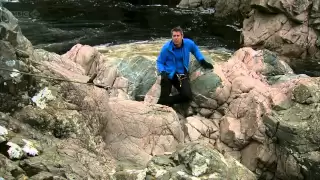
[Music] W I'm here that's said a there was a top just there a this is fantastic what a view I'm back I'm I was last here 25 years ago 25 years I i' someon around here I left my hammer oh look at this here we [Music] are oh would you look at this look at this view this is what I remember this is our ancient Heritage laid out before our very [Music] eyes Scotland's landscape has an epic and violent [Music] past hidden in these mountains and glands is the history of the planet I'm going to
show you how this landscape was used by a bunch of brilliant Maverick eccentric scientists to solve the greatest Mysteries of the [Music] earth and following in the footsteps of these Pioneers who blazed a trail where no one had been before they showed vision and determination to piece together baffling evidence and uncover the forces that shape our world wow that is so hot it's all out there if you know what to look for written into the Scottish landscape is a story of the entire planet [Music] [Music] Toran in the Northwest Highlands of Scotland the most ancient
landscape in Britain wow this is so remote it feels like the hands in the Earth for centuries people have looked at this landscape and wondered how long it's been here and how it was formed it wasn't until the 1750s that the answer began to emerge from myth and Superstition towards a new view of the earth based on science one man had a revolutionary new idea that changed everything changed the way we thought of about the planet even about the way we thought about [Music] [Music] ourselves the man who started the Scientific Revolution grew up in
Scotland's capital [Music] Edinburgh James hotton was to become the founding father of geology as a Young Man the hills around his home City made him curious about how the earth was formed Hutton used to often come up here and he would have made a fantastic traveling companion I mean he was he was funny he was bodyy he was a bit rude he liked his whiskey he liked his woman and he loved Deb dating new ideas in 1747 Hutton was a young medical graduate with an unusually broad interest in the whole natural [Music] world when he
studied the origins of the landscape he found that they accepted Authority wasn't science but theology when Hutton was starting to think about the Earth there really only was one geology textbook and that was this the Bible what I love about this Edition from Hutton's time is it gives a date for when God created the earth and the Seas before Christ 404 not just in 404 BC but actually on Saturday the 22nd of October 404 BC Hutton believed in God but unusually for a man of his time he wasn't committed to a literal interpretation of the
Bible he believed that God had created a world that had a system of natural [Music] laws but he didn't particularly dwell on these ideas instead he did what many students do he got drunk he was also getting seriously distracted by the ladies and it was that that would prove his downfall it was Hutton's relationship with one particular woman that seems to have led to heartache to his banishment from his beloved edra Hutton had got his young lover Miss Edington pregnant this was a scandal she was rushed away to London to give birth to limit the
damage to his family's reputation Hutton left [Music] Edinburgh at the age of 20 6 he was forced to make a new life on a small disused family farm in southern Scotland Hutton wrote that it was a cursed country where everything conspires to break my [Music] heart but it was this remote farm that would trigger His Brilliant insights about the planet well this is Sly House's Farm but what a landscape I mean it's Bleak and wind swept and pretty soggy today it's certainly not looking a place you feel as if you would devise a major new
theory about the Earth as a system but that is exactly what Hutton [Music] did first he to turn this rain drenched landscape into a profitable working [Music] farm one of the Dirty Jobs he constantly faced was to dig and clear drainage ditches Denise daily Walton farms nearby and knows what he was up against well the purpose of this Stitch was to carried the water off the field yeah but AB what's happened is over time all the sediment all the top Stone has run off the field and it just it's actually blocked us up yeah this
is gold dust in terms of cultivated land but it's still wasted in these [Music] ditches every year Hutton cleared these drainage ditches and every year the rain washed the precious top soil off his fields into the ditches and carried it Downstream this burn draining through Hutton's land was the start of a long journey for all that soil washed away from his Fields the water flows down into larger and larger streams and in rivers and of course where the water flows the sand s and mud follows eventually been dumped in the sea this incessant erosion of
the land seriously concerned H CU he realized that all the soil was washed away then eventually there'd be nothing to grow crops in and ultimately people would starve Hutton looked at this erosion and realized it must happen not just in Scotland but across the whole planet it appeared that God had made a world that stripped Farms of good soil eventually if this continued there would be an utterly Barren landscape but to be honest Hutton just didn't buy that in his heart it made no sense that God would let his people starve and in his head
it made no sense that the Earth would irreversibly wear away to nothing he was convinced that there had to be a way to make new land Hutton still only 34 and working in isolation had come to completely reject a conventional view of the [Music] Earth he just couldn't accept that the world had been created by God at a single stroke and remained [Music] unchanged his radical thought was that God must have designed a planet that could rebuild [Music] itself the question was how could new land be formed Hutton spotted something in the landscape around his
farm that gave him his first clue huton would have seen cff like this all over the place if you look at this rock fish you see there's distinct layers of rock all of them subtly different hundreds of them what Hutton realized was that these BNS of sedent were laid down at different times in from rivers and deposited one on top of the other just builds up over time year after year slowly compacted into a rock Hutton's greatest idea and I guess it seems so obvious now is that the creation of land and the destruction of
land are not sudden and dramatic events that we've done in biblical past but slow and imp acceptable actions that are going on all the time they're going on right [Music] now the idea that land was created from the rubble of the past was a startling new way to see the landscape and this sedimentary rock formed from layers of mud and sand laid down in rivers and seas is found everywhere from the White Cliffs of England's South Coast to America's Grand Canyon Hutton had made his first breakthrough he was now sure there was a great system
driving the Earth after 15 years on the farm Hutton was about to start a new chapter in his life one that would test his ideas and push him to even greater [Music] discoveries at the age of 41 his years of Exile were over he returned to the city of his youth it was the time of the Scottish Enlightenment Edinburgh was the intellectual capital of the world Hutton made the most of being back all over town he debates and drinks with the greatest minds of his era you know you can see why these gatherings were ideal
for Hutton his personality a mix of deep thinker and deep Drinker this open convivial atmosphere was perfect from to's big idea mind you even all this bonam me wasn't enough to paper over the cracks in Hutton's [Music] Theory Hutton knew that not all the Rocks he could see had been laid down in layers of [Music] sediment if the Earth system continually recycled all land what other ways could rocks be formed Hutton still had a large piece of the jigsaw missing he got his inspiration from another great mind of the Scottish Enlightenment his friend and arguably
more famous James James [Music] Watt fellow Scotsman James wart was in aom inventor famous for making steam engines more efficient was James what's harnessing of heat that would power the Industrial [Music] Revolution hon had a thing about machines and he was fascinated by what's steam pared Contraptions Hutton saw that heat gives steam engines enormous power he began to wonder if heat powered the planet maybe heat within the Earth was a force that could change and renew the landscape perhaps the center of the earth contained a mighty heat engine scientists in the 1700s had SE active
volcanoes but they thought they were only small isolated fires Hutton was a the first person to imagine that the center of the Earth was a molten ball he saw volcanoes as the vents of a giant furnace deep in the earth he believed that this furnace had the power to create new land land that was born m if he could prove that much of the landscape had started out molten then he would have discovered another way in which the Earth could continually renew [Music] itself the trouble was that if a lot of the Rocks started off
molten why were they all so different if they had the same origin then surely they would look the same if you were trying to Define genius then I guess it would be about making remarkable connections that no one had ever considered before but time and time again he got his ideas from Farm ditches from local Cliff from steam engines and perhaps his cleverest piece of lateral thinking which when he hears about an accident at a glass bottle Factory let's try this time put another one on yeah next one glass artist sioban Healey is going to
help me recreate the incident that caught Hutton's attention something immensely satisfying with this at a glass factory in Edinburgh the workers accidentally left a batch of Molen glass in the kol too long okay we've got two piles of broken glass we'll treat one normally and use the other to recreate the accident so this is ready we'll just close it over that says up to our top temperature it will go completely molten at that temperature and it goes like liquid so this one goes in the other one yeah the slow one yeah this one's going to
um be substantially longer this program because everything will be exactly the same apart from the rate of cooling the reason Hutton was so interested in the results is because he knew that molten glass would behave in the same way as molten rock wow God that is so hot so that is what 900° feels like that's fantastic yeah oh that's so you just want to touch it I know it's the last thing my fingers would do but W skoru [Music] skoru we've cooled the two samples at different rates the results are dramatic this one here is
what this is the vitrified piece of glass so this is the one that coed really fast quenched really fast you can see right it's beautifully transparent I mean look at that but this completely defin this is a molten rock then it's solidified really slowly so you can actually see the crystals in here look at them little angular crystals and the texture is completely completely [Music] different crystals are formed inside the glass or Rock when atoms stick together it takes a long time for clusters of atoms to grow big enough to be seen when glass cools
quick ly the crystals are very small and the glass is clear but when the workers left the glass to cool down over a long period large crystals were created Hutton had an explanation for the many different rock types we see on the Earth's [Music] surface very slow cooling creates large crystals faster cooling creates smaller crystals like in this granite and rapid cooling creates tiny crystals like in volcanic bassal all we've done is Alter how fast the molten glass cooled and we've created two completely different materials from it hot and grasp that a whole variety of
rocks could have started off as mold and and as they solidified under different conditions their appearance and look would change this meant that heat could have formed far more of the Earth's surface than previously thought and it convinced Hutton that there really was a vast internal heat engine at work huton had come up with two fundamental ways that land could be created sedimentary rock could form when weather rain Frost and wind eroded the soil [Music] Rivers carried the sediment to the oceans it was compressed to form new [Music] rock and a second idea that a
hot core in the center of the earth could create molten rock which cooled to become [Music] land he had a Clear Vision of an earth that destroyed and repaired itself in an endless [Music] cycle Hutton's idea is so so beautiful and amazingly for something that was conceived 250 years or so ago it's nearly all right it's a big coherent impressive idea and this concept of the Earth as a system continually self-renewing well it feels so modern but the big question was back then was the world ready for it Hutton had to be persuaded by friends
to go public with his ideas he was worried about how they would be received but in 1785 he presented his theory of the Earth as a system at the Royal Society of Edinburgh imagine the scene in front of some of the greatest scientists of the age The Outsider huton prepares to present his radical theory of the earth he's a terrible speaker though he he talks in a broad Scots accent and he's incredibly nervous what's more he's got this this nagging feeling that he doesn't yet have enough evidence from the field to back up his theory
and he knows that what he's going to say is really controversial his ideas go against all the religious Orthodoxy of the day in the event his worst fears are realized the presentation bombs the gentleman of the Royal Society rejected Hutton's Theory out of hand worse for the God-fearing Hutton he was accused of being an [Music] atheist one of the biggest upsets was about this stuff Granite it's hard to believe that this could cause even mild disagreement but it produced the most Almighty stink the accepted wisdom was that Granite was the first part of the earth
to be created by God nothing could be more solid than the Lord's foundation stone seems solid enough but Hutton was claiming that this hard stuff which seems so ancient and immutable was actually the prime example of a young Rock which had once been almost liquid he was saying this was born Molen to claim that Granite had started out molten challenged the whole biblical view of creation 220 years ago this was heresy hotton needed to find some evidence from the field at the age of 60 when he should have been at home with his pipe and
slippers Hutton hit the trail he headed Northeast from Edinburgh into the wild Hill Country of Blair AOL and perire traveling in the 1780s was a wee bit different to what it is today it's going to take me a couple hours to go from edra to Blair a in the Southeast Highlands but for Hutton it would have taken him 3 days on Horseback his search for Stones would routinely give him sadow sores he once wrote Lord pity the ass that's cled that's attached to the head to hunts for stones but despite of s ass didn't put
them off [Music] on the 16th of September 1785 Hutton traveled along this track in Glen [Music] tilt heish krook shank is a gamekeeper on the AOL estate they've got a hell of an office it's one of the best offices in the world as far as I'm concerned isn't it 47,000 Acres of office so if I was coming up here in 1785 it wouldn't be much different I guess not much different you would be wearing the same sort of equip equipment as I'm wearing now yeah the Tweeds really only the designs changed you're more camouflaged than
the landscape than I am that's for sure it cly looks like I i' be stocking up some deer with it Hutton chose to explore Glenn tilt because two of Scotland's great rivers meet [Music] here the river D runs over a Bedrock of pink Granite the river T has a Bedrock of gray Sandstone where the rivers met Hutton hoped the granite and Sandstone would also meet the contact the meeting place is right down the river and that's that's what hon was going for and if he could find where the two rocks met maybe he would find
evidence that Granite had flowed as a molten liquid into the Sandstone as Hutton made his way along the river he could see the gray Sandstone for frustratingly close to never quite touching the pink [Music] Granite then Hutton arrived at these rabbits this is the bed look at this wonderful hot and must have been just so pleased to see this you can see there the gray rock that's the layered Rock and then in front of us here this pinky Rock which is the the granite and here especially over on the other side you can see it's
all mixed in if you you come and look actually there look down there you see the pink Rock and the gray rocks all muddled in and that that's the bridge used to be a bridge over here now there's no easy way to get across well hting head s SES I think I'm going to have rope worms [Music] [Music] woohoo [Music] this is the rock Hutton was looking for there's a cracker over here look at this this is a beautiful red granite and this is the gray lay Rock Sandstone you can see how the granite is
getting injecting itself forcefully into the Sandstone that's that's a brilliant but look at this it's just mad but down here so irregular it's kind of like Italian ice cream or something lovely you know it's Crystal Clear here that the granite came from molten rock it's getting injected in all directions it's this way it's this way over there it's going up there it's across that way this is like a geological Battle Zone these rocks showed that the landscape had changed it had not as the Bible said remained unchanged since creation moldt and granite was proof of
a giant heat engine in [Music] action this discovery in Glen tilt was a great moment for [Music] Hutton it's the kind of thrill that every geologist is after it's why I too am fascinated by the Rocks all around us you know the core to being a geologist is this ability to to read the landscape but it's really hard to explain to someone else you just get used to it it's kind of intuitive it's kind of like a curse as well because suddenly you can't really I don't know enjoy a landscape without thinking what is that
and how is it formed is that Sandstone what I always get to off when I'm on holiday for uh for working when I'm looking at the landscape and my wife says stop geologize and stop working and I say I'm just I'm just looking but it's true I think a geologist can't look at what's around and not think how was that [Applause] formed from his observations in Scotland James Hutton had proved much of his theory of the Earth as a system rocks were molden and cool they were eroded and built up [Music] again Hutton was not
yet satisfied and he set off once [Music] more this time he was in search of Clues as to how long this planet's cycle of renewal had been going on for was the earth thousands of years old as the Bible said or was it much much older in 1788 Hutton headed to sicker point on the Berkshire Coast just a few miles from his Old Farm you know this time in April normally the seas around here can be treacherous but we've got a a beautiful cam sunny day which is pretty much the weather that Hutton had when
he came here by boat two friends to try and convince them about his theories of the earth what Hutton was on the lookout for turned out to be the most celebrated geological find in history Hutton knew this Coast [Music] well what intrigued him was the different angles of the Rocks along the cliffs he had seen vertical layers along part of the coast but he knew that further north the angle changed completely the layers were [Music] horizontal Hutton's curiosity made him take a closer look cheers [Music] it's so good to be here I mean I guess
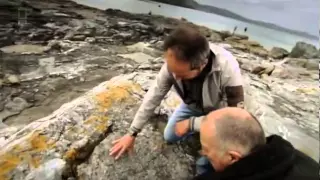
I guess it looks like a pretty normal piece of Rocky Force sure than most people but but this place is uh it's geological goal I mean quite simply this it's the most important geological site on the planet you'd never know what to look at it but there's a huge story to be told here an epic tale of geological violence it takes you a while to see it to to get your eye in but Hutton Hutton knew instantly what he'd seen nothing less than the birth and death of whole worlds what's remarkable is that Hutton could
see all of this not in a giant Cliff but a fire foot high section of rock in these horizontal and vertical layers of rock he saw one long geological cycle piled on top of another these layers of vertical gray rock started off as slurries of sand and mud slopped off an ancient land mass and deposited in the ocean they built up on the seabed as horizontal sheets inch by inch over millions of years but although they started off horizontal all of that was about to change because the ocean started to close what Hutton couldn't have
known but we've since discovered is that continents move slowly across the globe and this is why the rock layers are vertical and don't lie [Music] flat over millions of years a continent slowly and relentlessly drifted towards Scotland the seabed crumpled pushing the layers of Bedrock upright higher and higher until they became hills and mountains and there erosion started again rivers and Rain wearing down the land on top of the upright gray layers fresh sediment gradually built up and solidified into new flat layers of rock Hutton didn't know exactly what caused the formation at sicker Point
His Brilliant Insight was to realize it must involve gradual processes that happen not in biblical time but in deep time stretching back [Music] immeasurably hot was right and we now know how old these layers of rock are this gray rock is around 425 million years old and this red rock is about 345 million years old the gap between the two is 80 million years and that is ultimately Hutton's most important Legacy an appreciation of deep time the timeline of a planet hon had a phrase that he used he said no vestage of a beginning no
Prospect of an end in other words a timelessness in which small gradual changes can achieve almost [Music] anything here at sicker Point James Hutton realized if one ancient rock formation could sit on top of another this process must have taken an inconceivable length of time he had no idea of how long indeed he never offered an exact time scale he could only imagine the cycle of the Earth had gone on endlessly Hutton's recognition of deep time was an extraordinary breakthrough every bit is significant in its way is Darwin's theory of evolution or Einstein's theory of
Rel relativity as with all these great scientific advanage it was difficult for people to believe ideas in geology well and signs for that matter are kind of like a relay race where the Baton gets passed from hand to hand hopefully each time the Baton gets passed along the ideas get more solid and more accepted but in the case of Hutton that baton got seriously dropped along the [Music] [Applause] [Music] way 60 years after Hutton's death Britain's most respected physicist tried to calculate the age of the [Music] Earth a Scottish scientist so successful you could afford
a luxury yacht like this it's time to introduce you to a very different kind of scientist William Thompson better known as Baron Kelvin of logs he was a a Colossus of world science it's best known for the temperature scale degrees Kelvin that's him he was he was everything that hon wasn't he was was deeply embedded in the academic establishment forceful articulate a real [Music] showman Kelvin was a brilliant scientist supremely confident in his own ability he rejected Hutton's theory of the Earth as a system of endless change the Earth had to have an age even
if it was far older than the Bible said Kelvin thought that Hutton and his followers were unscientific his main problem was the claim that the Earth showed no vestage of a beginning and no Prospect of an end and that it was in a kind of Perpetual Motion in other words he thought that geologists were trying to break the laws of physics it was time to smash that idea to pieces Kelvin was a showman and he had a dramatic way to show that the Earth must be losing energy all the [Applause] time that could have been
my [Music] head here we have our 15 kg cannon ball I can hardly hold it it's a lot heavier than it looks all right so what are we doing so I want you to stand in position and we'll bring the Cannonball up Dr Stuart Reed from Glasgow University shows me why Kelvin was convinced that Hutton's theory of endless change in the Earth was wrong and then holding with your hands this Cannonball is a pendulum gosh everyone's pulling you forward such a way and bring it right up to your nose all right here we go when
I let the pendulum go it'll swing back towards me if it hits me my head will end up like the melon okay here we [Music] [Music] go why exactly is this not braining me then you know it's not possible for the cannon ball to end up swinging higher than when you let go of it because it can't gain energy from nowhere and in actual fact it's losing energy cuz of friction in the Rope because of the air resistance as it's moving back and forth and so the amplitude is decreasing as it's swinging you can see
[Music] that for Kelvin this demonstrated that the planet just like the pendulum must lose energy all the time the Earth could not be in a cycle of change that would never slow and never stop you know it's a simple but effective demonstration of the the real problem that Kelvin had with Hutton's Theory the perverse notion that the Earth was constantly creating destroying then recreating it surface over and over again forever in fact the Earth should be constantly losing energy just like this pendulum will eventually come to hold eventually based on the principle that everything has
to start and stop Kelvin was sure that the Earth had a beginning an age Hutton was a bit well wooly they never gave a precise age for the Earth and Kelvin wasn't going to let him get away with that grand claims needed to be backed up by hard figures and he Lord Kelvin was the man to get them he was going to take on the most audacious and controversial question of the era Lord Kelvin was going to calculate the age of planet [Music] Earth this is a lump of granite and we're going to try and
melt it now Granite melts about 1200° celsus several tens of kilometers down beneath our feet and we are going to try and melt it here with a with a Blue Torch take it away Kier meanwhile I'm going to film it with a thermal infrared camera which is going to try and capture the Heap and already I can see the soaring up it's uh 28 300° C waa it's bright that's for sure Kelvin believed the earth started off Molten God it's get hard to look at that's a th they're at 1,000° C look the melting point
of rock was kelvin's start point to calculate the age of the Earth he took this as the temperature of the planet when it was created and there is 1200° C oh oh yeah look at that this is molten rock beautiful Kelvin argued that the planet couldn't stay molten forever can we stop a second so this is this is now just basic physics once something's heated up it can't stay hot has to cool down from his experiment Kelvin knew how long it took small objects to cool down if he scaled up his figures to calculate how
long it would take an object the size of the planet to cool down then he would have the exact age of the Earth for years Kelvin continued to tweak and refine his calculations he finally put the age at the Earth at between 20 and 40 million years although we now know the calculations aren't accurate Lord kelvin's figures had an enormous impact he provoked intense debate about the age of the Earth and upset nearly everyone and this is Kelvin most times when I've seen this statue he's had a traffic going on his head and he was
ridiculed too when he published his age of the Earth the church hated it because it made the Earth too old fellow scientists they hated it because it made the Earth too young it just wasn't enough time for Darwin's theory of evolution to happen and as for Hutton's heat engine well on kelvin's time scale that was a nonstarter Lord Kelvin had made a crucial [Music] error his calculation was based on the idea that the Earth had C to a completely solid state but as we now know the Earth's interior didn't just cool like a lump of
molten rock parts of it stay molten just as hon imagined but couldn't prove Kelvin might have been wrong but his age of their stood for almost 50 years right up until 1898 when the Rocks themselves revealed the [Music] truth a few years before Kelvin died there was a major breakthrough scientists discovered a source of energy deep within the planet that has helped keep the Earth molten far longer than Kelvin could have imagined [Music] radioactivity this is a pretty ordinary lump of granite from the Scottish Highlands those clicks you're hearing are particles are hitting the thin
sheet at the front of this gager counter and they're coming from a from a tiny amount of radioactive uranium contained in the Rock we tend to think of radioactivity is man-made but it's actually a natural phenomenon a powerful energy source that's been around since the birth of the solar system radioactivity is one of the key forces that makes Hutton's Theory correct I'd love to meet Hutton and over a whiskey and weide a warm fire tell him about all the things we've discovered since he's been gone top of that list would be radioactivity I mean the
energy of radioactivity and the heat that it's generated has kept parts of the planet's interior molten it's part of Hutton's heat engine which has allowed the Earth's surface to be constantly recycled and rejuvenated but there's another reason why I'd love to tell him about radioactivity and that's because as well as explaining his heat engine it's been responsible for telling us just how old the planet [Music] is we can now look at the most ancient rocks on our plan planet and discover their true [Music] age I've returned to Toran in the Northwest Highlands I'm hoping to
find the oldest rocks in Britain up here I want to find out just how old Scotland is and radio activity will give me the [Music] answer [Music] I'm heading into the back country with fellow geologists John Wheeler and Ian Miller and you can see it's kind of swirly can't you it's AIT [Music] subtle this hill is 50 times older than the era of the dinosaurs it's one of the earliest parts of our [Music] planet wow this is spectacular isn't it look at this I mean this whole outcrop is just kind of vein after vein after
vein of this white beautiful White Rock This Rock is called louisian nice this this kind of rock heaven for me I mean it's just the textures the shapes the colors of this Louis and nice it's beautiful gorgeous and here this stff going across and it stops but what's even more fascinating more mindblown than just how gorgeous it is is that this rock could be part of the very first Bedrock of Britain right here we go ah this this is like the dark side of geology it's cold hard work oh there we go yes much as
I love this rock we need to take a sample so we can measure its age okay that's pretty good is it it's getting nasty now the snow is really coming in but we've got it we got the rock we wanted it's a beautiful piece of louisian night and apart from just looking gorgeous this is a question am I holding a in my hand a fragment one of the oldest bits of Britain we got to find out but we got to get it to the lab let's get off this [Music] m so this is it this
is my rock here it is the plan now is to find out how old this piece of Scotland is the key thing that we have to do first off is to smash the hell out of this rock we do this in this machine [Music] [Applause] here the ground up Rock contains the radioactive crystals I need look at that so that's what a rock started like and that's what it is now and somewhere in here the the little crystals that we want to do now we're going to examine those crucial crystals using an electron microscope that's
creating a vacuum yeah that's traing a vacuum inside your sample that you collected uh We've managed to extract uh a large number of ziron crystals the ziron crystals are tiny capsules they are full of radioactive uranium which breaks down into lead at a regular rate you can actually see the shape of the crystals quite nicely look at that yeah that's really beautiful the proportion of uranium and Lead left in the zircons will reveal the age of The Rock the machine spits out an extraordinary bunch of numbers lots of numbers lots and lots gosh lots of
lots of yeah many many numbers they're they're ranging from about 2, 2,500 up to a little bit over 3,000 million years old these ages are just unfeasibly old I mean 3,129 million years this is astonishingly old amazing you know the fact that it's between 2.6 and 3 billion years old is truly remarkable I mean this thing has been around for 2/3 of the age of the planet the Earth is 4.6 billion years old and the notion that a lump of Scotland is almost 3,000 million years old well what would Hutton a made of that [Music]
the rocks of Toran were created when the very first continents on earth were being born the ancient landscape of Scotland is a witness to billions of years of geological change it was one Pioneer who made this vision of our landscape possible James Hutton made one of the greatest leaps in human thought when he looked at the landscape he saw what no one else had seen before he was the first to grasp the true vast age of the Earth and it was that Discovery more than any other that's allowed us to piece together the complex story
of the life of our [Music] planet next time I'll follow in the footsteps of the gung-ho geologist who uncovered Scotland's volcanic past and the unsung hero oh you can actually see it starting to go up there who solved the mystery of what makes continents move across the surface of the [Music] [Music] globe [Music]