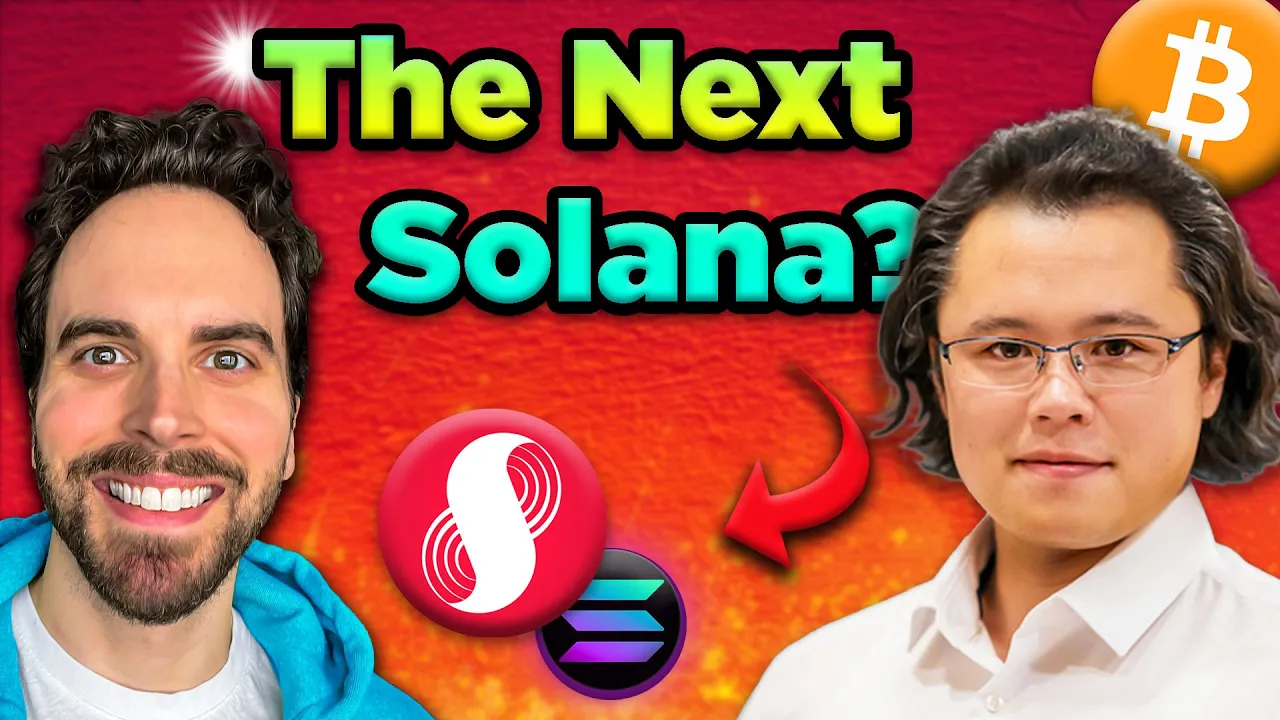
Imagine if Solana and Chainlink merged with Layer Zero all in one; that's what Supra is doing today. I sit down with co-founder and CEO Josh Topkin to discuss a revolutionary new blockchain called Supra. If I called Supra the Solana killer, do you think that would be accurate?
This is backed by Coinbase, backed by HashKey, working with other blockchains. We're servicing, I think, over 60 chains right now. Supra is the first all-in-one multi-m Layer 1 built for super dApps, and we have, I think, around 156 dApps on other ecosystems already using our services to power their applications.
I highly recommend you watch today's entire conversation. I think we do have an opportunity to get to a trillion-dollar market cap faster than Bitcoin. This could be big!
I actually believe Solana applications will outperform, or perform better, rather, on Supra than on Solana itself. This is everything you need to know about the Supra blockchain. Hit the like button to support me, and let's start.
Josh, with your background: I've been building things on the internet since I was 11 years old, actually, so it's been something that I've always been somewhat obsessed with. I'm 39 now, so it was a long time ago—like, I guess, 29 years or 28 years ago. Time really flies.
Back in the day, I was just trying to make a simple website to put up photos of the bands I liked and just photos of, like, back in the '90s, skateboarding, and just trying to figure out how this thing works. It was so frustrating because there weren't that many resources out there, and the internet was really slow. Fast forward a little bit; my first real startup was when I was around 21 or 22 years old.
It was in the online poker space; it was cash back, or what’s called rakeback. So, the players, you know, when they played at these rooms—all the major popular poker rooms back in the day—they would actually be paying rake; this is like the fee to the house. What we would do is we'd go to this poker room, say, "Hey, we have 5,000 or 7,000 active daily players.
We'll bring them to your site; we want half the revenue. " Then they’d do it, and then we’d take that revenue and give it back to the players—like 80% of it. So, that was the kind of model there.
I did that for several years. When online poker became illegal in the United States—what was called Black Friday—I decided to sell my shares to my partner at the time. He went on to service the global region outside the United States and did very well.
That experience, once I sold my shares, gave me some resources to travel the world a bit and experiment with different initiatives. I had some tools and, you know, online websites that would actually go viral to the point where it was growing, but I couldn't continue to afford to service it because I didn’t have any clear business model in mind. So, that was actually a very interesting wakeup call because I had to shut down one or two of the services.
Nonetheless, I learned a lot just by doing. Moving forward, I guess at this stage, I'm in San Francisco, and I am being introduced to Ethereum in, I guess, late 2016 or early 2017. I didn't really understand it.
I was in the SaaS industry, software as a service, making my own kind of cloud-based SaaS products, and in that world, you're really focused on centralization and speed and performance—low latency; you know, one place to do it all. Then I hear about Ethereum, and I just couldn't really understand it—like, why would you do it this way? Finally, just to kind of cut to the chase, it was when I connected the dots between the fact that I used to complain to my previous co-founder in the poker startup that I felt like these poker rooms and our partners and the affiliates were not paying us out properly.
Our player numbers would grow, but the revenue associated with them was not keeping track with that. We had no recourse; we had no way to prove anything; we had to just accept the data they gave us. Then that’s when I realized, "Oh, actually, there is a trust issue in the web.
" I took another look into Ethereum. Once it kind of clicked for me—and also, I do have an economics background, so building things on the web and economics is just something that I really resonated with—I decided to put my SaaS product on automation and went full-time into trying to solve how to scale Bitcoin. It's not Bitcoin, but Ethereum and blockchain at large.
Part of that journey also exposed me to oracles; you know, this is the same year I think that Chainlink came out. It was very clear to me that oracles are going to be necessary for smart contract platforms to do more things; otherwise blockchains are actually closed-loop systems. They don’t communicate with the outside world, so oracles allow blockchains to speak to the outside world.
Bridges allow blockchains to communicate with each other. Many of your audience may not know this, but blockchains don’t have an automation service that decentralizes "if this, then that. " There's no cron job to do this; it's typically done by an external service, usually an oracle service.
has to do this so, uh, long story short, in, uh, San Francisco, 2017, in around November, I had the insight into what ultimately would become Supra. This is, uh, what we call a fully vertically integrated layer one. I mean, so layer one with oracles, with cross-chain communication, bridge, with automation, a single stack, the security, extreme performance.
So, and you kind of just got into this, but for somebody who has never heard of Supra, what is it? Is it more of a layer one, like a Solana, or more of an oracle service, like a Chainlink? You know, what we say is that when I talk to a general audience, what I say is, well, imagine if Solana and Chainlink merged with Layer Zero: all in one.
That's what Supra is doing. So it is a layer one smart contract platform, but also, it’s equipped with native oracles. We have very good algorithms for our oracles: price feeds, cross-chain communication, on-chain randomness, also automation.
But the oracle problem is more than just price feeds. What makes it special is, uh, its shared security, its low latency, it’s very fast, and it’s a single chain where a developer doesn't have to focus on all these external networks and juggle multiple tokens. It's just one chain that has all these tools that allow the developer to do things they literally can’t do elsewhere.
Now, one last thing I should mention is, um, our consensus algorithm itself is very, very high performing as well: extreme throughput, low latency. So when I say low latency, that just means fast finality. So we’re, uh, you know, apples to apples.
If you were to compare Solana's algorithms to Supra's, we actually outperform them. And that’s Moonshot consensus. That’s right, Moonshot.
Yeah, and as I'm like going through the crypto market in general and trying to figure out which blockchains will be here five years from now or be here ten years from now, to me it often always comes down to where will the developers choose to develop. Then, they'll build the product, bring the people, and that’s a healthy blockchain. Moonshot consensus is one, but like what are other reasons that developers will choose Supra over the next ten years?
Sure, sure! So, Supra being this kind of, uh, single platform, we call it an all-in-one blockchain, meaning it’s a blockchain with the oracles, with the bridge, automation, all in one. There will literally be things that, uh, developers can do on Supra, especially as we mature the full stack, that they can’t do elsewhere.
So they’ll be able to have functionality and interesting creative ideas executed on Supra that they just cannot do on a single platform elsewhere. What's really interesting about Supra is, you know, we view, uh, we view like these networks as a world computer, right? We talk about that.
Now, the thing is, Supra actually thinks that we are building an actual world computer because, you know, we talk about these blockchains that don't communicate with the outside world. How could that be a world computer? You need oracles for that!
These blockchains don't communicate with each other unless you have cross-communication protocols. So, uh, how could the world computer not communicate with other blockchains, right? And then also, automation: decentralized, if this or that.
How could a blockchain be called a world computer if it cannot have automated transactions based on various events and triggers? So we do think that Supra, um, is kind of a new decentralized computation paradigm, so to speak. This infrastructure is also, um, you know, we’re not opinionated about the programming language either.
What I'm trying to get at is, Supra is designed to be a multi-platform VM, which stands for virtual machine. So, uh, right now, we are running the Move language. The Move language is provided by Aptos.
We are big fans of Move, so this is already launched right now. EVM, Ethereum smart contracts will be able to deploy on Supra, uh, then in a matter of months. Right now, we at least in testnet, we have it in staging nets.
We're moving into testnet; after testnet, it'll go to mainnet. So Ethereum applications can run on Supra and take advantage of our speed and performance and native services like price-feed oracles, cross-chain communication, etc. Then maybe six to eight months after that, Solana VM, Solana SVM applications can deploy on Supra.
So basically, we're program agnostic; we will let developers from many ecosystems deploy on Supra. The benefit being is that they will have these native services that you don't have elsewhere. And we also have very fast finality and we can handle a lot of throughput.
So basically, because you're compatible, um, whether it's language or code or whatever, with the SZEs and the Solanas and the Etheareums, as those DApp ecosystems grow, you say you believe they’ll eventually plug into Supra because that'll be the obvious move. Well, I think it’d be relatively simple for them to try us out. The thing that they can get from us that they can't get elsewhere is the native services.
So like the price feeds directly on Supra: it's not actually a different network. So what's happening today is you have a layer one network, and then you have to go to an external network for price feeds, another external network for a bridge, another external network for automation, and so on and so forth. Those disparate networks actually introduce two things: there's more latency; it’s slower because you have to communicate with them.
They have to finish the protocol, communicate back with you, submit the transactions, and so on and so forth. So slower, and it's also less secure because that is not your layer one security if your application uses some other. .
. Component that's some other network you have now inherited the security: the weakest component. So in our case, we have shared security; it's, uh, meaning it's—it's—it's all these services are backed by our layer one itself.
And, uh, we also, um, it's faster, and we frankly think our algorithms themselves are better than what our competitors are offering. What are Supra containers? Supra containers are pretty cool!
So what these are is—imagine you’ve got this layer one; it's a huge layer one that can do a lot of throughput. It's very fast, okay? But developers want to have their own ecosystem; you know, we’ve heard of app chains or layer twos, right?
This is our answer to the app chain. And why do folks want an app chain or a layer two? Well, first of all, I want to make it clear that layer twos are more of an Ethereum phenomenon; right?
This is mostly a result of Ethereum itself not necessarily scaling the layer one, but app chains—that's mostly from, like, the Cosmos ecosystem or Avalanche subnets or Polkadot parachains, or folks that just want to roll out their own chain and set their own rules. Why would a developer want to do this? Well, they want to sometimes decide which applications can deploy.
Maybe it's an application-specific chain, so developers typically want to have their own gas token. They might want to set their own fees; they might want to say, “Hey, these are the types of applications that can deploy on this app chain. ” And they can also have any form of decentralized governance.
So, containers give you all of that. You can have your own token as your gas fee, you can set your own gas fee price, you can have your own decentralized governance. But the main thing you can get on Supers that you can't get elsewhere is you don't have to bootstrap a network of node operators and validators in order to have your enclosed ecosystem.
Now, what's really great about this super container, right—this concept is that you can have your own ecosystem and set your own rules, right? And unlike layer twos, subnets, and parachains, and these other solutions—because they exist on Super layer one—we have what's called composability. Composability means smart contracts can communicate with other smart contracts in a single transaction.
That all the smart contracts have to execute for—to be atomic, meaning that they’ll either all execute together, or one fails, or it fails. Now when you splinter off these layer twos and layer threes, subnets, and parachains, you don’t have this composability; these smart contracts do not necessarily compose with each other. What's nice about the super container concept is that they exist on the same layer one itself.
You can have your own rules, gas token, decentralized governance, etc. But since they are on a shared infrastructure, they can compose and interact with each other, and you can set your access policies, meaning maybe this container is only for real-world assets. And maybe these assets themselves need to be KYC and AML-compliant due to various rules or regulations, or something like this that liquidity may not be able to touch, just open DeFi liquidity where it's permissionless.
So the access policies for this container say maybe we only interact with other KYC-AML-regulated DeFi containers. On the flip side, you could say maybe this is a game, and in this container only games that we approve are allowed to interact with our games. And we also will only work with certain types of other containers.
Long story short, I know that’s a lot to say, but the main benefit is you can have the app chain experience without having to roll your own network of nodes and figure out how to get 100 nodes running and have them stake your token. You can still have your gas token, you can set your own gas price in your container, but you don’t have the downsides of having to roll your own app chain. The last thing I want to share about this, which we're really excited about, is Super is extreme performance: low latency.
So it's very cheap—very, very cheap—sub-penny transactions; like Super sub-penny, like one-hundredth of a penny, right, for transactions. But in your container, suppose it's some sort of game container. You could say the movement of this NFT from this person to this person, we could say maybe it’s 20 cents—let’s just say that you price it at 20 cents.
But on Super's infrastructure, let’s say it’s half a penny; that’s actually a 40x markup! That’s a new revenue stream for your application, for your container. So, you know, once again, this is not a 40% markup; this is a 40 times, you know—so it's still 20 cents, but still a 40x markup.
This is the revenue for the application, so we think applications are going to actually capture a lot of the value, and we think that this is going to be a very attractive model in the near future as we roll this out. Supra's in very early stages, but what is the growth and the developer activity like today? Sure, sure!
So we’ve actually been in what we can call this main-alpha phase since April 2023. We have actually launched our main net just like last week—a couple of days ago—and been listed on exchanges. During the main-alpha phase, we were serving our Oracle price feeds and on-chain randomness services to other ecosystems, other layer ones, layer twos—we're servicing, I think… Over 60 chains right now, other mainnets, and we have, I think, around 156 dApps on other ecosystems already using our services to power their applications.
Supra's Mana is brand new, though. We have, for our own Mana itself, about, you know, us being a smart contract platform, we have about 183 million. These are applications from different ecosystems and projects that are interested in using Supra.
We have, I think, 10 applications about to deploy right now, with another 30 or so coming soon. Then, step by step, we're attracting, you know, having these folks as we roll out, for example, EVM support. We have a lot of folks that are EVM-based that want to deploy on Supra, so it's early, but nonetheless, it's exciting.
These developers are coming up with really interesting ideas on how to use smart contracts with oracles, with automation, across various settings—things that Supra will offer that you cannot get elsewhere. Some of these ideas are very, very interesting and creative. Once again, I think these application developers are going to be bringing the creativity to new ideas, whereas we are just bringing the tools and the infrastructure to enable them to do their magic.
If I called Supra the Solana killer, do you think that would be accurate? I wouldn't call it that. I don't really like that term.
We are very much early, but in terms of pure algorithmic performance, we just have better performance, frankly. Of course, we're not as hardened yet because they've been around for a long time, and we have quite a bit to go. But if, let's suppose, like apples to apples, algorithm to algorithm, and we were both at the maturity level of, you know, hardened Mana for some time, I would assert that Solana should not perform as well as Supra.
In fact, I say that, let's say, a year from now, when we roll out the Solana Virtual Machine support, I actually believe Solana applications will perform better, rather, on Supra than on Solana itself. So, the applications, the Rust code, and Solana, if they were deploying on Supra, I do believe that we'll have a better user experience than Solana. What is the use case of the token?
Should we think of it like a gas token, like ETH? Yeah, yeah. So, Supra is the token of the Supra Network, and it is a gas token.
But it's actually—we kind of call this the "Super Token Thesis," which is it's one token to do many, many things. So, Supra, as a layer-one smart contract platform, we do need gas like Ether on Ethereum. You need gas to transact; similarly, you need Supra to transact.
But what's interesting about what we have to offer is that Supra also has the other services. We have price feeds; we're servicing all these other mainnets right now, layer ones and layer twos. On-chain randomness is also very interesting.
You know, blockchains are these closed-loop, deterministic, very orderly systems, and in a perfectly deterministic system, on-chain randomness is hard to get into. But on-chain randomness to power games, and games of chance, lotteries, etc. , is a very interesting product that has been adopted quite a lot by various projects and ecosystems that we power.
That’s also going to be paid in the Supra token. The other services that are coming very soon are automation and cross-communication. All these services are going to be paid in a single token, and what's unique about Supra itself, as a layer one, is that we have our own gas token, yes, but eventually, these other chains and projects on other ecosystems that use our services will also have to pay us in the Supra token.
This is not, you know, let’s compare this to the kind of status quo today: you'll have a layer one token, you'll have an oracle token, you'll have a bridge token—you know, you splinter the value across four or five different tokens, whereas Supra is putting it all into one token. Josh, I'm so thankful you took the time today. I really do feel I have a way better understanding of Supra and its potential.
What didn’t we cover, or just final thoughts for the Altcoin Daily army? Sure, sure. So, of course, I'm not going to give any financial advice here.
I'll just say that this project actually started—like, the kernel of the seed was seven years ago, and we grinded through two bear markets. It was a very difficult journey, actually. My point here, though, is that we’re not going anywhere.
We love what we're doing. I highly recommend if you guys have a really geeky, smart researcher among your friend group, have them take a look at our white papers. When I say that moonshot consensus may be the absolute limit for classical consensus protocols in terms of performance, I'm serious.
We have formally verified our safety. When I say that Supra is composed of at least six or seven core primitives and algorithms to make it work, this was a labor of love. It wasn't just one consensus.
We had an oracle protocol, randomness protocol, and cross-communication protocol, along with other ideas. I would highly recommend that you consider using ChatGPT to take. .
. White papers? Just upload it; I’ll give you the summary.
Our overview paper is kind of the network architecture, and then the individual components and protocols themselves have their own extensive white papers. TPT is pretty remarkable; they can actually understand the pseudo code as well as the formalism within these complex white papers. Take a look at it, and you'll see that Supra is a new type of blockchain that hasn't existed before.
It's very high-performing, and frankly, these early days are a great time to get involved in the ecosystem. So, yeah, reach out any time. We're going to enable use cases you just can't do elsewhere, and we're always happy to share more.
I would be very happy to come on your show any other time if you'd like. I definitely want to have you back by 2030. Do you believe Supra will be a top two cryptocurrency by market cap in 2030?
Okay, top two. You know, the real game, in my opinion, is to be top three; you know, but do we have that kind of ambition? Yes, we do, but six years or five years is enough—maybe not.
Nonetheless, I don’t want to get too much in the weeds here, and people just make fun of me if I don’t hit the mark. But I think we do have an opportunity to get to a trillion-dollar market cap faster than Bitcoin did, so less than ten years or whatever it was. But that is not financial advice.
Frankly, let’s put it this way: it is my humble opinion that if indeed our network architecture has the edge that I’m talking about—which I do believe—it’s our fundamental limits of physics, right? The physics of nodes—we call that “noal physics. ” We have some really great insights here, and I think these insights we have are basically strict limits.
So every other network is going to have to run into the same limits—speed of light limitations and such—and our techniques and strategies are just very clever to do it in a very safe manner. So, very high-performing, as well as, you know, decentralization and security. So, yeah, the prediction for the future is that I don’t know where we’re going to be in ourselves, but I’ll tell you, in my humble opinion, I gotta be very careful what I say here: this is merely the beginning, and I think the crypto industry at large is going to get absolutely massive.
Yes, I do think it’s very natural for technology to vertically integrate, to become more integrated, and Supra is leading the pack there. We’re the first truly integrated blockchain out there that’s integrating the services that are required to actually be called the world computer. So, I don’t know exactly the price prediction by 2030, but do I think that we have a chance to hit a trillion-dollar market cap?
I think it’s absolutely possible. It’s going to take time, but I think we could also do it faster than Bitcoin. By the time we do it, Bitcoin’s going to be probably three, four, or five trillion, in my humble opinion.
So, you know, Josh, I appreciate your candor. Links for you, Supra, down below. I’ll be following.


![We Have Only Ever Seen This Once Before… [SP500, Bitcoin, Nasdaq]](https://img.youtube.com/vi/1iSR6rIhd0Y/maxresdefault.jpg)