(vigorous music) - Thanks for coming. - Yes, despite rain and plague, as we were talking about this. (chuckles) - Rain and plague.
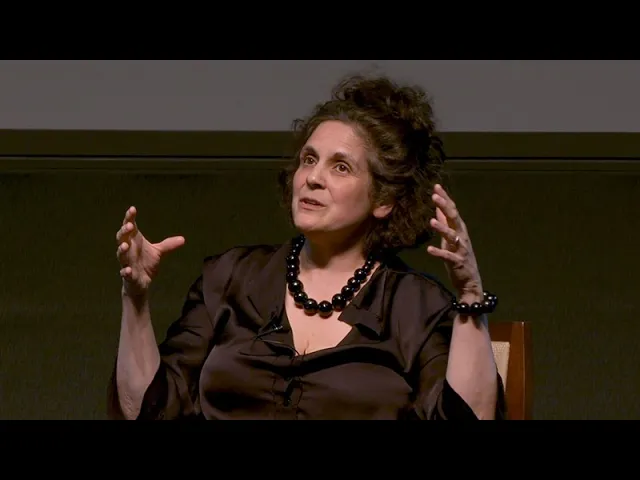
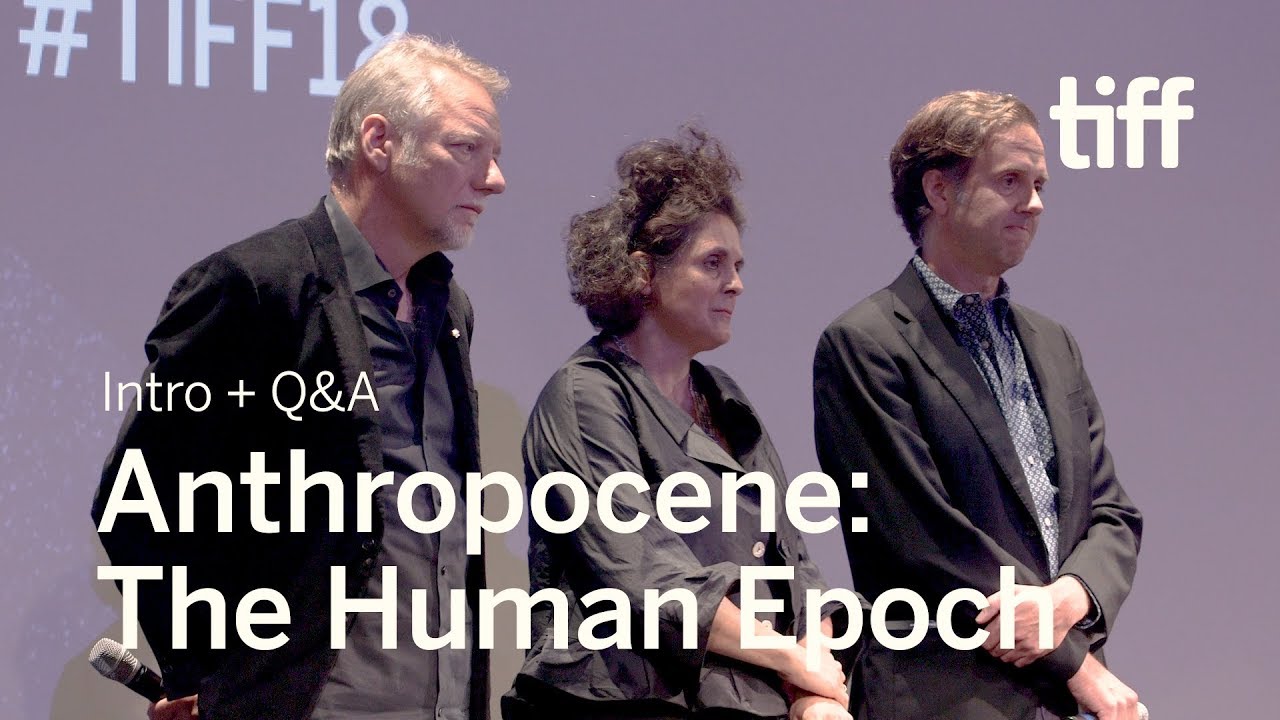
- (laughs) So let me just introduce our guest and myself briefly. My name is Alenda Chang, and I'm an associate professor in the Department of Film and Media Studies, and our distinguished guest is the director of the film that you just saw, Jennifer Baichwal, and - Nice. - Did I do it?
- Yep. - Okay, (chuckles) and so I have the honor and the privilege of just having a discussion with you for the next half an hour or so, and then we will open it up and hopefully take a few questions from you, so I thought we could start with the notion of the Anthropocene, which has been very fruitful for scholars in many environmental disciplines including the humanities and the sciences, but that I was just saying that it's a very double-edged thing where it draws attention to the scale of the problem, but at the same time sort of makes us look grand (chuckles) at the same time, so I wondered if you could talk about that concept and why you started there. - So there are a couple of things around that.
I mean, when Ed Burtynsky and I were in in Washington when "Watermark," the second film in this trilogy of films, was playing, and he said, "Should we do something together again? " and we were kind of, "Uh, I don't know," and I said, "What about the Anthropocene? "Nobody knows what that word means," and at that time it really was not a known word.
We would go to screenings and ask people if they knew, and maybe two or three people would put their hands up in an audience, and so there was this idea of how do we. . .
The interdisciplinarity of it was really interesting. The idea of taking we were inspired by the research of these scientists of the Anthropocene Working Group, who are a collection of scientists, not just archaeologists, but biologists, uh, no, sorry, not just geologists, but biologists, archaeologists, earth system scientists, who have been doing this investigation for 12 years of human impact on the planet, and so the idea of kind of looking at their work, and saying, "How can we make this accessible to an ordinary "to ordinary people? " That was the challenge, but even within those groups, and the International Commission on Stratigraphy, which will eventually do the vote to decide whether we are in the Anthropocene epoch, whether we have left the Holocene or not, and there's a huge debate in that group of this is where we're being very anthropogenic by naming an epoch after ourselves, number one.
Number two, that it's more a cultural thing. It's not geology. It's not in the rocks, so why can't we have it like the Renaissance?
Why does it have to be a geological term? So there's swirling debate, on the one hand, and then there's this critique of the concept, on the other, that is also fascinating, like people say it should be called Capitalocene, not Anthropocene, because there's a very small percentage of people on the Earth who actually are responsible for most of the impact, and a lot of people who are experiencing that impact, or there's feminist critiques, there's indigenous critiques, and so all of that swirls around in some way, and yet Elizabeth Kolbert, in "The Sixth Extinction," said that if it is ratified as an epoch, every geology textbook in the world will immediately become obsolete, and I thought, "That's interesting. " If it can penetrate to that level, where we're reading about ourselves and the fact that we, as a species, some more than others, now change the Earth more than all natural processes combined, that's a lot, and there's something about the recognition of that fact that I think is quite powerful.
- Yeah, that's great that you mentioned some of the alternatives that have been offered, including Capitalocene. I think I've heard Plantationocene, which is the agricultural sort of-- - [Jennifer] Sure. - But also Anthrobscene, like obscene.
(Jennifer chuckles) So you can pick your favorite, I suppose. Chthulucene is another one by Donna Haraway, and so-- - That's cool. - I guess you'll have to make five more films (laughs) with those titles.
- Or make a film just about the debate. - (laughs) Right, so I do have to indulge a bit in the sort of visual element and ask you how many of these incredibly stunning shots were achieved, and having gone back to look at your earlier work, including "Manufactured Landscapes" and "Watermark," I wanted to ask about how has the technology shifted that you're using? Is it more drones?
I know we have a special guest in our audience. - Well, there is somebody in our audience who, in fact, was responsible for quite a lot of the, well, certainly all of the aerial work that we did with drones, and then cinematography as well. That's Mike Reid, who's sitting right there (audience clapping) in the white shirt.
Very happy that he's here, and he's an incredibly valuable part of our team, and we've been working with him for he was with us on "Watermark" and the films that we've done in between, but it's interesting because, talking about critique of the "Anthropocene," there is a critique of "Anthropocene" imagery or representation, that it is aerial, that it is often diagrammatic. It's the God's-eye view from above, and it allows this kind of distance, this kind of omniscience that is really not the same thing as being in these places, and I think that, certainly, in "Watermark," especially, for Ed Burtynsky, he started to do much more aerial photography because he said you could only understand watersheds from above. They're so big you can really only understand them when you see the whole picture, but that sort of dovetails with our Nick's and my work as documentary filmmakers, and the ethic of our work, and the ethics of our work, where the two things: you can only understand scale when you are constantly pairing it with detail, and where you're above but you're down on the ground, and you're in a place, you're saturated in a place, and I think that that dialectic is a huge part of our work, and it's also part of the ethics of our work because when you travel all over the world, it's very arrogant to assume that you can convey anything about anyplace that you are not of, and it is also an aggressive act to put a camera in somebody's face, and so mitigating that power imbalance and finding a way of authentically being in these places that we are not of, and which is essentially humility, like going being humble in these places, and relinquishing control, which is a very difficult thing for people to do, especially when there's a lot of money on the line, and you have a crew, and you're paying.
You know, you've got, but really, just being there, and feeling that place, and trying to be open to conveying some kind of truth about that place, which always involves real interaction and a kind of authentic exchange of vulnerability with the people, or indeed other species in some way, who are in those contexts. - Yeah, I'm so glad you mentioned that, actually, because this time, when I was watching, I was paying attention to things like elevation of the camera, and it felt, at many points, that it was almost like you were taking a non-human perspective, in some ways, that sometimes it seemed to be trailing people, like a dog, (laughs) and then other times it seemed to be definitely too tall for a human perspective, and I don't know if this was intentional or sort of a just. (laughs) - Well, like an elephant's-eye view, or a I remember when the for me, the sequence in the London Zoo, I mean, the Zoological Society of London, and that whole area with these species that are at risk.
They're either endangered, critically endangered, or extinct in the wild, and when I was trying to tell Nick why I wanted to go there, he was just like, "We're not going to a zoo. "You want me to film in a zoo. "I can't do that," and I said, "Come on, Nick, just indulge me here," and so we went, and I feel like it is kind of the emotional apex of the film, in some way, to be sort of communing with these creatures that are gone, and then you see people like the mountain chicken frog mother, the person who has been raising these mountain chicken frog babies for two years, to slowly be reintroducing into the wild, taken to the Caribbean, put in a tent at night, taken out during the day.
I mean, it's an incredibly painstaking, long process to do this, and I felt like we have to show that. If we're going to try to talk about what extinction is, this is extinction, and it connects back to the elephants, and the ivory burn, which feels like an apocalyptic moment. It feels apocalyptic, but in fact it is this incredibly positive act of burning this ivory and saying there is no market for it, period.
- Right, exactly. I think the scholar, Thom van Dooren, who does animal studies work, actually has this interest in extinction, and how we, as humans, are the only ones that could come up with levels of extinction, including de-extinction, the possibility for de-extinction, but things like functionally extinct, or extinct in the wild, and all these shadings for something that we imagine. - For loss.
- Yeah, it's a bright line, but-- - It's interesting because geology, one of the sort of limitations of geology and this idea of looking for evidence in the strata, so some of these urban archaeologists will argue that the landfill, like you see in the Dandora landfill, will eventually become lithified into strata that will become rock, and it will be all human. The human signal will be there, but one of the limitations of geology is that it can't really measure extinction. You can't just look at what's absent, and so it becomes this limit in terms of one of the biggest hallmarks of the Anthropocene is extinction, but it's very difficult to convey in a geological framework.
- [Alenda] Mm-hmm, well, it's difficult to convey absence, in general. - Exactly. - I have a few more questions, I'm sorry, and I'll try to open it up, but I've been wanting to ask this ever since I first saw "Manufactured Landscapes," and I'm sure you get this all the time where you make environmental degradation look so beautiful, or in the case of that e-waste or something like that, and so that's sort of, I guess it's similar to the earlier question, but that sort of danger of aestheticization and how you deal with that because maybe the right term is from aesthetics, and it's the sublime, or it's meant to convey both wonder and terror, that I thought maybe if you could speak to that.
- You know, it's certainly something that a criticism that gets leveled at Ed a lot, and I remember thinking about that looking at his photographs that there is this you know, his photograph can hang in the boardroom of a mining company, and it can hang in the environmentalist's office who is fighting against that mining company, and a lot of people would find that to be an intolerable ambiguity, and I think, actually, that ambiguity is what is at the heart of the power of that work, and for us there was always this attempt, especially in that moving back and forth between scale and detail in the film, and also this in "Manufactured Landscapes," of questioning what frame you're looking at. Are you looking at the real world? Are you looking at our camera's-eye view of the real world?
Are we looking at Ed's camera's-eye view of the real world? Are we looking at a still of Ed's in a gallery that somebody is looking at? So you want to always be aware of that in documentary.
Documentary's all about the politics of representation, but on the other hand, if you don't draw people in, they're not going to listen to you, (chuckles) and so there's this kind of, it's true, there's a kind of aesthetic seduction that takes you into these places that you're responsible for but would never normally see, or you're connected to, but would never normally see, and then it allows you to be in that place without judgment, and that really is what I think the photographs can do really well, but also in a time-based medium of film we can do that even more powerfully in an emotional way, in a visceral way, and an intellectual way to move people, and for example, like Norilsk is something that we bring up because Norilsk is the you know, it has the largest supply of palladium in the world, which is in all of our cell phones, so the chances are that our cell phones in this room, and I'm assuming that most of us have one, has palladium in it from Norilsk. Who would ever go to Norilsk? You can't even go there as a Russian citizen.
You can't go you can't you have to make have special you know, permission-- - But it's such a happy company town. - Oh, well, you have to have special permission to go, and it took us a year to get in there, and we went under an artist visa. We got arrested because we interviewed the women in the copper smelter who were crane operators, and I was just, you know, I wanted to talk to them because I wanted to learn about their life, and then instantly they said, "Well, only journalists interview people; "Artists don't interview people," and we got into this semantic argument of, well, what's an artist?
What's a journalist? Are we allowed to talk to people? Are we not?
But that is an example of taking you to a place that you would never see or never go to, and I think that if that place was horrific, or if it was presented in a way that was sort of immediately a polemic, saying to you, "You're responsible for this place," people would turn away, or if it was just unrelenting degradation you would also turn away in despair, so it's a bigger conversation to have if you can move people and shift consciousness that way, and that leads to change, instead of a direct exhortation to action. - Mm-hmm, so apologies for continuing to invoke your entire body of work, or at least these trilogy of films that you did with Nick de Pencier and Edward Burtynsky-- - [Jennifer] And Mike. - Oh yeah, (laughs) but I do think I've always enjoyed how the films offer this sort of commentary on the photography and across media, like there's a moment in "Watermark" where you're watching Ed's book be printed in this German printing factory while the narration is talking about his relationship to nature, and there seems to be an irony that's sort of left to you, and I've always appreciated that, what you're able to do, and then back in the green room I had to actually ask a naive question, which was, "How much of this "was any of this based on Burtynsky's photography "because of the satellite "of some of that aerial imagery?
" - So in this film, for the first time, we really decided not to because Ed has been learning to be a film, like, he wanted to he codirected "Watermark," which, and we were still quite separate in that film in terms of he's taking photographs, we're doing the filming, and here, because this was not just a film. It's a museum exhibition. It's two books, and it's an educational program, so in the museum exhibition we have, well, we did 360 VR.
We did augmented reality, so literally in this exhibition you will be standing with an iPad or your phone, and through an app it will trigger a sculpture, a virtual sculpture of the biggest tusk pile before it was burned, and that involved taking thousands of photographs of this pile and stitching them together in software, and then developing the app that could work to trigger this virtual sculpture, and so everywhere we went we were shooting for all of those things at the same time: photographs, film installations, the movie, the 360 VR, and the augmented reality, and so it was quite complicated in terms of, like, wearing all of these different hats all of the time, so we were working together, and we did the research together. We researched for about a year before we even started to shoot using all of the Anthropocene Working Group's categories of research as our categories and saying, "Well, what is the most iconic example of anthroturbation? "Let's go to the biggest railway tunnel in the world.
"What is the most iconic example "of terraforming of the Earth? "Let's go to the biggest "open pit coal mine in Germany. " - I feel like we all now have great cocktail party trivia, like, "Did you know there was this word, anthroturbation?
(Jennifer chuckles) "And now I can tell you what it is. " (laughs) - Or the bagger. I have to tell people that the bagger, which is the biggest land machine on the planet, actually has a LEGO.
You can buy it-- - What? - You can put it together in LEGO, I know, and we got it because I thought, "Well, we have to do this or film somebody doing it," and nobody could figure out how to put it together, so we had to give it to an eight-year-old. - My six-year-old can help.
(Alenda laugh) - We did. We gave it to an eight-year-old boy and said, "You do it, you have it," anyway. - That's excellent, so I actually, I have some questions about, you know, you were saying earlier the ability to sort of fly all around the world and to do these projects that are very kind of mechanically intensive, and air-mile intensive, and all data intensive-- - Carbon.
- Carbon intensive, right, and the constant weighing of the benefits and sort of and the costs. If you just have thoughts about the sustainability of production. - Oh, God.
I mean-- - I know. (laughs) - I have insomnia, and when I wake up in the middle of the night and start fretting, that's one of the things that I fret about, which is is the carbon footprint even worth whatever awareness is being raised by this project? And I go back and forth on it.
Sometimes I think yes and sometimes I think no. I mean, there was a Buddhist monk. When somebody asked him, "What can I do to save the planet?
" and he said, "Go to sleep. " That was his answer, (Alenda laughs) and I get that. - You mean, like, sleep, or, like, sleep?
- No, I mean like sleep. (Alenda laughs) Just stop doing stuff. - Okay.
(laughs) - Stop doing stuff. Stop using up energy, and so I will say, and I'm not invoking this as an excuse, but all of our everything to do with that project, and since we actually physically could do it, which was the "Payback" film we made with Margaret Atwood, we have offset all of our productions, so we carbon offset everything, not just the travel and the production, but the post-production, the release. This trip is offset, so the work that we do in promotion of it.
I mean, and it's not enough, like, really, it's not, but it's something. It's one thing, but it doesn't I don't know the answer to that. I mean, I (sighs) I do know that the exhibition is traveling now around Europe.
It will probably travel for the next two years, and already, three, 400,000 people have seen it. Okay, that's pretty good, you know, and then the film, so I don't know. It's up to I can't answer that.
- One of my students-- - I feel terrible about it, though. - One of my students, actually, I think, saw the museum exhibition in Sweden. - Yeah, it was just it's there right now.
- I was promoting this screening tonight, and she said, "I think I saw that in Sweden. " (laughs) - Yeah, it's there right now. (Jennifer drowns out Alenda) - Correct, (chuckles) so it turns out we have somewhat of a shared background in that we were both at one point in our lives copy editors, (Jennifer laughs) that lucrative job.
- [Jennifer] Yes. (chuckles) - But I was wondering if you could speak to your role as a writer and maybe how that informs the way that you produce, and direct, and edit, or have approached this particular film. - Well, I think you know, editing is like because we don't work with a script, so when I say I'm a writer in the film, that means that and we're very careful to point that out, that there is no traditional script because we're doing a script for documentary is kind of an it's a useless exercise anyway 'cause you don't know what is going to happen, and you pretend you know what is gonna happen for your-- - Don't tell that to our students.
(Alenda laugh) - Well, no, I'm dealing with students. Don't do it. - Okay.
- Like, the funders ask you for this, and it's a ridiculous exercise, and it's one thing to do a treatment that says these are the things that I'm interested in exploring, but to pretend that you're gonna go somewhere and something's gonna happen, I disagree with that, but we do do an enormous amount of research, almost like a year of research before we even get into the field, so that then, when we're filming, we can forget about all of that and just kind of concentrate on being there and what is coming to us, but that means we have huge shooting ratios. They're, you know, it's 250 or 300 to one, which means that I'm sifting through 400 hours of material to get down to 90 minutes, and I do that with our editor, Roland Schlimme, who's edited all three of the films. We sit together in a room for a year and go through everything, and that is where the writing happens, so that's where it really comes together, and it's sort of like putting together a huge puzzle, like a 2,000-piece puzzle without ever seeing the picture of what it is supposed to look like in advance, but then just kind of finding your way, and I wrote the narration to this film in the last two months of editing because originally we were going to use text because, you know, there's a lot of words that you just don't know.
People, you know, techno-fossil, things like that, and I thought we would use text to define these words, and it just got too busy on the screen, and I started to think, "Is there a place for sparse narration here? " And originally, were we going to get one of the Anthropocene Working Group scientists to do it? And I was very clear I didn't want the voice of God to be a man because it almost always is, so I was thinking about who is an actor whose work I respect, who I also know is an environmentalist, and she was, Alicia Vikander was at the top of the list, and she said yes, which is, I mean, if I ever make a fiction film, which I never will, a drama, I hope it's as easy to get somebody like that to participate in it 'cause that was easy and she was amazing.
- Well, there were elements of the "Anthropocene" film that bordered on other genres, I felt like, like when you first see that massive machinery in Germany it felt like "Mad Max: Fury Road"-- - Horror. - Or, (laughs) you know, science fiction, you know, horror, suspense so. - Has anybody seen the new version of "Blade Runner" here?
You know, the Denis Villeneuve version, so he, as his, his research was our films and Ed's photographs, so you'll see shapes that look like the ship-breaking photographs of Ed's and I know he used that because he admitted to it later, but it was kind of his lookbook was our films for the dystopian future kind of makes sense. - Great, it's here now, already. (laughs) - Yes, we're here.
- Well, I have I guess we already mentioned that you have an educational component with VR, but I was going to ask about that sort of stereotype of younger generations as not being willing any longer to sit through, like, a future film, too long; didn't read, or, you know, a novel, a difficult novel, and how you (groans) I guess maybe how you feel about both those stereotypes and what like a kind of work that you're producing, and whether you need to shift your approaches, or if this is just this is what it is. (laughs) - I mean, there are very few opportunities for sustained reflection in the world right now, and these are slow films. I mean, they're really meant to kind of slow your heart rate down and they require attention, so I remember one person saying to me, a student saying, "I'm watching 'Manufactured Landscapes.
'" I said, "Oh, that's interesting. "What do you mean by that? "Like, 'I'm watching it.
'" She watched it for two weeks. Like, she watched she would sort of she'd get up in the morning, and she'd watch 10 minutes with her coffee, and then she'd go off, and literally she was watching it. I don't mind if somebody does that.
- Serial. - I mean, I would prefer that you sit down, but so I think people call VR the empathy tool because it's a different kind of experiential understanding, and quite frankly, the goal of, first of all, the museum exhibition with all these new lens-based ways of promoting experiential understanding through 360 VR and AR, was really a way of trying to translate what we have done in the films and what Ed has done in the photographs into other media that would be accessible to people, and we've had a we have had a lot of students through the exhibition. A lot of students have seen the film, so it opens it up in some way, but it really is about, again, maintaining that idea of no judgment, just allowing you to be in these places, and to feel what it is like to be in these places that you're connected to.
- I actually do research on games, so virtual reality crosses a bit, and I'm aware of some research at Stanford, for instance, where they've tried to communicate ocean acidification or deforestation through these experimental groups where you compare reading, and watching, and using virtual reality tools to actually cut down the tree, and-- - Oh, you have to cut it down? - Yeah, yeah, you feel the haptic feedback of the tree being cut. - One of our AR sculptures was this tree called Big Lonely Doug that was left in a clearcut in BC, and the fact that we're still cutting old growth in Canada is just insane, but it was left because it was too big to cut, so then it was alone, by itself, in this huge clearing.
Mike has been there. We went many times to photograph this tree, and so in the gallery, in the museum, you would hold up this thing, and there was this huge tree going through the ceiling, and that was a way of looking at scale, again, a different kind of scale. Wow, this tree, this is what this tree looks like in an urban environment, and I have to say that was one of the most devastating landscapes out of all the places that we'd been to, because I'm from BC, was seeing these clearcuts and thinking, "Wow, we're still doing it," and we're doing these raw-log exports.
We're not even processing them in British Columbia. We're just sending them away, so it's a Lorax situation: we'll just stop when they're all gone. - Oh no.
(laughs) - Yeah, (speaks faintly). - For Thneeds. (laughs) - Yeah.
(laughs) - And I, actually that kind of leads into a question I had. I've sometimes taught a comparative nature documentary course where I show films from all around the world, and try to think about how nature is differently culturally encoded across places, so for instance, like the slow television in some of the Scandinavian countries versus, I don't know, "Green Porno" by Rossellini (laughs) if you could claim that, but is there anything that makes your work, or this film in particular, distinctively a product of where you're from? - Well, my background is I have a bicultural identity.
My father's from South India. He died in 1995. My mother is British, and they met when he was a resident and she was training to be a nurse, and both their families totally rejected them because I guess people didn't really do that very often then, and so I feel like my this may not be what you were asking, but my background of never really belonging to a larger collective group or feeling like I'm part of this group has I used to lament it, and now I realize it's the basis of all of my work because I'm always looking for the marginal perspective that illuminates the center in a different way, and we're very careful to not have experts pronounce on what you're looking at or telling you what you're looking at.
Actually, you're learning about the place that you're in form the people who are of that place or the other species that are from that place, and I think that that comes from me having feeling that marginality and finally coming to sort of embrace it and say, "Wow, this perspective "is a valuable and interesting perspective. " - I think that was pretty much a valid answer because I think in the course we sort of discover that there's nothing distinctly, well, this might be fighting words, but (laughs) distinctively Canadian, for instance, about a nature documentary, so where we, at least these are things that are shifting categories that could mean totally different things to different people, so you know, I think this film, I thought, was interesting because it does go to so many different places than some of the earlier work, which spent a lot of time in China, in India, so I thought I'd ask if that was a conscious choice or dictated by the sort of nature of the film and the content that you were looking at, and for this particular film, what the most difficult location might have been to do work in, and was that a sort of physical consideration or bureaucratic consideration? (chuckles) - Well, all of those things, and remember, because "Anthropocene," even though that is it's one of the critiques, it is a global thing, so I mean, it's a global concept, so we were trying to find the most iconic examples and the most visually arresting examples of these categories of research, but also all over the world, and so there were places we were talking about the islands in the South China Sea, the Spratly Islands, which I really wanted to go to because they were very they're anthropogenic islands.
They were coral reefs that have been built up. They're these now military bases, and nobody would go there because they're very dangerous. I mean, it's a dangerous place.
That. We couldn't go to all of the locations had their own challenges. In the potash mines there's no light, so everything has to be lit.
That was sort of a complicated thing, plus everything is incredibly dusty all the time. There was that. Norilsk was difficult because we kept getting harassed by the police, and the underwater stuff.
There was somebody, one of the students that we were having dinner with does ocean-floor work, and we took that coral sequence that you see was actually a tiny piece of coral that we licensed because you can't just go and buy coral. We had to license it from a lab, and we took it into a place where we did stacked like a time lapse. We subjected it to the same temperature rise that the reef was experiencing, the Great Barrier Reef, and then we documented the bleaching, and it was really fascinating because it's thousands of photographs, but to see it in real time doing that, and then we put it back in, in the film, into the water, but it was literally in a little aquarium with this focus stacking, and the you see the zooxanthellae, the little black organisms that live inside the coral being expelled at the last minute as it's bleached.
You can see that in the shot and it's kinda fascinating. That was complicated. That was complicated 'cause it kept failing, and it wasn't working, and we finally made it work.
- I did wonder about that shot, actually, but it's hard to determine the scale sometimes. Pull tricks on us. (laughs) I think it is now time to open up the floor for audience questions, and Wes will kindly find you if you have a question so you can be heard.
(audience member speaks faintly) - Hi, so thanks so much for this film. I just wanted to ask a little question about the visual strategies that you use, so I notice that there are a lot of sequences where you start with a shot that is evacuated of a human presence, and then the camera zooms out, or it shifts, or something else, and you suddenly notice there's excavators, or there's people on the beach, or people in the forest, right, extracting, and so I wanted, you know, for me it reminded me of some of the work that I engage with, which really tries to break down this binary way of thinking of nature as being somehow separate from culture, right? So much of the work environmental humanities, right now, is about trying to think through coexistence as opposed to, like, a return to some sort of pristine past, and so that's what that made me thing of, but I wanted to ask you what was behind that strategy?
- So often, the sequences begin with you don't really know exactly what you're looking at, and there's something destabilizing about that, and the destabilization is what sort of opens you up to an awareness, like a kind of and an openness to what is going to come, so we beginning with something small, and then it kind of telescopes out so that you get the bigger view, and again, that's the scale-detail relationship. It's a kind of revelation that happens that makes you, I think, understand, in a kind of visceral way, what you're looking at, and the point about humans, and when they're there, and when they're not there, I mean, it feels, to me, like even those of us who are very much aware and environmentally aware, we still operate as though, when we live in these urban environments, that we're going to nature. We make forays into nature.
You know, we go on a canoe trip, or a hike, or something. Then we go back to the city, and everything we do every day is taking from some landscape somewhere, and so trying to draw attention to that. You know, you see the rocks.
Those cliffs of Zumaia were an ocean floor that was pushed up. You can see 60 million years of the Earth's history in one view. You're just standing, looking at these cliffs, and each of those layers of rock represent about 10,000 years, so that is human civilization in one of those, and so you look at this, and it's this geological wonder, and then it's a beach, like, I mean, it's a beach where people are we were filming, and filming early in the morning when people weren't there, but then it would kind of fill up, and people were on their beach blankets, and playing, and I mean, that was an irony that was actually kind of great, that the two things were coming together, so I wanted that revelation to happen the way that it happened for us, where we start just looking at the cliffs, and then people start coming down with their beach balls, and blankets, and umbrellas, and stuff.
- (laughs) We know a lot about beaches here. - Yes, I'm sure. - Thanks again for showing that film was absolutely amazing, and what my question is there must be dozens of more locations around the world that would be representative of the kind of thing that you showed here.
Is there a plan for part B of "Anthropocene," or part two? - You know, the project took five years, and it's still not over because the museum show is traveling, and we have to go when it opens, and make sure that everything is working properly and looks all right. I think.
. . Originally I wanted to follow the vote of the scientists, and we had a reasonable expectation that they were going to vote before we had finished, and so we were going to follow that trajectory, and the debate, and all the different sides of it, and then they didn't vote, and they probably they may not vote for another five years, 10 years, and they may vote not to ratify, so the film became about the research instead of about the vote, so I suppose if there was a part B, it could be that, if they finally vote on it, and whether it's a yes or a no, that we follow the scientists that way, but maybe not.
(laughs) (Alenda laughs) - Hi, thanks for being here, and thanks for making this. I think it's really important work that you do, and my question is, I guess, can you speak a little bit more towards your process in that year that you spent editing, and yeah, your process of, I guess, that extracting the story, and the most challenging part of that time period, I guess, for you? - I really love the editing process.
It's kind of my favorite part because it does feel like this mystery that you're figuring out, and I go through these different phases, and my codirectors are not in the edit room every day. They come in and look at cuts, and then they'll give notes, and then they go away, and then it's just me and Roland sitting there trying to figure it out, and sometimes he's there on his own for a while, and I'm looking at footage on my own or reading through transcripts, but it begins with my memory of what we shot. Eventually the allegiance shifts to the footage that exists because I'll look at something, and I'll say, "Where's that black bird "that was in the tree that went over," thinking that Nick has filmed everything that my eye sees, which he does not, and then I get sort of mad, and I think, "Why do you, how could you miss that?
" and so then I, eventually the universe becomes the footage that exists, and that is we go through these you know, we'll put assemblies together of scenes where we talk about the ideas and the philosophy, and then there'll be one scene that starts off as being kind of four hours in an assembly, or six hours, even, that ends up getting cut down to 15 minutes, and it just sort of whittles down to the most central part, the thing that really conveys that place, and it's interesting because the things that everybody says you have to kill your babies or whatever, the things that you love the most, that you try to maneuver so much around, are often the things that end up getting jettisoned, but there editing is all about rhythm, and every editor we've worked with is musical in some way, or a musicians, and it really is. It's copy editing, which is also rhythm, rhythm of language, and there's a kind of there's a music to it, so it has to have the right rhythm, and because we edit for so long, we just keep going until it I just sort of know that it's done, like, from cut to cut to cut to cut, like, there's just something that feels like, okay, this is it. This is the whole.
This is what it was meant to be, and I don't mean to be sort of mystical about it, but it is a bit like that, like it is finding the story in the footage that exists with the fidelity to what that place was, and again, humility and kindness. I think when you tip over sometimes, when I see work first of all, I don't ever direct things to happen. I very rarely ask somebody to do something for the camera.
I never ask somebody, "Could you please include my question in your answer, "because my question will be edited out. " I never do that, and so that's part of the reason that our shooting ratios are so high that we're just kind of waiting for things to happen and then following those things, so that relinquishing control, but then in the edit room it's about remembering that, remembering what the light was like in that place, the colors were like, what it smelled like, what it how the people were, what the elephants were like, and trying to convey that, so it's a great part. It's very frustrating.
I mean, we get to, like, "This is never gonna work. " I go through all of that numerous times, but in the end somehow it comes together. - Thank you.
(audience applauding) - Thank you. Thank you for coming.