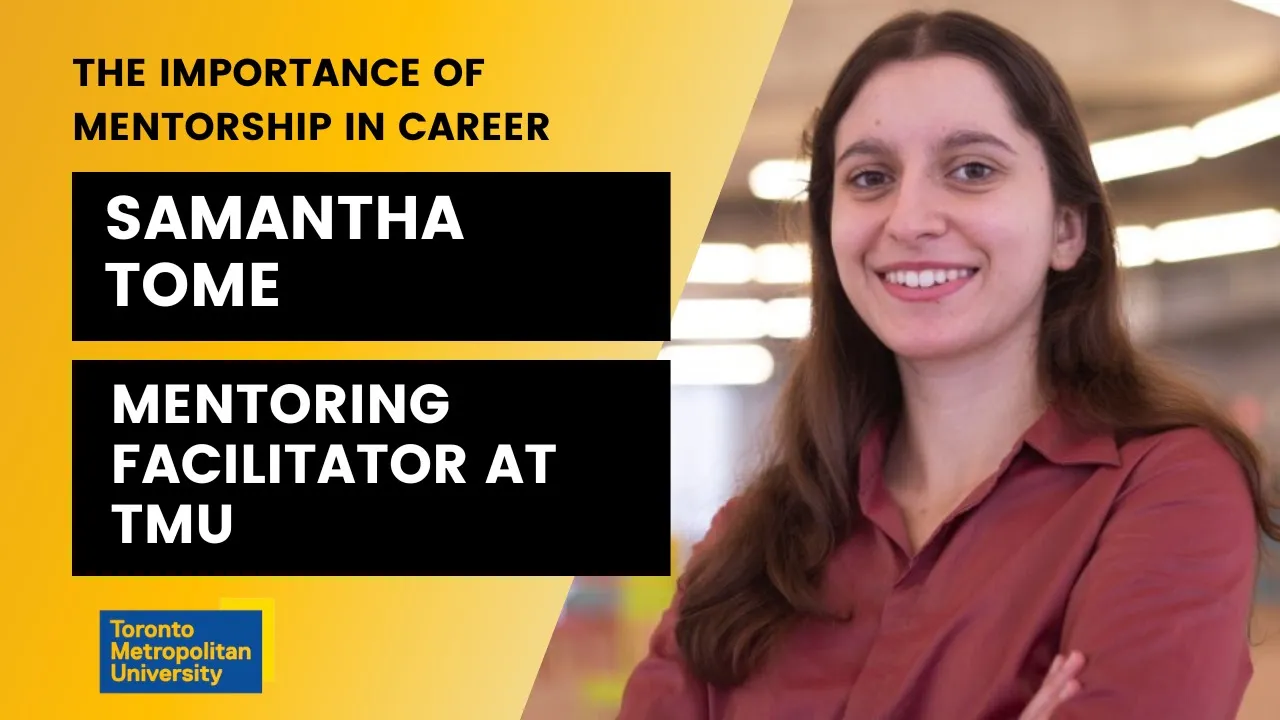
hi Samantha we're so excited to have you on today's episode and to learn more about your career Journey so thank you for being here it's lovely to meet you thank you for having me of course so I'll just jump right into our first question for you Samantha how did your post-secondary journey lead you to where you are today well honestly my post-secondary journey wasn't a very smooth one and I didn't expect this where I would end up at right now I did biomedical Sciences as my undergraduate degree at Toronto metropolitan University which is formerly known
as Ryerson University I went into University thinking that I would eventually become a psychiatrist I knew that I was really interested in mental health and I thought that was probably the way to go admittedly because I saw that they made a decent amount of money so that was my pressure and my push at first but I think I quickly realized that the job would not fulfill me enough because it's quite transactional it's an important job but I really wanted another way to get to know people properly and to get to have more opportunity to interact
with them and I ended up minoring in psychology as I realized I loved learning about other people and the way we all think and how to best interact with each other I worked as a student staff throughout my undergraduate degree in a couple of different roles at the University and I eventually landed back where I am right now at the time entering program so I worked there as a student staff previously and now I'm working here full time as a mentoring facilitator I always like to share that my degree in biomedical Sciences might not seem
extremely relevant to what I'm doing right now but I do think I learned many skills throughout University that are applicable to any job that I eventually get in terms of organization time management resilience teamwork and all of the other things I'm sure you can imagine and coursework also taught me to work well with others because I'm sure some of you might have felt this so far but you'll be put onto teams with such different types of people and you'll really learn how to be patient with each other and get to know each other and each
other's working Styles and how to respect that and still achieve the goal that you want to achieve by the end of it definitely thank you for sharing and I agree with what you said that it's important to emphasize regardless of the degree that you're pursuing that any University degree will set you up with very important lifelong skills so I like that you touched on that and I'm going to pass it up to CC to ask the next few questions by Samantha second question is it is clearly evident that you are passionate about Student Success and
Leadership how has your passion positively impacted you while working in the field and what advice would you give to Young individuals who are still searching for their passions and interests this is a great question I'd like to start off by saying there's no clear-cut answer to some of the things that you asked and I want to make that really clear but I think part of why I'm so passionate about Student Success and Leadership is because I remember what it feels like to be a student and at times how hard it was to balance work school
personal expectations parental expectations societal expectations right you have all this pressure coming from everywhere and you're trying to do a million things at once at times and I find myself often reflecting on my past self and trying to remember what would I have appreciated you know what type of Mentor or what type of support would I have appreciated so that gives me a lot of Drive in my current job right now the passion is what keeps me going because like any other job it can get tiring there are lots of different programs to balance lots
of student staff that I oversee right now and a lot of emotions because a lot of students that I'm interacting with are unfortunately often in distress so it's amazing to be able to give them a place where they feel comfortable to reach out and to speak out on what they need in that moment but it can be can be tiring quite honestly um but again the fact that I love the job the people that I work with and the students I interact with really helps keep me going in terms of advice to give to Young
individuals who are still searching for their passions and interests I want to say don't be so hard on yourself I know I was talking about all of those different expectations and the pressure that's all around but keep in mind that it takes time to find your passion and your interests I think I'm still finding mine right like I am passionate about my work and I love what I do but I also don't think we only have one great passion I think that's almost a misconception that's out there that we have we're constantly striving to find
our passion as we always say and I think it's okay to feel like you can have multiple and you know be patient with yourself as you search for that and try to figure that out because that might not be something that you figure out while you're a university or while you're in your post-secondary degree or wherever you are right whether you're already working in the field it takes time so be kind to yourself thank you so much for that as a student I can definitely attest to that student life is tiring and stressful some I
might have not made it here without mentoring facilitators like you so thank you and the next question being a mentoring facilitator requires interpersonal communication and technical skills what advice would you give to Young individuals looking to start their career journey in such a field with a wide range of required abilities there are a couple of things I want to bring up for this question actually the first recommendation that I have is actually volunteering I know in Ontario volunteering is a requirement for high schools I believe it's for all high schools and I think a lot
of students treat it like it's a drag unfortunately you know it's one thing you want to get out of the way but I would really recommend volunteering in a variety of areas because it gives you opportunities to learn new skills to strengthen your other skills even before you start getting any sort of paid employment so I'll give you folks a couple of examples I volunteered at an English as a second language school and I did a lot of administrative work there so that taught me how to work very quickly I volunteered at the Toronto Public
Library to tutor young children in reading and writing and that really taught me empathy and patience and I think that was probably the first glimpse of my love of helping others to achieve their educational goals it really stood out to me that again I wasn't just doing it to fill out my paper for high school of those hours you have to complete but I found myself just really loving it and then another example is I volunteered at some fundraising events at my local church and I was able to start to hone in my leadership skills
there as I found myself naturally taking a leadership role and directing other volunteers and making sure that everything was going really smoothly so these are a couple of my own personal examples but all this to say volunteering can be such a great opportunity for you to start to learn some new skills okay so that's my first one I know and I recognize that it's hard to do this but I also would recommend if at all possible to get a part-time job during school I know of folks who they want to focus on school and then
they want to go into the field and unfortunately I hear of a lot of them really struggling if they don't do any sort of part-time employment until they're done their undergraduate degree for example um because they they weren't able to hone in a lot of skills that you can't necessarily learn just within a classroom right so as much as I recognize it is a privilege to be able to have enough time to get a job it also teaches a lot of good time management and it helps build up a lot of those skills in advance
of whatever career you want to get into and the last thing I wanted to mention is definitely show your employer that you're open to learning on the spot you can't expect to have strengthened every single skill needed for a given job before even starting it in fact I wouldn't even recommend going into a job like that because there won't be enough room for you to grow and learn so that's a big piece I wish someone had told me previously but no one's expecting you to know everything just really show people that you're willing to learn
you're excited to learn and you're going to be proactive of either Googling things or looking up or asking questions around to be able to excel in whatever you need to excel in thank you so much for that yeah volunteering and you I know a lot of my friends personally treated volunteering in high school like a drug but it really does give you a lot of skills and so there's part-time appointments during undergraduate and I find it very hard for employees to go into a job and then be able to understand everything on at the job
before asking questions and the next question you worked as a development and communication intern while you were in University how did the skill set acquired from that role contributes to advancing your career in the development and Student Success field for some context I was a development and Communications intern at a shelter for at-risk and homeless youth here in Toronto called Horizons for youth it was actually just one summer that I worked there but it was an extremely interesting role when I applied for this role I actually felt like I was missing a lot of the
required skills for it but I was really interested in it so I prepped a lot you know prepared for the interview really updated my resume all of the things I possibly could do and eventually I landed the role which was exciting what is what stood out to me about this role was how much learning I really got out of it so like I said technically I didn't check every single box in terms of what they were expecting for the role but that also made it really exciting so I found myself doing social media posts and
campaigns I was writing and sending out grants applications to try to get funding for the shelter and I even hosted their very first virtual silent auction so what this role really taught me was actually to not be afraid to try new things and to ask lots of questions so it goes back to what I was saying a little bit before and just note that a good supervisor will support you and they'll be patient and kind as you ask lots of questions and as you're learning and just because something hasn't been done before doesn't mean you
can't try it out now so those are big things that stood out for me in terms of how it helped me prepare for what I currently do it really taught me as well about taking a holistic approach when assisting someone so the reason I mentioned that is what stood out to me so much about this shelter in particular was that it taught skills to its youth so as opposed to just giving beds for example to homeless youth it would also have different workshops on cooking budgeting and lots of other great life skills that are important
to know and this was to help ensure that they could end the cycle of homelessness so I find myself constantly thinking of that when I'm assisting a student or assisting anyone within the Student Success field so I'm really thinking about okay if they're coming to me sharing that they're really struggling academically I can definitely provide them with some resources at the University that can help them with that but I also want to dig a little deeper and to find out if there are other factors that are contributing to this challenge so for example are they
struggling mentally right now are they struggling with their physical health are they feeling a lack of community or belonging on campus and then based on what they share there I can make really good recommendations hopefully that they will find helpful but these are a couple of lessons that really helped me now in my current field even though again you could argue that these are two very different fields in a way but you really can just find ways to make those skills interchangeable thank you so much for sharing and for your advice for the last question
I'll pass it back to Sophie thank you Cece and thank you Samantha for those insights I really appreciated hearing your input on all of those different topics thank you for sharing our last question for you Samantha as someone who has transitioned from being a mentee in University to a mentoring facilitator how has this journey influenced your perspective on the importance of mentorship and empowering the next generation of leaders so I feel like I had to create a unique experience because of what you just mentioned I was part of the try mentoring program where I currently
work in such a variety of ways I was a mentee in my first year I was a career mentee in my third year and then I became a career Mentor when I graduated so I've been in the program in a variety of ways and in a variety of programs within the trial mentoring program so we actually have a couple of different programs in there but what I found really interesting or helpful for that is it gave me such a different perspective in terms of being able to see like what it feels like to be a
mentee and what it feels like to be a mentor and that helped me now in my mentoring facilitator role really try to constantly think of that and think of how to improve the program and how to make people feel comfortable and hopefully safe within the program to to be themselves and to develop the skills that they need to hopefully be as successful as possible whatever definition of success they have I also just overall see the importance in having mentors I'm sure some folks have heard this before but both formally and informally it really helps to
have mentors that you can look up to you can comfortably ask questions to and I would consider a couple of my past supervisors my mentors I would never have imagined myself to be where I am right now supervising student staff when at one point I felt like I was going to drop out of the university and I would attest that some of these mentors again some of them were informally I wasn't really matched with anyone but they helped me realize that I was resilient I am intelligent and I could really do whatever I wanted once
I was determined so once I finally put that in my head it really made the world of a difference and what I think makes an excellent Mentor is their vulnerability so sometimes sharing that they also struggled in school or things were not perfect on their end as well it just really helped me feel like it was okay to not be okay sometimes and so I just want to highlight that mentorship should never be ignored it's something that can make the world of a difference to your academic life your professional life your personal life Etc and
just remember that you need others at the end of the day so find your people find your community and I hope that helps amazing thank you so much for sharing that and I can only imagine how much better of a mentoring facilitator it has made you to be on the other side of it in the past as well so you can gauge what you think your mentees need as you did in your past as well so that's the last question that we had for you thank you so much for being a guest on the cast
today Samantha I'm sure our listeners will really benefit from all of the career advice and understanding the importance of mentorship in their future so we really appreciate your time and thank you again thanks so much for having me
![Visual Calculations in Power BI - DAX Made Easy! [Full Course]](https://img.youtube.com/vi/JITM2iW2uLQ/maxresdefault.jpg)


![DAX Filter Context Basics [Full Course]](https://img.youtube.com/vi/Rpa8mDH7mes/maxresdefault.jpg)