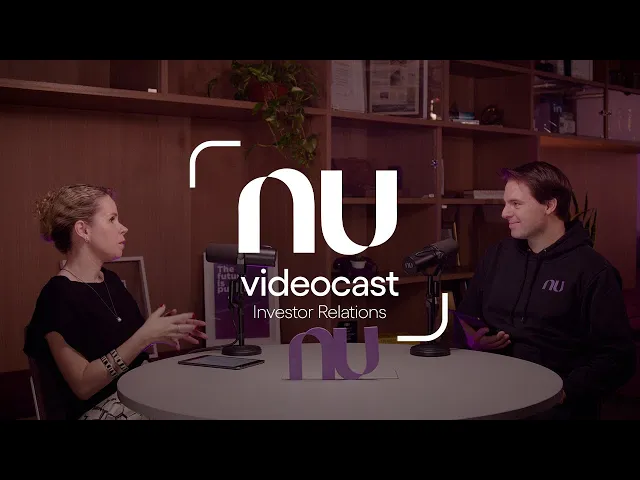
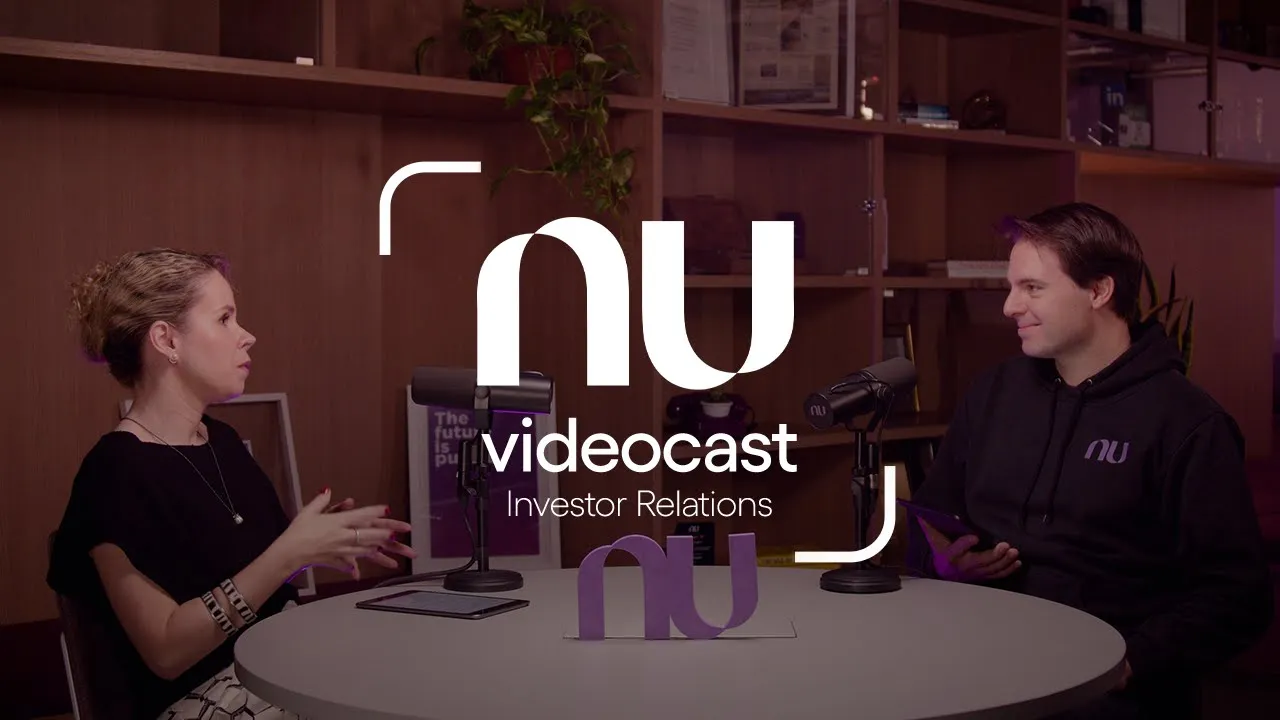
Hello and welcome once again to the Nu Videocast, powered by the IR Team. My name is Jorg Friedemann and I am the IRO and Senior Director for Market Intelligence and ESG at Nubank. Today is a big pleasure to have here Livia Chanes, who is our CEO for Brazil and is here to talk about segmentation at Nu and its implications for the business strategy.
Welcome, Livia. Thank you, Jorg. Hi, everybody.
It's a pleasure to be here today with you. It's our pleasure to have you here. And to start the conversation, Livia, we already surpassed 95 million customers in Brazil.
And this is just Brazil. Beyond, we have 10 million more coming from Colombia and Mexico. How has this impacted over time our business proposition?
Perfect. It's pretty crazy to just think of the scale that Nubank has reached in such a small amount of time. Right?
When we launched, back in 2014, 2015, it was a purple card that you could manage through an app with a pretty cool brand. It was mostly, adopted by tech savvy young Brazilians. Since then, we not only added more products, and there are some important milestones in that way, especially the launch of Nu Conta in 2017 that actually unlocked this growth beyond what we could do in terms of credit approval on day zero, we just started to see this growth become more and more exponential.
Our scale has reached more than 56% of the entire Brazilian population, which is massive. I'm going to talk about under 18 as well, we are growing a lot in this population. And we're just adding more products into the mix as well.
So we're growing multiple axis is actually, not only in terms of number of customers, but also in terms of engagement and in revenue per customer. And we're also happy to say that we're sustaining a very, very high level, industry leading levels of NPS, which is the fuel to our growth, to our business model. Perfect.
And you mentioned about this exponential growth. By the time that they arrived here in 2022, we had approximately 45 million customers. We are now at 100 million.
Over the last 12 months only, Nubank has grown approximately 21 million, which was more than the five biggest banks in the region combined. Is there a ceiling for this exponential growth? Well, the ceiling is the size of the Brazilian population, right?
So, certainly, there will be a ceiling. Unless, as I say, Brazilians start having many more babies right now. But we're still not seeing any signs of the saturation.
As you mentioned, the growth rate remains very strong, even if our penetration levels surpasses 50%, as I mentioned. What is interesting is also that our cost of acquisition remains flat. So, we're not seeing the need to actually inject more money to bring these customers.
What we're seeing is that the brand became so strong, and the value proposition is so well known that, you know, more and more customers are getting attracted, to join Nubank as customers. Of course, we have some populations in which we're still not at that level of penetration. As I mentioned, under 18 is an important growth avenue for us right now and in the future.
And, within SMEs, we are also seeing a very strong growth. Perfect. And by the way, can we deep dive here a bit more about the segmentation of customers we currently serve?
Of course. So, as we started to reach such a massive scale, we observe that as the Brazilian population, our customer base was also becoming slightly heterogeneous, that we had customers with different profiles, and that we had to think more granularly about what we would require to serve them, to be able to sustain the level of relevance and customer love that we intend to. And there are some fallacies that I want to make sure I just dismiss upfront, because some people still think that Nubank is mostly a bank, a solution for young people only.
Young, 20 year-olds. And some people also have the impression that Nubank is only for mass market. And that's not true.
When we look into the customer base, we have a very good distribution across income bands, for example. So just to give an example, we estimate that two in every three Brazilians that have an income above 5000 reais per month is already a Nubank customer. Of course, we have a massive penetration in mass market as well, right?
And this is the core of Brazil, that is 90%, between 80 and 90, depending on the take that you use of the entire Brazilian population is what we call mass market. We also have a very important representation of under 18, as I was mentioning, we surpassed 3 million customers with that profile, more than 4. 5 SMEs.
We have more than 4 million customers that are retired or over the age of 60 years old. So, you know, pretty much everything. And, we said, okay, so the Roxinho alone is not going to be enough, right?
How can we become a little bit more flexible and incorporate the needs of this specific subsegments within our product? That's when we created some of the new businesses, new brands and new tiers that we're now starting to scale. I think sometimes that the fallacies they are born because people have some difficulties understanding the model.
And the model resumes to the cost advantage that we have. Yes. When you are the lowest cost manufacturer in the industry, you can serve different pockets of the population other players cannot, and still have very compelling prices and make more attractive returns.
Yes. So, thinking about what I have seen so far in the IR, and they think our internal surveys corroborate that quite well, because our quality of service is superior and because we have better prices. Exactly.
And the materialization of this advantage in terms of economics will be different depending on the segment, right? For for mass market, for example, it allows us to have much more inclusion, to be more effective not only in prices but also extending credit to people that elsewhere it would be unfeasible to do, and to onboard these people in a profitable manner. Whereas in other higher cost models, they are just unprofitable customers.
So, it's pretty interesting the difference, how we kind of reinvest, this efficiency there. And, if we take a different example, in the other extreme of the spectrum, for high income, which is clearly one of the most profitable segments that we have historically in the industry in Brazil, we're able to provide more benefits, better solutions, and leverage our software development skills and our flexible platform to innovate in the products that we offer them. So, it's the same advantage, but translated into different value propositions depending on what matters the most for each customer segment.
So, let's take this hook and deep dive in each of our segments and our differentiations. Let's start with the mass market and what we are doing to better serve the segment. So, the mass market is is the core of Brazil, right?
As I mentioned, and of course, it's a big, big chunk of our customer base. We estimate more than 80 million of our customers to be what we call mass market customers. And, within that segment, it is super important to deliver two things.
One is to make it possible for them to make the most out of their money. They are very income constrained. And, just being able to provide efficient solutions, low price products, affordable products to them is not only an advantage, I would say it's what is mandatory to be able to sustain those customers, and sustain a healthy relationship with them.
The second thing is access to credit. We know how important credit is for the Brazilian population. It's almost like a cultural thing.
So, being able to provide sustainable credit solutions for them, either through the credit card platform or through lending platforms or adjacencies, like with innovations like the PIX financing solution that we have in our portfolio is also extremely important. And, of course, in mass market, we're always going to have two types of customers, customers that have access to credit, so, our objective there is to make sure that they have a sustainable relationship with those products. And, customers that do not have access to credit, that need to get approved.
And we have a full suite of products and experiences to actually help those customers get back on track and access credit. One example of that is our secured card product, in which customers can have a little small deposit to back up their purchases to show their behavior to us, and then we grant very small limits, starting at 50 reais and we go step by step with them until they understand how the product works, until we understand their behavior, so we can reinsert them in the market and give credit to them again in a sustainable manner. So, this is what we do.
Of course, there are basics that sometimes we forget to mention, but also at the core of the value proposition for Nubank, which is a very good level of customer service and a very intuitive app. We know some of the mass market customers also struggle with complexity, right? They don't have much time.
And I think being able to support them, to give them the confidence to experiment new products that beforehand they might not be able to afford, and to support them when they need, and also to have an app that is very intuitive that any person can actually feel confident dealing with is also at the center of our value prop. Yeah. As we learn when we join the Nubankvery quickly is that for us, it's always Day 1.
So, we never accommodate. We never do. And the good thing is, given that our cost is just it's 85% lower than some, competitors in the industry, we are able to provide excellent levels of service to these customers that elsewhere are seen as non-profitable.
So, it's really what what ties the entire thing together in fosters customer love. Which is our north metric and what we try to solve for. And in a word of choices customers will always gravitate towards companies that treat them best and offer them the best products.
Exactly. So, let's now talk about our supercore or mass-affluent customers, and how do we treat those customers and what we can provide of differentiated products for them. Perfect.
It's interesting because some people ask me: “Oh, is Nubank changing strategies? ow they're focusing on mass affluent and affluent customers. What is this about?
” And, before I answer your question, I just wanted to say that those customers, many of those supercore and high income customers have been with us since 2014, since 2015. And what happens is many of them have succeeded, have built their wealth and became also more mature. Now they have families, they have other responsibilities and explicitly addressing those customers as a separate segment was super important for us to maintain the relationship and the sympathy that they already had for us.
And so supercore, going back to your question, which is basically customers that, have an average income between 5, 12 to 15,000 reais per month, are customer that, different from mass market, they have already a more important need to think about investing their money. Still early stages, in more simple solutions, but still they already built some wealth. When we hear from these customers, it seems that they say: “I feel I'm at a different stage right now and I need more than what I used to.
” So, having a little bit of more structure to invest and to save their money and some, guardrails, that is important. They also feel that they became more valuable customers, so they expect more benefits in exchange of their loyalty. So, what we did was to turbocharge the Roxinho value proposition by launching Nubank+.
Nubank Plus, in English. Which is a tier in which customers get up to 0. 5%, of their credit card expenses in cashback.
They also have some special discounts, and special conditions in some products, including a partnership that we have with Max, the streaming service, that they can access at a discount by being part of the Nubank+ tier. And we're seeing a lot of important impact in terms of how those customers perceive the value and how much they kind of bring more principality to Nubank once they become Nubank+ customers, and they spend more on their credit cards and the NPS goes up, which are everything that we wanted to see. So, still a long way for us to really get that product exactly the way we want, but the early days are very exciting.
Perfect. So, now, let's talk about one of our core priorities for 2024, which is our approach towards high income. So, can you describe a bit of our strategy and how we are progressing in this segment?
Perfect. Of course. High income and SuperCore together, they represent roughly 40% of the entire revenue pool of Brazil.
So, they're massive, right? And you know, roughly 50/50 between high income and SuperCore depending on the specifics of how you define them. But they are just so important.
It's not that many people, if you look into the representation of the overall population, we're talking about 10 to 15 million Brazilians. But, the the relative value is massive. And, so, creating and crafting a value proposition for high income was super strategic to us, not only because of the intrinsic value, not only because many of them were already customers of ours, as I just described, but also because it also brings an additional layer of aspiration to our brand and to our product suite.
Differently to what we did to supercore, , for which we turbocharged Roxinho, as I was mentioning to you, for high income, we decided to launch a sub-brand which is Ultraviolet. So, it's Nubank Ultravioleta or Nubank Ultravioletviolet. And the reason why we did that is because the high income population not only has some specific product needs, which I'm going to cover in a second, but it has a different affinity and lifestyle.
So, we thought it was truly important for us to have that very explicitly in the offer that we were providing them. So, once you become an Ultravioleta customer, not only you get access to a specific, a different credit card, it's a metal card, it's a different card design, which actually, earns 1% cashback that earns 200% of the CDI, for your credit card purchases, but also you have a different app experience. So, when you open the Ultraviolet app, you see a different color scheme and different products.
So, let me give two examples. First of them was the launch of our international account that allows our customers to have access to different types of currencies very seamlessly through our app, manage those deposits within the same application, have interoperability between the accounts. The global account with Wise, right?
Exactly. The partnership with Wise, this is what I'm referring to. And we're also giving customers that actually have our global account access to data roaming services up to ten gigabytes for when they travel.
They don't have to worry about, having. . .
. As IR I am already using by the way. Oh, that's great.
That's great. And this is what I was referring to, we’re talking about simplicity. So you don't have to worry.
When you travel, you know Nubank is going to have your covered. Because you already have the account, you already have the gigabytes. So, you don't have to think more.
Because, you know, what we learned that high income customers are just so busy, right? Their lives got so complicated that the most important asset to them is time. And, we want to protect them so they can have time back.
And we take care of the money and of the lifestyle. We also integrated within our app through partnership with Hopper, a travel marketplace in which customers can get access to hotel reservations, flights, and some experiences directly within the Nubank app and also having some special conditions. Someone told me that, when you talk about high income customers, more than 40% of them here at Nubank are business owners.
Is that true? And can you please elaborate on that specific strategy? Yeah, that is true, Jorg.
And it actually is also true in terms of market structure, not only for Nubank but there is a very important representation of business owners within the high income population. And that's great because our SME product portfolio is also becoming very, It’s much more complete and comprehensive. Over the past years, we've launched a bunch of new products.
So it's a good synergy for us. And, we do intend to explore that, of course, one of the things that we hear from business owners, which for me is very interesting, is the fact that the most important reason for them to choose the financial institution that they are going to choose as their primary account is if the institution has a solution for their businesses as well. So, you know, it's not an option for us to stay out of SME.
It's just something that our customers expect, in high income but not only. Yeah, and just to put things into context for the audience, the holy grail of our model is getting principality. Why?
Because a customer that has developed a primary banking relationship with Nu generates three times plus more revenues than non primary bank accounts number one. Has lower price elasticity, number two. And generates levels of delinquency that is 48 to 49% lower than for non primary bank accounts.
And as per what you are describing, Livia, chances are that if you get the relationship with the SME account of this business owner, probably the personal account you will increase the chances for me to get to principality. You're absolutely right. And what we try to do, which is pretty unique, is to look at that customer in a holistic manner.
So, for example, a business owner at Nubank can transfer the limit that he or she has in their personal credit card to their business credit card because one of the key pain points of the small business, especially when companies are at early stages, is that they don't get access to credit. Because none of the banks will trust them because they don't have historical data. So, we give that flexibility for them to invest in their own businesses.
Which seems quite simple, but it's very innovative. And more recently we just launched the so long awaited working capital product, which is so massively important for both principality and for the customer love for the segment. So, we're sophisticating this product to their needs.
And given that, this segment is pretty underserved across the market, we're seeing also very positive results. I remember that before we launched the working capital solution for SMEs, when we tracked why people were getting a personal loan with us on their personal account, more than 15% were getting to finance working capital. We launched, the Money Box solution then we translated that to the SMEs as well, to provide them with an investment solution.
So, this is simply fantastic. Well done. Absolutely.
It gives us so much flexibility. And, finally, our most recent segment is under 18. What we have to talk about for the under 18 band?
I'm just so excited about this under 18 population, not only because it's proven to be a massive growth avenue for us, and I'm going to talk about the numbers in a second, but also because we've seen so many great brands just get dated that when I see the amount of demand that the under 18 population has for a Nubank, it's very reassuring that we're doing the right thing and that we're creating something that is not going to last for one generation, but it's going to be pervasive and sustainable over time. We haven't spent $1 dollar or real in marketing for that population. So it's 100% organic.
Either to MGM or through the referrals of the parents, as parents need to get the approval for the under 18 customer to have access to the account. We are seeing higher levels of activity in that population. Our activity levels are already very high, above 80%, 80 to 85%, depending on the subsegment.
And for under 18 It's even higher than that, a very high level of engagement. And we have already more than 600,000 customers that graduated, that became over 18, and that are now customers of Roxinho and got access to credit and are learning to be “adult” customers. So it's really interesting to see the importance of that kind of solution, not only for us as a growth avenue, but also in terms of financial education.
Because we're seeing that that's being used by families as a tool to talk about money in a sustainable manner, to teach children and teenagers on how to save. We have the Caixinha product within the under 18 account as well. And, it's pretty, pretty interesting.
One of the things that we did also, that has a very high level of customer love is the fact that the parents can control and can have visibility of where the under 18 customer is spending their money. So, you know, we really seeing that as more than a product, but also a kind of a tool for family talks. Yeah.
Once again, it talks also to our ESG purpose. I have a directorship of financial inclusion, financial education and what they have been doing, goes beyond, financial education because, it really embraces a generation and empowers them to, from the beginning, know how to use and treat financial services on their behalf. Exactly, exactly.
Speaking of the future, now, Livia. What is next for our Brazilian operation? We have so much to do, right?
It looks like you know, we’ve done a lot. But when we look ahead, there's just so much for us to do. I think we talked a lot about the segments here today, and this is certainly something that we still want to strengthen a lot.
I think still very early days for both Ultraviolet and Nubank+. We have a lot planned for those two tiers in terms of new product launches and growth. So, we do expect to see a lot of traction coming from those demographics in the future.
SMEs, as I mentioned as well, we just launched Working Capital, which is a massively important product. We're moving upstream to slightly larger companies, what we call small companies. Most of our customer base today are micro companies, so, we're doing a lot in that respect too.
We expect not only the average revenue per customer to grow, given that we're extending the credit offer, but also the relative size of these customers to also grow. So a lot for us to do there. And even in mass market, our market share for many of our products is still much smaller than what we consider to be our fair share, which is our principality share within that population.
Many of these products are very recent, so it's just a matter of maturity until we can increase that penetration. So there's so much for us to grow that it’s very hard to even say what to do first. We're doing a lot at the same time.
And it's exciting to see that this 100 million customers are becoming more and more of our customers, right? Because I think the 100 million is just the first step. We need to kind of keep improving our relationship with them, keep deepening the relationship with them and regaining their trust every day.
Great problem to have. A great one, yes. Livia, I learned so much and enjoyed so much this conversation.
So, thank you so much for coming here and sharing a bit more about our strategy for Brazil. I am pretty sure that our audience also enjoyed quite a lot of this conversation, so stay tuned for the next episode. Thank you, bye bye.
Bye.