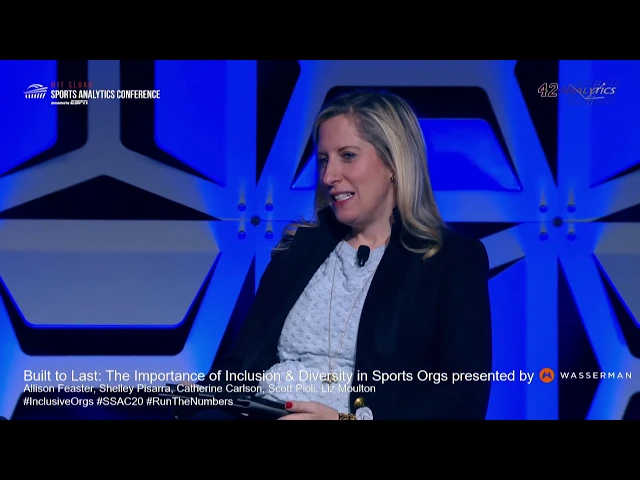
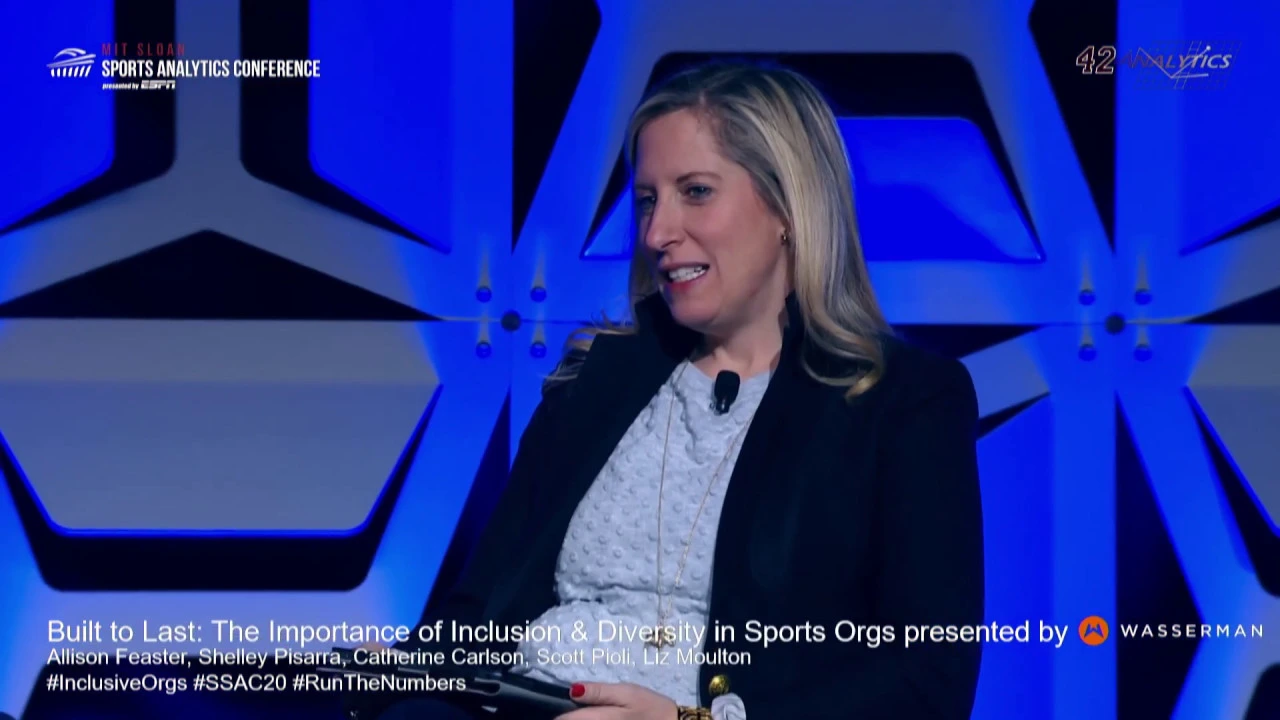
My name is Maggie riddle I am a first year MBA student at MIT Sloan and it is my pleasure to introduce the next panel built to last the importance of inclusion and diversity and sports organizations sponsored by Wasserman this panel is also a part of the business track sponsored by Ticket Master the panelists today are Allison Feaster director of player development and personal growth at Boston Celtics Shelly pizarra EVP of global insights and strategy at water demand katherine carlson SVP of revenue and strategy of the philadelphia eagles and Scott Pioli former NFL executive and television
analyst this panel will be moderated by Liz Moulton co-lead of the sports business practice at Spencer Stewart the panel will be 45 minutes long with 10 minutes at the end for questions if you have any questions please put them on Twitter and using the hashtag inclusive Boards with that I'll pass it off to lives thank you thank you everyone for coming on Saturday morning the origin of this panel has been well it's something that's been long in the making and over the years here at ssac and the idea behind it is that we in sports
really have a lot of good intention to try and diversify our front office's and the business side of sports and we're still falling very flat you see through the lapchick report and Others at the greens that sports leagues and teams get are still well below what they should be so we have an amazing panel here that exemplifies trying to achieve that dynamic I'm gonna have each of you introduce yourselves and then we'll get into a good discussion I'm sorry Alison awesome Alison Feaster director of player development personal growth at the Boston Celtics Shelley pisarra I
lead global insights in the strategy globally Katherine Carlson I'm the senior vice president of revenue and strategy at the Philadelphia Eagles Scott Pioli I'm currently under employed I work several different jobs as a consultant all for CBS but 27 years in the NFL is an executive great okay thank you guys there's a lot to talk about how each of these people have made a huge difference in this dynamic of diversifying and we can talk a little bit about we should talk a little bit why diversity is So important in so many ways from a business
perspective a moral and ethical perspective and just as our world continues to evolve but there was an article this year in the Wall Street Journal I got a lot of traction about the Philadelphia Eagles having more women in the front office and the business side really great article I was very proud to have been a part of recruiting mm-hmm several of those women there what what is your experience been Like to go to as a career in your career generally as a woman in sports and to go from the MBA and MBA team to an
NFL team and the importance of women leadership well it's an interesting question I'll actually go back further than my NFL and NBA experience but I started off my career about 25 years ago and I I was in Australia I grew up in a small rural town and I had this passion of a sports and where there was this new sports degree and it was a master's degree in Sports management and I distinctly remember about my first week at classes I had a professor and he said something and it really stuck with me he said half
of you are gonna have to work twice as hard to get half as far I said what are you talking about and then it dawned on me that it was half the room it was the women in in in the young classroom so I definitely have a little perseverance and determination I'm not gonna let this comment throw me Off my aspirations to work in sports as a woman but then I started my my my career in rugby league in Australia and I was the only woman in the entire organization and it's a very not uncommon
in in our industry however building credibility in a sport like rugby league if you see rugby league players and the big guys then I can plant work in the NFL that's a whole different story but one of the challenges that I had from a credibility Standpoint as a woman in sports was that what does a woman know about rugby league if I gave you a dollar for every time the guys in my office would say what does a woman in Australia you say what does a sheíll I know about rugby league it was really frustrating
so I actually went out and got my coaching certification rugby league you may not not from this physique a qualified rugby league coach and the amount of credibility that Builds when you're you know trying to start out your career it was just a little taste of what was to come throughout my career and so do to show up to the you know I've worked at various organizations along the way some very diverse like the Walt Disney World company was one of the most diverse companies that I've worked for and quite frankly it had to be
you know Disney welcomes over 100 million guests on annual basis they have to make sure that They're their staff matched that and I thought so I learned a lot about diversity inclusion through that but then fast forward to working had an opportunity to to come to the Eagles and my first first day on the job a show up to the executive team meeting and four out of six of our senior leadership are women and that's a rarity in the NFL I think it's evolving and I'm happy to be part of that but that's definitely an
exciting development in our sport and it Gives me hope for everyone out there that there is opportunities for women in our industry one of the things I want to say about that is almost every search I lead I'm doing two right now for CEOs of pro teams they say I really want women leaders every search and the challenge is actually that there's not enough women leaders coming up so that's a large thing we have to address but Allison talking about credibility and being I was talking to rich Gotham Yesterday about your rich Gotham's CEO of
the Celtics about plucking you into the basketball operations I think one of the most poignant things this year has been about how the sport of basketball is actually such a the men and the women really Revere each other and it was kinda came out so much with Kobe and his daughter but I think what that showed was that you know Sue Bird and others we know we're at this conference are really and you are really respected by the men But there's got to be ways when you walked into the front office the bass cooperation is
going to show credibility to well you know I come from a culture of a company that really was deliberate and is deliberate about you know including women and and having diverse faces you know throughout the organization I spent before arriving with the Celtics spent three years at the NBA where you know the leadership is a top-down thing Leadership really stressed you know having diverse faces all around Adam silver and including women and diverse faces wanted to include former players and then mix as well because there might not have been enough you know across them on
the business side and the best of operations out on the teams that as well so and you know those types of leadership you know deliberate decisions where you know you target specific you know organizational you know Representatives like like former players so it's it's been great for me I haven't really faced any adversity so to speak on being one of the few women on the bball outside I'm really used to being one of only you know throughout my life throughout my career so it's been you know time after time practicing you know for this moment
but coming to the Celtics it's been a very smooth transition rich Gotham Danny Ainge Brett Stevens all of them have been very Open-minded very welcoming and very you know eager to hear a different voice and it comes from the top and Adam has said has me publicly said he would like 50% of all NBA congratz to be women right you did mention that and I think that's you know it's a it's a very great very bold statement to make but I think what's most important is that we get the right people you know in the
positions and a lot of times women haven't had access to certain roles officiating Being one of them you know in the past definitely coaching where the NBA now has 11 you know women sitting on benches tons of others and player development roles and in for an office role so you know little by little step by step we're making great strides in the NBA and across the league office and across the team side and giving access god I think that's one of the big lessons from all of the amazing work you're doing I do you think
the NFL generally as a Sport is just behind where the NBA is in terms of driving diversity generally women and people of color but can you talk a little bit tell the crowd a little bit about your the work you've been doing on equalizing the playing field and getting more women into leadership roles and people of different backgrounds - not just women yeah I you know I just have I've always been a part of football my entire life and from growing up as a kid It's supposed to be a very inclusive sport right everyone is
supposed to do everything together then as you get older you realize that we're inclusive for only certain segments of the population I've been very intentional in the work that I've done but without getting into the long details of stories we shared back behind stage some of the reasons just the bottom line is I have two sisters that were better than me in every way and more accomplished in every Way and they had very very limited opportunities as opposed to me and that always stuck in my head as to how fundamentally wrong that was and I
just I've always known that I've had this privileged looking like I do and I've just never thought it was very fair or that it should be that way so I've just spent again without getting into all the details now because it'll take far too much time but I don't understand I hear we were talking back to stage two about This whole idea that it's a great business model and yes it is we all know that we all know those statistics that have come out about more diverse organizations or the B gender race the gay lesbian
community how it helps in terms of the business model but now that we know all that that's never really been my driver to me it's just been something that's supposed it's fundamentally right to just do the right thing of course it's a good business Model and I understand some of us have to talk about it being a good business model but why anyone else up here on this stage or anyone out there shouldn't be involved in football or have an opportunity for about whether it's coaching whether it's on the business side or football operations and
I think part of my my goal and mission is it's interesting Catherine you know you're on the business side and I think when we look at the lab chick report and we look A lot of the work I think the way that some of the major sports and my sport included which I love dearly the way that we hide these things is we we hire people in certain segments of the organization say or or the operation within football and different NFL teams and say wow look at whatever what a wonderful job we're doing here but
then when you look at the football side of the house the limitations that we have with coaches trainers video Scouting front office it's just not necessary and you know when you mentioned Catherine which you had to go through when you've been told that well how do you know you've never played the game well with all due respect there's a number of head coaches and general managers assistant coaches that have never played the game at any level let alone just college that's never it's never a reason it's just an excuse I want to get to the
data behind it with Shelley's doing some insights from Wasserman about diversity what do you think of the Rooney rule I think it was well-intentioned when it came out because it's like anything people that look like me have spent a great deal of time in this country creating models and systems that have that generally I will say have good intentions and have a good plan and we roll these ideas out and they start to do a little bit of work but we don't understand that there are People on the other side that are trying to always
find a workaround to make sure that certain rules don't don't work because they don't want to relinquish their power or their their space or they want to eliminate the competition because they're not really as competitive as they say they are so the Rooney rule was a very good idea it was a great start I think we have found out in time that it's not working the way it's supposed to that we need it's just Like any model or system in this country that we create for equality is you create this and you have to continually
let it evolve like our country is evolving and like people that are battling against those rules so it needs a lot of a lot more addressing to make it truly work in the spirit that it was that was meant to have Shelley do you think some of why a Rooney rule type thing doesn't work is because some of the companies and organizations so not Just outside not just in sports but there's like Rooney rules actually in corporate America too is as we know I do searches for corporate America because the companies aren't like authentically embracing
that need yeah I mean at the end of the day and we talked a lot about this backstages if you're not willing to put yourself on the line or actually make it a part of your DNA and who you are that is just Naturally going to happen because it's harder you know you gave that example of half of you're gonna have to work twice as hard to get twice as far and that can be do do you just don't have enough proof points there just aren't enough different voices around the table and that can be
any type of diversity not just women its diversity of thought diversity of background diversity of experience we talked a lot about that in the back in before we came on stage Today too and just bringing new thoughts and ideas to the table now something like the Rooney rule or just even Adam silver statement around 50% of coaches or executive teams you know I've been blessed at wasserman to have an incredibly strong leader in our president Elizabeth Lindsay but also Casey has done a great job of making sure that we have you know a strong foundational
leadership team the thing is is it it did take us a bit of time to Actually put that out and in a business practice we launched the collective this past year and that was actually saying you know what we're gonna drive visibility beyond our own organization and put it into a business practice so drive visibility for women in sports give our brands and properties clients access to information so maybe they need more data more proof points to elevate how they're approaching women as their consumers how they're approaching women As additional voices to bring new ideas
and thought leadership into the organization whatever that might be but it was one of those things saying you know what we've been doing it for 20 years now how do we actually turn it into something and live it and commit and invest in a business to drive that message out and frankly bring honestly a new commercial opportunity to our clients which that kind of goes back to our gonna put yourself on the line or is It just really good business sense you know what the good news is in this case it's both right so from
that standpoint that's I think what we have to continue to do is you know deliver those proof points as an insights leader that's great that's lots of work for us to continue to but also really work closely kind of shoulder-to-shoulder with these leaders and say it makes sense on stoma different levels to really think about diversity inclusion as your business Practice what did the people what do what amend leader what what do they say now where do they say ten years ago I want to hear about that from you to where when you give this
mandate because what I think is I fear sometimes is unlike I've told the story to this panel but I was pitching for a CEO search to cook male co-founders and they said well what's really important about what should we be thinking about on this CEO search and I said you should be Including women leaders and your senior elite of candidates and they this is two years ago and they said why would we have to do that and I thought that was so I meant ten years ago I feel like I heard things like that but
now I don't but do you feel like there's a shift and people still are like why are we why are we ringing this Bell like why are we banging on the drum so hard I think there absolutely is and a bit of it is because we've slowly been climbing the Way up and and do have more voices at the top I also think that because because of a lot of the data and science that's behind it that actually shows that it's good business practice you kind of can argue with it you know prior to watching
when I was very fortunate to work at PepsiCo for seven years under you know a great leader in Indra Nui and I was in marketing as well so there were quite a few women there but at times we would run into barriers and in different Opportunities to share that share that perspective of oh maybe we have to fight a little bit harder or work a little bit differently to to press forward but you had a larger infrastructure and organization around you to to kind of help elevate and kind of lift you up but there's still
programs and the need for mentorship to exist no matter what industry you're in because you need a sponsor you need someone to help pull you up so I don't know that it's as much That there's still a concern you you've given us stories where there can be concerns at CEO levels but you know among senior leadership you have to go down and pull up as much as you know really us standing and kind of supporting each other and in elevating and pushing our way up but the mind shift it's it's it's different it's changed and
you know I have to think it's because we're we're at the table now and that's not changing Kathryn have You had a mentor sponsor to help pull you up oh yes when when I was at at Walt Disney World I had two very incredible women leaders there and they showed me a lot about courage and also you take risks as well and I thought you know great learning in life because my mentor once said she says you realize 60 pips like when when when you're looking at our device Paul for hiring a position she said
most guys will apply for the job if They're about 60% qualified and women will look at the job description and pick it apart and there might be 20 bullet bullets of like what the Job Description is but there's that one oh I'm not qualified I can't possibly apply for that job and so I had some very strong leaders at Disney that said you know what take risks I said cuz you're the guy who's applying for that job that you want he's acting you're actually more qualified than him He's just willing to take more risks and
so I give that advice to a lot of my women mentees that I you know that I give advices take that risk it's okay and you'll figure it out on the job because I can guarantee you don't know everything you're not perfectly qualified for every job I didn't know a lot about NFL before I started at the Eagles but Lee's did a great sales job on me but you know you learn and you take risks and you can exceed in any any Area that you go whether you know the sport or not you have that
you have that ability to grow in the role and we don't take enough risks as women in our industry how did you decide or how do I know you said it was just natural to you because you had strong sisters and but to really stick your neck out there and say I want to do that more things aren't sponsoring and mentoring and how did your peers how have your peers over the years receive that it's it's been Received differently by different people it and I'll be truthful you asked the question it's been as we're moving
forward it's becoming more more embraceable yeah and being embraced more and I think a lot of it has to do with comfort that people are afraid of the unknown right they we've created this narrative of what it would look like if women work in sports you know one of the elephants in the room we talked about is you know how can People coexist in different sexes in those relationships and not you know not let things go to a play in an appropriate place and I think that yes of course there's some of that but I
think that that narrative is also overstated and I think part of part of the reason that it's been easy is the vetting process that I go through in helping people for instance we talked earlier about Katy sours yeah tell her story well it's okay too young I don't Know who knows Katy sours or who doesn't she everybody I will ever know because she did the Microsoft commercial oh by the way before that she was before she was a celebrity she was a football coach he's a football coach so Katy was our daughter's fifth grade basketball
coach in Kansas City and Katy approached me after the first basketball practice of our daughter and started talking football and she was an incredible football fan but an even better football Player and I actually saw her play for the Kansas City Titans which is part of the Women's Football Alliance at the time and she's an incredible player very very smart football player and we just cultivated this relationship and fortunately when I was when I left Kansas City and went to the Atlanta Falcons I had to rig things a little bit but was able to hire
her and the the good news it k-katie was very easy to mentor and to help give an opportunity To because and that's the important part is I did nothing but mentor her give her some confidence because she was going to world where she had less confidence she wasn't as much of a risk-taker and part of that is is the way that why not let's be honest that's how women are treated and you're so our women are sometimes pigeon holed into that space where they're taught to not take as much risk for all the reasons that
we know and Katy just didn't incredible jobs so it Was easy to advocate for her and and and I do want to say this because mentors have been mentioned and and I want think is a very important part of mentorship because I mentor quite a few people and and not just women I work in the space of racial equality again I don't use the words diversity inclusion I believe in equality not University and inclusion is good but I would say this those of you that want to be mentors mentorship is meant to be unconditional Totally
unconditional and and that means in every sense of the word it's not to elevate your platform or to let people know the work that you're doing and and it's also not meant for any inappropriate behavior so if you're going to be a mentor I encourage you particularly those that that look like me because we hold the power is become a mentor be a mentor and please do it unconditionally in Scott won't say this I only knew it because I read the Article about it but he not only helped Katie from a man's perspective Hina's wife
totally gave her to find some financial stability and emotional stability to to go on their way to go on her way I should say we're because one of the challenges I think Allison you know I know the MBA has a program but it's like how do you get started and one of the things that a lot of students at the conference will come up to me and say how do I break in how do I break in And I do think that sports being such an opaque and challenging and not well paying $10 an hour
was Katie's first and a ceiling of 40 hours a week yes stealing forty hours basically how do you live on that at 29 years old at 29 yeah so like it's so impossible for it's like my husband's and politics and he says the only people that can work on Capitol Hill are underwritten by their parents because they don't make any money so you've got I mean that's so Crazy right so how did you how did your this program really help you get a start right it started way before that my mother always encouraged me to
you know really take a long sighted view of things and to really view education and you know networking opportunities and as an investment in myself but I can't say enough about the mentorship piece because along the way there was always someone There too you know advise guide like you know for example Jess Gilman who is a former teammate of mine all sister you know obscure figure who's yeah but you know people like that who as I was trying to transition out of professional basketball and find my space you know on the other side of the
game were crucial in being a sounding board and beyond for me so I would say really in taking the time to invest if you money's always going to be sure spend time to you know Pay for a plane ticket to be where you think the decision-makers are are the influencers are show up at someone's office email reach out call if you're thinking about today then you really have to think about you know what you have to do in the future to prepare for it so I would say really take alongside of you towards that and
it is it's probably generally true about any passion you have because there's so many people in the world who who work three Jobs while they're working on their pet project of like building a tech company and it probably is very true its unless you take the very known path of going into a lucrative role like finance or corporate law or something you're probably gonna have to scrap it together no matter what no absolutely I remember being in Europe and you know kind of winding down my career and working a job playing at a Division two
team you know being a mom and studying for my MBA at The same time and you know if I focused on that moment and I would have lost my mind so you did you do what you do Shelly will you tell us a little bit about the collective because I think it's an interesting initiative that Wasserman's doing yeah so I mentioned we launched it this past year and you know we're in a really privileged position where we represent over 150 of the world's greatest female athletes you know across I think it's 26 sports but We
have our 21 sports over half of you know the women's national team in soccer 26 WNBA players right lots of number-one draft picks are you kidding me we have this unbelievable group of women to tap into to listen to to elevate to bring visibility to as well as Amy in leadership and then we have the privilege of working with you know 400 brands on an annual basis and more properties than I could ever list that Just gives you access and opportunity to say I am going to stand behind this and not just elevate women within
sports entertainment organizations but actually really help brands and properties understand women as consumers not just mom buying a Jersey for her kid if we're gonna just stay in the sports space but actually what trends are affecting her life what is happening you just said this is relative to pressing forward in your Career but imagine you have all of that going on and yet you're making 80 percent of the spending decisions in your house you probably want to be talked to a little bit differently and done whatever you know spray-and-pray mass marketing is going on or
kind of the pink it and shrink it movement that that went through an emergent I think pinking of the jerseys speaking of the jerseys and thinking them but this idea but that that was the answer yeah from a Merchandising it's come so far I sat on a panel yesterday with with Matt Smith from fanatics and they have done a tremendous amount of work to really understand this facet of things but just the idea that we could very easily take that 20 years of work and turn it around and really bring a level of understanding and
authenticity to the marketplace not just in bringing brands and properties together to to meet you know a consumer need but also in Education and conferences and there's philanthropy behind it and part of being at this conference is is very important for it too so it's continuing to again walk the talk and kind of live what what we're talking about and frankly represent best represent our talent both men and women but really taking that that opportunity to elevate the role of women can play in bringing their stories to bear and frankly laying that groundwork you know
may be inspiring Some mentorship and and telling the woman out there who's thinking about breaking into sports and analytics you can do it watch listen to the stories you know call someone have a coffee you know do what you need to do if it's something you're passionate about so we're excited about it there's the lots of tracks you wouldn't believe how many people we heard from in that first yeah in that first month and now we've got some really great projects going I'm In the middle of a gigantic research project that we can't wait to
come out with a point of view this fall and talk more about that evolution over the last 20 years and what we think the next 10 are going to look like how many men like Scot who have like a power and a you know just have a platform because they've been so successful have been really interested and excited about it lots honestly we get more calls from men than we do from women very much so the Majority of the executives we hear from are actually men and it's fantastic I mean it's not maybe it's because
the we've already been having the conversations with the female executives right and and and that's already been a big part of work that we're doing but just saying hey you know what it's not just about the marketing component of it do you have education do you have thoughts let's just talk about this here are some things we're doing we have a You know diversity inclusion council how do I actually put that into my business practice do I want to think about things a little differently what I maybe you know do X instead of Y but
it's more that introductory education type of of conversation that we're having which is really refreshing frankly versus coming in saying help me understand which set of sponsorships I should do next year or or tell me about the performance of some program now we're going in and we're Sitting around a table and you know 90 minutes can get away from us just like that talking about the opportunity to really reframe how we're talking with women and elevating them in the industry so what do you know III would agree I think and again you're all being very
gracious I'm not a unicorn there I'm serious there are a lot of men doing a lot of work in the gender equality space and diversity inclusion space a lot more Than then then come forward and I think part of that is you know for certain reasons i I've never publicized you know what I do but I also think there's a lot of people and as silly as it sounds because it's been the way that things are that there are a lot of people doing the work willing to do the work want to do the work
but there's almost this the silly boy like behavior of peer pressure and not wanting to put your yourself out Front so I think there's a lot of people that are doing the work they just do it in different ways right there's time there's treasure this talent everyone has has some degree of all of those and use them and I think different people are using them but I think it is a lot more common than we hear about and it's becoming more common and it's becoming more acceptable which therefore makes it self-perpetuating but what else besides
can you point to besides Katie or well I Mean we have on the stage we've cast remove Alice and we have like proof points around how things are changing but they're still not changing that much I mean I would say I don't know 75% of the meetings I go into her all men except me so why why isn't it changing like what's what's or do you think just taking it in take time it's taking it's changing it's happening too slowly because again there are still it's not just the sports industries if you look Around that
at the banking world you know financial industry the in every industry that has enormous amounts of money and power that's the way it is it's changing and it's just changing too slowly and because it's there's not just an absence of women there's an absence of color - okay so it's it's and and and what's happening is there's there's so many only so many seats and now the people that look like me are having to go through this process okay we've got To find a black man a woman a person of color and what with these
seats are disappearing so I think that there's also as this work is happening that there is this fear there's so much that has to be done yeah and it's just happening slowly it'll never it'll never be fast enough and and and I I don't like saying that the change is happening it is it's occurring at a fast enough rate because it's just never gonna be fast enough but can we talk about like The locker room talk mm-hmm you know we were doing it here when you change your shoes because one of the things I think
this is like a working theory I'm just gonna test that on this whole audience is one of the things I think about why women don't rise faster in people of color and people who are not like central casting for male sports executives is because some other rooms are so unfriendly like we've talked about this about golf I Remember the first time someone asked me to play golf with the Mojo Genna chefs use this awesome guy at the Texas Rangers I'd want to come play golf with us I'm like you're asking me to play golf because
I was like couldn't go play golf with them because I was the woman which I think is unbelievable and like the things they say in my presence or not I mean is that changing I think I certainly learned how to play golf meeting on the business side of sports I You know I used to play field hockey so I had a pretty good yeah me too but I also I realized early on that I I was missing out on too many opportunities by not playing golf but I also realized that most of the time the
guys aren't that good golfers anyway and so my foot year he was I would be I was really good off the tee so I would really focus on the first hole of the game of the round and I would line it up and I could heat it about 200 off the tee and after that They're like she's okay we could shot over 110 that's Drive and it's just a perception thing and I think a lot of my colleagues and staff over the years have been just too scared quite frankly to make a fool of themselves
in front of their male colleagues or clients or whatever the case may be and I actually took my stuff when I was at the Orlando Magic we actually went when you know a daylight saving camera came around on Wednesdays we would go out and actually Do golf lessons for my entire team and because we went from having golf events which every year most organizations have a corporate golf event and they were the ones driving the golf carts and not missing out on that or our interaction without with our top clients and so that really changed
the dialogue and quite frankly now I encourage instead of doing golf let's do a top golf event so you're getting that but it's more inclusive and you're you because what I realized one Time we were doing a golf event in Orlando and I looked around it everyone was teeing off and there were no women executives and I knew I had a ton of clients that were women executives they didn't feel comfortable joining our corporate event so I was missing a critical touch point with half of my clients and so that that's a real problem and
so simple changes like why does it always have to be golf or but we really if our clients really like golf Let's do top golf or something that's more inclusive well let's just not do golf all together let's do something that's a lot more that's a broader appeal to our clients with a male-female or with different varying degrees of athletic skills I don't golf yeah you don't know all these years do it badly never people have asked you over the years yeah to me I was wasn't good at the beginning and I when I had
an extra five hours whatever It takes right yes I wanted to work and I got better at my job and I'm learning doing my job and then as I get older you know and having a family I mean you have these various in professional sports you have so so little time I would rather work on getting better at my job than shaking hands on the golf but it we're saying golf golf but it's like golf is emblematic it's like a little boy yeah he's like yeah and like access old boys network jockey You know palying
around on the golf course the locker room talk I was making fun of but it's true I've been in so many situations like that and I'm like so what do you think Chile I think it's about us changing that dynamic so whether it's you know throwing out golf is the event or whatever that might be maybe it's on us then in that mentorship type of role and opportunity to create more forums for those conversations you know in the deal-making we might not be Able to control that immediately so maybe that's part of the slow trajectory
change but the more we suggest and/or organize and/or put ourselves out there first to create those forums for the conversations and the deal-making we can provide that greater access you know and I'll go back I did learn to play golf as a child I grew up in a really tiny town in northern Wisconsin my mom was a farmer's daughter who was a valedictorian of her high school class And told not to go to college because she needed to stay home and take care of the family and that was my motivation right so then once she
actually told me that story then I was like oh have I got work to do I've got a lot a lot I needed to do one of the things she did was sign me up for golf and that was very my dad used golf a lot to do his work in the paper industry and so then I played golf and then I sold my clubs in college when I ran out of money and you Know took a bunch of years off and now I'm slowly getting back but I'm petrified I am a I can hang
but I'm very afraid to play with strangers and so like it didn't end up helping me anyway but she knew I need to think about giving Shelley access to something that I couldn't have in the late sixties right and so from that it was just one of those things in my head always thinking about all right I need a plan I had I need to be thoughtful I Need to find a way to get in the room how do you go about doing that so guess what let's change the room let's let's create a new
form let's create a new conversation what do you think that is one side is one group you know being deliberate and be more inclusive providing activities I think the other side is us not being afraid to step through the door not being afraid to step in the locker room when male reporters already there us not being Afraid to step into the almost coach's office to say hello or sit down and you know chop it up I think it's on us to to take that responsibility yeah you're right one of the things I was I'm always
really and also just being confident about it like the in my in my industry when it's very client focused and formerly you would get a lot of sports clients by like going out to a bar and worse things I would never do and I would always say to clients you know and Drinking and and I would say I go to sleep at 9:00 p.m. so see you later like I'll meet you for lunch I'm not gonna play in that like you just have to be really confident about like I'm not putting myself in this like
male dominated type of social I just it's not it's not how things should go yeah I think it's really important for people to put their foot down like that not just women just anyone who like that's not central casting for them so I'm Getting a card we have 15 minutes and plus there's some really good questions here so I'm going to ask them for Allison how do you think your diversity makes you approach player development differently than others in the organization I don't know if that oh I love that question yeah I love so I
really never wanted to I wasn't dying to work on the player side but having since you joined the team and just looking back on my experience getting to where I Am today having you know grown up in a small rural town to go into Harvard to you know playing in Europe for 17 years to being an ambassador for the game around the world I played every role on a team I've lived a lot of what these guys have lived so I come to this role with such enthusiasm and intensity and in general passion you know
to help impact their lives so yeah diversity for me is bringing all that to the to the table me these guys yeah I just want to Come on it because in addition to you have all the planes being yeah the athlete experience so in 2009 when I was what - left New England become the general manager the Kansas City Chiefs I hired the NFL's first ever director of player development that was female Katie Douglas another Katie and Katie had worked at the Patriots as the number 2 person in player development she did all the programming
all the compliance she was the connection with the league To make sure that we were doing everything the way that the league wanted to do it and creating all the programs and one of the things that in terms of analytics and paying attention to the numbers one of the studies and I forgive me I don't remember if it was oh six or oh seven that year we had 330 ish players at the combine of the 330 players at the combine that year just about 70% of them had come from single-parent homes of the 70% that
were Single-parent homes over 80% of those players were single-parent homes that were female dominant either a mother a grandmother and odd and so when in having these conversations with players in a league that's seventy percent black male you talk to the players the the person that they trust the least looks like me the person they trust the most is a woman particularly a black woman so in the role of player development in terms of getting players To trust the club trust the truth someone who's trying to help them the last person that they would want
to talk to it is me so just in going by the number you being in that role is tremendous tremendous help for the Celtics and the league so thank you feel that way thank you where's Katie dad Katie now she's at the University of San Antonio Texas San Antonio and so she left the Chiefs after that time and she went to work for exo's In helping exo's and they're their draft eligible players in football and basketball and now she's at the University of Texas San Antonio for Scott why in spite of the Rooney rule or
black coaches the significant experience continually passed over for less experience with white male coaches like Kliff Kingsbury because it's broken I mean that there's a very simple reason it the system is broken and we are not doing enough you know you're talking About golf and then while you're talking about golf and the access and the one of the things you've been working as a consultant for the NFL now in the in the diversity space of sell and Bill Wolf's diversity Council and we had this conversation recently and one of the one of the big problems
that we believe is that the that that a lot of the owners who all look the same are just not comfortable in relationships because they don't have a right that the the Reality is that we are most of our relationships in life are with people that look like us whoever we are those are our closest communities and I you think one of the things we're trying to overcome is that that there's because of ownership they they're not in the same rooms with people that don't look like them often enough and it it's and that is
human and it's something that we have to fix and start creating this now now I want to take this a step for Because we always talk about the Rooney rule right if we're coaching well we don't have enough black or female general managers in the National Football League we don't have enough black or female directors of player development and the other fact is this we talk about the coaching problem there's 32 teams in the National Football League and there's not one black or female team president and we talk about this part we get caught up
on The optics and we're looking at the focus of the coaching issue this issue exists everywhere so and it's not just on the football side it's on the business side there every single team president is a white male yeah no I know though we I mean you can count on less than one hand the number of women CEOs or presidents of sports teams and a couple of them are inherited like me they're from the family just to be blunt they're not there they inherited like Their father usually is on the team or there you know
so if that is my the biggest thing I'm working on by far there's this good question which I think where's there every time you had to make it a point the your organization was dropping the ball on gene I like the NFL and how do you handle that conflict I've had some times for me we go to someone else I don't know if I don't know that I would say that it was dropping the ball I think we we've had lots of Conversation we've recently instituted diversity and inclusion Council that's led by frankly our younger
generation more junior folks in the organization I think it took it took us a bit of time to really listen and understand best practices in the marketplace because we didn't want to miss on the swing there and making sure that we got it right within the organization but also there was an urgency saying you know eventually we need to just go and send The signal and give everyone a voice and really make sure our organization is representative of those that we serve in the community and as consumers as clients and so on and and it's
one of those things where you're not sure when the when the timing is perfect but to actually feel like you're behind and want to catch up a bit I think was was something that no one was overly comfortable with mm-hmm so the first year we launched it's been Wildly successful to manage it's so meaningful to the management committee to have it up and running and then taking a little bit of a step back and letting this group frankly bubble up because it's this next generation where the excitement is where where there aren't the lines that
we all grew up with and they believe that they can maintain that right so letting them really put the agenda together do the training program do the listening and so On and that's been a remarkable uplift to our organization internally and frankly just to to educate I think up the ranks as well so as much as we were doing as as much listening and learning from best-in-class programs out there in the marketplace it actually took us stepping back and letting our own people tell us what it really should look like because we are a diverse
organization and it's it's one where they're just saying hey just let us be who we are and Facilitate that versus trying to overly orchestrate and set guardrails around what you think this should be yeah so it's not that we dropped the ball it's more just maybe listening and learning and trying to kind of oversteer when it was like once we took our hands off it and said come on guys you know it's it's your agenda and it's been fantastic since that got going Kathryn have you ever had to well you're a Jeffrey Lurie now who's
so focused on This so I mean hence why we did searches for Jeffrey to bring more women leaders but previously dumped to name names both in the MBA have you had to really did you have to really say like we're totally dropping the ball here no I think any leader at any level with you're a manager whether you're hiring the interns or you're looking doing the executive search I think we have to be more deliberate in whining the pool so if I'm if I'm opening up a position Whether it's intern to entry level like the
reality is is our industries so competitive like you know any any intern that we in turn our group that we advertise we get hundreds and hundreds of resumes and so what's really important is at any level which all of you can this is if you're looking at a pool of candidates make sure that pool is diverse because it's a simple number games guy your analytics so if you've Got ten candidates and only ones a woman and ones of you know and it's not a quota thing it's it's it's simple math if you provide the opportunity
open up at least the opportunity then you have a fighting chance to to bring in diverse and diversity of thought is probably my big saying into your organization I think it can start at the the entry level because then let's face it when we have great interns we want to hire them it's that year of training and then then You start to build the funnel so that you have a chance at the top to have a broader base of debuts of candidates so that would be my yeah I you know and I think that's a
really really important point if you get a stack of resumes back or folks that have applied it's sending them back and saying try again this isn't this isn't the pool that we're looking for there's not enough here and there are times when you say where are the women Really where how can how can I be in research insights and strategy and I still primarily get resumes from men but why is do you think okay obviously I think this because I'm asking a leading question what when you know sometimes is those resumes just don't include diversity
and I think it's because people still are not yet opting into this industry okay am i working my hypothesis still is that some of these barriers are still exist like this the Language of that what a lot when you're you're not culturally you don't feel culturally assimilated into it because you get in there and the men are talking about golf I I would say one of the things that I've really been delivered about is how are you writing the Job Description is such it's such a simple thing but there are ways to write a job
description that opens up a broader description so it really comes back to what I said earlier is women are going To be more critical of every single bullet point on that job description and so some of the language and that we use in job descriptions are very male centric and so I think we need to be more deliberate about even from a you know a simple job description can ya narrow your candidates yeah you know it's interesting I'm assuming the the panel we're doing a lot of people here intentionally and we're somewhat preaching to the
choir and if I'll just Encourage everyone here and if you're with an organization you need to have people that are in positions of hiring people that are willing to do the work and a simple example you know so I with the Falcons it actually when I was even when I was two manager with the Chiefs some of the minutiae that I allowed myself to get involved with was with some of the hiring and in this work you have to be intentional so we talked about the Rooney rule and we talked About the getting people into
the program and getting started the Bill Walsh diversity program where we're getting fellows in there and it's simple it I think all you have to do is stop at some point and truly do the work so one of the things we complained about within the NFL was that back in the day when when the Bill Walsh program started training camps started earlier in July training camps for colleges started in a little bit later in August so as each TV Has gone that's gotten the NFL starting later in July colleges are starting early so this window
define college coaches black college coaches come in and be fellows for us there were fewer to pick from because they were having to go to their training camp well there's always a work around those things are excuses and there's a lot of very smart people in this room instead of finding reasons and excuses stop saying that they're fewer coaches in a smaller pool To pick from something that I did is I was very simple that we have the internet now right so you go on the internet you understand that there's leagues and conferences around this
country like the Ivy League that don't start their football camp training camp until the third week of August so the Internet's a pretty amazing thing because you can click on and see a coach's face and you compare you pretty much figure out what they look like Right I mean it's not that difficult and that's how simple some of this work is we tried to make this so much more difficult than it is and something we started doing is every single year we started hiring coaches in the CIA s from the the MEAC because they start
seasons late at the Ivy League and you can see who the black coaches are you can see who the female coaches are you can see who these people are it's all very simple we Try to overcomplicate this stuff and we're at times trying to find ways to be so much smarter that rather than just using very simple common sense to fix some problems that are everywhere in front of us and there's very simple solutions use the Internet finally find a good candidates being into heart parting words about using the internet or things that you're most
hopeful about a sentence of what you're most hopeful about or parting words for the audience Wow I'm most hopeful about the next wave of NBA female coaches yeah let's see what we add to the mix yeah I think just this next generation of leaders that it's amazing they don't necessarily we're kind of having to be retrained because of the way that we grew up yeah but I think if we're doing our jobs for our kids in this next generation of leaders they're really gonna crush it I'm excited I'm excited for you know Bringing a more
diverse workforce think it brings diversity of thought and the backgrounds it doesn't matter gender just bringing different experiences don't your career doesn't have to be linear you can do all sorts of different steps along the way and I think I'm most excited for people to take risks and try something new and get out of your comfort zone I'm most hopeful for the people here in this audience because of what you're bringing because you're so Much more thoughtful and better than than my generation is I think I'm the oldest person up here so maybe they're not
even like yeah I'm excited that that this is going to be a better place we're in this weird place in this country right now but I'm excited and hopeful that there's people here that are gonna be far smarter and better than then than my generation thank you all so much thank you thank you all for coming you