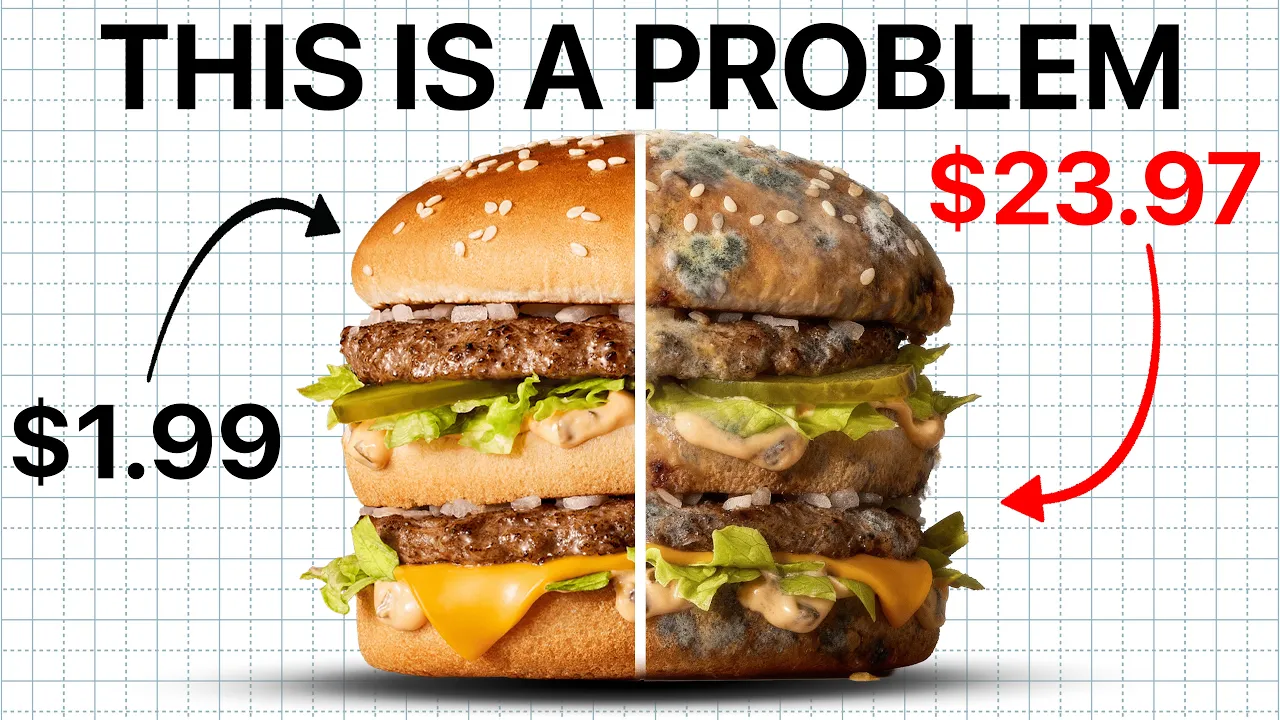
This might actually be the most misleading headline of all time. Over the last two years, major restaurant chains across America have sat empty for too long, and now they're being forced to close their doors for good. But the reason for all of this might surprise you, because these restaurants didn't go broke because of endless shrimp or inflation, and we can't actually blame it all on private equity either.
So, what really caused these iconic chains to shut down? And why does eating at a restaurant feel almost pointless and overpriced in 2025? >> I just want to know when as a society we got to this point.
>> When did fast food restaurants become the same price as a fivestar restaurant? >> We cannot go out to lunch or dinner without spending $50 plus dollars and we don't even drink >> at Chili's. >> In 1969, this man had an idea.
At the time, restaurants received all of their ingredients from all over the place. They had their beef supplier who brought the burger patties. They had their produce supplier who brought the lettuce.
And they had their dairy farmer who brought fresh milk. As you can imagine, this was anything but efficient. And it was even harder on the suppliers who had to find customers, supply them with what they needed when they needed it, and sell their product at a decent price.
But it was all they knew at the time until John Ba came along. He realized that there was strength in numbers and by coming together as a group of suppliers they would be able to control the market. So in 1969 he merged nine different regional food distributors under one roof and called it systems and services company otherwise known today as >> Cisco >> Cisco >> Cisco Cisco.
>> In 1970 he took the company public and started his all-out assault on the US food network. By 1981, Cisco became the largest distributor in America and continued swallowing up regional players piece by piece, leaving us today with two major food suppliers we see every day in every restaurant parking lot. Cisco and US Foods.
Cisco even tried to buy US Foods in 2013, but it was eventually blocked by the government because of the risk of a monopoly. Now, I don't say all of this to give you a random history lesson. But this series of acquisitions and takeovers is the very foundation of the problem we're seeing today because once you control the supply to every restaurant, you get to make the rules.
And that's exactly what Cisco is doing. If we take a look at this chart, we start to see some hints as to what is going on. As we all know, in 2020, the restaurant industry was all but decimated because no one was eating out, which meant Cisco saw a pretty severe drop in earnings, which was to be expected.
But in 2022, once restaurants were open again, we see something interesting. Cisco saw a 159% increase in earnings, which feels a little off because we were all there in 2022. It wasn't like the restaurant industry just exploded overnight and everybody was dining out again.
In fact, inflation was running wild at the time and everything was way more expensive, which meant most people didn't have the money to spend on a night out. But Cisco continued to grow. And the reason for this is a strategy they created in late 2021.
As their costs increased in price, Cisco stopped focusing on their overall profit margin and instead moved their attention to gross profit per case. This allowed them to raise individual prices on actual units of food like a box of lettuce, passing on about 13 1. 5% of the inflation spike to the restaurants, which in turn led to a massive jump in revenue for Cisco.
But that alone isn't the reason the restaurants are going out of business. Although the revenue jumped, Cisco didn't suddenly see a spike in actual profit because all of their costs increased as well. From delivery fees to storage fees and everything in between.
But the spike does explain why everything tastes the same. Now, these spikes are not only important to watch in your business, but also in your personal life. Because unlike a business, you can't really operate in a loss with your personal finances.
And that's why a tool like Monarch Money is so important. I've personally been using Monarch for about 2 years now, and it is by far my favorite tool for budgeting and just keeping an eye on everything. My wife and I are currently saving to buy a house, and at the end of every month, I check all of our income and expenses before moving money into our savings account.
In the past, that meant I was opening 25 different tabs to check our bank accounts, investment accounts, and credit cards. But with Monarch, that's no longer an issue. Monarch is a private and adfree platform, which means you are actually the customer and not just the product.
Your data won't be sold to the highest bidder, and you won't get any ads. Monarch also syncs with over 13,000 institutions, allowing you to skip the 25 tabs and just see everything in one simple dashboard. As we're saving up for the house, Monarch makes it easier than ever to create a custom goal and automatically update it with our progress.
And when it's time to sit down at the end of the month with my wife, there's no explaining what this number means or what that number means because it's all right there and simply broken down. I cannot recommend Monarch enough. It's a tool that I use every day.
And as a supporter of the channel, they are offering you 50% off your first year using the code grant 50 or by scanning the QR code right here to access your free trial. Thank you again to Monarch for sponsoring today's video. Now, let's get back to the monopoly that is Cisco.
When you open a restaurant and register your account with Cisco, which you pretty much have to do because they're the only option, you receive a catalog. That catalog contains just about any item you could ever need for your restaurant. Burger patties, fresh lettuce, cheese, mozzarella sticks, pre-made beef Wellingtons.
You get the idea. And you're going to pay the price that Cisco decides because you can't really shop around. But in order to have a catalog this big, you need some fancier ingredients.
And these fancy ingredients are designed for logistics, not necessarily taste. For example, do you ever wonder why all pizza chains have perfectly melted cheese? Their crust might be different.
Their boxes are definitely different, but the cheese is always perfect. I've personally made a lot of pizzas at home, and I've never achieved the picture perfect cheese pull you get from a fresh Domino's or Pizza Hut pizza. Well, there's actually a reason for this.
There's this company in Denver that's been making cheese for over 75 years, and their sole focus is mozzarella. You've probably never heard of them, but they supply almost every major pizza chain in America, and their main goal is to optimize cheese to its maximum potential. Laprino Foods has over 50 patents on their cheese, from how it melts to how it's made, and how they can pre-shredd it and ship it 3,000 miles to a pizza chain without it going bad.
And because they own the market, they pick the price. Similar to Cisco, the restaurants just kind of have to deal with it or somehow piece together a nationwide network of smaller suppliers while trying to create a uniform experience across all of their locations. As you can imagine, this is pretty much impossible for a nationwide chain, which is what forces the restaurants to use the monopolies in the industry, making them bigger and stronger while we're left eating the same food just on a different plate at all these major restaurants.
But if there's one business model that loves standardization, that's private equity. Now, private equity is the typical scapegoat for situations like these failing restaurants. Basically, taking a good thing, stripping it down to the bare minimum, and then running it into the ground at the expense of the consumer.
But in this case, it's not necessarily the sole reason for these restaurant failures, but it is a piece to the puzzle. Red Lobster, TGI Fridays, and Hooters are some of the more recognizable chains that were owned by private equity, and they all filed for bankruptcy at some point over the last 5 years. Each of these chains fell victim to the classic private equity playbook, which to PE's credit does work sometimes.
In these cases, it didn't. If we return to Red Lobster, we see the perfect example. Golden Gate Capital bought Red Lobster in 2014 for $2.
1 billion and immediately sold off all of the real estate that the restaurant sat on. This added a massive line item to every restaurant location because they were now having to pay rent on the land that they used to own. This is a classic move PE will make to try to bring in immediate cash after an acquisition.
And sometimes it works, but most of the time it severely impacts the underlying business. In this case, it didn't really work out for them and they ended up selling 49% of the company to a seafood supplier called Thai Union. And Thai Union can be thanked for the endless shrimp deal.
As a seafood supplier, they thought they could cash in on both their seafood and their new restaurant chain by pushing an unlimited daily special of bottomless shrimp. What they didn't realize was the power of Tik Tok and YouTube. >> Today, we're going to Red Lobster trying their all you can eat shrimp deal.
Let's go. >> Red Lobster has an all you can eat endless shrimp deal for 20 bucks. Let's get it.
>> Now, we got the crispy dragon shrimp over here. As you can see, this one looks like nicely glazed. Big piece of shrimp.
I ate all eight of them. For $20, you get a pretty good deal. Prior to the Thai union acquisition, Red Lobster had a pretty diverse network of seafood suppliers.
They did this specifically to keep their cost down and not be under the control of one entity. But PE does what PE does, and they were forced to standardize everything and consolidate their suppliers. This consolidation in turn leads to higher prices because the main suppliers like Cisco and US Foods know you have nowhere to go and they can just push you around and tell you what you're going to pay.
Between selling off real estate, consolidating suppliers, and just overall poor decision-making, restaurants like Red Lobster, Hooters, and TGI Fridays have all but faded into the background of the American mind, leaving us with countless fast casual restaurants and slot bowls that are now all starting to taste and look the same. And as prices have increased and margins have gotten tighter and tighter, restaurants have been forced to hire logistics consultants and supply chain managers. Because it's no longer important to just order what you need every week.
It's now a game of cost reduction, shelf life management, and product consistency, while flavor falls to the bottom of the list. Instead of a chef making the menu, it's the consultants designing something that is easy to supply and the least likely to be recalled. After all, we all know what happened to Chipotle in 2015.
>> Breaking news, the CDC now investigating another outbreak of E. coli linked to Chipotle. >> More cases have been reported in the Northwest.
Dozens of restaurants temporarily close. And now the company is taking aggressive action to get to the bottom of that outbreak. >> Chipotle is a prime example of something that was once great turning into just another bland bowl because of incentives.
After the E. coli outbreak in 2015, Chipotle had to rethink how they did things. And instead of shipping every individual restaurant fresh ingredients and raw meat to cook on site, they started pre-cooking, pre-shredding, and pre- chopping everything in a central location and then shipping all the pre-made items to the restaurant who then just reheat it and serve it to us.
And Chipotle isn't the only one. This is now a common practice among most restaurants because it's the least likely way to get sued. But most of the time, it's the most likely way to make food that all tastes the same.
Which leaves you and me with the choice of deciding which overpriced slot bowl to get today that isn't even fresh. But the saddest part of the decline in restaurants is that it doesn't just affect the nationwide chains who are forced to standardize. It also hurts the local mom and pop restaurants in your area because they're all forced to buy from either Cisco or US Foods.
They don't have any bargaining power. When you're a nationwide chain like Chipotle, you have enough pull to argue for lower prices. But when you're a one-off restaurant, you just have to pay what they tell you.
And when they're passing on 13% price hikes because of inflation, it could put you out of business. But beyond that problem, we as consumers have standardized bland food. These national chains have set a new low baseline for consumer expectations, leaving us just wanting fast, consistent, and cheap food.
So your local sandwich shop that makes the best sandwich you've ever had has to charge more, which in turn drives most customers away in 2025. This leads us to a decline in new people wanting to become chefs in America because they don't get paid, they don't get to make the menu themselves, and they work a ridiculously stressful job. Whether or not you've noticed the decline in restaurant goers or the increase in prices, it's hard not to argue that buildings and signs that were pinnacles of our community are slowly disappearing.
Some of them for good reason, but for the others, it's almost like we're seeing these bad decisions that were made finally coming to a head all at once. After all, restaurants are notoriously some of the hardest businesses to run, no matter what level you're at. And I hope after this video you understand that it can't be boiled down to just one villain.
Sure, private equity played a part, Cisco played a part, and inflation definitely had its impact. But if we bring it together, it's on us as the consumers to fix this problem. You have to stop buying lowquality, logistically optimized food and start spending your money where it matters.
If you want more good restaurants, you need to support the good restaurants and force the market to compete on taste and quality again, not just on who can serve the fastest, most convenient meal. I hope you enjoy this video. This is going to be the last one for 2025, and I truly cannot understate how grateful I am for each and every one of you for watching these videos.
It's been a dream of mine since I was a kid to have a YouTube channel and I still kind of pinch myself every day that this is what I get to do for work now. Starting this channel 9 months ago. I never would have expected we would be where we are today with over 82,000 subscribers, over 11 million views, and I feel like we're just getting started.
The videos are only going to get bigger, better, and more in-depth from here. I'm going to eventually get out of this office and take these videos on the road and interview people and see things and actually be out there in the world making even better videos. So, if that's something you're interested in seeing, make sure that you subscribe because this time next year, we're going to look back and see that we were barely even getting started.
So, with that, I'll see you in the next one.