okay so um I should start with um how I experienced the Ala fold Revolution and it started with a bit of hunger and the next stage was a bit of denial you know like it's one of these meetings that you're invited to share or these uh journals that um you will be the new editor and it went on with bargaining because you know like as you're closing retirement as a crystallographer I thought it's a bit too early and uh uh the Natural stat is depression because we all leave on grants and I felt as a
structural biologist uh that you know the future was looking a bit bleed and what followed was acceptance and what better way to accept it but try a revieww article so we wrote this AR we were invited actually by ambo to write this article together with my colleague T 6man and this is the point that I started thinking again about what alphafold is ringing and I honestly realized that alphafold is great artificial intelligence algorith for predicting protein structures are great opportunities not only for experimental structural biology but for structural biology in zenera and I would like
to give you an example before I go on in Alpha field I'll give you a couple of examples of how structural prediction affected our real life projects in structural biology and this is an example that we had determine the structure like some a decade ago it's about 160 residues uh and this was a part of a bigger protein and it is blue domain right in the middle is a structure that you see on top and we realized a few years later that actually also we that if we splice out this domain and we fuse the
N terminal and the C terminal part of the structure H that form of the protein was enzymatically active with because it's an enzyme and a DNA binding protein and actually this is the only this was the only other transation form of that prote that we were able to make and at the time we did some small angle scattering measurements and we showed that this small domain is quite flexible with respect to the main catalytic domain that is made by the n and the C Terminus alone so we were actually very happy to see the alpha
full structure that uh has modeled H this helical domain that you see on the right of the picture connected with two links uh with respect to the main enzimatic domain and what was also extremely impressive is that if you see the beta sheet in the middle of the big domain the big blue domain it is made four of the strands are from the end terminal part and the other four Str are from the C terminal part so that was not only an impressive prediction as many many predictions that you've seen also in the previous talks
but it was also like confirming our experimental work of more than a decade and a few other things that I I have not sown H what was even more remarkable is that when we looked at these pae plots and uh you can see actually what I just said at the PA plot level that the n and the C terminal form a sort of a rigid body that's moving together in the middle it's the other and in terminal to the left where the big red arrow is pointing out it was sort of telling us that uh
these s terminal residues are synergizing with a DNA binding domain and we formed a very simple hypothesis that if these 50 30 about and terminal residues seem to have coevolved and are in a relative similar position other part of the could could they also be involved in DNA binding and indeed this is a we deleted this residues and we indeed we so through these assays that actually this n terminal sequence is involved in DNA binding something we have not suspected for nearly two decades another example of what we have done is that there's a protein
that's called spinley that I've been working with my friends and colleagues H cops and Andrea masakio and you know at some called the structure a few years ago of the first 100 residues that was a coil coil very clearly they made a coil coil uh but then we were looking at the SX data because that's a 600 residue protein is it all of it a coil coil it was not making sense it was looking much more bulky but pretty long um and of course the alpha database structure was useless for the monomer but then Alpha
fold multimer came in we knew that it was a diic coil coil we modeled it a diic coil coil and we got this beautiful structure that the coil coil in some break points it folds upon itself and this fitted beautifully with cross-linking mass spectrometry data that was indeed sewing cross links between distant regions of the coil coil that that we could not have explained while we were suspecting that the parts of the coil coil are falling into its other but we were wondering if these are like trans or CE interactions inter or intramolecular and the
alpha model was amazing in clarifying this out and actually joining up with Andrea and um putting together all these data with some beautiful mechanistic explanations of how this protein functions in events in early mitosis in the soall corona expansion and contraction another project that actually again I found very impressive for how alpha full helped us is that we had the structure of this stud repat domains of taling a five heis bundle and a four heis bundle and there is another helis that binds to the four helis is very interesting puzzle for molecular replacement by the
way and um uh it was a bit strange because when we you know this this protein taling has 13 uh repeats our domains and when we deleted the domain with with we knew there was the interaction that did not abolish the interaction it enhanced it and we we're wondering you know like how could this happen so what we did there is that we got the sequence of each and every our domain and we tried to predict through alphafold multim if it would come with likely with a good pae Matrix again suggesting an interaction and this
suggested that some of the art domains there is no data that uh e Evolution again in reality that does not support the interaction for some other repeats it was supporting an interaction and indeed that gave us the idea that mainly the are 11 and the r 12 repeats are also likely binders we confirmed that experimentally and the g Alpha fold helped us to generate a hypothesis H and refine actually the biological hypothesis and make our experimental life much much easier so while doing all these uh I also came to my attention and other people's attentions
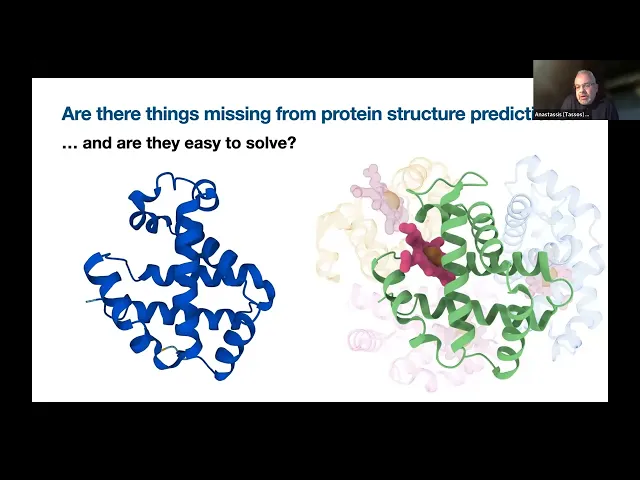
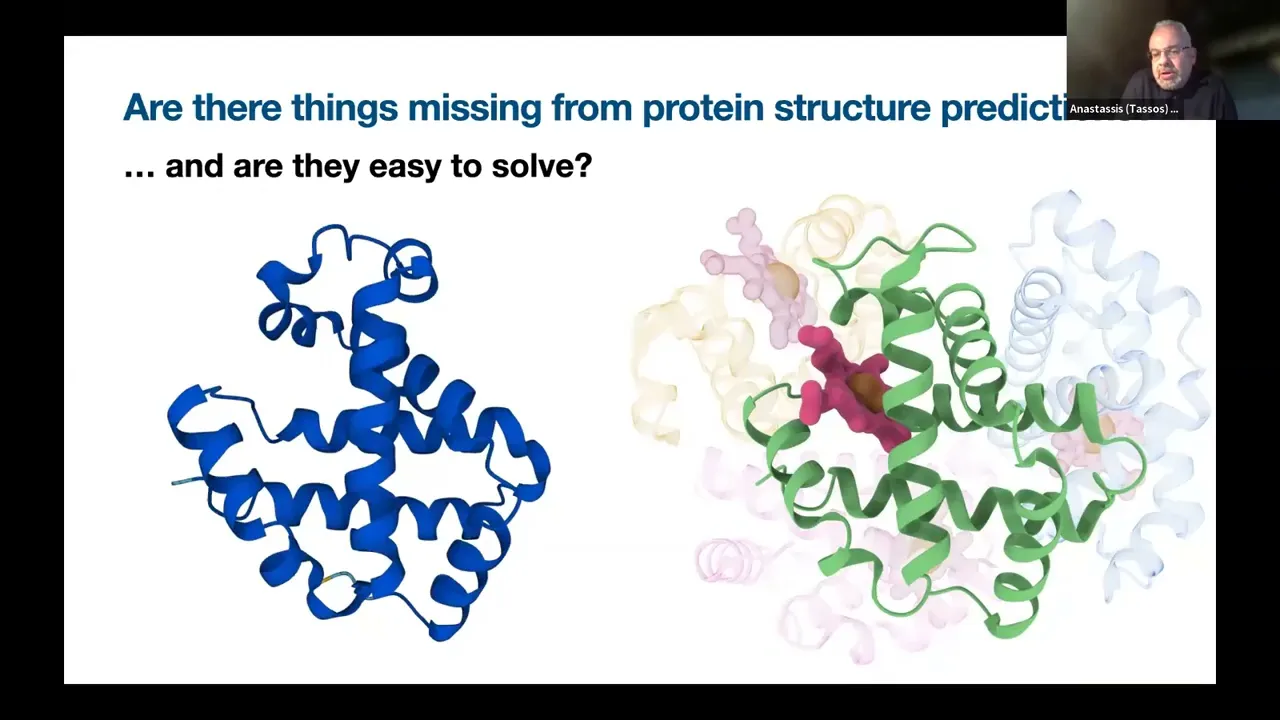
of course that there are also things missing from proin structal prediction and this what you see to the left is the alpha model for hemoglobin and it has no he and it's a monomer and by biologically this does not make any sense because we all know that the more accurate description of hemoglobin is to the right that you see in different colors the the tetramer and you see the he and you see a nice big fat iron in the middle so that's what gave uh rise to this Aly idea that there's missing co-actors there's missing
lians and we know so many crystal structures of course and NMR and crym structures as well that we could use this knowled for transplanting lians natural lians at least and co-actors and metal ions uh from the pdb models from the experimental models to all these predictions so we made some choices for what uh we would be transplanting just to make a long story short uh we avoided things that we know that there are crystal on like you know like glycero uh Peg ions and uh we ended up that uh we decided that about 95% of
all occurrances of lians of the pdb are interesting molecules that we could be transplanting and example is SCH another example is ATP and so on so we're using a list of about 2700 compounds that we're transplanting towards uh all the alpha fold models and that's uh an embarrassingly simple algorithm uh which it's putting bits and pieces together that we had we get an alpha model that has no co-actors we blast the sequence against pdbd do why pdbd do because we like it it's pretty accurate and we like it because uh we are maintaining and developing
it h then we get the heat list by escore with some criteria of the size of the domain and so on and we check now the pdb structures that um are likely homologues of this Alpha fold model if they had compounds that are in our transplant list and uh we do a bit of a cleanup there and we come up with a transplant list H then we do a quick structural alignment using quion between the pdb and the alpha fold model we get the aligned models we calculate some rmsds for validation and then we simp
transplant the compound from the pdb to the alpha field model and as a result of that H if you go to the alpha full database and you look for myoglobin for example you will see that the two hins are perfectly in place but if you go to the alpha field model you will also see the HM you will see the iron and you will see a few oxygen or monoxide atoms that might actually be there H when we did that work that was the time that it was only 1 million models to Alpha fold and
this resulted to about 600 of them we could find at least one liant that would fit into them and about 12 million transplanted compounds H when alphafold got expanded uh to 240 million we decided not to do it quite honestly because this could be quite a big waste of electricity calculating things that would not be very likely for people to use uh but we still get give the opportunity of people to to do it a big issue there is validation and how are we sure that we're doing a sensible job of course and for that
we chose transplanted compounds that transplanted from sequence with 100% identity which means that uh although we put the compound in an alpha hold model the exact same uh structure has been determined experimentally for that domain and when uh we defined a lean validation score that we Lo local environment validation score the lead score which is the rmsd for non-hydrogen atoms in the neighborhood of the Lian so this is a score that we can only know when we know the correct answer the experimental answer so the question we ask is that does this L score correlate
with metrics that we can know that we can compute without knowing the correct answer and for that we chose the local rmsd the root mean Square deviation of superposition in the in in a sphere around the Lian and actually also a new score that we Define find the transplant class core that basically is telling us if there are classes of the Lian within the local environment following the transplantation and when we check the scores that we can calculate without knowing the answer against the left score that is when we know it with the answer they
showed a good correlation uh so we decided that these are the local rmsd and the PCS are good validation score for the success of this transplantation exercise H that's also the point that we have a couple of ways for making to everybody accessible these models and the success metrics assoc the validation metrics Associated to them and this is either through our own Alpha fill interface uh but also in a very nice and very efficient collaboration uh with the macromolecular structures team at the ebi we also have a 3D beacons interface in the um ebi knowledge
base and you can also access our the alpha field models together with Alpha fold models if you use the uni the knowledge the knowledge space the ab all the space and you see that in our another feature is that if you are particularly interested in a particular compound we also give you access through a quick mization through yasara and we also so for a few answers that for a few examples uh that if we find uh lians that have either a low or a pretty high TCS score we can improve at least the TCS score
IE reducing the classes and very likely getting uh a more optimal and realistic representation of the Lian this is a very very simple and rough energy minimization but makes life a bit easier if you want to use the structure for generating some hypothesis also I I should advise for quite a lot of caution there it it's a handy to another thing is that this days you can not only retrieve these uh models for 1 million structure if it's not there you can simply upload your own predicted model which could be also a multim or a
complex or anything and uh you can run it uh through uh through Alpha field and we will try to check every domain fill up the possible liance you can also get Alpha fill on GitHub if you don't want to be using our CPU power and and so on and so forth you have two more minutes yes I'll go on with examples uh in this uh two minutes you see like these are successful predictions um of of atoms over here this is a b metallic um uh enzimatic site H and so on and I will use
the last minute and a half to say that what happens if we don't have experimental structures available and what we did here is that actually we trained an AI that we developed and in which I think we have a very interesting obstruction of the protein model in terms of nine different chemotypes that we came up with in which wees ENT the protein structure as a three-dimensional imid as and to be exact we represent protein structure as as a three-dimensional image in a greet and as soon as you have something in a greet that resembles an
image that makes it quite easy to use out of the box um uh learning methods and with a few tricks like you know we take a metal site so you see in the middle of this Cube there is a metal side and there is environment around it the gray is carbon red is oxygen and so on and then within this environment we use what we call the sampling Cube to sample this environment and the learning Cube which is a zooming into this environment to learn how metal binding sites look from different views and uh then
we start learning and within the learning EPO we use the typical image man ipulation tricks that we rotate the image around to create the rotational variability and so on and we simply pass that to an outof the Box uran Network used in many AI applications H to predict the most the five most common metal sites on proteins so we trained that on something like 11,000 proteins for 40,000 metal sides and then we can get any protein sample it with this learning cubes come up with some probabilities for every point in this image to have a
protein we translate back to the protein coordinates we use a few tricks of the probabilities to to consolidate the answers the probability answers that come out from the AI and the bottom line is that now we can also predict the position of metals without directly looking at the homologous protein structure but Having learned having teached an AI for how metal environments look like and you see here some prediction that it comes up with it's doing pretty well it even gets B metallic sites which were a bit supris but it's quite good on getting that it
also finds a few things that could be false positive because here it predicted something when there was nothing there but perhaps there is something really a magnesium this Amin oxidase or a copper over here is perhaps a false negative perhaps not and it finds if F Snell is ning to me he mailed me in cases that you have nickel down we predict zinc which is very likely the correct thing to be there we also find and importantly not only known PTP structures we can recover that but also in Alpha fold models we can also retrieve
metal sides like structural zinc sites so quite a lot new with shy irons in very welln crystallographic structures and of course our Dream together with the dream of a few others is that if we can use this AI that we develop for metal sites to predict The Binding of larger molecules like fragments or leans sorry for stepping a bit over time but I will just show the names of the collaborators Martin who did fantastic job implementing either the F who did all the validation and her name is not there because I stole her an knowledgement
slide and forgot to add it as I now realize Ren came up with AI algorithm and all these projects have been co-supervised as always with Robbie Aon and I should also mention that the fact that ccp4 has supported and that is supporting Roby has been fantastic and it allowed us also to indirectly do things like that hope you visit the site don't cross it we got 3,000 requests this morning from a single person don't do it but please go and check the website sorry for being a bit overtime and thank you for your attention I
hope I did not Tire you in the last Talk of the meeting I wish I was there I hope you all had a fantastic time thank you again thank you