hello students today I want to finish chapter three and discuss uh the formation of ionic compounds uh that's the first section then we will move on to understanding uh charges and then we will talk about polyatomics briefly um ionic compounds form when a metal and a non-metal Bond uh due to their charges and remember it's an Electro St charge it's basically static opposites attractive so if you look you can see sodium chloride and sodium chloride forms because of the positive charge of the sodium ion is attracted to the negative charge of the chloride ion and
remember from the previous uh from the previous lecture that sodium wants to give up that one s electron and in doing so it ends up with one more proton than neut or one more proton than electron excuse me and as a result uh it ends up with a positive one charge uh conversely chlorine wants to pick up an electron so when chlorine picks up that electron what it's doing is it is then becoming a negatively charged ion it becomes an anion with negative one charge the key thing to remember here is that the sum of
the charges in ionic compound is zero so if you look we have one sodium one chlorine each the sodium has a plus one charge the chlorine has a minus one charge when I add the two together I end up with zero so the sum of the charges of the net charges in ionic compound must be zero now we look at examples of ionic compounds we can see such things as um magnesium chloride which is mgcl2 or sodium oxide which is na2o in both instances what you will see is you see that the sum of the
charges is zero so in the first instance magnesium chloride the magnesium is a 2+ therefore it needs two one minus charges in order for it to be a have a net charge of zero so that's something that I want you to keep in mind is that you have to have this net charge uh be zero in the next instance you can see sodium uh sodium oxide well the oxygen forms a negative2 ion so therefore the sodium um with a plus one we need two of those to balance it out so the key thing to remember
is the sum of the charges is always zero now when we name ionic compounds in the main group um there's a couple rules that you need to understand and this is for main group Metals so these are your s block Metals the cation will keep its whole name the annion keeps the first syllable and then we add I so the two examples I've listed sodium chloride NaCl sodium keeps its whole first name chloride we take the Chlor the first syllable from chlorine and we change it from in to IDE and the same thing with barium
fluoride um we have a barium and that actually should be bf2 I apologize uh that should be bf2 let me let me make a little quick note about that that should be BF to and my Pen's not working there we go bf2 so that's something to keep in mind is we need to also understand that we need to keep our charges barium is a plus two metal Florine is a minus one non-metal so I need two of them so I just caught that we do not use any prefixes to talk about the number of anything
in ionic compounds so we don't need to use di Tri Tetra any of that stuff uh when we're talking about these things um because the main group elements have fixed charges so there's no need uh we understand what the charges are and even when we get to the next SL when we get to transition metals we understand what the charges are uh due to the fact that um we're GNA we're going to be either given the charge it's either going to be in the name or we're going to have to figure the charge out so
main group U the main group ionic compounds are very straightforward um in understanding what they are it just involves a little bit of algebra sometimes now transition metals are a little bit different the cation keeps its whole name but it it ends up with a middle name and the middle name is a Roman numeral for the charge of the cation so we'll get back to that in a second and then the last name is going to be the annion um and it keeps the first syllable and we add I so it's the same thing so
f fe203 is iron 2 oxide and so let's take a let's let's take a look at what's going on um actually I have made another mistake I'm glad I'm catching this stuff so this is actually not iron 2 oxide iron 2 oxide is f let me just draw on it let me make this correction right quick that's not correct fe32 is iron to oxide and again it just shows you I've been doing this for a long time but if you if you don't pay attention you can still make some little tiny mistakes and that can
cost you so the iron 2 oxide we have the titanium dioxide or titanium 4 dioxide we have titanium um four so that the titanium needs a plus four charge the oxygen is two time -2 so again we have to keep the charges balanced so I have a plus four and a minus four so the sum of my charges is going to be zero again we don't use any prefixes die or try or anything else to talk about the number and transition elements uh do not have fixed charges so we have to do some calculation uh
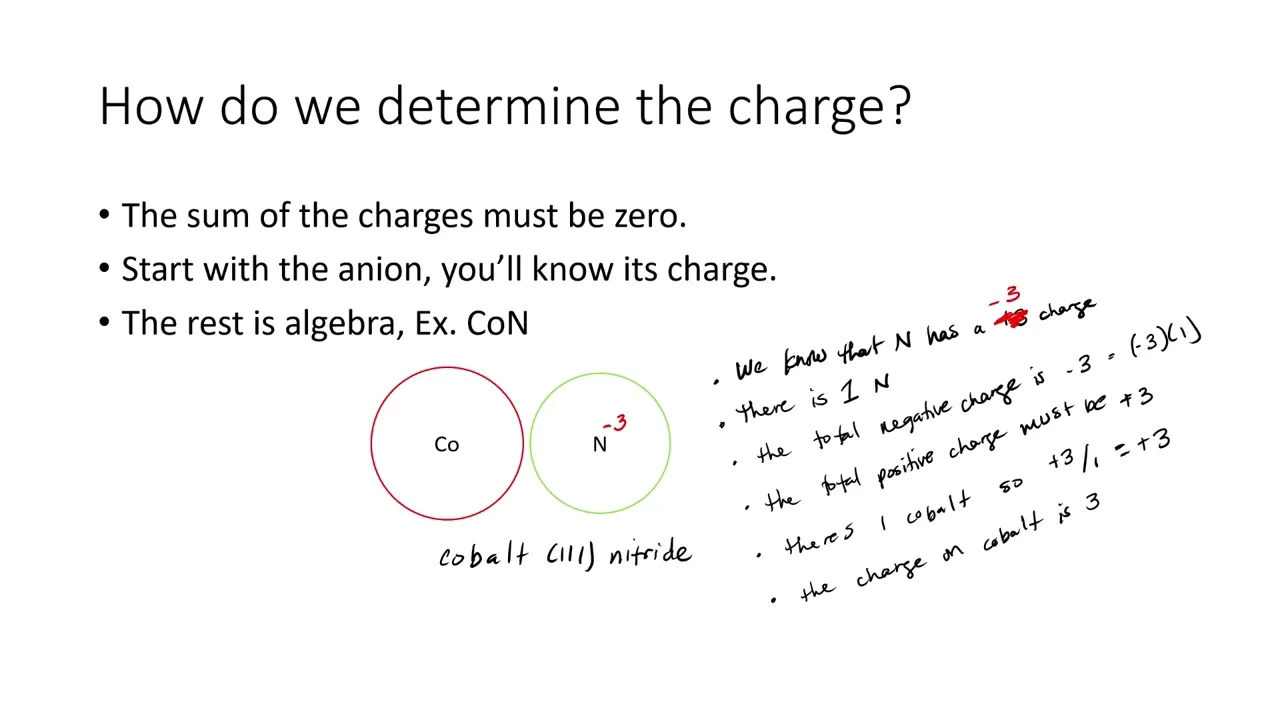
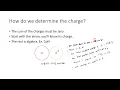
that's something that's very important to remember is we need to be able uh to do these calculations so how do we determine the charge so in this instance I'm going to use Cobalt nitride and we're going to start with the anion because we know the charge so we know that n has a plus three charge so we know that excuse me has a minus three charge I have just mistake ridden today this is a minus three charge we know nitrogen has a minus three charge so there's one nitrogen so when we multiply 1 by -3
we end up with -3 so I know that my total negative charge is equal to minus three now my total this means my total positive charge for the whole thing must be zero so my positive plus my negative has to equal zero well my total positive charge has to be plus3 I have one Cobalt so when I take positive3 / by one that tells me I have a positive three which gives me Cobalt 3 nitride that's where the three comes in the charge on the Cobalt is positive3 so that tells me that I have Cobalt
3 nitride finally let's talk quickly about polyatomic ions uh polyatomic ions are cations ions or anion they can be both hint hint test question uh they contain more than one atom now there is a table uh table 3.5 in your book I just want you to understand what's going on with them uh I don't expect you to memorize them treat them like they were own element when you calculate charge and for that example I've given you calcium plus Hydrox so you treat calcium like it's a thing and you treat hydroxide like it's its own thing
don't try and break it up now I have a plus two I have a minus one which means I need another hydroxide to balance things out so I need two of them and to show that I have two of them you put parentheses around the polyatomic when you have more than one so this is correct I have CA open parentheses O2 what is not correct is ca2 H2 that is that's not a thing so the key thing I want you to remember is that when we use polyatomics I want to make sure that I have
parentheses around these things so let's say I have something like barium nitride or nitrate excuse me nitrate is NO3 it has a single negative charge so I need two of them because ba is 2+ nitrate is NO3 1 minus so this is a polyatomic so remember when we have our polyatomics we need to make sure that when we have more than one we put them in parentheses all right so what I've done is for tomorrow I've scheduled an AMA for chapter 3 and we will get started on um chapter chap 4 here and we will
have a test on Monday and that that test will cover all of chapter 3 and most of chapter four um so we're going to get through as much as we can I want I want you to have two test grades in the book uh before we get to the midpoint uh so you can kind of have a good idea but I'm not I'm not overly concerned about anything right now uh the content will get a little bit harder um but again most of you did really well on the first exam I expect that to continue
as well so if you have any questions please feel free to email me um and I look forward uh to meeting with everyone uh tomorrow during the [Music] AMA all right uh again if you have any questions please don't be bashful email me and I sent out the AMA before I recorded this so if you need anything please let me know thank you

![Morning Joe [6AM] 9/16/24 | 🅼🆂🅽🅱️🅲 Breaking News September 16, 2024](https://img.youtube.com/vi/BiUuySKQg8M/maxresdefault.jpg)