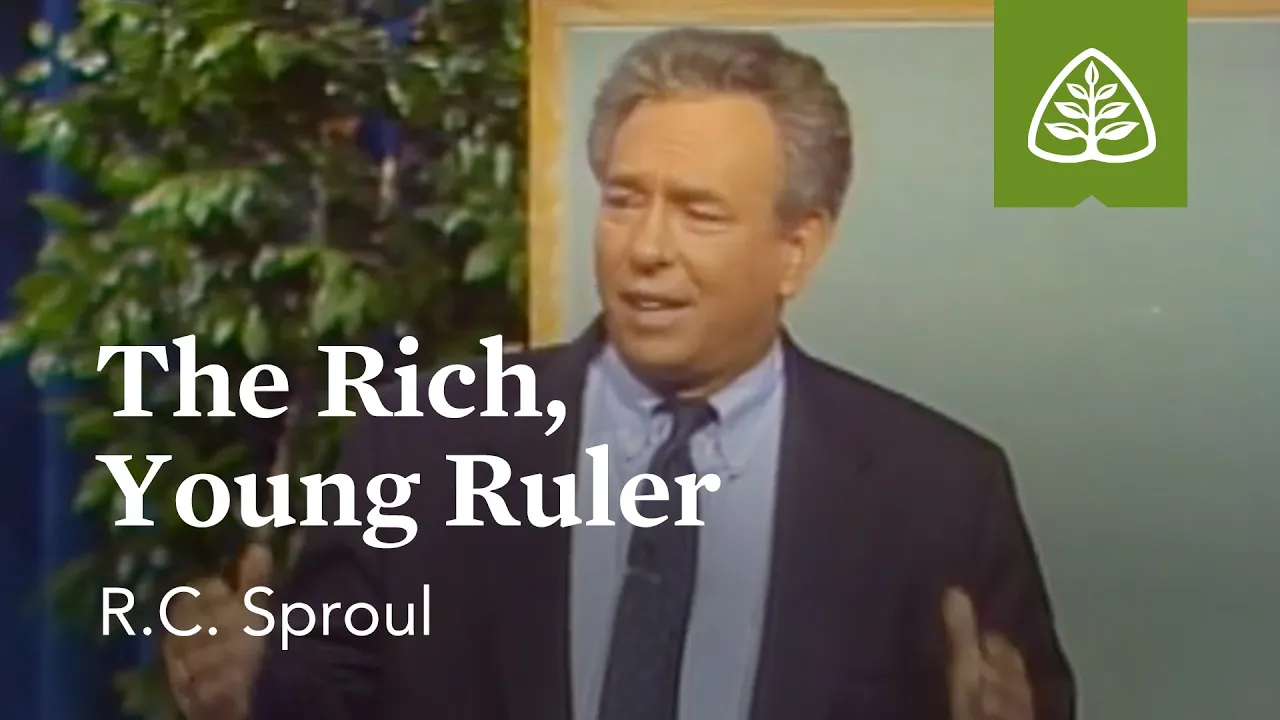
SPROUL: As we continue now with this series of those who were face to face with Jesus, I want to remind those who are listening on the radio that in the course of this series we are doing a little experiment in terror, that while we are doing the broadcast for the radio audience at the same time we are videotaping these programs. And the bane of my existence for videotaping is to have some woman come beforehand and put all kinds of make up all over my face and put powder on me, and I don't know how people can stand to do that sort of thing on a regular basis. But on this occasion, the woman who is in charge of make up also does this sort of thing for the new Golf Channel.
And we were talking about that Golf Channel and about how people are responding in this country to unique opportunities for instruction by some of the greatest golf teachers in the world who are now made available to the public at large through the magic of television. And as we were speaking about that, I thought of the one question that golf professionals are asked more frequently than any other question. And that question is simply this: "What am I doing wrong?
" You know, most of us are loathe to look for criticism, but the one group of people who are masochistic enough to seek criticism are people who play golf. And they will go to their golf teacher, and they will say, "Tell me what I am doing wrong. " The standard reply from the golf professional, of course, in that circumstance is to say, "Is not so much what you are doing wrong, it is what you are not doing right," and then they take that opportunity to begin to give them instruction.
But when we ask questions, because we are looking for solutions to problems or ways to get where we want to go, we ask these questions like, "What, When, Why, Where, How," and so on. Now, the person who we are going to look at today who came face to face with Christ, is a man who asked Jesus probably the single most important question that a human being could ever ask of Jesus. You might ask yourself the question if you had the opportunity to meet Jesus face to face and ask him one question, what question would you ask?
Well, this man was in a hurry to ask Jesus his question. He pressed through the crowd, and apparently rushed up to him with great enthusiasm, and flattered Jesus with a few nice words of formal address, saying to him, "Good Teacher, what must I do to inherit eternal life? " Other translations put it this way: "Good Teacher, what shall I do in order to inherit eternal life?
" Now, to ask a question like that is to ask the ultimate question. And let's take a few moments to look carefully at that particular question. This isn't a matter of improving one's golf swing, but we have the same first part of the question, "What," and we will take the second word "must," or "shall,” I do?
It is an obvious question. What does it take to get into the kingdom of God? And obviously, different things that people do do for certain objectives and to reach certain goals, and that's the question on this man's mind, "What do I have to do?
" He's asking, "What are the requirements for getting into the kingdom of God? " He's not asking Jesus, "Jesus, what do you have to do in order that I might get into the Kingdom of God? " He doesn't ask, "What does God do to make it possible for me to get into the Kingdom of God?
" But he wants to know what he has to do as a human being. Now, in that regard we are not interested in this person who is usually referred to as the "rich young ruler," because of the implications of this question simply for him. But let him represent everyman today because, as I say, he is asking of Jesus the ultimate question.
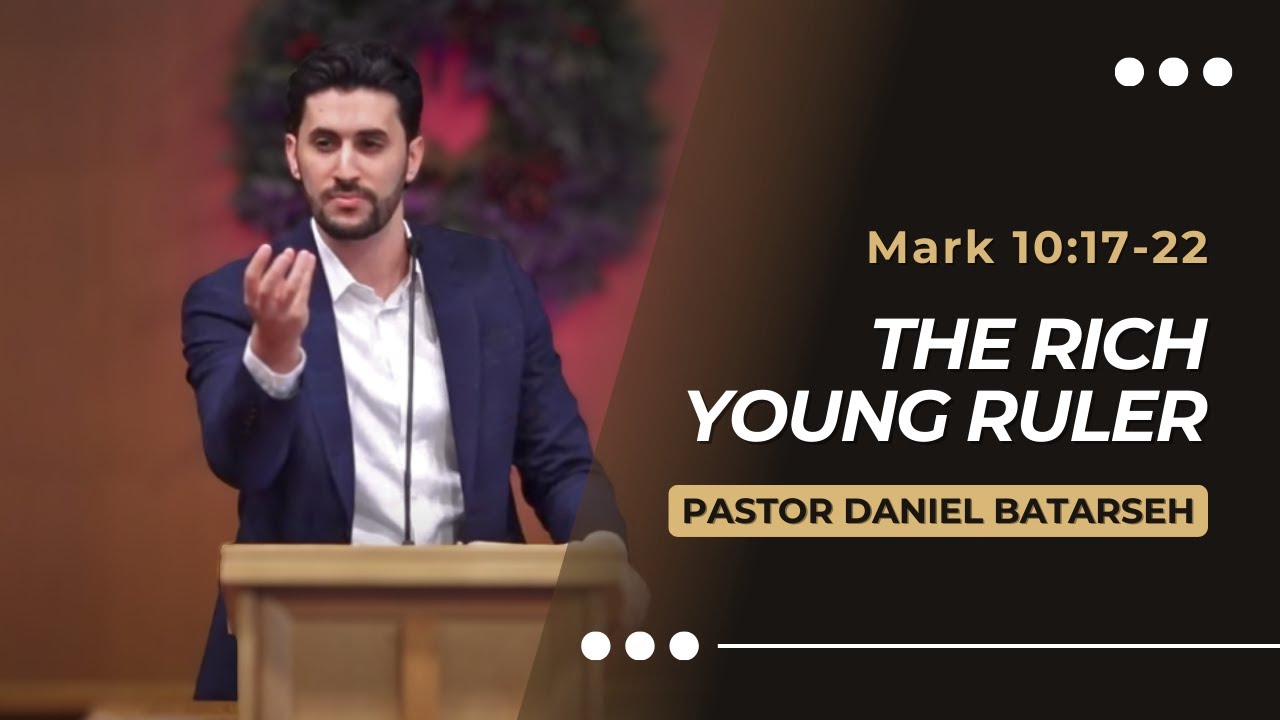
Well, Jesus, as the master teacher, rarely answered questions that people posed to him in a direct manner. Frequently, when a question was posed to Jesus, Jesus would so shape and formulate his answer, and then he would use the question as an occasion for teaching people something that was profoundly important. Now, we notice in the text, let's look if we will at Mark's record of this, beginning in chapter 10, verse 17, "Now, as he was going out on the road, one came running, knelt before him and asked him, 'Good Teacher, what shall I do that I may inherit eternal life?
'" Now, again, here is an eager person, a "seeker," if you will, at least who gives the outward appearance of seeking truth from a man that he regarded at least as an outstanding teacher of the things of God, perhaps even as a prophet. And so he runs up to Jesus and he kneels before him. Now, this is a man of great wealth, of great education, and of great social standing, and yet he humbles himself before Jesus and says, "What shall I do to inherit eternal life?
" On the surface, it seems like this man is the most humble creature that Jesus has met to this point in his ministry, and he extols the virtue of Christ, calling him "Good Teacher. " Well, Jesus answers the question indirectly. The first thing he does is, responds to this description of himself that had come from the mouth of the rich young man.
So Jesus said to him, "Why do you call me good? No one is good, but one, that is God. " So we see that Jesus for the moment, at least, evades the question and raises a question of his own to this young man.
He says to him, "Why do you call me good? " And there is a thinly veiled rebuke in this, that what is implicit in the question, now becomes explicit in Jesus' exclamation for why he gives this rebuke, "Don't you know that there is only one who is good, namely God? " Now, that may offend our sensibilities in this day and age, because we live in a culture that has been so pervasively influenced by the philosophy of humanism that we have heard it said so often that we begin to believe the idea that human beings are fundamentally, basically, good.
We may do things that are wrong. We grant willingly that no one is perfect, but in the main, we are, basically, good. A recent Gallup poll was given among professing evangelical Christians in America, where over 60 percent of them affirmed the statement that human beings are basically good.
Whereas, Paul, in the New Testament, tells us "There is none righteous; no, not one. There is none who does good; no, not one. " And so we have a collision here between the evaluation of human performance and virtue by our own philosophies, and by that view that is uttered by Christ and by the teaching of sacred Scripture.
But it seems like such a dire thing for the Bible to say that, "There is none righteous; no, not one. There is none who does good at all. " What if I said to you, "You are simply no good.
" How offensive would that be to you? That would be a terrible insult for me to say to you that you are just plain no good. Well, you aren't any good, so I say it with a smile, but that's the point that Jesus is trying to make with the rich young man.
This man, you know, he wants to know how to get to heaven: "What do I have to do, Good Teacher, tell me, please? " And the good teacher said, "Why do you call me good? Don't you know that only God is good?
" Now, I know that the word "good" is a word that is a relative term. Please don't misunderstand me, I'm not embracing moral relativism, but something can only be deemed to be good or bad against some standard, some norm. Now, when we say that we are good, and we think that we are good, what's the standard by which we are judging ourselves?
The Scriptures indicate that our tendency is to judge ourselves by ourselves and judge ourselves among ourselves, and then adds the evaluation of that which is not wise, because that's not the standard that God has established, but we try to grade ourselves on a curve. I look around and I take comfort if I can see somebody behaving in a more godless manner than I do, and I will say, "Compared to that fellow, I'm a pretty good guy. " But the standard by which God determines goodness is the character of God himself.
As Calvin once said, that when we keep our eyes on the horizontal level, fixed on this earthly plane, on the terrestrial sphere, we begin to think of ourselves more highly than we ought, we begin to flatter ourselves and consider ourselves slightly less than demigods, until once we turn our gaze to heaven, and contemplate just for one single second what kind of being God is. If we do that for an instant, suddenly our self image is shattered, and we realize that if we examine ourselves in light of the character of God that we must repent in dust and ashes. Now, there are critics who say, well, here Jesus is denying his own sinlessness, he is denying his own perfection, when he says to the man, "Why do you call me good; don't you know that only God is good?
" Jesus is not talking about his own character. Jesus understands that the rich young ruler has no idea really to whom he is speaking. He does not know that he's face to face with God incarnate.
He does not know that he's talking with a sinless teacher, not just a "good teacher" by his own evaluation. And so Jesus is challenging the man's assumption of goodness, because Jesus understands that the man who wants to go to heaven is relying on his own perceived goodness to get there, that becomes plain in the conversation that follows. Jesus now answers the question that he asked in the first place in a somewhat strange manner.
And the man said, "Good Teacher, what must I do to inherit eternal life? " Jesus first rebukes him for calling him good. And then he said, "You know the commandments: Thou shall not kill, thou shalt not steal, thou shall not commit adultery.
" Do you notice anything strange about that answer? There are lots of things that are strange about that answer. The last thing we would expect Jesus to teach people is that the way to heaven is through the law.
If anyone understood that the law was capable of saving no one, it was Jesus. So why does he say to the young man, "You know the law"? Now, that's strange, Number one.
Number two, when Jesus starts to give his recapitulation of the law, where does he start? Does he start at the beginning of the Ten Commandments? No.
He starts with the second table of the law. "Thou shall not kill, thou shalt not steal, thou shalt not commit adultery. " Now, how does the rich young ruler, who some think was an attorney, respond to this, being the Philadelphia attorney that he was?
He breathes this massive sigh of relief, "Aw, is that all I have to do to inherit eternal life, is keep the Ten Commandments? All I have to do is not kill anybody, not steal from anybody, and not commit adultery? " That's what Jesus said, do you want to know how to get to heaven, you want to know how to inherit eternal life?
Keep the law. So the rich young ruler looks at Jesus, and says, "All of these things I have done from my youth. " Listen to that.
I mean, you see a man get himself in trouble and fall into the mire, and the more he struggles, the deeper he sinks into it. This guy is killing himself. He is having a conversation with Jesus on how to get to heaven.
And Jesus tells him, you have to keep the law, don't kill, don't steal, don't commit adultery. And he goes, "Oh, great. I have kept all of these things since I was a little boy.
" Now, Jesus doesn't argue with him, he could have. He could have ended the discussion right there. But this is an example of Jesus teaching sort of like a Socratic dialogue, where he leads the student to try to come to the right answer on his own with a little help from the hints that are being supplied by the teacher on this occasion.
Jesus could have said to him, and said, "You have done what? You have kept all of these things from your youth? You must not have been there when I gave the Sermon on the Mount, you must have missed that one.
And if you are impressed with my teaching, maybe I ought to give you a cassette tape on that sermon where I explain what that law really means, 'Thou shalt not kill, thou shalt steal, thou shall not commit adultery,' and let's put you to the test. You maybe haven't killed anybody in the sense of taking their life, but have you hated your brother without cause? Have you been angry unjustly towards anybody?
Have you lusted after a woman in your heart? You don't steal? Were you ever late in paying a bill?
" "Oh, well, yes, I was late in paying a bill once, but I never stole money from anybody. " “So, well, wait a minute. When you agree to pay somebody for goods or services rendered by a certain date, that money belongs to that other person.
And if the day comes and goes without your paying it, and you use the money that belongs to that person to buy something for yourself without paying your bills that you owe, what's the difference between that and just going into that person's house and helping yourself to their money that is there, and going out and using it to furnish your own house? It is stealing nevertheless. " This is how Jesus explained the deeper implications of the law of God.
And obviously, the rich young ruler didn't get it, but that's not what Jesus did. That's what I would have done. Head on, you know, let's go for the gusto and get right at the point, but Jesus doesn't.
Jesus is gently trying to get this man to understand the answer to the most important question he could ever ask. Jesus doesn't even argue with him. He says, "Oh, okay, you don't kill, you don't steal; you have kept all of the law of God since you were a child.
There is just one thing you lack, just one little problem, one little shortcoming. Go and sell all that you have, and give it to the poor, and follow me. " Now, what is Jesus doing here?
Jesus is not setting forth a universal law that any person whoever wants to get to heaven, or any person who wants to enter the kingdom of God, or any person who wants to be a Christian has to divest themselves of all personal property and give it away. That is not the point. What is Jesus doing here?
This young man had deluded himself into thinking that he was good enough to satisfy the demands of God's law. This man actually believed that he was keeping the Ten Commandments. He glibly said that he had kept three of the commandments from the time he was a child.
And so Jesus is going to put him to the test. And what I hear Jesus saying, what I see Jesus doing in this situation is this, he said, "Okay, you keep the decalogue, you keep the Ten Commandments. Let me see, what is the first one?
'Thou shalt have no other gods before me. ' Young man, let's see if you have any gods before God. It seems to me that you worship and serve your money, that the whole inclination of your heart, what you invest your passion is, is in your wealth.
Let me see if you are willing to love God with all of your heart and all of your soul and all of your mind. Let's see if you have any other gods that rank ahead of him. Go and sell all that you have, give it to the poor, then come and see me, and we will go to the second commandment and see how you do on that one.
" And we are told something very sad, "The rich young ruler walked away sorrowfully for he had great possessions. " Jesus was teaching him a lesson he didn't want to hear. And the lesson was this: He was a law breaker.
And there was no way that he, or anybody else who had ever broken the law of God, can inherit eternal life by the law. It's so easy for us to stand back and be critical of the rich young ruler. We see in him all of the vices of the hypocrite, of the Pharisee, who is smug in his self-confidence, self-righteousness, his holier than thou attitude because he really believes that he has been righteous enough to satisfy the demands of God.
But this man is who we are. One of the hardest lessons for us ever to grasp from sacred Scripture is that the only possible way to inherit eternal life is by relying on grace and on grace alone. This man missed the kingdom of God even after meeting Jesus Christ face to face.
This man came with the most important question that you could ever ask or that I could ever ask, and he missed the answer. The vast majority of people that I meet today still think that they are good enough that they do enough work, enough striving have enough virtue to get into the kingdom of God, but the only person who has ever made it to heaven on the basis of merit is Christ and Christ alone. The message the rich man needed to hear is the message we need to hear.
That our justification is by the righteousness of Christ and by His righteousness alone. Not by ours, but because we have an abundance of possessions that we think are possessions of righteousness, we also are in danger of walking away from Christ because our possessions are great.