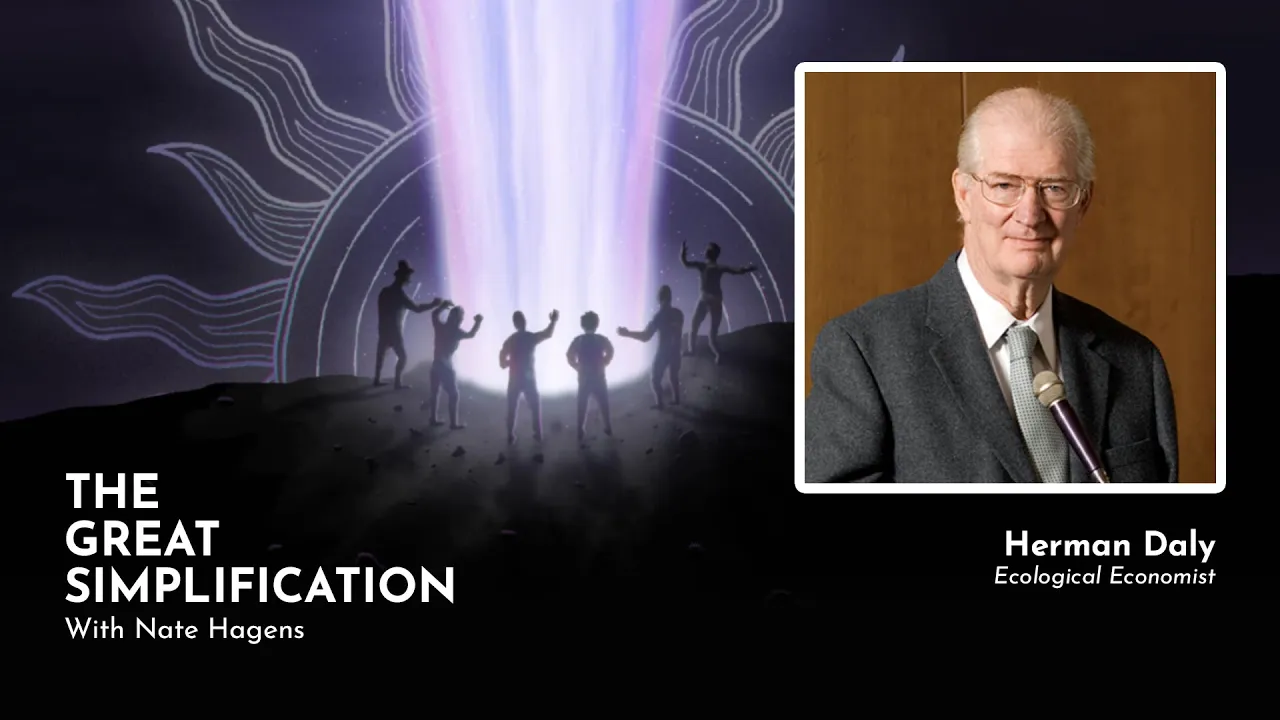
[Music] you're listening to the great simplification with nate higgins that's me on this show we try to explore and simplify what's happening with energy the economy the environment and our society together with scientists experts and leaders this show is about understanding the bird's eye view of how everything Fits together where we go from here and what we can do about it as a society and as individuals today's guest is my friend and educational mentor herman daly for many of my listeners herman will need no introduction he is an emeritus professor of economics at the university
of maryland a former senior economist at the world bank and one of the founders of the field of ecological economics reading his book valuing the earth over 20 years ago was one of the key things that caused me to leave wall street and study natural resources and ecological economics those who have been lucky enough to interact with hermann would probably all concur that he brings wisdom and insight to a conversation but he does it with a humility light and grace that is becoming lost in the modern supernormal stimuli culture today herman and i talk about
the Biophysical underpinnings of human economies and how a social system that is more tethered to our ecological reality might come into being i hope you learn from and are inspired by my conversation with herman daly hello herman hello nate good to see you again sir it's a pleasure so you may or may not know this or may not remember this but 20 years ago this month I read for the common good soon followed by valuing the earth and it was the main thing that propelled me to leave my wall street career a year later and
i think you do remember that around that time i called you i emailed you and then i called you and i asked if i could be your student and you told me uh that you were not accepting any students For phd programs and you connected me with your colleague josh farley so i ended up getting my phd at university of vermont but i owe leaving the dark side largely to you and and you're thinking well i i probably cost you a lot of money well that was good i was gonna say i i wish i
would have waited five years before i read your books and then i would have had some money saved but it's all good i traded uh real capital knowledge and relationships for Financial capital and i'm i'm happy with that that's good you know the reason i i didn't accept as students was i was at that time on the outs with my department at lsu and i was such a minority that any student who studied with me was at a disadvantage i could not put together a committee of five people that would likely accept a dissertation Done
with me and i shortly after left left lsu and went to the world bank which in some ways was out of the frying pan and into the fire but in other ways was a big improvement so so let's talk about that a little bit first of all give us a little bit of background like me um you know i was doing one thing and i moved to study this stuff and live it and teach it and i'll try to understand it better what was your Change in thinking the from the conventional way i know you
were a graduate student of nikolai georgesko rogan how did you start thinking that the stories we're told in conventional textbooks and uh parlance are are not exactly what's going on yeah i had to change my mind you know i started out as a ordinary growth economist and i grew up in texas and i was right there in contact with mexico And i thought i saw a lot of poverty in mexico and in texas and i felt that my little contribution to the world would be to through economics help to eliminate poverty or reduce it at
least so i i went to study as an undergraduate at rice university in houston i guess you know and it's interesting uh all undergraduates at some point has To choose a major and i was having real difficulty choosing a major because i liked science and i liked humanities and uh i didn't want to give up either one in preference for the other particularly and so i thought social science well there's a compromise that's right in the middle you know and Economics looks like the most uh interesting of the social sciences to me uh has it
has one foot in uh the uh world of ethics and humanities and the other foot in the world of physical science so that's what i'll choose and i was aided in that choice but because the first course i took was the history of economic thought and that was sort of the way it was But quickly i realized when i got into microeconomics macro economics and so forth more advanced courses that i'd made a mistake that economics being taught had sort of both feet in the air there wasn't any grounding and physical science there wasn't any
grounding and ethics to speak of but i was already committed to that and and i did like it and i thought There was i was still interested in the poverty aspect in latin america so i went to vanderbilt university because of the latin american development program there not because of nicholas georgeski rogan in fact all the students in vanderbilt were scared of jordiskie rogan because he was kind of fierce but i was required to take his course And i did and it really opened my eyes i said well this guy's really really got it right
and i so i became his devoted student like what were one of two things that opened your eyes back then in the same way that my eyes were open from your work well you know i'd i'd been unhappy with the lack of grounding of economics and something more solid at that time Well he he himself went through a transition he was a mathematical statistical economist and then he got interested in the entropy law and as a foundation of economics so while i was taking his course he was working on his magnum opus which was the
entropy law and economic so i got a preview of that book in his course and that really opened my eyes i mean to See the importance of you know economics deals with scarcity one of the roots of scarcity in the physical world is the entropy law and the laws of thermodynamics generally so that turned me on and i just thought you know i was in presence of a Real intellect switched my view it didn't i was still interested in going to latin america and working in development and so i eventually did that went to northeast
brazil with the uh as a ford foundation professor at the university of serra and this was seeing the population problem in the northeast of brazil at that time i guess further Gave emphasis to my uh interest in the balance between population and resources and scarcity and environment and so and then i read rachel carson's book silent spring and that was an eye-opener because i said well that's it's not just pesticides that are screwing things up it's the whole waste stream from the uh entropic use of resources so that's more or less what led Led me
away so the the main two things that i learned from your work 20 years ago and i've continued to learn them and now they just seem obvious to me is number one we live in an energy and materials economy not a monetary economy money is just a marker for the real biophysical things and the second thing is that the damages to nature and other species And ecosystems and the environment are not included in the prices of things we pay for and that is called an externality and it just shocked me that you know we we
go and consume and live our lives but a lot of the negative impacts are not included in our prices and i just never thought of that before and now it just seems so obvious so these are two of the aspects of uh of The field that you uh were one of the founders of ecological economics which was what i got my phd in so in your own words how would you describe ecological economics in contrast to conventional economics you know going back to the common first syllable eco ecological economics repeats that syllable And for ecology
that means the uh the household eco comes from the greek oikos meaning household and free college it's the study of the total household of mankind the natural ecosystem the biosphere and economics then is the more narrow household of mankind and that the economy and so ecological economics studies the Relationship between the human household and the larger household of nature what flows across the boundary of those household and how does the economy fit within the larger biosphere and more importantly i guess how does it fail to fit how does it fit badly and what can be
done to correct it you know why wasn't that always the way we looked at it you know what i think the earlier economists looked at It looked at it as the economy was everything and indeed that that made sense if the economy was very very small relatives in total ecosystem you could therefore assume that the larger system was basically infinite and then you didn't you couldn't hurt it you could take from it without depleting it and you could throw waste into it without polluting it because it was so large relative to the system well Then
as the economy grew this is a great insight by the economist kenneth bolding you know he told us that when something grows it gets bigger and sure enough when the economy grows it gets bigger and bigger and bigger and the ecosystem stays basically the same size so we have a bigger and bigger impact and that's where these externalities come from they used to be maybe negligible but now they Occupy center stage and uh and and have to be taken into account so uh so i one way of putting it is if if the net if
neoclassical economics has to consider the capacity of the biosphere to support life as an externality something outside of its theory While it's destroying that capacity then it's really past time to change the theory to take into account and that's what ecological economics tries to do but that was two generations ago and things have gotten so much worse and so much more obvious which leads me to question is it people's ignorance or lack of knowledge that is Limiting including ecological economics principles into our operating system or is it something else is it that the power and
the metabolism and the momentum and the politics of our situation will not allow for these better long-term sustainability governance things to be incorporated into our system what do you Think about that well i started out thinking that it was a question of ignorance and that once we explained things more clearly we would gain adherence in the total mainstream economics would move in our direction so we were not trying to start ecological economics we were trying to influence mainstream economics but we couldn't do it there was no acceptance so that has led Me more to accept
the likelihood of your second explanation that their real uh systemic and uh invested interests not only material economic vested interests of people who benefit from the growth system and don't want to see it changed but also intellectual vested interests from economists and thinkers who have invested their time and mental effort into elaborating and studying all these Complex models of growth and then i think there's just a i would call it uh almost a a religious or ideological or indeed idolatrous uh mindset that human beings are all-powerful you know we we are not creatures subject to
the limits of a larger creation we are the creators and uh you know look at what's going on now with the uh Our billionaires racing each other to the moon to sell short-term flights to other billionaires and touting this as the wave of the future and and the evidence that we can do anything while the world is burning flooding and pestilence is raising is rape how does that happen yeah it's amazing to me first of all that uh stephen hawking and elon musk are saying that we need to colonize mars uh because Of climate change
and and nuclear risks and other things on the worst possible mad max armageddon post-nuclear collapse the world that we live on would be a paradise compared to mars so it's even if it were physically possible it's just a delusional but did you see a couple days ago herman william shatner's response after he flew on uh bezos's ship and came back into uh from space That was amazing wasn't it i mean he felt a profound sadness he's like out there is death this is life and i i mean and he's captain kirk so i was thinking
this could be an overton window maybe of of the preciousness of what we have and what we're losing yeah i couldn't help wondering if if bezos at that moment when he was speaking might might be telling him hey don't say that that's Not what i wanted to hear i don't know i didn't i don't know i don't know what went on there but but i will say this and i think i've told you this on uh our previous chat with you i've talked to parliamentarians and senators and governors and world leaders over the last decade
on our uh existential risks that we face with energy climate finance you know the whole story Invariably hermann these high-level people are always directly flanked by an economist or an mba that's kind of acting as the gate the idea gatekeeper and so all this um we have an energy and materials economy not a monetary one uh you know climate change is an existential risk all these things are poo pooed away under the framework of of neoclassical economics So let me ask you a question the the power and the influence aside do standard economists truly believe
intellectually that things in our economy are have perfect substitutability and that we actually can physically grow for centuries or millennia do they really believe that well goodness i think some do julian simon i think believed it but others don't Um i've i've been thinking about that uh i read an article that impressed me a while back comparing the uh two economic ways of thinking i believe that economists study what are they studying they are studying their model in other words they have a number of what they have taken to calling canonical assumptions and you make
those assumptions And then the rest is a model studied and elaborated mathematically and worked out in all its implications and that's the subject matter that's that's what you study and you contrast that with what you're talking about here which is the matter energy economy sort of the real world the physical world the thing that i didn't want to give up as an undergraduate That is another subject that's often the physics department or chemistry or ecology or something in the university that's not economics economics studies the model and so i think uh that's a case of
what uh philosopher alfred north whitehead called the fallacy of misplaced concreteness you we have to we have to deal with Abstractions in order to understand things but then when you forget the level of abstraction and you begin to treat your abstractions as if they were in fact the real world then that's that's what he called the fallacy of misplaced country and i think economics commits that wholesale was it always that way or did the early economist have a a tighter link to Physics and and the real world the earlier economists were much more connected to
the the real world the classical economists uh were much more tied to and one example of that is i mean they didn't have the laws of thermodynamics at that time but they well alfred marshall did and he did refer to the the fact that you can either uh create or destroy matter and energy But if he failed to go on you know the idea with the degradation entropically of matter and energy and all of the classical economists in their textbooks always had a chapter on population that was part of the the total picture you know
population and they looked at resources they the you know the law of diminishing returns the fixed factor of production is land And you keep adding labor with you're not going to continue to get the same returns so they were much more connected to the real world and when did that change yeah how did that change that was the i think when classical economics sort of changed to neoclassical economics the theory of values shifted from labor and a more physical concept of value To a utility a psychic notion of value and i think uh while he
perceived limits to the physical limits to labor and capital and land utility psychic experience didn't seem to have any obvious physical limitations you know enjoyment you could just go on uh enjoying things more and more utility could increase without limit or at least so it seemed so i think that pushed the Physics into the background so i'm going to come back to that in a second but in your excellent essay economics for a full world you write that neoclassical economics is essentially economic imperialism and here's a quote from that essay subjective individual preferences however whimsical
or unconstructed are taken as the ultimate source of value so maximizing utility is the goal of humans In an economy but what is utility it's self-referential it's kind of like what you were saying before that you're not studying the real world you're studying the model because if you define as our objective as utility and you you define utility as that which what we want more of isn't that this tautology is circular reasoning like untethered from biology or physics uh yes i think it is uh I do think that value in in economic has two roots
one is a root in the physical world of scarcity entropy matter energy and so forth and the and the other route is in the psychic world of wants and satisfaction uh i mean you can have all you can spend all the energy you want but if it's on something that that nobody cares for it's not going to be valuable So you can't have a total cost a simply a cost theory of value and i think you can't have just a utility theory of value either you have to have the as alfred marshall a great uh
economist put it you know you to ask you know what causes uh value or in his moon price is it is it supply or is it demand well it's the intersection of the two uh that determines price and price has Something to do with value the way we operate today but isn't a lot of that based on the ability to pay and how does that involve in this because uh you know an obese westerner another slice of pizza brings them more utility when that the same amount of dollars would feed a family in nigeria or
or whatever how does the the market Treat that or doesn't it that is uh what you just described there is the law of diminishing marginal utility which was a fundamental concept of neoclassical economics part of the breaking away from classical economics the diamonds water paradox was something of a conundrum to early economist how is it that diamonds which are totally useless could come in such a high price while water Which is necessary for life it hasn't is zero price well that they resolve that by the law of diminishing margin utility there's such a great abundance
of water that our marginal wants our least important wants of for water can be easily satisfied because there's so much of it whereas our diamonds are very scarce and hard to Come by and so even though our wants for our total utility of diamonds is very low the marginal utility the extra the least important use we have for diamonds is still important to us because the diamonds are so rare and so that was the resolution of the diamonds water paradox by diminishing martian utility and that and that and then of course marginal utility is what
Determines price that's that's when you go into the market to exchange things you exchange them on the basis of marginal utility not on the basis of their total utility so that was a real advance of classical uh of neoclassical economics but then i don't know then that you got into the growth business Which i think obscured a lot of that reasoning here's what i think about that and tell me uh if you concur or take it a little deeper classical economists used to have land land productivity as variables and then when we started to access
fossil carbon and added to our economies it was so powerful just a barrel of oil does around five years of yours or my physical work and that was like all of a sudden our Productivity and our growth took a moonshot and over time they attributed that to our cleverness and technology because all we were doing was paying for the marginal cost of extraction not the cost of creation or the pollution we've underpaid for the main input to our economies for over a century and the main flaw in macroeconomics neoclassical economics Is they treat energy the
same as any other input into our system it's not special but from an ecological economic standpoint or a biophysical economic standpoint energy cannot be substituted by anything other than energy or another form of energy and so the the cobb douglas function in economic theory describes where our wealth comes from where our productivity Comes from and neoclassical economics treats capital and labor with a little bit of a productivity factor in there as describing our wealth but energy is completely absent yeah you're absolutely right like the cop douglas production function as it's represented in textbooks nearly always
omits any resources energy materials any natural resources only Labor and capital and the amazing thing to me and to many others is that the uh the work of robert solo they fitted the cobb douglas production function to the data you know on production and they explain he explained the total increase in production by increases in labor and capital but then Statistically he had this huge residual of unexplained that was unexplained was like 60 unexplained residual so what do you do you'd say oh that's technology you know that's the so you just attribute that all to
technology well you could attribute it all to energy yeah and that's what other economists have done They said well if you don't call it technically advanced and just call it energy and you get an explanation of just about everything you have very little residual if you put in energy so that just seems to me to be a very bad mistake on the part of economy reiner kumal who was on our board a few years ago wrote papers on this showing that almost the entire residual is due to energy and i think if there were more
funding for for this research it could Be shown that the vast majority of that is due to uh energy inputs but this seems so obvious herman why is it persisted to this day that this isn't breaking through other than heterodox economics i can't give you a definite answer but my suspicion going back is that it's again this bias in favor of of human beings human beings want to consider themselves the star of the show not nature or Other things so labor and man-made capital are human things where they're controlled by human beings so we're this
is what accounts for production these are things that we do that we're controlling nature well that's just a pile of of uh indifferent stuff that's just stuff that we use and it doesn't have any Particular properties that we need to pay any attention to well and i think the further away that we get from a biophysical ecological equilibrium the harder it is to actually make these hard choices to to change the system to something more sustainable which is why i'm of the opinion and i don't know if you read my paper about the super organism
economics for the future I think we're going to continue to kick cans until we have no cans to kick and there's going to be a a recalibration i mean right now stock markets are making all-time highs it's not because the world is a healthy place it's because central banks artificially low interest rates too big to fail guarantees quantitative easing all these these prop ups and this flood of liquidity into financial markets this is not a response to a healthy System meanwhile 20 percent of americans during covid went broke uh so the the wealth divide and
the the income divide is is still accelerating but in any case i i personally am of the opinion we're not going to make incremental steps to change our policies and change our underlying structures we have to build plans for when there's a crisis because there is going to be a crisis right now we are getting back to Your the the core of a biophysical worldview we are creating money and monetary claims on an exponential trajectory and our low entropy high uh potential energy and resources are declining and the disparity between those curves is growing right
by the month so what do you think about all that well you know that's it what you say is very very well put i got into ecological Economics and i think all of us in the early days of ecological economics we said well money is simply a veil which economists have always sort of believed but let's get just deal with the real stuff uh energy materials and what happens i think we went a little bit too far in that direction and i was brought up short by discovering After i the the work of frederick saudi
uh frederick saudi just a word he was a chemist who won the nobel prize this was like in the 1920s right yeah this was 1926 that he won the nobe i think won the nobel prize around then saudi was a chemist he worked with rutherford in Developing atomic theory and he realized that as a result of the theories that he had helped develop what they then call subatomic energy would become available and he said well what will people do with this new source of energy well hell they'll blow each other up with they'll make bombs
with it that's the first thing they'll do and uh I frederick saudi i'm putting this imagining that he thought this uh and partly responsible for this although i didn't intend it so i should do something to correct it why do we use the gifts of science in such a bad way and so he said well it's because of the economy our economy's screwed up and we don't know what we're doing so he went to study economics and what did he just find out Very much like what you just said a minute ago he said we
have what really governs the our economic life in addition to wants and satisfaction are the laws of thermodynamics and look at all the magnitudes of economics production you know and consumption energy materials All of that obeys the laws of thermodynamics you don't create matter out of nothing you don't dispose it into nothing so forth what is it that doesn't obey the laws of thermodynamics well it's money we create money out of nothing and we destroy it into nothing and money is supposed to be the symbol or counter For real wealth so if this if the
symbol by which we calculate and operate and govern the production and consumption of wealth if the symbol we use can do things which the reality that it's supposed to symbolize cannot do then we're going to screw up and we already are and we have been and the big problem is with the banking system and the Commercial banking system's ability to create money and which was based at the time it still is on fractional reserve banking so he advocated very strongly 100 reserve requirements for the banking system to take away their ability to create and destroy
money so that would at least be a step in the direction of controlling money was saudi the guy that had the example of the the Negative pigs or or was that yeah right could you describe that yeah sadie said that well it's like negative pigs and possibly if you have a positive pig like you can increase if he's on the farm you have to feed the pig the pig takes up space the pig needs to be cared for and fed and cleaned up after et cetera so there's kind of a limit to how many positive
pigs you can have Because it costs money to have positive pigs but negative pigs that is a debt claim on a pig in the future a negative pig that's subject to the loss of mathematics not to the laws of physics and so you can increase the number of negative pigs all you want and so we have too many negative pigs and not enough positive pigs we have a whole lot of negative pigs uh right now because as you know from an ecological Economic standpoint money is a claim on energy and debt is a claim on
future energy every dollar bill or electron in yours or my bank account when we eventually spend it it will be spent on something creating requiring energy so when we are issuing all these debt bailouts Stimulus plans some of that will go at a real productive investment but we're creating it by increasing our debt which means basically we're borrowing physical resources from someone in the future yeah the debt will have to be redeemed in out of future production if it is ever to be redeemed and it probably won't be when it gets to Be too big
yeah so in your essay that i referenced you had a large list of recommendations near the end but i just want to talk about a couple of them one you have reforming national accounts separate gdp into a cost account and a benefits account so that throughput growth can be stopped when the marginal costs equal the marginal benefits could you talk about that for a bit we didn't vote to have gdp as our goal it started out as An econometric measure uh that wasn't ever intended to be a goal around 1930s or something right right that's
right gdp started out as a way really i think it was more a way of trying to have a measure of how much of productive activity of the economy could be diverted into the war effort and still and what would you have left over in a way of just keeping account of what was going on in in the economy It was never intended as a measure of welfare or benefit or something to be maximized and indeed economics itself if you look at microeconomics this is where that idea of equating marginal cost with marginal benefit the
the whole idea of microeconomics is not to for a firm to grow forever it's to grow to the point at which they're maximizing profits and when do you maximize profits you Maximize profits when marginal revenue equals marginal cost and so you grow up to that point and then that's sort of what's been called the when to stop rule in microeconomics you stop growing a micro entity when marginal costs equal marginal benefit okay jump over to macro economics now oh where where's the where where's the when to stop rule well it's not there anymore So we
just keep on adding more and more micro activities and with no notion or counting of the of the limits of the total scale of the system one way i like to say is we don't have anything in economics currently which is analogous to the plimsoll line on a ship you know the plimsoll line Is a mark on the hull of a ship and when the water level reaches the plimsoll line that's the signal that the ship is fully loaded and you don't go beyond that for danger of seeking well i mean we can we can
allocate weight in the boat in the optimal manner there if you put it all on in one place you'll sink the boat faster and you can Distribute among the passengers in all sorts of different ways so you've got the distribution of the load among passengers you've got the allocation of the load in different parts of the boat by efficiency and then you've got the total limit load limit of the boat the plum saw line our economy doesn't have any plimsoll line we talk about allocation among different Parts of the boat different commodities we talk some
about distribution we ought to deal with that a whole lot more and we don't talk at all about the total load limit of the scale of the economy so i think that's a major effort or contribution of ecological economics is to build that into analysis so let me ask you about that if we were to have a plimsaw line would that have to be global because if For example the united states created such a a limit uh and lived within our limits then other countries would out-compete us at least economically though maybe that would no
longer be our goal but does such a governance potential structure even theoretically have to be global i would say that in maybe you know thinking really logically in the long run yes but i think if we try to go directly First step global we we won't get anywhere in in my opinion i think you can do a lot at the local level you can live within the confines of your national geography and have a plimsoll you can consider that you know what's the carrying capacity of our natural uh ecosystem within our country and try To
live within that and then you'll but that does mean you'll have to control um international trade you will not be able to really have free trade with that kind of system so it'll you'll so i think and then eventually you might broaden the the uh area to the world but i don't have any faith whatsoever after six years working in the world bank Of going to a global control policy for uh plimsoll and i'd be very happy to see us approximated at a national level and then gradually attempt to influence other nations to do similar
things i mean my my belief is the boat is gonna have leaks and have to go to shore and be rebuilt or things like that i mean as you know when i called you a few weeks ago i was in dc what i'm trying to do is work with Politicians and future politicians meaning current staffers and analysts and such to understand the systemic predicament that we face to build in a plimshaw line break glass in case of emergency plans for when there is a crisis because i just don't see all the things that we need
to do now to make our future more sustainable are going to require pain in the near term that no one is going to vote for So we have to anticipate that on mass as a society we are not going to keep the carbon in the ground we are not going to constrain our consumption as individuals we can but as a society i just don't see that's going to happen so if you understand that you know that eventually there will be a crisis and we want to build in as many possible speed bumps and metaphorical pair
parachutes etc to prepare for that Moment and i know on your long list you have a ton of big ideas one of which overlaps with a big project we're working on i'd love your input on it you talk about changing the prices via taxes and given that we've underpaid for the main input to our economies for the last century just for an example a barrel of oil does four and a half years of my work The average american uh at fifty thousand dollars a year uh four and a half years that's two hundred thousand dollars
worth of productivity in one sense that you get for sixty dollars so if we were able to put a tax on non-renewable inputs to our economy and remove a tax on labor which is 95 of where what's taxed right now so that if you if you make fifty Thousand dollars a year you get to keep all fifty thousand but a lot of things in your life are substantially more expensive you might have to do without some things you might have to repair things and have them last longer and such attacks would spur innovation tethered to
our reality and it would spur conservation so what what do you think about that what work have you done on that well i Think that just i agree with you that's a very important and obvious thing to do and uh i for the life of me cannot understand the fixation economists and others politicians have had on the so-called value-added tax you've got two things you've got the the flow of matter and energy through the economy which we call it you know the throughput Now that is what we're adding value to what is it where when
we add value what is it you're adding value to you're adding value to the natural resource energy and materials going through the what is adding the value labor and capital are adding the value to now what is what is the limiting factor in the long run Well back in the old days in the empty world the limiting factor used to be labor and capital we had a whole lot of natural resources very little limit that was a limiting factor nowadays the limiting factor is natural resources energy and structured materials so let's raise the price let's
tax the limiting factor raise its price use it more efficiently Garner our public revenue which we need any in any case from that largely and let's ease up on taxing value added actually we want to add more value the more value we can add the better you know so that's that's almost the definition of efficiency to add more value to the what's basically scarce uh so i would like to sh as you outlined shift the tax burden the tax base away from Value added and onto that to which value is added the labor flow i
think that would would help so that would indirectly help the environment as well because we would be using less and there therefore there would be less waste but what would be a why are there any other wider boundary um recommendations that that you would have well i as you know there's this sort of A debate uh about the the carbon tax versus uh cap and trade sort of things that i think is a difficult debate and i personally think that quantitative limits theoretically are better than price limits taxes uh if you if you limit that
quantity then given a demand curve you'll Determine the price but demand curves are really not known you can draw one on the blackboard but they're shifting all around and there's errors and omissions and so if you fix a price then a shifting demand curve will result in quantity variations the ecosystem cares about quantities the ecosystem doesn't really care about prices so safe it's safer ecologically i think To fix the quantity and then let the variations and errors and omissions work themselves out in price variations uh that would be my preference theoretically politically i'll you know
there's a good argument counter to that saying yeah but that's complicated you have to set up all these auction systems and so forth and the the carbon tax is much Simpler in fact all you'd have to do is just change the algebraic sign of the uh the depletion allowance to the oil companies change that from a subsidy to a tax and you're and you're almost there so i could see that being an immediate policy a first step something that's easier to do right now you can try them both out but i do think I do
prefer limiting quantities and letting the price work itself out rather than trying to limit the quant the the price or tax that increase the price and think that that's going to control the quantity because as you pointed out earlier you know look at look at what the fed's doing with the money supply you could increase the money supply to finance the tax that you just impose and end up not limiting quantity Much at all yeah i mean i i often ask uh my climate friends what is the carbon impact of quantitative easing and they don't
really make the connection that when we're issuing all this debt it's an immediate claim on energy that is tethered to carbon so these financial crises in 2009 and 2020 have have made our carbon our climate situation much worse so Not to put you on the spot but what do you think about the future uh we won't discuss worst case but what do you expect as a base case of the next coming decades and if some of your prescriptions and others come to pass what would be the best case of our society heading in the direction
of a ecological economy i guess you might say i'm i try to be a a hopeful pessimist I mean i just i think one has to work with the idea that there is a possibility uh i can't really foresee the future and there may be an inbreaking of of understanding that that is a surprise so i'm glad to see people continuing with ecological economics and i continue with it for my few remaining years but for reasons you've indicated that May not that really may not work out and as my students would frequently say just as
you did at the end of the semester yeah yeah professor daily all this steady state you know it uh what you advocate looks reasonable you your assumptions we can't find anything wrong with them your logic sounds true we can't find an error yet But you know this is this is never going to congress will never enact these kinds of programs that you suggest and that follow so um you know are you sure you haven't wasted our time maybe we should be doing something else and my my answer to that is not a very good answer
but it's i said well you know what are you going to do after after it All crashes and every day it looks like we're heading more and more to a crash what are you going to do then it would be good to have some ideas on the shelf for rebuilding and reconstructing whatever is left after we crash in a way that it may not crash again so i see that as a justification even in the worst-case scenario of doom And gloom i mean that's my similar philosophy and by the way your work has created an
overton window if nothing else for hundreds of thousands of people uh or more because you know my class called reality 101 a lot of my students are already worried about climate change and they take my class and they learn a lot more things that are are risks energy financial depletion Geopolitics but at the end of the semester they feel energized because they understand what's happening and the understanding resolves some uncertainty and it just makes their actions a little clearer so i i think we have a biophysical bill coming due this decade and it doesn't have
to be a disaster but if we Prepare as individuals as communities as a nation and start to change i mean not our consciousness in a metaphysics sort of view but change our values and our consciousness of what matters we don't need a hundred to one exosomatic surplus of energy to be happy healthy and live meaningful lives i mean europe has half of what we have And most europeans are as happy or more than americans oh yeah so it's this that's right it's this giant monkey trap we've got our hand on the banana which is economic
growth and we cannot let it go all we need to do yeah you know you've had a long and illustrious career and you've influenced so many people including me if you had to do anything different looking back professionally or educationally would you change anything Well that's a good question and it's a very hard one to answer because so many things looking back on one's life are the result of apparently trivial coincidences or changes you know i mean i came under the influence of george ski rogue that didn't have to happen you know uh i didn't
have to be interested in Population so i it's really hard to know to put together all of the influences on one's life growing up in texas you know i might have i probably wasted a lot of time in junior high school and high school so does everyone herman any interesting stories about your experience at the world bank oh well yeah their number but a story that i think is very Instructive uh in the world bank yes you probably know the world bank comes out with a world development report every year or sometimes two years back
in 1992 a couple years after i had just gone to the world bank they were going to do one on sustainable development which at that time was the big new concept that had just come down from the U.n and they had to deal with it i was not on the team which was going to write the report because i was too low in the hierarchy but because i was environmentalist in the environment department they i was on the review panel to comment on successive drafts of the report and i thought that was very important here's
here's something really The world bank comes out and said okay first draft comes i eagerly start reading it in the first chapter there's a diagram which is titled the relation of the economy to the environment and it consisted of a rectangle labeled economy and an arrow coming in from the left labeled inputs and an arrow exiting to the right Labeled outputs nothing else that was the relationship of the economy to the environment so i said okay okay so i wrote a comment i said this is a really good beginning here we've got got a picture
of the economy it depends on inputs and it generates these outputs uh but the caption says relation of economy to the environment where's the environment You know there's these inputs are coming from nowhere the outputs are going nowhere so let's draw a big circle around the rectangle and label that uh environment and then we'll see that the inputs are coming from the environment that's that's we could talk then about depletion the outputs are going back to the environment as waste we could talk about pollution We can talk about the capacity of the environment to regenerate
the wastes so that they might some might be reusable again we can talk about the balance between the two inputs and outputs in terms of the loss of thermodynamics and the size of the subsystem relative to the total system how big can the subsystem be relative to the total system we can talk about the entropic nature of this throughput of Matter energy et cetera et cetera we can really develop this picture and uh into something important and so i sent that back in as my comment uh here comes the second draft of the thing i
look i look at the diagram again there's the same diagram but this time with a great big rectangle drawn around the original rectangle that's basically a picture frame you just took the same Picture and put it in a frame no labeling no changing the text no discussion of anything so i said well okay i said this is really the same thing uh i repeated the things i've said before tried to be more diplomatic set it back in here comes the third draft the third draft i look no more diagram Completely abandon any attempt to draw
a diagram of the relation of the economy to the environment now you know that's something isn't it that's not hard to do i mean this is kindergarten you know you could you hear you've got a large system and a smaller system inside it and a regulation of dependence Why won't they look at it that way why do they not want to do it well i've realized slowly the reason is you that picture threatens you with questions to which you cannot give a good answer within the context of the world bank because it immediately says if
the economy is the subsystem of a larger System the larger system is finite non-growing and materially closed how big can the subsystem be relative to the total system before it just disrupts it oh limits to growth holy cow we can't talk about that entropic relation to pollution laws of thermodynamics hell nobody understands that there nobody's going to Listen to that we don't understand it either it's going to limit growth we understand that much and we can't do that because the world bank is in the business to grow so better to abandon it how soon after
that did you leave the world bank i struggled all that was in 1992 i left in uh i guess it was 94. okay yeah so it's a while later you know on All these things it is truth is out-competed by identity and job and tribal affiliation and that's very discouraging but i will tell you in talking to former politicians uh very senior people these ideas are finally staring us in the face and people are wanting explanations for the human ecosystem how do things fit together and they're still threatened And scared about the answers because the
answers are not going to be politically or socially sanguine but they are fundamentally aware in a way that 20 years ago or even 10 years ago they weren't i mean people on both sides of the aisle are very worried about climate change and and resources i think people are becoming aware i mean the united states we've squandered our endowment of of High quality uh ores and oil and and resources we've effectively drained america first and now we're left with the source rock which is depleting at you know 40 percent a year on balance what could
we do with that energy 20 50 80 years from now um if we had adopted your kind of principles 40 years ago So herman thank you so much for this uh this hour you know as a long-term uh educator uh and i i was able to teach for seven years you've been a teacher your whole life would you what kind of advice would you give to young americans young humans who are alive during this time i have a whole lifetime ahead of them about preparing for learning about playing a role in our Collective future what
what kind of advice or thoughts would you have yeah of course i guess the obvious one would be to pay attention to ecological economics and to politically you know try to push it and to recognize that so-called economic growth which we've been pursuing for so long has now become uneconomic it's increasing ilf faster than wealth it's making us worse off So we have to reverse our long-held positions i mean in a way back to the idea of scale you know what is the the scale of the human niche in the total biosphere well we've been
increasing that scale over and over and that just plays into our natural anthropocentrism the more of us the better that's progress the more the more we are the better and the more things we have The better well that's going to have to reverse that's going to have to contract we're going to have to go back and say no for at least a while the less of us and the less of those things the better so when i say things like that people say oh you're anti-human you're you know misanthropist et cetera et cetera well no
i my answer to that is I think more people are better than fewer people more lives are better than fewer lives as long as they're not all lived at the same time you know so we have to spread out our lives and our identity into the few that's sort of what we mean by sustainability if you have too many people alive at the same time You know you're elbowing each other and god's other creatures off the planet to a good approximation it's kind of a disgusting factoid to or shocking fact around 10 of all humans
that have ever lived are alive today i mean we have 8 billion and the estimate is around 100 billion i've ever lived so you know yeah i mean it's a pretty profound thing your recommendations to young People oh recommendations well i think you know pay we we're going to have to pay more attention to i see a big danger in materialism and i don't mean materialism so much just in the sense of consumerism and that but philosophical materialism i mean the basic notion that the world consists only of matter and Motion and that determines everything
and including our thoughts and so forth and so i think determinism if you're a philosophical materialist you're pretty sure to be a determinist also and uh i think i think that's a real danger philosophically that's going to undercut any sort of policy efforts that we try to take Because if you're if your fundamental view of the way the world is is that it's determined then it doesn't make sense to try to have policy and so i think that's a very deep underlying philosophical problem that young people need to think about because they've been fed a
whole lot of a lot of determinism In the colleges yeah well i mean that's dovetails with my view that i think we have some emergence on the horizon and that's why you and i are doing what we're doing we're trying to change the initial conditions of future moments so that humans uh rise to the occasion as we have many times before yes we have a hell of a lot of constraints but i think no one knows the future i think using ecological economics framework Gives us an ability to see what's likely not to happen but
it doesn't tell us what's going to happen and i think we have to keep breathing life into those those opportunities uh any closing thoughts uh herman well i'm just very glad that you're devoting your youthful energy to these things and and i'm delighted by what you're doing and i hope you keep it up because it's certainly needed Thanks so much herman for everything that you've done and everything you've done to influence my life well thank you nate god bless you and your work if you enjoyed or learned from this episode of the great simplification please
subscribe to us on your favorite podcast platform and visit thegreatsimplification.com for more information on future releases