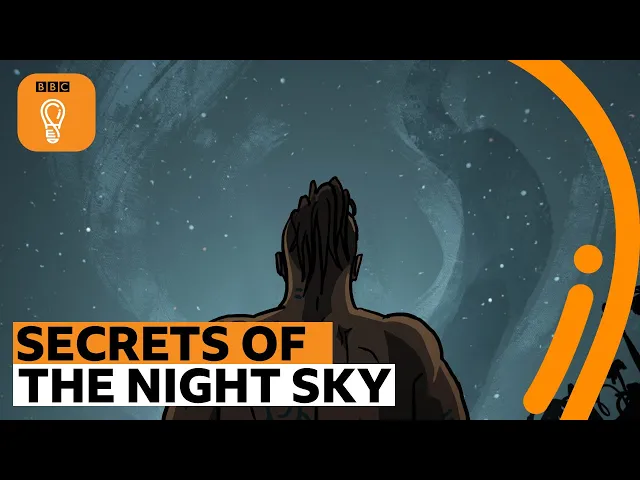
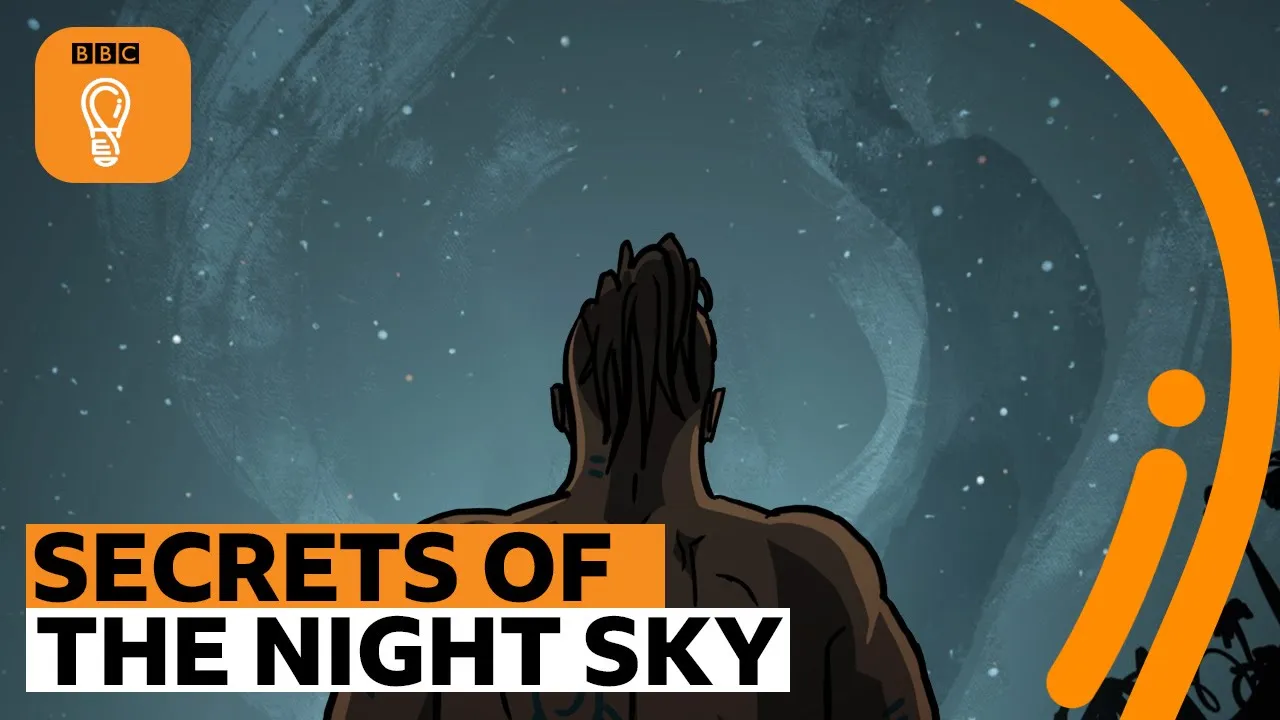
It's night-time in the Australian outback. And it's dark. Very dark.
But if you look up, the sky is ablaze with light. We're looking towards the heart of the Milky Way galaxy, a vast pinwheel of about 100 billion stars. Can you see the emu?
Yeah, that's the one. It's made of dark clouds of dust and gas obscuring the lighter parts of the sky. There are several legends about how the emu was banished to the heavens, but in the Aboriginal nation of Wiradjuri, her position in the sky signals the time of year best for collecting emu eggs.
For most of human history, understanding the sky was not the preserve of scientists, but a precious tool for our survival, for building cultures, religions and societies. And in some places it still is. This is Orion, the Hunter.
You're probably familiar with his belt and sword. But if you're close to the equator, it looks a lot more like a canoe. A thousand years ago, the Polynesians were the most accomplished navigators in the world.
Up to the 11th Century, they explored over 1,000 tiny islands scattered across the Pacific Ocean. One of the ways they did this was by using an ingenious memory technique. With a stone canoe built on the beach, a trainee navigator would face the sea and sit in there night after night, memorising the rising and falling positions of the stars.
When the crew was ready to depart, they would head for a star near the horizon, switching to a new one once the first either rose or set as it moved across the sky. Each sailing route required a specific sequence of stars, like a password or a musical motif. Celestial navigation using the sun, moon, and stars to work out precisely where you are in the world was essential to European seafarers, too.
But what if it wasn't a navigation tool you were after, but a way of judging time? Some have suggested that Stonehenge in England was built as an astronomical computer of great sophistication, capable of predicting eclipses. This can't be proven.
It's most likely to be a precise-ish way of determining the winter solstice, perfect for timing observances around the shortest day of the year. Stonehenge is solstitially aligned, meaning if you're approaching the entrance from the northeast, the sunset at midwinter will cut the monument neatly in half. Newgrange in Ireland does an even better job.
A 19-metre passage runs the length of a long barrow, leading to a central chamber. In the mornings around the winter solstice, the sun shines directly in through a crack above the doorway. Newgrange was a tomb, so for the people that built it, ancestors death, the sun and seasonal renewal were probably linked.
Perhaps it was the job of the ancestors to turn the sun around at midwinter, guaranteeing the return of spring. One of the most stunning examples of an ancient astronomical tool is at Chankillo in Peru. A line of 13 towers provided a detailed solar calendar to someone viewing it from a specially built doorway.
People may have gathered from miles around to celebrate certain days of the year. But with the development of complex technologies such as GPS, most humans no longer rely on the sun, moon and stars to travel or to organise their lives. Just as well, because light pollution is increasing globally between 2% and 10% year on year.
Only one in five people in Western Europe and America can now see the Milky Way. But birds need the stars, including the North Star, to navigate. If they can't see them due to light pollution from cities, they run into trouble.
Denying animals access to the stars is just one of the many ways in which light pollution impacts nature, but that's another story. Reliance on the sky as a guiding light is not uniquely human, but perhaps our use of the sky to find food, to organise our lives, to socialise, to pray was not just something we did before better technology became available. Perhaps it was what made us who we are.