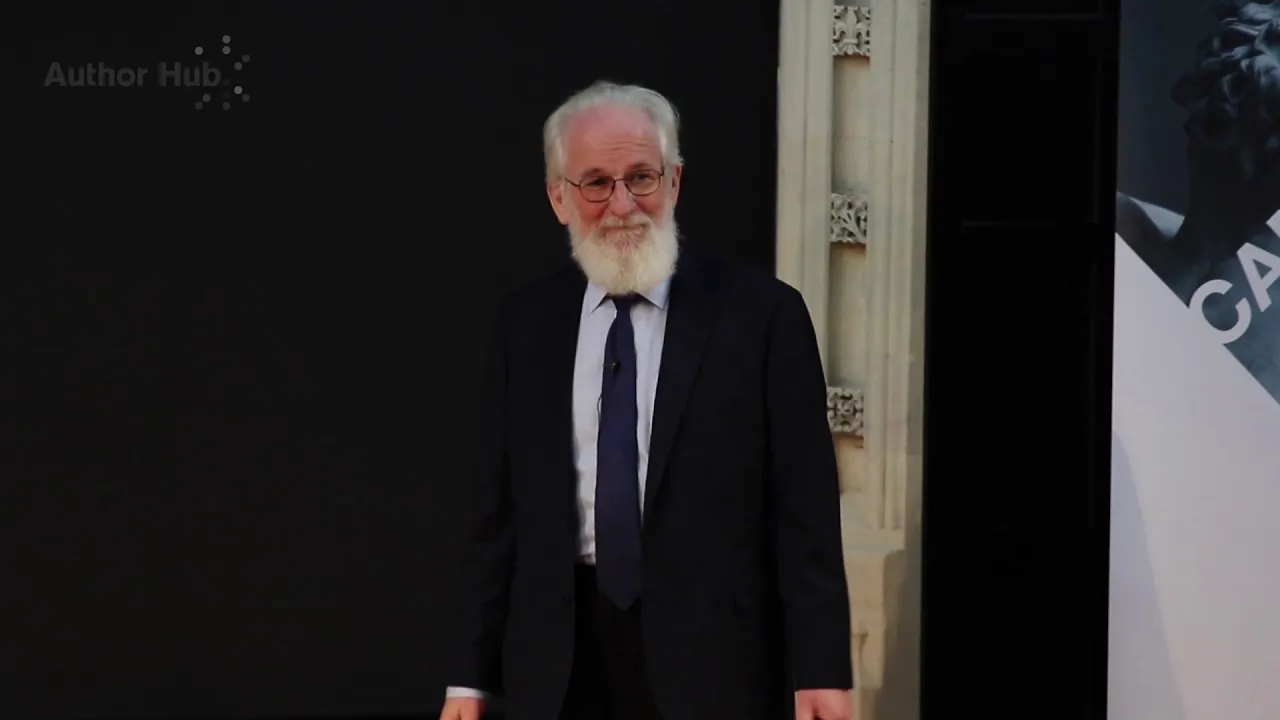
[Music] good evening everyone and many thanks for coming to this event tonight we're delighted to welcome David crystal here to the festival of ideas to share his fascinating insights into language change David is of course a renowned writer editor lecturer and broadcaster and is one of the world's foremost authorities on language I was fortunate enough to work with David on the recent third edition of the Cambridge encyclopedia of the English language which has been a flagship work for Cambridge University Press ever since it was first published back in 1995 so tonight David's going to talk about the many significant developments in the English language since the previous edition of the Encyclopedia was published fifteen years ago and he will be glad to take your questions at the end there are copies of the encyclopedia available to purchase downstairs I believe for a bargain price of 20 pounds this evening and David will be on hand to sign copies as well please join me in welcoming David crystal to the festival stage well well thank you for that 20 pounds that's very good value yeah it's not bad at all actually yeah I'm very impressed very impressed I've been having a great time out there I've been sitting there waiting to come on and there's a lovely chap on the street with his tin whistle they don't whether you've heard him playing some fantastic stuff I've been introduced with with all sorts of music in my life but never with Danny Boy which was really quite quite appealing actually oh dear no it's lovely to be here thank you thanks for the invitation to talk about this this this work a bit of background about it you mentioned it's the third edition yes well you'll get a sense of what's happened to the English language if I give you the other two dates of the other two editions first edition comes out in 1995 do you remember 1995 it's quite a while ago and I mean and then the second one was 2003 like you mentioned 15 years ago yeah a lot has happened and the extent to which I was expecting a new edition to come out really took me aback I have to say the extra fifty pages in the third edition compared with the second you know what that's 50 thousand words pretty well with some space for pictures and things you know it's almost like a new book I wasn't expecting that really so much has happened and so much of it has been unpredictable and that's what this talk is going to be about in fact there's a mixture of predictability and unpredictability about this whole English language business isn't there really there are certain things you can say I'm going to carry on happening and there are certain things that you couldn't imagine happening no matter how good your imagination might be let me start with some of the predictable things what was the most predictable thing of all I suppose it was the question of English continuing to be a global language I mean we all know English is a global language of course it's the world's lingua franca more than any other language and and yet you know people were not really talking about English in global terms until the 1990s there were never any books written on English as a global language until the mid 1990s and the first time I ever gave talks and it was round about then and the question of course everybody was asking was how many people do actually speak English as a language around the world I mean the Sun once had a headline saying everybody speaks English now wherever you go doesn't matter everybody well of course we all know that's false you have to go to a city somewhere and go into the suburbs or into the countryside you soon find the people who don't speak English so how many do and of course it was tricky researching this because there are no statistics there are no surveys when you do census returns you don't actually tick off how many languages you know and how well you speak or listen or read or write those languages so it's a lot of guesswork goes on so you you go to the sources of information that are available people who teach English in those countries have to do exams in English in those countries the British Council for example does surveys every now and again and all the sources that you can find and you put together a guess and then as long as you keep those same criteria going year after year then even if that guess is out a little bit then at least you're producing a fairly reasonable graph of growth well I did all this for the first edition in 1995 and the answer was 1. 5 billion so it's one thousand five hundred million people speaking English around the world at a reasonable conversational level not necessarily saying they'd be able to give stunning lectures in it or anything but you know an everyday level of conversation four hundred million or so speaking them in the first language countries of the world that's Britain Ireland United States Canada Australia New Zealand South Africa the country the Caribbean you know in a few other countries and then the rest of people who speak English as a second or foreign language in places well everywhere else well China especially in India especially and Nigeria huge english-language populations there for every one native speaker of English there were then something like for non-native speakers of English so the center of gravity of the language had already shifted away from the native speaker to the non-native speaker so 1. 5 billion I was expecting as everybody was that to increase so by the time of the second edition in 2003 did the same exercise all over again and it takes a while by the way you know we're talking a couple of months here especially if you have to ring up embassies and things like that and the figure had grown to two billion two thousand million well that's that's fine you know that's a sort of steady steady growth a lot of people were coming up with that figure not just me there was some other specialists in this kind of survey at the time David gradall some of you will know dear David who died last year he did a similar survey came up with a similar figure 2000 million mmm interesting in just eight years eight years half a billion increase so what happened for this third edition did the same exercise all over again and the figure that came out was 2.
3 billion 2. 3 billion interesting cause I was expecting it I mean if you get half a billion in eight years I was expecting it if the growth was going to carry on like that there to be in 15 years we're going to have another billion not we but in fact only 0.