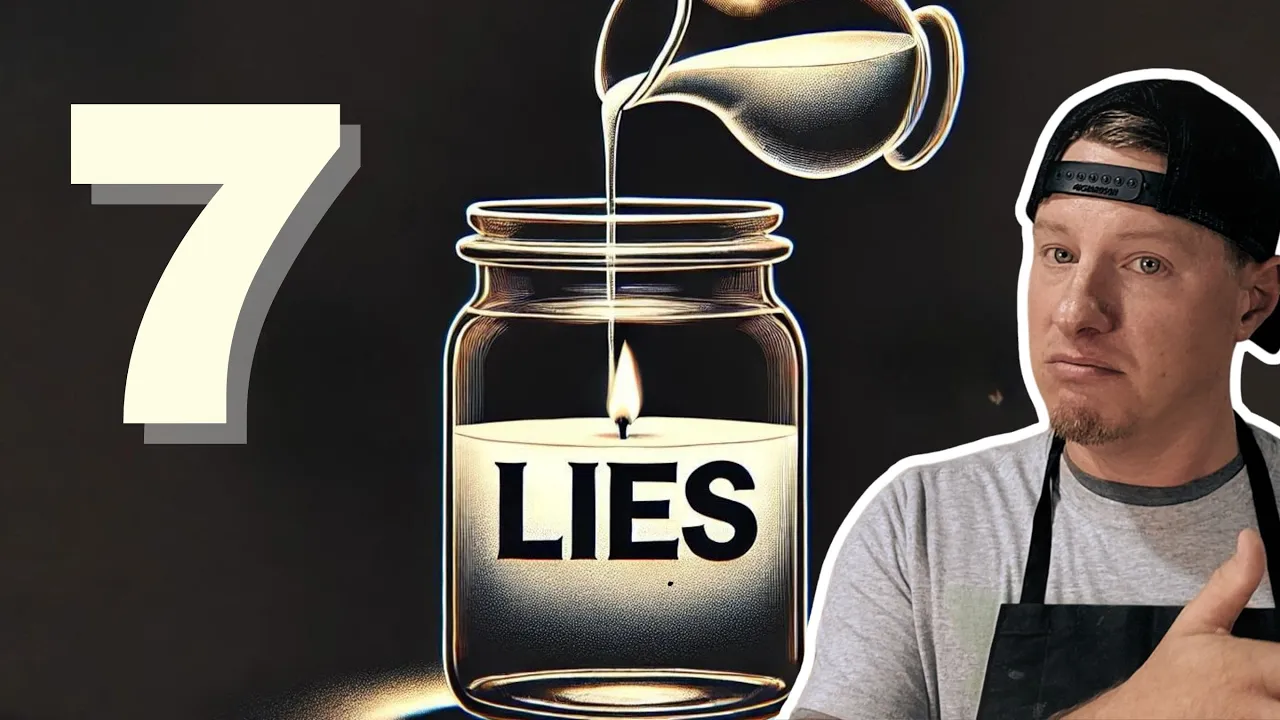
well how did that get in there candle making is a bit unique in that it's a healthy balance of Art and science process and experience so undoubtedly there is plenty of room for interpretation flexibility and well Artistry however there is a big difference between wiggle room and just Flatout false information so today I'm going to address seven of these common lies or at the very least seven bits of false information and help you keep them out of your candles hi everyone my name is Wade I'm the owner of black taii barn where my primary focus
is candle making and candle business education as well as selling supplies and other materials to help you as a Candle Maker whether you're a hobbyist or a business owner so if this channel seems right up your alley and something you're interested in and you'd like to see more videos hit subscribe below this video it is free of course and if you click that little bell icon I will notify you whenever I post new videos all right let's get into it number one more fragrance equals stronger scent throw there's a lot of problems with this statement
but it is something you will commonly see in fact a lot of candle or new candle makers ask others what can I do to increase my scent throw or my hot throw a lot of others will say you just need to add more oil but that is really not true at all in fact these days the fragrance load is much higher than it ever was before for decades the common fragrance load was anywhere between 3 4 5% range and you had plenty strong candles at that time so there's a lot more going on here than
just the amount of fragrance you're using now with that being said a lot of waxes these days allow you to add more fragrance which is why people use more than they used to but it's not necessary all the time in fact a lot of problems can come by adding too much fragrance but that's a separate topic the question today is does adding more fragrance increase scent throw generally speaking the answer is it can but it's usually not the case first of all it's important to address something I just briefly touched on and that's adding more
fragrance oil can introduce other problems burn issues wicking problems and these things can actually inhibit syn thr because it can clog the wick it can lead to mushrooming or carbon buildup on the wick and that can actually stop the candle from performing correctly can adding more fragrance sometimes increase hot throw the scent throw of your candle yes especially if it's a weaker uh fragrance hole to begin with sometimes you need a little bit more to give it that extra kick but most of the time if you can get away with less you should in fact
that's kind of the next point and that is you will eventually read a point of diminishing returns when it comes to adding fragrance oil and what that basically means is you can continue to add more and more fragrance oil and increase your results but at some point adding more fragrance oil isn't going to give you more results but it's going to cost more money and waste more oil and finding that balance finding that point of diminishing returns is important it's up to use a Candle Maker and that's why we test that's why most candle makers
these days tend to start with somewhere around 8% or so and with certain waxes you might need to go up to 9% but at some point you're not going to just keep pressing the pedal and adding more and more and more because you're going to get to a point where you're not getting any more results and you're just wasting product do you actually need it test your candles with 7% 8% 9% 10% and if you're not noticing a difference between 7 and 9 or 8 and 10 there's no reason to go up that because then
you've reached a point of diminishing returns and you're increasing your cost and waste for no reason now number two I've heard phrase two different ways commonly one is that soy wax doesn't soot and paraffin wax is the only wax that soots but I can simplify this for you neither one is true all candles can soot all waxes can soot there are several factors of what causes that to happen happen they can be poorly made bad burning practices for example burning too long they could be around drafts it could be the fragrance oil it could be
the wick type or the wrong size of Wick there's a lot of factors that cause soot and it's very rarely strictly due to the wax itself secondly soot comes in a different variety of colors so a lot of traditional waxes you'll see a soot that's more black or darker but a lot of waxes these days like some of your soy waxes will be a much more lighter or almost kind of grayish white soot but it's still soot so you might not think certain candles are soting but it's just harder to detect and less noticeable and
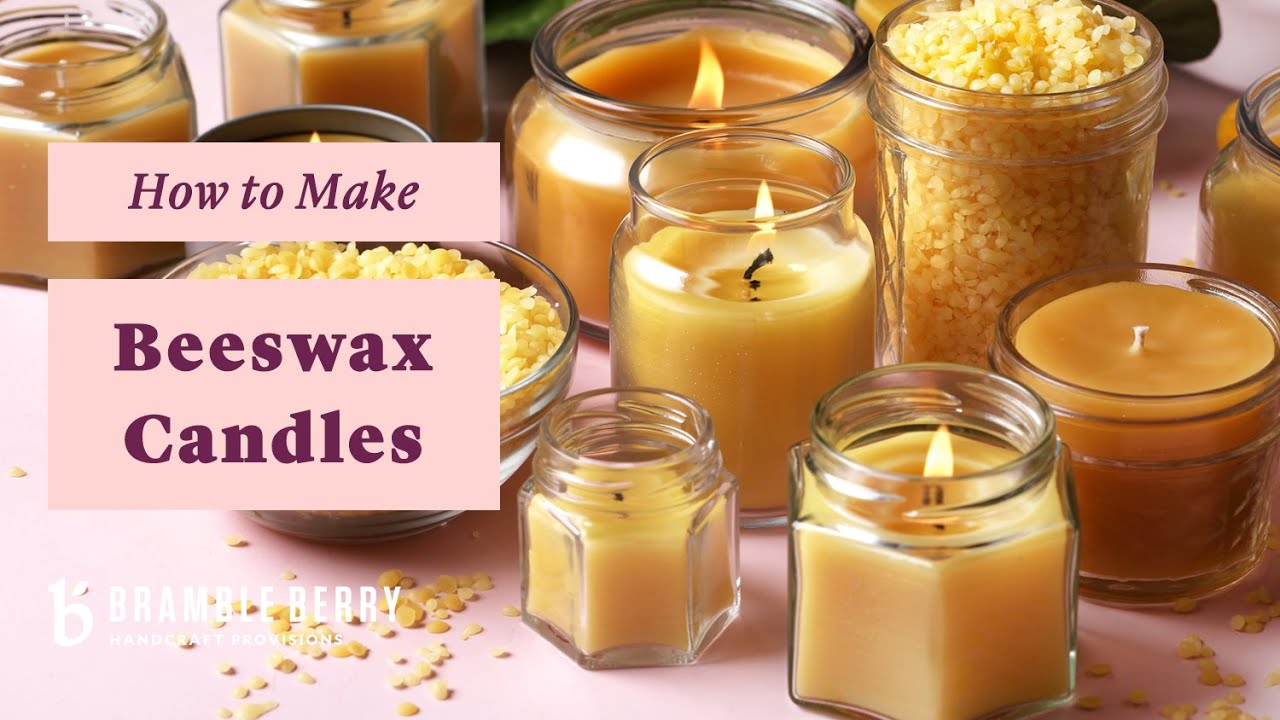
if that's what your main concern is then by all means I mean that makes sense if you just want your candle to look like it's soting less even if it's not I can understand that point however the fact that a candle soots does not necessarily make it bad beeswax for example is widely accepted as the cleanest burning wax and can actually improve air quality however beeswax kicks off a ton of black soot and smoke often way more than others so soot and the color of the soot doesn't always just directly equate to the quality of
the wax but you will hear that all the time these natural waxes are safer healthier and don't soot and there are a lot of pros and cons to all sorts of waxes and of course there are a lot of benefits to Natural waxes as well however the fact that something is natural has nothing to do with whether or not it would soot for example I think we would all agree that wood is a natural product but when's the last time you've looked inside a fire pit or your chimney there's a ton of black soot build
up in there Wood's natural it still soots or strike a match and hold it against the inside of a jar at an angle you'll notice that you'll get some black soot and smoke even though there's no wax at all present the point is it's just a false statement now I'm not trying to encourage or suggest that certain waxes are better than others and that you need to go all natural or not natural or some kind of mix of both I'm just trying to address the false statement and that is that soy wax doesn't soit and
only paraffin wax does it's just not true again all waxes have pros and cons and you have to make a choice as a candle maker of which wax to use just don't choose one based on false premises and don't Market your candles as such either it's best just to be honest and honestly you should hit that like button below if you're enjoying this video so far number three candles don't expire now this is uh a little bit trickier of a question I don't entirely disagree with it um most candles 95% of candles are going to
be totally fine several years down the road you can light them up and they're going to smell great and perform just fine however these days a lot more candles are made with natural organic Blends and some of those organic materials won't just last forever they will expire go rancid and such and it can happen for a variety of reasons sometimes it's just Visual and Aesthetics they might disol for example and while that has nothing to do with the quality of the candle it might still perform if it's sitting on a retail shop the fact that
it's changed colors or looks a little bit different is its value that's that's part of its perceived value so in a sense it's still expiring and it still becomes waste so what are some of the things that can happen as I mentioned candles can degrade U they can fade they can discolor over time when they exposed to direct sunlight for a long period of time or really any direct UV light or if they're just exposed to extreme temperature changes fragrance or scent throw is another thing to consider now generally speaking most of the time as
candles sit around the fragrance profile will actually develop more and you'll actually it it'll seem like it smells better over time or stronger over time that's very common however not all fragrance oils are the same that doesn't apply to all fragrance oils many will go rancid after a period of time even though they're already mixed with wax and a jar and a full new product there's still the risk that over time that blend can kind of go rancid but generally speaking you're you're fine to to leave your candles sitting around for 6 months or year
or two years in your house or on a shelf somewhere just got to keep an eye on them and check them every once in a while if they look like they did when you first made them and they smell basically the same then I'd say you're good to go but just be aware that it is possibility that candles can expire so to speak over time and if you're super worried about it candles that are not being used keep them stored in a dark cool place like you would canned vegetables for example but as a business
owner over time you'll get a better grasp of how much inventory you should make and stock at any given time and again that just comes with time and experience number four more expensive materials and supplies make better quality products for example more expensive wax fragrance and so on the short answer most of the time is is no generally speaking more expensive materials means more marketing cost however they're exceptions and we'll talk about that here in a minute but let's talk about wax for example these days a lot of the wax trends is what's jacking up
that cost now there are costs to manufacture that wax and package the wax and distribute that wax for sure and certain waxes cost more to do that apricot waxes coconut waxes for example however a lot of them are just trend-based or there's more demand and less of it for example and that's going to of course jack up the price that doesn't mean it's a better quality wax it doesn't mean it's going to perform better right so price isn't everything cost isn't everything uh there's a lot of reasons there can be a high cost and it
doesn't mean it's it's matches the quality or the the value of that product now fragrance oils yes super cheap fragrance oils can suffer from quality issues mostly because there's a lot of natural elements out there and fragrance notes that just cost more to get and to use in products to make that the oils themselves cost more to make so if you're using an oil that's super cheap often they're not using really the right raw material and that that's what can drive that price price down so yeah there are times that super cheap oils can reflect
cheap quality but not always you can get away with very very lowcost oil sometimes that still scream with hot throw and perform fantastic just because they're cheaper doesn't necessarily mean you're not getting the results you're after but really the only way you can determine whether something is valuable to you and high quality for you is by testing it because value is perception and if something's working for you then you're getting the max value out of it regardless of the cost now with that being said if you aren't aware we sell fragrance oils at black taiar
and we're kind of nestled right in the middle we're not on that super low in price range and we're not anywhere near those kind of luxury type fragrance oil brands we are smack right in the middle but we are candle makers and make fragrance oils for candle makers so every oil that we sell and produce are ones that we would use ourselves and we test ourselves we're confident in them we know what we're looking for we know their quality and we know that the price Point's Fair across the board and you'll notice the prices vary
and it's kind of to my point certain oils cost more to make so they're naturally going to cost more to sell but if you're interested in checking out our fragrance oils go to Black tar.com go to fragrance oils we're adding more all the time but they are fantastic and uh would love to have you check them out samples by the way we we start at 2 O samples not your typical one or uh even smaller than 1 o that way you're getting enough to actually test a couple candles with or even wax melts now supplies
should you spend more on supplies tools gadgets to help you with your candle making um well again I think the same thing holds true supplies are about what makes your job easier what makes your process more efficient that does not necessarily mean it's going to be better quality but it can help in other ways again efficiency process make your life easier for example one of the tools I talk about all the time is these Wick centering devices and clips from Nord and Candle supply and I'll show you a little bit of the footage here of
what I'm talking about and I'll link a video in the description if you want to see what those products really are and how you can use them and by the way since that video they've released several other products now so they do a great job but products and tools like that are meant to make your life easier make you faster more efficient but not necessarily improve quality although I would argue that their their tools actually do improve quality because they make sure your Wicks are centered and consistent all the time so clearly there are some
exceptions to this rule but generally speaking spending more money on supplies materials is not going to get you guarantee you better results this is science this is Art and it takes some experience and and practice from you as well to get the results you're after certain things can make it easier but doesn't guarantee you there's results you don't need to spend a fortune to get good results number five candle should get a full melt pool across the top of the candle on the very first burn this one drives me mad it has been a common
myth for I don't I don't even know how long I mean ever since I've started making candles 12 years ago I've been hearing this can that happen yes should that happen not necessarily it depends on the jar the size of the jar the shape of the jar depends on the wax if you got a really hard wax yeah you're better off trying to get closer to full melt poool because it's going to be harder to catch up later a super soft wax not needed it's going to catch up easily later as as the candle burns
down and heat gets trapped in the jar there is no you cannot put a rule like this in place as a just a black and white rule it just it's just not true in fact a lot of times if you get a candle with a full melt pool across the top on the first burn you're you could be over Wicked easily in fact a lot of times you are there's just so much time for the candle to catch up and burn properly as the candle burns down and if you're getting that at the very beginning
you could e easily be over Wicked number six all essential oils are safe for candle making some yes but only in controlled and small amounts all definitely not many have very low flash points which makes them flammable so added to hot wax or exposed to an open flame can cause them to ignite and become a fire hazard in addition many essential oils also give off very toxic fumes if they're exposed to heat or Flames or basically when they're burned like with most everything when it comes to this craft testing's key you need to test your
products and the way they're going to be used and make sure they are safe before you roll them out as a finished product number seven strong cold throw should also mean strong hot throw oh I wish that was the case but unfortunately it's not the two are not related there's a reason there's two different names cold throw and hot throw because they're different if you're not familiar with those terms cold throw is how strong your candle puts off the scent without burning it just kind of walking by or smelling it when it's not lit hot
throw is how strong a candle fills the room or the open area it's in when it's burning some waxes have great cold throw and weak hot throw and others vice versa they've got strong hot throw and weak cold throw why hell I don't know I'm not a scientist I can tell you what I've learned all I can do is really pass along some of the information I've got from others who are definitely more experts in this field than I am what I've learned from some of the best in the industry first of all you need
to know that it often just depends on the oil some fragrances are just not that strong and uh some are super strong no matter what you do and others are picky some are just not great when they're exposed to heat and and they just don't they don't really dissipate into the air very well or or travel through air very well but just kind of sitting there present they're pretty strong but it frequently depends on the wax too certain waxes are very soft and they've got more open molecules open space so when a candle's just sitting
there it's easy for that scent to sort of just kind of hover and float and just it's very easy for that to it's very easy to pick up and detect that scent just kind of being close to it a lot of your natural soft soy waxes for example have great cold Thro but that has nothing to do with when that candle is burned for starters it's no longer a solid wax it's now turned into a liquid wax you've totally changed the properties which means you've changed how that material is going to perform now it's in
a liquid state and liquid particles are very different than solid particles it's a whole different process look we could get more and more sciency with this but the simple answer is they're just not the same and certain waxes are going to excel at one or the other or both and some don't Excel really at either one like I always say you as a Candle Maker need to decide what factors are most important to you do you care more about cold throw do you care more about hot throw do you want something that's a good balance
of both and again those are just a few of the factors to consider there's a lot of things that you need to decide what's important to you when choosing your wax kandle making can be a lot of fun and rewarding and profitable if you're in it for that but it gets a lot more difficult and stressful if you buy into false pretenses and start creating candles based off of that false information so try not to buy into the myths stick to the facts and learn from your own experiences as a candlemaker now don't get me
wrong I don't think most people are intentionally spreading lies about candle making we just ofly simply repeat what we see or hear we regurgitate information and often we're just taught wrong in the first place whether it's done intentionally or Not facts are facts myths are myths as a new candlemaker as a beginner this can be an overwhelming craft so I don't want to add lies into the mixture it's just going to make things a lot more difficult a lot more confusing keep being flexible introduce your own processes your own experiences and so on but do
so within the constraints of reality and the truth thank you all for watching don't forget to like this video below if you did enjoy And subscribe to the channel so you don't miss out on more videos also check out our amazing line of fragrance oils at Blacky bar.com as well as other supplies materials as well and I also provide some educational resources there free to check out if you're interested thank you again and I'll see you next time